

Recent Insights into the Paradoxical Effect of Echinocandins
Open accessThe DOI matches its Crossref record; 67 of the 67 references it cites were found in a registry or an index.
Abstract
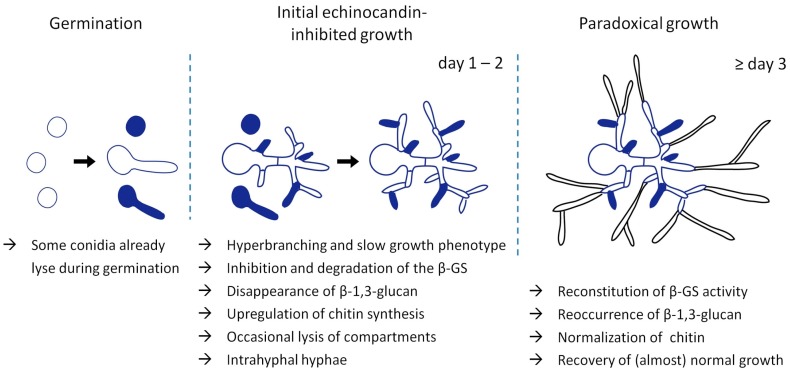
Echinocandin antifungals represent one of the most important drug classes for the treatment of invasive fungal infections. The mode of action of the echinocandins relies on inhibition of the β-1,3-glucan synthase, an enzyme essentially required for the synthesis of the major fungal cell wall carbohydrate β-1,3-glucan. Depending on the species, echinocandins may exert fungicidal or fungistatic activity. Apparently independent of this differential activity, a surprising in vitro phenomenon called the “paradoxical effect” can be observed. The paradoxical effect is characterized by the ability of certain fungal isolates to reconstitute growth in the presence of higher echinocandin concentrations, while being fully susceptible at lower concentrations. The nature of the paradoxical effect is not fully understood and has been the focus of multiple studies in the last two decades. Here we concisely review the current literature and propose an updated model for the paradoxical effect, taking into account recent advances in the field.
Overview
The claims and statistics of this paper haven’t been checked yet.
Free: it reads the open-access text and checks the first 5 claims that cite a source we can check. Create a free account to check every claim.
Integrity signals
Registry
Cites
Statistics
Figures
Verification
Claims the paper makes
The claims and statistics of this paper haven’t been checked yet.
Free: it reads the open-access text and checks the first 5 claims that cite a source we can check. Create a free account to check every claim.
Claims other papers make about this one
Each is checked against this paper’s own text: does it say what the citing paper says it does?
The cited source says what the claim attributes to it.
In the citing paper
“This paradoxical growth also seems to exist in vivo (623–625).”
From Aspergillus fumigatus and Aspergillosis in 2019 (2019) · cites this paper as [625]
Self-check
Percentages, sums and reported differences re-computed from the paper’s own numbers.
The self-check needs the paper’s full text.
Citations
Cites
Pappas, P. G., Kauffman, C. A., Andes, D. R., Clancy, C. J., Marr, K. A., Ostrosky-Zeichner, L., Reboli, A. C., Schuster, M. G., Vazquez, J. A., Walsh, T. J., et al. (2016) · Clinical Infectious Diseases · doi:10.1093/cid/civ933 · Cited by 4,200
Pappas, P. G., Kauffman, C. A., Andes, D. R., Clancy, C. J., Marr, K. A., Ostrosky-Zeichner, L., Reboli, A. C., Schuster, M. G., Vazquez, J. A., Walsh, T. J., et al. (2016) · Clinical Infectious Diseases · doi:10.1093/cid/civ1194 · Cited by 1,298
Micafungin versus Caspofungin for Treatment of Candidemia and Other Forms of Invasive Candidiasis
Pappas, P. G., Rotstein, C. M. F., Betts, R. F., Nucci, M., Talwar, D., De Waele, J. J., Vazquez, J. A., Dupont, B. F., Horn, D. L., Ostrosky-Zeichner, L., et al. (2007) · Clinical Infectious Diseases · doi:10.1086/520980 · Cited by 638
Fungal Cell Wall Organization and Biosynthesis
Free, S. J. (2013) · Advances in Genetics · doi:10.1016/b978-0-12-407677-8.00002-6 · Cited by 576 · cited 1×
“Depending on the fungal species, approximately one-third to four-fifths of the cell wall consists of β-1,3-glucan and its rearrangement derivatives [5].”
BackgroundStimulation of Chitin Synthesis Rescues Candida albicans from Echinocandins
Walker, L. A., Munro, C. A., de Bruijn, I., Lenardon, M. D., McKinnon, A., & Gow, N. A. R. (2008) · PLoS Pathogens · doi:10.1371/journal.ppat.1000040 · Cited by 445 · cited 1×
“albicans the cell wall integrity (CWI), the high osmolarity glycerol (HOG), and the calcineurin signaling pathways mutually stimulate the chitin synthases Chs2 and Chs8 to overcome echinocandin-induced stress [59].”
BackgroundDifferential Expression and Function of Two Homologous Subunits of Yeast 1,3-β-D-Glucan Synthase
Mazur, P., Morin, N., Baginsky, W., el-Sherbeini, M., Clemas, J. A., Nielsen, J. B., & Foor, F. (1995) · Molecular and Cellular Biology · doi:10.1128/mcb.15.10.5671 · Cited by 424
Echinocandin Antifungal Drugs in Fungal Infections: A Comparison
Chen, S. C.-A., Slavin, M. A., & Sorrell, T. C. (2011) · Drugs · doi:10.2165/11585270-000000000-00000 · Cited by 371
Douglas, C. M., D'Ippolito, J. A., Shei, G. J., Meinz, M., Onishi, J., Marrinan, J. A., Li, W., Abruzzo, G. K., Flattery, A., Bartizal, K., et al. (1997) · Antimicrobial Agents and Chemotherapy · doi:10.1128/aac.41.11.2471 · Cited by 344
Garcia-Effron, G., Lee, S., Park, S., Cleary, J. D., & Perlin, D. S. (2009) · Antimicrobial Agents and Chemotherapy · doi:10.1128/aac.00443-09 · Cited by 323
Garcia-Effron, G., Park, S., & Perlin, D. S. (2009) · Antimicrobial Agents and Chemotherapy · doi:10.1128/aac.01162-08 · Cited by 256
Cited by
Aspergillus fumigatus and Aspergillosis in 2019
Latgé, J.-P., & Chamilos, G. (2019) · Clinical Microbiology Reviews · doi:10.1128/cmr.00140-18 · Cited by 1,400
Drug resistance and tolerance in fungi.
Berman, J., & Krysan, D. J. (2020) · Nature Reviews Microbiology · doi:10.1038/s41579-019-0322-2 · Cited by 642
Aspergillus fumigatus and aspergillosis: From basics to clinics
Arastehfar, A., Carvalho, A., Houbraken, J., Lombardi, L., Garcia-Rubio, R., Jenks, J. D., Rivero-Menendez, O., Aljohani, R., Jacobsen, I. D., Berman, J., et al. (2021) · Studies in Mycology · doi:10.1016/j.simyco.2021.100115 · Cited by 241
Ghassemi, N., Poulhazan, A., Deligey, F., Mentink-Vigier, F., Marcotte, I., & Wang, T. (2022) · Chemical Reviews · doi:10.1021/acs.chemrev.1c00669 · Cited by 188
A molecular vision of fungal cell wall organization by functional genomics and solid-state NMR
Chakraborty, A., Fernando, L. D., Fang, W., Dickwella Widanage, M. C., Wei, P., Jin, C., Fontaine, T., Latgé, J.-P., & Wang, T. (2021) · Nature Communications · doi:10.1038/s41467-021-26749-z · Cited by 158
Review on Current Status of Echinocandins Use
Mroczyńska, M., & Brillowska‐Dąbrowska, A. (2020) · Antibiotics · doi:10.3390/antibiotics9050227 · Cited by 128
“Another explanation may be the overproduction of chitin, which could supplement the deficiency of glucan in the cell wall [49,50].”
BackgroundMulti-omics Signature of Candida auris , an Emerging and Multidrug-Resistant Pathogen
Zamith-Miranda, D., Heyman, H. M., Cleare, L. G., Couvillion, S. P., Clair, G. C., Bredeweg, E. L., Gacser, A., Nimrichter, L., Nakayasu, E. S., & Nosanchuk, J. D. (2019) · mSystems · doi:10.1128/msystems.00257-19 · Cited by 99
“This effect was previously reported for Aspergillus and Candida species (19) and was very recently described for C.”
BackgroundCandida auris : multi-omics signature of an emerging and multidrug-resistant pathogen
Zamith-Miranda, D., Heyman, H. M., Cleare, L. G., Couvillion, S., Clair, G., Bredeweg, E., Gacser, A., Nimrichter, L., Nakayasu, E. S., & Nosanchuk, J. D. (2019) · doi:10.1101/528232 · Cited by 99
“auris strains were able to grow when 164 exposed to caspofungin concentrations above their MIC, a phenomenon known as 165 “Paradoxal effect” or “Eagle effect” (34).”
BackgroundSpecial Issue: Fungal Cell Wall
Beauvais, A., & Latgé, J. (2018) · Journal of Fungi · doi:10.3390/jof4030091 · Cited by 104
Satish, S., Jiménez-Ortigosa, C., Zhao, Y., Lee, M. H., Dolgov, E., Krüger, T., Park, S., Denning, D. W., Kniemeyer, O., Brakhage, A. A., et al. (2019) · mBio · doi:10.1128/mbio.00779-19 · Cited by 64
Dannaoui, É., & Espinel‐Ingroff, A. (2019) · Journal of Fungi · doi:10.3390/jof5040108 · Cited by 65
“The first one is the paradoxical effect corresponding to enhanced growth at high supra-MIC concentrations [16,17].”
BackgroundChitin Biosynthesis in Aspergillus Species
Brauer, V. S., Pessoni, A. M., Freitas, M. S., Neto, M. P. C., Ries, L. N. A., & Almeida, F. B. D. R. (2023) · Journal of Fungi · doi:10.3390/jof9010089 · Cited by 63
Kim, H. Y., Baldelli, S., Märtson, A., STOCKER, S. L., Alffenaar, J. C., Cattaneo, D., & Marriott, D. J. E. (2021) · Therapeutic Drug Monitoring · doi:10.1097/ftd.0000000000000931 · Cited by 42
Polysaccharide assemblies in fungal and plant cell walls explored by solid-state NMR
Fernando, L. D., Zhao, W., Gautam, I., Ankur, A., & Wang, T. (2023) · Structure · doi:10.1016/j.str.2023.07.012 · Cited by 38
Franconi, I., & Lupetti, A. (2023) · Journal of Fungi · doi:10.3390/jof9121188 · Cited by 47
“This paradoxical growth is also driven by echinocandin drugs, with caspofungin as the molecule showing the strongest association [99].”
BackgroundInfluentialdu Pré, S., Birch, M., Law, D., Beckmann, N., Sibley, G. E. M., Bromley, M., Read, N. D., & Oliver, J. D. (2020) · Journal of Fungi · doi:10.3390/jof6020047 · Cited by 38
“fumigatus treated with caspofungin [29], an echinocandin which targets β-1,3-glucan synthase.”
BackgroundHoang, T. N. M., Cseresnyés, Z., Hartung, S., Blickensdorf, M., Saffer, C., Rennert, K., Mosig, A. S., von Lilienfeld‐Toal, M., & Figge, M. T. (2022) · Biomaterials · doi:10.1016/j.biomaterials.2022.121420 · Cited by 40
Aspergillus fumigatus Transcription Factors Involved in the Caspofungin Paradoxical Effect
Valero, C., Colabardini, A. C., Chiaratto, J., Pardeshi, L. A., de Castro, P. A., Filho, J. A. F., Silva, L. P., Rocha, M. C., Malavazi, I., Costa, J. H., et al. (2020) · mBio · doi:10.1128/mbio.00816-20 · Cited by 40
“Although the clinical significance of CPE remains unclear (16, 61),”
BackgroundSouza, A. C. O., Martín‐Vicente, A., Nywening, A. V., Ge, W., Lowes, D. J., Peters, B. M., & Fortwendel, J. R. (2021) · PLoS Pathogens · doi:10.1371/journal.ppat.1009806 · Cited by 37
“These mechanisms include remodeling of the cell wall, upregulation of cell wall integrity machinery and the induction of calcium-regulated stress pathways [21,25].”
BackgroundResultCaspofungin: a review of its characteristics, activity, and use in intensive care units
Hashemian, S. M. R., Farhadi, T., & Velayati, A. A. (2020) · Expert Review of Anti-infective Therapy · doi:10.1080/14787210.2020.1794817 · Cited by 31
Schoen, T. J., Calise, D. G., Bok, J. W., Giese, M. A., Nwagwu, C. D., Żarnowski, R., Andes, D. R., Huttenlocher, A., & Keller, N. P. (2023) · PLoS Pathogens · doi:10.1371/journal.ppat.1011152 · Cited by 27
“We selected 8 μg/ mL to test whether ZfpA mutants were capable of paradoxical growth, a phenomenon in which drug efficacy decreases with increased drug concentrations [36].”
MethodHu, K., Li, R., Mo, F., Ding, Y., Zhou, A., Guo, X. Y., Li, R., Li, M., Ou, M., & Li, M. (2023) · Pesticide Biochemistry and Physiology · doi:10.1016/j.pestbp.2023.105623 · Cited by 26
Avramovska, O., & Hickman, M. A. (2019) · G3 Genes Genomes Genetics · doi:10.1534/g3.119.400752 · Cited by 29
α- and β-1,3-Glucan Synthesis and Remodeling
Wagener, J., Striegler, K., & Wagener, N. (2020) · Current topics in microbiology and immunology · doi:10.1007/82_2020_200 · Cited by 49
Self-citationAspergillus fumigatus Can Display Persistence to the Fungicidal Drug Voriconazole
Scott, J., Valero, C., Mato-López, Á., Donaldson, I. J., Roldán, A., Chown, H., Van Rhijn, N., Lobo-Vega, R., Gago, S., Furukawa, T., et al. (2023) · Microbiology Spectrum · doi:10.1128/spectrum.04770-22 · Cited by 24
Schruefer, S., Böhmer, I., Dichtl, K., Spadinger, A., Kleinemeier, C., & Ebel, F. (2021) · Scientific Reports · doi:10.1038/s41598-021-84740-6 · Cited by 25
Kerkaert, J. D., Mauff, F. L., Wucher, B. R., Beattie, S. R., Vesely, E. M., Sheppard, D. C., Nadell, C. D., & Cramer, R. A. (2022) · mBio · doi:10.1128/mbio.02933-21 · Cited by 22
Tóth, Z., Forgács, L., Kardos, T., Kovács, R., Locke, J. B., Kardos, G., Nagy, F., Borman, A. M., Adnan, A., & Majoros, L. (2020) · Journal of Fungi · doi:10.3390/jof6030136 · Cited by 22
Lee, H., Choi, S. H., Oh, J., Koo, J., Lee, H. J., Cho, S., Shin, J. H., Lee, H. K., Kim, S., Lee, C. H., et al. (2022) · Microbiology Spectrum · doi:10.1128/spectrum.01253-21 · Cited by 27
“This has been observed in several species of Candida and Aspergillus (22).”
BackgroundErofeeva, E. A., & Yakimov, B. N. (2020) · Symmetry · doi:10.3390/sym12050727 · Cited by 20
Perrine-Walker, F. M. (2022) · Brazilian Journal of Microbiology · doi:10.1007/s42770-022-00739-9 · Cited by 23
Beattie, S. R., & Krysan, D. J. (2021) · mSphere · doi:10.1128/msphere.00539-21 · Cited by 16
“This may also be due to the paradoxical effect, where increased caspofungin concentrations trigger cell wall salvage pathways, resulting in paradoxically low antifungal activity at drug concentrations above the MIC (19, 20).”
BackgroundGlycobiology of Human Fungal Pathogens: New Avenues for Drug Development
Lee, D. J., O’Donnell, H., Routier, F. H., Tiralongo, J., & Haselhorst, T. (2019) · Cells · doi:10.3390/cells8111348 · Cited by 15
“biosynthesis of the fungal cell wall (Figure 1) [7,26,49,52].”
BackgroundInfluentialRapid screening method of Saccharomyces cerevisiae mutants using calcofluor white and aniline blue
Perrine-Walker, F. M., & Payne, J. A. E. (2021) · Brazilian Journal of Microbiology · doi:10.1007/s42770-021-00515-1 · Cited by 15
Antifungal Resistance in Isolates of Aspergillus from a Pig Farm
White, J. K., Nielsen, J. L., Poulsen, J. S., & Madsen, A. M. (2021) · Atmosphere · doi:10.3390/atmos12070826 · Cited by 28
Novel antifungal activity of oligostyrylbenzenes compounds on Candida tropicalis biofilms
Quinteros, M. A., Galera, I. L. D., Tolosa, J., García-Martínez, J. C., Páez, P. L., & Paraje, M. G. (2020) · Medical Mycology · doi:10.1093/mmy/myaa046 · Cited by 14
A posttranscriptional pathway regulates cell wall mRNA expression in budding yeast
Bresson, S., Shchepachev, V., & Tollervey, D. (2023) · Cell Reports · doi:10.1016/j.celrep.2023.112184 · Cited by 10
Boyer, J., Hoenigl, M., & Kriegl, L. (2024) · Expert Review of Clinical Pharmacology · doi:10.1080/17512433.2024.2317293 · Cited by 12
“However, the clinical impact of this phenomenon is uncertain and a matter of debate [45].”
BackgroundEUCAST Ibrexafungerp MICs and Wild-Type Upper Limits for Contemporary Danish Yeast Isolates
Jørgensen, K. M., Astvad, K. M. T., Hare, R. K., & Arendrup, M. C. (2022) · Journal of Fungi · doi:10.3390/jof8101106 · Cited by 13
“Of note, this was not observed for the highest concentration tested (8 mg/L), which is somewhat in contrast to the paradoxical effect described for echinocandins [21].”
ResultChloroacetamide derivatives as a promising topical treatment for fungal skin infections
Machado, G. D. R. M., de Andrade, S. F., Pippi, B., Bergamo, V. Z., Berlitz, S. J., Lopes, W., Lavorato, S. N., Külkamp‐Guerreiro, I. C., Vainstein, M. H., Teixeira, M. L., et al. (2019) · Mycologia · doi:10.1080/00275514.2019.1620550 · Cited by 13
Víglaš, J., & Olejníková, P. (2023) · Research in Microbiology · doi:10.1016/j.resmic.2023.104055 · Cited by 8
Therapeutic Approaches for Combating Aspergillus Associated Infection
Chhillar, A. K., Punia, A., Choudhary, P., Sharma, N., Dahiya, S., & Gulia, P. (2022) · Current Drug Targets · doi:10.2174/1389450123666220623164548 · Cited by 10
Juin, C., Perrin, F., Puy, T., Bernard, C., Mollichella, M.-L., Girardot, M., Costa, D., Guillard, J., & Imbert, C. (2019) · Medical Mycology · doi:10.1093/mmy/myz087 · Cited by 8
Penaud, V., Alahmad, A., Vrieze, M. D., Bouteiller, M., Eude, M., Bernardon-Mery, A., Trinsoutrot‐Gattin, I., Laval, K., & Gauthier, A. (2025) · Frontiers in Microbiology · doi:10.3389/fmicb.2025.1569281 · Cited by 6
“This effect is believed to involve an increase in cell wall chitin, followed by the reactivation of β -1,3-glucan synthase (Wagener and Loiko, 2018).”
Maldiney, T., Garcia‐Hermoso, D., Sitterlé, E., Chassot, J., Thouvenin, O., Boccara, C., Blot, M., Piroth, L., Quenot, J., Charles, P., et al. (2023) · Frontiers in Cellular and Infection Microbiology · doi:10.3389/fcimb.2023.1183340 · Cited by 6
“…contrast, whose intensity and frequency are both decreasing, altogether re fl ecting the well-known caspofungin-mediated paradoxical growth effect (Wagener and Loiko, 2017) occurring in A. fumigatus only for microcolonies in the regions of interest with higher caspofungin concentrations…”
BackgroundJayaweera, S. L. D., Van, T. T. H., & Dias, D. A. (2025) · Journal of Xenobiotics · doi:10.3390/jox15010032 · Cited by 7
“…involved in the non-competitive inhibition of a membrane-bound enzyme called β -1,3-glucan synthase, which is an important enzyme in the biosynthesis of the major fungal cell wall carbohydrate called β -1,3-glucan, which affects the integrity of the cell wall, resulting in cell damage [16,17].”
Chen, X., Koteva, K. K., Chou, S., Guitor, A. K., Pallant, D., Lee, Y., Sychantha, D., French, S., Hackenberger, D., Robbins, N., et al. (2025) · Nature Communications · doi:10.1038/s41467-025-62630-z · Cited by 7
Perspectives on the Use of Echinocandins in the Neonatal Intensive Care Unit
Dermitzaki, N., Balomenou, F., Gialamprinou, D., Giapros, V. I., Rallis, D., & Baltogianni, M. S. (2024) · Antibiotics · doi:10.3390/antibiotics13121209 · Cited by 7
“However, the clinical significance of this remains a topic of debate [127–131].”
Antifungal and other bioactive properties of the volatilome of Streptomyces scabiei
Stulanovic, N., Bensaada, D., Belde, L., Adam, D., Hanikenne, M., Focant, J., Stefanuto, P., & Rigali, S. (2025) · Applied and Environmental Microbiology · doi:10.1128/aem.00863-25 · Cited by 8
Signaling Pathways Governing the Caspofungin Paradoxical Effect in Aspergillus fumigatus
Papon, N., Morio, F., & Sanglard, D. (2020) · mBio · doi:10.1128/mbio.01816-20 · Cited by 5
“This intriguing phenomenon, formerly described with the echinocandin cilofungin in the opportunistic yeasts Candida albicans and Candida tropicalis, was referred to as the paradoxical effect (5).”
BackgroundTan, J., Yang, J., Aobulikasimu, N., Zhang, C., Cao, B., Lv, H., Jiang, M., Han, L., & Huang, X. (2023) · Pest Management Science · doi:10.1002/ps.7696 · Cited by 5
Wei, Y., Wang, J., Tang, N., Lin, Z., Li, W., Xu, Y., & Guo, L. (2025) · Frontiers in Cellular and Infection Microbiology · doi:10.3389/fcimb.2025.1618815 · Cited by 7
Chastain, D. B., Anderson, D. T., Eudy, J., Henao‐Martínez, A. F., & Cluck, D. B. (2026) · Journal of Antimicrobial Chemotherapy · doi:10.1093/jac/dkag055 · Cited by 6
Valero, C., Colabardini, A. C., de Castro, P. A., Silva, L. P., Ries, L. N. A., Pardeshi, L. A., Wang, F., Rocha, M. C., Malavazi, I., Silva, R. N., et al. (2021) · Frontiers in Fungal Biology · doi:10.3389/ffunb.2021.689900 · Cited by 4
“Regarding β-1,3-glucan, ZnfA also promotes the expression of fks1 in the presence of CSP, which encodes the catalytic subunit of the 1,3-β-glucan synthase (Beauvais et al., 2001), the CSP target, whose reactivation has been reported to be essential for the CPE (Loiko and Wagener, 2017).”
BackgroundTsipis, A. C., & Tsipis, C. A. (2021) · The Journal of Physical Chemistry A · doi:10.1021/acs.jpca.1c05706 · Cited by 4
Ye, M., Chen, H., Liu, C., Ren, A.-J., Yang, H., & Wang, S.-S. (2022) · Journal of Applied Microbiology · doi:10.1111/jam.15718 · Cited by 4
“…sub- inhibitory caspofungin concentrations in patients infected with C. albicans and suggests that there is still plenty of room for further research, such as the role of the als1 gene in determining the paradoxical effect of caspofungin on C. albicans (Papon et al., 2020; Wagener & Loiko, 2017).”
BackgroundDelbaje, E., de Castro, P. A., Calise, D. G., Niu, M., Horta, M. A. C., Akiyama, D. Y., Pontes, J. G. D. M., Fill, T. P., Kniemeyer, O., Krüger, T., et al. (2024) · Journal of Fungi · doi:10.3390/jof10110749 · Cited by 4
“CPE is thought to be mediated by re-localized β -(1,3)-glucan synthase, reconstituted β -(1,3)-glucan synthesis, and normalized levels of cell wall chitin emerging from slow-growing microcolonies [14], although the precise mechanism behind CPE remains speculative.”
Posteraro, B., Menchinelli, G., Ivagnes, V., Cortazzo, V., Liotti, F. M., Falasca, B., Fiori, B., D’Inzeo, T., Spanu, T., Angelis, G. D., et al. (2023) · Microbiology Spectrum · doi:10.1128/spectrum.04104-22 · Cited by 4
“auris) at concentrations above the MIC (7, 26).”
BackgroundÇocuklarda Mikafungin Kullanımının Değerlendirilmesi
Yeşil, E., Çelebi, S., Evim, M. S., Özer, A., Turan, C. A., Timur, D., Çakır, S. Ç., Bülbül, B., Ener, B., Güneş, A. M., et al. (2020) · Mikrobiyoloji Bulteni · doi:10.5578/mb.68832 · Cited by 6
Distribution and Antifungal Sensitivity of Candida Isolates Detected in Blood Cultures
Beder, D., Taşbent, F. E., & Doğan, M. (2020) · ANKEM Dergisi · doi:10.5222/ankem.2020.077 · Cited by 6
Rapid automated antifungal susceptibility testing system for yeasts based on growth characteristics
Yu, J., Chun, H., Wang, T., Zhang, G., Li, J., Zhang, J., Kang, W., Xu, Y., & Zhao, Y. (2023) · Frontiers in Cellular and Infection Microbiology · doi:10.3389/fcimb.2023.1153544 · Cited by 3
“However, the “caspofungin paradoxical effect” (CPE) and other echinocandins have been frequently reported (Wagener and Loiko, 2017; Valero et al., 2020; Valero et al., 2022).”
BackgroundInfluentialBrazil, S., Kopp-Fouquet, I., Yap, S. Z. K., Carty, M., & Wagener, J. (2025) · The Cell Surface · doi:10.1016/j.tcsw.2025.100166 · Cited by 3
Self-citationPotruch, A., Elinav, H., Cohen, M. J., Rouvinski, A., Polacheck, I., & Korem, M. (2024) · Microbiology Spectrum · doi:10.1128/spectrum.00280-24 · Cited by 2
“Echinocandins are second-line therapy and are used in patients who are refractory to primary azole therapy (3), partially due to the high MIC sometimes observed upon Aspergillus incubation with different echinocandin preparations (13).”
BackgroundCandida albicans ergosterol disorders as a consequence of the new sulfone derivative action mode
Staniszewska, M., Kazek, M., Rogalska, M., Wojewódzka, A., Kuryk, Ł., & Ochal, Z. (2024) · Medicinal Chemistry Research · doi:10.1007/s00044-024-03234-y · Cited by 1
“The syntheses of compounds 11 and 12 are shown in Fig.”
InfluentialShen, T., Liu, P., Chen, D., Liu, D., Fang, J., Wang, Q., Xu, Y., Tan, C., & Wang, C. (2024) · Journal of Medical Microbiology · doi:10.1099/jmm.0.001811 · Cited by 2
Interaction between the opportunistic pathogen Aspergillus fumigatus and its host
Keizer, E. (2021) · Utrecht University Repository (Utrecht University) · doi:10.33540/632
Kim, K.-H., Kang, S. H., Seo, H., & Yun, C. (2022) · Medical Mycology · doi:10.1093/mmy/myad005
Evaluation of Children with Stenotrophomonas maltophilia Bacteremia
Yeşil, E., Çelebi, S., Özaslan, Z., Özer, A., KİLİMCİ, D. D., & HACIMUSTAFAOĞLU, M. K. (2023) · Güncel Pediatri · doi:10.4274/jcp.2023.61482
Luperini, R. S. (2023) · Digital Library of Theses and Dissertations (Universidade de São Paulo) · doi:10.11606/d.17.2023.tde-17102023-105339
Choi, J.-J., Kang, S. H., Lee, Y., Lee, D.-H., Jang, Y., Goo, J.-I., Choi, Y., Lee, D., & Yun, C. (2025) · Bioscience Reports · doi:10.1042/bsr20250001
Singh, K., Ankur, A., Yarava, J. R., Fernandes, C. M., Vascelli, G., Sulla, A., Zelante, T., Poeta, M. D., & Wang, T. (2026) · Journal of the American Chemical Society · doi:10.1021/jacs.6c00915
Endoplasmic reticulum stress reduces caspofungin resistance in Cryptococcus neoformans
Qu, X., Hu, G., Lee, C. W. J., Horianopoulos, L. C., & Kronstad, J. W. (2026) · mSphere · doi:10.1128/msphere.00451-26
“This paradox caused by caspofungin has been studied in Candida and Aspergillus species (42, 78–81).”
Lass‐Flörl, C., & Vahedi‐Shahandashti, R. (2026) · The Lancet Infectious Diseases · doi:10.1016/s1473-3099(26)00424-x
Metadata
- Authors
- Wagener, J., & Loiko, V.
- Affiliations
- University of Würzburg (DE)
- Max-von-Pettenkofer-Institut für Hygiene und Medizinische Mikrobiologie (DE)
- Corresponding author
- Wagener, Johannes
- ORCID
- Wagener, Johannes
- Venue
- Journal of Fungi
- Publisher
- MDPI AG
- Published
- 2017-12-28
- Volume
- 4
- Issue
- 1
- Pages
- 5
- ISSN
- 2309-608X (ISSN-L)
- PMC
- PMC5872308
- OpenAlex
- W2779926281
- Cited by
- 73
- References
- 67
- Citations by year
- 2026: 4 · 2025: 7 · 2024: 6 · 2023: 14 · 2022: 8 · 2021: 12 · 2020: 12 · 2019: 8 · 2018: 2
- FWCI
- 0.92
- Type
- journal article
- Language
- en
- Open access
- gold
- doi.org
- Licence
- Locations
- Journal of Fungi (publishedVersion, cc-by)
- Europe PMC (PubMed Central) (publishedVersion, cc-by)
- PubMed Central (publishedVersion, cc-by)
- PubMed (publishedVersion)
- DOAJ (DOAJ: Directory of Open Access Journals) (submittedVersion, cc-by-sa)
- Open access LMU (Ludwid Maxmilian's Universitat Munchen) (submittedVersion, cc-by)
- Online Publication Service of Würzburg University (Würzburg University) (submittedVersion, cc-by)
- Topics
- Health Sciences › Medicine › Infectious Diseases › Antifungal resistance and susceptibility
- Life Sciences › Biochemistry, Genetics and Molecular Biology › Molecular Biology › Fungal and yeast genetics research
- Health Sciences › Medicine › Infectious Diseases › Fungal Infections and Studies
- Keywords
- echinocandins, paradoxical effects, beta-1,3-glucan synthase, β-1,3-glucan, fungal cell wall, invasive fungal infections, antifungal resistance
About these checks
Registry, retraction, Cites and statistics results are computed, not judged, with one exception: a printed reference that no index lists is read once by a model before it counts as a citation error. Claims are extracted by a model and kept only when their quote appears verbatim in the text; each cited source is then checked, with a model’s help, for whether it says what the claim relies on. Those verdicts can be wrong — read the claim’s quote and the cited source before relying on one.
Statistics and arithmetic are recomputed, not judged.
Confidence bands are shown only for fields calibrated on our annotated test set. None is calibrated yet, so no band is shown.
What counts as a claim ›How we measure confidence ›How we check this ›
Are you an author, or do you see a problem with this page? Request a review
Data sources
Bibliographic data: Semantic Scholar, OpenAlex, Crossref.
Contains information from the Semantic Scholar Academic Graph Datasets, made available under the ODC Attribution License (ODC-BY 1.0).
Semantic Scholar’s data is described in: Kinney, R., et al. (2023). The Semantic Scholar Open Data Platform. arXiv:2301.10140.
