

Mechanisms of Pulmonary Escape and Dissemination by Cryptococcus neoformans
Open accessThe DOI matches its Crossref record; 134 of the 135 references it cites were found in a registry or an index.
Abstract
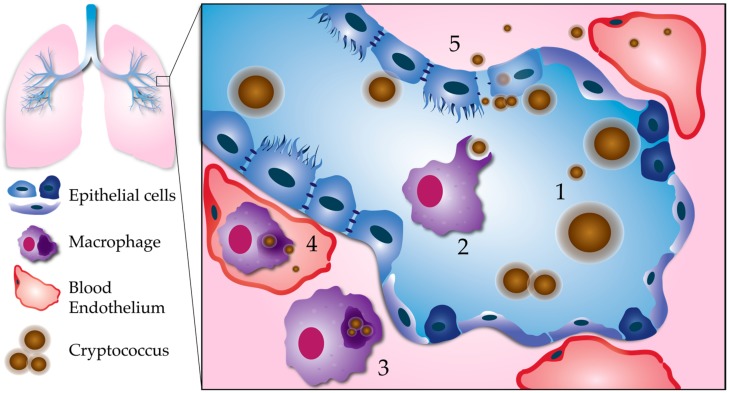
Cryptococcus neoformans is a common environmental saprophyte and human fungal pathogen that primarily causes disease in immunocompromised individuals. Similar to many environmentally acquired human fungal pathogens, C. neoformans initiates infection in the lungs. However, the main driver of mortality is invasive cryptococcosis leading to fungal meningitis. After C. neoformans gains a foothold in the lungs, a critical early step in invasion is transversal of the respiratory epithelium. In this review, we summarize current knowledge relating to pulmonary escape. We focus on fungal factors that allow C. neoformans to disseminate from the lungs via intracellular and extracellular routes.
Overview
The claims and statistics of this paper haven’t been checked yet.
Free: it reads the open-access text and checks the first 5 claims that cite a source we can check. Create a free account to check every claim.
Integrity signals
Registry
Cites
Statistics
Figures
Verification
Claims the paper makes
The claims and statistics of this paper haven’t been checked yet.
Free: it reads the open-access text and checks the first 5 claims that cite a source we can check. Create a free account to check every claim.
Claims other papers make about this one
Each is checked against this paper’s own text: does it say what the citing paper says it does?
In the citing paper
“This enables viable yeast to be transported out of the lungs within migrating phagocytes; a process known as the Trojan horse mechanism of dissemination [12].”
From Mechanisms of fungal dissemination (2021) · cites this paper as [12]
In the citing paper
“In order to utilize phagocytes as vehicles for dissemination, C. neoformans must successfully survive within and exit from these cells following internalization. This requires that C. neoformans defend against acidic, oxidative and nitrosative stresses commonly encountered within macrophages [12].”
From Mechanisms of fungal dissemination (2021) · cites this paper as [12]
In the citing paper
“Infectious propagules in the form of desiccated yeast or spores are inhaled into the respiratory tract on a daily basis [12]. Due to their small size these organisms are able to avoid cough and mucociliary clearance and penetrate deep into alveolar spaces [1].”
From Mechanisms of fungal dissemination (2021) · cites this paper as [12]
In the citing paper
“One such pathway is transcellular crossing, also known as transcytosis. This mechanism involves exploitation of host cell endocytic pathways to facilitate fungal traversal of epithelial barriers and grants C. neoformans access to the lung interstitium, vasculature or lymph system [12].”
From Mechanisms of fungal dissemination (2021) · cites this paper as [12]
In the citing paper
“Disseminated C. neoformans enters the bloodstream and can infect distant organs, but preferentially targets the central nervous system (CNS) [12].”
From Mechanisms of fungal dissemination (2021) · cites this paper as [12]
2 more claims about this paper
Create a free account to see every claim other papers make about this one.
Self-check
Percentages, sums and reported differences re-computed from the paper’s own numbers.
The self-check needs the paper’s full text.
Citations
Cites
Hidden Killers: Human Fungal Infections
Brown, G. D., Denning, D. W., Gow, N. A. R., Levitz, S. M., Netea, M. G., & White, T. C. (2012) · Science Translational Medicine · doi:10.1126/scitranslmed.3004404 · Cited by 4,284 · cited 1×
“, Coccidiodes immitis, Blastomyces dermatitis, and Histoplasma capsulatum, initiate infection via inhalation [2].”
BackgroundA pathology atlas of the human cancer transcriptome
Uhlen, M., Zhang, C., Lee, S., Sjöstedt, E., Fagerberg, L., Bidkhori, G., Benfeitas, R., Arif, M., Liu, Z., Edfors, F., et al. (2017) · Science · doi:10.1126/science.aan2507 · Cited by 3,371
Global burden of disease of HIV-associated cryptococcal meningitis: an updated analysis
Rajasingham, R., Smith, R. M., Park, B. J., Jarvis, J. N., Govender, N. P., Chiller, T. M., Denning, D. W., Loyse, A., & Boulware, D. R. (2017) · The Lancet Infectious Diseases · doi:10.1016/s1473-3099(17)30243-8 · Cited by 1,861 · cited 7×
“In the case of C. neoformans, it is most commonly low CD4+ T cell count due to HIV/AIDS [4].”
BackgroundInfluentialRespiratory epithelial cells orchestrate pulmonary innate immunity
Whitsett, J. A., & Alenghat, T. (2015) · Nature Immunology · doi:10.1038/ni.3045 · Cited by 801 · cited 2×
“The lung epithelium also plays a constitutive role in regulating microbial load through mechanisms such as secretion of antimicrobial defensins and mucociliary clearance [6].”
BackgroundSynthesis and assembly of fungal melanin
Eisenman, H. C., & Casadevall, A. (2012) · Applied Microbiology and Biotechnology · doi:10.1007/s00253-011-3777-2 · Cited by 711 · cited 1×
“neoformans, melanin pigment is exported to the cell wall [105], where it provides protection against ultraviolet radiation and oxidative damage [106,107].”
BackgroundCryptococcus: from environmental saprophyte to global pathogen
May, R. C., Stone, N. R. H., Wiesner, D. L., Bicanic, T., & Nielsen, K. (2016) · Nature Reviews Microbiology · doi:10.1038/nrmicro.2015.6 · Cited by 541
Cryptococcus neoformans and Cryptococcus gattii, the etiologic agents of cryptococcosis
Kwon-Chung, K. J., Fraser, J. A., Doering, T. L., Wang, Z. A., Janbon, G., Idnurm, A., & Bahn, Y.-S. (2014) · Cold Spring Harbor Perspectives in Medicine · doi:10.1101/cshperspect.a019760 · Cited by 531 · cited 1×
“gattii is more likely to infect immunocompetent individuals [10,11].”
BackgroundHigh diversity of fungi in air particulate matter
Fröhlich-Nowoisky, J., Pickersgill, D. A., Després, V. R., & Pöschl, U. (2009) · Proceedings of the National Academy of Sciences · doi:10.1073/pnas.0811003106 · Cited by 506 · cited 1×
“In fact, it is estimated that every breath contains 1–10 fungal spores [1].”
BackgroundChapter 4 The Capsule of the Fungal Pathogen Cryptococcus neoformans
Zaragoza, O., Rodrigues, M. L., De Jesus, M., Frases, S., Dadachova, E., & Casadevall, A. (2009) · Advances in Applied Microbiology · doi:10.1016/s0065-2164(09)01204-0 · Cited by 457
Systematic Genetic Analysis of Virulence in the Human Fungal Pathogen Cryptococcus neoformans
Liu, O. W., Chun, C. D., Chow, E. D., Chen, C., Madhani, H. D., & Noble, S. M. (2008) · Cell · doi:10.1016/j.cell.2008.07.046 · Cited by 443 · cited 6×
“1 cells will associate with a cryptococcal cell in in vitro experiments [33].”
BackgroundInfluential
Research works printed but not linked: 1
- Mitchell T.G. Castaneda E. Nielsen K. Wanke B. Lazera M.S. Environmental niches for Cryptococcus neoformans and Cryptococcus gattii Cryptococcus: From Human Pathogen to Model Yeast ASM Press Washington, DC, USA 2011
Cited by
Mechanisms of fungal dissemination
Strickland, A. B., & Shi, M. (2021) · Cellular and Molecular Life Sciences · doi:10.1007/s00018-020-03736-z · Cited by 127
Immunomodulatory Role of Capsular Polysaccharides Constituents of Cryptococcus neoformans
Decotè-Ricardo, D., LaRocque-de-Freitas, I. F., da Rocha, J. D. B., Nascimento, D. O., Nunes, M. P., Morrot, A., Freire‐de‐Lima, L., Previato, J. O., Mendonça‐Previato, L., & Freire-de-Lima, C. G. (2019) · Frontiers in Medicine · doi:10.3389/fmed.2019.00129 · Cited by 109
“Most of these pathogens kill the host cell to escape and infect other tissues (37, 38).”
BackgroundA dissemination-prone morphotype enhances extrapulmonary organ entry by Cryptococcus neoformans
Denham, S. T., Brammer, B., Chung, K. Y., Wambaugh, M. A., Bednarek, J. M., Guo, L., Moreau, C. T., & Brown, J. C. S. (2022) · Cell Host & Microbe · doi:10.1016/j.chom.2022.08.017 · Cited by 80
Self-citationWalsh, N. M., Botts, M. R., McDermott, A. J., Ortiz, S. C., Wüthrich, M., Klein, B., & Hull, C. M. (2019) · PLOS Pathogens · doi:10.1371/journal.ppat.1007777 · Cited by 60
Fungal Pathogens: Shape-Shifting Invaders
Min, K., Neiman, A. M., & Konopka, J. B. (2020) · Trends in Microbiology · doi:10.1016/j.tim.2020.05.001 · Cited by 64
“the major capsular components GXM and GXMGal are thought to modulate the host immune response by inhibiting immune recognition and activation [16, 17].”
Background
Metadata
- Authors
- Denham, S., & Brown, J.
- Affiliations
- University of Utah (US)
- Corresponding author
- Brown, Jessica
- Venue
- Journal of Fungi
- Publisher
- MDPI AG
- Published
- 2018-02-17
- Volume
- 4
- Issue
- 1
- Pages
- 25
- ISSN
- 2309-608X (ISSN-L)
- PMC
- PMC5872328
- OpenAlex
- W2793310115
- Cited by
- 67
- References
- 135
- Citations by year
- 2026: 9 · 2025: 7 · 2024: 7 · 2023: 5 · 2022: 8 · 2021: 9 · 2020: 15 · 2019: 5 · 2018: 2
- FWCI
- 1.11
- Type
- journal article
- Language
- en
- Open access
- gold
- doi.org
- Licence
- Locations
- Journal of Fungi (publishedVersion, cc-by)
- Europe PMC (PubMed Central) (publishedVersion, cc-by)
- PubMed Central (publishedVersion, cc-by)
- PubMed (publishedVersion)
- DOAJ (DOAJ: Directory of Open Access Journals) (submittedVersion)
- Topics
- Health Sciences › Medicine › Infectious Diseases › Fungal Infections and Studies
- Health Sciences › Medicine › Infectious Diseases › Antifungal resistance and susceptibility
- Health Sciences › Medicine › Epidemiology › Pneumocystis jirovecii pneumonia detection and treatment
- Keywords
- Cryptococcus neoformans, dissemination, fungal meningitis, respiratory epithelium, intracellular infection, fungal virulence factors, pulmonary infection
About these checks
Registry, retraction, Cites and statistics results are computed, not judged, with one exception: a printed reference that no index lists is read once by a model before it counts as a citation error. Claims are extracted by a model and kept only when their quote appears verbatim in the text; each cited source is then checked, with a model’s help, for whether it says what the claim relies on. Those verdicts can be wrong — read the claim’s quote and the cited source before relying on one.
Statistics and arithmetic are recomputed, not judged.
Confidence bands are shown only for fields calibrated on our annotated test set. None is calibrated yet, so no band is shown.
What counts as a claim ›How we measure confidence ›How we check this ›
Are you an author, or do you see a problem with this page? Request a review
Data sources
Bibliographic data: Semantic Scholar, OpenAlex, Crossref.
Contains information from the Semantic Scholar Academic Graph Datasets, made available under the ODC Attribution License (ODC-BY 1.0).
Semantic Scholar’s data is described in: Kinney, R., et al. (2023). The Semantic Scholar Open Data Platform. arXiv:2301.10140.
