

Understanding the Determinants of FinTech Adoption: Integrating UTAUT2 with Trust Theoretic Model
Open accessThe DOI matches its Crossref record; 63 of the 63 references it cites were found in a registry or an index.
Abstract
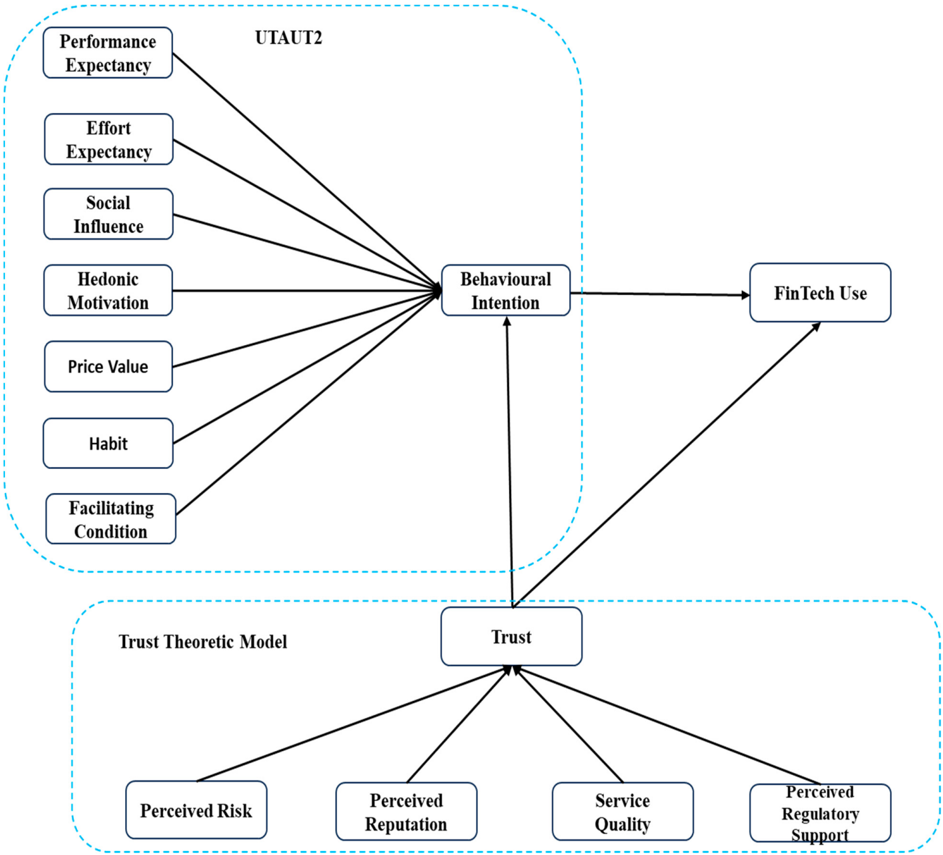
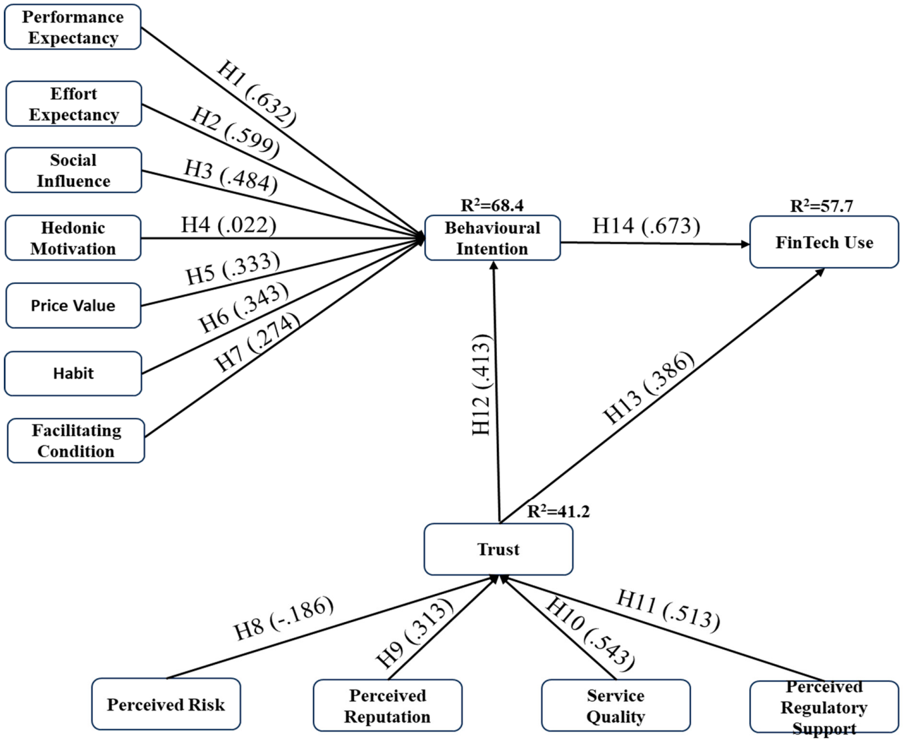
Financial technology (FinTech) is transforming the financial services industry by offering innovative, convenient solutions for businesses and individuals. This study examines the factors influencing FinTech adoption, with a special focus on trust. By integrating insights from both the unified theory of acceptance and use of technology (UTAUT2), and the trust theoretic model (TTM), this research uncovers critical determinants of FinTech adoption. Utilizing survey responses obtained from 399 participants, this research employs the partial least squares structural equation modelling method. The findings reveal that performance expectancy, effort expectancy, social influence, habit, price value, and facilitating conditions significantly influence users’ intentions to use FinTech services. In addition, the study shows that trust plays a crucial role in FinTech use, as it influences both the intentions to use and the actual use of FinTech. Surprisingly, hedonic motivation was found not to affect users’ intentions, implying that people see FinTech as a practical, rather than enjoyable, endeavor. These insights provide valuable guidance for service providers and policymakers seeking to enhance FinTech adoption and utilization while ensuring the security and trustworthiness of these digital platforms.
Overview
The claims and statistics of this paper haven’t been checked yet.
Free: it reads the open-access text and checks the first 5 claims that cite a source we can check. Create a free account to check every claim.
Integrity signals
Registry
Cites
Statistics
Figures
Verification
Claims the paper makes
The claims and statistics of this paper haven’t been checked yet.
Free: it reads the open-access text and checks the first 5 claims that cite a source we can check. Create a free account to check every claim.
Claims other papers make about this one
Each is checked against this paper’s own text: does it say what the citing paper says it does?
The source backs part of the claim, not all of it — or backs it for a different population, condition or comparison.
In the citing paper
“Studies in emerging economies indicate that perceived risk is a significant barrier, particularly in unregulated or novel markets [13,36,47].”
From Institutional Trust, Risk-Taking, and FinTech Adoption: Evidence from an Emerging Economy (2026) · cites this paper as [47]
Experimental — accuracy not yet measuredThe source backs part of the claim, not all of it — or backs it for a different population, condition or comparison.
In the citing paper
“Empirical evidence from Hungary and other European contexts suggests that trust significantly moderates the relationship between technology acceptance and actual usage behavior [24,47-49].”
From Institutional Trust, Risk-Taking, and FinTech Adoption: Evidence from an Emerging Economy (2026) · cites this paper as [47]
Experimental — accuracy not yet measuredThe cited source says what the claim attributes to it.
In the citing paper
“These services are more likely to be trusted by users who believe there is a robust regulatory framework in place because it provides them with a sense of security and confidence.”
From Institutional Trust, Risk-Taking, and FinTech Adoption: Evidence from an Emerging Economy (2026) · cites this paper as [47]
The cited source says what the claim attributes to it.
In the citing paper
“According to research by Amnas et al. [47], trust in FinTech is significantly positively impacted by perceived regulatory backing.”
From Institutional Trust, Risk-Taking, and FinTech Adoption: Evidence from an Emerging Economy (2026) · cites this paper as [47]
Self-check
Percentages, sums and reported differences re-computed from the paper’s own numbers.
The self-check needs the paper’s full text.
Citations
Cites
The theory of planned behavior
Ajzen, I. (1991) · Organizational Behavior and Human Decision Processes · doi:10.1016/0749-5978(91)90020-t · Cited by 134,657 · cited 2×
“This relationship is grounded in the theory of planned behavior (Ajzen 1991), which posits that behavioral intention strongly predicts actual behavior.”
User Acceptance of Information Technology: Toward A Unified View1
Venkatesh, V., Morris, M. G., Davis, G. B., & Davis, F. D. (2003) · MIS Quarterly · doi:10.2307/30036540 · Cited by 45,035 · cited 4×
“Behavioral intention refers to an individual’s willingness and intention to engage in a specific behavior, such as using FinTech services, while actual use reflects the tangible execution of that behavior (Bajunaied et al. 2023; Venkatesh et al. 2003, 2012).”
InfluentialWhen to Use and How to Report the Results of PLS-SEM
Hair, J. F., Risher, J. J., Sarstedt, M., & Ringle, C. M. (2019) · European Business Review · doi:10.1108/ebr-11-2018-0203 · Cited by 27,541 · cited 1×
“Generally, reliability, as evaluated through Cronbach’s alpha coefficient and composite reliability, is considered satisfactory when it exceeds the threshold of 0.70, consistent with the guidelines provided by Henseler et al. (2016).”
InfluentialVenkatesh, V., Thong, J. Y. L., & Xu, X. (2012) · MIS Quarterly · doi:10.2307/41410412 · Cited by 15,756 · cited 10×
“Due to the absence of a predefined sampling framework for FinTech users, we opted for the convenience sampling method, a practice recommended in prior studies (Alrawad et al. 2023; Bajunaied et al. 2023; Senyo and Osabutey 2020).”
InfluentialCommon Method Bias in PLS-SEM: A Full Collinearity Assessment Approach
Kock, N. (2015) · International Journal of e-Collaboration · doi:10.4018/ijec.2015100101 · Cited by 10,215 · cited 2×
“Regarding the relation between behavioral intention and actual use of FinTech services, the results reveal that behavioral intention has a significant positive effect on the actual use of FinTech services ( β = 0.673; p < 0.001), thus supporting H14.”
InfluentialTrust and TAM in Online Shopping: An Integrated Model1
Gefen, D., Karahanna, E., & Straub, D. W. (2003) · MIS Quarterly · doi:10.2307/30036519 · Cited by 8,635 · cited 7×
“Due to the absence of a predefined sampling framework for FinTech users, we opted for the convenience sampling method, a practice recommended in prior studies (Alrawad et al. 2023; Bajunaied et al. 2023; Senyo and Osabutey 2020).”
InfluentialUsing pls path modeling in new technology research: updated guidelines
Henseler, J., Hubona, G., & Ray, P. A. (2016) · Industrial Management & Data Systems · doi:10.1108/imds-09-2015-0382 · Cited by 7,173 · cited 2×
“However, the results also highlight the significant influence of trust on the behavioral intention to use FinTech services ( β = 0.413; p < 0.01) and actual use of FinTech services ( β = 0.386; p < 0.01), thereby accepting H12 and H13.”
InfluentialAlalwan, A. A., Dwivedi, Y. K., & Rana, N. P. (2017) · International Journal of Information Management · doi:10.1016/j.ijinfomgt.2017.01.002 · Cited by 1,581 · cited 2×
“Researchers and practitioners often use the UTAUT2 model to assess and predict technology adoption in various contexts, including the adoption of financial technology (FinTech) services, mobile apps, and information systems (Alalwan et al. 2017; De Blanes Sebasti á n et al. 2023; Ong et al. 2023).”
Oliveira, T., Thomas, M., Baptista, G., & Campos, F. (2016) · Computers in Human Behavior · doi:10.1016/j.chb.2016.03.030 · Cited by 1,361
An empirical examination of continuance intention of mobile payment services
Zhou, T. (2013) · Decision Support Systems · doi:10.1016/j.dss.2012.10.034 · Cited by 914 · cited 4×
“The FinTech platform responds promptly to inquiries and requests for assistance”
Influential
Cited by
Items 101–199 of 199
Transitioning to Cashless Society: Challenges and Opportunities for Small Business
Askarzai, W., & Unhelkar, B. (2025) · Open Journal of Business and Management · doi:10.4236/ojbm.2025.136232
Fardiansyah, A., Yunus, A., Wardani, R., & Nurwijayanti, N. (2025) · Salud Ciencia y Tecnología · doi:10.56294/saludcyt20262568
Añaguari Zamalloa, L. F., & Sedan Cuya, R. A. (2025) · Repositorio Académico UPC (Universidad Peruana de Ciencias Aplicadas)
Weiß, J.-L. (2024) · Portuguese National Funding Agency for Science, Research and Technology (RCAAP Project by FCT)
Unveiling the Determinants of Intention to Use Fintech among Gen Y and Gen Z in Pakistan
Masood, A. B., & Muqadas, F. (2025) · Journal of Emerging Business Innovation Management · doi:10.65072/jebim.v1i1.2
Dinh, D. H., Ha, V. T., Dong, H. Q., Nguyen, T. D. M., Styazhkov, A., & Ametsbichler, T. (2026) · Studies in systems, decision and control · doi:10.1007/978-3-032-07220-7_51
Generative AI, Embedded Lending, and Consumer Satisfaction: Enabling Seamless Credit Journeys
Kumar, P., & Sharma, P. (2025) · International Conference on Digital Innovations for Sustainable Solutions (ICDISS) · doi:10.1109/icdiss68238.2025.11320660
Institutional Quality, Entrepreneurship, and Economic Outcomes in Low- and Middle-Income Economies
Gbadebo, A. D. (2025) · Reviews of Management Sciences · doi:10.53909/rms.07.02.0323
“Women entrepreneurs may face slower diffusion due to weaker social networks, lower exposure to peer learning, and higher perceived risks associated with digital platforms, suggesting that adoption is not gender-neutral (Neves et al., 2023; Amnas et al., 2023).”
Yuhelmi, Y., Yunilma, Y., Trianita, M., & Yolanda, Y. (2026) · Jurnal Manajemen Universitas Bung Hatta · doi:10.37301/jmubh.v21i1.29131
Arifin, A., Sudarmanto, F., Husna, L., Wahyuni, D. S., & Hadi, M. K. (2026) · Jurnal Kawakib · doi:10.24036/kwkib.v6i2.394
(2026) · International Research Journal of Modernization in Engineering Technology and Science · doi:10.56726/irjmets89224
Danquah, K. O. (2026) · Research Square · doi:10.21203/rs.3.rs-8843096/v1
Putri, A. A. K. S., Fitrianna, H., Widodo, A. S., & Fitriani (2026) · Journal of risk analysis and crisis response · doi:10.54560/jracr.v16i1.662
Mukhibad, H., Fachrurrozie, F., Anisykurlillah, I., Jati, K. W., Yanto, H., Nurkhin, A., & Musyaffi, A. M. (2026) · Discover Sustainability · doi:10.1007/s43621-026-05019-2
Toward Financial Autonomy: Why Consumers are Embracing Digital Investment Platforms
Saldanha, L. C., Gonçalves, R., Pereira, L., & Costa, R. L. D. (2026) · Annals of Financial Economics · doi:10.1142/s2010495226500053
LANDSCAPE OF FINTECH AND TRUST RESEARCH: PARTNERSHIP NETWORKS AND THEMATIC EVOLUTION
Czechowska, I. D., & Paduszyńska, M. (2025) · Scientific Papers of Silesian University of Technology Organization and Management Series · doi:10.29119/1641-3466.2025.240.2
Matoka, W., Mwange, A. M., Chibesa, K. C., Katuta, B., Kalaba, L., & Kabwalwa, C. (2026) · African Quarterly Social Science Review · doi:10.51867/aqssr.3.2.17
“Several FinTech adoption studies have employed this framework, sometimes incorporating FinTech-specific contextual variables including trust, security, and ethical considerations (Amnas et al., 2023).”
InfluentialYucra, E. J. A. (2025) · LA Referencia (Red Federada de Repositorios Institucionales de Publicaciones Científicas)
The Impact of Digitalization on Retail Investor Participation: Empirical Evidence from NEPSEPreprint
Gupta, R., & Dhunganna, S. (2026) · SSRN Electronic Journal · doi:10.2139/ssrn.6646400
User as the System Core: Evolution of the User-Aligned Systems Engineering Framework
Yaldaie, A., & Porras, J. (2026) · Applied Computer Systems · doi:10.2478/acss-2026-0005
Singh, D. S., Ghosh, D. R., Thakur, S., Rakesh, D., wani, P., & Srivastava, S. K. (2026) · doi:10.1922/mrnj6047
Online Fraud Risk and Its Impact on Student Trust in Digital Financial Services
Lauron, K. G. M., Malinao, B. R. E., Detecio, C. J. T., Abejero, E. L. Y., Genon, P. A. A., Abarquez, P. J. F., Malubay, R. B., & Narsico, P. G. (2026) · International Journal of Multidisciplinary Applied Business and Education Research · doi:10.11594/ijmaber.07.04.25
FinTech versus Traditional Banking: Consumer Evidence on Revolut, SEB and Swedbank in the EU Context
Kamble, M., & Uygur, M. R. (2026) · Applied Business Issues & Solutions · doi:10.57005/ab.2025.4.2
Is Greenwashing Hindering Green FinTech Adoption? A UTAUT‐Based Perspective
Adil, M., Anas, M., & Azmi, S. N. (2026) · Human Behavior and Emerging Technologies · doi:10.1155/hbe2/3391348
Modelling the Barriers to Indian Gen Z’s Adoption of Neo-Banking Services: An ISM–MICMAC Approach
Ray, S., Chandramouli, G., & Aswath, B. (2026) · Lecture notes in networks and systems · doi:10.1007/978-3-032-19684-2_38
The Growth of Fintech in Developing Countries: Evidence from Jordan
Al-Qudah, A. A., & Chahine, M. (2026) · FIIB Business Review · doi:10.1177/23197145261451945
Cognitive Bias and Trust in Digital Accounting Decisions
Lampropoulos, I. C., Aggelopoulos, E., Paraschi, E. P., Georgopoulos, N., & Καλογερά, Μ. (2026) · FinTech · doi:10.3390/fintech5020049
“Trust is a decisive factor in the adoption of FinTech services, influencing both intention and actual usage [20,21].”
InfluentialAmegbe, H., Dzandu, M. D., & Hanu, C. (2026) · Electronic Markets · doi:10.1007/s12525-026-00911-1
“…the UTAUT with a trust-based model indicates that higher trust strengthens continuous use intention and can promote a feeling of ownership (Amnas et al., 2023), while studies on emerging digital environments (e.g., metaverse applications) underline the role of technology readiness,…”
Narsis, I., & N., B. (2026) · MANTHAN Journal of Commerce and Management · doi:10.17492/jpi.manthan.v13i1.1312601
Global Trends in Fintech Adoption: A Systematic Literature Review and Bibliometric Analysis
Pramitasari, T. D., Rustiarini, N. W., & Widnyana, P. K. I. W. (2026) · WSEAS TRANSACTIONS on SYSTEMS archive · doi:10.37394/23202.2026.25.32
Kumar, M. V., & Jindoliya, D. (2026) · JOURNAL OF ADVANCE AND FUTURE RESEARCH · doi:10.56975/jaafr.v4i6.510431
Prakash, N., Prakash, H., & Sahoo, A. (2026) · Services Marketing Quarterly · doi:10.1080/15332969.2026.2690277
Harianto, J., Zebua, S., Purnama, I. Y., Halomoan, H. S., & Fransiso, G. (2026) · International Conference on Creative Communication and Innovative Technology (ICCIT) · doi:10.1109/iccit70127.2026.11748957
Assessing the business performance impact of fintech diffusion in emerging economies
Ali, M. A., Akbar, W., Akmal, S. B., Mubeen, M., & Kumar, M. (2026) · Business Performance Review · doi:10.22495/bprv4i3p1
Ilias, A., Mohaidin, N. J., Ghani, E. K., & Rahman, R. A. (2026) · International Journal of Business Management (IJBM) · doi:10.52650/5j6s4r84
“Effort Expectation demonstrated a moderate positive relationship with behavioural intention (r = 0.526, p < 0.01), confirming H2, which is aligned with Amnas et al. (2023) and Apau et al. (2025).”
InfluentialGülpınar, G., Çeşit, S., & Şit, A. (2026) · DergiPark (Istanbul University)
Norbu, T., Park, J. Y., Wong, K. W., & Cui, H. (2026) · SSRN Electronic Journal · doi:10.2139/ssrn.7051230
Aswan, L. S., Ermawati, W. J., & Anggraeni, L. (2026) · Jurnal Ilmu Manajemen · doi:10.26740/jim.v14n2.p372-388
Heriyanto, C. J., Frederica, G., & Saputra, D. (2026) · International Conference on ICT for Smart Society (ICISS) · doi:10.1109/iciss71466.2026.11715498
“The emphasis on trust is highly relevant since trust has been consistently identified as a major factor of the adoption of fintech and sustained use of fintech [10].”
DETERMINANTS OF PATIENT CHOICE IN DENTAL SERVICES: THE ROLE OF REPUTATION AND PERCEIVED RISK
Nguyen, T. N. (2025) · Annals of dental specialty · doi:10.51847/dtgbey7c7v
Arifin, M. S., Prihatiningrum, R. R. Y., Said, L. R., & Albushairi, S. A. (2026) · Jurnal Relevansi Ekonomi Manajemen dan Bisnis · doi:10.61401/relevansi.v10i1.473
Financial literacy and trust in digital health payment adoption
Ha, V. T. Y., Diep, B. H., Quang, H. T., & Ghi, T. N. (2026) · Journal Of Advanced Pharmacy Education And Research · doi:10.51847/fybonz9hac
Setiawati, I., Ghozali, I., & Hadiprajitno, P. B. (2026) · WSEAS TRANSACTIONS ON COMPUTER RESEARCH · doi:10.37394/232018.2026.14.40
Aziz, N. J. A., Pradani, T., Anggraini, W. A., & Rasyid, D. A. (2026) · Jurnal Akuntansi dan Audit Syariah (JAAiS) · doi:10.28918/jaais.v7i1.14316
Financial Wellbeing through Fintech Adoption: An Integrated UTAUT Perspective
C, L. P., & Kumar, M. A. (2026) · International Journal of Research and Innovation in Applied Science · doi:10.51584/ijrias.2026.11070062
Yulfiswandi, Aprilliah, L., & Agustin, I. N. (2026) · Tazkia Islamic Finance and Business Review · doi:10.30993/tifbr.v20i1.519
“This hypothesis is strengthened in UTAUT, which confirms that Hedonic Motivation is a high emotional factor towards the pleasure and comfort felt by Generation Z in using Sharia digital banking services (Amnas et al., 2023; Wu et al., 2021).”
Determinants of e-wallet adoption in Indonesia: An empirical investigation using the UTAUT model
Susanto, V. G., & Nur, T. (2026) · Asian Development Policy Review · doi:10.55493/5008.v14i3.6179
Khumairo, V. N. N., & Waluyo, M. (2026) · AJARCDE (Asian Journal of Applied Research for Community Development and Empowerment) · doi:10.29165/ajarcde.v10i3.1298
“…Partial Least Squares Structural Equation Modeling (PLS-SEM) through SmartPLS, while the use of Covariance-Based Structural Equation Modeling (CB-SEM) using AMOS, which provides stricter confirmation of measurement models and overall model fit, remains relatively uncommon in this context [21].”
Aftab, R., Meng, K., Zeeshan, A., Coetzee, J., Andleeb, R., & Hanif, S. (2026) · African Journal of Economic and Management Studies · doi:10.1108/ajems-11-2025-0954
Yanty, F. Y. F. (2025) · Repository IAIN Palopo
Gusti, M. A. S. B. A., & Zadeh, A. V. (2026) · International Journal of Academic Research in Business and Social Sciences · doi:10.6007/ijarbss/v16-i8/28880
Rizvi, S. A. R., & Siddiqui, D. A. (2026) · Research Journal of Human and Social Aspects · doi:10.71085/rjhsa.04.03.122
Fintech Adoption in Albania: A Comparative Analysis of Residents and Tourists
Bitri, A., & Hamiti, K. (2025) · International Scientific Conference ERAZ. Knowledge Based Sustainable Development · doi:10.31410/eraz.2025.135
“Both frameworks provide a grounded and flexible structure for interpreting the adoption of technological services in both groups (Zhang et al. 2024; Nguyen et al., 2023).”
Goundar, S. (2026) · Directory of Open access Books (OAPEN Foundation)
Putri, A. A. K. S. (2026) · Repository Universitas PGRI Yogyakarta (Universitas PGRI Yogyakarta)
Trust and behavioral intention toward blockchain-based mudharabah smart contracts in Islamic banking
Fielnanda, R., Novida, I., Rahma, S., Anggraini, D., & Alwahidin, A. (2026) · Jurnal Ekonomi & Keuangan Islam · doi:10.20885/jeki.vol12.iss2.art1
“This finding supports prior fintech adoption studies asserting that performance expectancy and perceived benefits are the primary drivers of trust formation (Amnas et al., 2023; Uula, 2025).”
Depari, S. E. N., & Lestari, I. (2026) · Indonesian Journal of Innovation Multidisipliner Research · doi:10.69693/ijim.v4i3.2452
Utarindasari, D., Herawati, E., Kumala, D., & Dara, S. R. (2025) · BELGIFOODS JOURNALS · doi:10.67925/belgi.v1i1.11
“Existing studies primarily focus on formal financial institutions, with limited exploration of how informal online lending operates within the broader framework of UTAUT2 (Amnas et al., 2023; Chand et al., 2025).”
Drivers of user engagement with FinTech: a cross-country analysis in digitally mature markets
Macedo, Â. C., Almeida, D., & Duarte, P. (2026) · International Journal of Bank Marketing · doi:10.1108/ijbm-03-2026-0205
(2026) · Forman Journal of Business & Innovation · doi:10.32368/fjbi.20262701
Fintech Innovation and Financial Inclusion: A Rural Malaysian Perspective
Mohamad, S., Beneett, B. B., Sundaram, K. V., & Kuppusamy, N. (2026) · International Journal of Research and Innovation in Social Science · doi:10.47772/ijriss.2026.100800271
Rajuansyah, M., Ibnu, A. R., & Munawar, W. (2026) · Indonesian Journal of Multidisciplinary on Social and Technology · doi:10.69693/ijmst.v4i3.13138
Toward a Theoretical Framework for Green Digital Finance: Bridging FinTech and Sustainability Goals
Sarkar, A., & Singh, S. K. (2026) · Advances in economics, business and management research/Advances in Economics, Business and Management Research · doi:10.2991/978-94-6239-772-9_28
Rizvi, S. A. R., & Siddiqui, D. A. (2026) · Journal of Climate and Community Development · doi:10.68065/joccd.05.01.166
“…risk-laden and forward-looking, trust reduces perceived risk and uncertainty and is repeatedly identified as decisive for the adoption and continued use of financial technology, especially in emerging markets where confidence in providers is fragile (Aracil et al., 2025; Amnas et al., 2023).”
InfluentialNyanga, T., & Eresia-Eke, C. (2026) · Acta Commercii · doi:10.4102/ac.v26i1.1637
Anshori, A., & Rahmat, R. (2026) · Dinasti International Journal of Economics Finance & Accounting · doi:10.38035/dijefa.v7i4.7343
Determinants of fintech lending adoption among Indonesian SMEs: An integrated UTAUT2–TAM perspective
Abdillah, W., Usman, B., Nurazi, R., Kamaludin, Afandy, C., & Lestari, C. K. (2026) · Journal of Open Innovation Technology Market and Complexity · doi:10.1016/j.joitmc.2026.100877
The role of FinTech in enhancing bank loan performance in Bangladesh through the UTAUT model
Rana, M., Jalal, S., Kamruzzaman, M., & Islam, M. A. (2026) · Discover Global Society · doi:10.1007/s44282-026-00573-6
Crespo, V. G., Grande, A. A., & Guede, J. R. S. (2026) · Journal of Business and Industrial Marketing · doi:10.1108/jbim-12-2025-1227
ALTUNAY, M. A. (2026) · Mehmet Akif Ersoy Üniversitesi İktisadi ve İdari Bilimler Fakültesi Dergisi · doi:10.30798/makuiibf.1969028
Modification of the UTAUT Model in the Adoption of Financial Lending Technology
Lestari, C. K., & Abdillah, W. (2026) · IJBE (Integrated Journal of Business and Economics) · doi:10.33019/ijbe.v10i3.1634
Shaikh, A. Z., Shaikh, M. S., & Zaheer, H. (2026) · PUBLIC ADMINISTRATION AND LAW REVIEW · doi:10.36690/2674-5216-2026-3-40-61
Aulia, A. N., & Harris, L. (2026) · International Journal of Research on Finance & Business · doi:10.70575/ijrfb.v9i1.145
Tripathy, P. K. K. D. M. P. (2025) · European Economic Letters (EEL)
Safiyuddin, F. S., Razali, N. S. B. M., Musaddad, H. A., & Nasir, N. M. (2026) · Journal of Islamic Social Economics and Development
Anitha, M. (2025) · Anusandhanvallari
Proposing a Smartization Model in the Insurance Industry Based on Financial Technology
Imani, R., Nourollahzade, N., Abbasi, F. B., & Sarraf, F. (2025) · Journal of Management and Business Solutions · doi:10.61838/jmbs.128
Diwya, K. G. S., & Setiawan, I. M. I. (2026) · Journal of Enterprise and Development · doi:10.20414/jed.v8i3.16361
FinTech and Financial Well-Being Among Malaysian Young Adults: Direct or Moderating Role?
Ariff, F. F. B. M., Abdullah, S. M. M. B., Ya’cob, N. B., & Salleh, M. N. B. M. (2026) · International Journal of Research and Innovation in Social Science · doi:10.47772/ijriss.2026.100900138
The Effect of Financial Capability and Trust on The Adoption Fintech Services
Ramadhani, S. R. (2024) · Proceeding of International Student Conference on Business, Education, Economics, Accounting, and Management. · Cited by 2
Husnain, H. (2026) · Center for Management Science Research · doi:10.5281/zenodo.23186657
Delima, C. J., Pecundo, A. J., Cabahug, J. M., & Geloca, K. M. B. (2026) · American Journal of Business and Management Innovation · doi:10.54536/ajbmi.v1i1.8669
“Lack of integration and support from banking institutions may affect the interoperability of e-wallet systems, hence affecting cashless transactions (Shetu et al., 2022; Amnas et al., 2023).”
Masood, S., Sohail, M. S., Al-Sharafi, M. A., Alzaeemi, S., & Dwivedi, Y. K. (2026) · Journal of Financial Services Marketing · doi:10.1057/s41264-026-00398-z
“Prior FinTech research further indicates that trans-parency and trust are important considerations in users’ evaluations of digital financial services (Amnas et al. 2023; Mainardes et al. 2023).”
Safdeni, H. F., Faslah, R., & Dwipanilih, R. (2026) · Ekopedia Jurnal Ilmiah Ekonomi · doi:10.63822/afzdmt77
Ismail, S. A., Parlyna, R., & Usman, O. (2026) · Ekopedia Jurnal Ilmiah Ekonomi · doi:10.63822/6884qj34 · Cited by 1
Women, FinTech, and Financial Inclusion: A Systematic Review and TCM Research Agenda
Kumar, N., Kumar, P., & Saxena, N. (2026) · Journal of risk and financial management · doi:10.3390/jrfm19100788
Arora, N. (2026) · Journal of business management, commerce and research · doi:10.61101/2319-250x.vol.13.issue3.7
Purnama, R. A. C., & Susyani, N. (2026) · International Journal of Scientific Multidisciplinary Research · doi:10.55927/ijsmr.v4i9.157
“…money (Penney et al., 2021), whereas Paramita and Cahyadi (2024) reported a significant effect of facilitating condition specifically within a QRIS context; hedonic motivation itself was found to be a significant predictor by Febriani et al. (2023), yet non-significant by Amnas et al. (2023).”
Zahra, F., Alexandri, M. B., Bainus, A., & Tresna, P. W. (2026) · Research Square · doi:10.21203/rs.3.rs-10591100/v1
Mohamad, S. (2026) · International Journal of Research and Innovation in Social Science · doi:10.47772/ijriss.2026.100900658
Mukhibad, H., Fachrurrozie, F., Anisykurlillah, I., Jati, K. W., Nurkhin, A., & Musyaffi, A. M. (2026) · Journal of economic and administrative sciences. · doi:10.1108/jeas-05-2025-0264
Zulqarnaen, N. :. 2. T. F. (2026) · Digital Library UIN Sunan Kalijaga (Sunan Kalijaga State Islamic University)
Alibrahim, S., & Samha, A. K. (2026) · Communications in computer and information science · doi:10.1007/978-981-92-7298-3_24
Ramayanti, R., Rachmawati, N. A., Setyawati, A., Agusalim, L., Azhar, Z., & Azman, N. H. N. (2026) · International Journal of Information Management Data Insights · doi:10.1016/j.jjimei.2026.100455
Agustine, R. S., & Marsasi, E. G. (2026) · Jurnal Riset Akuntansi · doi:10.54066/jura-itb.v4i4.4683
開発途上国の銀行セクターにおけるデジタルトランスフォーメーション:ラオス人民民主共和国に着目した組織的・人的・技術的要因の多層的分析
SOULITA, T. (2026) · Institutional Repositories DataBase (IRDB)
Ravines, M. G. M., García-Salirrosas, E. E., Salas-Tenesaca, E. E., Flores, E. I. B., Gamero, J. G. M., & Apaza-Cáceres, J. A. (2026) · International Journal of Financial Studies · doi:10.3390/ijfs14110309
Purevsuren, T., Tsogt-erdene, D., Zanabazar, A., Ukhnaa, M., & Purev, B. (2026) · Humanities Journal. · doi:10.31893/humanitj.2026051
The diffusion of digital financial inclusion across Chinese counties: A panel Bass model analysis
Wang, Z., Yang, X.-Y., & Zhang, H. (2026) · Socio-Economic Planning Sciences · doi:10.1016/j.seps.2026.102638
Metadata
- Authors
- Amnas, M. B., Selvam, M., Raja, M., Santhoshkumar, S., & Parayitam, S.
- Affiliations
- Bharathidasan University (IN)
- Department of Commerce and Financial Studies, Bharathidasan University, Tiruchirappalli 620024, India
- University of Massachusetts Dartmouth (US)
- Corresponding author
- Parayitam, Satyanarayana
- ORCID
- Venue
- Journal of Risk and Financial Management
- Publisher
- MDPI AG
- Published
- 2023-12-06
- Volume
- 16
- Issue
- 12
- Pages
- 505
- ISSN
- 1911-8066 (ISSN-L)
- 1911-8074
- OpenAlex
- W4389379484
- Semantic Scholar
- 074b3905cd0cb2a46addfda1d027a1a19133da8f
- Cited by
- 110
- References
- 63
- Citations by year
- 2026: 63 · 2025: 35 · 2024: 12
- FWCI
- 28.12
- Type
- journal article
- Language
- en
- Open access
- hybrid
- doi.org
- Licence
- Locations
- Journal of risk and financial management (publishedVersion, cc-by)
- RePEc: Research Papers in Economics (submittedVersion)
- Topics
- Social Sciences › Decision Sciences › Information Systems and Management › Technology Adoption and User Behaviour
- Social Sciences › Business, Management and Accounting › Management Information Systems › FinTech, Crowdfunding, Digital Finance
- Health Sciences › Health Professions › Health Information Management › Health, Technology, Consumer Behavior
- Keywords
- fintech adoption, UTAUT2, trust in technology, performance expectancy, effort expectancy, social influence, habit, price value, facilitating conditions, hedonic motivation, intention to use, digital financial services
About these checks
Registry, retraction, Cites and statistics results are computed, not judged, with one exception: a printed reference that no index lists is read once by a model before it counts as a citation error. Claims are extracted by a model and kept only when their quote appears verbatim in the text; each cited source is then checked, with a model’s help, for whether it says what the claim relies on. Those verdicts can be wrong — read the claim’s quote and the cited source before relying on one.
Statistics and arithmetic are recomputed, not judged.
Confidence bands are shown only for fields calibrated on our annotated test set. None is calibrated yet, so no band is shown.
What counts as a claim ›How we measure confidence ›How we check this ›
Are you an author, or do you see a problem with this page? Request a review
Data sources
Bibliographic data: Semantic Scholar, OpenAlex, Crossref.
Contains information from the Semantic Scholar Academic Graph Datasets, made available under the ODC Attribution License (ODC-BY 1.0).
Semantic Scholar’s data is described in: Kinney, R., et al. (2023). The Semantic Scholar Open Data Platform. arXiv:2301.10140.
