

Understanding the Determinants of FinTech Adoption: Integrating UTAUT2 with Trust Theoretic Model
Open accessThe DOI matches its Crossref record; 63 of the 63 references it cites were found in a registry or an index.
Abstract
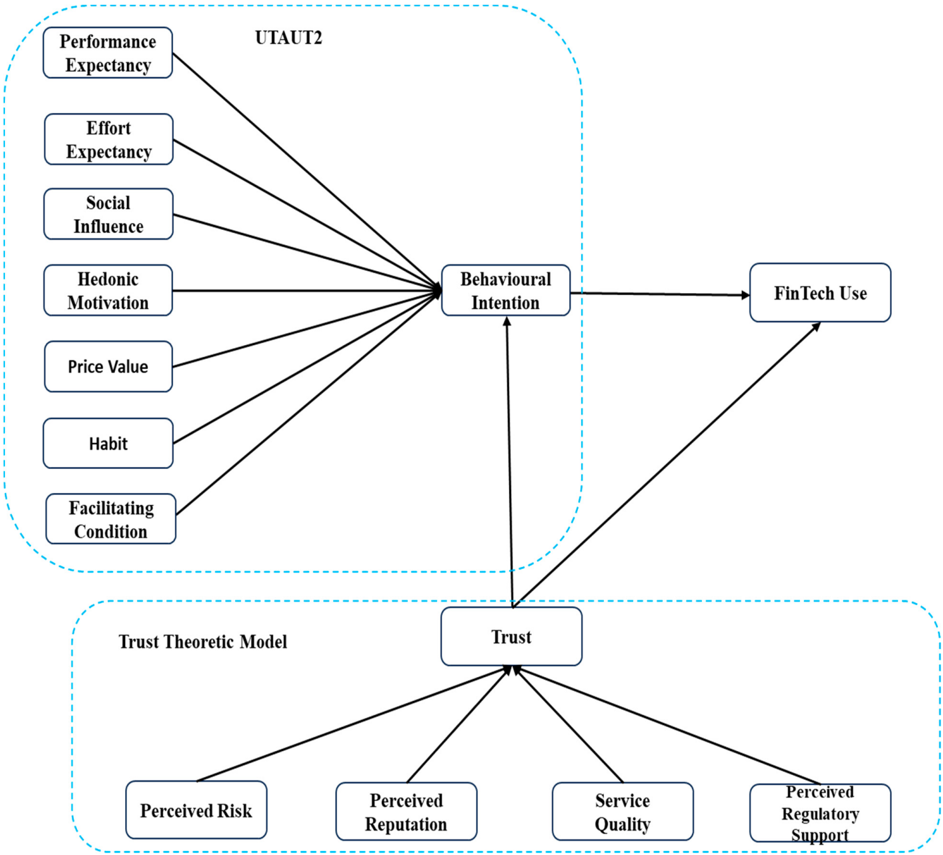
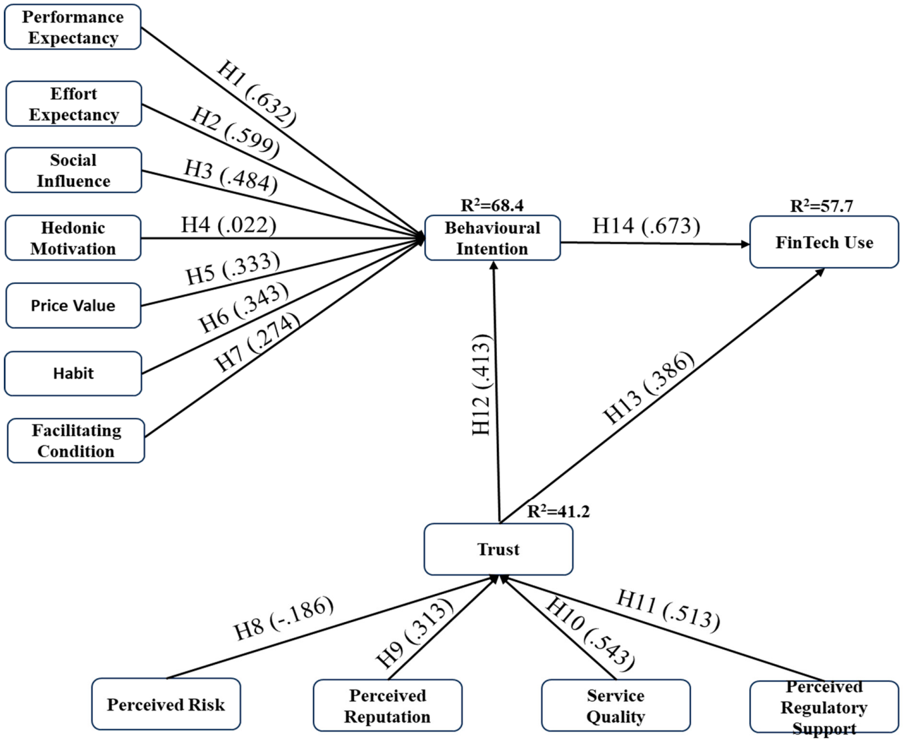
Financial technology (FinTech) is transforming the financial services industry by offering innovative, convenient solutions for businesses and individuals. This study examines the factors influencing FinTech adoption, with a special focus on trust. By integrating insights from both the unified theory of acceptance and use of technology (UTAUT2), and the trust theoretic model (TTM), this research uncovers critical determinants of FinTech adoption. Utilizing survey responses obtained from 399 participants, this research employs the partial least squares structural equation modelling method. The findings reveal that performance expectancy, effort expectancy, social influence, habit, price value, and facilitating conditions significantly influence users’ intentions to use FinTech services. In addition, the study shows that trust plays a crucial role in FinTech use, as it influences both the intentions to use and the actual use of FinTech. Surprisingly, hedonic motivation was found not to affect users’ intentions, implying that people see FinTech as a practical, rather than enjoyable, endeavor. These insights provide valuable guidance for service providers and policymakers seeking to enhance FinTech adoption and utilization while ensuring the security and trustworthiness of these digital platforms.
Overview
The claims and statistics of this paper haven’t been checked yet.
Free: it reads the open-access text and checks the first 5 claims that cite a source we can check. Create a free account to check every claim.
Integrity signals
Registry
Cites
Statistics
Figures
Verification
Claims the paper makes
The claims and statistics of this paper haven’t been checked yet.
Free: it reads the open-access text and checks the first 5 claims that cite a source we can check. Create a free account to check every claim.
Claims other papers make about this one
Each is checked against this paper’s own text: does it say what the citing paper says it does?
The source backs part of the claim, not all of it — or backs it for a different population, condition or comparison.
In the citing paper
“Studies in emerging economies indicate that perceived risk is a significant barrier, particularly in unregulated or novel markets [13,36,47].”
From Institutional Trust, Risk-Taking, and FinTech Adoption: Evidence from an Emerging Economy (2026) · cites this paper as [47]
Experimental — accuracy not yet measuredThe source backs part of the claim, not all of it — or backs it for a different population, condition or comparison.
In the citing paper
“Empirical evidence from Hungary and other European contexts suggests that trust significantly moderates the relationship between technology acceptance and actual usage behavior [24,47-49].”
From Institutional Trust, Risk-Taking, and FinTech Adoption: Evidence from an Emerging Economy (2026) · cites this paper as [47]
Experimental — accuracy not yet measuredThe cited source says what the claim attributes to it.
In the citing paper
“These services are more likely to be trusted by users who believe there is a robust regulatory framework in place because it provides them with a sense of security and confidence.”
From Institutional Trust, Risk-Taking, and FinTech Adoption: Evidence from an Emerging Economy (2026) · cites this paper as [47]
The cited source says what the claim attributes to it.
In the citing paper
“According to research by Amnas et al. [47], trust in FinTech is significantly positively impacted by perceived regulatory backing.”
From Institutional Trust, Risk-Taking, and FinTech Adoption: Evidence from an Emerging Economy (2026) · cites this paper as [47]
Self-check
Percentages, sums and reported differences re-computed from the paper’s own numbers.
The self-check needs the paper’s full text.
Citations
Cites
The theory of planned behavior
Ajzen, I. (1991) · Organizational Behavior and Human Decision Processes · doi:10.1016/0749-5978(91)90020-t · Cited by 90,587 · cited 2×
“This relationship is grounded in the theory of planned behavior (Ajzen 1991), which posits that behavioral intention strongly predicts actual behavior.”
User Acceptance of Information Technology: Toward A Unified View1
Venkatesh, V., Morris, M. G., Davis, G. B., & Davis, F. D. (2003) · MIS Quarterly · doi:10.2307/30036540 · Cited by 45,035 · cited 4×
“Behavioral intention refers to an individual’s willingness and intention to engage in a specific behavior, such as using FinTech services, while actual use reflects the tangible execution of that behavior (Bajunaied et al. 2023; Venkatesh et al. 2003, 2012).”
InfluentialWhen to Use and How to Report the Results of PLS-SEM
Hair, J. F., Risher, J. J., Sarstedt, M., & Ringle, C. M. (2019) · European Business Review · doi:10.1108/ebr-11-2018-0203 · Cited by 27,541 · cited 1×
“Generally, reliability, as evaluated through Cronbach’s alpha coefficient and composite reliability, is considered satisfactory when it exceeds the threshold of 0.70, consistent with the guidelines provided by Henseler et al. (2016).”
InfluentialVenkatesh, V., Thong, J. Y. L., & Xu, X. (2012) · MIS Quarterly · doi:10.2307/41410412 · Cited by 15,756 · cited 10×
“Due to the absence of a predefined sampling framework for FinTech users, we opted for the convenience sampling method, a practice recommended in prior studies (Alrawad et al. 2023; Bajunaied et al. 2023; Senyo and Osabutey 2020).”
InfluentialCommon Method Bias in PLS-SEM: A Full Collinearity Assessment Approach
Kock, N. (2015) · International Journal of e-Collaboration · doi:10.4018/ijec.2015100101 · Cited by 10,215 · cited 2×
“Regarding the relation between behavioral intention and actual use of FinTech services, the results reveal that behavioral intention has a significant positive effect on the actual use of FinTech services ( β = 0.673; p < 0.001), thus supporting H14.”
InfluentialTrust and TAM in Online Shopping: An Integrated Model1
Gefen, D., Karahanna, E., & Straub, D. W. (2003) · MIS Quarterly · doi:10.2307/30036519 · Cited by 8,635 · cited 7×
“Due to the absence of a predefined sampling framework for FinTech users, we opted for the convenience sampling method, a practice recommended in prior studies (Alrawad et al. 2023; Bajunaied et al. 2023; Senyo and Osabutey 2020).”
InfluentialUsing pls path modeling in new technology research: updated guidelines
Henseler, J., Hubona, G., & Ray, P. A. (2016) · Industrial Management & Data Systems · doi:10.1108/imds-09-2015-0382 · Cited by 7,173 · cited 2×
“However, the results also highlight the significant influence of trust on the behavioral intention to use FinTech services ( β = 0.413; p < 0.01) and actual use of FinTech services ( β = 0.386; p < 0.01), thereby accepting H12 and H13.”
InfluentialAlalwan, A. A., Dwivedi, Y. K., & Rana, N. P. (2017) · International Journal of Information Management · doi:10.1016/j.ijinfomgt.2017.01.002 · Cited by 1,581 · cited 2×
“Researchers and practitioners often use the UTAUT2 model to assess and predict technology adoption in various contexts, including the adoption of financial technology (FinTech) services, mobile apps, and information systems (Alalwan et al. 2017; De Blanes Sebasti á n et al. 2023; Ong et al. 2023).”
Oliveira, T., Thomas, M., Baptista, G., & Campos, F. (2016) · Computers in Human Behavior · doi:10.1016/j.chb.2016.03.030 · Cited by 1,361
An empirical examination of continuance intention of mobile payment services
Zhou, T. (2013) · Decision Support Systems · doi:10.1016/j.dss.2012.10.034 · Cited by 914 · cited 4×
“The FinTech platform responds promptly to inquiries and requests for assistance”
InfluentialExecuting and interpreting applications of PLS-SEM: updates for family business researchers
Hair, J. F., Astrachan, C. B., Moisescu, O. I., Radomir, L., Sarstedt, M., Vaithilingam, S., & Ringle, C. M. (2021) · Journal of Family Business Strategy · doi:10.1016/j.jfbs.2020.100392 · Cited by 860 · cited 2×
“We determined the significance of the path coefficients using a bootstrapping technique with 5000 samples.”
InfluentialSustainability, FinTech and Financial Inclusion
Arner, D. W., Buckley, R. P., Zetzsche, D. A., & Veidt, R. (2020) · European Business Organization Law Review · doi:10.1007/s40804-020-00183-y · Cited by 730 · cited 4×
“The cost-effectiveness of digital payment apps was a key driver of adoption among users, especially in regions with a focus on affordability (Arner et al. 2020; Car è et al. 2023).”
InfluentialTamilmani, K., Rana, N. P., Wamba, S. F., & Dwivedi, R. (2021) · International Journal of Information Management · doi:10.1016/j.ijinfomgt.2020.102269 · Cited by 660 · cited 2×
“Trust is identified as a significant factor that influences both intention and actual use.”
Consumer adoption of mobile banking in Jordan
Alalwan, A. A., Dwivedi, Y. K., Rana, N. P. P., & Williams, M. D. (2016) · Journal of Enterprise Information Management · doi:10.1108/jeim-04-2015-0035 · Cited by 507 · cited 4×
“Individuals are more likely to adopt FinTech if they believe their peers or close contacts have had positive experiences with it and support its use (Alalwan et al. 2016; Hsu and Lin 2016).”
InfluentialChopdar, P. K., Korfiatis, N., Sivakumar, V. J., & Lytras, M. D. (2018) · Computers in Human Behavior · doi:10.1016/j.chb.2018.04.017 · Cited by 468 · cited 1×
“Behavioral intention acts as a bridge between users’ attitudes, perceptions, and external influences and their actual engagement with FinTech services (Chopdar et al. 2018).”
The rise of digital finance: Financial inclusion or debt trap?
Yue, P., Korkmaz, A. G., Yin, Z., & Zhou, H. (2022) · Finance Research Letters · doi:10.1016/j.frl.2021.102604 · Cited by 440 · cited 1×
“A robust regulatory environment can provide users with a sense of security and confidence in the industry (Nawayseh 2020; Yue et al. 2022).”
Hsu, C.-L., & Lin, J. C.-C. (2016) · Technological Forecasting and Social Change · doi:10.1016/j.techfore.2016.04.012 · Cited by 439 · cited 3×
“Individuals are more likely to adopt FinTech if they believe their peers or close contacts have had positive experiences with it and support its use (Alalwan et al. 2016; Hsu and Lin 2016).”
Evaluating the Role of Trust in Consumer Adoption of Mobile Payment Systems: An Empirical Analysis
Chandra, S., Srivastava, S. C., & Theng, Y.-L. (2010) · Communications of the Association for Information Systems · doi:10.17705/1cais.02729 · Cited by 429 · cited 10×
“Trust refers to the confidence and belief that users have in the reliability, security, and integrity of FinTech platforms and providers (Alalwan et al. 2016; Chandra et al. 2010).”
InfluentialUnearthing antecedents to financial inclusion through FinTech innovations
Senyo, P., & Osabutey, E. L. C. (2020) · Technovation · doi:10.1016/j.technovation.2020.102155 · Cited by 374 · cited 7×
“Habitual use was linked to factors such as convenience, ease of access, and regular financial activities (Senyo and Osabutey 2020).”
InfluentialGansser, O. A., & Reich, C. S. (2021) · Technology in Society · doi:10.1016/j.techsoc.2021.101535 · Cited by 360 · cited 2×
“It has been widely adopted and extended in the fields of information systems, human–computer interaction, and technology adoption research (Gansser and Reich 2021; Kilani et al. 2023; Martinez and McAndrews 2023).”
Ali, M., Raza, S. A., Khamis, B., Puah, C. H., & Amin, H. (2021) · foresight · doi:10.1108/fs-09-2020-0095 · Cited by 238 · cited 1×
“The potential benefits outweigh the risks, and they may be more inclined to adopt FinTech services (Ali et al. 2021).”
Yu, H., Wang, J., Hou, J., Yu, B., & Pan, Y. (2023) · Journal of Environmental Management · doi:10.1016/j.jenvman.2022.117172 · Cited by 232 · cited 1×
“When regulations are stable and consistent, users are more likely to trust the industry, as they anticipate a lower risk of regulatory changes impacting their use of FinTech services (Yu et al. 2023).”
Al nawayseh, M. K. (2020) · Journal of Open Innovation: Technology, Market, and Complexity · doi:10.3390/joitmc6040153 · Cited by 217
Consumer post-adoption of e-wallet: An extended UTAUT2 perspective with trust
Kilani, A. A.-H. Z., Kakeesh, D. F., Al-Weshah, G. A., & Al‐Debei, M. M. (2023) · Journal of Open Innovation Technology Market and Complexity · doi:10.1016/j.joitmc.2023.100113 · Cited by 208 · cited 7×
“Social influence is particularly relevant when individuals perceive that influential people or groups in their social network have positive attitudes toward technology and encourage its use (Kilani et al. 2023).”
InfluentialMobile money as a driver of digital financial inclusion
Shaikh, A. A., Glavee-Geo, R., Karjaluoto, H., & Hinson, R. E. (2023) · Technological Forecasting and Social Change · doi:10.1016/j.techfore.2022.122158 · Cited by 202
Data Quality in HIV/AIDS Web-Based Surveys: Handling Invalid and Suspicious Data
Bauermeister, J. A., Pingel, E., Zimmerman, M., Couper, M., Carballo-Diéguez, A., & Strecher, V. J. (2012) · Field Methods · doi:10.1177/1525822x12443097 · Cited by 192 · cited 1×
“PLS-SEM was selected for its ability to effectively address issues related to sample size and the distribution of data, especially when examining complex structural models (Hair et al. 2019).”
The Impact of Fintech and Digital Financial Services on Financial Inclusion in India
Asif, M., Khan, M. N., Tiwari, S., Wani, S. K., & Alam, F. (2023) · Journal of Risk and Financial Management · doi:10.3390/jrfm16020122 · Cited by 180 · cited 3×
“For individuals to engage with FinTech services, they must possess a mobile device, an active subscription with a carrier, and the proficiency to navigate their mobile devices effectively (Alalwan et al. 2016; Asif et al. 2023).”
Bajunaied, K., Hussin, N., & Kamarudin, S. (2023) · Journal of Open Innovation: Technology, Market, and Complexity · doi:10.1016/j.joitmc.2023.100010 · Cited by 174
Bongomin, G. O. C., & Ntayi, J. M. (2020) · Digital Policy Regulation and Governance · doi:10.1108/dprg-01-2019-0005 · Cited by 157 · cited 4×
“FinTech platforms handle vast amounts of sensitive financial data, making them attractive targets for cyberat-tacks (Bongomin and Ntayi 2020).”
InfluentialChauhan, S. (2015) · info · doi:10.1108/info-02-2015-0018 · Cited by 154 · cited 4×
“Digital banking, payment solutions, and mobile money services are able to reach individuals who previously lacked access to traditional banking services (Chauhan 2015).”
InfluentialOng, M. H. A., Yusri, M. Y., & Ibrahim, N. S. (2023) · Technology in Society · doi:10.1016/j.techsoc.2023.102305 · Cited by 154 · cited 4×
“Research by Ong et al. (2023) on behavioral intention to use digital payment systems among rural residents found that the involvement and support of family members played a vital role.”
InfluentialImpact of service quality dimensions in internet banking on customer satisfaction
George, A., & Kumar, G. S. G. (2014) · DECISION · doi:10.1007/s40622-014-0028-2 · Cited by 145 · cited 2×
“Ensuring consistently high service quality is essential for Fin-Tech providers to foster trust and encourage adoption in the highly competitive FinTech industry (Chauhan 2015; George and Kumar 2014).”
Determining factors of continuance intention in mobile payment: fintech industry perspective
Laksamana, P., Suharyanto, S., & Cahaya, Y. F. (2022) · Asia Pacific Journal of Marketing and Logistics · doi:10.1108/apjml-11-2021-0851 · Cited by 143
Using digital technology to improve financial inclusion in China
Shen, Y., Hueng, C. J., & Hu, W. (2020) · Applied Economics Letters · doi:10.1080/13504851.2019.1606401 · Cited by 126 · cited 1×
“This cost advantage has been a significant driver of FinTech adoption, particularly among younger and more tech-savvy consumers (Shen et al. 2019).”
What determines customers’ continuance intention of FinTech? Evidence from YuEbao
Wang, Z., GUAN, Z. (., Hou, F., Li, B., & Zhou, W. (2019) · Industrial Management & Data Systems · doi:10.1108/imds-01-2019-0011 · Cited by 122 · cited 2×
“Moreover, numerous studies have found that service quality is a crucial factor in creating trust among consumers (Chauhan 2015; George and Kumar 2014; George 2018; George and Sunny 2022; Li é bana-Cabanillas et al. 2020; Verma 2023; Wang et al. 2019).”
Trust: mediator between mobile money adoption and usage and financial inclusion
Bongomin, G. O. C., & Ntayi, J. M. (2019) · Social Responsibility Journal · doi:10.1108/srj-01-2019-0011 · Cited by 116 · cited 3×
“Research by Bongomin and Ntayi (2019) on mobile money adoption identified trust as a key predictor of the actual use of FinTech services.”
Do Robo-Advisors Make Us Better Investors?
Back, C., Morana, S., & Spann, M. (2021) · Journal of Behavioral and Experimental Economics · doi:10.1016/j.socec.2023.101984 · Cited by 111
The Moderating Effect of Perceived Risk on Users’ Continuance Intention for FinTech Services
Jangir, K., Sharma, V., Taneja, S., & Rupeika-Apoga, R. (2022) · Journal of Risk and Financial Management · doi:10.3390/jrfm16010021 · Cited by 107 · cited 3×
“To encourage greater adoption and sustained usage, FinTech providers must prioritize building trust through robust security measures, transparent communication, and compliance with regulations (Jangir et al. 2022).”
InfluentialReputation and its consequences in Fintech services: the case of mobile banking
Nguyen, Y. T. H., Tapanainen, T., & Nguyen, H. T. T. (2022) · International Journal of Bank Marketing · doi:10.1108/ijbm-08-2021-0371 · Cited by 106
Yang, X., Yang, J., Hou, Y., Li, S., & Sun, S. (2022) · Journal of Business Research · doi:10.1016/j.jbusres.2022.113406 · Cited by 106
Dzandu, M. D., Hanu, C., & Amegbe, H. (2022) · Technological Forecasting and Social Change · doi:10.1016/j.techfore.2022.122049 · Cited by 103 · cited 1×
“Hedonic motivation represents the pleasure or enjoyment individuals derive from using technology (Dzandu et al. 2022; Venkatesh et al. 2012).”
Alrawad, M., Lutfi, A., Almaiah, M. A., & Elshaer, I. A. (2023) · Journal of Open Innovation: Technology, Market, and Complexity · doi:10.1016/j.joitmc.2023.100070 · Cited by 103
Exploring the Determinants of Intention to Use P2P Mobile Payment in Spain
Liébana-Cabanillas, F. J., Molinillo, S., & Japutra, A. (2020) · Information Systems Management · doi:10.1080/10580530.2020.1818897 · Cited by 98
Aduba, J. J., Asgari, B., & Izawa, H. (2023) · Borsa Istanbul Review · doi:10.1016/j.bir.2023.06.001 · Cited by 94
Zarifis, A., & Cheng, X. (2022) · Journal of Behavioral and Experimental Finance · doi:10.1016/j.jbef.2022.100739 · Cited by 93
de Blanes Sebastián, M. G., Antonovica, A., & Sarmiento Guede, J. R. (2023) · Technological Forecasting and Social Change · doi:10.1016/j.techfore.2022.122235 · Cited by 86
Schaarschmidt, M. (2016) · European Management Journal · doi:10.1016/j.emj.2016.02.005 · Cited by 82 · cited 1×
“A technology with a positive perceived reputation is more likely to gain user trust and attract adoption (Chandra et al. 2010; Schaarschmidt 2016).”
Developing a Research Model for Mobile Wallet Adoption and Usage
George, A., & Sunny, P. (2020) · IIM Kozhikode Society & Management Review · doi:10.1177/2277975220965354 · Cited by 82 · cited 2×
“Habitual savings and investment practices can be cultivated through FinTech apps that promote automated savings or micro-investing (George and Sunny 2020).”
Why do people continue using mobile wallets? An empirical analysis amid COVID-19 pandemic
George, A., & Sunny, P. (2022) · Journal of Financial Services Marketing · doi:10.1057/s41264-022-00174-9 · Cited by 72 · cited 4×
“High service quality, characterized by reliability, security, positive user experience, and effective problem resolution, can build trust in FinTech providers (George and Sunny 2022).”
InfluentialPerceptions of Internet banking users — a structural equation modelling (SEM) approach
George, A. (2018) · IIMB Management Review · doi:10.1016/j.iimb.2018.05.007 · Cited by 69 · cited 2×
“Research by George (2018) on internet banking adoption found that perceived service quality positively influenced users’ trust in internet banking services.”
Customer Fintech Readiness (CFR): Assessing customer readiness for fintech in Bangladesh
Mahmud, K., Joarder, M. M. A., & Sakib, K. M. (2023) · Journal of Open Innovation Technology Market and Complexity · doi:10.1016/j.joitmc.2023.100032 · Cited by 64
Continuance intentions to use FinTech peer-to-peer payments apps in India
Savitha, B., Hawaldar, I. T., & Kumar K, N. (2022) · Heliyon · doi:10.1016/j.heliyon.2022.e11654 · Cited by 62
How do FinTech companies contribute to the achievement of SDGs? Insights from case studies
Carè, R., Boitan, I. A., & Fatima, R. (2023) · Research in International Business and Finance · doi:10.1016/j.ribaf.2023.102072 · Cited by 60
Role of digital economy and technology adoption for financial inclusion in India
Vyas, V., & Jain, P. (2021) · Indian Growth and Development Review · doi:10.1108/igdr-01-2020-0009 · Cited by 43 · cited 2×
“Perceived regulatory support refers to individuals’ perceptions and beliefs regarding the level of support, guidance, and regulation provided by government authorities, regulatory bodies, or relevant institutions for the technology or innovation (Chandra et al. 2010; Vyas and Jain 2021).”
Sustainability challenges of artificial intelligence and Citizens' regulatory preferences
König, P. D., Wurster, S., & Siewert, M. B. (2023) · Government Information Quarterly · doi:10.1016/j.giq.2023.101863 · Cited by 38
Lee, E. W. J., Lim, V. S. H., & Ng, C. J. K. (2022) · Telematics and Informatics Reports · doi:10.1016/j.teler.2022.100024 · Cited by 33
Impact of gamification on mitigating behavioral biases of investors
Şenol, D., & Onay, C. (2022) · Journal of Behavioral and Experimental Finance · doi:10.1016/j.jbef.2022.100772 · Cited by 33 · cited 2×
“This outcome contradicts certain earlier research (Lee et al. 2022; ¸Senol and Onay 2023) but aligns with Oliveira et al. (2016), who also explored technology adoption.”
FinTech innovation regulation based on reputation theory with the participation of new media
Zhou, X., & Chen, S. (2021) · Pacific-Basin Finance Journal · doi:10.1016/j.pacfin.2021.101565 · Cited by 31 · cited 3×
“It encompasses how users or potential adopters perceive the credibility, reliability, and trustworthiness of the technology and the organization or provider behind it (Xi and Chen 2021).”
Fan, S., Wei, Y., Xiao, N., Baležentis, T., & Agnusdei, L. (2023) · Structural Change and Economic Dynamics · doi:10.1016/j.strueco.2023.09.009 · Cited by 27
Reconfigure and evaluate consumer satisfaction for Open API in advancing FinTech
Wang, J. (2023) · Journal of King Saud University - Computer and Information Sciences · doi:10.1016/j.jksuci.2023.101738 · Cited by 24 · cited 1×
“Users often rely on the experiences and opinions of their peers to gauge the credibility and reputation of FinTech providers (Wang 2023).”
Martinez, B. M., & McAndrews, L. E. (2023) · Telematics and Informatics Reports · doi:10.1016/j.teler.2023.100076 · Cited by 18
Understanding organizational reputation formation in mobile commerce
Lin, S.-W., Huang, E. Y., & Cheng, K.-T. (2022) · Electronic Commerce Research and Applications · doi:10.1016/j.elerap.2022.101200 · Cited by 17
Embracing Fintech Applications in the Banking Sector Vis-á-Vis Service Quality
Verma, J., & Gagandeep (2023) · Emerald Group Publishing Limited eBooks · doi:10.1108/978-1-80455-566-820231010 · Cited by 3
Cited by
Amnas, M. B., Selvam, M., & Parayitam, S. (2024) · Journal of risk and financial management · doi:10.3390/jrfm17030108 · Cited by 316
“First, the results demonstrated that trust significantly and positively influenced the use of FinTech services (Hypothesis 1), concurring with prior research (Alrawad et al. 2023; Amnas et al. 2023; Savitha et al. 2022; Wang et al. 2019; Zarifis and Cheng 2022).”
BackgroundResultSelf-citationWu, C., & Lim, G. G. (2024) · Frontiers in Public Health · doi:10.3389/fpubh.2024.1449594 · Cited by 108
“This model has significant advantages due to its effective predictive ability and high explanatory power for technology use (53).”
BackgroundResultInfluentialSharma, A., Mohan, A., Johri, A., & Asif, M. (2024) · Journal of Open Innovation Technology Market and Complexity · doi:10.1016/j.joitmc.2024.100273 · Cited by 96
Albuainain, A., & Ashby, S. (2025) · FinTech · doi:10.3390/fintech4030049 · Cited by 56
Assessing Unified Payments Interface (UPI) adoption and usage through the interplay of UTAUT factors
Kiran, K. P., & Vedala, N. S. (2025) · Humanities and Social Sciences Communications · doi:10.1057/s41599-025-05313-w · Cited by 58
“Other variables, such as Perceived trust (Amnas et al., 2023; Khan & Abideen, 2023; Manrai & Gupta, 2020; Patil et al., 2020a; Roh et al., 2022), perceived promotional bene fi ts (Kuriakose et al., 2022a), and Add-on services (Kuriakose et al., 2022a), were evaluated using fi ve items each.”
Metadata
- Authors
- Amnas, M. B., Selvam, M., Raja, M., Santhoshkumar, S., & Parayitam, S.
- Affiliations
- Bharathidasan University (IN)
- Department of Commerce and Financial Studies, Bharathidasan University, Tiruchirappalli 620024, India
- University of Massachusetts Dartmouth (US)
- Corresponding author
- Parayitam, Satyanarayana
- ORCID
- Venue
- Journal of Risk and Financial Management
- Publisher
- MDPI AG
- Published
- 2023-12-06
- Volume
- 16
- Issue
- 12
- Pages
- 505
- ISSN
- 1911-8066 (ISSN-L)
- 1911-8074
- OpenAlex
- W4389379484
- Semantic Scholar
- 074b3905cd0cb2a46addfda1d027a1a19133da8f
- Cited by
- 110
- References
- 63
- Citations by year
- 2026: 63 · 2025: 35 · 2024: 12
- FWCI
- 28.12
- Type
- journal article
- Language
- en
- Open access
- hybrid
- doi.org
- Licence
- Locations
- Journal of risk and financial management (publishedVersion, cc-by)
- RePEc: Research Papers in Economics (submittedVersion)
- Topics
- Social Sciences › Decision Sciences › Information Systems and Management › Technology Adoption and User Behaviour
- Social Sciences › Business, Management and Accounting › Management Information Systems › FinTech, Crowdfunding, Digital Finance
- Health Sciences › Health Professions › Health Information Management › Health, Technology, Consumer Behavior
- Keywords
- fintech adoption, UTAUT2, trust in technology, performance expectancy, effort expectancy, social influence, habit, price value, facilitating conditions, hedonic motivation, intention to use, digital financial services
About these checks
Registry, retraction, Cites and statistics results are computed, not judged, with one exception: a printed reference that no index lists is read once by a model before it counts as a citation error. Claims are extracted by a model and kept only when their quote appears verbatim in the text; each cited source is then checked, with a model’s help, for whether it says what the claim relies on. Those verdicts can be wrong — read the claim’s quote and the cited source before relying on one.
Statistics and arithmetic are recomputed, not judged.
Confidence bands are shown only for fields calibrated on our annotated test set. None is calibrated yet, so no band is shown.
What counts as a claim ›How we measure confidence ›How we check this ›
Are you an author, or do you see a problem with this page? Request a review
Data sources
Bibliographic data: Semantic Scholar, OpenAlex, Crossref.
Contains information from the Semantic Scholar Academic Graph Datasets, made available under the ODC Attribution License (ODC-BY 1.0).
Semantic Scholar’s data is described in: Kinney, R., et al. (2023). The Semantic Scholar Open Data Platform. arXiv:2301.10140.
