

Understanding the Determinants of FinTech Adoption: Integrating UTAUT2 with Trust Theoretic Model
Open accessThe DOI matches its Crossref record; 63 of the 63 references it cites were found in a registry or an index.
Abstract
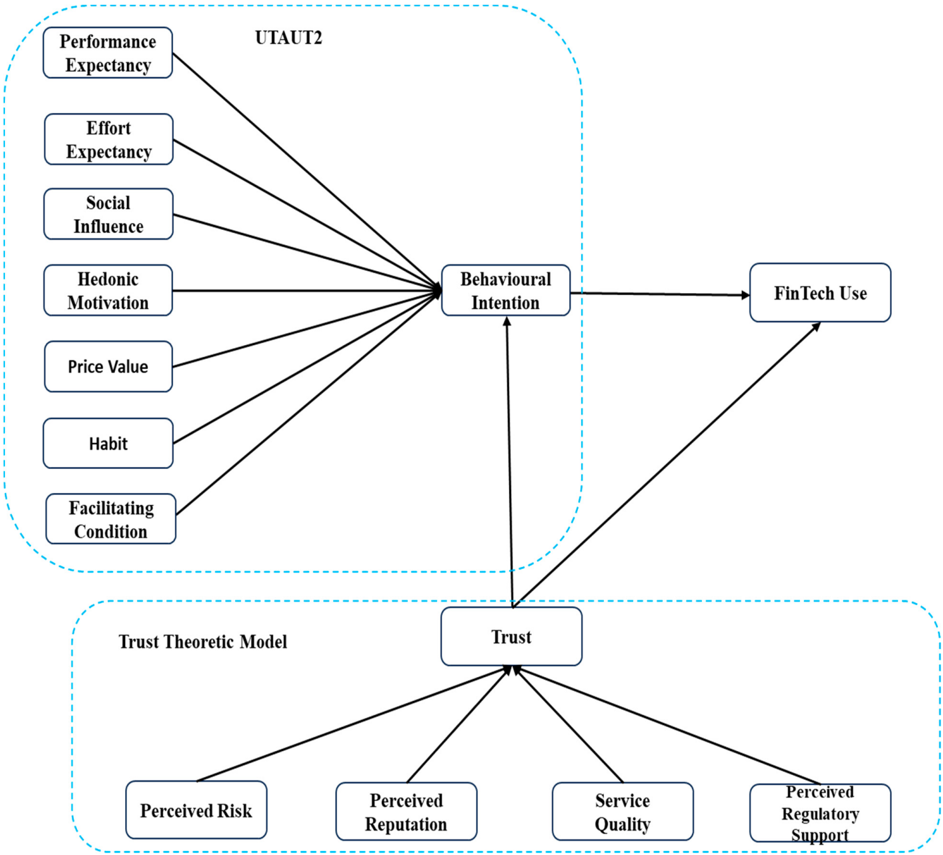
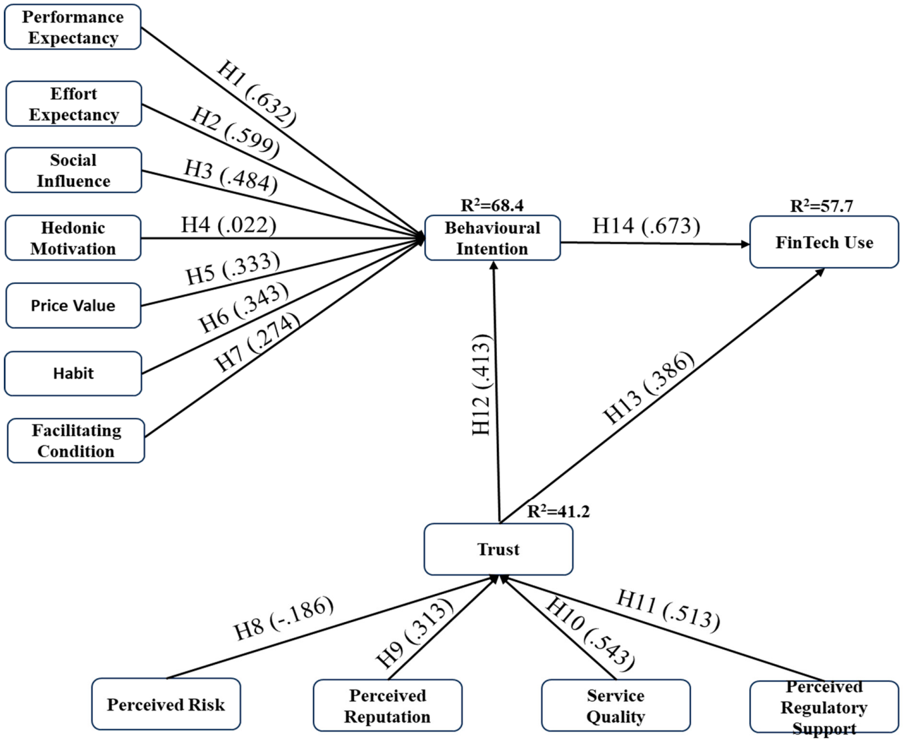
Financial technology (FinTech) is transforming the financial services industry by offering innovative, convenient solutions for businesses and individuals. This study examines the factors influencing FinTech adoption, with a special focus on trust. By integrating insights from both the unified theory of acceptance and use of technology (UTAUT2), and the trust theoretic model (TTM), this research uncovers critical determinants of FinTech adoption. Utilizing survey responses obtained from 399 participants, this research employs the partial least squares structural equation modelling method. The findings reveal that performance expectancy, effort expectancy, social influence, habit, price value, and facilitating conditions significantly influence users’ intentions to use FinTech services. In addition, the study shows that trust plays a crucial role in FinTech use, as it influences both the intentions to use and the actual use of FinTech. Surprisingly, hedonic motivation was found not to affect users’ intentions, implying that people see FinTech as a practical, rather than enjoyable, endeavor. These insights provide valuable guidance for service providers and policymakers seeking to enhance FinTech adoption and utilization while ensuring the security and trustworthiness of these digital platforms.
Overview
The claims and statistics of this paper haven’t been checked yet.
Free: it reads the open-access text and checks the first 5 claims that cite a source we can check. Create a free account to check every claim.
Integrity signals
Registry
Cites
Statistics
Figures
Verification
Claims the paper makes
The claims and statistics of this paper haven’t been checked yet.
Free: it reads the open-access text and checks the first 5 claims that cite a source we can check. Create a free account to check every claim.
Claims other papers make about this one
Each is checked against this paper’s own text: does it say what the citing paper says it does?
The source backs part of the claim, not all of it — or backs it for a different population, condition or comparison.
In the citing paper
“Studies in emerging economies indicate that perceived risk is a significant barrier, particularly in unregulated or novel markets [13,36,47].”
From Institutional Trust, Risk-Taking, and FinTech Adoption: Evidence from an Emerging Economy (2026) · cites this paper as [47]
Experimental — accuracy not yet measuredThe source backs part of the claim, not all of it — or backs it for a different population, condition or comparison.
In the citing paper
“Empirical evidence from Hungary and other European contexts suggests that trust significantly moderates the relationship between technology acceptance and actual usage behavior [24,47-49].”
From Institutional Trust, Risk-Taking, and FinTech Adoption: Evidence from an Emerging Economy (2026) · cites this paper as [47]
Experimental — accuracy not yet measuredThe cited source says what the claim attributes to it.
In the citing paper
“These services are more likely to be trusted by users who believe there is a robust regulatory framework in place because it provides them with a sense of security and confidence.”
From Institutional Trust, Risk-Taking, and FinTech Adoption: Evidence from an Emerging Economy (2026) · cites this paper as [47]
The cited source says what the claim attributes to it.
In the citing paper
“According to research by Amnas et al. [47], trust in FinTech is significantly positively impacted by perceived regulatory backing.”
From Institutional Trust, Risk-Taking, and FinTech Adoption: Evidence from an Emerging Economy (2026) · cites this paper as [47]
Self-check
Percentages, sums and reported differences re-computed from the paper’s own numbers.
The self-check needs the paper’s full text.
Citations
Cites
The theory of planned behavior
Ajzen, I. (1991) · Organizational Behavior and Human Decision Processes · doi:10.1016/0749-5978(91)90020-t · Cited by 90,587 · cited 2×
“This relationship is grounded in the theory of planned behavior (Ajzen 1991), which posits that behavioral intention strongly predicts actual behavior.”
User Acceptance of Information Technology: Toward A Unified View1
Venkatesh, V., Morris, M. G., Davis, G. B., & Davis, F. D. (2003) · MIS Quarterly · doi:10.2307/30036540 · Cited by 45,035 · cited 4×
“Behavioral intention refers to an individual’s willingness and intention to engage in a specific behavior, such as using FinTech services, while actual use reflects the tangible execution of that behavior (Bajunaied et al. 2023; Venkatesh et al. 2003, 2012).”
InfluentialWhen to Use and How to Report the Results of PLS-SEM
Hair, J. F., Risher, J. J., Sarstedt, M., & Ringle, C. M. (2019) · European Business Review · doi:10.1108/ebr-11-2018-0203 · Cited by 27,541 · cited 1×
“Generally, reliability, as evaluated through Cronbach’s alpha coefficient and composite reliability, is considered satisfactory when it exceeds the threshold of 0.70, consistent with the guidelines provided by Henseler et al. (2016).”
InfluentialVenkatesh, V., Thong, J. Y. L., & Xu, X. (2012) · MIS Quarterly · doi:10.2307/41410412 · Cited by 15,756 · cited 10×
“Due to the absence of a predefined sampling framework for FinTech users, we opted for the convenience sampling method, a practice recommended in prior studies (Alrawad et al. 2023; Bajunaied et al. 2023; Senyo and Osabutey 2020).”
InfluentialCommon Method Bias in PLS-SEM: A Full Collinearity Assessment Approach
Kock, N. (2015) · International Journal of e-Collaboration · doi:10.4018/ijec.2015100101 · Cited by 10,215 · cited 2×
“Regarding the relation between behavioral intention and actual use of FinTech services, the results reveal that behavioral intention has a significant positive effect on the actual use of FinTech services ( β = 0.673; p < 0.001), thus supporting H14.”
InfluentialTrust and TAM in Online Shopping: An Integrated Model1
Gefen, D., Karahanna, E., & Straub, D. W. (2003) · MIS Quarterly · doi:10.2307/30036519 · Cited by 8,635 · cited 7×
“Due to the absence of a predefined sampling framework for FinTech users, we opted for the convenience sampling method, a practice recommended in prior studies (Alrawad et al. 2023; Bajunaied et al. 2023; Senyo and Osabutey 2020).”
InfluentialUsing pls path modeling in new technology research: updated guidelines
Henseler, J., Hubona, G., & Ray, P. A. (2016) · Industrial Management & Data Systems · doi:10.1108/imds-09-2015-0382 · Cited by 7,173 · cited 2×
“However, the results also highlight the significant influence of trust on the behavioral intention to use FinTech services ( β = 0.413; p < 0.01) and actual use of FinTech services ( β = 0.386; p < 0.01), thereby accepting H12 and H13.”
InfluentialAlalwan, A. A., Dwivedi, Y. K., & Rana, N. P. (2017) · International Journal of Information Management · doi:10.1016/j.ijinfomgt.2017.01.002 · Cited by 1,581 · cited 2×
“Researchers and practitioners often use the UTAUT2 model to assess and predict technology adoption in various contexts, including the adoption of financial technology (FinTech) services, mobile apps, and information systems (Alalwan et al. 2017; De Blanes Sebasti á n et al. 2023; Ong et al. 2023).”
Oliveira, T., Thomas, M., Baptista, G., & Campos, F. (2016) · Computers in Human Behavior · doi:10.1016/j.chb.2016.03.030 · Cited by 1,361
An empirical examination of continuance intention of mobile payment services
Zhou, T. (2013) · Decision Support Systems · doi:10.1016/j.dss.2012.10.034 · Cited by 914 · cited 4×
“The FinTech platform responds promptly to inquiries and requests for assistance”
Influential
Cited by
Amnas, M. B., Selvam, M., & Parayitam, S. (2024) · Journal of risk and financial management · doi:10.3390/jrfm17030108 · Cited by 316
“First, the results demonstrated that trust significantly and positively influenced the use of FinTech services (Hypothesis 1), concurring with prior research (Alrawad et al. 2023; Amnas et al. 2023; Savitha et al. 2022; Wang et al. 2019; Zarifis and Cheng 2022).”
BackgroundResultSelf-citationWu, C., & Lim, G. G. (2024) · Frontiers in Public Health · doi:10.3389/fpubh.2024.1449594 · Cited by 108
“This model has significant advantages due to its effective predictive ability and high explanatory power for technology use (53).”
BackgroundResultInfluentialSharma, A., Mohan, A., Johri, A., & Asif, M. (2024) · Journal of Open Innovation Technology Market and Complexity · doi:10.1016/j.joitmc.2024.100273 · Cited by 96
Albuainain, A., & Ashby, S. (2025) · FinTech · doi:10.3390/fintech4030049 · Cited by 56
Assessing Unified Payments Interface (UPI) adoption and usage through the interplay of UTAUT factors
Kiran, K. P., & Vedala, N. S. (2025) · Humanities and Social Sciences Communications · doi:10.1057/s41599-025-05313-w · Cited by 58
“Other variables, such as Perceived trust (Amnas et al., 2023; Khan & Abideen, 2023; Manrai & Gupta, 2020; Patil et al., 2020a; Roh et al., 2022), perceived promotional bene fi ts (Kuriakose et al., 2022a), and Add-on services (Kuriakose et al., 2022a), were evaluated using fi ve items each.”
Adhikari, M., Ghimire, D. M., & Lama, A. D. (2024) · Journal of Emerging Management Studies · doi:10.3126/jems.v1i2.71512 · Cited by 51
Sustainable Investments in the Blue Economy: Leveraging Fintech and Adoption Theories
Sharma, V., Rupeika-Apoga, R., Singh, T. P., & Gupta, M. (2025) · Journal of risk and financial management · doi:10.3390/jrfm18070368 · Cited by 41
Liu, N., Deng, W., & Ayub, A. F. M. (2025) · Education and Information Technologies · doi:10.1007/s10639-025-13349-3 · Cited by 37
“…actual usage behavior across various domains, including mobile banking adoption in Iran (Shaikh & Karjaluoto, 2015), mobile shopping behavior among older adults in China (Huang, 2023), FinTech adoption (Amnas et al., 2023), and mobile learning among university students (Nikolopoulou et al., 2020).”
FinTech adoption for ESG integration through robo advisors, personalization, and perceived trust
Chen, A., Wang, S., Mehta, A. M., Asif, M., Xu, S., & Shahzad, M. F. (2025) · Scientific Reports · doi:10.1038/s41598-025-17046-6 · Cited by 51
“Additionally, perceived trust is a vital factor in the adoption of FinTech solutions; it influences users’ willingness to engage with digital platforms, particularly when it comes to managing personal financial data and investments 22 .”
Al-Sharafi, M. A., Ibrahim, M., Alzaeemi, S. A., Albashrawi, M. A., Chae, I., & Dwivedi, Y. K. (2025) · Information Discovery and Delivery · doi:10.1108/idd-04-2025-0098 · Cited by 42
Sharkasi, N., & Agag, G. (2024) · Journal of Marketing Analytics · doi:10.1057/s41270-024-00341-y · Cited by 33
Khaddam, A. A., & Alhanatleh, H. (2024) · Innovative Marketing · doi:10.21511/im.20(4).2024.19 · Cited by 28
Factors leading to the adoption of blockchain technology in financial reporting
Saheb, S. S., Chinnapareddy, V. K. R., Devalla, D., Charugulla, S., Chakka, N. B., & Sekhar, K. R. (2025) · Frontiers in Blockchain · doi:10.3389/fbloc.2025.1491609 · Cited by 29
FinTech adoption: driving financial inclusion at the bottom of pyramid
Goswami, S., Chouhan, V., & Saraswat, P. (2025) · Future Business Journal · doi:10.1186/s43093-025-00570-2 · Cited by 26
Alhanatleh, H., Khaddam, A. A., & Alzghoul, A. (2024) · Banks and Bank Systems · doi:10.21511/bbs.19(4).2024.16 · Cited by 24
“…that employing a trust theoretic platform provides a considerable effect on consumers’ trust of metaverse mobile banking services based on two worthy keys: features of mobile banking services provider and features of mobile banking technology environment (Amnas et al., 2023; Chandra et al., 2010).”
Cardoso, A., Pereira, M. S., da Silva, A., de Souza, A. N., Oliveira, I., & Figueiredo, J. (2024) · Sustainability · doi:10.3390/su16219604 · Cited by 29
“Additionally, trust, financial literacy, and security concerns have been found to significantly impact adoption [56,57].”
Tech titans: Generation Z’s role in the FinTech evolution
Vinkóczi, T., Idziak, E., Tamás, B., & Kurucz, A. (2024) · Journal of Infrastructure Policy and Development · doi:10.24294/jipd.v8i10.8201 · Cited by 18
Chang, R., Zadeh, A. V., Hanifah, H. M., Nikbin, D., & Ramayah, T. (2025) · Energy Strategy Reviews · doi:10.1016/j.esr.2025.101934 · Cited by 16
Financing sustainable farming: The role of trust in the adoption of fintech by farmers
Köster, M., Hurst, W., & Krampe, C. (2025) · Technological forecasting & social change · doi:10.1016/j.techfore.2025.124302 · Cited by 16
“Amnas et al. (2023) demonstrated that individuals who trust that the FinTech company securely stores their data and acts in the best interest of their customers have a high intention to use the tool.”
Abbas, N. N., & Khan, H. G. M. (2024) · Pakistan Journal of Humanities and Social Sciences · doi:10.52131/pjhss.2024.v12i4.2577 · Cited by 21
Intention to Use Cryptocurrencies for Business Transactions: The Case of North Carolina
Ullah, S. (2025) · Journal of risk and financial management · doi:10.3390/jrfm18020058 · Cited by 15
Gaur, D., Gupta, K., Tiwari, C. K., & Pal, A. (2025) · International Journal of Human-Computer Interaction · doi:10.1080/10447318.2025.2483862 · Cited by 14
“Integration of technology in the financial services industry has been studied by Amnas et al. (2023).”
Fintech adoption in emerging economies: exploring demographic patterns and preferences
Singla, M., Jain, N., & Rani, P. (2025) · Journal of economic and administrative sciences. · doi:10.1108/jeas-10-2024-0402 · Cited by 14
Papanikolaou, N., Boufounou, P. V., & Eriotis, N. (2025) · IntechOpen eBooks · doi:10.5772/intechopen.1011799 · Cited by 13
Universitas Widyatama, I., Yanida, P., Padmanegara, O. H., Universitas Widyatama, I., Muklis, T. I., & Universitas Widyatama, I. (2025) · Journal of Economics Finance and Management Studies · doi:10.47191/jefms/v8-i1-02 · Cited by 9
Amnas, M. B., Selvam, M., & Parayitam, S. (2025) · South Asian Journal of Marketing · doi:10.1108/sajm-01-2024-0007 · Cited by 8
Self-citationVardari, L., & Hameli, K. (2025) · Global Knowledge, Memory and Communication · doi:10.1108/gkmc-02-2025-0137 · Cited by 7
Adoption of Central Bank Digital Currency in India: A Structural Model Using ISM
Dixit, V., Shailesh, A., Mishra, S., & Verma, R. (2025) · NMIMS Management Review · doi:10.1177/09711023251370836 · Cited by 7
“CBDCs provide the benefits of programmable, digital financial infrastructure while preserving monetary sovereignty, in contrast to decentralized cryptocurrencies (Surgentova, 2023).”
InfluentialBouteraa, M., Chekima, B., Al-Daihani, M., Benlahcene, A., Baddou, A., & Elhachemi, T. (2026) · Journal of Islamic marketing · doi:10.1108/jima-05-2025-0327 · Cited by 9
Cahyasari, D., Hamidah, H., & Widyastuti, U. (2025) · ABAC Journal · doi:10.59865/abacj.2025.18 · Cited by 7
Islamic Social FinTech in Europe: Behavioral Intention to Adopt Blockchain-Based Zakat Platforms
Selimović-Fijuljanin, A., Mešković, A., & Aydın, Š. (2026) · Religions · doi:10.3390/rel17010078 · Cited by 8
Köse, N., & Kudratovna, K. M. (2026) · Discover Education · doi:10.1007/s44217-026-01169-7 · Cited by 8
Meiranto, W., Abbad, T. A. S., Ramadhan, A. F., & Marsono, M. (2026) · Journal of risk and financial management · doi:10.3390/jrfm19060421 · Cited by 7
The Role of Digital Payment Systems in Advancing Financial Inclusion in India
Chandel, S., & Chandel, S. (2025) · Cureus Journal of Business and Economics. · doi:10.7759/s44404-025-03950-7 · Cited by 13
“We used the convenience sampling approach, which had been recommended in previous studies (Alrawad et al., 2023), (Amnas et al., 2023), (Bajunaied et al., 2023), and (Senyo and Osabutey, 2020).”
Why do people use P2P lending services? The role of AI literacy and green self identity
Setiawan, B., Utami, D., Arifin, F., Igamo, A. M., Permana, K. W. A., Nathan, R. J., & Fekete‐Farkas, M. (2026) · Journal of Financial Services Marketing · doi:10.1057/s41264-026-00357-8 · Cited by 5
“This suggests that perceived phases of technology adoption, where digital familiarity cannot be assumed (Hassan et al. 2022 ; Amnas et al. 2023).”
InfluentialAI in Wealth Management and WealthTech
Tomic, I., Jokanović, B., & Ivković, S. (2024) · Social informatics journal · doi:10.58898/sij.v3i2.30-36 · Cited by 5
Small-scale merchants’ acceptance of UPI payment apps: evidence from India
Rao, K. V. K., & Upadhyaya, P. (2026) · Humanities and Social Sciences Communications · doi:10.1057/s41599-026-08005-1 · Cited by 7
“To strengthen the model ’ s explanatory capacity, several studies have extended UTAUT2 with perceived security, trust, and perceived risk (Nandru et al., 2023; Amnas et al., 2023; Apau et al., 2025).”
Ben‐Othman, J. (2025) · Journal of Digital Market and Digital Currency. · doi:10.47738/jdmdc.v2i4.47 · Cited by 4
Geidam, M. M., Yahaya, H. D., Bizi, M. K., & Ahmadu, S. (2025) · Fintech and Digital Accounting Review · doi:10.1108/fdar-06-2025-0005 · Cited by 6
Kashyap, A. K., Priyanka, & Gupta, P. (2026) · Journal of Financial Crime · doi:10.1108/jfc-09-2025-0300 · Cited by 7
Role of Digital Technologies in Enhancing Financial Inclusion of Farmers in Guntur, Andhra Pradesh
Devi, J. A., Devi, K. U., Vani, C. S., & Umar, S. N. (2026) · Millennial Asia · doi:10.1177/09763996261416091 · Cited by 4
Preschool Teachers’ Intentions to Use GenAI: Extending UTAUT
Hao, C., Wang, Z., & Wang, P. (2026) · Behavioral Sciences · doi:10.3390/bs16060840 · Cited by 5
“Perceived risk suggests a significant negative association with preschool teachers’ behavioral intentions toward using GenAI ( β = − 0.118, p = 0.02), a finding consistent with technology adoption patterns in fields such as eHealthcare and FinTech (Arfi et al., 2021; Amnas et al., 2023).”
InfluentialExploring FinTech adoption: A systematic literature review on user acceptance
Bhowal, P., & Shil, P. (2026) · Telematics and Informatics Reports · doi:10.1016/j.teler.2026.100343 · Cited by 4
Large Language Model Adoption: Systematic Review, Theoretical Frameworks, and Meta-Analytic Evidence
Achuthan, K., Kolil, V. K., Tang, K., & Raman, R. (2026) · Information · doi:10.3390/info17060615 · Cited by 4
Dahiya, P., Gupta, A., Khandelwal, M. K., Saxena, M., & Sabharwal, S. (2026) · Future Business Journal · doi:10.1186/s43093-026-00928-0 · Cited by 5
Territorial characteristics and the emergence of mutual credit systems: a study of Sardex
Lafuente-Sampietro, O., & Reyns, A. (2025) · Finance and Space · doi:10.1080/2833115x.2025.2539717 · Cited by 4
Institutional Trust, Risk-Taking, and FinTech Adoption: Evidence from an Emerging Economy
Deák, Z., & Horváth, Á. B. (2026) · FinTech · doi:10.3390/fintech5020027 · Cited by 3
“Studies in emerging economies indicate that perceived risk is a significant barrier, particularly in unregulated or novel markets [13,36,47].”
Factors Influencing User Retention and User Experience in Malaysian Fintech
Adnan, M. F., Efendi, E. N., Zamri, M. W. A., Ridwan, N., & Yusoff, Y. (2025) · International Journal of Research and Innovation in Social Science · doi:10.47772/ijriss.2025.90300255 · Cited by 5
Singh, V. K., Shaikh, Z. H., Sinha, K., Panigrahi, R. R., Mukherjee, S., & Chowdury, V. G. (2025) · Journal of Open Innovation Technology Market and Complexity · doi:10.1016/j.joitmc.2025.100712 · Cited by 3
A mixed methods analysis of palm payment adoption based on UTAUT2 and perceived trust
Dang, T.-Q., Mai, V. T. L., Đức, Đ. T. V., Huynh, T. B., & Nguyen, N. T. T. (2026) · Discover Psychology · doi:10.1007/s44202-025-00548-9 · Cited by 5
Marjohan, M., Satria, R., Sunanto, S., & Ishwara, P. I. (2026) · Economics · doi:10.2478/eoik-2026-0042 · Cited by 3
“Therefore, this study extends previous research by integrating trust and perceived risk into the Unified Theory of Acceptance and Use of Technology (UTAUT) frame - work, reflecting current dynamics in fintech investment adoption (Amnas et al., 2023).”
User trust and continued engagement in digital lending platforms: evidence from app review analytics
Helal, M. Y. I., Alzaeemi, S. A., Al-Sharafi, M. A., Ukil, M. I., Basri, E., & Dwivedi, Y. K. (2026) · Journal of Marketing Analytics · doi:10.1057/s41270-026-00520-z · Cited by 3
Loe, D. B., Ratnawati, T., & Pristiana, U. (2024) · Edelweiss Applied Science and Technology · doi:10.55214/25768484.v8i6.2280 · Cited by 3
“Several objectives may impact the effectiveness of the financial planning for instance convenience and their openness brought by FinTech (Amnas et al., 2023) .”
BackgroundInfluentialExploring Key Drivers of Insurtech Adoption: Insights from India’s Digital Insurance Revolution
Amnas, M. B., Raja, M., & Velmurugan, J. M. (2025) · SMART Journal of Business Management Studies · doi:10.34293/2321-2012.2025.0001.10 · Cited by 6
Self-citationAhmeti, F. (2025) · SSRN Electronic Journal · doi:10.2139/ssrn.5268248 · Cited by 4
WEALTHTECH: FUTURE TRENDS AND APPROACHES IN GLOBAL WEALTH MANAGEMENT
Jokanović, B., Okanović, A., Brkanlić, S., Ivković, S., & Tomic, I. (2025) · International Conference on Business, Management and Economics Engineering (Future-BME) · doi:10.24867/future-bme-2024-060 · Cited by 2
The Role of Perceived Usability, Social Media and Data Security in the Adoption of Fintech Services
Fernando, C. N., Maranata, S., & Syahchari, D. H. (2024) · IEEE International Conference on Computing, Engineering and Design (ICCED) · doi:10.1109/icced64257.2024.10983807 · Cited by 2
“Factors such as encryption protocols, authentication, and regulations significantly shape public perception regarding security when using fintech [27].”
InfluentialNovianti, N., Puttri, D., Azliyanti, E., Zaitul, Z., & Ilona, D. (2025) · TEM Journal · doi:10.18421/tem144-42 · Cited by 4
Shriya, K., & Velmurugan, T. (2025) · International Journal of Accounting and Economics Studies · doi:10.14419/05tcqc37 · Cited by 2
Keshavammaiah, P. H., Kannan, B., Parayitam, S., & Papenhausen, C. (2026) · Journal of risk and financial management · doi:10.3390/jrfm19020095 · Cited by 4
Self-citationDriving event tech adoption: extending UTAUT with perceived investment value
Çavuşoğlu, M., Doğan, S., & Çobanoğlu, C. (2026) · Journal of Hospitality and Tourism Insights · doi:10.1108/jhti-06-2025-0736 · Cited by 2
Bhojak, N. P., Momin, M. K., JOSHI, D. B. H., Kumar, S. D., & Acharya, U. (2026) · South Asian Journal of Business Studies · doi:10.1108/sajbs-02-2025-0072 · Cited by 3
FinTech Education With Artificial Intelligence
Ahsan, A., Yusuf, D. H. M., & Abidin, J. Z. (2026) · Advances in computational intelligence and robotics book series · doi:10.4018/979-8-3693-6346-1.ch009 · Cited by 2
Fachrurrozie, F. (2026) · Journal of Applied Data Sciences · doi:10.47738/jads.v7i2.1138 · Cited by 2
Fatima, E., Khan, A. A., Watto, W. A., & Aftab, J. (2026) · Journal of Science and Technology Policy Management · doi:10.1108/jstpm-11-2025-0518 · Cited by 2
Raza, H., & Ali, N. (2024) · Contemporary Issues in Social Sciences and Management Practices · doi:10.61503/cissmp.v3i3.225 · Cited by 2
FAKTOR-FAKTOR YANG MEMENGARUHI INTENSI PENGGUNAAN MOBILE BANKING
Vianto, J., & Arifin, A. Z. (2024) · Jurnal Muara Ilmu Ekonomi dan Bisnis · doi:10.24912/jmieb.v8i2.30014 · Cited by 2
“Service credibility merujuk pada sejauh mana seorang pelanggan percaya bahwa penyedia layanan tersebut dapat diandalkan, dipercaya, dan kompeten (Amnas et al., 2023; Gupta et al., 2023).”
Tmava, Q., & Ahmeti, F. (2025) · Multidisciplinary Science Journal · doi:10.31893/multiscience.2025518 · Cited by 1
Mobile FinTech Adoption for Remittance Among Women Migrants of India: A UTAUT 2 Model Perspective
Nisha, S., & Jayaraman, R. (2025) · Lecture notes in networks and systems · doi:10.1007/978-3-032-00444-4_45 · Cited by 1
Babu, L., & Kumar, G. S. G. (2025) · The Review of Finance and Banking · doi:10.24818/rfb.25.17.01.05 · Cited by 3
Fintech Adoption and Credit Access of Micro, Small, Medium Enterprises in Nairobi City County, Kenya
Terry, F. O. I., Kithandi, C. K., & Onchomba, M. S. (2025) · East African Finance Journal · doi:10.59413/eafj/v4.i4.5 · Cited by 1
Rajagukguk, S. A. (2025) · International Conference on Information Technology and Computing (ICITCOM) · doi:10.1109/icitcom66635.2025.11265047 · Cited by 1
“Behavioral intention theory provides a robust framework for understanding cognitive processes preceding customer behaviors [21], [22].”
Mai, K. L., Thi, N. Q. N., & Cao, T. H. (2025) · British Journal of Business Sciences · doi:10.65687/bjbs.v1i1.2 · Cited by 1
Shriya, K., & Velmurugan, T. (2025) · Asian Journal of Interdisciplinary Research · doi:10.54392/ajir25416 · Cited by 1
“Through mobile applications, online platforms and digital wallets, users are now able to access a wide range of financial services with much greater ease (Amnas et al., 2023).”
Assessing the impact of FinTech on bank efficiency: insights from the MENA region
Ridene, S., Jedidi, L., & Ayed, W. B. (2026) · Fintech and Digital Accounting Review · doi:10.1108/fdar-08-2025-0023 · Cited by 1
Risk perception and trust mechanisms in AIGC technologies: evidence from a Bayesian SEM analysis
Wei, M., Song, Z., Liu, J., & Liu, P. (2026) · The Electronic Library · doi:10.1108/el-05-2025-0181 · Cited by 1
Maharani, S., & Maharani, A. Y. (2026) · Environmental, Social, Governance, and Sustainable Business · doi:10.61511/esgsb.v3i1.2026.3429 · Cited by 1
“The synthesis reveals that consumer trust is significantly and positively influenced by the perception of a strong, supportive, and stable regulatory environment (Amnas et al., 2023).”
Offiong, U. P., Szopik‐Depczyńska, K., & Cheba, K. (2026) · European Journal of Innovation Management · doi:10.1108/ejim-12-2025-1783 · Cited by 1
Shetu, S. H., Akter, F., Shuvo, M. A. H., & Akter, S. (2026) · Business Perspective Review · doi:10.38157/bpr.v8i1.752 · Cited by 1
“In doing so, it aligns with the expanding body of literature suggesting that UTAUT2's explanatory power can be improved by incorporating contextual variables, such as trust and perceived risk, particularly in consumer environments (Amnas et al., 2023).”
de Barros, S. D. J. M., Lopes, R. D. O. A., & Dias, M. D. O. (2026) · Aposta · doi:10.23900/ra.v24i110.715 · Cited by 1
“It can be used to explain consumers’ behavior in adopting consumer technologies such as digital platforms and FinTech (Amnas et al., 2023; Firmansyah et al., 2023; Venkatesh et al., 2012).”
Nyagadza, B., Mazuruse, G., Makoni, T., Chuchu, T., Maziriri, E. T., & Bashar, A. (2026) · Strategic Business Research · doi:10.1016/j.sbr.2026.100191 · Cited by 1
Supriono, I. A. (2026) · EDUKASIA Jurnal Pendidikan dan Pembelajaran · doi:10.62775/edukasia.v7i1.2119 · Cited by 1
“TAM explains that an individual's acceptance of technology is primarily influenced by two key factors: perceived usefulness and perceived ease of use (Amnas, et.al, 2023).”
Santosa, K. N., Nadlifatin, R., & Subriadi, A. P. (2026) · Journal of Information Systems Engineering and Business Intelligence · doi:10.20473/jisebi.12.2.236-252 · Cited by 1
“The theories that discuss technology adoption have been discussed extensively in previous literature, such as the Technology Acceptance Model (TAM) [13] and the Unified Theory of Acceptance and Use of Technology (UTAUT) [14].”
Role of Fintech Adoption In User Quality of Life: A UTAUT-Based Study In Surabaya, Indonesia
Yusup, A. K., & Chang, D. R. (2026) · BIMA Journal (Business Management & Accounting Journal) · doi:10.37638/bima.7.1.257-272 · Cited by 1
“Recent studies support this link, confirming that EE has a significant influence on adoption behavior (Amnas et al., 2023; Bajunaied et al., 2023; Namahoot & Jantasri, 2022).”
Rayhan, M. G. S., Karuppiah, K., & Sankaranarayanan, B. (2026) · Process Integration and Optimization for Sustainability · doi:10.1007/s41660-026-00827-5 · Cited by 1
Fintech Innovation, Adoption, And Financial Decision-Making: A Study of Swedish Consumers
Lundqvist, E. (2025) · iRASD Journal of Finance · doi:10.52131/jof.2025.0401.0019 · Cited by 1
“(Amnas et al., 2023).”
Kartika, W., & Leon, F. M. (2026) · Journal of Management Small and Medium Enterprises (SMEs) · doi:10.35508/jom.v19i2.29173 · Cited by 1
AI Decision Support System Adoption in Dental Education: An Empirical PLS-SEM Study
Son, L. N. (2026) · Annals of dental specialty · doi:10.51847/saegs2axxf · Cited by 1
What Drives Consumers to Use InsurTech Apps? The Role of Insurance Literacy
Lee, H. S., Chia, J. C., & Kai, S. B. (2026) · International Journal of Management Finance and Accounting · doi:10.33093/ijomfa.2026.7.2.3 · Cited by 1
A hybrid SEM–ANN approach to fintech lending adoption: Insights from Generation Z
Ramayanti, R., Rachmawati, N. A., Setyawati, A., Azhar, Z., & Azman, N. H. N. (2026) · Social Sciences & Humanities Open · doi:10.1016/j.ssaho.2026.103591 · Cited by 1
Dixit, V., & Shailesh, A. (2026) · Rajagiri Management Journal · doi:10.1108/ramj-01-2026-0018 · Cited by 1
Trust as the Key to Social Media Success in K-Pop Fandoms
Roslan, M. A. A., Murad, M. A. A., & Nasharuddin, N. A. (2024) · Journal of Communication in Scientific Inquiry (JCSI) · doi:10.58915/jcsi.v6i2.1563 · Cited by 1
Exploring the Adoption of Fintech P2P Financing Among MSMEs: MGA and IPMA Approaches
Setiawan, B., Utami, D., Arifin, F., & Ahmed, A. M. (2025) · SRIWIJAYA INTERNATIONAL JOURNAL OF DYNAMIC ECONOMICS AND BUSINESS · doi:10.29259/sijdeb.v9i2.105-136 · Cited by 1
Behavioral Analysis of MSME Owners in Subang Regency to Adopt Islamic P2P Lending Platform
Hapsari, R. E., & Rahadian, D. (2025) · Enrichment Journal of Multidisciplinary Research and Development · doi:10.55324/enrichment.v3i6.444 · Cited by 1
Yadav, M., & Keshari, A. (2026) · Journal of Financial Services Marketing · doi:10.1057/s41264-026-00378-3 · Cited by 1
“(Amnas et al., 2023) Similarly, meta-analytic research by Albuainain and Ashby (2025) shows that high prices and transaction fees limit the adoption of FinTech by increasing the perceived risk, but not by being a separate psychosocial element in technology-acceptance models.”
Alhanatleh, H., Khaddam, A. A., & Alzghoul, A. (2024) · SSRN Electronic Journal · doi:10.2139/ssrn.4875971
Albuainain, A., & Ashby, S. (2024) · SSRN Electronic Journal · doi:10.2139/ssrn.4886846
"The Role of Data Security and Trust in Banks Clients' Attitude for Adopting Fintech Applications"
EL-Hendawy, A. M. A., & Metawea, S. A. (2025) · Al-Maǧallaẗ Al-Miṣriyyaẗ Lil Dirāsāt Al-Tiǧāriyyaẗ /Al-Maǧallaẗ Al-Miṣriyyaẗ Lil Dirāsāt Al-Tiǧāriyyaẗ · doi:10.21608/alat.2025.443321
FINTECH ADOPTION: THE ROLE OF FINANCIAL LITERACY, TRUST AND USER INNOVATIVENESS IN MSMES IN SAMPANG
Amaniyah, E., & Aguilika, D. (2025) · The International Conference on Sustainable Economics Management and Accounting Proceeding · doi:10.32424/icsema.1.1.116 · Cited by 1
“Trust plays an important role in FinTech usage, as it influences the intention to use and the actual use of fintech (Amnas et al., 2023).”
Transitioning to Cashless Society: Challenges and Opportunities for Small Business
Askarzai, W., & Unhelkar, B. (2025) · Open Journal of Business and Management · doi:10.4236/ojbm.2025.136232
Metadata
- Authors
- Amnas, M. B., Selvam, M., Raja, M., Santhoshkumar, S., & Parayitam, S.
- Affiliations
- Bharathidasan University (IN)
- Department of Commerce and Financial Studies, Bharathidasan University, Tiruchirappalli 620024, India
- University of Massachusetts Dartmouth (US)
- Corresponding author
- Parayitam, Satyanarayana
- ORCID
- Venue
- Journal of Risk and Financial Management
- Publisher
- MDPI AG
- Published
- 2023-12-06
- Volume
- 16
- Issue
- 12
- Pages
- 505
- ISSN
- 1911-8066 (ISSN-L)
- 1911-8074
- OpenAlex
- W4389379484
- Semantic Scholar
- 074b3905cd0cb2a46addfda1d027a1a19133da8f
- Cited by
- 110
- References
- 63
- Citations by year
- 2026: 63 · 2025: 35 · 2024: 12
- FWCI
- 28.12
- Type
- journal article
- Language
- en
- Open access
- hybrid
- doi.org
- Licence
- Locations
- Journal of risk and financial management (publishedVersion, cc-by)
- RePEc: Research Papers in Economics (submittedVersion)
- Topics
- Social Sciences › Decision Sciences › Information Systems and Management › Technology Adoption and User Behaviour
- Social Sciences › Business, Management and Accounting › Management Information Systems › FinTech, Crowdfunding, Digital Finance
- Health Sciences › Health Professions › Health Information Management › Health, Technology, Consumer Behavior
- Keywords
- fintech adoption, UTAUT2, trust in technology, performance expectancy, effort expectancy, social influence, habit, price value, facilitating conditions, hedonic motivation, intention to use, digital financial services
About these checks
Registry, retraction, Cites and statistics results are computed, not judged, with one exception: a printed reference that no index lists is read once by a model before it counts as a citation error. Claims are extracted by a model and kept only when their quote appears verbatim in the text; each cited source is then checked, with a model’s help, for whether it says what the claim relies on. Those verdicts can be wrong — read the claim’s quote and the cited source before relying on one.
Statistics and arithmetic are recomputed, not judged.
Confidence bands are shown only for fields calibrated on our annotated test set. None is calibrated yet, so no band is shown.
What counts as a claim ›How we measure confidence ›How we check this ›
Are you an author, or do you see a problem with this page? Request a review
Data sources
Bibliographic data: Semantic Scholar, OpenAlex, Crossref.
Contains information from the Semantic Scholar Academic Graph Datasets, made available under the ODC Attribution License (ODC-BY 1.0).
Semantic Scholar’s data is described in: Kinney, R., et al. (2023). The Semantic Scholar Open Data Platform. arXiv:2301.10140.
