

Function and Benefits of Natural Competence in Cyanobacteria: From Ecology to Targeted Manipulation
Open accessThe DOI matches its Crossref record; 118 of the 120 references it cites were found in a registry or an index.
Abstract
Natural competence is the ability of a cell to actively take up and incorporate foreign DNA in its own genome. This trait is widespread and ecologically significant within the prokaryotic kingdom. Here we look at natural competence in cyanobacteria, a group of globally distributed oxygenic photosynthetic bacteria. Many cyanobacterial species appear to have the genetic potential to be naturally competent, however, this ability has only been demonstrated in a few species. Reasons for this might be due to a high variety of largely uncharacterised competence inducers and a lack of understanding the ecological context of natural competence in cyanobacteria. To shed light on these questions, we describe what is known about the molecular mechanisms of natural competence in cyanobacteria and analyse how widespread this trait might be based on available genomic datasets. Potential regulators of natural competence and what benefits or drawbacks may derive from taking up foreign DNA are discussed. Overall, many unknowns about natural competence in cyanobacteria remain to be unravelled. A better understanding of underlying mechanisms and how to manipulate these, can aid the implementation of cyanobacteria as sustainable production chassis.
Overview
The claims and statistics of this paper haven’t been checked yet.
Free: it reads the open-access text and checks the first 5 claims that cite a source we can check. Create a free account to check every claim.
Integrity signals
Registry
Cites
Statistics
Figures
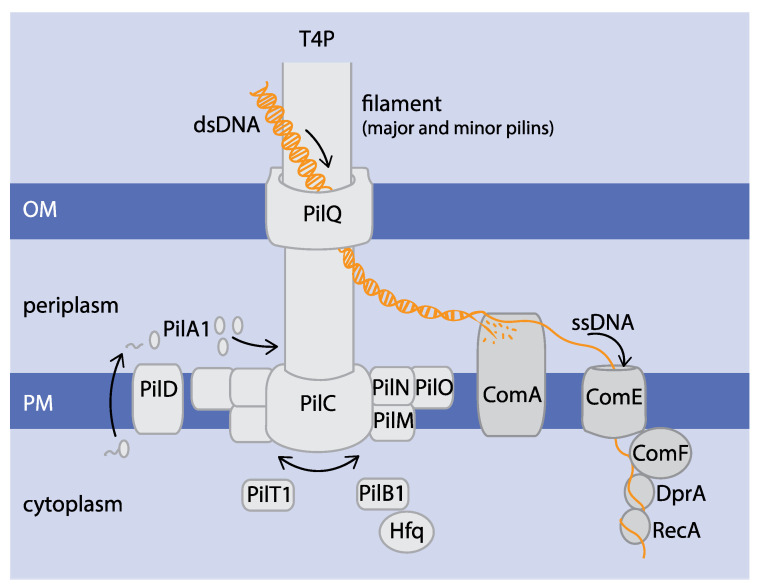
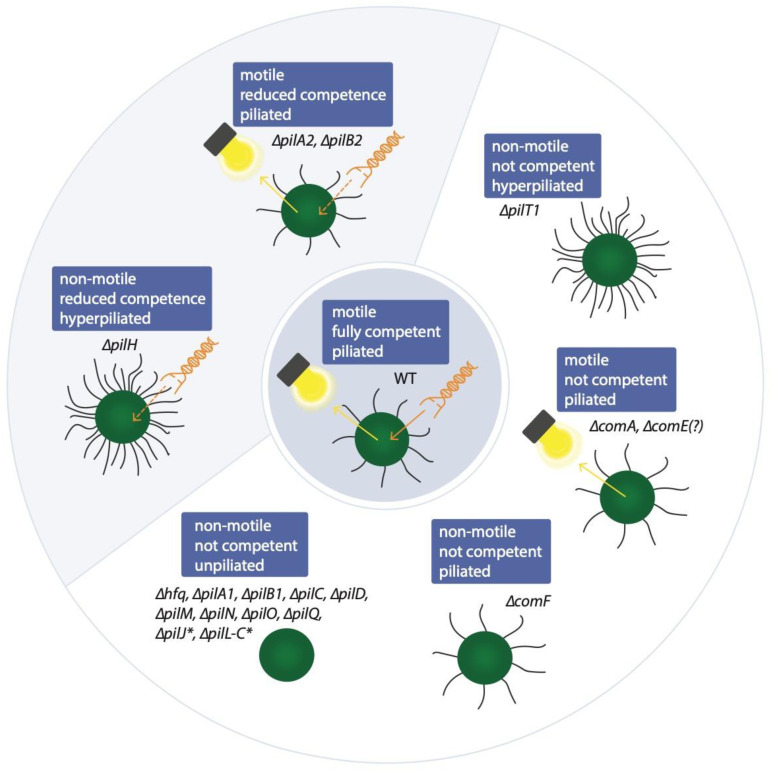
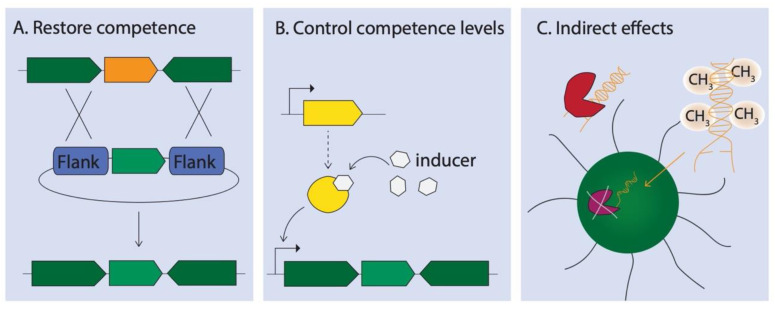
Verification
Claims the paper makes
The claims and statistics of this paper haven’t been checked yet.
Free: it reads the open-access text and checks the first 5 claims that cite a source we can check. Create a free account to check every claim.
Claims other papers make about this one
Each is checked against this paper’s own text: does it say what the citing paper says it does?
In the citing paper
“The highest induction was observed for the gene coding for PilQ (41.61-fold), a monomer that in combination with PilC, PilM, PilN, and PilO conforms the DNA uptake and processing machinery (Schirmacher et al., 2020).”
From Characterization of Limnospira platensis PCC 9108 R-M and CRISPR-Cas systems (2024) · cites this paper as Schirmacher et al., 2020
Self-check
Percentages, sums and reported differences re-computed from the paper’s own numbers.
The self-check needs the paper’s full text.
Citations
Cites
Flagellar and twitching motility are necessary for Pseudomonas aeruginosa biofilm development
O'Toole, G. A., & Kolter, R. (1998) · Molecular Microbiology · doi:10.1046/j.1365-2958.1998.01062.x · Cited by 2,697
Biofilm formation by Pseudomonas aeruginosa wild type, flagella and type IV pili mutants
Klausen, M., Heydorn, A., Ragas, P., Lambertsen, L., Aaes‐Jørgensen, A., Molin, S., & Tolker‐Nielsen, T. (2003) · Molecular Microbiology · doi:10.1046/j.1365-2958.2003.03525.x · Cited by 1,020
Bacterial transformation: distribution, shared mechanisms and divergent control
Johnston, C., Martin, B., Fichant, G., Polard, P., & Claverys, J.-P. (2014) · Nature Reviews Microbiology · doi:10.1038/nrmicro3199 · Cited by 731 · cited 5×
“For example, induction of competence can depend on growth phase [1,3,47,48], quorum sensing [47,49–51], biofilm formation [50,52,53], nutrient limitation [54], DNA damage [55,56], presence of antibiotics [56,57] or certain substrates [47,58–60].”
BackgroundInfluentialHåvarstein, L. S., Coomaraswamy, G., & Morrison, D. A. (1995) · Proceedings of the National Academy of Sciences · doi:10.1073/pnas.92.24.11140 · Cited by 730
Chitin Induces Natural Competence in Vibrio cholerae
Meibom, K. L., Blokesch, M., Dolganov, N. A., Wu, C.-Y., & Schoolnik, G. K. (2005) · Science · doi:10.1126/science.1120096 · Cited by 622 · cited 1×
“For example, induction of competence can depend on growth phase [1,3,47,48], quorum sensing [47,49–51], biofilm formation [50,52,53], nutrient limitation [54], DNA damage [55,56], presence of antibiotics [56,57] or certain substrates [47,58–60].”
BackgroundKlausen, M., Aaes‐Jørgensen, A., Molin, S., & Tolker‐Nielsen, T. (2003) · Molecular Microbiology · doi:10.1046/j.1365-2958.2003.03677.x · Cited by 556
Natural Genetic Transformation of Streptococcus mutans Growing in Biofilms
Li, Y.-H., Lau, P. C. Y., Lee, J. H., Ellen, R. P., & Cvitkovitch, D. G. (2001) · Journal of Bacteriology · doi:10.1128/jb.183.3.897-908.2001 · Cited by 532 · cited 1×
“For example, induction of competence can depend on growth phase [1,3,47,48], quorum sensing [47,49–51], biofilm formation [50,52,53], nutrient limitation [54], DNA damage [55,56], presence of antibiotics [56,57] or certain substrates [47,58–60].”
BackgroundType IV Pili, Transient Bacterial Aggregates, and Virulence of Enteropathogenic Escherichia coli
Bieber, D., Ramer, S. W., Wu, C.-Y., Murray, W. J., Tobe, T., Fernandez, R., & Schoolnik, G. K. (1998) · Science · doi:10.1126/science.280.5372.2114 · Cited by 465 · cited 1×
“T4P are multifunctional cellular appendages known to be involved in natural competence, twitching motility [6], predation [7], cell adhesion [8], biofilm formation [9–11], virulence [12] and secretion [13].”
BackgroundBiochemical and genetic characterization of a competence pheromone from B. subtilis
Magnuson, R., Solomon, J., & Grossman, A. D. (1994) · Cell · doi:10.1016/0092-8674(94)90313-1 · Cited by 464
Antibiotic Stress Induces Genetic Transformability in the Human Pathogen Streptococcus pneumoniae
Prudhomme, M., Attaiech, L., Sanchez, G., Martin, B., & Claverys, J.-P. (2006) · Science · doi:10.1126/science.1127912 · Cited by 451 · cited 1×
“For example, induction of competence can depend on growth phase [1,3,47,48], quorum sensing [47,49–51], biofilm formation [50,52,53], nutrient limitation [54], DNA damage [55,56], presence of antibiotics [56,57] or certain substrates [47,58–60].”
Background
Cited by
Barone, G. D., Cernava, T., Ullmann, J., Liu, J., Lio, E., Germann, A. T., Nakielski, A., Russo, D. A., Chavkin, T., Knufmann, K., et al. (2023) · Heliyon · doi:10.1016/j.heliyon.2023.e14708 · Cited by 60
“Despite the presence of the genes required for natural competence [182], progress towards a fully transformable Spirulina has been slow [183,184].”
BackgroundCurrent Metabolic Engineering Strategies for Photosynthetic Bioproduction in Cyanobacteria
Satta, A., Esquirol, L., & Ebert, B. E. (2023) · Microorganisms · doi:10.3390/microorganisms11020455 · Cited by 51
Genetic, Genomics, and Responses to Stresses in Cyanobacteria: Biotechnological Implications
Cassier-Chauvat, C., Blanc-Garin, V., & Chauvat, F. (2021) · Genes · doi:10.3390/genes12040500 · Cited by 50
Incorporation, fate, and turnover of free fatty acids in cyanobacteria
Kahn, A., Oliveira, P., Cuau, M., & Leão, P. N. (2023) · FEMS Microbiology Reviews · doi:10.1093/femsre/fuad015 · Cited by 38
“…and only fully developed in a few model strains, cyanobacteria can be genetically engineered (Heidorn et al. 2011, Cassier-Chauvat et al. 2016, Schirmacher et al. 2020) making them suitable hosts to increase biofuel precursors biosynthesis and secretion, en route to generate fourth generation…”
BackgroundGeneration of Synthetic Shuttle Vectors Enabling Modular Genetic Engineering of Cyanobacteria
Opel, F., Siebert, N. A., Klatt, S., Tüllinghoff, A., Hantke, J. G., Toepel, J., Bühler, B., Nürnberg, D. J., & Klähn, S. (2022) · ACS Synthetic Biology · doi:10.1021/acssynbio.1c00605 · Cited by 30
Current Knowledge on CRISPR Strategies Against Antimicrobial-Resistant Bacteria
Tagarro, C. D. L. F., Martín-González, D., Lucas, A. D., Bordel, S., & Santos‐Beneit, F. (2024) · Antibiotics · doi:10.3390/antibiotics13121141 · Cited by 34
Customized molecular tools to strengthen metabolic engineering of cyanobacteria
Klähn, S., Opel, F., & Hess, W. R. (2024) · Green Carbon · doi:10.1016/j.greenca.2024.05.002 · Cited by 27
Oeser, S., Wallner, T., Schuergers, N., Bučinská, L., Sivabalasarma, S., Bähre, H., Albers, S., & Wilde, A. (2021) · Molecular Microbiology · doi:10.1111/mmi.14768 · Cited by 21
“T4P are also known to be important for natural competence (Piepenbrink, 2019; Schirmacher et al., 2020; Yoshihara et al., 2001).”
BackgroundLong-term land use in Amazon influence the dynamic of microbial communities in soil and rhizosphere
Merloti, L. F., Pedrinho, A., Mendes, L. W., Gontijo, J. B., da Fonseca, M. D. C., de Chaves, M. G., Chaves, S. S. D. F., de Camargo, P. B., & Tsai, S. M. (2022) · Rhizosphere · doi:10.1016/j.rhisph.2022.100482 · Cited by 16
Horizontal Gene Transfer and Recombination in Cyanobacteriota
Bhaya, D., Bîrzu, G., & Rocha, E. P. C. (2025) · Annual Review of Microbiology · doi:10.1146/annurev-micro-041522-100420 · Cited by 14
Beyond movement: the dynamic roles of Type IV pili in cyanobacterial life
Hammerl, J., Schuergers, N., Enomoto, G., Mullineaux, C. W., & Wilde, A. (2025) · Journal of Bacteriology · doi:10.1128/jb.00086-25 · Cited by 13
Zedler, J. A. Z., Michel, M., Pohnert, G., & Russo, D. A. (2023) · Environmental Microbiology · doi:10.1111/1462-2920.16426 · Cited by 12
Self-citationThe second messenger c-di-AMP controls natural competence via ComFB signaling protein
Samir, S., Doello, S., Enkerlin, A. M., Zimmer, E., Haffner, M. C., Muller, T. A., Dengler, L., Lambidis, S. P., Sivabalasarma, S., Albers, S., et al. (2025) · Cell Discovery · doi:10.1038/s41421-025-00816-x · Cited by 10
“In fact, the filamentous cyanobacterium Nostoc sp. PCC7120 is regarded as being not naturally competent (Schirmacher et al. 2020), implying that ComFB or CdgR might play different roles in multicellularity lifestyle.”
The Molecular Toolset and Techniques Required to Build Cyanobacterial Cell Factories
Opel, F., Axmann, I. M., & Klähn, S. (2022) · Advances in Biochemical Engineering/Biotechnology · doi:10.1007/10_2022_210 · Cited by 7
Characterization of Limnospira platensis PCC 9108 R-M and CRISPR-Cas systems
Castillo, M., Guevara, G., Baldanta, S., Rodríguez, P. S., Agudo, L., Nogales, J., Carrasco, A. D., Arribas-Aguilar, F., Pérez-Pérez, J., García, J. L., et al. (2024) · Microbiological Research · doi:10.1016/j.micres.2023.127572 · Cited by 7
Simkovsky, R., & Carcellar, F. (2023) · Elsevier eBooks · doi:10.1016/b978-0-323-99982-3.00002-x · Cited by 3
Genetic Modifications in Cyanobacteria: Current Status and Future Prospects
Tripathi, K., & Mishra, Y. (2026) · IntechOpen eBooks · doi:10.5772/intechopen.1014041 · Cited by 2
A geminivirus attenuation vector for crop protection using episomal plant gene therapy
Thompson, N. S., Rekha, K., Fathima, A. A., Polston, J. E., Sunter, G., & Curtis, W. R. (2025) · Scientific Reports · doi:10.1038/s41598-025-09038-3 · Cited by 2
“Microbial plasmids are the natural analogue of episomal gene therapy, and some organisms such as cyanobacteria are ‘naturally competent’ and readily take up exogenously supplied DNA fragments 32 .”
Selim, K. A., & Maldener, I. (2021) · Life · doi:10.3390/life11020132 · Cited by 2
Exploring genetic tools for cyanobacteria and their application for biofuels production
Kufryk, G. I. (2022) · Elsevier eBooks · doi:10.1016/b978-0-323-91202-0.00005-1 · Cited by 1
Soliz, P. A. A. (2022) · Portuguese National Funding Agency for Science, Research and Technology (RCAAP Project by FCT) · doi:10.34626/ea7z-x237
Aphanizomenon flos-aquae and 161 closely related Nostocales genomes: insights for biotechnologyPreprint
Purton, S., Scoglio, G. D., Green, D. H., & Jackson, H. O. (2025) · SSRN Electronic Journal · doi:10.2139/ssrn.5536719
Rodríguez-Cruz, U. E., Moreno‐Hagelsieb, G., Abreu-Goodger, C., Martinez-Guerrero, C., & Delaye, L. (2026) · Genome Biology and Evolution · doi:10.64898/2026.06.24.733823
Pal, S., Singh, M., & Singh, M. P. (2026) · Exploration of Drug Science · doi:10.37349/eds.2026.1008166
Environmental risk assessment for genetically modified microalgae
Gallego, I., Friedrich, A., Robbens, J., & Romeis, J. (2026) · Ecotoxicology and Environmental Safety · doi:10.1016/j.ecoenv.2026.120559 · Cited by 1
Craig, S., Green, D., Martin, C. A., Spence, E. M., Barajas-Solano, A. F., & Bryan, S. J. (2026) · SynBio · doi:10.3390/synbio4030016
“DNA is introduced by either conjugation [1], electroporation [2] or natural competency [3].”
Scoglio, G. D., Green, D. H., Jackson, H. O., & Purton, S. (2026) · Microbial Genomics · doi:10.1099/mgen.0.001832 · Cited by 1
“Many Nostocales possess genes associated with natural competence for exogenous DNA uptake, allowing a potential genetic modification strategy for enhanced production of high-value compounds such as antimicrobials, pharmaceuticals and nutraceuticals [25–27].”
Cyanobacteria: A sustainable platform for high-value biopharmaceutical protein production
Majhi, B. K. (2026) · Journal of Pharmaceutical Analysis · doi:10.1016/j.jpha.2026.101807
Metadata
- Authors
- Schirmacher, A. M., Hanamghar, S. S., & Zedler, J. A. Z.
- Affiliations
- Friedrich Schiller University Jena (DE)
- Corresponding author
- Zedler, Julie A. Z.
- Venue
- Life
- Publisher
- MDPI AG
- Published
- 2020-10-22
- Volume
- 10
- Issue
- 11
- Pages
- 249
- ISSN
- 2075-1729 (ISSN-L)
- PMC
- PMC7690421
- OpenAlex
- W3094482479
- Cited by
- 28
- References
- 120
- Citations by year
- 2026: 7 · 2025: 4 · 2024: 3 · 2023: 6 · 2022: 5 · 2021: 3
- FWCI
- 0.50
- Type
- journal article
- Language
- en
- Open access
- gold
- doi.org
- Licence
- Locations
- Life (publishedVersion, cc-by)
- PubMed Central (publishedVersion, cc-by)
- PubMed (publishedVersion)
- DOAJ (DOAJ: Directory of Open Access Journals) (submittedVersion, cc-by-sa)
- Topics
- Life Sciences › Biochemistry, Genetics and Molecular Biology › Genetics › Bacterial Genetics and Biotechnology
- Life Sciences › Biochemistry, Genetics and Molecular Biology › Molecular Biology › Photosynthetic Processes and Mechanisms
- Life Sciences › Immunology and Microbiology › Virology › Bacteriophages and microbial interactions
- Keywords
- natural competence, cyanobacteria, horizontal gene transfer, competence regulation, cyanobacterial genomics
About these checks
Registry, retraction, Cites and statistics results are computed, not judged, with one exception: a printed reference that no index lists is read once by a model before it counts as a citation error. Claims are extracted by a model and kept only when their quote appears verbatim in the text; each cited source is then checked, with a model’s help, for whether it says what the claim relies on. Those verdicts can be wrong — read the claim’s quote and the cited source before relying on one.
Statistics and arithmetic are recomputed, not judged.
Confidence bands are shown only for fields calibrated on our annotated test set. None is calibrated yet, so no band is shown.
What counts as a claim ›How we measure confidence ›How we check this ›
Are you an author, or do you see a problem with this page? Request a review
Data sources
Bibliographic data: Semantic Scholar, OpenAlex, Crossref.
Contains information from the Semantic Scholar Academic Graph Datasets, made available under the ODC Attribution License (ODC-BY 1.0).
Semantic Scholar’s data is described in: Kinney, R., et al. (2023). The Semantic Scholar Open Data Platform. arXiv:2301.10140.
