

The DOI matches its Crossref record; 43 of the 43 references it cites were found in a registry or an index.
Antioxidant Activity of Hawaiian Marine Algae
Open accessAbstract
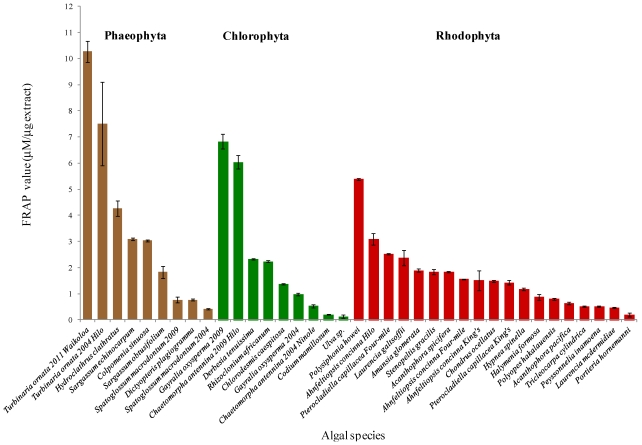
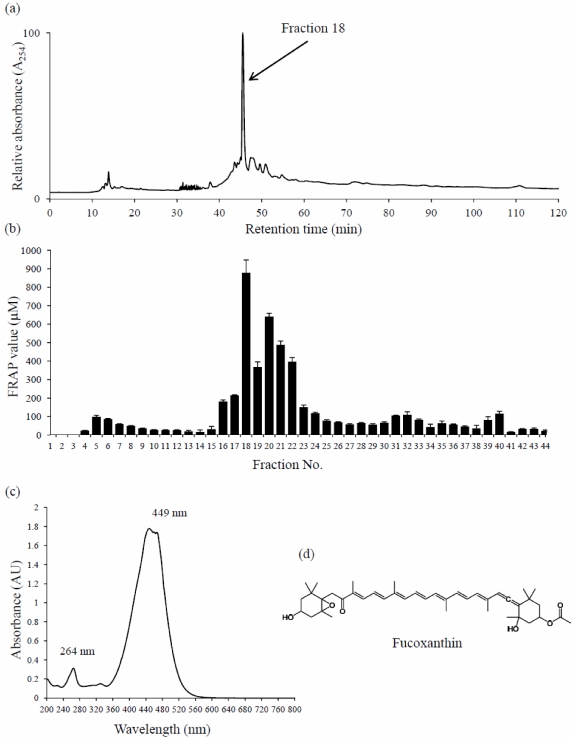
Marine algae are known to contain a wide variety of bioactive compounds, many of which have commercial applications in pharmaceutical, medical, cosmetic, nutraceutical, food and agricultural industries. Natural antioxidants, found in many algae, are important bioactive compounds that play an important role against various diseases and ageing processes through protection of cells from oxidative damage. In this respect, relatively little is known about the bioactivity of Hawaiian algae that could be a potential natural source of such antioxidants. The total antioxidant activity of organic extracts of 37 algal samples, comprising of 30 species of Hawaiian algae from 27 different genera was determined. The activity was determined by employing the FRAP (Ferric Reducing Antioxidant Power) assays. Of the algae tested, the extract of Turbinaria ornata was found to be the most active. Bioassay-guided fractionation of this extract led to the isolation of a variety of different carotenoids as the active principles. The major bioactive antioxidant compound was identified as the carotenoid fucoxanthin. These results show, for the first time, that numerous Hawaiian algae exhibit significant antioxidant activity, a property that could lead to their application in one of many useful healthcare or related products as well as in chemoprevention of a variety of diseases including cancer.
Overview
The claims and statistics of this paper haven’t been checked yet.
Run the check — free, no account needed. It reads the open-access text and checks the sources it cites.
Integrity signals
Registry
Cites
Statistics
Figures
Verification
Claims the paper makes
The claims and statistics of this paper haven’t been checked yet.
Run the check — free, no account needed. It reads the open-access text and checks the sources it cites.
Claims other papers make about this one
Each is checked against this paper’s own text: does it say what the citing paper says it does?
In the citing paper
“However, when attempting to reproduce their synthesis artificially, a decrease in activity with respect to those obtained directly from natural matrices was observed [162].”
From The Potential of Seaweeds as a Source of Functional Ingredients of Prebiotic and Antioxidant Value (2019) · cites this paper as [162]
Self-check
Percentages, sums and reported differences re-computed from the paper’s own numbers.
The self-check needs the paper’s full text.
Citations
Cites
The Ferric Reducing Ability of Plasma (FRAP) as a Measure of “Antioxidant Power”: The FRAP Assay
Benzie, I. F. F., & Strain, J. (1996) · Analytical Biochemistry · doi:10.1006/abio.1996.0292 · Cited by 23,027 · cited 1×
“Antioxidant activity of algal extracts was determined using the ferric reducing antioxidant power (FRAP) assay, modified from the Benzie and Strain protocol [40,41].”
MethodFaulkner, D. J. (1990) · Natural Product Reports · doi:10.1039/np9900700269 · Cited by 4,880
Benzie, I. F. F., & Strain, J. (1999) · Methods in enzymology on CD-ROM/Methods in enzymology · doi:10.1016/s0076-6879(99)99005-5 · Cited by 3,940 · cited 1×
“Antioxidant activity of algal extracts was determined using the ferric reducing antioxidant power (FRAP) assay, modified from the Benzie and Strain protocol [40,41].”
MethodAntioxidant defence mechanisms: From the beginning to the end (of the beginning)
Halliwell, B. B. (1999) · Free Radical Research · doi:10.1080/10715769900300841 · Cited by 1,023 · cited 1×
“By donating an electron, antioxidants neutralize free radicals that would otherwise oxidize biomolecules leading to cell death and tissue damage [6–8].”
BackgroundMetabolites from algae with economical impact
Cardozo, K. H. M., Guaratini, T., Barros, M. P., Falcão, V. D. R., Tonon, Â. P., Lopes, N. P., Campos, S. C. G., Torres, M. A., Souza, A. D. O., Colepicolo, P., et al. (2006) · Comparative Biochemistry and Physiology Part C Toxicology & Pharmacology · doi:10.1016/j.cbpc.2006.05.007 · Cited by 960
Carotenoids in Algae: Distributions, Biosyntheses and Functions
Takaichi, S. (2011) · Marine Drugs · doi:10.3390/md9061101 · Cited by 839
Peng, J., Yuan, J.-P., Wu, C.-F., & Wang, J.-H. (2011) · Marine Drugs · doi:10.3390/md9101806 · Cited by 820
Medicinal and pharmaceutical uses of seaweed natural products: A review
Smit, A. J. (2004) · Journal of Applied Phycology · doi:10.1023/b:japh.0000047783.36600.ef · Cited by 806 · cited 2×
“Algae from the three groupings traditionally known as Chlorophyta (green algae), Rhodophyta (red algae), and Phaeophyta (brown algae) produce compounds with varying bioactivities [4].”
BackgroundOxidative stress and apoptosis: Impact on cancer therapy
Ozben, T. (2007) · Journal of Pharmaceutical Sciences · doi:10.1002/jps.20874 · Cited by 751 · cited 1×
“By donating an electron, antioxidants neutralize free radicals that would otherwise oxidize biomolecules leading to cell death and tissue damage [6–8].”
BackgroundMaeda, H., Hosokawa, M., Sashima, T., Funayama, K., & Miyashita, K. (2005) · Biochemical and Biophysical Research Communications · doi:10.1016/j.bbrc.2005.05.002 · Cited by 647 · cited 1×
“This unique carotenoid was found to possess potent anti-inflammatory, anticancer, anti-obese, anti-diabetic, anti-angiogenic, anti-malarial, and antioxidant activities, as well as protective effects on the liver, blood vessels of the brain, bones, skin, and eyes, including chemoprevention of a variety of diseases incl…”
Background
Cited by
Sorted by citations
Items 201–249 of 249
Rohimat, R., Widowati, I., & Trianto, A. (2014) · doi:10.14710/jmr.v3i3.6002 · Cited by 2
“…panjang akan mengakibatkan sifat karsinogenik dan menimbulkan kerusakan hati pada konsumennya (Heo et al. , 2005), Rumput laut coklat merupakan salah satu kelompok rumput laut yang memiliki aktivitas antioksidan tertinggi jika dibandingkan dengan rumput laut merah dan hijau (Kelman et al., 2012).”
Hamza, W., Bogardus, R., Ahmadani, A., Meskari, R. A., & Hashmi, A. A. (2015) · Journal of Applied Phycology · doi:10.1007/s10811-015-0694-2 · Cited by 2
“It has been documented that numerous Hawaiian algae, including S. echinocarpum, exhibit antioxidant activities (Kelman et al. 2012), and extracts of the alga are believed to reduce oxidative stress in diabetic rats (Firdaus 2011).”
BackgroundShukor, M. I., Darnis, D. S., Sabarudin, N. S., Nor, N. M., & Taher, M. (2022) · AIP conference proceedings · doi:10.1063/5.0113206 · Cited by 2
Feei, Z., Fu, C., Li, Z., & Wan, Z. (2022) · Elsevier eBooks · doi:10.1016/b978-0-12-823960-5.00060-3 · Cited by 2
Sumandiarsa, I. K., Hamida, N., Santoso, J., & Tarman, K. (2022) · Omni-Akuatika · doi:10.20884/1.oa.2022.18.2.907 · Cited by 2
“Free radical is an atom, molecule, or compound with an electron without paired to be reactive and quickly react with other substances (Kelman et al., 2012; Miyashita et al., 2020).”
BackgroundAlgal Photoprotective Phytochemicals: Sources and Potential Applications
Kumari, N., Mishra, S., Jaiswal, J., Gupta, A., Singh, V. K., & Sinha, R. P. (2023) · Springer eBooks · doi:10.1007/978-981-99-0749-6_2 · Cited by 2
Kajian Pustaka Potensi Sargassum Sp. Sebagai Nutrasetikal
Aryatikta, R., Winarni, S., & Pramono, S. N. W. (2022) · Food Scientia Journal of Food Science and Technology · doi:10.33830/fsj.v2i2.3083.2022 · Cited by 3
Azis, M., Soekamto, N. H., & Firdaus, F. (2023) · AIP conference proceedings · doi:10.1063/5.0127046 · Cited by 1
de Almeida, R. P. C., Cardoso, S. L., Tolentino, S., Arantes, A. F. B., Mota, I. S., Gelfuso, G. M., Saldanha‐Araújo, F., Guerra, E. N. S., Nóbrega, Y. K. D. M., Fagg, C. W., et al. (2025) · Plants · doi:10.3390/plants14193099 · Cited by 1
“The reducing capacity of EAPG was evaluated using the FRAP assay, as described by Kelman et al. (2012) [57], with slight modifications.”
Valverde-Urrea, M., Otero, C. K., Terradas, M., & Lopez‐Moya, F. (2026) · Plants · doi:10.3390/plants15101485 · Cited by 1
“The general trend (brown > green > red algae) agrees with previous observations [50,51] and reflects differences in algae metabolite composition.”
Gomes‐Bispo, A., Cardoso, C. L., Afonso, C., Lourenço, H. M., Pedro, S., Moniz, P., & Bandarra, N. M. (2026) · Marine Drugs · doi:10.3390/md24060197 · Cited by 1
Wanlambok, S. M., Dirborne Carefulness, M., & Ramanujam, P. (2021) · International Journal of Life Sciences · Cited by 1
Nursid, M., Hadiati, D., & Winanto, T. (2022) · IOP Conference Series Earth and Environmental Science · doi:10.1088/1755-1315/967/1/012027 · Cited by 1
Supercritical extraction of marine antioxidants
Díaz-Reinoso, B., Balboa, E. M., Moure, A., & Domı́nguez, H. (2023) · Elsevier eBooks · doi:10.1016/b978-0-323-95086-2.00026-6 · Cited by 1
Future Challenges and Opportunities of Marine Algae in Cosmeceuticals
Jain, A. (2024) · International Journal for Research in Applied Science and Engineering Technology · doi:10.22214/ijraset.2024.58255 · Cited by 1
Radiena, A. (2018) · Majalah BIAM · doi:10.29360/mb.v14i1.3754 · Cited by 1
Tapping the Potential of Marine Resources in the Arena of Cosmetics
Dangar, K. G., Changela, D. B., & Chauhan, K. S. (2020) · Springer eBooks · doi:10.1007/978-981-15-5017-1_19 · Cited by 1
Gunathilaka, M. D. T. L., & Peiris, L. D. C. (2022) · Elsevier eBooks · doi:10.1016/b978-0-12-823960-5.00012-3 · Cited by 1
Role of Algae in Skin Benefits: An Alternative to Chemical Cosmetics
Chauhan, A. G., Prajapati, N. D., Joshi, V., & Oza, K. P. (2022) · ACTA SCIENTIFIC MICROBIOLOGY · doi:10.31080/asmi.2022.05.1031
Magdugo, R. P. (2020) · doi:10.70675/ae24689cz37d3z44b0z95f0z94d5d1029c71 · Cited by 1
New record of an economic marine alga, Ahnfeltiopsis concinna, in Korea
Kang, P. J., & Nam, K. W. (2017) · Fisheries and aquatic sciences · doi:10.1186/s41240-017-0070-z
“Particularly, it has been known that this alga can be used as a potential commercial material of antioxidant compounds in the medicine, food, pharmaceutical, and cosmetic industries in Hawaii (Kelman et al. 2012).”
BackgroundSaied, S., & K, M. (2018) · International Journal of Pharma and Bio Sciences · doi:10.22376/ijpbs.2018.9.3.p68-73
RESPONSES TO CADMIUM- INDUCED OXIDATIVE STRESS IN MARINE MACROALGA ULVA LINZA.
AAbdelLatif, S. (2019) · International Journal of Advanced Research · doi:10.21474/ijar01/9524
“Marine algae are considered to be a rich source of antioxidants (Devi et al., 2011; Kelman et al., 2012).”
BackgroundApriani, L. A., & Ariyanti, I. (2019) · Proceedings of the International Conference on Applied Science and Health
Avances en la Valoración de Macroalgas del Género Ulva como Nutracéutico en Litopenaeus vannamei
Cruz‐Suárez, L. E., Nieto-López, M. G., Tapia‐Salazar, M., Gamboa‐Delgado, J., Maldonado-Muñiz, M., Villarreal‐Cavazos, D., & Ricque-Marie, D. (2013) · Avances en Nutrición Acuicola
Evolution of Algae: Using Algae as an Art Medium to Discuss Morphology and Evolution
Wright, S., Chan, D., Riggleman, M., McConaghay, K., Burdick, A., Niegowski, L., Bahl, M., & Ruffell, S. E. (2020) · Advances in Biology Laboratory Education · doi:10.37590/able.v41.art54
Widowati, R., Handayani, S. R., Suprihatin, S., & Rahayu, I. L. (2021) · European Journal of Molecular & Clinical Medicine
Desenvolvimento de técnicas de produção de Codium tomentosum em substratos artificiais
Mata, J. R. D. A. (2020) · Portuguese National Funding Agency for Science, Research and Technology (RCAAP Project by FCT)
Marine Drugs as a Valuable Source of Natural Biomarkers Used in the Treatment of Alzheimer’s Disease
U, U. N. U. D. U. N. (2022) · Open Access Journal of Biogeneric Science and Research · doi:10.46718/jbgsr.2022.10.000253
Büyükköroğlu, G., Şenel, B., & Sevim, G. (2022) · Elsevier eBooks · doi:10.1016/b978-0-323-90042-3.00008-6
Cultivation of Edible Algae: Present and Future
Largo, D. B. (2022) · BENTHAM SCIENCE PUBLISHERS eBooks · doi:10.2174/9789815051872122010005
Antioxidant Properties of Algae in the U.S. Virgin Islands
Charles, E., & Castillo, B. F. (2022) · Journal of Student Research · doi:10.47611/jsr.v11i1.1546
Fouda, F. (2023) · Annals of Agricultural Science Moshtohor · doi:10.21608/assjm.2023.290372
Sianipar, E. A., Solang, J. A. N., Nurcahyanti, A. D., Wira, A., & Indonesia (2023) · Pakistan Journal of Pharmaceutical Sciences · doi:10.36721/pjps.2023.36.2.reg.477-482.1
Adetunji, C. O., Olaniyan, O. T., Inobeme, A., Bodunrinde, R. E., Wike, N. Y., Dauda, W. P., Adetunji, J. B., Ozolua, P. O., Farid, A., Ghazanfar, S., et al. (2023) · doi:10.1002/9781119857860.ch27
Appu, A., Sadanandan, R., & Ravichandran, S. (2023) · Advances in Zoology and Botany · doi:10.13189/azb.2023.110401
MANFAAT ULVA LACTUCA SEBAGAI MASKER WAJAH ALAMI
Maulidya, R., Handayani, L., Syahputra, F., Thaib, A., & Mardhiah, A. (2024) · Beujroh Jurnal Pemberdayaan dan Pengabdian pada Masyarakat · doi:10.61579/beujroh.v2i2.89
“…laut yang mengandung senyawa bioaktif yaitu fenol, saponin, tanin, flavonoid, sesquiterpenoid, diterpenoid dan caulerpin yang memiliki aktivitas antioksidan, anti bakteri, anti jamur, antitumor dan bisa digunakan untuk terapi tekanan darah rendah serta penurun glukosa darah (Kelman et al., 2012).”
BackgroundSari, W. K. P., & Muslimin, M. (2023) · Jurnal Riset Akuakultur · doi:10.15578/jra.17.3.2022.155-167
Formulation and antioxidant activity of lip-balm enriched with brown seaweed Sargassum sp. extract
Rembaya, N. S. F., & Husni, A. (2025) · IOP Conference Series Earth and Environmental Science · doi:10.1088/1755-1315/1496/1/012027
Antioxidant enhancement of Cystoseira barbata extracts via nanoliposomal encapsulation
Cafer, M., Kızılkaya, İ. T., & ÇAĞAL, M. M. (2025) · International Journal of Secondary Metabolite · doi:10.21448/ijsm.1622199
Emerging pharmaceutical products from marine plants
Ebrahimbabaie, P., Okoji, C. N., Musa, S. I., Otedo, J. O., Nadoushan, M. A., Onosakponome, I., Moses, N., & Isoje, A. O. (2025) · Elsevier eBooks · doi:10.1016/b978-0-443-36320-7.00003-x
Hemamalini, D., Sundari, S. K., Faizee, K. M. S. H., & Jeyachandran, S. (2025) · Biomaterial Investigations in Dentistry · doi:10.2340/biid.v12.45099
“These antioxidant effects are likely due to the presence of phenolic compounds and flavonoids, which help to neutralize reactive oxygen species (ROS) [5, 23].”
Guo, R., Liu, T., Guo, C., Chen, G., Fan, J., & Zhang, Q. (2023) · Figshare · doi:10.6084/m9.figshare.22604428
Guo, R., Liu, T., Guo, C., Chen, G., Fan, J., & Zhang, Q. (2023) · Figshare · doi:10.6084/m9.figshare.22604425
Microalgae-Based Pigments as Food Freshness Indicators in Smart Packaging
Abedini, A., Rastegarpour, M., Hasanvand, S., Sina, M., Mohamadi, B., Sani, M. A., & Mortazavian, A. M. (2026) · Springer eBooks · doi:10.1007/978-3-032-05253-7_6
Lee, S. M., Park, S.-Y., & Kim, J. Y. (2026) · Food & Function · doi:10.1039/d5fo05258k
Nicolai, R., Vasiljev, T. G., Morelli, L., Greselin, F., Galli, P., Zuccarello, G. C., & Colombo, M. (2026) · Algal Research · doi:10.2139/ssrn.7002659
Know your seaweed: fundamental knowledge needed to bring new species into cultivation
Augytė, S., & Yarish, C. (2026) · Botanica Marina · doi:10.1515/bot-2026-0059
“Studies have identi fi ed Halymenia formosa nutritional and dietary fi ber contents (Kelman et al. 2012; McDermid and Stuercke 2003; McDermid et al. 2005).”
Safety Assessment of Red Algae-Derived Ingredients as Used in Cosmetics
Ferguson, P., Bergfeld, W. F., Belsito, D. V., Cohen, D. E., Klaassen, C. D., Liebler, D. C., Marks, J. G., Peterson, L. A., Shank, R. C., Slaga, T. J., et al. (2026) · International Journal of Toxicology · doi:10.1177/10915818261474837
Metadata
- Authors
- Kelman, D., Posner, E. K., McDermid, K. J., Tabandera, N. K., Wright, P. R., & Wright, A. D.
- Affiliations
- University of Hawaii at Hilo (US)
- University of Freiburg (DE)
- Corresponding author
- Wright, Anthony D.
- Venue
- Marine Drugs
- Publisher
- MDPI AG
- Published
- 2012-02-15
- Volume
- 10
- Issue
- 2
- Pages
- 403-416
- ISSN
- 1660-3397 (ISSN-L)
- PMC
- PMC3297004
- OpenAlex
- W2079779859
- Cited by
- 250
- References
- 43
- Citations by year
- 2026: 8 · 2025: 13 · 2024: 12 · 2023: 22 · 2022: 30 · 2021: 24 · 2020: 30 · 2019: 23 · 2018: 21 · 2017: 13 · 2016: 9 · 2015: 13 · 2014: 12 · 2013: 16 · 2012: 4
- FWCI
- 21.08
- Type
- journal article
- Language
- en
- Open access
- gold
- doi.org
- Licence
- Locations
- Marine Drugs (publishedVersion, cc-by)
- PubMed Central (publishedVersion, cc-by)
- PubMed (publishedVersion)
- DOAJ (DOAJ: Directory of Open Access Journals) (submittedVersion, cc-by-sa)
- Topics
- Life Sciences › Agricultural and Biological Sciences › Aquatic Science › Seaweed-derived Bioactive Compounds
- Health Sciences › Medicine › Biochemistry (medical) › Phytochemicals and Antioxidant Activities
- Physical Sciences › Earth and Planetary Sciences › Oceanography › Marine and coastal plant biology
- Keywords
- antioxidant activity, marine algae, Turbinaria ornata, fucoxanthin, carotenoids, bioassay-guided fractionation, oxidative damage, chemoprevention, natural antioxidants
- MeSH terms
- Phaeophyceae, Chlorophyta, Rhodophyta, Antioxidants, Hawaii, Pacific Ocean, Species Specificity, Xanthophylls, Drug Discovery
About these checks
Registry, retraction, Cites and statistics results are computed, not judged, with one exception: a printed reference that no index lists is read once by a model before it counts as a citation error. Claims are extracted by a model and kept only when their quote appears verbatim in the text; each cited source is then checked, with a model’s help, for whether it says what the claim relies on. Those verdicts can be wrong — read the claim’s quote and the cited source before relying on one.
Statistics and arithmetic are recomputed, not judged.
Confidence bands are shown only for fields calibrated on our annotated test set. None is calibrated yet, so no band is shown.
What counts as a claim ›How we measure confidence ›How we check this ›
Are you an author, or do you see a problem with this page? Request a review
