

The DOI matches its Crossref record; 43 of the 43 references it cites were found in a registry or an index.
Antioxidant Activity of Hawaiian Marine Algae
Open accessAbstract
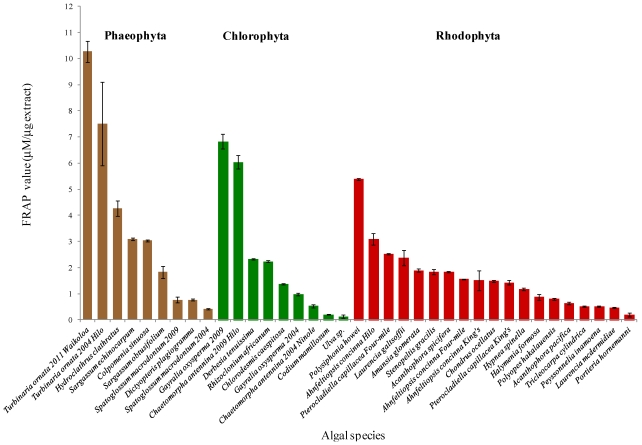
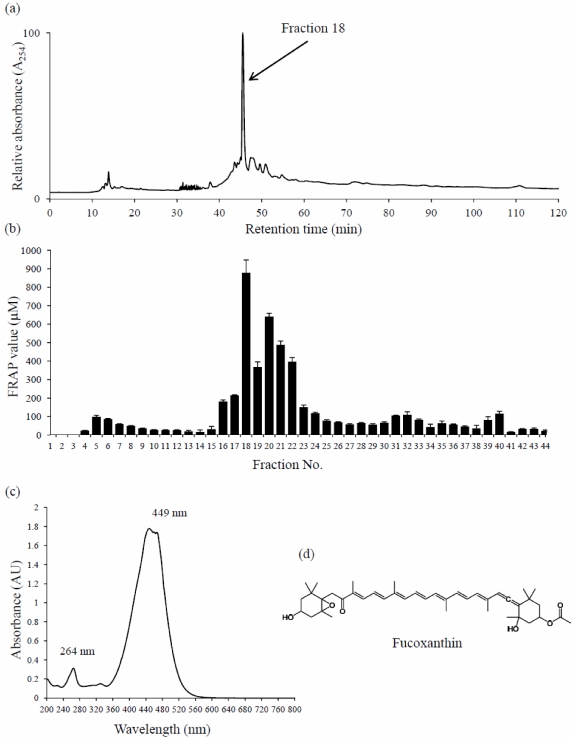
Marine algae are known to contain a wide variety of bioactive compounds, many of which have commercial applications in pharmaceutical, medical, cosmetic, nutraceutical, food and agricultural industries. Natural antioxidants, found in many algae, are important bioactive compounds that play an important role against various diseases and ageing processes through protection of cells from oxidative damage. In this respect, relatively little is known about the bioactivity of Hawaiian algae that could be a potential natural source of such antioxidants. The total antioxidant activity of organic extracts of 37 algal samples, comprising of 30 species of Hawaiian algae from 27 different genera was determined. The activity was determined by employing the FRAP (Ferric Reducing Antioxidant Power) assays. Of the algae tested, the extract of Turbinaria ornata was found to be the most active. Bioassay-guided fractionation of this extract led to the isolation of a variety of different carotenoids as the active principles. The major bioactive antioxidant compound was identified as the carotenoid fucoxanthin. These results show, for the first time, that numerous Hawaiian algae exhibit significant antioxidant activity, a property that could lead to their application in one of many useful healthcare or related products as well as in chemoprevention of a variety of diseases including cancer.
Overview
The claims and statistics of this paper haven’t been checked yet.
Run the check — free, no account needed. It reads the open-access text and checks the sources it cites.
Integrity signals
Registry
Cites
Statistics
Figures
Verification
Claims the paper makes
The claims and statistics of this paper haven’t been checked yet.
Run the check — free, no account needed. It reads the open-access text and checks the sources it cites.
Claims other papers make about this one
Each is checked against this paper’s own text: does it say what the citing paper says it does?
In the citing paper
“However, when attempting to reproduce their synthesis artificially, a decrease in activity with respect to those obtained directly from natural matrices was observed [162].”
From The Potential of Seaweeds as a Source of Functional Ingredients of Prebiotic and Antioxidant Value (2019) · cites this paper as [162]
Self-check
Percentages, sums and reported differences re-computed from the paper’s own numbers.
The self-check needs the paper’s full text.
Citations
Cites
The Ferric Reducing Ability of Plasma (FRAP) as a Measure of “Antioxidant Power”: The FRAP Assay
Benzie, I. F. F., & Strain, J. (1996) · Analytical Biochemistry · doi:10.1006/abio.1996.0292 · Cited by 23,027 · cited 1×
“Antioxidant activity of algal extracts was determined using the ferric reducing antioxidant power (FRAP) assay, modified from the Benzie and Strain protocol [40,41].”
MethodFaulkner, D. J. (1990) · Natural Product Reports · doi:10.1039/np9900700269 · Cited by 4,880
Benzie, I. F. F., & Strain, J. (1999) · Methods in enzymology on CD-ROM/Methods in enzymology · doi:10.1016/s0076-6879(99)99005-5 · Cited by 3,940 · cited 1×
“Antioxidant activity of algal extracts was determined using the ferric reducing antioxidant power (FRAP) assay, modified from the Benzie and Strain protocol [40,41].”
MethodAntioxidant defence mechanisms: From the beginning to the end (of the beginning)
Halliwell, B. B. (1999) · Free Radical Research · doi:10.1080/10715769900300841 · Cited by 1,023 · cited 1×
“By donating an electron, antioxidants neutralize free radicals that would otherwise oxidize biomolecules leading to cell death and tissue damage [6–8].”
BackgroundMetabolites from algae with economical impact
Cardozo, K. H. M., Guaratini, T., Barros, M. P., Falcão, V. D. R., Tonon, Â. P., Lopes, N. P., Campos, S. C. G., Torres, M. A., Souza, A. D. O., Colepicolo, P., et al. (2006) · Comparative Biochemistry and Physiology Part C Toxicology & Pharmacology · doi:10.1016/j.cbpc.2006.05.007 · Cited by 960
Carotenoids in Algae: Distributions, Biosyntheses and Functions
Takaichi, S. (2011) · Marine Drugs · doi:10.3390/md9061101 · Cited by 839
Peng, J., Yuan, J.-P., Wu, C.-F., & Wang, J.-H. (2011) · Marine Drugs · doi:10.3390/md9101806 · Cited by 820
Medicinal and pharmaceutical uses of seaweed natural products: A review
Smit, A. J. (2004) · Journal of Applied Phycology · doi:10.1023/b:japh.0000047783.36600.ef · Cited by 806 · cited 2×
“Algae from the three groupings traditionally known as Chlorophyta (green algae), Rhodophyta (red algae), and Phaeophyta (brown algae) produce compounds with varying bioactivities [4].”
BackgroundOxidative stress and apoptosis: Impact on cancer therapy
Ozben, T. (2007) · Journal of Pharmaceutical Sciences · doi:10.1002/jps.20874 · Cited by 751 · cited 1×
“By donating an electron, antioxidants neutralize free radicals that would otherwise oxidize biomolecules leading to cell death and tissue damage [6–8].”
BackgroundMaeda, H., Hosokawa, M., Sashima, T., Funayama, K., & Miyashita, K. (2005) · Biochemical and Biophysical Research Communications · doi:10.1016/j.bbrc.2005.05.002 · Cited by 647 · cited 1×
“This unique carotenoid was found to possess potent anti-inflammatory, anticancer, anti-obese, anti-diabetic, anti-angiogenic, anti-malarial, and antioxidant activities, as well as protective effects on the liver, blood vessels of the brain, bones, skin, and eyes, including chemoprevention of a variety of diseases incl…”
Background
Cited by
Sorted by citations
Bandeira, M., Giovanela, M., Roesch‐Ely, M., Devine, D. M., & Crespo, J. D. S. (2020) · Sustainable Chemistry and Pharmacy · doi:10.1016/j.scp.2020.100223 · Cited by 570
Blunt, J. W., Copp, B. R., Keyzers, R. A., Munro, M. H. G., & Prinsep, M. R. (2014) · Natural Product Reports · doi:10.1039/c3np70117d · Cited by 496
Exploring the potential of using algae in cosmetics
Wang, H., Chen, C.-C., Huynh, P., & Chang, J. (2014) · Bioresource Technology · doi:10.1016/j.biortech.2014.12.001 · Cited by 509
In vitro antioxidant properties of crude extracts and compounds from brown algae
Balboa, E. M., Conde, E., Moure, A., Falqué, E., & Domínguez, H. (2013) · Food Chemistry · doi:10.1016/j.foodchem.2012.11.026 · Cited by 436
“…0.015 mg/mL; EC50, LP, C = 0.07 mg/mL Zahra et al. (2007) Sargassum echinocarpum (M) Richardson’s Ocean Park (Hawaii), September, 2004 – FRAP = 3 mol/g Kelman et al. (2012) Sargassum hyxtrix (M-NaOH)(M) (NaOH) Gunung Kidul (Indonesia), October 2009 1.21 9.95 EC50, DPPH = 13.86 mg/mL; FICA = 0.84%…”
InfluentialPhytochemical and Potential Properties of Seaweeds and Their Recent Applications: A Review
EL-BELTAGI, H. S., Mohamed, A. A., Mohamed, H. I., Ramadan, K. M. A., Barqawi, A. A., & Mansour, A. T. (2022) · Marine Drugs · doi:10.3390/md20060342 · Cited by 395
Metadata
- Authors
- Kelman, D., Posner, E. K., McDermid, K. J., Tabandera, N. K., Wright, P. R., & Wright, A. D.
- Affiliations
- University of Hawaii at Hilo (US)
- University of Freiburg (DE)
- Corresponding author
- Wright, Anthony D.
- Venue
- Marine Drugs
- Publisher
- MDPI AG
- Published
- 2012-02-15
- Volume
- 10
- Issue
- 2
- Pages
- 403-416
- ISSN
- 1660-3397 (ISSN-L)
- PMC
- PMC3297004
- OpenAlex
- W2079779859
- Cited by
- 250
- References
- 43
- Citations by year
- 2026: 8 · 2025: 13 · 2024: 12 · 2023: 22 · 2022: 30 · 2021: 24 · 2020: 30 · 2019: 23 · 2018: 21 · 2017: 13 · 2016: 9 · 2015: 13 · 2014: 12 · 2013: 16 · 2012: 4
- FWCI
- 21.08
- Type
- journal article
- Language
- en
- Open access
- gold
- doi.org
- Licence
- Locations
- Marine Drugs (publishedVersion, cc-by)
- PubMed Central (publishedVersion, cc-by)
- PubMed (publishedVersion)
- DOAJ (DOAJ: Directory of Open Access Journals) (submittedVersion, cc-by-sa)
- Topics
- Life Sciences › Agricultural and Biological Sciences › Aquatic Science › Seaweed-derived Bioactive Compounds
- Health Sciences › Medicine › Biochemistry (medical) › Phytochemicals and Antioxidant Activities
- Physical Sciences › Earth and Planetary Sciences › Oceanography › Marine and coastal plant biology
- Keywords
- antioxidant activity, marine algae, Turbinaria ornata, fucoxanthin, carotenoids, bioassay-guided fractionation, oxidative damage, chemoprevention, natural antioxidants
- MeSH terms
- Phaeophyceae, Chlorophyta, Rhodophyta, Antioxidants, Hawaii, Pacific Ocean, Species Specificity, Xanthophylls, Drug Discovery
About these checks
Registry, retraction, Cites and statistics results are computed, not judged, with one exception: a printed reference that no index lists is read once by a model before it counts as a citation error. Claims are extracted by a model and kept only when their quote appears verbatim in the text; each cited source is then checked, with a model’s help, for whether it says what the claim relies on. Those verdicts can be wrong — read the claim’s quote and the cited source before relying on one.
Statistics and arithmetic are recomputed, not judged.
Confidence bands are shown only for fields calibrated on our annotated test set. None is calibrated yet, so no band is shown.
What counts as a claim ›How we measure confidence ›How we check this ›
Are you an author, or do you see a problem with this page? Request a review
