

Medicinal Plants, Phytochemicals and Regulation of the NLRP3 Inflammasome in Inflammatory Bowel Diseases: A Comprehensive Review
Open accessThe DOI matches its Crossref record; 109 of the 111 references it cites were found in a registry or an index.
Abstract
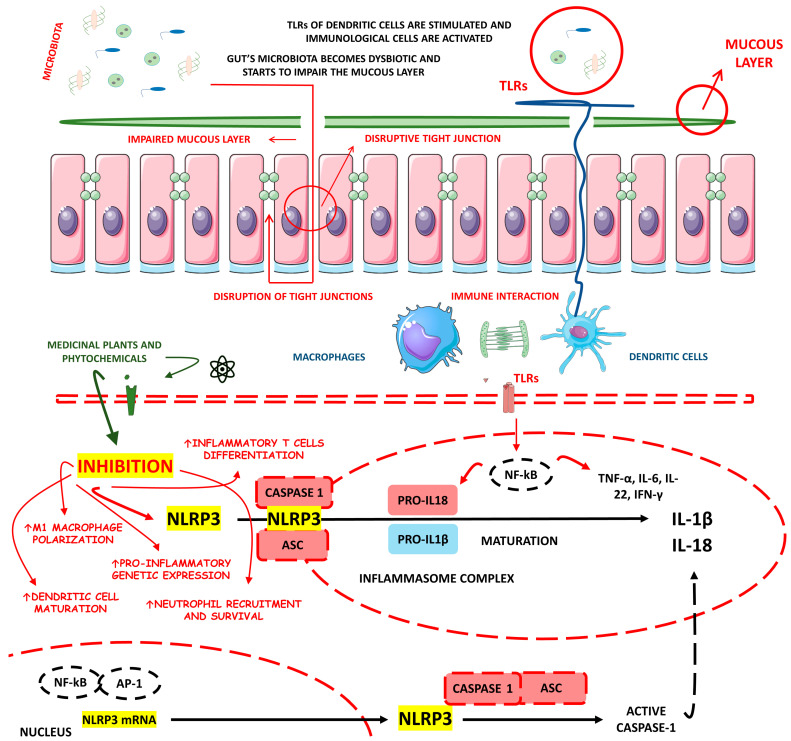
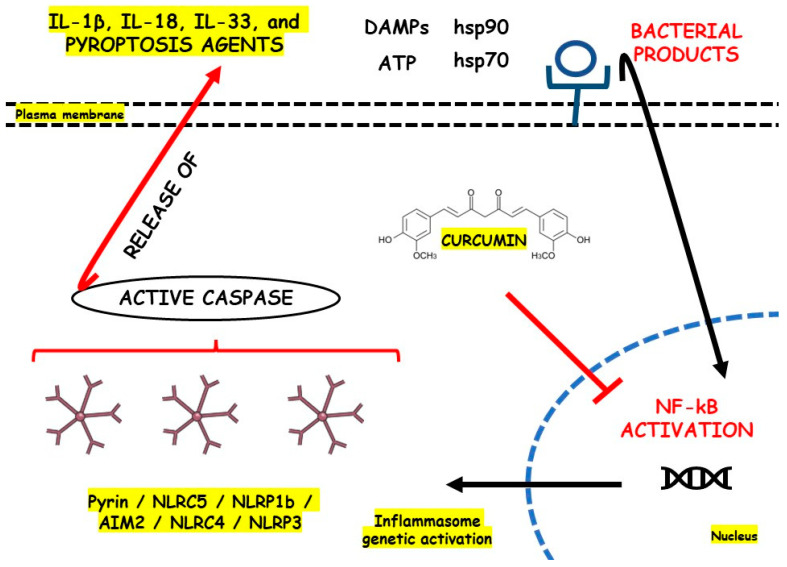
Ongoing research explores the underlying causes of ulcerative colitis and Crohn’s disease. Many experts suggest that dysbiosis in the gut microbiota and genetic, immunological, and environmental factors play significant roles. The term “microbiota” pertains to the collective community of microorganisms, including bacteria, viruses, and fungi, that reside within the gastrointestinal tract, with a particular emphasis on the colon. When there is an imbalance or disruption in the composition of the gut microbiota, it is referred to as dysbiosis. Dysbiosis can trigger inflammation in the intestinal cells and disrupt the innate immune system, leading to oxidative stress, redox signaling, electrophilic stress, and inflammation. The Nod-like Receptor (NLR) Family Pyrin Domain Containing 3 (NLRP3) inflammasome, a key regulator found in immunological and epithelial cells, is crucial in inducing inflammatory diseases, promoting immune responses to the gut microbiota, and regulating the integrity of the intestinal epithelium. Its downstream effectors include caspase-1 and interleukin (IL)-1β. The present study investigated the therapeutic potential of 13 medicinal plants, such as Litsea cubeba, Artemisia anomala, Piper nigrum, Morus macroura, and Agrimonia pilosa, and 29 phytocompounds such as artemisitene, morroniside, protopine, ferulic acid, quercetin, picroside II, and hydroxytyrosol on in vitro and in vivo models of inflammatory bowel diseases (IBD), with a focus on their effects on the NLRP3 inflammasome. The observed effects of these treatments included reductions in IL-1β, tumor necrosis factor-alpha, IL-6, interferon-gamma, and caspase levels, and increased expression of antioxidant enzymes, IL-4, and IL-10, as well as regulation of gut microbiota. These effects could potentially provide substantial advantages in treating IBD with few or no adverse effects as caused by synthetic anti-inflammatory and immunomodulated drugs. However, additional research is necessary to validate these findings clinically and to develop effective treatments that can benefit individuals who suffer from these diseases.
Overview
The claims and statistics of this paper haven’t been checked yet.
Free: it reads the open-access text and checks the first 5 claims that cite a source we can check. Create a free account to check every claim.
Integrity signals
Registry
Cites
Statistics
Figures
Verification
Claims the paper makes
The claims and statistics of this paper haven’t been checked yet.
Free: it reads the open-access text and checks the first 5 claims that cite a source we can check. Create a free account to check every claim.
Claims other papers make about this one
Each is checked against this paper’s own text: does it say what the citing paper says it does?
The cited source says what the claim attributes to it.
In the citing paper
“Direito, R. et al. noted that P-II exhibits potential to inhibit caspase-1 expression [53].”
From Picroside II suppresses chondrocyte pyroptosis through MAPK/NF-κB/NLRP3 signaling pathway alleviates osteoarthritis (2024) · cites this paper as [53]
Self-check
Percentages, sums and reported differences re-computed from the paper’s own numbers.
The self-check needs the paper’s full text.
Citations
Cites
SANRA—a scale for the quality assessment of narrative review articles
Baethge, C., Goldbeck-Wood, S., & Mertens, S. (2019) · Research Integrity and Peer Review · doi:10.1186/s41073-019-0064-8 · Cited by 3,469 · cited 1×
“[14] specifically designed to evaluate the quality of non-systematic reviews.”
BackgroundOrdás, I., Eckmann, L., Talamini, M., Baumgart, D. C., & Sandborn, W. J. (2012) · The Lancet · doi:10.1016/s0140-6736(12)60150-0 · Cited by 2,078
Molecular mechanisms regulating NLRP3 inflammasome activation
Jo, E.-K., Kim, J. K., Shin, D.-M., & Sasakawa, C. (2016) · Cellular & Molecular Immunology · doi:10.1038/cmi.2015.95 · Cited by 1,378 · cited 3×
“Indeed, IL-1β is crucial in mediating pro-inflammatory responses in various tissues among multiple systemic inflammatory diseases and is associated highly with leukocytosis and elevated acute phase proteins [88,90].”
BackgroundGuidelines for the management of inflammatory bowel disease in adults
Carter, M. J., Lobo, A. J., & Travis, S. P. L. (2004) · Gut · doi:10.1136/gut.2004.043372 · Cited by 1,083
Rogler, G., Singh, A., Kavanaugh, A., & Rubin, D. T. (2021) · Gastroenterology · doi:10.1053/j.gastro.2021.07.042 · Cited by 869 · cited 1×
“Common symptoms include diarrhea, rectal bleeding, and abdominal pain [6,7].”
BackgroundNLRP3 inflammasome and its inhibitors: a review
Shao, B.-Z., Xu, Z.-Q., Han, B.-Z., Su, D.-F., & Liu, C. (2015) · Frontiers in Pharmacology · doi:10.3389/fphar.2015.00262 · Cited by 836
NLRP3 Inflammasome and Inflammatory Bowel Disease
Zhen, Y., & Zhang, H. (2019) · Frontiers in Immunology · doi:10.3389/fimmu.2019.00276 · Cited by 649 · cited 2×
“Meanwhile, IL-1β also upregulates IL-2 receptor expression in T cells, which prolongs their survival and enhance their antibody production by direct B cell proliferation [10,102].”
BackgroundEpidemiology and Pathogenesis of Ulcerative Colitis
Du, L., & Ha, C. (2020) · Gastroenterology Clinics of North America · doi:10.1016/j.gtc.2020.07.005 · Cited by 645 · cited 1×
“The aims of a successful treatment consist of maintaining a steroid-free remission, mucosal healing, preventing surgery necessity as well as hospital admission, avoiding disability, and improving the quality of life for all patients [60,68,69].”
BackgroundMetabolic syndrome and cardiovascular diseases: Going beyond traditional risk factors
Silveira Rossi, J. L., Barbalho, S. M., Reverete de Araujo, R., Bechara, M. D., Sloan, K. P., & Sloan, L. A. (2022) · Diabetes/Metabolism Research and Reviews · doi:10.1002/dmrr.3502 · Cited by 604
Self-citationThe NLRP3 inflammasome: Mechanism of action, role in disease and therapies
Wang, L., & Hauenstein, A. V. (2020) · Molecular Aspects of Medicine · doi:10.1016/j.mam.2020.100889 · Cited by 426
Cited by
Fornari Laurindo, L., Aparecido Dias, J., Cressoni Araújo, A., Torres Pomini, K., Machado Galhardi, C., Rucco Penteado Detregiachi, C., Santos de Argollo Haber, L., Donizeti Roque, D., Dib Bechara, M., Vialogo Marques de Castro, M., et al. (2024) · Frontiers in Immunology · doi:10.3389/fimmu.2023.1305933 · Cited by 144
Self-citationBas, T. G. (2026) · International Journal of Molecular Sciences · doi:10.3390/ijms27031404 · Cited by 107
Tauil, R. B., Golono, P. T., de Lima, E. P., Goulart, R. D. Á., Guiguer, É. L., Bechara, M. D., Nicolau, C. C. T., Yanaguizawa, J. L., Fiorini, A. M. R., Méndez‐Sánchez, N., et al. (2024) · Pharmaceuticals · doi:10.3390/ph17101354 · Cited by 87
Self-citationLiu, J., Guan, Y., Yang, L., Fang, H., Sun, H., Sun, Y., Yan, G., Kong, L. D., & Wang, X. (2025) · Pharmaceuticals · doi:10.3390/ph18060912 · Cited by 72
Li, J.-H., Xu, J., Huang, C., Hu, J.-X., Xu, H., Guo, X., Zhang, Y., Xu, J., Peng, Y., Zhang, Y., et al. (2024) · International Journal of Nanomedicine · doi:10.2147/ijn.s493434 · Cited by 62
Metadata
- Authors
- Direito, R., Barbalho, S. M., Figueira, M. E., Minniti, G., de Carvalho, G. M., de Oliveira Zanuso, B., de Oliveira dos Santos, A. R., de Góes Corrêa, N., Rodrigues, V. D., de Alvares Goulart, R., Guiguer, E. L., Araújo, A. C., Bosso, H., & Fornari Laurindo, L.
- Affiliations
- University of Lisbon (PT)
- São Paulo State Technological College (BR)
- Universidade de Marília (BR)
- Department of Biochemistry and Pharmacology, School of Medicine, University of Marília (UNIMAR), Avenida Hygino Muzzy Filho, 1001, Marília 17525-902, São Paulo, Brazil
- Faculdade de Medicina de Marília (BR)
- Faculdade de Medicina de São José do Rio Preto (BR)
- ORCID
- Venue
- Metabolites
- Publisher
- MDPI AG
- Published
- 2023-06-06
- Volume
- 13
- Issue
- 6
- Pages
- 728
- ISSN
- 2218-1989 (ISSN-L)
- PMC
- PMC10305268
- OpenAlex
- W4379799957
- Cited by
- 32
- References
- 111
- Citations by year
- 2026: 9 · 2025: 10 · 2024: 11 · 2023: 2
- FWCI
- 0.85
- Type
- journal article
- Language
- en
- Open access
- gold
- doi.org
- Licence
- Locations
- Metabolites (publishedVersion, cc-by)
- PubMed Central (publishedVersion, cc-by)
- PubMed (publishedVersion)
- DOAJ (DOAJ: Directory of Open Access Journals) (submittedVersion, cc-by-sa)
- Topics
- Life Sciences › Biochemistry, Genetics and Molecular Biology › Molecular Biology › Inflammasome and immune disorders
- Health Sciences › Medicine › Gastroenterology › Inflammatory Bowel Disease
- Health Sciences › Medicine › Complementary and alternative medicine › Natural Compounds in Disease Treatment
- Keywords
- inflammatory bowel disease, NLRP3 inflammasome, medicinal plants, phytochemicals, Crohn's disease, ulcerative colitis, gut dysbiosis, caspase-1, IL-1β, oxidative stress, antioxidant enzymes, morroniside, protopine, ferulic acid, quercetin, picroside II, hydroxytyrosol, Litsea cubeba, Artemisia anomala, black pepper, Morus macroura, Agrimonia pilosa, anti-inflammatory therapy
About these checks
Registry, retraction, Cites and statistics results are computed, not judged, with one exception: a printed reference that no index lists is read once by a model before it counts as a citation error. Claims are extracted by a model and kept only when their quote appears verbatim in the text; each cited source is then checked, with a model’s help, for whether it says what the claim relies on. Those verdicts can be wrong — read the claim’s quote and the cited source before relying on one.
Statistics and arithmetic are recomputed, not judged.
Confidence bands are shown only for fields calibrated on our annotated test set. None is calibrated yet, so no band is shown.
What counts as a claim ›How we measure confidence ›How we check this ›
Are you an author, or do you see a problem with this page? Request a review
How to cite
Cite CoChat for the checks on this page, and the paper for its own findings.
- This page
- CoChat. (2026). Citation check: Medicinal Plants, Phytochemicals and Regulation of the NLRP3 Inflammasome in Inflammatory Bowel Diseases: A Comprehensive Review. https://app.cochat.ai/papers/10.3390/metabo13060728
- The paper
- Direito, R., Barbalho, S. M., Figueira, M. E., Minniti, G., de Carvalho, G. M., de Oliveira Zanuso, B., de Oliveira dos Santos, A. R., de Góes Corrêa, N., Rodrigues, V. D., de Alvares Goulart, R., Guiguer, E. L., Araújo, A. C., Bosso, H., & Fornari Laurindo, L. (2023). Medicinal Plants, Phytochemicals and Regulation of the NLRP3 Inflammasome in Inflammatory Bowel Diseases: A Comprehensive Review. Metabolites. https://doi.org/10.3390/metabo13060728
Data sources
Bibliographic data: Semantic Scholar, OpenAlex, Crossref.
Contains information from the Semantic Scholar Academic Graph Datasets, made available under the ODC Attribution License (ODC-BY 1.0).
Semantic Scholar’s data is described in: Kinney, R., et al. (2023). The Semantic Scholar Open Data Platform. arXiv:2301.10140.
