

Extraction of Betulin, Trimyristin, Eugenol and Carnosic Acid Using Water-Organic Solvent Mixtures
Open accessThe DOI matches its Crossref record; 32 of the 32 references it cites were found in a registry or an index.
Abstract
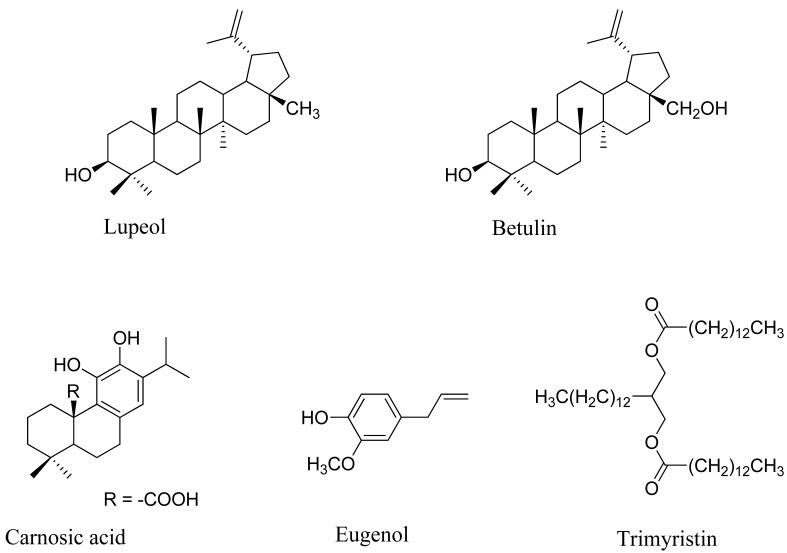
A solvent system consisting of ethyl acetate, ethyl alcohol and water, in the volume ratio of 4.5:4.5:1, was developed and used to extract, at room temperature, betulin from white birch bark and antioxidants from spices (rosemary, thyme, sage, and oregano) and white oak chips. In addition, under reflux conditions, trimyristin was extracted from nutmeg using the same solvent system, and eugenol from olives was extracted using a mixture of salt water and ethyl acetate. The protocol demonstrates the use of water in organic solvents to extract natural products from plants. Measurement of the free-radical scavenging activity using by 2,2-diphenyl-1-picrylhydrazyl (DPPH) indicated that the extraction of plant material using ethyl acetate, ethyl alcohol and water (4.5:4.5:1, v/v/v) was exhaustive when carried out at room temperature for 96 h.
Overview
The claims and statistics of this paper haven’t been checked yet.
Free: it reads the open-access text and checks the first 5 claims that cite a source we can check. Create a free account to check every claim.
Integrity signals
Registry
Cites
Statistics
Figures
Verification
Claims the paper makes
The claims and statistics of this paper haven’t been checked yet.
Free: it reads the open-access text and checks the first 5 claims that cite a source we can check. Create a free account to check every claim.
Claims other papers make about this one
Each is checked against this paper’s own text: does it say what the citing paper says it does?
The cited source says what the claim attributes to it.
In the citing paper
“Lugemwa used water-organic solvent mixtures for the isolation of trimyristin from nutmeg and obtained the desired triglyceride with a yield of only 8% at the end of 1 hour of extraction (19).”
From An improved isolation of trimyristin from Myristica fragrans as a renewable feedstock with assistance of novel cationic gemini surfactant (2020) · cites this paper as [19]
Self-check
Percentages, sums and reported differences re-computed from the paper’s own numbers.
The self-check needs the paper’s full text.
Citations
Cites
Antioxidant Determinations by the Use of a Stable Free Radical
BLOIS, M. S. (1958) · Nature · doi:10.1038/1811199a0 · Cited by 12,994
ON TYROSINE AND TRYPTOPHANE DETERMINATIONS IN PROTEINS
Folin, O., & Ciocalteu, V. (1927) · Journal of Biological Chemistry · doi:10.1016/s0021-9258(18)84277-6 · Cited by 2,946
Subcritical Water Extraction of Antioxidant Compounds from Rosemary Plants
Ibañez, E., Kubátová, A., Señoráns, F. J., Cavero, S., Reglero, G., & Hawthorne, S. B. (2003) · Journal of Agricultural and Food Chemistry · doi:10.1021/jf025878j · Cited by 417 · cited 1×
“Carnosic acid has been extracted from rosemary by different methods, including supercritical carbon dioxide and super-heated water [17–23].”
MethodPhenolic compounds in food and their effects on health
Harborne, J. B. (1993) · Phytochemistry · doi:10.1016/0031-9422(93)85492-a · Cited by 414
Albu, S., Joyce, E., Paniwnyk, L., Lorimer, J. P., & Mason, T. J. (2004) · Ultrasonics Sonochemistry · doi:10.1016/j.ultsonch.2004.01.015 · Cited by 334 · cited 1×
“The free-radical scavenging activity was measured by the ,-diphenyl-1-picrylhydrazyl (DPPH) method described by Blois, with some modification [17].”
MethodMiura, K., Kikuzaki, H., & Nakatani, N. (2002) · Journal of Agricultural and Food Chemistry · doi:10.1021/jf011314o · Cited by 276 · cited 1×
“In order to further test the efficacy of extraction at room temperature without isolating any one pure compound, four spices and white oak wood that contain antioxidants [24,25] were extracted twice, and the radical-scavenging activity of the two different extracts measured by ,-diphenyl-1-picrylhydrazyl (DPPH) assa…”
MethodMilos, M. (2000) · Food Chemistry · doi:10.1016/s0308-8146(00)00144-8 · Cited by 235
Glabasnia, A., & Hofmann, T. (2006) · Journal of Agricultural and Food Chemistry · doi:10.1021/jf052617b · Cited by 216 · cited 1×
“The wood components that are hydrophobic and have low solubility in aqueous solvent systems include ellagic acid, furfural, vanillin, and syringaldehyde [13,14].”
BackgroundVolatile Compounds in Spanish, French, and American Oak Woods after Natural Seasoning and Toasting
Cadahía, E., de Simón, B. F., & Jalocha, J. (2003) · Journal of Agricultural and Food Chemistry · doi:10.1021/jf0302456 · Cited by 195 · cited 1×
“During the maturation of distilled spirits in wood casks, the ethyl alcohol-water mixture extracts several compounds from the wood during the slow maturation process [11,12].”
BackgroundExtraction of Rosemary by Superheated Water
Basile, A., Jiménez-Carmona, M. M., & Clifford, A. A. (1998) · Journal of Agricultural and Food Chemistry · doi:10.1021/jf980437e · Cited by 175 · cited 1×
“Carnosic acid has been extracted from rosemary by different methods, including supercritical carbon dioxide and super-heated water [17–23].”
Method
Research works printed but not linked: 1
- Postovskn I.Ya. Structure of betulin J. Russ. Phys.-Chem. Soc. 1930 62 101 109
Cited by
Betulin and its derivatives as novel compounds with different pharmacological effects
Amiri, S., Dastghaib, S., Ahmadi, M., Mehrbod, P., Khadem, F., Behrouj, H., Aghanoori, M.-R., Machaj, F., Ghamsari, M., Rosik, J., et al. (2020) · Biotechnology Advances · doi:10.1016/j.biotechadv.2019.06.008 · Cited by 272
Šiman, P., Filipová, A., Tichá, A., Niang, M., Bezrouk, A., & Havelek, R. (2016) · PLoS ONE · doi:10.1371/journal.pone.0154933 · Cited by 94
Methods of Betulin Extraction from Birch Bark
Demets, O. V., Takibayeva, A. T., Касенов, Р. З., & Aliyeva, M. R. (2022) · Molecules · doi:10.3390/molecules27113621 · Cited by 77
Kerosenewala, J., Vaidya, P., Ozarkar, V., Shirapure, Y., & More, A. P. (2022) · Polymer Bulletin · doi:10.1007/s00289-022-04414-9 · Cited by 57
HPLC Fingerprint of Important Phenolic Compounds in Some Salvia L. Species from Iran
(2018) · Records of Natural Products · doi:10.25135/rnp.72.18.02.228 · Cited by 54
Effect of lignocellulose related compounds on microalgae growth and product biosynthesis: a review
Miazek, K., Remacle, C., Richel, A., & Goffin, D. (2014) · Energies · doi:10.3390/en7074446 · Cited by 50
“Terpenoids such as monoterpenes and diterpenes can be found in softwood residues [46,47] and triterpenes are constituents of hardwood bark [48].”
BackgroundStructure–property relationships of a bio‐based reactive diluent in a bio‐based epoxy resin
Maiorana, A., Yue, L., Manas‐Zloczower, I., & Gross, R. A. (2016) · Journal of Applied Polymer Science · doi:10.1002/app.43635 · Cited by 46
Fridén, M. E., Jumaah, F., Gustavsson, C., Enmark, M., Fornstedt, T., Turner, C., Sjöberg, P. J. R., & Samuelsson, J. (2015) · Green Chemistry · doi:10.1039/c5gc00519a · Cited by 40
Antioxidant activity and kinetics studies of eugenol and 6-bromoeugenol
Mahboub, R., & Memmou, F. (2014) · Natural Product Research · doi:10.1080/14786419.2014.958738 · Cited by 38
“…cinnamon, basil and bay leaf (Reverchon 1997; Porta et al. 1998; Clifford et al. 1999; Lee & Shibamoto 2001; Srivastava et al. 2005; Alma et al. 2007; Guan et al. 2007; Palacios et al. 2009; Bhuiyan et al. 2010; Jayawardena & Smith 2010; Lugemwa 2012; Ghosh et al. 2013, 2014).”
BackgroundLuyer, S. L., Quienne, B., Bouzaid, M., Guégan, P., Caillol, S., & Illy, N. (2021) · Green Chemistry · doi:10.1039/d1gc02138a · Cited by 33
Current Advances on the Extraction and Identification of Bioactive Components of Sage (Salvia spp.)
Poulios, E., Giaginis, C., & Vasios, G. K. (2019) · Current Pharmaceutical Biotechnology · doi:10.2174/1389201020666190722130440 · Cited by 28
Louati, K., Kolsi, F., Kallel, R., Gdoura, Y., Borni, M., Hakim, L. S., Zribi, R., Choura, S., Maalej, A., Sayadi, S., et al. (2023) · ACS Omega · doi:10.1021/acsomega.3c04592 · Cited by 20
Xu, X., Ma, X., Wang, X., Zhu, J., Wang, J., Yan, N., & Chen, J. (2023) · ACS Applied Polymer Materials · doi:10.1021/acsapm.3c01431 · Cited by 19
Lugemwa, F. N., Snyder, A. M., & Shaikh, K. (2013) · Antioxidants · doi:10.3390/antiox2030110 · Cited by 19
Self-citationAkinlolu, A., Ameen, M., Quadri, T., Odubela, K., Omotoso, G. O., Yahya, R., Biliaminu, S., Adeyanju, M. M., Ebito, G., & Otulana, J. (2021) · Journal of Phytomedicine and Therapeutics · doi:10.4314/jopat.v19i2.1 · Cited by 16
“Extraction of Trimyristin from MF seeds was carried out at the Research Laboratory of the Department of Anatomy, University of Ilorin, Nigeria using the modified method described by (11).”
MethodYadav, R., Kumar, D., Kumari, A., & Yadav, S. K. (2015) · Biotechnology Letters · doi:10.1007/s10529-015-1981-3 · Cited by 13
“FTIR peaks of BT obtained from BT-En1 and BT-En-2 NVs spectra are in agreement with the FTIR spectra of BT reported earlier (Lugemwa 2012).”
ResultZeng, W., Xu, S., Du, G., Liu, S., & Zhou, J. (2018) · Bioprocess and Biosystems Engineering · doi:10.1007/s00449-018-1979-z · Cited by 12
Li, D., Iversen, T., & Ek, M. (2015) · Holzforschung · doi:10.1515/hf-2014-0261 · Cited by 11
“%) consisted of betulin as indicated by 1H NMR (Lugemwa 2012).”
BackgroundMethodVieira, T. M. F. D. S., Shimano, M. Y. H., Lima, R. D. S., & de Camargo, A. C. (2019) · Journal of Food Bioactives · doi:10.31665/jfb.2019.7200 · Cited by 11
“The extraction of phenolic compounds was performed by mixing dried spices (3.0 g) with ethanol/water (30 mL) in a water bath, according to Lugemwa (2012).”
MethodInfluentialANTI-BIOFILM POTENTIAL OF MENTHOL PURIFIED FROM MENTHA PIPERITA L. (MINT)
Ejaz, R., Malik, S., Ahmad, M. S., Ali, H. M., & Choudhry, S. (2020) · Biological and Clinical Sciences Research Journal · doi:10.54112/bcsrj.v2020i1.37 · Cited by 10
“Menthol being weakly polar itself, does not dissolve in water (Lugemwa, 2012; Still et al., 1978).”
BackgroundResultStructural Conformational Study of Eugenol Derivatives Using Semiempirical Methods
Mahboub, R. (2014) · Advances in Chemistry · doi:10.1155/2014/490358 · Cited by 8
Jablonský, M., Šíma, J., Strižincová, P., Hroboňová, K., Majová, V., & Ház, A. (2021) · Green Processing and Synthesis · doi:10.1515/gps-2021-0083 · Cited by 6
“By using an ethyl acetate/ethanol/water mixture in the presence of sodium or potassium hydroxide, it was possible to obtain an extract with betulin content of 74–75% and 85–89%, respectively [19].”
MethodPutri, I. Y. V. S., Atikah, A., Utomo, Y., & Sanjaya, E. H. (2022) · Jurnal Ilmu Lingkungan · doi:10.31258/jil.16.1.p.87-99 · Cited by 5
Treatment of a Cellulose Fiber Surface with a Suberin Monomer-Derived Polymer
Li, D., Iversen, T., & Ek, M. (2015) · Polymers from Renewable Resources · doi:10.1177/204124791500600301 · Cited by 5
Lukáč, M., Horváth, B., Pisárčik, M., Devínsky, F., & Horáková, R. (2018) · Monatshefte für Chemie - Chemical Monthly · doi:10.1007/s00706-018-2165-3 · Cited by 5
Synthesis and cytotoxic properties of alkynic triterpenoid Mannich compounds
Sczepek, R., Nitsche, C., Heller, L., Siewert, B., Schäfer, R., Flemming, F., Otgonbayar, C., & Csük, R. (2015) · Mediterranean Journal of Chemistry · doi:10.13171/mjc.4.3.2015.05.26.14.18/csuk · Cited by 5
Application of Bio-Based Epoxy Resin as the Matrix for Composites
Yue, L. (2018) · ACS symposium series · doi:10.1021/bk-2018-1310.ch016 · Cited by 5
Synthesis of biobased poly(ether-ester) from potentially bioproduced betulin and p-coumaric acid
Guérin, T., Pollet, É., & Avérous, L. (2024) · Materials Today Sustainability · doi:10.1016/j.mtsust.2024.101039 · Cited by 4
Şoica, C., Antal, D., Andrica, F., Racoviceanu, R., Moacă, E.-A., Ardelean, F., Ghiulai, R. M., Avram, Ș., Danciu, C., Coricovac, D. E., et al. (2017) · InTech eBooks · doi:10.5772/intechopen.68908 · Cited by 4
“Pure betulin was prepared from a crude mixture using a chromatographic column with silica gel as a stationary phase and a mixture of hexane and ethyl acetate as eluent, followed by recrystallization from 75% ethyl alcohol [59].”
MethodMyristica fragrans Houtt. (Myristicaceae)
Akbar, S. (2020) · Springer eBooks · doi:10.1007/978-3-030-16807-0_130 · Cited by 4
YILDIRIM, A., ÖZTÜRK, S., TÜRKDEMİR, H., KOLALI, A., ATALAY, B. G., & KOCATAŞ, H. (2020) · Journal of the Turkish Chemical Society Section A Chemistry · doi:10.18596/jotcsa.605805 · Cited by 3
“Lugemwa used water-organic solvent mixtures for the isolation of trimyristin from nutmeg and obtained the desired triglyceride with a yield of only 8% at the end of 1 hour of extraction (19).”
MethodBiobased Epoxy Composites: Sustainable Alternative for Advanced Materials
Yue, L. (2018) · OhioLink ETD Center (Ohio Library and Information Network) · Cited by 1
1.11. Isolation and Purification of Carnosol from Salvia officinalis
Pereira, F., & Rijo, P. M. (2016) · Royal Society of Chemistry eBooks · doi:10.1039/9781849739634-00043
Akinlolu, A., Ameen, M., Biliaminu, M., Abdulhamid, M., Ajiboye, O., Quadri, T., Jaji‐Sulaimon, R., Oyewopo, A. O., Aiyedogbon, A., Akanmode, B., et al. (2023) · The Thai Journal of Pharmaceutical Sciences · doi:10.56808/3027-7922.2817
New Perspectives in Sustainable Bioconversion of Lignocellulose to Biofuel by Diatoms
Saxena, A., Marella, T. K., Singh, P. K., & Tiwari, A. (2024) · Springer eBooks · doi:10.1007/978-981-97-1837-5_9
Valorization of wood bark towards value-added chemicals, structures, and bioproducts
Niu, X. (2025) · cIRcle (University of British Columbia) · doi:10.14288/1.0445091
Saxena, B. B., Singh, V. K., Khirwar, S. S., & Singh, D. K. (2026) · International Journal of Chemical Science · doi:10.66856/chemical.2026.10.2.10054
Metadata
- Authors
- Lugemwa, F. N.
- Affiliations
- Pennsylvania State University (US)
- Corresponding author
- Lugemwa, Fulgentius N.
- Venue
- Molecules
- Publisher
- MDPI AG
- Published
- 2012-08-03
- Volume
- 17
- Issue
- 8
- Pages
- 9274-9282
- ISSN
- 1420-3049 (ISSN-L)
- PMC
- PMC6268899
- OpenAlex
- W2115239996
- Cited by
- 32
- References
- 32
- Citations by year
- 2024: 2 · 2023: 3 · 2022: 2 · 2021: 3 · 2020: 3 · 2019: 3 · 2018: 4 · 2017: 1 · 2016: 3 · 2015: 4 · 2014: 3 · 2013: 1
- FWCI
- 1.79
- Type
- journal article
- Language
- en
- Open access
- gold
- doi.org
- Licence
- Locations
- Molecules (publishedVersion, cc-by)
- Europe PMC (PubMed Central) (publishedVersion, cc-by)
- PubMed Central (publishedVersion, cc-by)
- PubMed (publishedVersion)
- DOAJ (DOAJ: Directory of Open Access Journals) (submittedVersion)
- Topics
- Health Sciences › Medicine › Biochemistry (medical) › Phytochemicals and Antioxidant Activities
- Life Sciences › Agricultural and Biological Sciences › Food Science › Agricultural and Biological Research
- Physical Sciences › Chemistry › Organic Chemistry › Phytochemical Studies and Bioactivities
- Keywords
- betulin, trimyristin, eugenol, carnosic acid, ethyl acetate, ethanol, nutmeg, olive, Rosmarinus officinalis, thyme, sage, oregano, antioxidants, free radical scavenging, DPPH assay, natural product extraction
- MeSH terms
- Acetates, Betulinic Acid, Ethanol, Biphenyl Compounds, Eugenol, Free Radicals, Picrates, Plant Extracts, Solvents, Triglycerides, Triterpenes, Water, Free Radical Scavengers, Plant Bark, Myristica, Rosmarinus, Salvia officinalis, Betula, Quercus, Origanum, Abietanes, Thymus Plant, Liquid-Liquid Extraction
About these checks
Registry, retraction, Cites and statistics results are computed, not judged, with one exception: a printed reference that no index lists is read once by a model before it counts as a citation error. Claims are extracted by a model and kept only when their quote appears verbatim in the text; each cited source is then checked, with a model’s help, for whether it says what the claim relies on. Those verdicts can be wrong — read the claim’s quote and the cited source before relying on one.
Statistics and arithmetic are recomputed, not judged.
Confidence bands are shown only for fields calibrated on our annotated test set. None is calibrated yet, so no band is shown.
What counts as a claim ›How we measure confidence ›How we check this ›
Are you an author, or do you see a problem with this page? Request a review
Data sources
Bibliographic data: Semantic Scholar, OpenAlex, Crossref.
Contains information from the Semantic Scholar Academic Graph Datasets, made available under the ODC Attribution License (ODC-BY 1.0).
Semantic Scholar’s data is described in: Kinney, R., et al. (2023). The Semantic Scholar Open Data Platform. arXiv:2301.10140.
