

Extraction of Betulin, Trimyristin, Eugenol and Carnosic Acid Using Water-Organic Solvent Mixtures
Open accessThe DOI matches its Crossref record; 32 of the 32 references it cites were found in a registry or an index.
Abstract
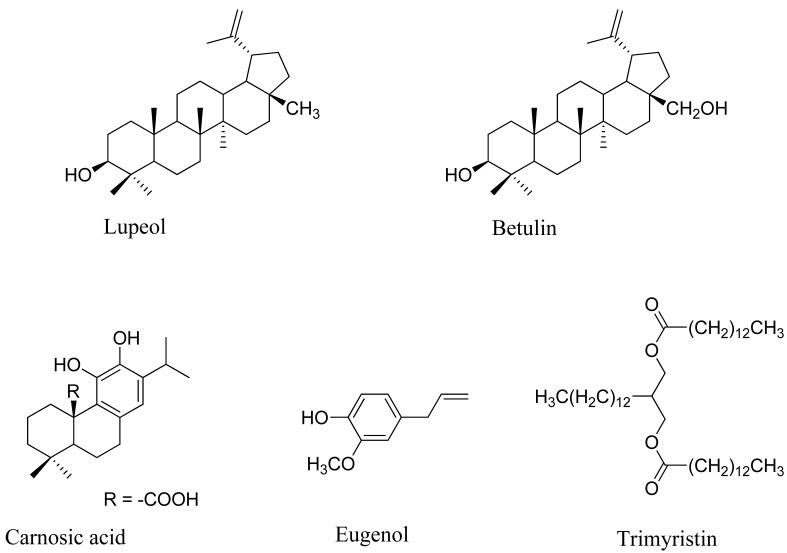
A solvent system consisting of ethyl acetate, ethyl alcohol and water, in the volume ratio of 4.5:4.5:1, was developed and used to extract, at room temperature, betulin from white birch bark and antioxidants from spices (rosemary, thyme, sage, and oregano) and white oak chips. In addition, under reflux conditions, trimyristin was extracted from nutmeg using the same solvent system, and eugenol from olives was extracted using a mixture of salt water and ethyl acetate. The protocol demonstrates the use of water in organic solvents to extract natural products from plants. Measurement of the free-radical scavenging activity using by 2,2-diphenyl-1-picrylhydrazyl (DPPH) indicated that the extraction of plant material using ethyl acetate, ethyl alcohol and water (4.5:4.5:1, v/v/v) was exhaustive when carried out at room temperature for 96 h.
Overview
The claims and statistics of this paper haven’t been checked yet.
Free: it reads the open-access text and checks the first 5 claims that cite a source we can check. Create a free account to check every claim.
Integrity signals
Registry
Cites
Statistics
Figures
Verification
Claims the paper makes
The claims and statistics of this paper haven’t been checked yet.
Free: it reads the open-access text and checks the first 5 claims that cite a source we can check. Create a free account to check every claim.
Claims other papers make about this one
Each is checked against this paper’s own text: does it say what the citing paper says it does?
The cited source says what the claim attributes to it.
In the citing paper
“Lugemwa used water-organic solvent mixtures for the isolation of trimyristin from nutmeg and obtained the desired triglyceride with a yield of only 8% at the end of 1 hour of extraction (19).”
From An improved isolation of trimyristin from Myristica fragrans as a renewable feedstock with assistance of novel cationic gemini surfactant (2020) · cites this paper as [19]
Self-check
Percentages, sums and reported differences re-computed from the paper’s own numbers.
The self-check needs the paper’s full text.
Citations
Cites
Antioxidant Determinations by the Use of a Stable Free Radical
BLOIS, M. S. (1958) · Nature · doi:10.1038/1811199a0 · Cited by 12,994
ON TYROSINE AND TRYPTOPHANE DETERMINATIONS IN PROTEINS
Folin, O., & Ciocalteu, V. (1927) · Journal of Biological Chemistry · doi:10.1016/s0021-9258(18)84277-6 · Cited by 2,946
Subcritical Water Extraction of Antioxidant Compounds from Rosemary Plants
Ibañez, E., Kubátová, A., Señoráns, F. J., Cavero, S., Reglero, G., & Hawthorne, S. B. (2003) · Journal of Agricultural and Food Chemistry · doi:10.1021/jf025878j · Cited by 417 · cited 1×
“Carnosic acid has been extracted from rosemary by different methods, including supercritical carbon dioxide and super-heated water [17–23].”
MethodPhenolic compounds in food and their effects on health
Harborne, J. B. (1993) · Phytochemistry · doi:10.1016/0031-9422(93)85492-a · Cited by 414
Albu, S., Joyce, E., Paniwnyk, L., Lorimer, J. P., & Mason, T. J. (2004) · Ultrasonics Sonochemistry · doi:10.1016/j.ultsonch.2004.01.015 · Cited by 334 · cited 1×
“The free-radical scavenging activity was measured by the ,-diphenyl-1-picrylhydrazyl (DPPH) method described by Blois, with some modification [17].”
MethodMiura, K., Kikuzaki, H., & Nakatani, N. (2002) · Journal of Agricultural and Food Chemistry · doi:10.1021/jf011314o · Cited by 276 · cited 1×
“In order to further test the efficacy of extraction at room temperature without isolating any one pure compound, four spices and white oak wood that contain antioxidants [24,25] were extracted twice, and the radical-scavenging activity of the two different extracts measured by ,-diphenyl-1-picrylhydrazyl (DPPH) assa…”
MethodMilos, M. (2000) · Food Chemistry · doi:10.1016/s0308-8146(00)00144-8 · Cited by 235
Glabasnia, A., & Hofmann, T. (2006) · Journal of Agricultural and Food Chemistry · doi:10.1021/jf052617b · Cited by 216 · cited 1×
“The wood components that are hydrophobic and have low solubility in aqueous solvent systems include ellagic acid, furfural, vanillin, and syringaldehyde [13,14].”
BackgroundVolatile Compounds in Spanish, French, and American Oak Woods after Natural Seasoning and Toasting
Cadahía, E., de Simón, B. F., & Jalocha, J. (2003) · Journal of Agricultural and Food Chemistry · doi:10.1021/jf0302456 · Cited by 195 · cited 1×
“During the maturation of distilled spirits in wood casks, the ethyl alcohol-water mixture extracts several compounds from the wood during the slow maturation process [11,12].”
BackgroundExtraction of Rosemary by Superheated Water
Basile, A., Jiménez-Carmona, M. M., & Clifford, A. A. (1998) · Journal of Agricultural and Food Chemistry · doi:10.1021/jf980437e · Cited by 175 · cited 1×
“Carnosic acid has been extracted from rosemary by different methods, including supercritical carbon dioxide and super-heated water [17–23].”
MethodSupercritical Fluid Extraction and Fractionation of Different Preprocessed Rosemary Plants
Ibáñez, E., Oca, A., de Murga, G., López-Sebastián, S., Tabera, J., & Reglero, G. (1999) · Journal of Agricultural and Food Chemistry · doi:10.1021/jf980982f · Cited by 159 · cited 1×
“Carnosic acid has been extracted from rosemary by different methods, including supercritical carbon dioxide and super-heated water [17–23].”
MethodPhenolic compounds in food and their effects on health II
Pratt, D. B. (1992) · Medical Entomology and Zoology · Cited by 152
Betulin and lupeol in bark from four white-barked birches
O'Connell, M. M., Bentley, M. D., Campbell, C. S., & Cole, B. J. W. (1988) · Phytochemistry · doi:10.1016/0031-9422(88)80120-1 · Cited by 141 · cited 1×
“The extraction of betulin from white birch bark has been carried out using different solvents [3,15,16].”
MethodFerreira, V., Escudero, A., Fernández, P., & Cacho, J. F. (1997) · Zeitschrift für Lebensmittel-Untersuchung und -Forschung. B, Referate und Lebensmittelrecht · doi:10.1007/s002170050187 · Cited by 123
Tena, M. T., Valcárcel, M., Hidalgo, P. J., & Ubera, J. L. (1997) · Analytical Chemistry · doi:10.1021/ac960506t · Cited by 114 · cited 1×
“Carnosic acid has been extracted from rosemary by different methods, including supercritical carbon dioxide and super-heated water [17–23].”
MethodAllobetulin and Its Derivatives: Synthesis and Biological Activity
Dehaen, W., Mashentseva, A. A., & Сейтембетов, Т. С. (2011) · Molecules · doi:10.3390/molecules16032443 · Cited by 111
Extraction and Evolution of Lignin Products in Armagnac Matured in Oak
Puech, J. (1981) · American Journal of Enology and Viticulture · doi:10.5344/ajev.1981.32.2.111 · Cited by 99 · cited 1×
“During the maturation of distilled spirits in wood casks, the ethyl alcohol-water mixture extracts several compounds from the wood during the slow maturation process [11,12].”
BackgroundChen, Q., Fu, M.-L., Liu, J., Zhang, H., He, G., & Ruan, H. (2008) · Ultrasonics Sonochemistry · doi:10.1016/j.ultsonch.2008.11.009 · Cited by 75 · cited 1×
“The extraction of betulin from white birch bark has been carried out using different solvents [3,15,16].”
MethodDetermination of the Carnosic Acid Content in Wild and Cultivated Rosmarinus officinalis
Hidalgo, P. J., Ubera, J. L., Tena, M. T., & Valcárcel, M. (1998) · Journal of Agricultural and Food Chemistry · doi:10.1021/jf970974j · Cited by 68 · cited 1×
“Carnosic acid has been extracted from rosemary by different methods, including supercritical carbon dioxide and super-heated water [17–23].”
MethodIsolation of Betulin and Rearrangement to Allobetulin. A Biomimetic Natural Product Synthesis
Green, B., Bentley, M. D., Chung, B. Y., Lynch, N. G., & Jensen, B. L. (2007) · Journal of Chemical Education · doi:10.1021/ed084p1985 · Cited by 68
Galloylglucosides from Berries of Pimenta dioica
Kikuzaki, H., Sato, A., Mayahara, Y., & Nakatani, N. (2000) · Journal of Natural Products · doi:10.1021/np9906121 · Cited by 60 · cited 1×
“Toxic organic solvents such as dichloromethane, chloroform, benzene, and toluene are frequently used for extracting compounds from different sources in natural products research [3,5–10].”
BackgroundSocha, A. M., Garcia, D. R., Sheffer, R., & Rowley, D. C. (2006) · Journal of Natural Products · doi:10.1021/np050449b · Cited by 58
Graber, M. A., & Gerwick, W. H. (1998) · Journal of Natural Products · doi:10.1021/np970539j · Cited by 58
Meksuriyen, D., Cordell, G. A., Ruangrungsi, N., & Tantivatana, P. (1987) · Journal of Natural Products · doi:10.1021/np50054a018 · Cited by 47 · cited 1×
“The raw material can be macerated and suspended in a solvent at room temperature for a few h to several days [1,2]; it can be boiled in organic solvents such as toluene [3]; or, can be directly extracted using a Soxhlet apparatus [4].”
A New Limonoid Insect Antifeedant from the Fruit of Melia volkensii
Rajab, M. S., Bentley, M. D., Alford, A. R., & Mendel, M. J. (1988) · Journal of Natural Products · doi:10.1021/np50055a030 · Cited by 44 · cited 1×
“The raw material can be macerated and suspended in a solvent at room temperature for a few h to several days [1,2]; it can be boiled in organic solvents such as toluene [3]; or, can be directly extracted using a Soxhlet apparatus [4].”
Betulin isolation from birch bark by vacuum and atmospheric sublimation. A thermogravimetric study
Guidoin, M.-F., Yang, J. R., Pichette, A., & Roy, C. (2003) · Thermochimica Acta · doi:10.1016/s0040-6031(02)00358-1 · Cited by 35 · cited 1×
“Toxic organic solvents such as dichloromethane, chloroform, benzene, and toluene are frequently used for extracting compounds from different sources in natural products research [3,5–10].”
BackgroundComparative toxicity assessment of three Tephrosia species on Artemia salina and animal cell lines
Subhadra, S., Ravindran, V., Chintala, S., Kanacharalapalli, V., Parre, S., & Thatipally, R. (2011) · Journal of Natural Pharmaceuticals · doi:10.4103/2229-5119.86262 · Cited by 19
Sesterterpenoids and Diterpenoids of the Wax Excreted by a Scale Insect, Ceroplastes pseudoceriferus
Toki, M., Ooi, T., & Kusumi, T. (1999) · Journal of Natural Products · doi:10.1021/np990170t · Cited by 18 · cited 1×
“Toxic organic solvents such as dichloromethane, chloroform, benzene, and toluene are frequently used for extracting compounds from different sources in natural products research [3,5–10].”
Background15. Triterpene constituents of the fruits of the osage orange (maclura pomifera)
Lewis, K. (1959) · Journal of the Chemical Society (Resumed) · doi:10.1039/jr9590000073 · Cited by 17
Calycopterones and Calyflorenones, Novel Biflavonoids from Calycopteris floribunda
Mayer, R. (1999) · Journal of Natural Products · doi:10.1021/np990182e · Cited by 16 · cited 1×
“The raw material can be macerated and suspended in a solvent at room temperature for a few h to several days [1,2]; it can be boiled in organic solvents such as toluene [3]; or, can be directly extracted using a Soxhlet apparatus [4].”
Maxima Isoflavone J: a New O-Prenylated Isoflavone from Tephrosia maxima
Murthy, M. S. R., & Rao, E. V. (1985) · Journal of Natural Products · doi:10.1021/np50042a015 · Cited by 16
7α,20(S)-Dihydroxy-4,24(28)-ergostadien-3-one from Entandrophragma utile
Tchouankeu, J. C., Nyasse, B., Tsamo, E., & Connolly, J. D. (1996) · Journal of Natural Products · doi:10.1021/np960132z · Cited by 13
Research works printed but not linked: 1
- Postovskn I.Ya. Structure of betulin J. Russ. Phys.-Chem. Soc. 1930 62 101 109
Cited by
Betulin and its derivatives as novel compounds with different pharmacological effects
Amiri, S., Dastghaib, S., Ahmadi, M., Mehrbod, P., Khadem, F., Behrouj, H., Aghanoori, M.-R., Machaj, F., Ghamsari, M., Rosik, J., et al. (2020) · Biotechnology Advances · doi:10.1016/j.biotechadv.2019.06.008 · Cited by 272
Šiman, P., Filipová, A., Tichá, A., Niang, M., Bezrouk, A., & Havelek, R. (2016) · PLoS ONE · doi:10.1371/journal.pone.0154933 · Cited by 94
Methods of Betulin Extraction from Birch Bark
Demets, O. V., Takibayeva, A. T., Касенов, Р. З., & Aliyeva, M. R. (2022) · Molecules · doi:10.3390/molecules27113621 · Cited by 77
Kerosenewala, J., Vaidya, P., Ozarkar, V., Shirapure, Y., & More, A. P. (2022) · Polymer Bulletin · doi:10.1007/s00289-022-04414-9 · Cited by 57
HPLC Fingerprint of Important Phenolic Compounds in Some Salvia L. Species from Iran
(2018) · Records of Natural Products · doi:10.25135/rnp.72.18.02.228 · Cited by 54
Metadata
- Authors
- Lugemwa, F. N.
- Affiliations
- Pennsylvania State University (US)
- Corresponding author
- Lugemwa, Fulgentius N.
- Venue
- Molecules
- Publisher
- MDPI AG
- Published
- 2012-08-03
- Volume
- 17
- Issue
- 8
- Pages
- 9274-9282
- ISSN
- 1420-3049 (ISSN-L)
- PMC
- PMC6268899
- OpenAlex
- W2115239996
- Cited by
- 32
- References
- 32
- Citations by year
- 2024: 2 · 2023: 3 · 2022: 2 · 2021: 3 · 2020: 3 · 2019: 3 · 2018: 4 · 2017: 1 · 2016: 3 · 2015: 4 · 2014: 3 · 2013: 1
- FWCI
- 1.79
- Type
- journal article
- Language
- en
- Open access
- gold
- doi.org
- Licence
- Locations
- Molecules (publishedVersion, cc-by)
- Europe PMC (PubMed Central) (publishedVersion, cc-by)
- PubMed Central (publishedVersion, cc-by)
- PubMed (publishedVersion)
- DOAJ (DOAJ: Directory of Open Access Journals) (submittedVersion)
- Topics
- Health Sciences › Medicine › Biochemistry (medical) › Phytochemicals and Antioxidant Activities
- Life Sciences › Agricultural and Biological Sciences › Food Science › Agricultural and Biological Research
- Physical Sciences › Chemistry › Organic Chemistry › Phytochemical Studies and Bioactivities
- Keywords
- betulin, trimyristin, eugenol, carnosic acid, ethyl acetate, ethanol, nutmeg, olive, Rosmarinus officinalis, thyme, sage, oregano, antioxidants, free radical scavenging, DPPH assay, natural product extraction
- MeSH terms
- Acetates, Betulinic Acid, Ethanol, Biphenyl Compounds, Eugenol, Free Radicals, Picrates, Plant Extracts, Solvents, Triglycerides, Triterpenes, Water, Free Radical Scavengers, Plant Bark, Myristica, Rosmarinus, Salvia officinalis, Betula, Quercus, Origanum, Abietanes, Thymus Plant, Liquid-Liquid Extraction
About these checks
Registry, retraction, Cites and statistics results are computed, not judged, with one exception: a printed reference that no index lists is read once by a model before it counts as a citation error. Claims are extracted by a model and kept only when their quote appears verbatim in the text; each cited source is then checked, with a model’s help, for whether it says what the claim relies on. Those verdicts can be wrong — read the claim’s quote and the cited source before relying on one.
Statistics and arithmetic are recomputed, not judged.
Confidence bands are shown only for fields calibrated on our annotated test set. None is calibrated yet, so no band is shown.
What counts as a claim ›How we measure confidence ›How we check this ›
Are you an author, or do you see a problem with this page? Request a review
Data sources
Bibliographic data: Semantic Scholar, OpenAlex, Crossref.
Contains information from the Semantic Scholar Academic Graph Datasets, made available under the ODC Attribution License (ODC-BY 1.0).
Semantic Scholar’s data is described in: Kinney, R., et al. (2023). The Semantic Scholar Open Data Platform. arXiv:2301.10140.
