

The DOI matches its Crossref record; 55 of the 56 references it cites were found in a registry or an index.
Synthesis and Electrochemical Properties of Two-Dimensional RGO/Ti3C2Tx Nanocomposites
Open accessAbstract
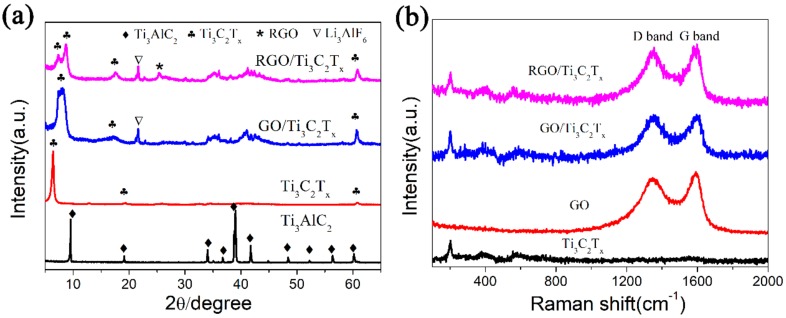
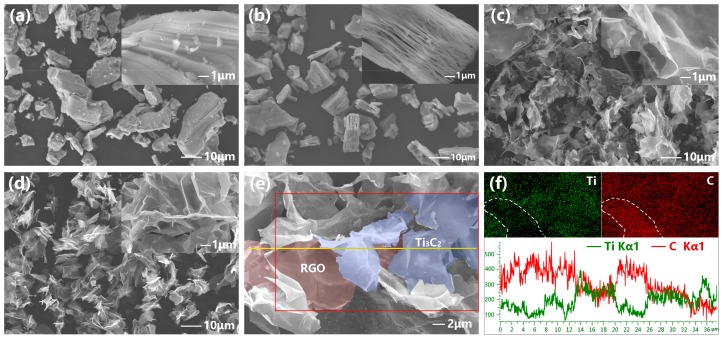
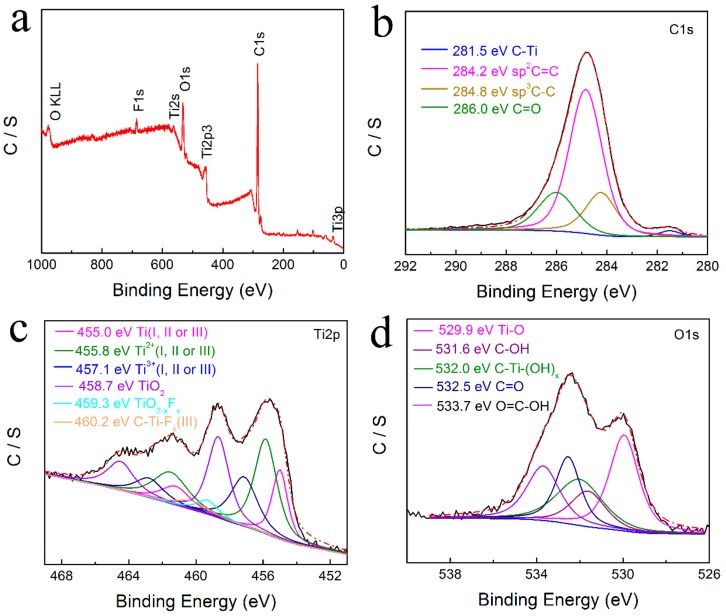
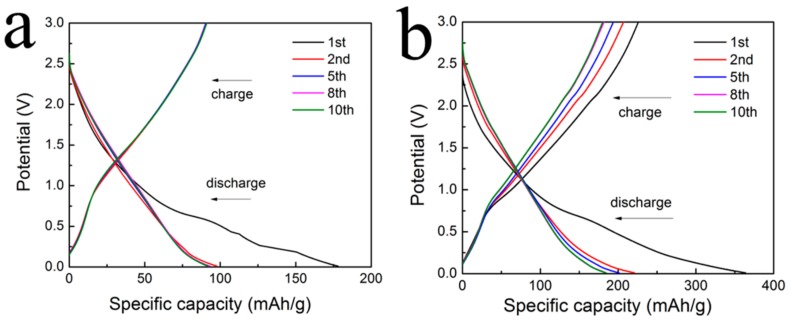
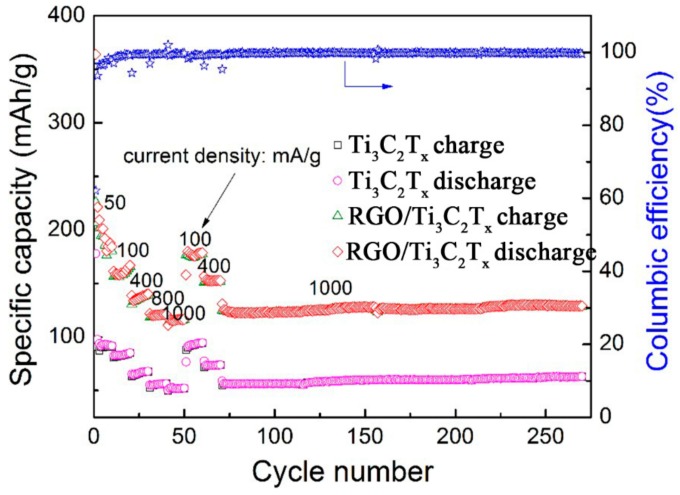
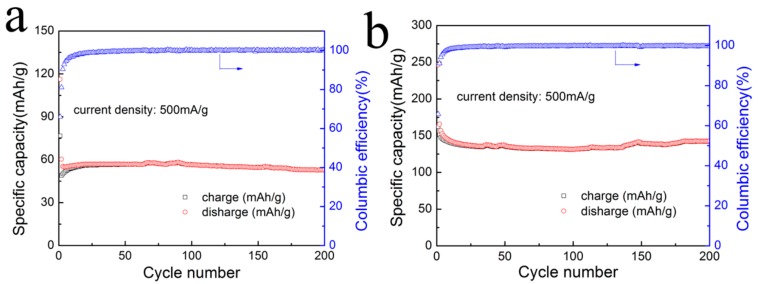
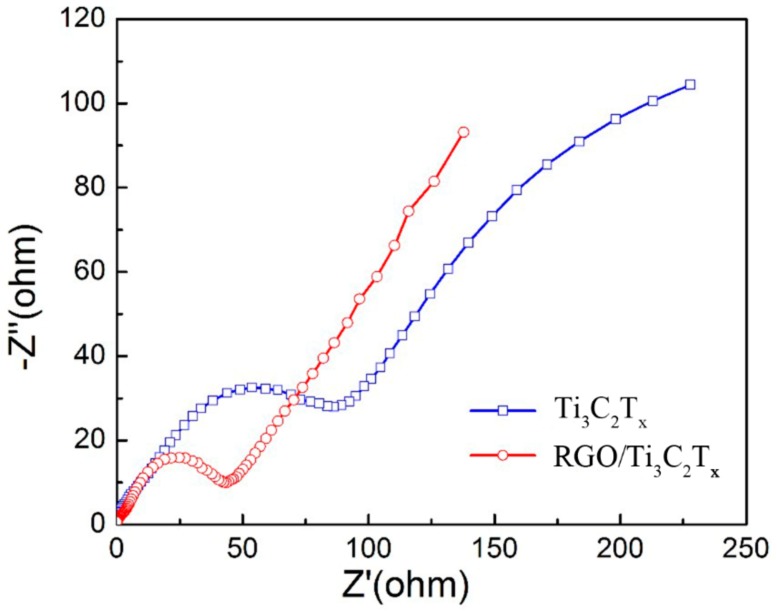
MXene is a new type of two-dimensional layered material. Herein, a GO/Ti3C2Tx nanocomposite was prepared by a simple liquid phase method, and the obtained GO/Ti3C2Tx was transformed into RGO/Ti3C2Tx under high temperature with Ar/H2. The prepared samples were characterized using X-ray diffraction (XRD), Raman measurement, scanning electron microscopy (SEM), energy disperse spectroscopy (EDS), and X-ray photoelectron spectroscopy (XPS). As an electrode material in lithium-ion batteries, the RGO/Ti3C2Tx nanocomposite exhibited an excellent electrochemical performance and an excellent rate performance. Compared to pure Ti3C2Tx, the nanocomposite had a better reversible capacity at different current densities and had no attenuation after 200 cycles, which is one time higher than pure Ti3C2Tx. The improvement in the specific capacity was due to the excellent electrical conductivity and the unique structure of RGO, in which a charge transfer bridge was built among the Ti3C2Tx flakes. Such a bridge shortened the transmission distance of the electrons and ions and effectively controlled the restacking of the laminated materials.
Overview
The claims and statistics of this paper haven’t been checked yet.
Run the check — free, no account needed. It reads the open-access text and checks the sources it cites.
Integrity signals
Registry
Cites
Statistics
Figures
Verification
Claims the paper makes
The claims and statistics of this paper haven’t been checked yet.
Run the check — free, no account needed. It reads the open-access text and checks the sources it cites.
Claims other papers make about this one
Each is checked against this paper’s own text: does it say what the citing paper says it does?
The check wasn’t confident either way, so it gives no verdict — never disputed.
In the citing paper
“the MXene utilized in this study can be oxidized at temperature higher than 600 °C [20, 32–34]”
From Hybrid MXene/reduced graphene oxide aerogel microspheres for hydrogen evolution reaction (2021) · cites this paper as [34]
Experimental — accuracy not yet measured
Self-check
Percentages, sums and reported differences re-computed from the paper’s own numbers.
The self-check needs the paper’s full text.
Citations
Cites
Two‐Dimensional Nanocrystals Produced by Exfoliation of Ti 3 AlC 2
Naguib, M., Kurtoglu, M., Presser, V., Lu, J., Niu, J., Heon, M., Hultman, L., Gogotsi, Y. G., & Barsoum, M. W. (2011) · Advanced Materials · doi:10.1002/adma.201102306 · Cited by 12,026 · cited 2×
“The A element is selectively etched from the MAX phase using hydrofluoric acid (HF) [9,13] or a mixture of fluoride salt and hydrochloric acid (HCl) [14] to produce MXene, which are known to possess graphene-like 2D structures.”
BackgroundMethodThe chemistry of graphene oxide
Dreyer, D. R., Park, S., Bielawski, C. W., & Ruoff, R. S. (2010) · Chem. Soc. Rev. · doi:10.1039/b917103g · Cited by 11,653 · cited 1×
“GO was synthesized with expanded graphite by a modified Hummers method [42].”
Method25th Anniversary Article: MXenes: A New Family of Two‐Dimensional Materials
Naguib, M., Mochalin, V. N., Barsoum, M. W., & Gogotsi, Y. G. (2013) · Advanced Materials · doi:10.1002/adma.201304138 · Cited by 6,453 · cited 2×
“5)3C2, Ti3CN, Ta4C3, Nb2C, V2C, and Nb4C3 [13,16].”
MethodTwo-Dimensional Transition Metal Carbides
Naguib, M., Mashtalir, O., Carle, J., Presser, V., Lu, J., Hultman, L., Gogotsi, Y. G., & Barsoum, M. W. (2012) · ACS Nano · doi:10.1021/nn204153h · Cited by 4,818 · cited 1×
“For example, MXene contains Ti3C2Tx and Ti2CTx [8,9].”
BackgroundCation Intercalation and High Volumetric Capacitance of Two-Dimensional Titanium Carbide
Lukatskaya, M. R., Mashtalir, O., Ren, C. E., Dall’Agnese, Y., Rozier, P., Taberna, P., Naguib, M., Simon, P., Barsoum, M. W., & Gogotsi, Y. G. (2013) · Science · doi:10.1126/science.1241488 · Cited by 4,365
The MN+1AXN phases: A new class of solids
Barsoum, M. W. (2000) · Progress in Solid State Chemistry · doi:10.1016/s0079-6786(00)00006-6 · Cited by 3,685
Science and technology roadmap for graphene, related two-dimensional crystals, and hybrid systems
Ferrari, A. C., Bonaccorso, F., Fal’ko, V. I., Novoselov, K. S., Roche, S., Bøggild, P., Borini, S., Koppens, F. H. L., Palermo, V., Pugno, N. M., et al. (2014) · Nanoscale · doi:10.1039/c4nr01600a · Cited by 3,065
Intercalation and delamination of layered carbides and carbonitrides
Mashtalir, O., Naguib, M., Mochalin, V. N., Dall’Agnese, Y., Heon, M., Barsoum, M. W., & Gogotsi, Y. G. (2013) · Nature Communications · doi:10.1038/ncomms2664 · Cited by 2,874
Flexible and conductive MXene films and nanocomposites with high capacitance
Ling, Z., Ren, C. E., Zhao, M., Yang, J. H., Giammarco, J. M., Qiu, J., Barsoum, M. W., & Gogotsi, Y. G. (2014) · Proceedings of the National Academy of Sciences · doi:10.1073/pnas.1414215111 · Cited by 2,284
Tang, Q. H., Zhou, Z. P., & Shen, P. (2012) · Journal of the American Chemical Society · doi:10.1021/ja308463r · Cited by 2,254
Cited by
Sorted by citations
Advances in the Synthesis of 2D MXenes
Yi, W., Zhang, P., Soomro, R. A., Zhu, Q., & Xu, B. (2021) · Advanced Materials · doi:10.1002/adma.202103148 · Cited by 1,241
Surface Termination Dependent Work Function and Electronic Properties of Ti3C2Tx MXene
Schultz, T., Frey, N. C., Hantanasirisakul, K., Park, S., May, S. J., Shenoy, V. B., Gogotsi, Y. G., & Koch, N. (2019) · Chemistry of Materials · doi:10.1021/acs.chemmater.9b00414 · Cited by 738
Flexible 3D Porous MXene Foam for High‐Performance Lithium‐Ion Batteries
Zhao, Q. C., Zhu, Q., Miao, J., Zhang, P., Wan, P., He, L., & Xu, B. (2019) · Small · doi:10.1002/smll.201904293 · Cited by 391
MXene as emerging material for photocatalytic degradation of environmental pollutants
Solangi, N. H., Karri, R. R., Mazari, S. A., Mubarak, N. M., Jatoi, A. S., Malafaia, G., & Азад, А. К. (2022) · Coordination Chemistry Reviews · doi:10.1016/j.ccr.2022.214965 · Cited by 284
Yuan, S., Lai, Q., Duan, X., & Wang, Q. (2023) · Journal of Energy Storage · doi:10.1016/j.est.2023.106716 · Cited by 265
Wang, L., Liu, H., Lv, X., Cui, G., & Gu, G. (2020) · Journal of Alloys and Compounds · doi:10.1016/j.jallcom.2020.154251 · Cited by 243
Self-citationWu, X., Ding, M., Xu, H., Yang, W. J., Zhang, K., Tian, H., Wang, H., & Xie, Z. (2020) · ACS Nano · doi:10.1021/acsnano.0c04471 · Cited by 233
Venkateshalu, S., & Grace, A. N. (2019) · Applied Materials Today · doi:10.1016/j.apmt.2019.100509 · Cited by 224
Nguyen, V.-T., Min, B. K., Yi, Y., Kim, S. J., & Choi, C. (2020) · Chemical Engineering Journal · doi:10.1016/j.cej.2020.124608 · Cited by 218
Ti3C2Tx MXene core-shell spheres for ultrahigh removal of mercuric ions
Shahzad, A., Nawaz, M., Moztahida, M., Jang, J., Tahir, K., Kim, J., Lim, Y., Vassiliadis, V. S., Woo, S. H., & Lee, D. S. (2019) · Chemical Engineering Journal · doi:10.1016/j.cej.2019.02.160 · Cited by 211
Synthesis and electrochemical properties of V2C MXene by etching in opened/closed environments
Wu, M., He, Y., Wang, L., Xia, Q., & Zhou, A.-G. (2020) · Journal of Advanced Ceramics · doi:10.1007/s40145-020-0411-8 · Cited by 140
Self-citationHe, Y., Ma, L., Zhou, L., Liu, G., Jiang, Y., & Gao, J. Y. (2020) · Nanomaterials · doi:10.3390/nano10050866 · Cited by 150
“It is in agreement with previous reports [20].”
Result3D Porous Ti3C2 MXene/NiCo-MOF Composites for Enhanced Lithium Storage
Liu, Y., He, Y., Vargün, E., Plachý, T., Sáha, P., & Cheng, Q. (2020) · Nanomaterials · doi:10.3390/nano10040695 · Cited by 145
Yang, S., Lee, Y., Kang, H.-S., Park, S.-K., & Kang, Y.-C. (2021) · Nano-Micro Letters · doi:10.1007/s40820-021-00741-0 · Cited by 122
MXene‐Based Anodes for Metal‐Ion Batteries
Greaves, M. D., Barg, S., & Bissett, M. A. (2019) · Batteries & Supercaps · doi:10.1002/batt.201900165 · Cited by 137
Advancements in MXene-Polymer Nanocomposites in Energy Storage and Biomedical Applications
Parajuli, D., Murali, N., Devendra, K. C., Karki, B., Samatha, K., Kim, A. A., Park, M., & Pant, B. (2022) · Polymers · doi:10.3390/polym14163433 · Cited by 125
Zhang, S., Zahed, M. A., Sharifuzzaman, M., Yoon, S., Hui, X., Barman, S. C., Sharma, S., Yoon, H. S., Park, C., & Park, J. Y. (2020) · Biosensors and Bioelectronics · doi:10.1016/j.bios.2020.112844 · Cited by 126
Chen, Y., Zhao, P., Liang, Y., Ma, Y., Liu, Y., Zhao, J., Hou, J., Hou, C., & Huo, D. (2023) · Talanta · doi:10.1016/j.talanta.2023.124294 · Cited by 123
Liu, L., Ying, G., Wen, D., Zhang, K., Hu, C. F., Zheng, Y., Zhang, C., Wang, X., & Wang, C. (2020) · Materials & Design · doi:10.1016/j.matdes.2020.109276 · Cited by 105
Self-citationMicrowave-assisted rapid MAX phase etching and delamination: A paradigm shift in MXene synthesis
Numan, A., Rafique, S., Khalid, M., Zaharin, H. A., Radwan, A., Mokri, N. A., Oh, P. C., & Walvekar, R. (2022) · Materials Chemistry and Physics · doi:10.1016/j.matchemphys.2022.126429 · Cited by 101
Dong, B., Qiu, F., Li, Q., Shu, S., Yang, H., & Jiang, Q. (2019) · Nanomaterials · doi:10.3390/nano9081152 · Cited by 98
PVA / SA / MXene dual‐network conductive hydrogel for wearable sensor to monitor human motions
Wang, T., Wang, J., Li, Z., Yue, M., Qing, X., Zhang, P., Liao, X., Fan, Z., & Yang, S. (2021) · Journal of Applied Polymer Science · doi:10.1002/app.51627 · Cited by 89
Jangra, S., Kumar, B., Sharma, J., Sengupta, S., Das, S., Brajpuriya, R. K., Ohlan, A., Mishra, Y., & Goyat, M. (2024) · Journal of Energy Storage · doi:10.1016/j.est.2024.113810 · Cited by 74
Kitchamsetti, N., & Cho, J. S. (2024) · Journal of Energy Storage · doi:10.1016/j.est.2023.110293 · Cited by 87
Ali, H. G., Khan, K., Hanif, M. B., Khan, M. Z., Hussain, I., Javed, M. S., AL-bonsrulah, H. A. Z., Mosiałek, M., Fichtner, M., & Motola, M. (2023) · Journal of Energy Storage · doi:10.1016/j.est.2023.108980 · Cited by 89
Rajendran, J., Sundramoorthy, A. K., Ganapathy, D. M., Atchudan, R., Habila, M. A., & Nallaswamy, D., V (2022) · Journal of Hazardous Materials · doi:10.1016/j.jhazmat.2022.129705 · Cited by 72
Rajendran, J. (2023) · Journal of Hazardous Materials · doi:10.1016/j.jhazmat.2023.130979 · Cited by 72
Gan, R., Yang, N., Dong, Q., Fu, N., Wu, R. F., Li, C., Liao, Q., Li, J., & Wei, Z. (2020) · Journal of Materials Chemistry A · doi:10.1039/d0ta02374d · Cited by 67
He, Y., Wang, Z., Ma, L., Zhou, L., Jiang, Y., & Gao, J. (2020) · RSC Advances · doi:10.1039/d0ra02522d · Cited by 64
Emerging 2D MXenes as next-generation materials for energy storage applications
Solangi, N. H., Karri, R., Mubarak, N. M., Mazari, S., & Azad, A. (2023) · Journal of Energy Storage · doi:10.1016/j.est.2023.108004 · Cited by 52
MXenes from MAX phases: synthesis, hybridization, and advances in supercapacitor applications
Paul, T. K., Khaleque, M. A., Ali, M. R., Aly, M. A. S., Bacchu, M. S., Rahman, S., & Khan, M. Z. H. (2025) · RSC Advances · doi:10.1039/d5ra00271k · Cited by 65
Bharath, G., Hai, A., Rambabu, K., Savariraj, A. D., Ibrahim, Y., & BANAT, F. A. (2019) · Environmental Science Water Research & Technology · doi:10.1039/c9ew00805e · Cited by 60
Lyu, P., Zhu, J., Han, C., Qiang, L., Zhang, L., Mei, B., He, J., Liu, X., Bian, Z., & Li, H. (2020) · ACS Applied Materials & Interfaces · doi:10.1021/acsami.0c19414 · Cited by 60
Self-citationZhu, J.-J., Avireddy, H., Biendicho, J. J., Martinez-Soria, L., Rueda-García, D., Morante, J. R., Ballesteros, B., & Gómez‐Romero, P. (2022) · Journal of Colloid and Interface Science · doi:10.1016/j.jcis.2022.04.170 · Cited by 60
Ti3C2Tx MXene@rGO composite electrodes for high-performance supercapacitor applications
Rundla, A., Priyanka, Kumar, B., Tripathi, P., Kumar, P., & Singh, K. (2025) · Journal of Power Sources · doi:10.1016/j.jpowsour.2025.236408 · Cited by 59
Wang, R., Chang, Z., Fang, Z., Xiao, T., Zhu, Z., Ye, B., Xu, C., & Cheng, J. (2020) · International Journal of Hydrogen Energy · doi:10.1016/j.ijhydene.2020.03.068 · Cited by 59
Kitchamsetti, N., & de Barros, A. L. F. (2023) · ChemCatChem · doi:10.1002/cctc.202300690 · Cited by 56
Flexible Ti3C2Tx/Graphene Films with Large‐Sized Flakes for Supercapacitors
Guo, T., Fu, M., Zhou, D., Pang, L., Su, J., Lin, H., Yao, X., & Sombra, A. S. B. (2021) · Small Structures · doi:10.1002/sstr.202100015 · Cited by 55
Jiang, F., Du, R., Yan, X., Zhang, M., Han, Q., Sun, X., Zhang, X., & Zhou, Y. (2019) · Electrochimica Acta · doi:10.1016/j.electacta.2019.135146 · Cited by 54
Su, M., Lan, H., Tian, L., Jiang, M., Cao, X., Zhu, C., & Yu, C. (2021) · Sensors and Actuators B Chemical · doi:10.1016/j.snb.2022.132019 · Cited by 56
“Visualization” Gas—Gas Sensors Based on High Performance Novel MXenes Materials
Wang, Y., Wang, Y., Kuai, Y., & Jian, M. (2023) · Small · doi:10.1002/smll.202305250 · Cited by 53
Fu, Y., Cheng, Y., Weı, Q., Zhao, Y., Zhang, W., Yang, Y., & Li, D. (2022) · Applied Surface Science · doi:10.1016/j.apsusc.2022.153783 · Cited by 51
Yuan, K., Hao, P., Hu, X., Zhang, J., & Zhou, Y. (2022) · Journal of Materials Science · doi:10.1007/s10853-022-06983-6 · Cited by 47
MXene-Based Ink Design for Printed Applications
Aghayar, Z., Malaki, M., & Zhang, Y. (2022) · Nanomaterials · doi:10.3390/nano12234346 · Cited by 47
Liu, D., Wang, L., He, Y., Liu, L., Yang, Z., Wang, B., Xia, Q., Hu, Q., & Zhou, A. (2020) · Energy Technology · doi:10.1002/ente.202000753 · Cited by 47
Self-citationWang, Y., Wu, X., Sun, J., Wang, C., Zhu, G., Bai, L., Jiang, Z., & Zhang, W. (2022) · Electrochemistry Communications · doi:10.1016/j.elecom.2022.107233 · Cited by 46
Progress of Advanced Cathode Materials of Rechargeable Aluminum-Ion Batteries
Ma, D., Li, J., He, L., Yuan, D., Ji, Z., Manawan, M. T. E., de León, C. P., Wu, C. K., & Pan, J. H. (2024) · Energy Material Advances · doi:10.34133/energymatadv.0088 · Cited by 46
Raagulan, K., Braveenth, R., Jang, H. J., Lee, Y. S., Yang, C., Kim, B. M., Moon, J. J., & Chai, K. Y. (2018) · Bulletin of the Korean Chemical Society · doi:10.1002/bkcs.11616 · Cited by 45
Raagulan, K., Braveenth, R., Lee, L. R., Lee, J., Kim, B., Moon, J. J., Lee, S. B., & Chai, K. Y. (2019) · Nanomaterials · doi:10.3390/nano9040519 · Cited by 44
Ashok, A., Saseendran, S. B., & Asha, A. S. (2022) · Physica Scripta · doi:10.1088/1402-4896/ac4c53 · Cited by 42
2D Nb2CTx MXene/MoS2 heterostructure construction for nonlinear optical absorption modulation
Wang, Y., Dong, Y., Dong, Y., Zhou, L., Kang, J., Wang, N., Li, Y., Yuan, X., Zhang, Z., Huang, H., et al. (2023) · Opto-Electronic Advances · doi:10.29026/oea.2023.220162 · Cited by 43
Hakim, M. W., Ali, I., Fatima, S., Li, H., Jafri, H., & Rizwan, S. (2024) · ACS Omega · doi:10.1021/acsomega.3c04932 · Cited by 46
Preparation, mechanical and thermal characteristics of d-Ti3C2/PVA film
Liu, S., Wang, L., Wang, X., Liu, L., Zhou, A., & Cao, X. (2019) · Materials Today Communications · doi:10.1016/j.mtcomm.2019.100799 · Cited by 40
Self-citationZhang, S., Xu, Z., Duan, H., Xu, A., Xia, Q. X., Yan, Y., & Wu, S. (2020) · Electrochimica Acta · doi:10.1016/j.electacta.2020.135767 · Cited by 41
MXene/MoS2 Piezotronic Acetone Gas Sensor for Management of Diabetes
Siraj, S., Bansal, G., Hasita, B., Srungaram, S., S, S. K., Rybicki, F. J., Sonkusale, S., & Sahatiya, P. (2024) · ACS Applied Nano Materials · doi:10.1021/acsanm.4c00834 · Cited by 39
Liang, Y., Gong, Q., Sun, X. L., Xu, N., Gong, P., & Qiao, J. (2020) · Electrochimica Acta · doi:10.1016/j.electacta.2020.136108 · Cited by 39
Feng, Y., Zhou, F., Dai, Y., Xu, Z., Deng, Q., & Peng, C. (2020) · Ceramics International · doi:10.1016/j.ceramint.2020.04.114 · Cited by 39
Wu, S., Feng, Y., Wu, K., Jiang, W., Xue, Z., Xiong, D., Chen, L., Feng, Z., Wen, K., Li, Z., et al. (2022) · Journal of Alloys and Compounds · doi:10.1016/j.jallcom.2022.167414 · Cited by 39
Phosphate Ion-Modified RuO2/Ti3C2 Composite as a High-Performance Supercapacitor Material
Zhao, J., Liu, F., & Li, W. (2019) · Nanomaterials · doi:10.3390/nano9030377 · Cited by 38
Lingamdinne, L. P., Kulkarni, R., Koduru, J. R., Karri, R. R., Somala, A. R., Solangi, N. H., Mubarak, N. M., Choi, J.-S., Chang, Y., & Dehghani, M. H. (2024) · Journal of Energy Storage · doi:10.1016/j.est.2024.113806 · Cited by 38
Zhao, X. Z., Dall’Agnese, C., Chu, X., Zhao, S., Chen, G., Gogotsi, Y. G., Gao, Y. P., & Dall’Agnese, Y. (2019) · ChemSusChem · doi:10.1002/cssc.201901746 · Cited by 36
Hybrid MXene/reduced graphene oxide aerogel microspheres for hydrogen evolution reaction
Cheng, Y., Zhan, Y., Ran, J., Wang, Z., Agnoli, S., Xia, H., & Granozzi, G. (2021) · Ionics · doi:10.1007/s11581-021-04062-5 · Cited by 34
Sakthivel, R., Lin, Y.-C., Yu, M., Dhawan, U., Liu, X., Chen, J.-C., Tung, C.-W., & Chung, R.-J. (2024) · Colloids and Surfaces B: Biointerfaces · doi:10.1016/j.colsurfb.2024.113755 · Cited by 30
Self-citationPrasanna, S. B., Jagtap, A. A., Kumar, G. S., Ningappa, K. S., Lin, Y., Lu, Y., Sakthivel, R., Liu, T., & Chung, R. (2024) · Electrochimica Acta · doi:10.1016/j.electacta.2024.144703 · Cited by 34
Pd/MXene(Ti 3 C 2 T x )/reduced graphene oxide hybrid catalyst for methanol electrooxidation
Zhang, P., Fan, C., Wang, R., Xu, C., Cheng, J., Wang, L., Lu, Y., & Luo, P. (2019) · Nanotechnology · doi:10.1088/1361-6528/ab5609 · Cited by 34
Self-citationWen, D., Ying, G., Liu, L., Sun, C. G., Li, Y., Zhao, Y., Ji, Z., Wu, Y., Zhang, J., Zhang, J., et al. (2021) · Advanced Materials Interfaces · doi:10.1002/admi.202101453 · Cited by 34
Self-citationElemike, E. E., Osafile, O. E., & Omugbe, E. (2021) · Journal of Energy Storage · doi:10.1016/j.est.2021.102993 · Cited by 34
Li, Y., Xin, B., Lu, Z., Zhou, X. Y., Liu, Y., & Hu, Y. (2021) · International Journal of Energy Research · doi:10.1002/er.6454 · Cited by 31
“As a result, a large number of hydrogen bonds between the surface of modified CC and MXene make them tightly combine together and thus increase the stability of CMCM electrodes.(29) CV curves of CC, OPMCC, and CMCC in the sulfuric acid electrolyte are shown in Figure S1.”
BackgroundGhanbari, R., Wu, D., & Heynderickx, P. M. (2024) · Coordination Chemistry Reviews · doi:10.1016/j.ccr.2024.216253 · Cited by 32
Farjadfar, S., Ghiaci, M., Kulinich, S. A., & Wunderlich, W. (2022) · Materials Research Bulletin · doi:10.1016/j.materresbull.2022.111963 · Cited by 30
Harnessing the unique properties of MXenes for advanced rechargeable batteries
Singh, D., Shukla, V., Khossossi, N., Ainane, A., & Ahuja, R. (2020) · Journal of Physics Energy · doi:10.1088/2515-7655/abceac · Cited by 29
Kaur, R., Chhabra, V. A., Chaudhary, V. K., Vikrant, K., Tripathi, S. K., Su, Y., Kumar, P., Kim, K., & Deep, A. (2022) · International Journal of Energy Research · doi:10.1002/er.8046 · Cited by 29
Gamma‐Ray Tolerant Flexible Pressure–Temperature Sensor for Nuclear Radiation Environment
Mondal, S., Min, B. K., Yi, Y., Nguyen, V., & Choi, C. (2021) · Advanced Materials Technologies · doi:10.1002/admt.202001039 · Cited by 28
Zhang, F., Qi, Z., Han, X., Cai, H., & Yang, K. (2024) · Sustainable Energy & Fuels · doi:10.1039/d4se00617h · Cited by 27
Shen, L., Dong, J., Wen, B., Wen, X., & Li, J. (2023) · Nanomaterials · doi:10.3390/nano13040707 · Cited by 27
Alaizeri, Z. M., Alhadlaq, H. A., Aldawood, S. A., Akhtar, M. J., Aziz, A. A., & Ahamed, M. (2023) · Molecules · doi:10.3390/molecules28135153 · Cited by 25
“These peaks are attributed to the presence of oxygen-containing functional groups on the RGO in the In2O3/RGO NCs, as reported in previous studies [46,47].”
ResultNguyen, N. T. A., & Kim, H. (2022) · Nanomaterials · doi:10.3390/nano12142464 · Cited by 24
He, Y., Wang, L., Wang, X., Shen, C., Hu, Q., Zhou, A., & Liu, X. (2020) · Journal of Materials Science Materials in Electronics · doi:10.1007/s10854-020-03230-z · Cited by 23
Self-citationJena, D. P., Anwar, S., Parida, R. K., Parida, B. N., & Nayak, N. C. (2021) · Journal of Materials Science Materials in Electronics · doi:10.1007/s10854-021-05531-3 · Cited by 23
MXenes: state-of-the-art synthesis, composites and bioapplications
Fadahunsi, A. A., Li, C., Khan, M. I., & Ding, W. (2022) · Journal of Materials Chemistry B · doi:10.1039/d2tb00289b · Cited by 24
Vikrant, K., Yang, H., Chung, M., Kim, K.-H., Dong, F., Weon, S., He, C.-Z., & Heynderickx, P. (2022) · Materials Today Nano · doi:10.1016/j.mtnano.2022.100283 · Cited by 21
MXene/graphene oxide heterojunction as a high performance anode material for lithium ion batteries
Wang, L., Yuan, K., Bai, H., Xuan, P., Xu, N., Yin, C., Li, K., Hao, P., Zhou, Y., & Dong, B. (2023) · RSC Advances · doi:10.1039/d3ra04775j · Cited by 22
Self-citationMXene Synthesis and Carbon Capture Applications: Mini‐Review
Li, X., Zhan, M., Liu, Y., Tu, W., & Li, H. (2024) · Chemistry - A European Journal · doi:10.1002/chem.202400874 · Cited by 21
MXenes: advances in synthesis, characterisation, and applications in water purification
Sultana, S., Ali, M. H., Dutta, S. K., Mamun, M. S. A., Chakrabarty, S., & Hasan, M. K. (2025) · Environmental Technology Reviews · doi:10.1080/21622515.2025.2475260 · Cited by 20
Indhumathi, R., Priya, A. S., Aepuru, R., & Shanmugaraj, K. (2025) · Journal of Materials Science · doi:10.1007/s10853-025-10728-6 · Cited by 21
Nanomaterials for IoT Sensing Platforms and Point-of-Care Applications in South Korea
Choi, S.-H., Lee, J., Choi, W.-J., Seo, J., & Choi, S. (2022) · Sensors · doi:10.3390/s22020610 · Cited by 19
Rau, A. V., & Lu, K. (2025) · Advanced Composites and Hybrid Materials · doi:10.1007/s42114-025-01329-7 · Cited by 18
Headway towards contemporary 2D MXene-based hybrid electrodes for alkali-ion batteries
Mathew, H. T., Abhisek, K., Vhatkar, S. S., & Oraon, R. (2022) · Energy Advances · doi:10.1039/d2ya00212d · Cited by 18
Yang, Q., Wang, W. A., Li, X., Li, Q., Xun, M., Meng, L., Tang, Q., & Xu, J. (2023) · Journal of Solid State Electrochemistry · doi:10.1007/s10008-023-05488-9 · Cited by 17
Liu, P., Zhu, Z., Zhang, W., Liu, J., Su, Z., Liu, X., Yang, S., & Lai, C. (2023) · Rare Metals · doi:10.1007/s12598-022-02182-z · Cited by 17
Self-citationRecent advances in MXene based intelligent sensing
Song, Y., Sun, Z., Kong, P., Gui, H., Li, Y., Wang, Y., Tang, J., & Huang, L. (2024) · Chemical Engineering Journal · doi:10.1016/j.cej.2024.157305 · Cited by 18
2D-Transition Metal Carbides and Nitrides: Prospects and Challenges
Kagalkar, A., & Dharaskar, S. A. (2023) · ACS symposium series · doi:10.1021/bk-2023-1445.ch001 · Cited by 16
Li, D., Zhou, C., Liang, X., Shi, X., Song, Q., Chen, M., & Jiang, D. (2021) · Colloids and Surfaces A Physicochemical and Engineering Aspects · doi:10.1016/j.colsurfa.2021.126252 · Cited by 15
Faryad, S., Tahir, M. B., Almutairi, B. S., Sagir, M., Nazir, S., Ahmed, B., Ali, H. E., Alrobei, H., & Alzaid, M. (2023) · International Journal of Hydrogen Energy · doi:10.1016/j.ijhydene.2023.05.166 · Cited by 14
Wu, X., Fernandes, D., Feron, P. H. M., Ding, M., Xu, H., & Xie, Z. (2021) · Journal of Membrane Science · doi:10.1016/j.memsci.2021.119877 · Cited by 14
Xue, X., Chen, L., Zhao, C., Lu, M. X., Qiao, Y., Wang, J., Shi, J., & Chang, L. (2023) · Spectrochimica Acta Part A Molecular and Biomolecular Spectroscopy · doi:10.1016/j.saa.2023.123019 · Cited by 14
Baumgarten, L. G., Dreyer, J. P., de Campos, C. E. M., Germano, A. T., Vitali, L., Spinelli, A., Santana, E. R., Winiarski, J. P., & Vieira, I. C. (2024) · Electrochimica Acta · doi:10.1016/j.electacta.2024.144423 · Cited by 11
2D MXene-based photocatalysts for efficient water splitting and hydrogen evolution: a brief review
Subba, C. B., Mattipally, P., Sivakumar, J., Laref, A., Yvaz, A., Raics, P., & Pachuau, Z. (2025) · Journal of the Iranian Chemical Society · doi:10.1007/s13738-025-03273-1 · Cited by 13
Ding, Q.-H., Ji, C., Shan, Q., Yang, C., & Wu, W. (2023) · Materials Today Communications · doi:10.1016/j.mtcomm.2023.107012 · Cited by 13
Khalaj, H., Shahpouri, E., Khakpour, Z., Kalantarian, M. M., & Farvizi, M. (2024) · Energy Technology · doi:10.1002/ente.202301128 · Cited by 11
Metadata
- Authors
- Shen, C., Wang, L., Zhou, A., Wang, B., Wang, X., Lian, W., Hu, Q., Qin, G., & Liu, X.
- Affiliations
- Henan Polytechnic University (CN)
- Chinese Academy of Sciences (CN)
- University of Manchester (GB)
- Corresponding author
- Wang, Libo
- Venue
- Nanomaterials
- Publisher
- MDPI AG
- Published
- 2018-01-31
- Volume
- 8
- Issue
- 2
- Pages
- 80
- ISSN
- 2079-4991 (ISSN-L)
- PMC
- PMC5853712
- OpenAlex
- W2785719750
- Cited by
- 152
- References
- 56
- Citations by year
- 2026: 15 · 2025: 9 · 2024: 19 · 2023: 35 · 2022: 25 · 2021: 12 · 2020: 21 · 2019: 15 · 2018: 1
- FWCI
- 4.57
- Type
- journal article
- Language
- en
- Open access
- gold
- doi.org
- Licence
- Locations
- Nanomaterials (publishedVersion, cc-by)
- Europe PMC (PubMed Central) (publishedVersion, cc-by)
- PubMed Central (publishedVersion, cc-by)
- PubMed (publishedVersion)
- DOAJ (DOAJ: Directory of Open Access Journals) (submittedVersion, cc-by-sa)
- Research Explorer (The University of Manchester) (submittedVersion, cc-by)
- Funders
- National Natural Science Foundation of China (51403056, 51472075, 134100510008, 51772077, T2013-4)
- Henan Polytechnic University (T2013‐4)
- Henan Province Science and Technology Innovation Talent Program
- Topics
- Physical Sciences › Materials Science › Materials Chemistry › MXene and MAX Phase Materials
- Physical Sciences › Engineering › Electrical and Electronic Engineering › Advancements in Battery Materials
- Physical Sciences › Materials Science › Electronic, Optical and Magnetic Materials › Supercapacitor Materials and Fabrication
- Keywords
- MXene, Ti3C2Tx, reduced graphene oxide, lithium-ion battery anodes, electrochemical performance, rate capability, reversible capacity, two-dimensional layered materials
About these checks
Registry, retraction, Cites and statistics results are computed, not judged, with one exception: a printed reference that no index lists is read once by a model before it counts as a citation error. Claims are extracted by a model and kept only when their quote appears verbatim in the text; each cited source is then checked, with a model’s help, for whether it says what the claim relies on. Those verdicts can be wrong — read the claim’s quote and the cited source before relying on one.
Statistics and arithmetic are recomputed, not judged.
Confidence bands are shown only for fields calibrated on our annotated test set. None is calibrated yet, so no band is shown.
What counts as a claim ›How we measure confidence ›How we check this ›
Are you an author, or do you see a problem with this page? Request a review
