

Ultra-Processed Foods and Nutritional Dietary Profile: A Meta-Analysis of Nationally Representative Samples
Open accessThe DOI matches its Crossref record; 58 of the 58 references it cites were found in a registry or an index.
Abstract
Excessive consumption of ultra-processed foods (UPFs), as described by the NOVA classification system, represents a potential threat to human health. The nutritional composition of UPFs may explain their observed adverse effects. The present study aimed to provide a quantitative meta-analysis of nationally representative surveys on the consumption of UPFs and the dietary/nutrient composition of respondents' diets. A systematic search for relevant studies published prior to July 2021 was conducted via electronic databases. The studies that provided the dietary/nutrient composition of foods categorized according to the NOVA classification system were selected. The association between UPFs and other dietary variables was modelled using ordinary least squares linear regression based on aggregated data extracted from the selected articles. Consumption of UPFs represented up to 80% of total caloric intake in the US and Canada, with confectionery and sugar-sweetened beverages being the most consumed items. When considered in relation to other food groups, an inverse linear relation between UPFs and less-processed foods was evident. Increased UPF intake correlated with an increase in free sugars, total fats, and saturated fats, as well as a decrease in fiber, protein, potassium, zinc, and magnesium, and vitamins A, C, D, E, B12, and niacin. In conclusion, the data indicate that increased UPF consumption negatively affects the nutritional quality of diets.
Overview
The claims and statistics of this paper haven’t been checked yet.
Free: it reads the open-access text and checks the first 5 claims that cite a source we can check. Create a free account to check every claim.
Integrity signals
Registry
Cites
Statistics
Figures
Verification
Claims the paper makes
The claims and statistics of this paper haven’t been checked yet.
Free: it reads the open-access text and checks the first 5 claims that cite a source we can check. Create a free account to check every claim.
Claims other papers make about this one
Each is checked against this paper’s own text: does it say what the citing paper says it does?
The source backs part of the claim, not all of it — or backs it for a different population, condition or comparison.
In the citing paper
“diets rich in ultra-processed foods are associated with markers of poor diet quality, with higher levels of added sugars, saturated fat, and sodium; higher energy density; and lower fibre, protein, and micronutrients.”
From Ultra-processed food exposure and adverse health outcomes: umbrella review of epidemiological meta-analyses (2024) · cites this paper as [6]
Experimental — accuracy not yet measuredThe source backs part of the claim, not all of it — or backs it for a different population, condition or comparison.
In the citing paper
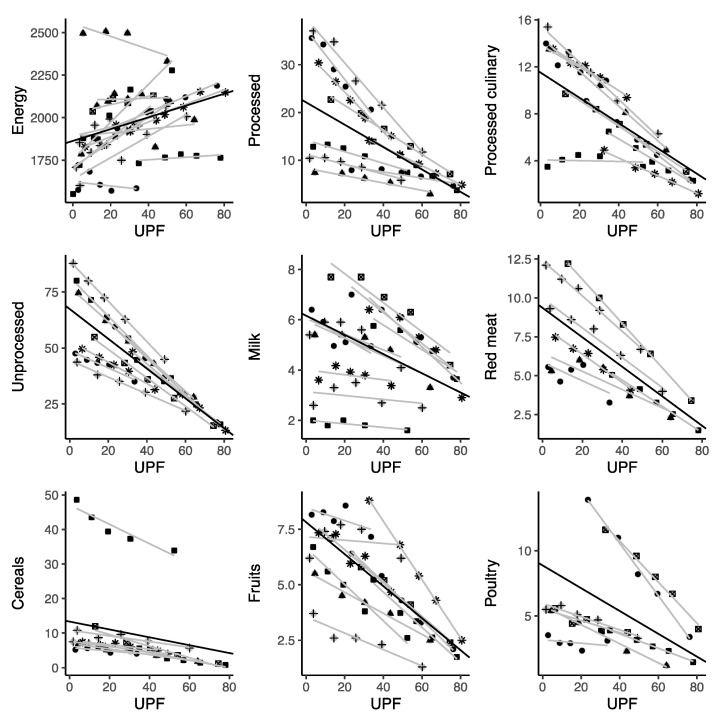
“The aforementioned 13-country meta-analysis predicted that when UPFs represented 15% of total energy intake, the dietary energy share of fruits, vegetables, and legumes (ie, sources of health-protective phytochemicals) was 12•4%.When UPFs represented 75% of total energy intake, that share dropped to 4%. 46”
From Ultra-processed foods and human health: the main thesis and the evidence (2025) · cites this paper as [46]
Experimental — accuracy not yet measuredThe cited source says what the claim attributes to it.
In the citing paper
“For example, UPFs now make up nearly 60 % of daily caloric intake in the US, nearly 50 % in Canada, 42 % in Australia, and 20 % in Brazil (Martini et al. 2021).”
From Corporate concentration and power matter for agency in food systems (2025) · cites this paper as Martini et al. 2021
The cited source says what the claim attributes to it.
In the citing paper
“The consumption of ultra-processed foods is linked to a lower intake of unprocessed or minimally processed fruits, vegetables, legumes, and seafood.”
From Ultra-processed food exposure and adverse health outcomes: umbrella review of epidemiological meta-analyses (2024) · cites this paper as [6]
The cited source says what the claim attributes to it.
In the citing paper
“The 13-country meta-analysis predicted a 34•7 kcal increase (95% CI 14•7-54•7) in total daily energy intake for each 10% increase in UPF share.46”
From Ultra-processed foods and human health: the main thesis and the evidence (2025) · cites this paper as [46]
2 more claims about this paper
Create a free account to see every claim other papers make about this one.
Self-check
Percentages, sums and reported differences re-computed from the paper’s own numbers.
The self-check needs the paper’s full text.
Citations
Cites
von Elm, E., Altman, D. G., Egger, M., Pocock, S. J., Gøtzsche, P. C., Vandenbroucke, J. P., & Initiative, F. T. S. (2007) · PLoS Medicine · doi:10.1371/journal.pmed.0040296 · Cited by 23,020
von Elm, E., Altman, D. G., Egger, M., Pocock, S. J., Gøtzsche, P. C., & Vandenbroucke, J. P. (2008) · Journal of Clinical Epidemiology · doi:10.1016/j.jclinepi.2007.11.008 · Cited by 17,893
Murray, C. J. L., Aravkin, A. Y., Zheng, P., Abbafati, C., Abbas, K. M., Abbasi-Kangevari, M., Abd-Allah, F., Abdelalim, A., Abdollahi, M., Abdollahpour, I., et al. (2020) · The Lancet · doi:10.1016/s0140-6736(20)30752-2 · Cited by 9,854
Self-citationAfshin, A., Sur, P. J., Fay, K. A., Cornaby, L., Ferrara, G., Salama, J. S., Mullany, E. C., Abate, K. H., Abbafati, C., Abebe, Z., et al. (2019) · The Lancet · doi:10.1016/s0140-6736(19)30041-8 · Cited by 5,811
Self-citationStanaway, J. D., Afshin, A., Gakidou, E., Lim, S. S., Abate, D., Abate, K. H., Abbafati, C., Abbasi, N., Abbastabar, H., Abd-Allah, F., et al. (2018) · The Lancet · doi:10.1016/s0140-6736(18)32225-6 · Cited by 4,943
Self-citationUltra-processed foods: What they are and how to identify them
Monteiro, C. A., Cannon, G., Levy, R. B., Moubarac, J.-C., Louzada, M. L., Rauber, F., Khandpur, N., Cediel, G., Neri, D., Martinez-Steele, E., et al. (2019) · Public Health Nutrition · doi:10.1017/s1368980018003762 · Cited by 2,964 · cited 1×
“In addition to these formulation features, most products that are classified as UPFs are highly palatable, convenient, and easily available [10].”
BackgroundBaker, P., Machado, P., Santos, T., Sievert, K., Backholer, K., Hadjikakou, M., Russell, C., Huse, O., Bell, C., Scrinis, G., et al. (2020) · Obesity Reviews · doi:10.1111/obr.13126 · Cited by 1,194 · cited 1×
“Europe, and Australasia than in other regions; however, substantial growth in Latin America, Eastern Europe, North Africa, the Middle East, and Central and Eastern Asia was noted and is projected to continue over the coming years [11].”
BackgroundMartínez Steele, E., Baraldi, L. G., Louzada, M. L. D. C., Moubarac, J.-C., Mozaffarian, D., & Monteiro, C. A. (2016) · BMJ Open · doi:10.1136/bmjopen-2015-009892 · Cited by 838
Dietary quality among men and women in 187 countries in 1990 and 2010: a systematic assessment
Imamura, F., Micha, R., Khatibzadeh, S., Fahimi, S., Shi, P., Powles, J., & Mozaffarian, D. (2015) · The Lancet Global Health · doi:10.1016/s2214-109x(14)70381-x · Cited by 834 · cited 1×
“Diet quality at the global level has experienced a substantial deterioration when considering dietary components such as processed meats, sugar-sweetened beverages, saturated and trans fats, cholesterol, and sodium [39].”
BackgroundConsumption of ultra-processed foods predicts diet quality in Canada
Moubarac, J.-C., Batal, M., Louzada, M. L., Martinez Steele, E., & Monteiro, C. A. (2017) · Appetite · doi:10.1016/j.appet.2016.11.006 · Cited by 649 · cited 1×
“Moubarac, 2017 [24] Canadian Community Health Survey (CCHS) Canada 2004 33,694; 46,5% females 2+ years old (55,1% aged 2–18 years) two 24-h dietary recalls 47.”
Background
Cited by
Lane, M. M., Gamage, E., Du, S., Ashtree, D. N., McGuinness, A. J., Gauci, S., Baker, P., Lawrence, M., Rebholz, C. M., Srour, B., et al. (2024) · BMJ · doi:10.1136/bmj-2023-077310 · Cited by 1,153
“6 This raises the question of whether the associations between exposure to ultra-processed foods and poorer health are due to an overall unhealthy dietary pattern.”
Ultra-processed foods and food additives in gut health and disease
Whelan, K., Bancil, A. S., Lindsay, J. O., & Chassaing, B. (2024) · Nature Reviews Gastroenterology & Hepatology · doi:10.1038/s41575-024-00893-5 · Cited by 292
“Importantly, people with high UPF intake commonly consume lower intakes of dietary fibre and higher intakes of processed meat 13 , both of which are risk factors for CRC 45,46 and are rarely specifically adjusted for in these cohort studies.”
Ultra-processed foods and human health: the main thesis and the evidence
Monteiro, C. A., Louzada, M. L., Steele-Martinez, E., Cannon, G., Andrade, G. C., Baker, P., Bes-Rastrollo, M., Bonaccio, M., Gearhardt, A. N., Khandpur, N., et al. (2025) · The Lancet · doi:10.1016/s0140-6736(25)01565-x · Cited by 339
Self-citationDicken, S. J., & Batterham, R. L. (2021) · Nutrients · doi:10.3390/nu14010023 · Cited by 256
“UPFs tend to be high in saturated fat, added sugar and sodium [47], with meta-analyses demonstrating that diets higher in UPFs tend to contain greater intakes of total energy, free sugars and total and saturated fat, and lower intakes of fibre, protein and some micronutrients [30,48].”
BackgroundInfluentialLow-Grade Inflammation and Ultra-Processed Foods Consumption: A Review
Tristan Asensi, M., Napoletano, A., Sofi, F., & Dinu, M. (2023) · Nutrients · doi:10.3390/nu15061546 · Cited by 257
Metadata
- Authors
- Martini, D., Godos, J., Bonaccio, M., Vitaglione, P., & Grosso, G.
- Affiliations
- University of Milan (IT)
- University of Catania (IT)
- Istituto Neurologico Mediterraneo (IT)
- University of Naples Federico II (IT)
- Corresponding author
- Godos, Justyna
- Venue
- Nutrients
- Publisher
- MDPI AG
- Published
- 2021-09-27
- Volume
- 13
- Issue
- 10
- Pages
- 3390
- ISSN
- 2072-6643 (ISSN-L)
- PMC
- PMC8538030
- OpenAlex
- W3202712388
- Cited by
- 481
- References
- 58
- Citations by year
- 2026: 122 · 2025: 137 · 2024: 113 · 2023: 71 · 2022: 37 · 2021: 1
- FWCI
- 9.89
- Type
- journal article
- Language
- en
- Open access
- gold
- doi.org
- Licence
- Locations
- Nutrients (publishedVersion, cc-by)
- PubMed Central (publishedVersion, cc-by)
- PubMed (publishedVersion)
- Archivio Istituzionale della Ricerca (Universita Degli Studi Di Milano) (submittedVersion, other-oa)
- DOAJ (DOAJ: Directory of Open Access Journals) (submittedVersion, cc-by-sa)
- Topics
- Health Sciences › Medicine › Public Health, Environmental and Occupational Health › Consumer Attitudes and Food Labeling
- Health Sciences › Medicine › Public Health, Environmental and Occupational Health › Nutritional Studies and Diet
- Health Sciences › Nursing › Nutrition and Dietetics › Nutrition, Health and Food Behavior
- Keywords
- ultra-processed foods, NOVA classification, diet quality, nutrient composition, free sugars, saturated fat, dietary fiber, micronutrient intake, confectionery, sugar-sweetened beverages, energy intake
- MeSH terms
- Dietary Sugars, Sugar-Sweetened Beverages, Adolescent, Adult, Energy Intake, Child, Diet, Female, Food Handling, Humans, Male, Nutrition Surveys, Nutritive Value, Fast Foods, Snacks, Food Quality
About these checks
Registry, retraction, Cites and statistics results are computed, not judged, with one exception: a printed reference that no index lists is read once by a model before it counts as a citation error. Claims are extracted by a model and kept only when their quote appears verbatim in the text; each cited source is then checked, with a model’s help, for whether it says what the claim relies on. Those verdicts can be wrong — read the claim’s quote and the cited source before relying on one.
Statistics and arithmetic are recomputed, not judged.
Confidence bands are shown only for fields calibrated on our annotated test set. None is calibrated yet, so no band is shown.
What counts as a claim ›How we measure confidence ›How we check this ›
Are you an author, or do you see a problem with this page? Request a review
Data sources
Bibliographic data: Semantic Scholar, OpenAlex, Crossref.
Contains information from the Semantic Scholar Academic Graph Datasets, made available under the ODC Attribution License (ODC-BY 1.0).
Semantic Scholar’s data is described in: Kinney, R., et al. (2023). The Semantic Scholar Open Data Platform. arXiv:2301.10140.
