

The DOI matches its Crossref record; 37 of the 38 references it cites were found in a registry or an index, and 1 are not checked yet; none of the 41 sources its claims cite is checked for support yet.
Hydration Status and Fluid Replacement Strategies of High-Performance Adolescent Athletes: An Application of Machine Learning to Distinguish Hydration Characteristics
Open accessAbstract
There are limited data on the fluid balance characteristics and fluid replenishment behaviors of high-performance adolescent athletes. The heterogeneity of hydration status and practices of adolescent athletes warrant efficient approaches to individualizing hydration strategies. This study aimed to evaluate and characterize the hydration status and fluid balance characteristics of high-performance adolescent athletes and examine the differences in fluid consumption behaviors during training. In total, 105 high-performance adolescent athletes (male: 66, female: 39; age 14.1 ± 1.0 y) across 11 sports had their hydration status assessed on three separate occasions—upon rising and before a low and a high-intensity training session (pre-training). The results showed that 20–44% of athletes were identified as hypohydrated, with 21–44% and 15–34% of athletes commencing low- and high-intensity training in a hypohydrated state, respectively. Linear mixed model (LMM) analyses revealed that athletes who were hypohydrated consumed more fluid (F (1.183.85)) = 5.91, (p = 0.016). Additional K-means cluster analyses performed highlighted three clusters: “Heavy sweaters with sufficient compensatory hydration habits,” “Heavy sweaters with insufficient compensatory hydration habits” and “Light sweaters with sufficient compensatory hydration habits”. Our results highlight that high-performance adolescent athletes with ad libitum drinking have compensatory mechanisms to replenish fluids lost from training. The approach to distinguish athletes by hydration characteristics could assist practitioners in prioritizing future hydration intervention protocols.
Checked 2026-11-14 · 1 reference not checked yet
Overview
CoChat Summary
TL;DR
This field study characterized hydration status and fluid balance in 105 heat-acclimatized high-performance adolescent athletes across 11 sports, assessing first-morning and pre-training hydration and ad libitum fluid intake during low- and high-intensity sessions. Hypohydration was common but few athletes exceeded 2% body-mass loss, and k-means clustering identified three hydration-profile clusters (heavy sweaters with sufficient/insufficient compensatory habits and light sweaters with sufficient habits).
Key findings
- First-morning urine specific gravity (USG) classified 20% (USG > 1.025) and 44% (USG > 1.020) of athletes as hypohydrated; before low-intensity training, 21% and 44% began hypohydrated, and before high-intensity training, 15% and 34% began hypohydrated. Post-training, 2% of athletes in the low-intensity session and 0% in the high-intensity session showed excessive dehydration (>2% body-mass loss).
- Athletes who arrived hypohydrated consumed significantly more fluid during training than euhydrated athletes (main effect: F(1, 183.85) = 5.91, p = 0.016; mean difference 82.1 mL/h, 95% CI 15.5–148.7, p < 0.05).
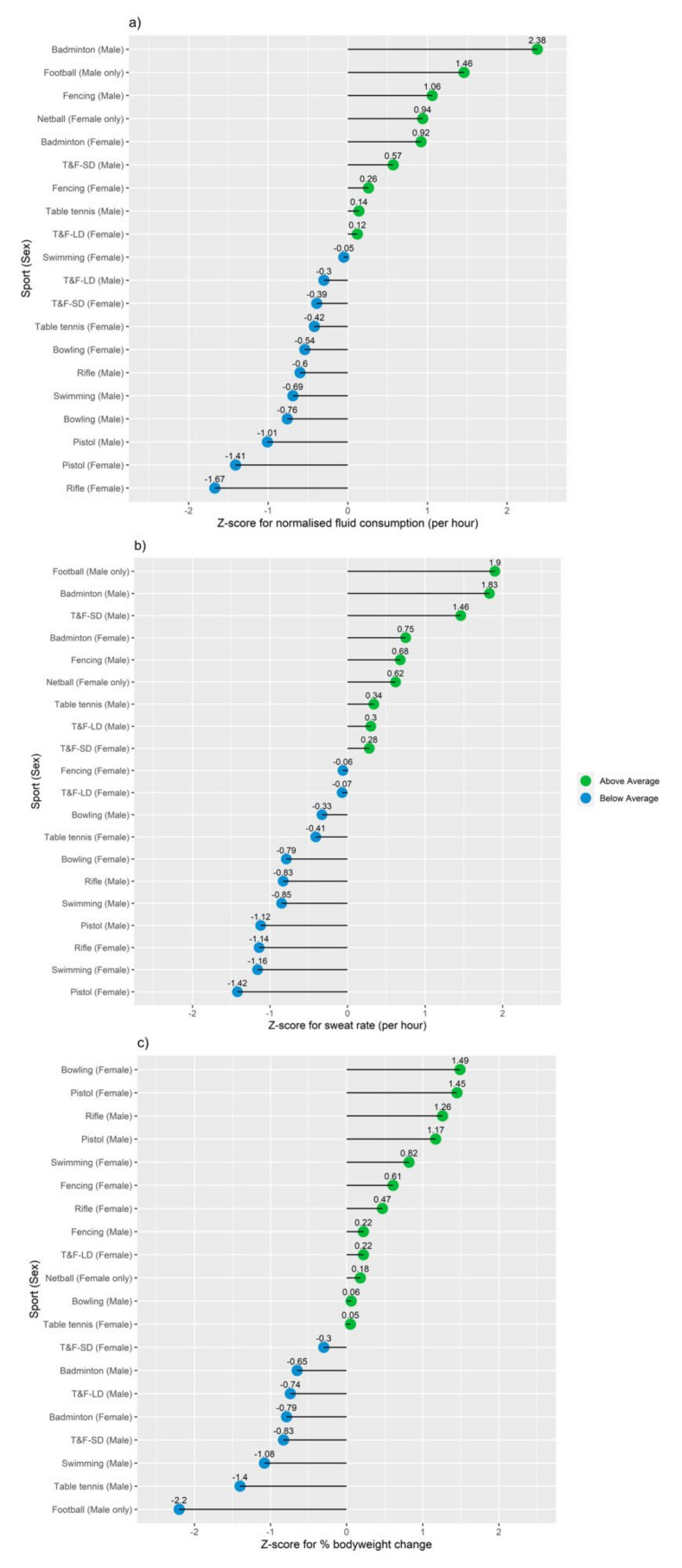
- Linear mixed models found sport × session interactions for sweat rate (F(10, 94) = 2.901, p = 0.003) and fluid consumption per hour (F(10, 94) = 2.297, p = 0.018), plus a main effect of sport on percentage body-mass change (F(10, 94) = 3.558, p = 0.001). Sex main effects were found for sweat rate (F(1, 103) = 4.64, p = 0.034) and percentage body-mass change (F(1, 103) = 6.347, p = 0.013).
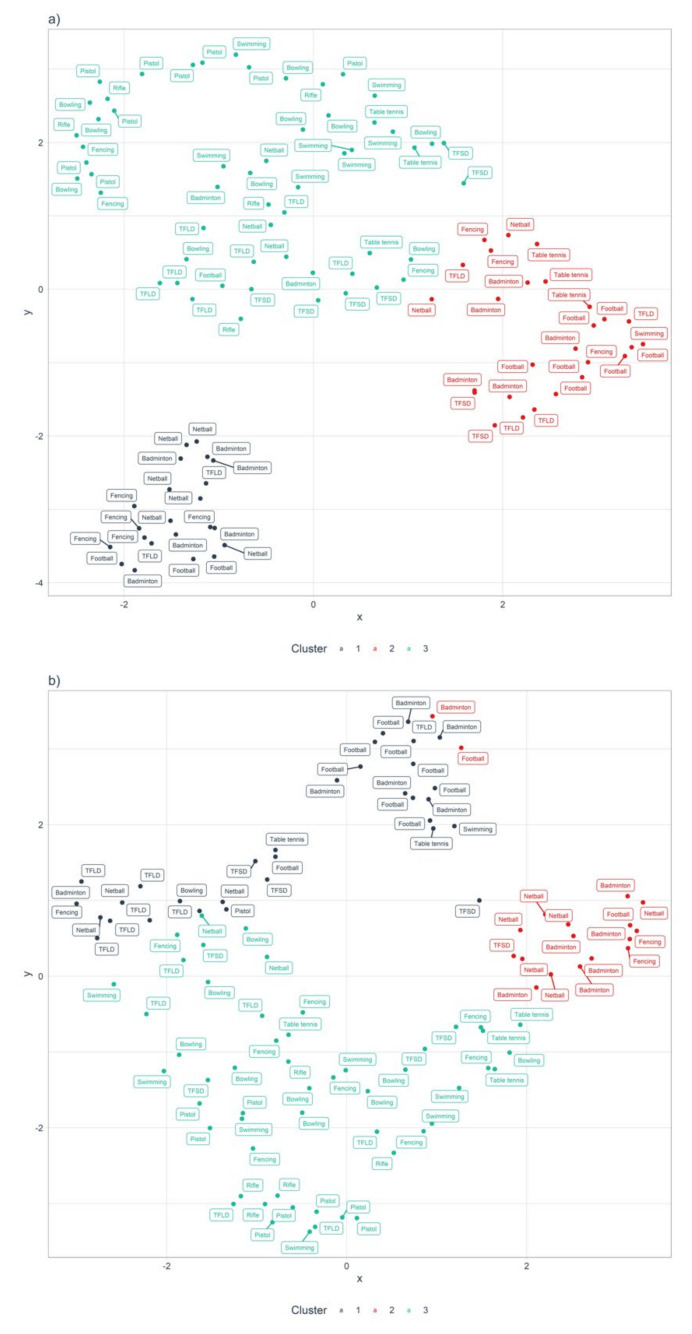
- K-means cluster analyses converged on three clusters: “Heavy sweaters with sufficient compensatory hydration habits” (HSSH), “Heavy sweaters with insufficient compensatory hydration habits” (HSIH), and “Light sweaters with sufficient compensatory hydration habits” (LSSH).
Methods
- Descriptive field study. A total of 199 Singaporean adolescent athletes from 11 sports were recruited by convenience sampling from a high-performance sports academy; 105 (male: 66, female: 39; age 14.1 ± 1.0 y) completed all protocols and were analyzed, with 94 unable to complete sessions due to academic commitments.
- Hydration status was assessed on three occasions: first-morning urine, and 30 min before low- and high-intensity training sessions held 1 week apart between 1500 and 1800 h. Hypohydration was defined by USG > 1.020 and, secondarily, USG > 1.025; post-training dehydration was defined as ≥2.0% body-mass change. Fluid consumption was measured by bottle weighing with ad libitum drinking; sweat rate was calculated from body mass and urine output.
- Training intensity was measured by session RPE (CR10 scale), training load as RPE × duration, and thirst on a 9-point scale. Analyses included linear mixed models with participant as random effect, Pearson correlations, and K-means clustering (optimal n = 3 by elbow method) with UMAP projection.
Limitations
- Paper-stated: hydration status was assessed using USG rather than plasma osmolality; USG is recognized to produce higher false positives for dehydration, so a secondary USG > 1.025 threshold was reported.
- Paper-stated: low- and high-intensity training sessions were classified according to coaches’ interpretation and execution of training plans, not by a standardized research-imposed intensity.
- Evident from the text: the study used convenience sampling from one high-performance academy in Singapore, had substantial attrition (199 recruited, 105 analyzed), and was an observational field study, limiting generalizability and causal inference.
Model-written summary. Check it against the paper before relying on it.
Integrity signals
Registry
Cites
Statistics
Figures
Verification
Claims the paper makes
0 Valid · 0 Not valid · 35 Not checked · 49 Own results and interpretations
A result the paper reports from its own data — it cites no other source for it, so there is none to check. The quote shows it is in the paper.
In the paper
“The LMM identified a sport by session interaction for sweat rate (F (10.94) = 2.901, p = 0.003) and fluid consumption (per hour) (F (10.94) = 2.297, p = 0.018) (Table 3)”
§ Hydration Status and Fluid Replacement Strategies of High-Performance Adolescent Athletes: An Application of Machine Learning to Distinguish Hydration Characteristics > 3. Results > 3.1. Hydration Status and Fluid Balance Characteristics
plainstates an association- Asserted: passes — The authors put it forward as true.
- Checkable: passes — It can be checked against evidence.
- Load-bearing: unclear — It is unclear whether the paper’s conclusions depend on it.
- Based: passes — The paper gives a reason why it holds.
In the paper
“In total, 2% of participants in the low-intensity and 0% in the high-intensity session exhibited excessive dehydration, based on ACSM classifications of more than 2% body mass loss [19], following both low- and high-intensity training sessions.”
§ Hydration Status and Fluid Replacement Strategies of High-Performance Adolescent Athletes: An Application of Machine Learning to Distinguish Hydration Characteristics > 3. Results > 3.1. Hydration Status and Fluid Balance Characteristics
What the sources say
- Not checked yetcites [19] Sawka, 2007, American College of Sports Medicine position stand. Exercise and fluid replacement, Med. Sci. Sports Exerc. source
plain- Asserted: passes — The authors put it forward as true.
- Checkable: passes — It can be checked against evidence.
- Load-bearing: unclear — It is unclear whether the paper’s conclusions depend on it.
- Based: passes — The paper gives a reason why it holds.
A result the paper reports from its own data — it cites no other source for it, so there is none to check. The quote shows it is in the paper.
In the paper
“The LMM analysis did not identify an interaction between pre-training USG hydration classification x training session (p = 0.881).”
§ Hydration Status and Fluid Replacement Strategies of High-Performance Adolescent Athletes: An Application of Machine Learning to Distinguish Hydration Characteristics > 3. Results > 3.2. Fluid Balance Characteristics between Euhydrated and Hypohydrated Athletes
plain- Asserted: passes — The authors put it forward as true.
- Checkable: passes — It can be checked against evidence.
- Load-bearing: unclear — It is unclear whether the paper’s conclusions depend on it.
- Based: passes — The paper gives a reason why it holds.
A result the paper reports from its own data — it cites no other source for it, so there is none to check. The quote shows it is in the paper.
In the paper
“There was no interaction of sport by session (p = 0.173) for percentage body mass change.”
§ Hydration Status and Fluid Replacement Strategies of High-Performance Adolescent Athletes: An Application of Machine Learning to Distinguish Hydration Characteristics > 3. Results > 3.1. Hydration Status and Fluid Balance Characteristics
plain- Asserted: passes — The authors put it forward as true.
- Checkable: passes — It can be checked against evidence.
- Load-bearing: unclear — It is unclear whether the paper’s conclusions depend on it.
- Based: passes — The paper gives a reason why it holds.
A result the paper reports from its own data — it cites no other source for it, so there is none to check. The quote shows it is in the paper.
In the paper
“The LMM identified a sport by session interaction for sweat rate (F (10.94) = 2.901, p = 0.003) and fluid consumption (per hour) (F (10.94) = 2.297, p = 0.018) (Table 3)”
§ Hydration Status and Fluid Replacement Strategies of High-Performance Adolescent Athletes: An Application of Machine Learning to Distinguish Hydration Characteristics > 3. Results > 3.1. Hydration Status and Fluid Balance Characteristics
plainstates an association- Asserted: passes — The authors put it forward as true.
- Checkable: passes — It can be checked against evidence.
- Load-bearing: unclear — It is unclear whether the paper’s conclusions depend on it.
- Based: passes — The paper gives a reason why it holds.
39 more claims
Create a free account to see all 84 claims and to verify the 41 references still open.
- It may state two separate claims as one. 18
- Probably not a substantial claim. 27
Self-check
Percentages, sums and reported differences re-computed from the paper’s own numbers.
Each contradiction between two passages listed here was confirmed by an independent check.
Rated minor: it would not touch a result — a value no result rests on, a p-value that stays on the same side of the significance level, or a conflict that is clerical, resolved elsewhere in the paper, or outside its own findings.
In the paper
§ Hydration Status and Fluid Replacement Strategies of High-Performance Adolescent Athletes: An Application of Machine Learning to Distinguish Hydration Characteristics > 2. Materials and Methods > 2.3. Procedure
“where participants with ≥2.0% body mass change were categorized as dehydrated”
§ Hydration Status and Fluid Replacement Strategies of High-Performance Adolescent Athletes: An Application of Machine Learning to Distinguish Hydration Characteristics > 3. Results > 3.1. Hydration Status and Fluid Balance Characteristics
“based on ACSM classifications of more than 2% body mass loss”
Citations
Cites
Finding Groups in Data: An Introduction to Cluster Analysis
Kaufman, L., & Rousseeuw, P. J. (1990) · Wiley Series in Probability and Statistics · doi:10.1002/9780470316801 · Cited by 7,344
A New Approach to Monitoring Exercise Training
Foster, C., FLORHAUG, J. A., FRANKLIN, J., GOTTSCHALL, L., HROVATIN, L. A., PARKER, S., DOLESHAL, P., & Dodge, C. (2001) · The Journal of Strength and Conditioning Research · doi:10.1519/00124278-200102000-00019 · Cited by 3,096
ACSM Position Stand: Exercise and Fluid Replacement
Convertino, V. A., Armstrong, L. E., Coyle, E. F., Mack, G. W., Sawka, M. N., Senay, L. C., & Sherman, W. M. (1996) · Medicine & Science in Sports & Exercise · doi:10.1097/00005768-199610000-00045 · Cited by 1,965
Exercise and Fluid Replacement
(2007) · Medicine & Science in Sports & Exercise · doi:10.1249/mss.0b013e31802ca597 · Cited by 1,497
Physiology of sweat gland function: The roles of sweating and sweat composition in human health
Baker, L. B. (2019) · Temperature · doi:10.1080/23328940.2019.1632145 · Cited by 732
American College of Sports Medicine Position Stand: Exercise and Fluid Replacement
Shephard, R. J. (2007) · Yearbook of Sports Medicine · doi:10.1016/s0162-0908(08)70206-x · Cited by 667
Assessing Hydration Status: The Elusive Gold Standard
Armstrong, L. E. (2007) · Journal of the American College of Nutrition · doi:10.1080/07315724.2007.10719661 · Cited by 643
Baker, L. B. (2017) · Sports Medicine · doi:10.1007/s40279-017-0691-5 · Cited by 403
Sex differences in thermoeffector responses during exercise at fixed requirements for heat loss
Gagnon, D., & Kenny, G. P. (2012) · Journal of Applied Physiology · doi:10.1152/japplphysiol.00637.2012 · Cited by 266
Nuccio, R. P., Barnes, K. A., Carter, J. M., & Baker, L. B. (2017) · Sports Medicine · doi:10.1007/s40279-017-0738-7 · Cited by 252
Sex Hormone Effects on Body Fluid Regulation
Stachenfeld, N. S. (2008) · Exercise and Sport Sciences Reviews · doi:10.1097/jes.0b013e31817be928 · Cited by 211
Thirst and fluid intake following graded hypohydration levels in humans
Engell, D. B., Maller, O., Sawka, M. N., Francesconi, R. P., Drolet, L. L., & Young, A. (1987) · Physiology & Behavior · doi:10.1016/0031-9384(87)90212-5 · Cited by 182
Accuracy of urine specific gravity and osmolality as indicators of hydration status
Oppliger, R. A., Magnes, S. A., Popowski, L. A., & Gisolfi, C. V. (2005) · International Journal of Sport Nutrition and Exercise Metabolism · doi:10.1123/ijsnem.15.3.236 · Cited by 175
Youth Athlete Development and Nutrition
Desbrow, B. (2021) · Sports Medicine · doi:10.1007/s40279-021-01534-6 · Cited by 159
Physiological characteristics of elite and sub-elite badminton players
Ooi, C. H., Tan, A., Ahmad, A., Kwong, K. W., Sompong, R., Mohd Ghazali, K. A., Liew, S. L., Chai, W. J., & Thompson, M. W. (2009) · Journal of Sports Sciences · doi:10.1080/02640410903352907 · Cited by 105
Volpe, S. L., Poule, K. A., & Bland, E. G. (2009) · Journal of Athletic Training · doi:10.4085/1062-6050-44.6.624 · Cited by 93
Effects of athletes’ muscle mass on urinary markers of hydration status
Hamouti, N., Coso, J. D., Ávila, A., & Mora‐Rodríguez, R. (2010) · European Journal of Applied Physiology · doi:10.1007/s00421-009-1333-x · Cited by 85
Maughan, R. J., & Shirreffs, S. M. (2010) · Scandinavian Journal of Medicine & Science in Sports · doi:10.1111/j.1600-0838.2010.01191.x · Cited by 75
Maresh, C. M., Gabaree-Boulant, C. L., Armstrong, L. E., Judelson, D. A., Hoffman, J. R., Castellani, J. W., Kenefick, R. W., Bergeron, M. F., & Casa, D. J. (2004) · Journal of Applied Physiology · doi:10.1152/japplphysiol.00956.2003 · Cited by 73
Fluid balance during training in elite young athletes of different sports
Arnaoutis, G., Kavouras, S. A., Angelopoulou, A., Skoulariki, C., Bismpikou, S., Mourtakos, S., & Sidossis, L. S. (2015) · Journal of Strength and Conditioning Research · doi:10.1519/jsc.0000000000000400 · Cited by 68
Bottled Water or Tap Water? A Comparative Study of Drinking Water Choices on University Campuses
Qian, N. (2018) · Water · doi:10.3390/w10010059 · Cited by 64
Hydration, sweat and thermoregulatory responses to professional football training in the heat
Duffield, R., McCall, A., Coutts, A. J., & Peiffer, J. J. (2012) · Journal of Sports Sciences · doi:10.1080/02640414.2012.689432 · Cited by 53
School based intervention has reduced obesity in Singapore
Toh, C. M. (2002) · BMJ · doi:10.1136/bmj.324.7334.427/a · Cited by 50
Goulet, E. D. B., & Hoffman, M. D. (2019) · Sports Medicine · doi:10.1007/s40279-018-01051-z · Cited by 46
Adams, W. M., Ferraro, E. M., Huggins, R. A., & Casa, D. J. (2014) · Journal of Strength and Conditioning Research · doi:10.1519/jsc.0000000000000501 · Cited by 41
Fluid needs for training, competition, and recovery in track-and-field athletes
Casa, D. J., Cheuvront, S. N., Galloway, S. D., & Shirreffs, S. M. (2019) · International Journal of Sport Nutrition and Exercise Metabolism · doi:10.1123/ijsnem.2018-0374 · Cited by 41
Arnaoutis, G., Kavouras, S. A., Kotsis, Y. P., Tsekouras, Y. E., Makrillos, M., & Bardis, C. N. (2013) · International Journal of Sport Nutrition and Exercise Metabolism · doi:10.1123/ijsnem.23.3.245 · Cited by 40
Da Silva, R. P., Mündel, T., Natali, A. J., Bara Filho, M. G., Alfenas, R. C. G., Lima, J. R. P., Belfort, F. G., Lopes, P. R. N. R., & Marins, J. C. B. (2012) · Journal of Sports Sciences · doi:10.1080/02640414.2011.623711 · Cited by 35
Fluid Replacement Requirements for Child Athletes
Rowland, T. (2011) · Sports Medicine · doi:10.2165/11584320-000000000-00000 · Cited by 34
Judge, L., Bellar, D., Popp, J., Craig, B., Schoeff, M., Hoover, D., Fox, B., Kistler, B., & Al-Nawaiseh, A. (2021) · Journal of Human Kinetics · doi:10.2478/hukin-2021-0065 · Cited by 33
First Reported Cases of Exercise-Associated Hyponatremia in Asia
LEE, J. K. W., Nio, A. Q. X., Ang, W. H., Johnson, C., Aziz, A. R., Lim, C. L., & Hew‐Butler, T. (2011) · International Journal of Sports Medicine · doi:10.1055/s-0030-1269929 · Cited by 32
Self-citationEndurance cyclist fluid intake, hydration status, thirst, and thermal sensations: Gender differences
Armstrong, L. E., Johnson, E. C., McKenzie, A. L., Ellis, L. A., & Williamson, K. H. (2016) · International Journal of Sport Nutrition and Exercise Metabolism · doi:10.1123/ijsnem.2015-0188 · Cited by 31
Hydration status in adolescent judo athletes before and after training in the heat
Rivera-Brown, A. M., & De Félix-Dávila, R. A. (2012) · International Journal of Sports Physiology and Performance · doi:10.1123/ijspp.7.1.39 · Cited by 29
Bancks, M. P., Casanova, R., Gregg, E. W., & Bertoni, A. G. (2019) · Diabetes Research and Clinical Practice · doi:10.1016/j.diabres.2019.107915 · Cited by 28
Fluid balance of adolescent swimmers during training
Adams, J. D., Kavouras, S. A., Robillard, J. I., Bardis, C. N., Johnson, E. C., Ganio, M. S., McDermott, B. P., & White, M. A. (2016) · Journal of Strength and Conditioning Research · doi:10.1519/jsc.0000000000001132 · Cited by 18
Seal, A., Suh, H., Jansen, L. T., Summers, L. G., & Kavouras, S. A. (2018) · Elsevier eBooks · doi:10.1016/b978-0-12-814556-2.00011-7 · Cited by 14
Windt, J., Taylor, D., Little, D., & Sporer, B. C. (2020) · British Journal of Sports Medicine · doi:10.1136/bjsports-2020-102938 · Cited by 13
(2000) · Europe PMC (PubMed Central)
Cited by
Nutritional Recommendations for the Young Athlete
Hecht, C., Bank, N., Cook, B., & Mistovich, R. J. (2023) · Journal of the Pediatric Orthopaedic Society of North America · doi:10.55275/jposna-2023-599 · Cited by 48
Papaoikonomou, G., Apergi, K., & Malisova, O. (2025) · Children · doi:10.3390/children12020171 · Cited by 13
Abdelnour, M., Berkachy, R., Nasreddine, L., & Fares, E.-J. (2024) · Sensors · doi:10.3390/s24186024 · Cited by 20
Zborowski, M., & Skotnicka, M. (2025) · Nutrients · doi:10.3390/nu17172841 · Cited by 18
Sreeharsha, A., McHale, S., Nnamoko, N., & Pereira, E. (2024) · Electronics · doi:10.3390/electronics13244960 · Cited by 15
Metadata
- Authors
- Suppiah, H. T., Ng, E. L., Wee, J., Taim, B. C., Huynh, M., Gastin, P. B., Chia, M., Low, C. Y., & Lee, J. K. W.
- Affiliations
- La Trobe University (AU)
- National Youth Sports Institute, Singapore 397778, Singapore
- National University of Singapore (SG)
- Technological University of the Shannon: Midlands Midwest (IE)
- Nanyang Technological University (SG)
- Agency for Science, Technology and Research (SG)
- Corresponding author
- Suppiah, Haresh T.
- ORCID
- Venue
- Nutrients
- Publisher
- MDPI AG
- Published
- 2021-11-15
- Volume
- 13
- Issue
- 11
- Pages
- 4073
- ISSN
- 2072-6643 (ISSN-L)
- PMC
- PMC8625246
- OpenAlex
- W3213732001
- Cited by
- 31
- References
- 37
- Citations by year
- 2026: 9 · 2025: 9 · 2024: 7 · 2023: 3 · 2022: 3
- FWCI
- 1.98
- Type
- journal article
- Language
- en
- Open access
- gold
- doi.org
- Licence
- Locations
- Nutrients (publishedVersion, cc-by)
- PubMed (publishedVersion)
- PubMed Central (publishedVersion, cc-by)
- NIE Digital Repository (National Institute of Education, Nanyang Technological University) (publishedVersion)
- National University of Singapore (submittedVersion)
- Figshare (submittedVersion, cc-by)
- La Trobe University (cc-by)
- Topics
- Health Sciences › Medicine › Physiology (medical) › Thermoregulation and physiological responses
- Health Sciences › Medicine › Orthopedics and Sports Medicine › Sports Performance and Training
- Health Sciences › Medicine › Orthopedics and Sports Medicine › Sports injuries and prevention
- Keywords
- hydration status, fluid replacement, youth athletes, hypohydration, sweat loss, exercise intensity, elite athletes, machine learning clustering
- MeSH terms
- Machine Learning, Organism Hydration Status, Adolescent, Dehydration, Drinking, Drinking Behavior, Female, Humans, Male, Singapore, Sports, Water-Electrolyte Balance, Cluster Analysis, Athletic Performance, Athletes
About these checks
Registry, retraction, Cites and statistics results are computed, not judged, with one exception: a printed reference that no index lists is read once by a model before it counts as a citation error. Claims are extracted by a model and kept only when their quote appears verbatim in the text; each cited source is then checked, with a model’s help, for whether it says what the claim relies on. Those verdicts can be wrong — read the claim’s quote and the cited source before relying on one.
A language model drew the claims from the paper on 2026-11-14, under version 3 of the claim definition (model deepseek-v4.1-flash, prompt extract-v3).
A second model labelled each claim on 2026-11-14 (model jev-1.13-20260917, definition revision gold-guideline-v0.2).
Statistics and arithmetic are recomputed, not judged.
Confidence bands are shown only for fields calibrated on our annotated test set. None is calibrated yet, so no band is shown.
What counts as a claim ›How we measure confidence ›How we check this ›
Are you an author, or do you see a problem with this page? Request a review
Data sources
Bibliographic data: Semantic Scholar, OpenAlex, Crossref.
Contains information from the Semantic Scholar Academic Graph Datasets, made available under the ODC Attribution License (ODC-BY 1.0).
Semantic Scholar’s data is described in: Kinney, R., et al. (2023). The Semantic Scholar Open Data Platform. arXiv:2301.10140.
