

The DOI matches its Crossref record; 124 of the 124 references it cites were found in a registry or an index.
The Role of the Microbiome-Brain-Gut Axis in the Pathogenesis of Depressive Disorder
Open accessAbstract
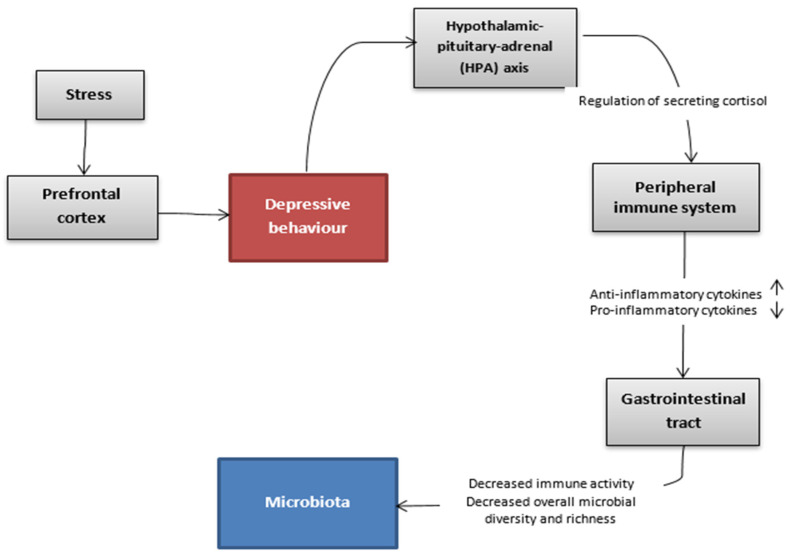
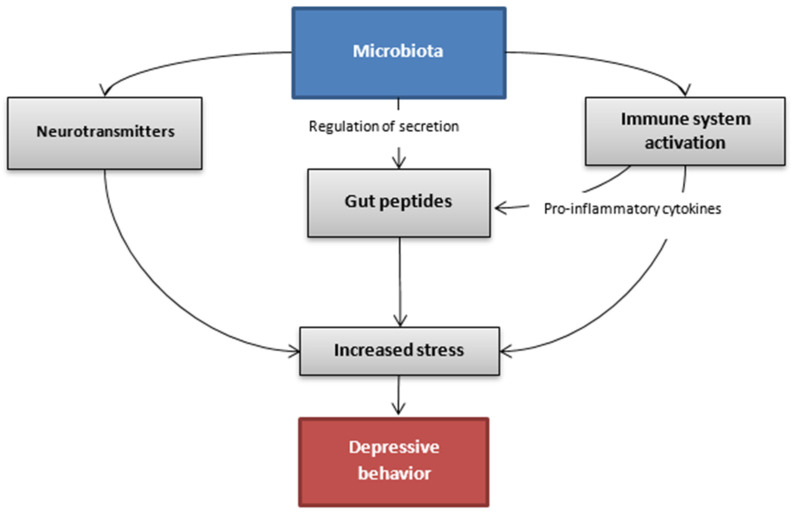
The role of gut microbiota and its association with the central nervous system via the microbiome-brain-gut axis has been widely discussed in the literature. The aim of this review is to investigate the impact of gut microbiota on the development of depression and underlying molecular mechanisms. There are two possible pathways in which this interaction might occur. The first one suggests that depressive disorder could lead to dysbiosis and one of the causes may be the influence on the hypothalamic-pituitary-adrenal (HPA) axis. The second one considers if changes in the composition of gut microbiota might cause depressive disorder. The mechanisms that could be responsible for this interaction include the secretion of neurotransmitters, gut peptides and the activation of the immune system. However, current knowledge on this topic does not allow for us to state an unambiguous conclusion, and future studies that take into consideration more precise stress-measurement methods are needed to further explore direct mechanisms of the interaction between gut microbiota and mental health.
Overview
The claims and statistics of this paper haven’t been checked yet.
Run the check — free, no account needed. It reads the open-access text and checks the sources it cites.
Integrity signals
Registry
Cites
Statistics
Figures
Verification
Claims the paper makes
The claims and statistics of this paper haven’t been checked yet.
Run the check — free, no account needed. It reads the open-access text and checks the sources it cites.
Claims other papers make about this one
Each is checked against this paper’s own text: does it say what the citing paper says it does?
In the citing paper
“Examples of these metabolic products include SCFAs, which are produced by Lactobacillus, Bifidobacterium, and Prevotella [93].”
From The Gut–Brain–Microbiota Connection and Its Role in Autism Spectrum Disorders (2025) · cites this paper as [93]
Self-check
Percentages, sums and reported differences re-computed from the paper’s own numbers.
The self-check needs the paper’s full text.
Citations
Cites
1 retracted
Gut Microbiome Dysbiosis and Depression: a Comprehensive Review
Capuco, A., Urits, I., Hasoon, J. J., Chun, R., Gerald, B., Wang, J. K., Ngo, A. L., Simopoulos, T. T., Kaye, A. D., Colontonio, M. M., et al. (2020) · Current Pain and Headache Reports · doi:10.1007/s11916-020-00871-x · Cited by 49
RetractedGhrelin is a growth-hormone-releasing acylated peptide from stomach
Kojima, M., Hosoda, H., Date, Y., Nakazato, M., Matsuo, H., & Kangawa, K. (1999) · Nature · doi:10.1038/45230 · Cited by 8,479
Changes of Intestinal Functions in Liver Cirrhosis
Fukui, H., & Wiest, R. (2016) · Inflammatory Intestinal Diseases · doi:10.1159/000444436 · Cited by 6,820
Protective and Damaging Effects of Stress Mediators
McEwen, B. S. (1998) · New England Journal of Medicine · doi:10.1056/nejm199801153380307 · Cited by 6,733 · cited 1×
“Corticotropin, in turn, stimulates adrenocorticotropin, which is the direct stimuli for the adrenal gland and its glucocorticoids [78].”
BackgroundDiversity, stability and resilience of the human gut microbiota
Lozupone, C. A., Stombaugh, J. I., Gordon, J. I., Jansson, J. K., & Knight, R. (2012) · Nature · doi:10.1038/nature11550 · Cited by 5,533
Host-Bacterial Mutualism in the Human Intestine
Bäckhed, F., Ley, R. E., Sonnenburg, J. L., Peterson, D. A., & Gordon, J. I. (2005) · Science · doi:10.1126/science.1104816 · Cited by 5,277
Richness of human gut microbiome correlates with metabolic markers
Le Chatelier, E., Nielsen, T., Qin, J., Prifti, E., Hildebrand, F., Falony, G., Almeida, M., Arumugam, M., Batto, J.-M., Kennedy, S., et al. (2013) · Nature · doi:10.1038/nature12506 · Cited by 4,662
Malhi, G. S., & Mann, J. J. (2018) · The Lancet · doi:10.1016/s0140-6736(18)31948-2 · Cited by 4,099
Formation of short chain fatty acids by the gut microbiota and their impact on human metabolism
Morrison, D. J., & Preston, T. (2016) · Gut Microbes · doi:10.1080/19490976.2015.1134082 · Cited by 3,781
Energy contributions of volatile fatty acids from the gastrointestinal tract in various species
Bergman, E. N. (1990) · Physiological Reviews · doi:10.1152/physrev.1990.70.2.567 · Cited by 2,750
Research works printed but not linked: 2
- Bains, N., and Abdijadid, S. (2021). Major Depressive Disorder. StatPearls, StatPearls Publishing. Available online: http://www.ncbi.nlm.nih.gov/books/NBK559078/.
- Selye, H. (1978). The Stress of Life, McGraw-Hill.
Cited by
Sorted by citations
Items 101–113 of 113
The Association Between Depression and Advanced Stages of Cardiovascular–Kidney–Metabolic Syndrome
Du, Z., Cao, C., Lv, X., Hou, Y., & Li, D. (2026) · Angiology · doi:10.1177/00033197261434136
INTERPLAY BETWEEN GUT MICROBIOTA AND NEURODEGENERATION
Yusupov, F. A., & Abdykadyrov, M. S. (2026) · Avicenna Bulletin · doi:10.25005/2074-0581-2026-28-1-162-173
Brain-gut communication and potential applications of microecological treatments in stroke
Gao, M., Zhou, Y., Zhang, K., Ye, Y., Han, Z., Chen, Q., Shi, W., & Lu, X. (2026) · Frontiers in Neuroscience · doi:10.3389/fnins.2026.1799890
Gut Microbiota and Depression: Mechanistic Links Within the Gut–Brain Axis — A Narrative Review
Siwiec, K., Purwin, A., Lach, K., Kulach, A., Piekarska, P., Lamparski, Ł., Modrzejewska, W., Szmit, G., Basak, W., & Krok, G. (2026) · Archiv Euromedica · doi:10.35630/2026/16/iss.2.16
杨佳敏, Bo, C., Zhang, H., & 薄智云 (2026) · Journal of Traditional Chinese Medical Sciences · doi:10.1016/j.jtcms.2026.05.001
Wu, A., Ou, W., Chen, D., Wang, Y. H., Lin, G., Yang, J., Hong, Y., Li, M., Yang, Q., Lin, C., et al. (2026) · Combinatorial Chemistry & High Throughput Screening · doi:10.2174/0113862073446908260305080457
Regulatory Effects of Functional Food Biscuits on Mouse Brain Function and Gut Microbiota
Zhang, Z., Xie, S., & 谭周进 (2026) · Molecular Nutrition & Food Research · doi:10.1002/mnfr.70545
Cunha, E. S., Alonso, V. R. Z., & Prado, R. D. C. G. G. (2026) · Revista Contemporânea · doi:10.56083/rcv6n7-033
Alonso, V. R. Z., & Prado, R. D. C. G. G. (2026) · Revista Contemporânea · doi:10.56083/rcv6n7-038
Zhong, H., Jin, Z., Liu, Y., Wang, Y., & Liu, Y. K. (2026) · Microbiology Spectrum · doi:10.1128/spectrum.03549-25
Perspective Chapter: Gut–Brain Axis and Psychobiotics – New Horizons in the Treatment of Depression
Işık, M. (2026) · IntechOpen eBooks · doi:10.5772/intechopen.1015811
Decoding the Gut-Brain Axis: Implications for Neurodegenerative Disease Therapies
(2026) · Frontiers research topics · doi:10.3389/978-2-8325-8753-9
The butyrate-m6A-BDNF axis: a hypothesis of gut-brain signal transduction in PSD
Wang, S., Zhao, S., Chen, S., Wei, X., Wang, H., & Gu, D. (2026) · Frontiers in Neuroscience · doi:10.3389/fnins.2026.1869522
Metadata
- Authors
- Młynarska, E., Gadzinowska, J., Tokarek, J., Forycka, J., Szuman, A., Franczyk, B., & Rysz, J.
- Affiliations
- Medical University of Lodz (PL)
- Corresponding author
- Młynarska, Ewelina
- Venue
- Nutrients
- Publisher
- MDPI AG
- Published
- 2022-05-04
- Volume
- 14
- Issue
- 9
- Pages
- 1921
- ISSN
- 2072-6643 (ISSN-L)
- PMC
- PMC9105444
- OpenAlex
- W4225384750
- Cited by
- 109
- References
- 123
- Citations by year
- 2026: 22 · 2025: 35 · 2024: 26 · 2023: 26
- FWCI
- 2.27
- Type
- journal article
- Language
- en
- Open access
- gold
- doi.org
- Licence
- Locations
- Nutrients (publishedVersion, cc-by)
- PubMed Central (publishedVersion, cc-by)
- PubMed (publishedVersion)
- DOAJ (DOAJ: Directory of Open Access Journals) (submittedVersion, cc-by-sa)
- Topics
- Life Sciences › Biochemistry, Genetics and Molecular Biology › Molecular Biology › Gut microbiota and health
- Life Sciences › Neuroscience › Biological Psychiatry › Tryptophan and brain disorders
- Health Sciences › Medicine › Gastroenterology › Gastrointestinal motility and disorders
- Keywords
- gut microbiota, depression, dysbiosis, hypothalamic-pituitary-adrenal axis, neurotransmitters, gut peptides, immune activation, stress, mental health
- MeSH terms
- Gastrointestinal Microbiome, Brain-Gut Axis, Brain, Depressive Disorder, Humans, Pituitary-Adrenal System, Dysbiosis
About these checks
Registry, retraction, Cites and statistics results are computed, not judged, with one exception: a printed reference that no index lists is read once by a model before it counts as a citation error. Claims are extracted by a model and kept only when their quote appears verbatim in the text; each cited source is then checked, with a model’s help, for whether it says what the claim relies on. Those verdicts can be wrong — read the claim’s quote and the cited source before relying on one.
Statistics and arithmetic are recomputed, not judged.
Confidence bands are shown only for fields calibrated on our annotated test set. None is calibrated yet, so no band is shown.
What counts as a claim ›How we measure confidence ›How we check this ›
Are you an author, or do you see a problem with this page? Request a review
