

The DOI matches its Crossref record; 264 of the 264 references it cites were found in a registry or an index.
Adipose tissue hyperplasia and hypertrophy in common and syndromic obesity-the case of BBS obesity
Open accessAbstract
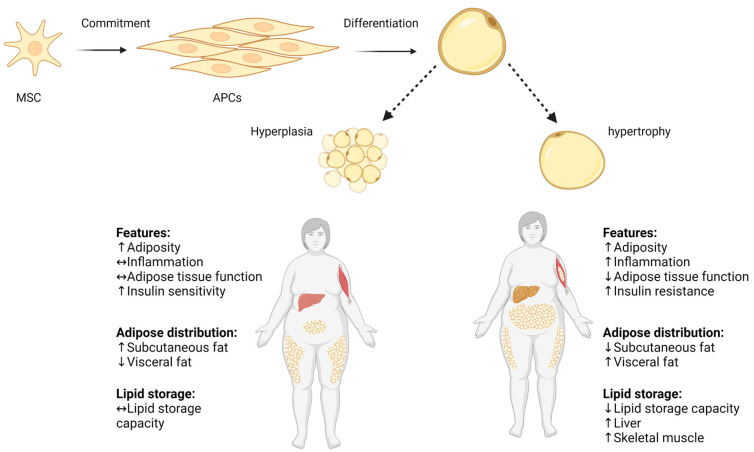
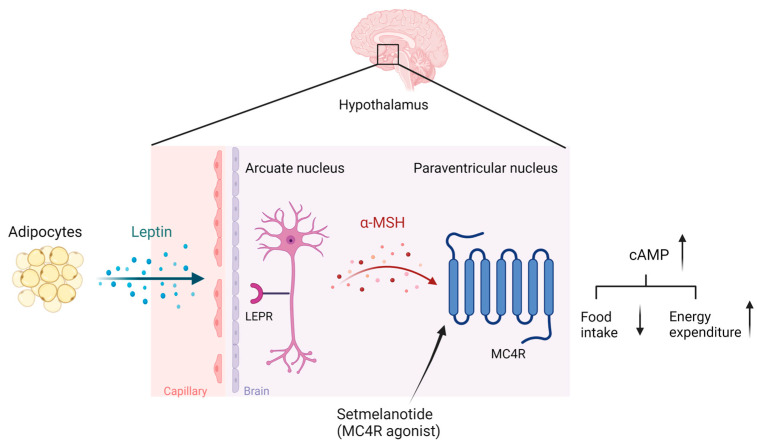
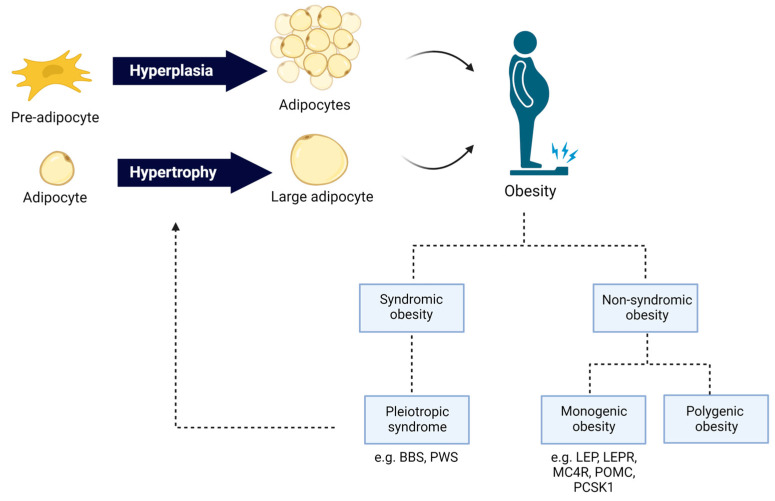
Obesity is a metabolic state generated by the expansion of adipose tissue. Adipose tissue expansion depends on the interplay between hyperplasia and hypertrophy, and is mainly regulated by a complex interaction between genetics and excess energy intake. However, the genetic regulation of adipose tissue expansion is yet to be fully understood. Obesity can be divided into common multifactorial/polygenic obesity and monogenic obesity, non-syndromic and syndromic. Several genes related to obesity were found through studies of monogenic non-syndromic obesity models. However, syndromic obesity, characterized by additional features other than obesity, suggesting a more global role of the mutant genes related to the syndrome and, thus, an additional peripheral influence on the development of obesity, were hardly studied to date in this regard. This review summarizes present knowledge regarding the hyperplasia and hypertrophy of adipocytes in common obesity. Additionally, we highlight the scarce research on syndromic obesity as a model for studying adipocyte hyperplasia and hypertrophy, focusing on Bardet–Biedl syndrome (BBS). BBS obesity involves central and peripheral mechanisms, with molecular and mechanistic alternation in adipocyte hyperplasia and hypertrophy. Thus, we argue that using syndromic obesity models, such as BBS, can further advance our knowledge regarding peripheral adipocyte regulation in obesity.
Overview
The claims and statistics of this paper haven’t been checked yet.
Run the check — free, no account needed. It reads the open-access text and checks the sources it cites.
Integrity signals
Registry
Cites
Statistics
Figures
Verification
Claims the paper makes
The claims and statistics of this paper haven’t been checked yet.
Run the check — free, no account needed. It reads the open-access text and checks the sources it cites.
Claims other papers make about this one
Each is checked against this paper’s own text: does it say what the citing paper says it does?
The source backs part of the claim, not all of it — or backs it for a different population, condition or comparison.
In the citing paper
“Hyperplasia and hypertrophy can occur in a depot-specific manner, as intra-abdominal fat depots primarily expand through hypertrophy, while subcutaneous WAT has been seen to expand through both methods (54).”
From Metabolic impact of endogenously produced estrogens by adipose tissue in females and males across the lifespan (2025) · cites this paper as [54]
Experimental — accuracy not yet measured
Self-check
Percentages, sums and reported differences re-computed from the paper’s own numbers.
The self-check needs the paper’s full text.
Citations
Cites
The metabolic phenotype in obesity: Fat mass, body fat distribution, and adipose tissue function
Goossens, G. H. (2017) · Obesity Facts · doi:10.1159/000471488 · Cited by 8,481
Genetics of Food Intake Self-Regulation in Childhood: Literature Review and Research Opportunities
Faith, M. S., Carnell, S., & Kral, T. V. E. (2013) · Human Heredity · doi:10.1159/000353879 · Cited by 7,633
Genetic studies of body mass index yield new insights for obesity biology
Study, T. L. C., Locke, A. E., The ADIPOGen Consortium, The AGEN-BMI Working Group, The CARDIOGRAMplusC4D Consortium, The CKDGen Consortium, The, G. L. G. C., The, I. C. B. P., The MAGIC Investigators, The MuTHER Consortium, et al. (2015) · Nature · doi:10.1038/nature14177 · Cited by 4,534
Mechanisms of fatty acid-induced inhibition of glucose uptake.
Boden, G., Chen, X., Ruiz, J., White, J. V., & Rossetti, L. (1994) · Journal of Clinical Investigation · doi:10.1172/jci117252 · Cited by 3,720
Targeted disruption of the melanocortin-4 receptor results in obesity in mice
Huszar, D., Lynch, C. A., Fairchild-Huntress, V., Dunmore, J. H., Fang, Q., Berkemeier, L. R., Gu, W., Kesterson, R. A., Boston, B. A., Cone, R. D., et al. (1997) · Cell · doi:10.1016/s0092-8674(00)81865-6 · Cited by 3,030
Pathophysiology of human visceral obesity: an update
Tchernof, A., & Després, J.-P. (2013) · Physiological Reviews · doi:10.1152/physrev.00033.2011 · Cited by 2,583
What we talk about when we talk about fat
Rosen, E. D., & Spiegelman, B. M. (2014) · Cell · doi:10.1016/j.cell.2013.12.012 · Cited by 2,373
Yengo, L., Sidorenko, J., Kemper, K. E., Zheng, Z., Wood, A. R., Weedon, M. N., Frayling, T. M., Hirschhorn, J. N., Yang, J., & Visscher, P. M. (2018) · Human Molecular Genetics · doi:10.1093/hmg/ddy271 · Cited by 2,368
Dynamics of fat cell turnover in humans
Spalding, K. L., Arner, E., Westermark, P. O., Bernard, S., Buchholz, B. A., Bergmann, O., Blomqvist, L., Hoffstedt, J., Näslund, E., Britton, T., et al. (2008) · Nature · doi:10.1038/nature06902 · Cited by 2,357 · cited 4×
“However, shown by several elegant studies, at any life stage, states of over-nutrition lead to adipose tissue hyperplasia and, consequently, to an increased mass [14,50,51,59].”
BackgroundInfluentialmPPAR gamma 2: tissue-specific regulator of an adipocyte enhancer.Preprint
Tontonoz, P., Hu, E., Graves, R. A., Budavari, A. I., & Spiegelman, B. M. (1994) · Genes & Development · doi:10.1101/gad.8.10.1224 · Cited by 2,181
Research works printed but not linked: 1
- Macdougald, O.A. (2014). Methods in Enzymology, Academic Press. [1st ed.].
Cited by
Sorted by citations
Impact of Adipose Tissue and Lipids on Skeletal Muscle in Sarcopenia
Jang, S. Y., & Choi, K. M. (2025) · Journal of Cachexia Sarcopenia and Muscle · doi:10.1002/jcsm.70000 · Cited by 81
Matar, D. B., Zhra, M., Nassar, W. K., Altemyatt, H., Naureen, A., Abotouk, N., Elahi, M. A., & Aljada, A. (2025) · Frontiers in Endocrinology · doi:10.3389/fendo.2025.1592683 · Cited by 93
“Adipocyte hypertrophy, with cell diameters expanding up to 150-200 m m (94), leads to reduced oxygen availability and tissue hypoxia (95).”
Lopez‐Yus, M., Horndler, C., Ansón, S. B., Monterde, V. B., & Arbonés-Mainar, J. M. (2024) · Cells · doi:10.3390/cells13050380 · Cited by 60
“This difference in insulin sensitivity plays a significant role in the systemic effects of obesity, particularly the development of insulin resistance [43].”
BackgroundKavitha, S. A., Zainab, S., Muthyalaiah, Y. S., John, C. M., & Arockiasamy, S. (2025) · Molecular Biology Reports · doi:10.1007/s11033-025-10632-x · Cited by 36
“This percentage rises to 45–60% in experimentally obese mice [20, 21].”
Mohaghegh, N., Iyer, A., Wang, E., Balajam, N. Z., Kang, H., Akbari, M., Barnhill, M. S., Khademhosseini, A., Pearson, R. M., & Najafabadi, A. H. (2025) · Journal of Controlled Release · doi:10.1016/j.jconrel.2025.113670 · Cited by 28
Metadata
- Authors
- Horwitz, A., & Birk, R.
- Affiliations
- Ariel University (IL)
- Corresponding author
- Birk, Ruth
- ORCID
- Birk, Ruth
- Venue
- Nutrients
- Publisher
- MDPI AG
- Published
- 2023-08-04
- Volume
- 15
- Issue
- 15
- Pages
- 3445
- ISSN
- 2072-6643 (ISSN-L)
- PMC
- PMC10421039
- OpenAlex
- W4385577907
- Cited by
- 143
- References
- 264
- Citations by year
- 2026: 50 · 2025: 52 · 2024: 37 · 2023: 4
- FWCI
- 5.59
- Type
- journal article
- Language
- en
- Open access
- gold
- doi.org
- Licence
- Locations
- Nutrients (publishedVersion, cc-by)
- PubMed Central (publishedVersion, cc-by)
- PubMed (publishedVersion)
- Topics
- Health Sciences › Medicine › Endocrinology, Diabetes and Metabolism › Adipokines, Inflammation, and Metabolic Diseases
- Health Sciences › Medicine › Physiology (medical) › Adipose Tissue and Metabolism
- Life Sciences › Biochemistry, Genetics and Molecular Biology › Biochemistry › Lipid metabolism and biosynthesis
- Keywords
- adipose tissue hyperplasia, adipocyte hypertrophy, syndromic obesity, Bardet-Biedl syndrome, monogenic obesity, polygenic obesity
- MeSH terms
- Adipose Tissue, Animals, Humans, Hyperplasia, Hypertrophy, Obesity, Syndrome, Adipocytes, Bardet-Biedl Syndrome
About these checks
Registry, retraction, Cites and statistics results are computed, not judged, with one exception: a printed reference that no index lists is read once by a model before it counts as a citation error. Claims are extracted by a model and kept only when their quote appears verbatim in the text; each cited source is then checked, with a model’s help, for whether it says what the claim relies on. Those verdicts can be wrong — read the claim’s quote and the cited source before relying on one.
Statistics and arithmetic are recomputed, not judged.
Confidence bands are shown only for fields calibrated on our annotated test set. None is calibrated yet, so no band is shown.
What counts as a claim ›How we measure confidence ›How we check this ›
Are you an author, or do you see a problem with this page? Request a review
