

The DOI matches its Crossref record; 59 of the 60 references it cites were found in a registry or an index; none of the 49 sources its claims cite is checked for support yet.
Dietary Intake of Masters Athletes: A Systematic Review
Open accessAbstract
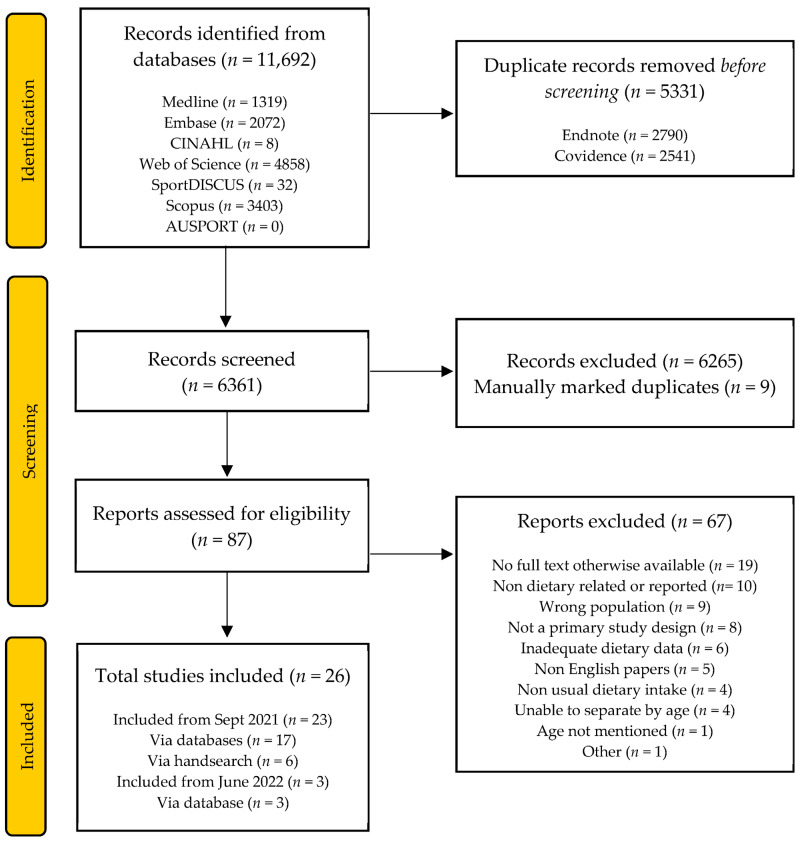
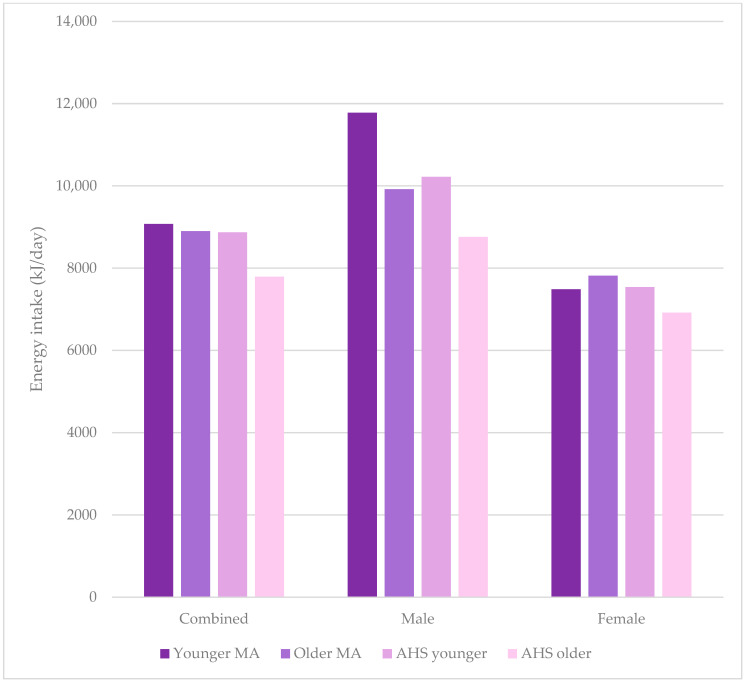
Dietary practices of masters athletes (MAs) may promote healthy ageing; however, they are poorly understood. The aims of this systematic review were to synthesise the literature on the dietary intakes of MAs and undertake comparisons between younger (35–50 years) and older (>50 years) MAs and the general population. A search was conducted across seven databases to identify relevant publications for screening and data extraction. Averages for energy intake (EI), macronutrients, and micronutrients were compared with data from the 2011–2012 Australian Health Survey (general population). Twenty-six studies (n = 2819) were included. Energy intake was higher for older (8908 kJ/d versus 7792 kJ/d) but not younger MAs (9073 kJ/d versus 8872 kJ/d) versus the general population. Younger versus older male MAs had higher energy and macronutrient intakes. Energy intake for older was comparable to younger female MAs (7819 kJ/d versus 7485 kJ/d), but older had higher protein, lower carbohydrate, and higher micronutrient intakes. Micronutrient intake was higher in MAs than the general population. Similar EIs for older MAs and younger general population may indicate potential for a higher-quality diet. Younger female MAs may restrict or misreport EI, requiring further investigation. There is a need for more comprehensive assessments of dietary intake in MAs to ascertain diet quality in relation to health.
Overview
CoChat Summary
TL;DR
This systematic review synthesizes dietary intake data from 26 studies of masters athletes (n = 2819), showing generally higher energy, macronutrient, and micronutrient intakes than the general Australian population, with some exceptions and possible underreporting. Younger female masters athletes may restrict or misreport energy intake, and more comprehensive diet-quality assessments are needed.
Key findings
- Older masters athletes had higher energy intake than the general population (8908 kJ/d versus 7792 kJ/d), while younger masters athletes did not (9073 kJ/d versus 8872 kJ/d).
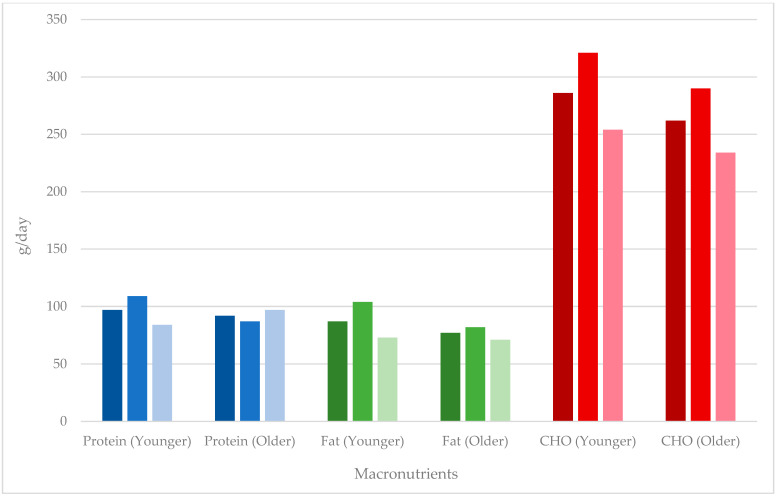
- Younger male masters athletes had higher energy and macronutrient intakes than older male masters athletes; older female masters athletes had energy intake comparable to younger female masters athletes (7819 kJ/d versus 7485 kJ/d) but higher protein, lower carbohydrate, and higher micronutrient intakes.
- Micronutrient intake was higher in masters athletes than the general population; the largest micronutrient percentage difference reported was 125% between older female masters athletes’ iron intakes and their general population counterparts.
- Protein intakes relative to body weight ranged from 1.0 to 2.0 g/kg/day across 12 of 26 studies, but many masters athletes fell short of carbohydrate recommendations for endurance activity, with the highest relative intake reported as 5.4 g/kg BW/day for younger male triathlete masters athletes.
Methods
- Systematic review following PRISMA, registered on Open Science Framework, with searches in seven databases (Medline, Embase, CINAHL, Web of Science, SPORTDiscus, Scopus, AUSPORT) in August 2021 and updated in June 2022; 26 studies with 2819 participants met inclusion criteria.
- Included studies were mostly cross-sectional (17), plus three RCTs, two longitudinal, two case studies, one validation study, and one before-and-after study; dietary assessment methods included food records (n = 16), food frequency questionnaires (n = 8), dietary behaviour questionnaires, and diet history.
- Data were tabulated by age group (younger 35–50 years; older >50 years) and gender, and averages were compared with the 2011–2012 Australian Health Survey using percentage difference, with an arbitrary 10% difference cut-off for discussion.
Limitations
- The paper states that differences between masters athletes and Australian Health Survey data may have been influenced by different dietary assessment methods: most masters athlete studies used food records or food frequency questionnaires, while the Australian Health Survey used interviewer-administered 24 h recalls.
- The paper states there was inconsistency in reported data, including variation in units of measurement; male- or female-only results excluded mixed-cohort studies where gender could not be separated, reducing the pool size.
- The paper states that endurance sports were disproportionately represented, competitive versus noncompetitive masters athletes could not be compared, and only eight of 26 studies included the five key micronutrients selected for comparison, so micronutrient findings are unlikely to be representative of all masters athletes or usual dietary intakes.
Model-written summary. Check it against the paper before relying on it.
Integrity signals
Registry
Cites
Statistics
Figures
Verification
Claims the paper makes
0 Valid · 0 Not valid · 34 Not checked · 73 Own results and interpretations
A result the paper reports from its own data — it cites no other source for it, so there is none to check. The quote shows it is in the paper.
In the paper
“Twenty-six studies (n = 2819) were included.”
- Also stated in: § 3.2. Participants and Study Characteristics · plain
“A total of 2819 participants were included.”
§ Dietary Intake of Masters Athletes: A Systematic Review > Abstract
plainn = 2,819- Asserted: passes — The authors put it forward as true.
- Checkable: passes — It can be checked against evidence.
- Load-bearing: unclear — It is unclear whether the paper’s conclusions depend on it.
- Based: passes — The paper gives a reason why it holds.
- Also stated in: § 3.2. Participants and Study Characteristics · plain
A result the paper reports from its own data — it cites no other source for it, so there is none to check. The quote shows it is in the paper.
In the paper
“There was a greater difference in energy intake for older MAs and younger male MAs compared to the Australian population data.”
§ Dietary Intake of Masters Athletes: A Systematic Review > 3. Results > 3.2. Participants and Study Characteristics
plainstates an association- Asserted: passes — The authors put it forward as true.
- Checkable: passes — It can be checked against evidence.
- Load-bearing: unclear — It is unclear whether the paper’s conclusions depend on it.
- Based: passes — The paper gives a reason why it holds.
A result the paper states — it cites no source for it, so there is none to check. The quote shows it is in the paper.
In the paper
“Higher energy intakes in MAs were generally reported in comparison to the Australian national average intakes, as well as higher micronutrient intakes, and they were more likely to meet national dietary guidelines.”
§ Dietary Intake of Masters Athletes: A Systematic Review > 4. Discussion
hedgedstates an association- Asserted: passes — The authors put it forward as true.
- Checkable: passes — It can be checked against evidence.
- Load-bearing: passes — The paper’s conclusions depend on it.
- Based: passes — The paper gives a reason why it holds.
A result the paper reports from its own data — it cites no other source for it, so there is none to check. The quote shows it is in the paper.
In the paper
“Energy intake was higher for older (8908 kJ/d versus 7792 kJ/d) but not younger MAs (9073 kJ/d versus 8872 kJ/d) versus the general population.”
§ Dietary Intake of Masters Athletes: A Systematic Review > Abstract
plainstates an association- Asserted: passes — The authors put it forward as true.
- Checkable: passes — It can be checked against evidence.
- Load-bearing: passes — The paper’s conclusions depend on it.
- Based: passes — The paper gives a reason why it holds.
A result the paper reports from its own data — it cites no other source for it, so there is none to check. The quote shows it is in the paper.
In the paper
“Intake of micronutrients was lower for younger MAs (combined) for magnesium, zinc, and iron and for younger female MAs for all micronutrients except sodium.”
§ Dietary Intake of Masters Athletes: A Systematic Review > 3. Results > 3.2. Participants and Study Characteristics
plain- Asserted: passes — The authors put it forward as true.
- Checkable: passes — It can be checked against evidence.
- Load-bearing: unclear — It is unclear whether the paper’s conclusions depend on it.
- Based: passes — The paper gives a reason why it holds.
55 more claims
Create a free account to see all 107 claims and to verify the 49 references still open.
- It may state two separate claims as one. 35
- Probably not a substantial claim. 18
Claims other papers make about this one
Each is checked against this paper’s own text: does it say what the citing paper says it does?
In the citing paper
“Although there are reports summarizing the general dietary habits of master athletes [18] as well as the benefit of higher protein intakes than the current RDA for physical function in the general aging population [19], current literature does not provide sufficient evidence to develop dietary guidelines, specifically for the crucial nutrient protein for aging athletes.”
From Protein Intake, Physical Performance and Body Composition in Master Athletes—A Short Scoping Review (2025) · cites this paper as [18]
In the citing paper
“A recent systematic review of the dietary intake of masters athletes indicated that while dietary intakes were generally higher than the general population, intakes of protein and carbohydrate may be insufficient to meet the demands of athletic performance and the intake of calcium might be lower than recommended for the maintenance of bone health [4].”
From Dietary Intake of Athletes at the World Masters Athletics Championships as Assessed by Single 24 h Recall (2024) · cites this paper as [4]
In the citing paper
“There are no known studies that have evaluated the underreporting of dietary intake in masters athletes [4], and therefore, this is a direction for future research by comparing reported intakes to double-labeled water for energy expenditure.”
From Dietary Intake of Athletes at the World Masters Athletics Championships as Assessed by Single 24 h Recall (2024) · cites this paper as [4]
In the citing paper
“A recent systematic review assessing dietary intake among master's athletes (> 35 y of age) showed eight of the 26 included studies reported on five key micronutrients: they found higher iron, calcium, and sodium intakes among the athletes compared to the general Australian population [21].”
From Dietary Intake of Canadian Middle‐Aged Endurance Athletes (2025) · cites this paper as [21]
In the citing paper
“A recent systematic review examining dietary practices of younger (35–50 years) and older (> 50 years) athletes competing in a variety of sporting disciplines (from endurance to power‐based) reported the highest protein intake among younger male athletes, and higher protein intake among older (vs. younger) female athletes [21].”
From Dietary Intake of Canadian Middle‐Aged Endurance Athletes (2025) · cites this paper as [21]
Self-check
Percentages, sums and reported differences re-computed from the paper’s own numbers.
Each contradiction between two passages listed here was confirmed by an independent check.
Rated minor: it would not touch a result — a value no result rests on, a p-value that stays on the same side of the significance level, or a conflict that is clerical, resolved elsewhere in the paper, or outside its own findings.
In the paper
§ Dietary Intake of Masters Athletes: A Systematic Review > 4. Discussion
“a difference of 125% between older female MAs’ iron intakes and those of their general population counterparts (Table 4)”
§ Dietary Intake of Masters Athletes: A Systematic Review > 3. Results > 3.2. Participants and Study Characteristics
“Table 4 and Table 5 show the combined averages of nutrients for MAs 35–50 years and >50 years, respectively”
Rated minor: it would not touch a result — a value no result rests on, a p-value that stays on the same side of the significance level, or a conflict that is clerical, resolved elsewhere in the paper, or outside its own findings.
In the paper
§ Dietary Intake of Masters Athletes: A Systematic Review > 3. Results > 3.2. Participants and Study Characteristics
“Seven studies reported micronutrients in mg/day [12,14,24,32,40,44,47]”
§ Dietary Intake of Masters Athletes: A Systematic Review > 4. Discussion
“Eight [12,14,24,32,40,44,47,50] out of 26 studies included the five key micronutrients selected for comparison in the data analysis”
Rated minor: it would not touch a result — a value no result rests on, a p-value that stays on the same side of the significance level, or a conflict that is clerical, resolved elsewhere in the paper, or outside its own findings.
In the paper
§ Dietary Intake of Masters Athletes: A Systematic Review > 2. Materials and Methods
“Two longitudinal studies assessed both baseline and follow-up dietary intake [24,25]”
§ Dietary Intake of Masters Athletes: A Systematic Review > 3. Results > 3.2. Participants and Study Characteristics
“two longitudinal [24,45]”
Citations
Cites
The PRISMA 2020 statement: An updated guideline for reporting systematic reviews
Page, M. J., McKenzie, J. E., Bossuyt, P. M., Boutron, I., Hoffmann, T. C., Mulrow, C. D., Shamseer, L., Tetzlaff, J. M., Akl, E. A., Brennan, S. E., et al. (2021) · BMJ · doi:10.1136/bmj.n71 · Cited by 108,283
The PRISMA 2020 statement: an updated guideline for reporting systematic reviews
Page, M. J., McKenzie, J. E., Bossuyt, P. M., Boutron, I., Hoffmann, T. C., Mulrow, C. D., Shamseer, L., Tetzlaff, J. M., Akl, E. A., Brennan, S. E., et al. (2021) · Systematic Reviews · doi:10.1186/s13643-021-01626-4 · Cited by 13,874
Afshin, A., Sur, P. J., Fay, K. A., Cornaby, L., Ferrara, G., Salama, J. S., Mullany, E. C., Abate, K. H., Abbafati, C., Abebe, Z., et al. (2019) · The Lancet · doi:10.1016/s0140-6736(19)30041-8 · Cited by 5,811
Skeletal muscle mass and distribution in 468 men and women aged 18–88 yr
Janssen, I., Heymsfield, S. B., Wang, Z., & Ross, R. (2000) · Journal of Applied Physiology · doi:10.1152/jappl.2000.89.1.81 · Cited by 3,087
Bauer, J., Biolo, G., Cederholm, T., Cesari, M., Cruz-Jentoft, A. J., Morley, J. E., Phillips, S., Sieber, C., Stehle, P., Teta, D., et al. (2013) · Journal of the American Medical Directors Association · doi:10.1016/j.jamda.2013.05.021 · Cited by 2,553 · cited 3×
“Protein requirements for athletes are likely to be met with 1.2–2.0 g/kg per day, and requirements for older (nonathletic) individuals are suggested to be ≥ 1.2 g/kg/day [16].”
BackgroundInfluentialNutrition and Athletic Performance
(2016) · Medicine & Science in Sports & Exercise · doi:10.1249/mss.0000000000000852 · Cited by 1,305
Carbohydrates for training and competition
Burke, L. M., Hawley, J. A., Wong, S. H. S., & Jeukendrup, A. E. (2011) · Journal of Sports Sciences · doi:10.1080/02640414.2011.585473 · Cited by 985
Mountjoy, M., Ackerman, K. E., Bailey, D. M., Burke, L. M., Constantini, N., Hackney, A. C., Heikura, I. A., Melin, A., Pensgaard, A. M., Stellingwerff, T., et al. (2023) · British Journal of Sports Medicine · doi:10.1136/bjsports-2023-106994 · Cited by 974 · cited 1×
“Alternatively, underconsumption may be part of a state of low energy availability (LEA), where energy intake minus exercise energy expenditure and energy intake (per kg of fat free mass) is suboptimal for health [56].”
BackgroundAugustin, L. S. A., Kendall, C. W. C., Jenkins, D. J. A., Willett, W. C., Astrup, A., Barclay, A. W., Björck, I., Brand-Miller, J. C., Brighenti, F., Buyken, A. E., et al. (2015) · Nutrition, Metabolism and Cardiovascular Diseases · doi:10.1016/j.numecd.2015.05.005 · Cited by 707
Whitton, C., Bogueva, D., Marinova, D., & Phillips, C. J. C. (2021) · Animals · doi:10.3390/ani11123466 · Cited by 215
Burrows, T. L., Ho, Y. Y., Rollo, M. E., & Collins, C. E. (2019) · Frontiers in Endocrinology · doi:10.3389/fendo.2019.00850 · Cited by 212
Hartung, G. H., Foreyt, J. P., Mitchell, R. E., Vlasek, I., & Gotto, A. M. (1980) · New England Journal of Medicine · doi:10.1056/nejm198002143020701 · Cited by 174
Viner, R. T., Harris, M., Berning, J. R., & Meyer, N. L. (2015) · International Journal of Sport Nutrition and Exercise Metabolism · doi:10.1123/ijsnem.2015-0073 · Cited by 118
Micronutrient requirements for athletes
Volpe, S. L. (2007) · Clinics in Sports Medicine · doi:10.1016/j.csm.2006.11.009 · Cited by 95 · cited 1×
“These five micronutrients were selected for comparison as they have been associated with chronic disease [27] and/or higher prevalence of inadequate intakes [28,29].”
BackgroundAging and Physiological Lessons from Master Athletes
Tanaka, H., Tarumi, T., & Rittweger, J. (2019) · Comprehensive physiology · doi:10.1002/cphy.c180041 · Cited by 88
Calcium Supplements and Risk of Cardiovascular Disease: A Meta-Analysis of Clinical Trials
Myung, S.-K., Kim, H.-B., Lee, Y.-J., Choi, Y.-J., & Oh, S.-W. (2021) · Nutrients · doi:10.3390/nu13020368 · Cited by 76
Low-Carbohydrate-High-Fat Diet: Can it Help Exercise Performance?
Chang, C., Borer, K. T., & Lin, P. (2017) · Journal of Human Kinetics · doi:10.1515/hukin-2017-0025 · Cited by 72
Comparison of nutrient intake in middle-aged men and women runners and controls
BLAIR, S. N., ELLSWORTH, N. M., HASKELL, W. L., STERN, M. P., FARQUHAR, J. W., & WOOD, P. D. (1981) · Medicine & Science in Sports & Exercise · doi:10.1249/00005768-198105000-00007 · Cited by 68
Masters Athletes: Exemplars of Successful Aging?
Geard, D., Reaburn, P. R. J., Rebar, A. L., & Dionigi, R. A. (2017) · Journal of Aging and Physical Activity · doi:10.1123/japa.2016-0050 · Cited by 67
McKenzie, B. L., Coyle, D. H., Santos, J. A., Burrows, T. L., Rosewarne, E., Peters, S. A. E., Carcel, C., Jaacks, L. M., Norton, R., Collins, C. E., et al. (2020) · American Journal of Clinical Nutrition · doi:10.1093/ajcn/nqaa370 · Cited by 60
García-Rovés, P. M., Terrados, N., Fernández, S., & Patterson, Á. M. (2000) · International Journal of Sport Nutrition and Exercise Metabolism · doi:10.1123/ijsnem.10.1.82 · Cited by 57
Age-related decline in RMR in physically active men: Relation to exercise volume and energy intake
Van Pelt, R. E., Dinneno, F. A., Seals, D. R., & Jones, P. P. (2001) · American Journal of Physiology-Endocrinology and Metabolism · doi:10.1152/ajpendo.2001.281.3.e633 · Cited by 57
Logue, D. M., Madigan, S. M., Heinen, M., McDonnell, S., Delahunt, E., & Corish, C. A. (2019) · European Journal of Sport Science · doi:10.1080/17461391.2018.1526973 · Cited by 53
Nutrient intake of marathon runners
Nieman, D. C., Butler, J. V., Pollett, L. M., Dietrich, S. J., & Lutz, R. D. (1989) · Journal of the American Dietetic Association · doi:10.1016/s0002-8223(21)02346-4 · Cited by 44
Doering, T. M., Reaburn, P. R., Phillips, S. M., & Jenkins, D. G. (2016) · International Journal of Sport Nutrition and Exercise Metabolism · doi:10.1123/ijsnem.2015-0102 · Cited by 41
Glenn, J. M., Gray, M., Stewart, R. W., Moyen, N. E., Kavouras, S. A., DiBrezzo, R., Turner, R. C., & Baum, J. (2015) · Amino Acids · doi:10.1007/s00726-015-2050-x · Cited by 39
Priego‐Quesada, J. I., Kerr, Z. Y., Bertucci, W., & Carpes, F. P. (2018) · Journal of Sports Sciences · doi:10.1080/02640414.2018.1432239 · Cited by 36
Analysis of food and fluid intake in elite ultra-endurance runners during a 24-h world championship
Lavoué, C., Siracusa, J., Chalchat, É., Bourrilhon, C., & Charlot, K. (2020) · Journal of the International Society of Sports Nutrition · doi:10.1186/s12970-020-00364-7 · Cited by 35
Milman, N. T. (2019) · Journal of Nutrition and Metabolism · doi:10.1155/2019/7631306 · Cited by 32
Beshgetoor, D., Nichols, J. F., & Rego, I. (2000) · International Journal of Sport Nutrition and Exercise Metabolism · doi:10.1123/ijsnem.10.3.290 · Cited by 27
Dietary intake and supplement use in female master cyclists and runners
Beshgetoor, D., & Nichols, J. F. (2003) · International Journal of Sport Nutrition and Exercise Metabolism · doi:10.1123/ijsnem.13.2.166 · Cited by 25
Effects of Long-Term Physical Activity and Diet on Skin Glycation and Achilles Tendon Structure
Hjerrild, J. N., Wobbe, A., Stausholm, M. B., Larsen, A. E., Josefsen, C. O., Malmgaard-Clausen, N. M., Dela, F., Kjaer, M., Magnusson, S. P., Hansen, M., et al. (2019) · Nutrients · doi:10.3390/nu11061409 · Cited by 24
van der Avoort, C. M. T., ten Haaf, D. S. M., de Vries, J. H. M., Verdijk, L. B., van Loon, L. J. C., Eijsvogels, T. M. H., & Hopman, M. T. E. (2021) · The Journal of nutrition, health and aging · doi:10.1007/s12603-020-1520-3 · Cited by 23
Higher protein intake is associated with improved muscle strength in elite senior athletes
Di Girolamo, F. G., Situlin, R., Fiotti, N., Tence, M., De Colle, P., Mearelli, F., Minetto, M. A., Ghigo, E., Pagani, M., Lucini, D., et al. (2017) · Nutrition · doi:10.1016/j.nut.2017.05.003 · Cited by 22
The Evolution of Urban Australian Meat-Eating Practices
Khara, T., Riedy, C., & Ruby, M. B. (2021) · Frontiers in Sustainable Food Systems · doi:10.3389/fsufs.2021.624288 · Cited by 20
Condello, G., Capranica, L., Migliaccio, S., Forte, R., Baldassarre, A. D., & Pesce, C. (2019) · Nutrients · doi:10.3390/nu11092122 · Cited by 19
Energy constraint and compensation: Insights from endurance athletes
Dolan, E., Koehler, K., Areta, J. L., Longman, D. P., & Pontzer, H. (2023) · Comparative Biochemistry and Physiology Part A Molecular & Integrative Physiology · doi:10.1016/j.cbpa.2023.111500 · Cited by 19
Nutritional status and physical fitness of elderly sportsmen
Chatard, J.-C., Boutet, C., Tourny, C., Garcia, S., Berthouze, S., & Guézennec, C.-Y. (1997) · European Journal of Applied Physiology and Occupational Physiology · doi:10.1007/s004210050314 · Cited by 16
Nutrition for Master Athletes: Is There a Need for Specific Recommendations?
Louis, J., Vercruyssen, F., Dupuy, O., & Bernard, T. (2020) · Journal of Aging and Physical Activity · doi:10.1123/japa.2019-0190 · Cited by 15
Pro-Healthy Diet Properties and Its Determinants among Aging Masters Athletes
Ratajczak, J., Czerniak, U., Wieliński, D., Ciekot-Sołtysiak, M., Zieliński, J., Gronek, P., & Demuth, A. (2021) · International Journal of Environmental Research and Public Health · doi:10.3390/ijerph18147614 · Cited by 13
Effects of Supplementation with Beef or Whey Protein Versus Carbohydrate in Master Triathletes
Naclerio, F., Seijo, M., Larumbe-Zabala, E., Ashrafi, N., Christides, T., Karsten, B., & Nielsen, B. V. (2017) · Journal of the American College of Nutrition · doi:10.1080/07315724.2017.1335248 · Cited by 12
The importance of protein intake in master marathon runners
Methenitis, S., Mouratidis, A., Manga, K., Chalari, E., Feidantsis, K., Arnaoutis, G., Arailoudi-Alexiadou, X., Skepastianos, P., Hatzitolios, A., Mourouglakis, A., et al. (2021) · Nutrition · doi:10.1016/j.nut.2021.111154 · Cited by 12
The impact of the COVID-19 pandemic on the diet, training habits and fitness of Masters cyclists
Shaw, K. A., Bertrand, L., Deprez, D., Ko, J., Zello, G. A., & Chilibeck, P. D. (2022) · Nutrition and Health · doi:10.1177/02601060211002350 · Cited by 12
(2020) · Routledge eBooks · doi:10.4324/9781003116592 · Cited by 12
The Use of Medications and Dietary Supplements by Masters Athletes—A Review
Harnett, J., Climstein, M., Walsh, J., & Gifford, J. (2022) · Current Nutrition Reports · doi:10.1007/s13668-022-00398-0 · Cited by 12
Self-citationNaclerio, F., Larumbe‐Zabala, E., Seijo, M., Ashrafi, N., Nielsen, B. V., & Earnest, C. P. (2018) · Journal of the American College of Nutrition · doi:10.1080/07315724.2018.1528906 · Cited by 10
Physical conditioning status and diet intake in active and sedentary older men
Hallfrisch, J., Drinkwater, D. T., Muller, D. C., Fleg, J., Janette^Busby-Whitehead, M., Andres, R., & Goldberg, A. (1994) · Nutrition Research · doi:10.1016/s0271-5317(05)80483-x · Cited by 9
Development and validation of a dietary screener for carbohydrate intake in endurance athletes
Harrison, S., Carbonneau, É., Talbot, D., Lemieux, S., & Lamarche, B. (2018) · Journal of the International Society of Sports Nutrition · doi:10.1186/s12970-018-0250-y · Cited by 8
Waldman, H. S., Heatherly, A. J., Killen, L. G., Hollingsworth, A., Koh, Y., & O'Neal, E. K. (2020) · The Journal of Strength and Conditioning Research · doi:10.1519/jsc.0000000000003761 · Cited by 8
Body composition, dietary intake and supplement use among triathletes residing in the Western Cape
Potgieter, S. (2011) · South African Journal of Sports Medicine · doi:10.17159/2078-516x/2011/v23i3a329 · Cited by 4
Louis, J., Tiollier, E., Lamb, A., Bontemps, B., Areta, J., & Bernard, T. (2020) · Frontiers in Sports and Active Living · doi:10.3389/fspor.2020.00009 · Cited by 4
Halar, F., O'Connor, H. T., Climstein, M., Prvan, T., Black, D. A., Reaburn, P. R. J., Stuart‐Smith, W., Wu, X. S., & Gifford, J. A. (2025) · PeerJ · doi:10.7717/peerj.18912 · Cited by 4
Self-citationPrevalence of chronic conditions in masters games athletes
Black, D., Climstein, M., Gifford, J., Halar, F., O’Connor, H., Prvan, T., Reaburn, P., & Stuart-Smith, W. (2021) · Journal of Science and Medicine in Sport · doi:10.1016/j.jsams.2021.09.023 · Cited by 3
Self-citationMorphofunctional Modification in Elderly Individuals Practicing Competitive Endurance Sport
Sullo, A., Brizzi, G., Cardinale, P., Fabbri, B., & Maffulli, N. (2004) · Acta Medica (Hradec Kralove Czech Republic) · doi:10.14712/18059694.2018.61 · Cited by 2
An Analysis of the Nutritional Practices of Club Level Cyclists before and during a Cyclocross Race
Dixon, D., & Hegedus, C. I. (2014) · International Journal of Sports Science · Cited by 1
Case studies: Effects of beef, whey and carbohydrate supplementation in female master triathletes
Mehta, K. J., Seijo, M., Larumbe-Zabala, E., Ashrafi, N., Christides, T., Karsten, B., Nielsen, B. V., & Naclerio, F. (2019) · Journal of Human Sport and Exercise · doi:10.14198/jhse.2019.141.14 · Cited by 1
Croteau, K. A., Eduljee, N., & Murphy, L. (2021) · Medicine & Science in Sports & Exercise · doi:10.1249/01.mss.0000759792.11915.ac · Cited by 1
Health, lifestyle behaviours, and well-being of International Masters field hockey athletes
Croteau, K. A., Eduljee, N. B., & Murphy, L. (2021) · International Sports Studies · doi:10.30819/iss.43-2.02 · Cited by 1
(2008) · PubMed
Research works printed but not linked: 1
- Sullo, 2004, Morphofunctional modification induced by a training protocol in the elderly, Acta Med., 47, 25
Cited by
Coronary atherosclerosis in athletes: emerging concepts and preventive strategies
Claessen, G., Eijsvogels, T. M. H., Albert, C. M., Baggish, A. L., Levine, B. D., Marijon, E., Michos, E. D., & La Gerche, A. (2025) · European Heart Journal · doi:10.1093/eurheartj/ehae927 · Cited by 43
Pérez-Castillo, Í. M., Rueda, R., Pereira, S. L., Bouzamondo, H., Chicharro, J. L., Segura-Ortiz, F., & Atherton, P. J. (2025) · Nutrients · doi:10.3390/nu17223503 · Cited by 25
Petkova, D., Stoyanova, S., Dinkov, G., & Bogdanov, M. G. (2025) · International Journal of Molecular Sciences · doi:10.3390/ijms262311264 · Cited by 19
Gonzalez, D. E., Dickerson, B. L., Roberts, B. M., Kurtz, J. A., Waldman, H. S., Gonzalez, A. M., McAllister, M. J., Heileson, J. L., Bloomer, R. J., Arent, S. M., et al. (2026) · Journal of the International Society of Sports Nutrition · doi:10.1080/15502783.2026.2629828 · Cited by 19
Leonhardt, T. P. M., Bristol, A., McLaurin, N., Forbes, S. C., Tanaka, H., Frings-Meuthen, P., Pesta, D., Rittweger, J., & Chilibeck, P. D. (2024) · Nutrients · doi:10.3390/nu16040564 · Cited by 8
Metadata
- Authors
- Guo, S., Shaoni, G. L. L., Stuart-Smith, W. A., Davies, A. J., & Gifford, J. A.
- Affiliations
- The University of Sydney (AU)
- Discipline of Nutrition and Dietetics, School of Nursing and Midwifery, Faculty of Medicine and Health, The University of Sydney, Camperdown, NSW 2006, Australia
- Corresponding author
- Gifford, Janelle A.
- Venue
- Nutrients
- Publisher
- MDPI AG
- Published
- 2023-11-30
- Volume
- 15
- Issue
- 23
- Pages
- 4973
- ISSN
- 2072-6643 (ISSN-L)
- PMC
- PMC10708321
- OpenAlex
- W4389206102
- Semantic Scholar
- 4009e4c61ce4c8f3dff4bd7599171a559cb6852a
- Cited by
- 21
- References
- 60
- Citations by year
- 2026: 5 · 2025: 11 · 2024: 5
- FWCI
- 0.79
- Type
- journal article
- Language
- en
- Open access
- gold
- doi.org
- Licence
- Locations
- Nutrients (publishedVersion, cc-by)
- PubMed Central (publishedVersion, cc-by)
- PubMed (publishedVersion)
- Funders
- University of Sydney
- Faculty of Medicine and Health, University of Sydney
- Topics
- Health Sciences › Medicine › Public Health, Environmental and Occupational Health › Nutrition and Health Studies
- Health Sciences › Nursing › Nutrition and Dietetics › Nutrition, Health and Food Behavior
- Health Sciences › Medicine › Public Health, Environmental and Occupational Health › Nutritional Studies and Diet
- Keywords
- masters athletes, dietary intake, energy intake, macronutrients, micronutrients, healthy aging, older adults, diet quality, sex differences, protein intake, carbohydrate intake
- MeSH terms
- Australia, Energy Intake, Diet, Dietary Carbohydrates, Dietary Proteins, Eating, Female, Humans, Male, Micronutrients, Athletes
About these checks
Registry, retraction, Cites and statistics results are computed, not judged, with one exception: a printed reference that no index lists is read once by a model before it counts as a citation error. Claims are extracted by a model and kept only when their quote appears verbatim in the text; each cited source is then checked, with a model’s help, for whether it says what the claim relies on. Those verdicts can be wrong — read the claim’s quote and the cited source before relying on one.
A language model drew the claims from the paper on 2026-11-14, under version 3 of the claim definition (model deepseek-v4.1-flash, prompt extract-v3).
A second model labelled each claim on 2026-11-14 (model jev-1.13-20260917, definition revision gold-guideline-v0.2).
Statistics and arithmetic are recomputed, not judged.
Confidence bands are shown only for fields calibrated on our annotated test set. None is calibrated yet, so no band is shown.
What counts as a claim ›How we measure confidence ›How we check this ›
Are you an author, or do you see a problem with this page? Request a review
Data sources
Bibliographic data: Semantic Scholar, OpenAlex, Crossref.
Contains information from the Semantic Scholar Academic Graph Datasets, made available under the ODC Attribution License (ODC-BY 1.0).
Semantic Scholar’s data is described in: Kinney, R., et al. (2023). The Semantic Scholar Open Data Platform. arXiv:2301.10140.
