

Polymers and Dyes: Developments and Applications
Open accessThe DOI matches its Crossref record; 122 of the 123 references it cites were found in a registry or an index.
Abstract
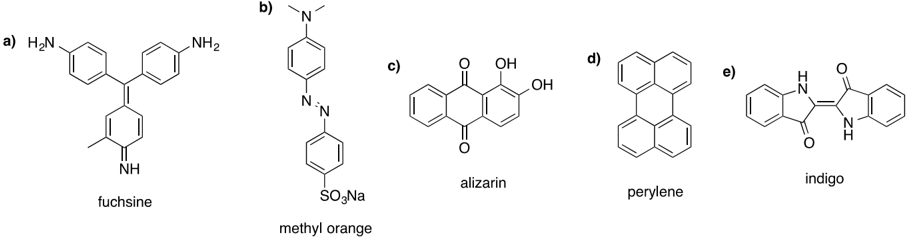
Amongst functional macromolecules, the combination of polymers and dyes is a research field of great potential with regard to high-performance materials. Accordingly, colored polymers have become increasingly important as materials for miscellaneous technical applications in recent years while also being a major part of everyday life. For instance, dye-containing polymers are nowadays widely applied in medicine, painting industries, analytics and gas separation processes. Since these applications are obviously connected to the dye’s nature, which is incorporated into the corresponding polymers, the affinity of certain polymers to dyes is exploited in wastewater work-ups after (textile) dyeing procedures. In this review, we wish to point out the great importance of dye-containing polymers, with a comprehensive scope and a focus on azo, triphenylmethane, indigoid, perylene and anthraquinone dyes. Since a large number of synthetic approaches towards the preparation of such materials can be found in the literature, an elaborated overview of different preparation techniques is given as well.
Overview
The claims and statistics of this paper haven’t been checked yet.
Free: it reads the open-access text and checks the first 5 claims that cite a source we can check. Create a free account to check every claim.
Integrity signals
Registry
Cites
Statistics
Figures








Verification
Claims the paper makes
The claims and statistics of this paper haven’t been checked yet.
Free: it reads the open-access text and checks the first 5 claims that cite a source we can check. Create a free account to check every claim.
Self-check
Percentages, sums and reported differences re-computed from the paper’s own numbers.
The self-check needs the paper’s full text.
Citations
Cites
Robinson, T., McMullan, G., Marchant, R., & Nigam, P. (2001) · Bioresource Technology · doi:10.1016/s0960-8524(00)00080-8 · Cited by 4,422 · cited 1×
“Hence, the environment is also being more and more affected by the steadily increasing frequency of dye pollutants, which induce unwanted color contaminations and sometimes have toxic effects to humans and animals [11,79].”
BackgroundLow-cost adsorbents for heavy metals uptake from contaminated water: a review
Babel, S. (2003) · Journal of Hazardous Materials · doi:10.1016/s0304-3894(02)00263-7 · Cited by 3,444 · cited 1×
“For instance, polysaccharide-based materials can be a cheap and effective alternative to commonly used systems [83,84].”
BackgroundRemoval of synthetic dyes from wastewaters: a review
Forgacs, E., Cserháti, T., & Oros, G. (2004) · Environment International · doi:10.1016/j.envint.2004.02.001 · Cited by 3,008 · cited 1×
“Plenty of physical, chemical and biological methods such as ozonation, fungal decolorization and degradation, membrane-filtration, activated carbon usage or electrochemical techniques like coagulation have been developed and optimized in recent years [80–82].”
MethodCrini, G., & Badot, P.-M. (2008) · Progress in Polymer Science · doi:10.1016/j.progpolymsci.2007.11.001 · Cited by 2,350 · cited 1×
“The only disadvantages in using chitosan are the variability in its characteristics, as the distribution of the acetyl groups along the backbone cannot be controlled, and its pH sensitivity [88].”
BackgroundPhotoinduced Motions in Azo-Containing Polymers
Natansohn, A., & Rochon, P. (2002) · Chemical Reviews · doi:10.1021/cr970155y · Cited by 2,229 · cited 1×
“This so-called Weigert effect induces birefringence of the materials [106,107].”
BackgroundRecent developments in polysaccharide-based materials used as adsorbents in wastewater treatment
Crini, G. (2005) · Progress in Polymer Science · doi:10.1016/j.progpolymsci.2004.11.002 · Cited by 2,183 · cited 1×
“For instance, polysaccharide-based materials can be a cheap and effective alternative to commonly used systems [83,84].”
BackgroundCharge Carrier Transporting Molecular Materials and Their Applications in Devices
Shirota, Y., & Kageyama, H. (2007) · Chemical Reviews · doi:10.1021/cr050143+ · Cited by 1,756 · cited 1×
“A quite new field of interest in polymers combined with dyes is organic light-emitting diodes (OLEDs) or rather polymer light-emitting diodes (PLEDs), which can be used as a full-color, high-efficiency and low-drive voltage material for flat-panel displays [118].”
BackgroundForce-induced activation of covalent bonds in mechanoresponsive polymeric materials
Davis, D. A., Hamilton, A., Yang, J., Cremar, L. D., Van Gough, D., Potisek, S. L., Ong, M. T., Braun, P. V., Martínez, T. J., White, S. R., et al. (2009) · Nature · doi:10.1038/nature07970 · Cited by 1,754 · cited 1×
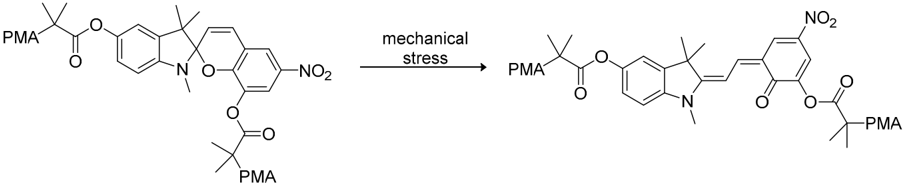
“A noted example for polymer-dye systems in chromogenic materials are spiropyrans [112,113].”
BackgroundPhotochemistry of azobenzene-containing polymers
Kumar, G. S., & Neckers, D. C. (1989) · Chemical Reviews · doi:10.1021/cr00098a012 · Cited by 1,366 · cited 1×
“Thereby, the original disorder in the molecule is reconstituted [15].”
BackgroundAdsorption behavior of reactive dye in aqueous solution on chemical cross-linked chitosan beads
Chiou, M. S., & Li, H. Y. (2003) · Chemosphere · doi:10.1016/s0045-6535(02)00636-7 · Cited by 840 · cited 1×
“In several publications epichlorhydrin cross-linked cyclodextrine and starch, as well as glutaraldehyde cross-linked chitosan, showed a high affinity, selectivity and capacity towards anthraquinone and azo dye pollutants in waste water [85–87].”
Background
Research works printed but not linked: 3
- Venkataraman, K. (2012). The Chemistry of Synthetic Dyes, Academic Press.
- Venkataraman, K. (2012). The Chemistry of Synthetic Dyes, Academic Press.
- Dawson, 1981, Polymeric dyes, Aldrichim. Acta, 14, 23
Cited by
Items 201–204 of 204
Kirchof, K., Marzec, A., & Szadkowski, B. (2026) · Molecules · doi:10.3390/molecules31162762
Broad-spectrum chromaticity and high color fastness of polyimide fibers via intrinsic coloration
Liu, Z., Liu, S., Wang, Y., Chen, Y., Deng, H., Tan, Z., Zhao, X., Chen, Y., & Zhu, M. (2026) · Journal of Material Science and Technology · doi:10.1016/j.jmst.2026.08.086
MORPHOLOGICAL STUDY AND COMPATIBILITY OF PMMA BLENDS WITH PVA PREPARED IN SOLUTION
Parra, C., Gualdron, Y., Chinea, C., Cañizales, E., Gomes, M., Soto, D., Catarí, E., & Herrera, A. (2025) · Acta microscópica
Zhang, M., Xiong, Y., Gong, W., Zhou, X., He, Y., Zhang, S., Zeng, B., Shu, Y., Zhu, K., Zhang, J., et al. (2026) · ACS Applied Polymer Materials · doi:10.1021/acsapm.6c01900
Metadata
- Authors
- Fleischmann, C., Lievenbrück, M., & Ritter, H.
- Affiliations
- University of California, Santa Barbara (US)
- Heinrich Heine University Düsseldorf (DE)
- Corresponding author
- Ritter, Helmut
- ORCID
- Fleischmann, Carolin
- Venue
- Polymers
- Publisher
- MDPI AG
- Published
- 2015-04-15
- Volume
- 7
- Issue
- 4
- Pages
- 717-746
- ISSN
- 2073-4360 (ISSN-L)
- OpenAlex
- W1965217519
- Cited by
- 188
- References
- 123
- Citations by year
- 2026: 10 · 2025: 20 · 2024: 32 · 2023: 16 · 2022: 14 · 2021: 18 · 2020: 21 · 2019: 17 · 2018: 15 · 2017: 14 · 2016: 10 · 2015: 1
- FWCI
- 18.11
- Type
- journal article
- Language
- en
- Open access
- gold
- dx.doi.org
- Licence
- Locations
- Polymers (publishedVersion, cc-by)
- DOAJ (DOAJ: Directory of Open Access Journals) (submittedVersion, cc-by-sa)
- Topics
- Physical Sciences › Materials Science › Polymers and Plastics › Dyeing and Modifying Textile Fibers
- Physical Sciences › Chemistry › Organic Chemistry › Advanced Polymer Synthesis and Characterization
- Physical Sciences › Materials Science › Polymers and Plastics › Polymer Synthesis and Characterization
- Keywords
- colored polymers, azo dyes, triphenylmethane dyes, indigoid dyes, perylene dyes, anthraquinone dyes, polymer synthesis, dyeing wastewater, gas separation, medical applications, painting industry
About these checks
Registry, retraction, Cites and statistics results are computed, not judged, with one exception: a printed reference that no index lists is read once by a model before it counts as a citation error. Claims are extracted by a model and kept only when their quote appears verbatim in the text; each cited source is then checked, with a model’s help, for whether it says what the claim relies on. Those verdicts can be wrong — read the claim’s quote and the cited source before relying on one.
Statistics and arithmetic are recomputed, not judged.
Confidence bands are shown only for fields calibrated on our annotated test set. None is calibrated yet, so no band is shown.
What counts as a claim ›How we measure confidence ›How we check this ›
Are you an author, or do you see a problem with this page? Request a review
Data sources
Bibliographic data: Semantic Scholar, OpenAlex, Crossref.
Contains information from the Semantic Scholar Academic Graph Datasets, made available under the ODC Attribution License (ODC-BY 1.0).
Semantic Scholar’s data is described in: Kinney, R., et al. (2023). The Semantic Scholar Open Data Platform. arXiv:2301.10140.
