

A Machine Learning Framework for Gait Classification Using Inertial Sensors: Application to Elderly, Post-Stroke and Huntington’s Disease Patients
Open accessThe DOI matches its Crossref record; 49 of the 49 references it cites were found in a registry or an index.
Abstract
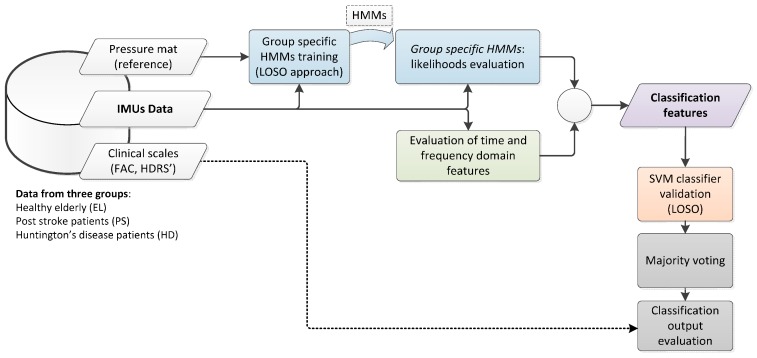
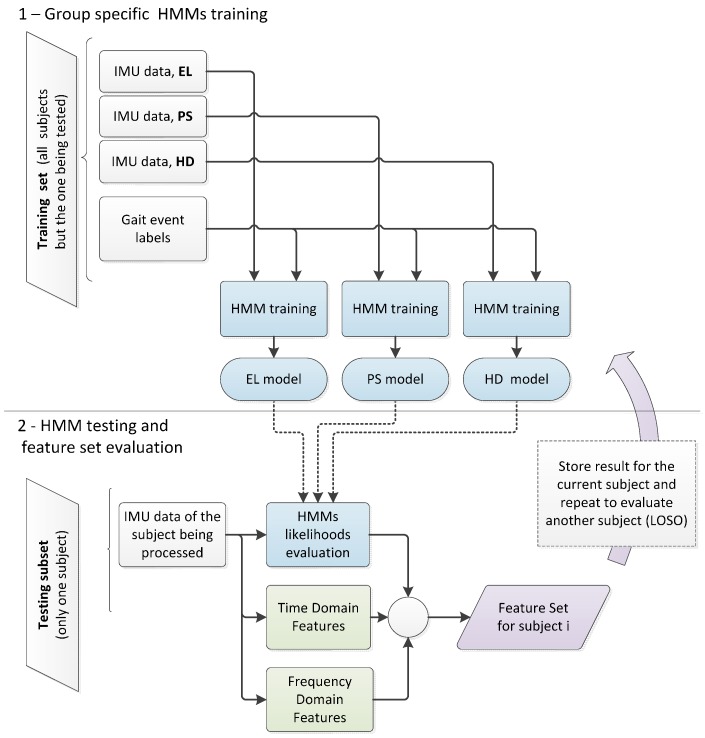
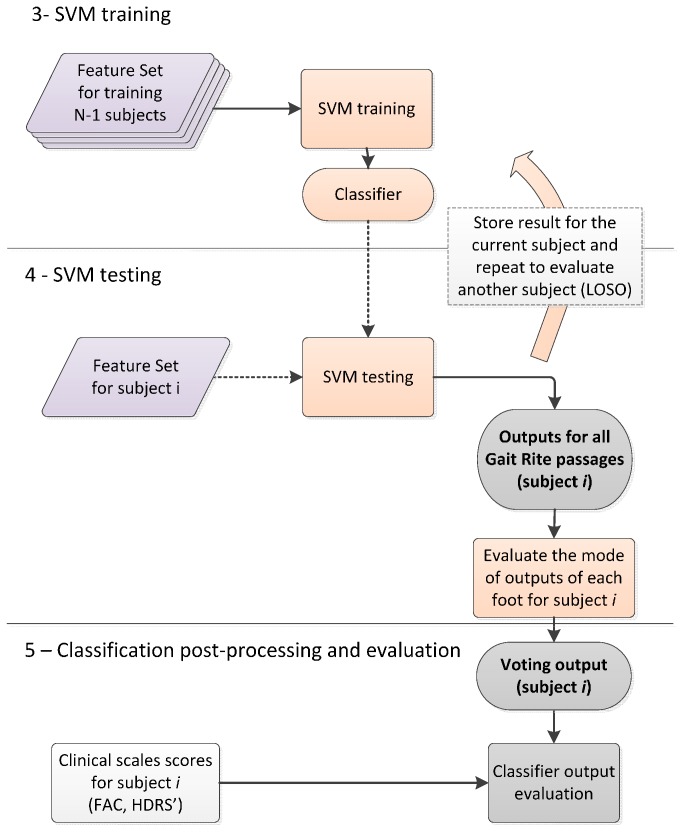
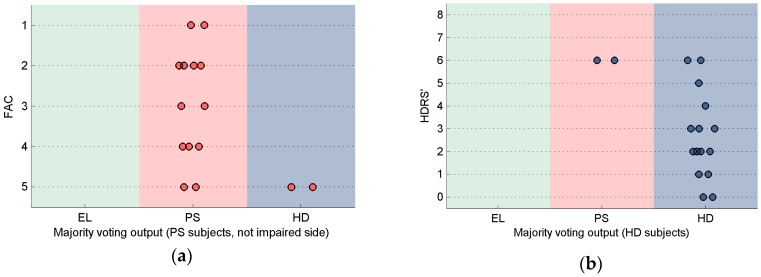
Machine learning methods have been widely used for gait assessment through the estimation of spatio-temporal parameters. As a further step, the objective of this work is to propose and validate a general probabilistic modeling approach for the classification of different pathological gaits. Specifically, the presented methodology was tested on gait data recorded on two pathological populations (Huntington’s disease and post-stroke subjects) and healthy elderly controls using data from inertial measurement units placed at shank and waist. By extracting features from group-specific Hidden Markov Models (HMMs) and signal information in time and frequency domain, a Support Vector Machines classifier (SVM) was designed and validated. The 90.5% of subjects was assigned to the right group after leave-one-subject–out cross validation and majority voting. The long-term goal we point to is the gait assessment in everyday life to early detect gait alterations.
Overview
The claims and statistics of this paper haven’t been checked yet.
Free: it reads the open-access text and checks the first 5 claims that cite a source we can check. Create a free account to check every claim.
Integrity signals
Registry
Cites
Statistics
Figures
Verification
Claims the paper makes
The claims and statistics of this paper haven’t been checked yet.
Free: it reads the open-access text and checks the first 5 claims that cite a source we can check. Create a free account to check every claim.
Claims other papers make about this one
Each is checked against this paper’s own text: does it say what the citing paper says it does?
The source backs part of the claim, not all of it — or backs it for a different population, condition or comparison.
In the citing paper
“Similarly, Maninini et al proposed a wearable device for collecting data about normal/pathological gaits for stroke prediction.49”
From Artificial intelligence in healthcare: past, present and future (2017) · cites this paper as [49]
Experimental — accuracy not yet measuredThe source backs part of the claim, not all of it — or backs it for a different population, condition or comparison.
In the citing paper
“Some researchers implemented systems to distinguish between normal and abnormal gaits for lower-limb rehabilitation [56,59,60], in which participants executed 10 m walks.”
From Wearable sensors and machine learning in post-stroke rehabilitation assessment: A systematic review (2022) · cites this paper as [56]
Experimental — accuracy not yet measuredThe check wasn’t confident either way, so it gives no verdict — never disputed.
In the citing paper
“All of these reasons resulted in IoT systems locally processing data [41,56,55].”
From Wearable sensors and machine learning in post-stroke rehabilitation assessment: A systematic review (2022) · cites this paper as [56]
Experimental — accuracy not yet measuredIn the citing paper
“The data would be extracted and modelled by hidden Markov models and SVM, and the algorithm could correctly classify 90.5% of the subjects to the right group.”
From Artificial intelligence in healthcare: past, present and future (2017) · cites this paper as [49]
Self-check
Percentages, sums and reported differences re-computed from the paper’s own numbers.
The self-check needs the paper’s full text.
Citations
Cites
LIBSVM: A library for support vector machines
Chang, C.-C., & Lin, C.-J. (2011) · ACM Transactions on Intelligent Systems and Technology · doi:10.1145/1961189.1961199 · Cited by 40,918 · cited 1×
“In this work, in particular, we used the LibSVM implementation of these algorithms [41].”
MethodThe Nature of Statistical Learning Theory
Vapnik, V. N. (1995) · doi:10.1007/978-1-4757-2440-0 · Cited by 39,138
A tutorial on hidden Markov models and selected applications in speech recognition
Rabiner, L. R. (1989) · Proceedings of the IEEE · doi:10.1109/5.18626 · Cited by 22,743
The Nature of Statistical Learning Theory
Vapnik, V. N. (2000) · Springer eBooks · doi:10.1007/978-1-4757-3264-1 · Cited by 10,696
‘Small Changes' to Diet and Physical Activity Behaviors for Weight Management
Hills, A. P., Byrne, N. M., Lindstrom, R., & Hill, J. O. (2013) · Obesity Facts · doi:10.1159/000345030 · Cited by 9,493
Physical Activity in the United States Measured by Accelerometer
TROIANO, R. P., BERRIGAN, D., DODD, K. W., MÂSSE, L. C., TILERT, T., & MCDOWELL, M. (2008) · Medicine & Science in Sports & Exercise · doi:10.1249/mss.0b013e31815a51b3 · Cited by 7,638 · cited 1×
“, gait spatio-temporal parameters, gait variability) and the quality and quantity of physical activity in both healthy and pathological populations [5–7].”
BackgroundStatistical pattern recognition: a review
Jain, A. K., Duin, P. W., & Mao, J. (2000) · IEEE Transactions on Pattern Analysis and Machine Intelligence · doi:10.1109/34.824819 · Cited by 6,767 · cited 1×
“To improve the final prediction and summarize the results, a majority voting (MV) strategy was finally applied [43].”
MethodThe Nature of Statistical Learning
Vapnik, V. N. (1995) · Medical Entomology and Zoology · Cited by 2,295
Unified Huntington's disease rating scale: Reliability and consistency
(1996) · Movement Disorders · doi:10.1002/mds.870110204 · Cited by 2,079
Clinical Gait Assessment in the Neurologically Impaired
Holden, M. K., Gill, K. M., Magliozzi, M. R., Nathan, J., & Piehl-Baker, L. (1984) · Physical Therapy · doi:10.1093/ptj/64.1.35 · Cited by 1,499
Unified Huntington's disease rating scale: reliability and consistency
Kremer, H. P. H. (1996) · Radboud Repository (Radboud University) · Cited by 1,059
Machine Learning Methods for Classifying Human Physical Activity from On-Body Accelerometers
Mannini, A., & Sabatini, A. M. (2010) · Sensors · doi:10.3390/s100201154 · Cited by 781 · cited 1×
“Moreover, twelve additional time and frequency domain features extracted from the IMU data were included (Table 1); such features confirmed their capability to extract information about ambulation in previous studies on data classification using inertial sensors [23,42].”
BackgroundSelf-citationChen, G., Patten, C., Kothari, D. H., & Zajac, F. E. (2005) · Gait & Posture · doi:10.1016/j.gaitpost.2004.06.009 · Cited by 701
Gesture recognition with a Wii controller
Schlömer, T., Poppinga, B., Henze, N., & Boll, S. (2008) · Proceedings of the 2nd international conference on Tangible and embedded interaction · doi:10.1145/1347390.1347395 · Cited by 461 · cited 1×
“Some examples of recent applications of this statistically-intensive approach include discrimination between walking and jogging [8], classification of type of walking (level walking, inclined walking and stair climbing) [17], gesture recognition [18] and user authentication based on gait [19].”
BackgroundBonato, P. (2010) · IEEE Engineering in Medicine and Biology Magazine · doi:10.1109/memb.2010.936554 · Cited by 423 · cited 1×
“Within this context, the assessment of gait in terms of quality and quantity is of great relevance since it provides indications of the level of physical mobility, of the risk of fall or of the effects of a therapy [1].”
BackgroundSupport Vector Machines for Automated Gait Classification
Begg, R. K., Palaniswami, M., & Owen, B. (2005) · IEEE Transactions on Biomedical Engineering · doi:10.1109/tbme.2005.845241 · Cited by 408 · cited 2×
“Very often the validation phase of newly proposed methodologies for the gait classification, especially in pathological populations, is overlooked or based on N-fold cross-validation approaches that includes data from the same subject in both training and test sets [21,22].”
MethodActivity Recognition Using a Single Accelerometer Placed at the Wrist or Ankle
MANNINI, A., INTILLE, S. S., ROSENBERGER, M., SABATINI, A. M., & HASKELL, W. (2013) · Medicine & Science in Sports & Exercise · doi:10.1249/mss.0b013e31829736d6 · Cited by 383 · cited 1×
“Moreover, twelve additional time and frequency domain features extracted from the IMU data were included (Table 1); such features confirmed their capability to extract information about ambulation in previous studies on data classification using inertial sensors [23,42].”
BackgroundSelf-citationMethods for gait event detection and analysis in ambulatory systems
Rueterbories, J., Spaich, E. G., Larsen, B., & Andersen, O. K. (2010) · Medical Engineering & Physics · doi:10.1016/j.medengphy.2010.03.007 · Cited by 350 · cited 1×
“, gait spatio-temporal parameters, gait variability) and the quality and quantity of physical activity in both healthy and pathological populations [5–7].”
BackgroundFunctional calibration procedure for 3D knee joint angle description using inertial sensors
Favre, J., Aissaoui, R., Jolles, B. M., de Guise, J. A., & Aminian, K. (2009) · Journal of Biomechanics · doi:10.1016/j.jbiomech.2009.06.025 · Cited by 301 · cited 1×
“Although this work did not include anatomical calibration of the IMU positioning [31–34], care was taken to align the IMU axes to the anatomical axes.”
MethodJoint kinematics estimate using wearable inertial and magnetic sensing modules
Picerno, P., Cereatti, A., & Cappozzo, A. (2008) · Gait & Posture · doi:10.1016/j.gaitpost.2008.04.003 · Cited by 262
Self-citationAvoiding non-independence in fMRI data analysis: Leave one subject out
Esterman, M., Tamber-Rosenau, B. J., Chiu, Y.-C., & Yantis, S. (2010) · NeuroImage · doi:10.1016/j.neuroimage.2009.10.092 · Cited by 261 · cited 1×
“Such a validation approach is particularly useful in evaluating the inter-subject generalization capability of the proposed methodology [8,35].”
Balasubramanian, C. K., Neptune, R. R., & Kautz, S. A. (2009) · Gait & Posture · doi:10.1016/j.gaitpost.2008.10.061 · Cited by 250
Trojaniello, D., Cereatti, A., Pelosin, E., Avanzino, L., Mirelman, A., Hausdorff, J. M., & Della Croce, U. (2014) · Journal of NeuroEngineering and Rehabilitation · doi:10.1186/1743-0003-11-152 · Cited by 244 · cited 1×
“, gait spatio-temporal parameters, gait variability) and the quality and quantity of physical activity in both healthy and pathological populations [5–7].”
BackgroundSelf-citationPalermo, E., Rossi, S., Marini, F., Patanè, F., & Cappa, P. (2014) · Measurement · doi:10.1016/j.measurement.2014.03.004 · Cited by 182 · cited 1×
“Although this work did not include anatomical calibration of the IMU positioning [31–34], care was taken to align the IMU axes to the anatomical axes.”
MethodMannini, A., & Sabatini, A. M. (2012) · Gait & Posture · doi:10.1016/j.gaitpost.2012.06.017 · Cited by 179
Self-citationAminian, K., Trevisan, C., Najafi, B., Dejnabadi, H., Frigo, C., Pavan, E., Telonio, A., Cerati, F., Marinoni, E. C., Robert, P., et al. (2004) · Gait & Posture · doi:10.1016/s0966-6362(03)00093-6 · Cited by 164
The gait abnormality of Huntington's disease
Koller, W. C., & Trimble, J. (1985) · Neurology · doi:10.1212/wnl.35.10.1450 · Cited by 161 · cited 1×
“The two pathological populations were selected as a paradigm since they are characterized by gait patterns that result in IMU signals with characteristic features [24–28].”
BackgroundAutomatic recognition of gait-related health problems in the elderly using machine learning
Pogorelc, B., Bosnić, Z., & Gams, M. (2012) · Multimedia Tools and Applications · doi:10.1007/s11042-011-0786-1 · Cited by 145 · cited 2×
“Very often the validation phase of newly proposed methodologies for the gait classification, especially in pathological populations, is overlooked or based on N-fold cross-validation approaches that includes data from the same subject in both training and test sets [21,22].”
BackgroundMethodTaborri, J., Rossi, S., Palermo, E., Patanè, F., & Cappa, P. (2014) · Sensors · doi:10.3390/s140916212 · Cited by 140 · cited 1×
“, classical threshold-based methods) was exploited to model gait data for both segmentation and classification purposes [8,10].”
MethodEstimation of spatio-temporal parameters for post-stroke hemiparetic gait using inertial sensors
Yang, S., Zhang, J., Novak, A. C., Brouwer, B. J., & Li, Q. (2012) · Gait & Posture · doi:10.1016/j.gaitpost.2012.07.032 · Cited by 130
Using Hidden Markov Models for accelerometer-based biometric gait recognition
Nickel, C., Busch, C., Rangarajan, S., & Mobius, M. (2011) · 2011 IEEE 7th International Colloquium on Signal Processing and its Applications · doi:10.1109/cspa.2011.5759842 · Cited by 122 · cited 1×
“Some examples of recent applications of this statistically-intensive approach include discrimination between walking and jogging [8], classification of type of walking (level walking, inclined walking and stair climbing) [17], gesture recognition [18] and user authentication based on gait [19].”
BackgroundOnline Decoding of Hidden Markov Models for Gait Event Detection Using Foot-Mounted Gyroscopes
Mannini, A., Genovese, V., & Sabatin, A. M. (2014) · IEEE Journal of Biomedical and Health Informatics · doi:10.1109/jbhi.2013.2293887 · Cited by 114 · cited 1×
“SVM classification and HMM-based gait assessment were successfully tested on Android-based smartphones in some previous works of ours [36,37].”
MethodSelf-citationDalton, A. F., Khalil, H. W., Busse, M. E., Rosser, A., Deursen, R. W. M. V., & OLaighin, G. M. (2012) · Gait & Posture · doi:10.1016/j.gaitpost.2012.05.028 · Cited by 113
Gait phase analysis based on a Hidden Markov Model
Bae, J., & Tomizuka, M. (2011) · Mechatronics · doi:10.1016/j.mechatronics.2011.03.003 · Cited by 106 · cited 1×
“sequences using Hidden Markov Models (HMMs) have been proposed [8–16].”
MethodClassification of gait disturbances: Distinguishing between continuous and episodic changes
Giladi, N., Horak, F. B., & Hausdorff, J. M. (2013) · Movement Disorders · doi:10.1002/mds.25672 · Cited by 97 · cited 1×
“In general, pathological gaits can be classified based on their characteristic motor features and according to the dominant observed motor disturbance [4].”
BackgroundExtracting a diagnostic gait signature
Lakany, H. (2007) · Pattern Recognition · doi:10.1016/j.patcog.2007.11.004 · Cited by 91 · cited 1×
“Lakany proposed a solution for pathology detection from kinematic data obtained using stereo-photogrammetry during gait [20].”
BackgroundGait Detection in Children with and without Hemiplegia Using Single-Axis Wearable Gyroscopes
Abaid, N., Cappa, P., Palermo, E., Petrarca, M., & Porfiri, M. (2013) · PLoS ONE · doi:10.1371/journal.pone.0073152 · Cited by 89 · cited 2×
“Although no classification tests were conducted, Abaid and colleagues found significant differences in the duration of the gait phases between 10 healthy and 10 hemiplegic children using IMU data [14].”
BackgroundReliability of spatiotemporal gait outcome measures in Huntington's disease
Rao, A. K., Quinn, L., & Marder, K. S. (2005) · Movement Disorders · doi:10.1002/mds.20482 · Cited by 86 · cited 1×
“The two pathological populations were selected as a paradigm since they are characterized by gait patterns that result in IMU signals with characteristic features [24–28].”
BackgroundA spot check for assessing static orientation consistency of inertial and magnetic sensing units
Picerno, P., Cereatti, A., & Cappozzo, A. (2011) · Gait & Posture · doi:10.1016/j.gaitpost.2010.12.006 · Cited by 81
Self-citationTracking motor impairments in the progression of Huntington's disease
Long, J. D., Paulsen, J. S., Marder, K. S., Zhang, Y., Kim, J., Mills, J. A., & the Researchers of the PREDICT‐HD Huntington's Study Group (2013) · Movement Disorders · doi:10.1002/mds.25657 · Cited by 70 · cited 1×
“The development of automatic methods to discriminate between normal and abnormal gait and among different pathological gait patterns would be of great interest in several clinical applications, [2,3].”
MethodAccelerometry-Based Classification of Human Activities Using Markov Modeling
Mannini, A., & Sabatini, A. M. (2011) · Computational Intelligence and Neuroscience · doi:10.1155/2011/647858 · Cited by 68 · cited 1×
“The training was supervised using the approach reported in [39].”
MethodSelf-citationMannini, A., & Sabatini, A. M. (2014) · Medical Engineering & Physics · doi:10.1016/j.medengphy.2014.07.022 · Cited by 65
Self-citationAccelerometry-based recognition of the placement sites of a wearable sensor
Mannini, A., Sabatini, A. M., & Intille, S. S. (2015) · Pervasive and Mobile Computing · doi:10.1016/j.pmcj.2015.06.003 · Cited by 58
Self-citationPfau, T., Ferrari, M., Parsons, K. J., & Wilson, A. M. (2007) · Journal of Biomechanics · doi:10.1016/j.jbiomech.2007.08.004 · Cited by 44 · cited 1×
“sequences using Hidden Markov Models (HMMs) have been proposed [8–16].”
MethodGuenterberg, E., Yang, A. Y., Ghasemzadeh, H. G., Jafari, R., Bajcsy, R. K., & Sastry, S. (2009) · IEEE Transactions on Information Technology in Biomedicine · doi:10.1109/titb.2009.2028421 · Cited by 44 · cited 1×
“sequences using Hidden Markov Models (HMMs) have been proposed [8–16].”
MethodHuman Abnormal Gait Modeling via Hidden Markov Model
Chen, M., Huang, B., & Xu, Y. (2007) · IEEE International Conference on Information Acquisition · doi:10.1109/icia.2007.4295787 · Cited by 42 · cited 1×
“Chen and colleagues proposed an HMM based approach for discriminating between two simulated gait deviations (toe-in and toe-out gait) [12].”
Mannini, A., Trojaniello, D., Croce, U. D., & Sabatini, A. M. (2015) · Annual International Conference of the IEEE Engineering in Medicine and Biology Society (EMBC) · doi:10.1109/embc.2015.7319558 · Cited by 35 · cited 3×
“In the present study, we tested the proposed methodology and validated it on about 3500 gait cycles recorded on three different populations (Huntington’s disease and post-stroke subjects and healthy elderly controls) [15].”
MethodInfluentialSelf-citationA smartphone-centered wearable sensor network for fall risk assessment in the elderly
Mannini, A., & Sabatini, A. M. (2015) · International Conference on Body Area Networks · doi:10.4108/eai.28-9-2015.2261433 · Cited by 8 · cited 2×
“, cascading a logistic regression to the SVM classifier [37,45].”
MethodSelf-citationHidden Markov Models Applied Onto Gait Classification
Bonnet, S., & Jallon, P. (2010) · INFM-OAR (INFN Catania) · doi:10.5281/zenodo.42060 · Cited by 7
Cited by
Artificial intelligence in healthcare: past, present and future
Jiang, F., Jiang, Y., Zhi, H., Dong, Y., Li, H., Ma, S., Wang, Y., Dong, Q., Shen, H., & Wang, Y. (2017) · Stroke and Vascular Neurology · doi:10.1136/svn-2017-000101 · Cited by 4,837
Adams, J. L., Dinesh, K., Xiong, M., Tarolli, C. G., Sharma, S., Sheth, N., Aranyosi, A. J., Zhu, W., Goldenthal, S., Biglan, K. M., et al. (2017) · Digital Biomarkers · doi:10.1159/000479018 · Cited by 3,171
Agri-food 4.0: A survey of the supply chains and technologies for the future agriculture
Lezoche, M., Hernandez, J. E., Alemany Díaz, M. D. M. E., Panetto, H., & Kacprzyk, J. (2020) · Computers in Industry · doi:10.1016/j.compind.2020.103187 · Cited by 835
Wearable health devices in health care: narrative systematic review
Lu, L., Zhang, J., Xie, Y., Gao, F., Xu, S., Wu, X., & Ye, Z. (2020) · JMIR mHealth and uHealth · doi:10.2196/18907 · Cited by 701
Machine learning in medical applications: a review of state-of-the-art methods
Shehab, M., Abualigah, L., Shambour, Q., Abu-Hashem, M. A., Shambour, M. K. Y., Alsalibi, A. I., & Gandomi, A. H. (2022) · Computers in Biology and Medicine · doi:10.1016/j.compbiomed.2022.105458 · Cited by 542
Metadata
- Authors
- Mannini, A., Trojaniello, D., Cereatti, A., & Sabatini, A.
- Affiliations
- Scuola Superiore Sant'Anna (IT)
- University of Sassari (IT)
- Corresponding author
- Mannini, Andrea
- Venue
- Sensors
- Publisher
- MDPI AG
- Published
- 2016-01-21
- Volume
- 16
- Issue
- 1
- Pages
- 134
- ISSN
- 1424-8220 (ISSN-L)
- PMC
- PMC4732167
- OpenAlex
- W2258968934
- Cited by
- 242
- References
- 49
- Citations by year
- 2026: 6 · 2025: 15 · 2024: 21 · 2023: 41 · 2022: 33 · 2021: 34 · 2020: 29 · 2019: 25 · 2018: 21 · 2017: 11 · 2016: 6
- FWCI
- 10.11
- Type
- journal article
- Language
- en
- Open access
- gold
- doi.org
- Licence
- Locations
- Sensors (publishedVersion, cc-by)
- PubMed Central (publishedVersion, cc-by)
- PubMed (publishedVersion)
- PORTO@Iris (submittedVersion, cc-by)
- UnissResearch (Università degli Studi di Sassari) (submittedVersion, cc-by)
- DOAJ (DOAJ: Directory of Open Access Journals) (submittedVersion, cc-by-sa)
- CINECA IRIS Institutional Research Information System (Sant'Anna School of Advanced Studies) (submittedVersion, other-oa)
- Funders
- Ministero dell’Istruzione, dell’Università e della Ricerca (PRIN project “A quantitative and multi-factorial approach for estimating and preventing the risk of falls in the elderly people.”)
- Topics
- Physical Sciences › Engineering › Biomedical Engineering › Gait Recognition and Analysis
- Health Sciences › Health Professions › Physical Therapy, Sports Therapy and Rehabilitation › Balance, Gait, and Falls Prevention
- Physical Sciences › Computer Science › Computer Vision and Pattern Recognition › Context-Aware Activity Recognition Systems
- Keywords
- gait classification, inertial sensors, pathological gait, Huntington's disease, post-stroke gait, elderly gait, hidden Markov models, support vector machine, gait analysis, gait deviations, wearable sensors
- MeSH terms
- Machine Learning, Aged, Female, Gait, Humans, Huntington Disease, Male, Markov Chains, Middle Aged, Paresis, Signal Processing, Computer-Assisted, Monitoring, Ambulatory, Stroke, Support Vector Machine, Accelerometry
About these checks
Registry, retraction, Cites and statistics results are computed, not judged, with one exception: a printed reference that no index lists is read once by a model before it counts as a citation error. Claims are extracted by a model and kept only when their quote appears verbatim in the text; each cited source is then checked, with a model’s help, for whether it says what the claim relies on. Those verdicts can be wrong — read the claim’s quote and the cited source before relying on one.
Statistics and arithmetic are recomputed, not judged.
Confidence bands are shown only for fields calibrated on our annotated test set. None is calibrated yet, so no band is shown.
What counts as a claim ›How we measure confidence ›How we check this ›
Are you an author, or do you see a problem with this page? Request a review
Data sources
Bibliographic data: Semantic Scholar, OpenAlex, Crossref.
Contains information from the Semantic Scholar Academic Graph Datasets, made available under the ODC Attribution License (ODC-BY 1.0).
Semantic Scholar’s data is described in: Kinney, R., et al. (2023). The Semantic Scholar Open Data Platform. arXiv:2301.10140.
