

The DOI matches its Crossref record; 26 of the 26 references it cites were found in a registry or an index.
Blood Pressure Estimation from Photoplethysmogram Using a Spectro-Temporal Deep Neural Network
Open accessAbstract
Blood pressure (BP) is a direct indicator of hypertension, a dangerous and potentially deadly condition. Regular monitoring of BP is thus important, but many people have aversion towards cuff-based devices, and their limitation is that they can only be used at rest. Using just a photoplethysmogram (PPG) to estimate BP is a potential solution investigated in our study. We analyzed the MIMIC III database for high-quality PPG and arterial BP waveforms, resulting in over 700 h of signals after preprocessing, belonging to 510 subjects. We then used the PPG alongside its first and second derivative as inputs into a novel spectro-temporal deep neural network with residual connections. We have shown in a leave-one-subject-out experiment that the network is able to model the dependency between PPG and BP, achieving mean absolute errors of 9.43 for systolic and 6.88 for diastolic BP. Additionally we have shown that personalization of models is important and substantially improves the results, while deriving a good general predictive model is difficult. We have made crucial parts of our study, especially the list of used subjects and our neural network code, publicly available, in an effort to provide a solid baseline and simplify potential comparison between future studies on an explicit MIMIC III subset.
Overview
The claims and statistics of this paper haven’t been checked yet.
Run the check — free, no account needed. It reads the open-access text and checks the sources it cites.
Integrity signals
Registry
Cites
Statistics
Figures
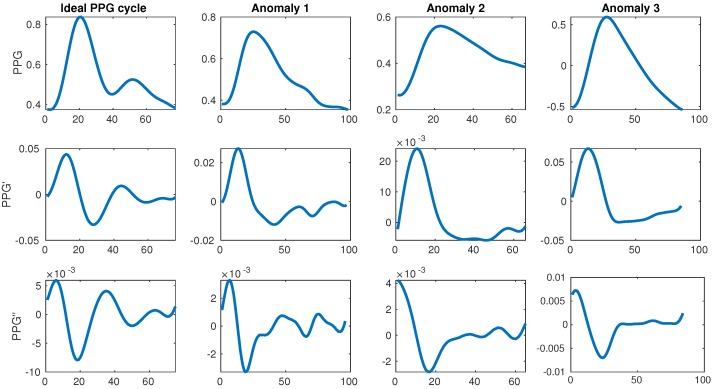
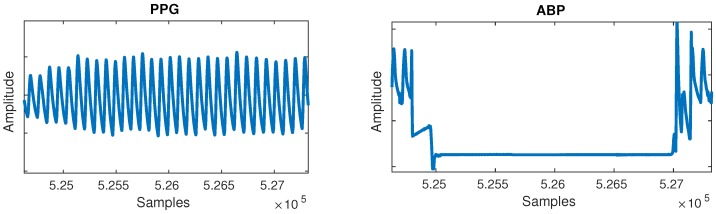
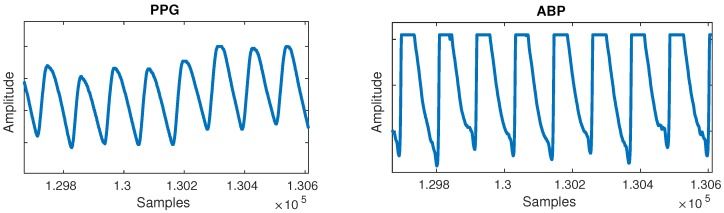
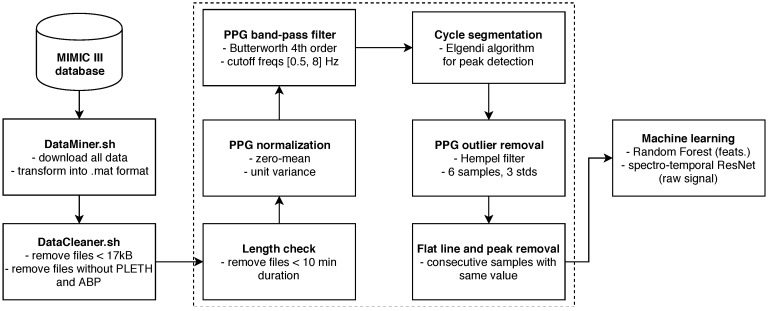
Verification
Claims the paper makes
The claims and statistics of this paper haven’t been checked yet.
Run the check — free, no account needed. It reads the open-access text and checks the sources it cites.
Claims other papers make about this one
Each is checked against this paper’s own text: does it say what the citing paper says it does?
In the citing paper
“Techniques that use a single PPG signal are based on analysis of pulse wave shape using either extracted features [151]–[153] or the whole pulse wave [154].”
From Wearable Photoplethysmography for Cardiovascular Monitoring (2022) · cites this paper as [154]
Self-check
Percentages, sums and reported differences re-computed from the paper’s own numbers.
The self-check needs the paper’s full text.
Citations
Cites
Deep Residual Learning for Image Recognition
He, K., Zhang, X., Ren, S., & Sun, J. (2016) · 2016 IEEE Conference on Computer Vision and Pattern Recognition (CVPR) · doi:10.1109/cvpr.2016.90 · Cited by 235,474
Goldberger, A. L., Amaral, L. A. N., Glass, L., Hausdorff, J. M., Ivanov, P. C., Mark, R. G., Mietus, J. E., Moody, G. B., Peng, C.-K., & Stanley, H. E. (2000) · Circulation · doi:10.1161/01.cir.101.23.e215 · Cited by 14,809
Welch, P. D. (1967) · IEEE Transactions on Audio and Electroacoustics · doi:10.1109/tau.1967.1161901 · Cited by 12,363
MIMIC-III, a freely accessible critical care database
Johnson, A. E. W., Pollard, T. J., Shen, L., Lehman, L.-W. H., Feng, M., Ghassemi, M., Moody, B., Szolovits, P., Anthony Celi, L., & Mark, R. G. (2016) · Scientific Data · doi:10.1038/sdata.2016.35 · Cited by 8,141
1,500 scientists lift the lid on reproducibility
Baker, M. (2016) · Nature · doi:10.1038/533452a · Cited by 4,209
Photoplethysmography and its application in clinical physiological measurement
Allen, J. (2007) · Physiological Measurement · doi:10.1088/0967-3334/28/3/r01 · Cited by 3,967
The progression from hypertension to congestive heart failure
Levy, D. (1996) · JAMA: The Journal of the American Medical Association · doi:10.1001/jama.1996.03530440037034 · Cited by 2,155 · cited 2×
“Cuff-based devices remain the golden standard and are commonly recommended by physicians [3].”
BackgroundToward ubiquitous blood pressure monitoring via pulse transit time: Theory and practice
Mukkamala, R., Hahn, J.-O., Inan, O. T., Mestha, L. K., Kim, C.-S., Toreyin, H., & Kyal, S. (2015) · IEEE Transactions on Biomedical Engineering · doi:10.1109/tbme.2015.2441951 · Cited by 935 · cited 1×
“The PTT approach was thoroughly tested in the past 10 years [15,16] and a number of slight variations were proposed, however, the underlying principle remains unchanged.”
BackgroundThe velocity of pulse wave in man
Bramwell, J. C., & Hill, A. V. (1922) · Proceedings of the Royal Society of London Series B Containing Papers of a Biological Character · doi:10.1098/rspb.1922.0022 · Cited by 809
Cuffless Blood Pressure Estimation Algorithms for Continuous Health-Care Monitoring
Kachuee, M., Kiani, M. M., Mohammadzade, H., & Shabany, M. (2017) · IEEE Transactions on Biomedical Engineering · doi:10.1109/tbme.2016.2580904 · Cited by 621
Research works printed but not linked: 1
- Lake, C., Hines, R., and Blitt, C. (2001). Pulse oximeter waveform: Photoelectric plethysmography. Clinical Monitoring, WB Saunders Company.
Cited by
Sorted by citations
Water quality classification using machine learning algorithms
Nasir, N., Kansal, A., Alshaltone, O., Barneih, F., Sameer, M., Shanableh, A., & Al-Shamma'a, A. I. (2022) · Journal of Water Process Engineering · doi:10.1016/j.jwpe.2022.102920 · Cited by 399
Thin, soft, wearable system for continuous wireless monitoring of artery blood pressure
Li, J., Jia, H., Zhou, J., Huang, X., Xu, L., Jia, S., Gao, Z., Yao, K., Li, D., Zhang, B., et al. (2023) · Nature Communications · doi:10.1038/s41467-023-40763-3 · Cited by 321
Chowdhury, M. H., Shuzan, M. N. I., Chowdhury, M. E. H., Mahbub, Z. B., Uddin, M. M., Khandakar, A., & Reaz, M. B. I. (2020) · Sensors · doi:10.3390/s20113127 · Cited by 276
Wearable Photoplethysmography for Cardiovascular Monitoring
Charlton, P. H., Kyriacou, P. A., Mant, J., Marozas, V., Chowienczyk, P., & Alastruey, J. (2022) · Proceedings of the IEEE · doi:10.1109/jproc.2022.3149785 · Cited by 250
Real-Time Cuffless Continuous Blood Pressure Estimation Using Deep Learning Model
Li, Y., Harfiya, L. N., Purwandari, K., & Lin, Y. (2020) · Sensors · doi:10.3390/s20195606 · Cited by 165
Metadata
- Authors
- Slapničar, G., Mlakar, N., & Luštrek, M.
- Affiliations
- Jožef Stefan Institute (SI)
- University of Ljubljana (SI)
- Corresponding author
- Slapničar, Gašper
- Venue
- Sensors
- Publisher
- MDPI AG
- Published
- 2019-08-04
- Volume
- 19
- Issue
- 15
- Pages
- 3420
- ISSN
- 1424-8220 (ISSN-L)
- PMC
- PMC6696196
- OpenAlex
- W2965846681
- Cited by
- 387
- References
- 26
- Citations by year
- 2026: 48 · 2025: 56 · 2024: 58 · 2023: 84 · 2022: 66 · 2021: 52 · 2020: 23
- FWCI
- 12.40
- Type
- journal article
- Language
- en
- Open access
- gold
- dx.doi.org
- Licence
- Locations
- Sensors (publishedVersion, cc-by)
- PubMed Central (publishedVersion, cc-by)
- PubMed (publishedVersion)
- DOAJ (DOAJ: Directory of Open Access Journals) (submittedVersion, cc-by-sa)
- Funders
- European Commission (689660)
- Topics
- Physical Sciences › Engineering › Biomedical Engineering › Non-Invasive Vital Sign Monitoring
- Health Sciences › Medicine › Cardiology and Cardiovascular Medicine › Cardiovascular Health and Disease Prevention
- Health Sciences › Medicine › Cardiology and Cardiovascular Medicine › Blood Pressure and Hypertension Studies
- Keywords
- blood pressure estimation, photoplethysmogram, skip connections, hypertension monitoring, cuffless blood pressure measurement, model personalization, MIMIC-III
- MeSH terms
- Deep Learning, Blood Pressure, Humans, Signal Processing, Computer-Assisted, Neural Networks, Computer, Photoplethysmography
About these checks
Registry, retraction, Cites and statistics results are computed, not judged, with one exception: a printed reference that no index lists is read once by a model before it counts as a citation error. Claims are extracted by a model and kept only when their quote appears verbatim in the text; each cited source is then checked, with a model’s help, for whether it says what the claim relies on. Those verdicts can be wrong — read the claim’s quote and the cited source before relying on one.
Statistics and arithmetic are recomputed, not judged.
Confidence bands are shown only for fields calibrated on our annotated test set. None is calibrated yet, so no band is shown.
What counts as a claim ›How we measure confidence ›How we check this ›
Are you an author, or do you see a problem with this page? Request a review
