

A Determination Method for Gait Event Based on Acceleration Sensors
Open accessThe DOI matches its Crossref record; 46 of the 46 references it cites were found in a registry or an index.
Abstract
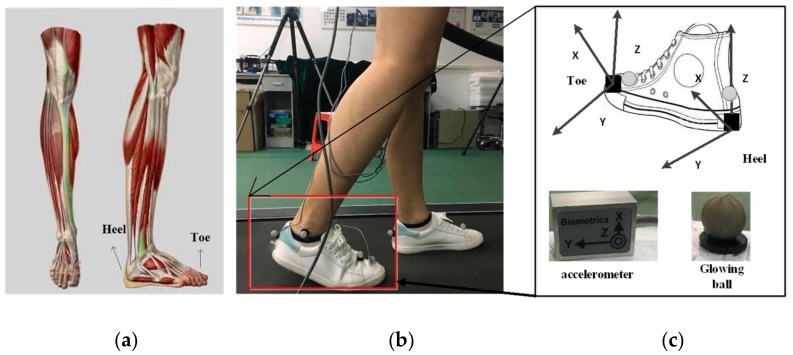
A gait event is a crucial step towards the effective assessment and rehabilitation of motor dysfunctions. However, for the data acquisition of a three-dimensional motion capture (3D Mo-Cap) system, the high cost of setups, such as the high standard laboratory environment, limits widespread clinical application. Inertial sensors are increasingly being used to recognize and classify physical activities in a variety of applications. Inertial sensors are now sufficiently small in size and light in weight to be part of a body sensor network for the collection of human gait data. The acceleration signal has found important applications in human gait recognition. In this paper, using the experimental data from the heel and toe, first the wavelet method was used to remove noise from the acceleration signal, then, based on the threshold of comprehensive change rate of the acceleration signal, the signal was primarily segmented. Subsequently, the vertical acceleration signals, from heel and toe, were integrated twice, to compute their respective vertical displacement. Four gait events were determined in the segmented signal, based on the characteristics of the vertical displacement of heel and toe. The results indicated that the gait events were consistent with the synchronous record of the motion capture system. The method has achieved gait event subdivision, while it has also ensured the accuracy of the defined gait events. The work acts as a valuable reference, to further study gait recognition.
Overview
The claims and statistics of this paper haven’t been checked yet.
Free: it reads the open-access text and checks the first 5 claims that cite a source we can check. Create a free account to check every claim.
Integrity signals
Registry
Cites
Statistics
Figures


Verification
Claims the paper makes
The claims and statistics of this paper haven’t been checked yet.
Free: it reads the open-access text and checks the first 5 claims that cite a source we can check. Create a free account to check every claim.
Claims other papers make about this one
Each is checked against this paper’s own text: does it say what the citing paper says it does?
The source backs part of the claim, not all of it — or backs it for a different population, condition or comparison.
In the citing paper
“Specifically, the extrema and variation frequency of acceleration can identify and distinguish between the stance and swing phases of gait 66 .”
From Recent advances in intelligent wearable systems: from multiscale biomechanical features towards human motion intent prediction (2026) · cites this paper as [66]
Experimental — accuracy not yet measuredIn the citing paper
“The human center of gravity exhibits corresponding sway patterns across different movement states 66 , forming the center of gravity stability mechanism.”
From Recent advances in intelligent wearable systems: from multiscale biomechanical features towards human motion intent prediction (2026) · cites this paper as [66]
In the citing paper
“Consequently, body acceleration is widely applied in HMIP-related domains including gait prediction 76 , fall detection 77 , and health assessment 66,78 .”
From Recent advances in intelligent wearable systems: from multiscale biomechanical features towards human motion intent prediction (2026) · cites this paper as [66]
Self-check
Percentages, sums and reported differences re-computed from the paper’s own numbers.
The self-check needs the paper’s full text.
Citations
Cites
Myoelectric control systems—A survey
Asghari Oskoei, M., & Hu, H. (2007) · Biomedical Signal Processing and Control · doi:10.1016/j.bspc.2007.07.009 · Cited by 1,244 · cited 1×
“In Equation (8), similarly, for the signal of the heel position, the subscript S corresponds to H; for the signal of the toe position, the subscript S corresponds to T; for the selection of threshold thS, thS = r×max( jaS(i)) is considered [47], while r is generally determined by the specific acceleration signals, as…”
BackgroundMachine Learning Methods for Classifying Human Physical Activity from On-Body Accelerometers
Mannini, A., & Sabatini, A. M. (2010) · Sensors · doi:10.3390/s100201154 · Cited by 781 · cited 1×
“The detection of gait events is an important tool in clinics [1,2], including human activity recognition for healthcare [3,4] and motor recovery assessments for effective rehabilitation strategies [5,6].”
BackgroundAutomatic detection of gait events using kinematic data
O’Connor, C. M., Thorpe, S. K., O’Malley, M. J., & Vaughan, C. L. (2007) · Gait & Posture · doi:10.1016/j.gaitpost.2006.05.016 · Cited by 557 · cited 1×
“In addition, the 3D Mo-Cap system is also affected by light and other environmental factors [17,19], limiting the widespread use of this method.”
MethodAccuracy of the Microsoft Kinect sensor for measuring movement in people with Parkinson's disease
Galna, B., Barry, G., Jackson, D., Mhiripiri, D., Olivier, P., & Rochester, L. (2014) · Gait & Posture · doi:10.1016/j.gaitpost.2014.01.008 · Cited by 544
Gait Partitioning Methods: A Systematic Review
Taborri, J., Palermo, E., Rossi, S., & Cappa, P. (2016) · Sensors · doi:10.3390/s16010066 · Cited by 361 · cited 1×
“In addition, the 3D Mo-Cap system is also affected by light and other environmental factors [17,19], limiting the widespread use of this method.”
MethodMethods for gait event detection and analysis in ambulatory systems
Rueterbories, J., Spaich, E. G., Larsen, B., & Andersen, O. K. (2010) · Medical Engineering & Physics · doi:10.1016/j.medengphy.2010.03.007 · Cited by 350
iFall: An android application for fall monitoring and response
Sposaro, F., & Tyson, G. (2009) · 2009 Annual International Conference of the IEEE Engineering in Medicine and Biology Society · doi:10.1109/iembs.2009.5334912 · Cited by 317 · cited 1×
“In recent years, wearable sensors have been widely used in gait speed estimation [28] and the assessment of a user’s health state, while being based on gait abnormalities [29] and fall detection [30].”
BackgroundAlgorithms to determine event timing during normal walking using kinematic data
Hreljac, A., & Marshall, R. N. (2000) · Journal of Biomechanics · doi:10.1016/s0021-9290(00)00014-2 · Cited by 272 · cited 4×
“Regarding the determination of gait events, studies point out that HS and TO events occur near the local maximum of the heel vertical acceleration signal, the events of HS and TO are identified if the differential of heel vertical acceleration signal is equal to 0 [38].”
BackgroundMethodInfluentialInertial Sensor-Based Methods in Walking Speed Estimation: A Systematic Review
Yang, S., & Li, Q. (2012) · Sensors · doi:10.3390/s120506102 · Cited by 204 · cited 1×
“In recent years, wearable sensors have been widely used in gait speed estimation [28] and the assessment of a user’s health state, while being based on gait abnormalities [29] and fall detection [30].”
BackgroundReal-time gait event detection for paraplegic FES walking
Skelly, M. M., & Chizeck, H. J. (2001) · IEEE Transactions on Neural Systems and Rehabilitation Engineering · doi:10.1109/7333.918277 · Cited by 157 · cited 1×
“the plantar switching signal and, consequently, the gait can be divided into support phase and swing phase [20].”
Background
Research works printed but not linked: 3
- Gao, 2015, Gait recogIlition for lower extremity electromyographic signals based on PSO-SVM method, J. Electron. Inf. Technol., 37, 1154
- Chen, 2016, Human gait events fast recognition method via surface electromyography, China Mech. Eng., 27, 911
- Luo, 2009, Hermite interpolation-based wavelet transform modulus maxima reconstruction algorithm’s application to EMG de-noising, J. Electron. Inf. Technol., 31, 857
Cited by
Human Gait Recognition: A Single Stream Optimal Deep Learning Features Fusion
Saleem, F., Khan, M. A., Alhaisoni, M. M., Tariq, U., Armghan, A., Alenezi, F. S., Choi, J.-I., & Kadry, S. (2021) · Sensors · doi:10.3390/s21227584 · Cited by 55
Huang, Y., Liu, Y., Hsu, W., Lai, L.-J., & Lee, M. S.-S. (2020) · Sensors · doi:10.3390/s20061703 · Cited by 52
“[18] used acceleration sensor signals to determine gait event.”
MethodHuman Gait Recognition Based on Multiple Feature Combination and Parameter Optimization Algorithms
Gao, F., Taixing, T., Yao, T., & Zhang, Q. (2021) · Computational Intelligence and Neuroscience · doi:10.1155/2021/6693206 · Cited by 36
“Gait refers to the movement and balance of the human body when walking upright, which is the basic movement mode of the lower limbs [1, 2].”
BackgroundSelf-citationAngle Estimation for Knee Joint Movement Based on PCA-RELM Algorithm
Deng, Y., Gao, F., & Chen, H. (2020) · Symmetry · doi:10.3390/sym12010130 · Cited by 35
Self-citationRattanakoch, J., Samala, M., Limroongreungrat, W., Guerra, G., Tharawadeepimuk, K., Nanbancha, A., Niamsang, W., Kerdsomnuek, P., & Suwanmana, S. (2023) · Sensors · doi:10.3390/s23031738 · Cited by 34
“Foot strike events were obtained for OMC using the lowest position of heel detection [27], and for IMU using foot acceleration signals [28].”
Method
Metadata
- Authors
- Mei, C., Gao, F., & Li, Y.
- Affiliations
- Hangzhou Dianzi University (CN)
- Corresponding author
- Gao, Farong
- Venue
- Sensors
- Publisher
- MDPI AG
- Published
- 2019-12-12
- Volume
- 19
- Issue
- 24
- Pages
- 5499
- ISSN
- 1424-8220 (ISSN-L)
- PMC
- PMC6960952
- OpenAlex
- W2996526055
- Cited by
- 16
- References
- 46
- Citations by year
- 2026: 1 · 2024: 1 · 2023: 3 · 2022: 2 · 2021: 5 · 2020: 4
- FWCI
- 0.97
- Type
- journal article
- Language
- en
- Open access
- gold
- dx.doi.org
- Licence
- Locations
- Sensors (publishedVersion, cc-by)
- PubMed Central (publishedVersion, cc-by)
- PubMed (publishedVersion)
- Funders
- National Natural Science Foundation of China (U1509203)
- Topics
- Physical Sciences › Engineering › Biomedical Engineering › Gait Recognition and Analysis
- Physical Sciences › Computer Science › Computer Vision and Pattern Recognition › Context-Aware Activity Recognition Systems
- Health Sciences › Health Professions › Physical Therapy, Sports Therapy and Rehabilitation › Balance, Gait, and Falls Prevention
- Keywords
- gait event detection, acceleration sensors, inertial sensors, wavelet denoising, signal segmentation, vertical displacement, gait recognition, wireless body area networks
About these checks
Registry, retraction, Cites and statistics results are computed, not judged, with one exception: a printed reference that no index lists is read once by a model before it counts as a citation error. Claims are extracted by a model and kept only when their quote appears verbatim in the text; each cited source is then checked, with a model’s help, for whether it says what the claim relies on. Those verdicts can be wrong — read the claim’s quote and the cited source before relying on one.
Statistics and arithmetic are recomputed, not judged.
Confidence bands are shown only for fields calibrated on our annotated test set. None is calibrated yet, so no band is shown.
What counts as a claim ›How we measure confidence ›How we check this ›
Are you an author, or do you see a problem with this page? Request a review
How to cite
Cite CoChat for the checks on this page, and the paper for its own findings.
- This page
- CoChat. (2026). Citation check: A Determination Method for Gait Event Based on Acceleration Sensors. https://app.cochat.ai/papers/10.3390/s19245499
- The paper
- Mei, C., Gao, F., & Li, Y. (2019). A Determination Method for Gait Event Based on Acceleration Sensors. Sensors. https://doi.org/10.3390/s19245499
Data sources
Bibliographic data: Semantic Scholar, OpenAlex, Crossref.
Contains information from the Semantic Scholar Academic Graph Datasets, made available under the ODC Attribution License (ODC-BY 1.0).
Semantic Scholar’s data is described in: Kinney, R., et al. (2023). The Semantic Scholar Open Data Platform. arXiv:2301.10140.
