

The DOI matches its Crossref record; 42 of the 42 references it cites were found in a registry or an index; 2 of the 6 sources its claims cite were checked for support.
Deep Metallic Surface Defect Detection: The New Benchmark and Detection Network
Open accessAbstract
Metallic surface defect detection is an essential and necessary process to control the qualities of industrial products. However, due to the limited data scale and defect categories, existing defect datasets are generally unavailable for the deployment of the detection model. To address this problem, we contribute a new dataset called GC10-DET for large-scale metallic surface defect detection. The GC10-DET dataset has great challenges on defect categories, image number, and data scale. Besides, traditional detection approaches are poor in both efficiency and accuracy for the complex real-world environment. Thus, we also propose a novel end-to-end defect detection network (EDDN) based on the Single Shot MultiBox Detector. The EDDN model can deal with defects with different scales. Furthermore, a hard negative mining method is designed to alleviate the problem of data imbalance, while some data augmentation methods are adopted to enrich the training data for the expensive data collection problem. Finally, the extensive experiments on two datasets demonstrate that the proposed method is robust and can meet accuracy requirements for metallic defect detection.
Overview
CoChat Summary
## TL;DR
The paper introduces GC10-DET, a new real-industry metallic surface defect dataset with 10 defect types and 3,570 grayscale images, and proposes an end-to-end defect detector (EDDN) based on SSD. Experiments on GC10-DET and NEU-DET show the method is robust, improves multi-scale defect detection, and achieves the best mAP on GC10-DET.
## Key findings
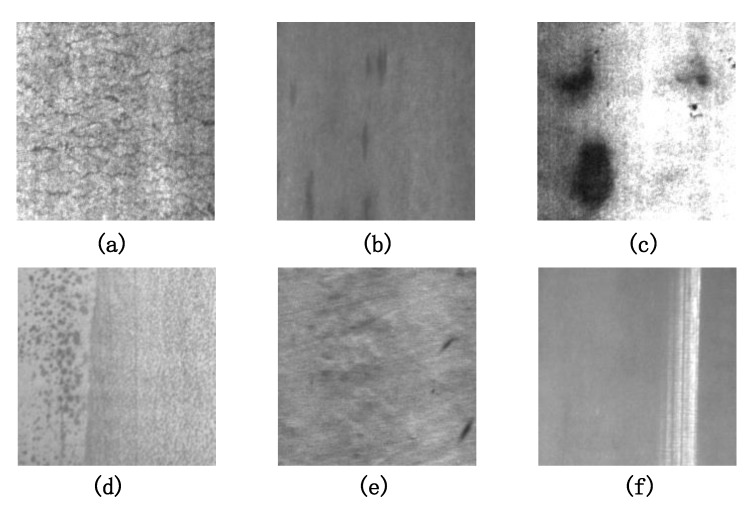
- GC10-DET contains 10 defect types and 3,570 grayscale images collected in a real industrial setting; NEU-DET has 6 defect types and 1,800 grayscale images.
- On NEU-DET, the proposed method achieves the best mAP of 0.724 and the best results on most defect categories; SSD300 is slightly better on Sc recall (0.990 vs. 0.981) and on In AP (0.796 vs. 0.763) and Rs AP (0.621 vs. 0.581).
- On GC10-DET, the proposed method achieves the best mAP and the best results on most categories; SSD300 is slightly better on Rp recall (0.667 vs. 0.333) and Faster-RCNN is better on Cr recall (1 vs. 0.857).
- Runtime is reported as 27 ms/image on NEU-DET and 33 ms/image on GC10-DET for the proposed method; the paper says this is fast enough for real-time use, though YOLO-V2 is slightly faster on GC10-DET testing set time (4.49 s vs. 8 s).
## Methods
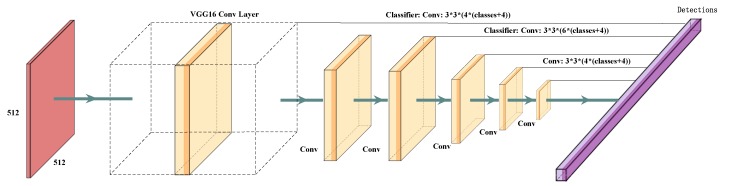
- The paper proposes EDDN, an end-to-end detector built on Single Shot MultiBox Detector (SSD) with VGG16, multi-scale feature maps, default boxes, and non-maximum suppression.
- It introduces hard negative mining, limiting negatives to at most a 3:1 ratio with positives, and applies data augmentation using full images, random patches, and patches with minimum Jaccard overlaps of 0.1, 0.3, 0.5, 0.7, or 0.9.
- Evaluation uses Recall, AP, and mAP on NEU-DET and GC10-DET, with comparisons against SSD, Faster-RCNN, YOLO-V2, YOLO-V3, and traditional LBP/HOG methods.
## Limitations
- The paper states that existing defect datasets are generally unavailable for deployment because of limited data scale and defect categories, and that metallic defect detection is difficult due to illumination, light reflection, and metal material effects.
- It notes that traditional methods are sensitive to lighting and background clutter and need repeated parameter tuning; this is a limitation of prior work, not the proposed method.
- Evident from the text: some reported gains are modest or mixed across categories, since other methods outperform the proposed method on a few defect classes (for example, SSD300 and Faster-RCNN on some NEU-DET and GC10-DET classes).
Model-written summary. Check it against the paper before relying on it.
Integrity signals
Registry
Cites
Statistics
Figures



Verification
Claims the paper makes
2 Valid · 1 Not valid · 1 Not checked · 29 Own results and interpretations
Every source the paper cites for this claim was checked and supports it.
In the paper
“we propose an end-to-end metallic surface defect network based on the Single Shot MultiBox Detector [6].”
- Also stated in: § 5. Conclusions · plain
“we propose an end-to-end defect detection and classification network based on the Single Shot MultiBox Detector.”
§ Deep Metallic Surface Defect Detection: The New Benchmark and Detection Network > 1. Introduction
What the sources say
- Supportedcites [6] Liu, W., Anguelov, D., Erhan, D., Szegedy, C., Reed, S., Fu, C.Y., and Berg, A.C. (2016, January 8–16). Ssd: Single Shot Multibox Detector. Proceedings of the European conference on computer vision, Amsterdam, The Netherlands. source
The citation identifies the Single Shot MultiBox Detector as the basis for the citing authors’ proposed network. The cited paper introduces SSD (Introduction, p. 2) and describes its single-network object detection method (p. 1); it need not describe the citing authors’ metallic-surface defect network. (LLM, conf=0.93)
plain- Asserted: passes — The authors put it forward as true.
- Checkable: passes — It can be checked against evidence.
- Load-bearing: passes — The paper’s conclusions depend on it.
- Based: passes — The paper gives a reason why it holds.
- Also stated in: § 5. Conclusions · plain
A result the paper reports from its own data — it cites no other source for it, so there is none to check. The quote shows it is in the paper.
In the paper
“Besides, the proposed method shows the best mAP accuracy.”
- Also stated in: § 4.4. Accuracy Comparisons with Deep Methods · plain
“the proposed method shows the best mAP accuracy.”
§ Deep Metallic Surface Defect Detection: The New Benchmark and Detection Network > 4. Experiments > 4.4. Accuracy Comparisons with Deep Methods
plain- Asserted: passes — The authors put it forward as true.
- Checkable: passes — It can be checked against evidence.
- Load-bearing: passes — The paper’s conclusions depend on it.
- Based: passes — The paper gives a reason why it holds.
- Also stated in: § 4.4. Accuracy Comparisons with Deep Methods · plain
A result the paper reports from its own data — it cites no other source for it, so there is none to check. The quote shows it is in the paper.
In the paper
“we contribute a new dataset called GC10-DET for large-scale metallic surface defect detection.”
- Also stated in: § 1. Introduction · plain
“We contribute a new dataset named”
- Also stated in: § 4.1. Datasets · plain
“GC10-DET is the surface defect dataset collected in a real industry. It contains ten types of surface defects”
§ Deep Metallic Surface Defect Detection: The New Benchmark and Detection Network > Abstract
plain- Asserted: passes — The authors put it forward as true.
- Checkable: passes — It can be checked against evidence.
- Load-bearing: passes — The paper’s conclusions depend on it.
- Based: passes — The paper gives a reason why it holds.
- Rests on an assumption not shown here.
- Also stated in: § 1. Introduction · plain
A result the paper reports from its own data — it cites no other source for it, so there is none to check. The quote shows it is in the paper.
In the paper
“the mAP can reach 0.724.”
§ Deep Metallic Surface Defect Detection: The New Benchmark and Detection Network > 4. Experiments > 4.4. Accuracy Comparisons with Deep Methods
plain- Asserted: passes — The authors put it forward as true.
- Checkable: passes — It can be checked against evidence.
- Load-bearing: passes — The paper’s conclusions depend on it.
- Based: passes — The paper gives a reason why it holds.
A result the paper states — it cites no source for it, so there is none to check. The quote shows it is in the paper.
In the paper
“the YOLO methods are difficult to distinguish the six types of defects.”
§ Deep Metallic Surface Defect Detection: The New Benchmark and Detection Network > 4. Experiments > 4.4. Accuracy Comparisons with Deep Methods
plain- Asserted: passes — The authors put it forward as true.
- Checkable: passes — It can be checked against evidence.
- Load-bearing: passes — The paper’s conclusions depend on it.
- Based: passes — The paper gives a reason why it holds.
7 more claims
Create a free account to see all 33 claims and to verify the 1 reference still open.
- Probably not a substantial claim. 8
- It may state two separate claims as one. 14
Citations
Cites
ImageNet classification with deep convolutional neural networks
Krizhevsky, A., Sutskever, I., & Hinton, G. E. (2017) · Communications of the ACM · doi:10.1145/3065386 · Cited by 112,155 · cited 1×
“Since the introduction of AlexNet [26], convolutional neural networks have been successfully deployed to detect surface defects.”
MethodFaster R-CNN: Towards Real-Time Object Detection with Region Proposal Networks
Ren, S., He, K., Girshick, R., & Sun, J. (2017) · IEEE Transactions on Pattern Analysis and Machine Intelligence · doi:10.1109/tpami.2016.2577031 · Cited by 73,472
Faster R-CNN: Towards Real-Time Object Detection with Region Proposal Networks
Ren, S., He, K., Girshick, R., & Sun, J. (2015) · arXiv · doi:10.48550/arxiv.1506.01497 · Cited by 70,812
Microsoft COCO: Common Objects in Context
Lin, T.-Y., Maire, M., Belongie, S., Hays, J., Perona, P., Ramanan, D., Dollár, P., & Zitnick, C. L. (2014) · Lecture Notes in Computer Science · doi:10.1007/978-3-319-10602-1_48 · Cited by 45,460 · cited 1×
“The pre-trained models are often trained on ImageNet [34] and MS COCO [35] datasets.”
MethodImageNet Large Scale Visual Recognition Challenge
Russakovsky, O., Deng, J., Su, H., Krause, J., Satheesh, S., Ma, S., Huang, Z., Karpathy, A., Khosla, A., Bernstein, M., et al. (2015) · International Journal of Computer Vision · doi:10.1007/s11263-015-0816-y · Cited by 39,380 · cited 1×
“The pre-trained models are often trained on ImageNet [34] and MS COCO [35] datasets.”
Method(2016) · Cited by 31,590
SSD: Single Shot MultiBox Detector
Liu, W., Anguelov, D., Erhan, D., Szegedy, C., Reed, S., Fu, C.-Y., & Berg, A. C. (2016) · Lecture Notes in Computer Science · doi:10.1007/978-3-319-46448-0_2 · Cited by 22,128 · cited 15×
“The proposed method can obtain the best results on the defects of Pu, In, and Rp, while the SSD300 is slightly higher than proposed on Wl (0.974 vs. 0.885), Ss, (0.689 vs. 0.650) and Wf (1 vs. 0.919).”
MethodInfluentialYOLO9000: Better, Faster, Stronger
Redmon, J., & Farhadi, A. (2017) · 2017 IEEE Conference on Computer Vision and Pattern Recognition (CVPR) · doi:10.1109/cvpr.2017.690 · Cited by 19,892 · cited 8×
“Therefore, the SSD method utilizes VGG16 as the pre-trained model, YOLO-V2 uses Darknet19 model, YOLO-V3 uses Darknet53 model, and Faster R-CNN adopts Resnet50 model.”
MethodInfluentialYOLOv3: An Incremental Improvement
Redmon, J., & Farhadi, A. (2018) · arXiv · doi:10.48550/arxiv.1804.02767 · Cited by 17,141
OverFeat: Integrated Recognition, Localization and Detection using Convolutional Networks
Sermanet, P., Eigen, D., Zhang, X., Mathieu, M., Fergus, R., & LeCun, Y. (2013) · arXiv · doi:10.48550/arxiv.1312.6229 · Cited by 2,680 · cited 1×
“In [29], the OverFeat network [30] was implemented to detect 5 different types of surface defects.”
MethodScalable Object Detection Using Deep Neural Networks
Erhan, D., Szegedy, C., Toshev, A., & Anguelov, D. (2014) · 2014 IEEE Conference on Computer Vision and Pattern Recognition · doi:10.1109/cvpr.2014.276 · Cited by 1,161
Song, K., & Yan, Y. (2013) · Applied Surface Science · doi:10.1016/j.apsusc.2013.09.002 · Cited by 1,026
Weimer, D., Scholz-Reiter, B., & Shpitalni, M. (2016) · CIRP Annals · doi:10.1016/j.cirp.2016.04.072 · Cited by 577
A Generic Deep-Learning-Based Approach for Automated Surface Inspection
Ren, R., Hung, T., & Tan, K. C. (2018) · IEEE Transactions on Cybernetics · doi:10.1109/tcyb.2017.2668395 · Cited by 485 · cited 1×
“Traditional image processing techniques extract hand-crafted features to describe and detect defects, which can be mainly divided into four categories: structural-based, threshold-based, spectral-based, and model-based methods [7].”
BackgroundDeep Multitask Learning for Railway Track Inspection
Gibert, X., Patel, V. M., & Chellappa, R. (2017) · IEEE Transactions on Intelligent Transportation Systems · doi:10.1109/tits.2016.2568758 · Cited by 441 · cited 1×
“There are lots of other features, such as co-occurrence matrix (GLCM) [23] and some grayscale statistical features [24,25].”
BackgroundDeep convolutional neural networks for detection of rail surface defects
Faghih-Roohi, S., Hajizadeh, S., Nunez, A., Babuska, R., & De Schutter, B. (2016) · 2016 International Joint Conference on Neural Networks (IJCNN) · doi:10.1109/ijcnn.2016.7727522 · Cited by 348 · cited 1×
“Similarly, the authors in [28] proposed segmentation architecture for surface defect detection based on deep learning.”
BackgroundAutomatic fruit classification using deep learning for industrial applications
Hossain, M. S., Al-Hammadi, M., & Muhammad, G. (2019) · IEEE Transactions on Industrial Informatics · doi:10.1109/tii.2018.2875149 · Cited by 347 · cited 1×
“detection and other industrial applications, such as the automotive industry [2], fruit classification [3], and object detection [4,5].”
BackgroundSteel defect classification with Max-Pooling Convolutional Neural Networks
Masci, J., Meier, U., Ciresan, D., Schmidhuber, J., & Fricout, G. (2012) · The 2012 International Joint Conference on Neural Networks (IJCNN) · doi:10.1109/ijcnn.2012.6252468 · Cited by 345
Automatic surface defect detection for mobile phone screen glass based on machine vision
Jian, C., Gao, J., & Ao, Y. (2017) · Applied Soft Computing · doi:10.1016/j.asoc.2016.10.030 · Cited by 242 · cited 1×
“In detail, the commonly used structural-based methods include skeleton-based [8], template match [9], edge-based [10], and morphological operations [11].”
MethodAutomated defect inspection of LED chip using deep convolutional neural network
Lin, H., Li, B., Wang, X., Shu, Y., & Niu, S. (2019) · Journal of Intelligent Manufacturing · doi:10.1007/s10845-018-1415-x · Cited by 241 · cited 1×
“Lin et al. [33] proposed a LEDNet to exploit image-annotation and large batch sizes.”
BackgroundFabric defect detection using morphological filters
Mak, K. L., Peng, P., & Yiu, K. F. C. (2009) · Image and Vision Computing · doi:10.1016/j.imavis.2009.03.007 · Cited by 238 · cited 1×
“In detail, the commonly used structuralbased methods include skeleton-based [8], template match [9], edge-based [10], and morphological operations [11].”
MethodAn improved Otsu method using the weighted object variance for defect detection
Yuan, X.-C., Wu, L.-S., & Peng, Q. (2015) · Applied Surface Science · doi:10.1016/j.apsusc.2015.05.033 · Cited by 228 · cited 1×
“The threshold-based methods mainly contain the iterative optimal threshold [12], the Otsu method [13], contrast adjustment threshold method [14], and the Kittler method [15].”
MethodSaliency-Based Defect Detection in Industrial Images by Using Phase Spectrum
Bai, X., Fang, Y., Lin, W., Wang, L., & Ju, B.-F. (2014) · IEEE Transactions on Industrial Informatics · doi:10.1109/tii.2014.2359416 · Cited by 225 · cited 1×
“The spectral-based methods commonly consist of Fourier transform [16], wavelet transform[17], and Gabor transform [18], which are commonly used in image processing.”
MethodTsanakas, J. A., Chrysostomou, D., Botsaris, P. N., & Gasteratos, A. (2015) · International Journal of Sustainable Energy · doi:10.1080/14786451.2013.826223 · Cited by 202 · cited 1×
“In detail, the commonly used structural-based methods include skeleton-based [8], template match [9], edge-based [10], and morphological operations [11].”
MethodDeep learning in the automotive industry: Applications and tools
Luckow, A., Cook, M., Ashcraft, N., Weill, E., Djerekarov, E., & Vorster, B. (2016) · 2016 IEEE International Conference on Big Data (Big Data) · doi:10.1109/bigdata.2016.7841045 · Cited by 164
A Contrast Adjustment Thresholding Method for Surface Defect Detection Based on Mesoscopy
Win, M., Bushroa, A. R., Hassan, M. A., Hilman, N. M., & Ide-Ektessabi, A. (2015) · IEEE Transactions on Industrial Informatics · doi:10.1109/tii.2015.2417676 · Cited by 142 · cited 1×
“The threshold-based methods mainly contain the iterative optimal threshold [12], the Otsu method [13], contrast adjustment threshold method [14], and the Kittler method [15].”
MethodA Compact Convolutional Neural Network for Textured Surface Anomaly Detection
Rački, D., Tomaževič, D., & Skočaj, D. (2018) · IEEE Winter Conference on Applications of Computer Vision · doi:10.1109/wacv.2018.00150 · Cited by 106 · cited 2×
“Recently, Racki et al. [32] followed a two-stage segmentation network, in which several changes were conducted to increase the size of the receptive field.”
BackgroundTransfer learning for automated optical inspection
Kim, S., Kim, W., Noh, Y.-K., & Park, F. C. (2017) · 2017 International Joint Conference on Neural Networks (IJCNN) · doi:10.1109/ijcnn.2017.7966162 · Cited by 101 · cited 1×
“Therefore, metallic surface defect detection has attracted increasing interest in recent years and has achieved a positive improvement for the quality control in industrial applications [1].”
BackgroundAdaBoost learning for fabric defect detection based on HOG and SVM
Shumin, D., Liu, Z., & Li, C. (2011) · International Conference on Multimedia Technology (ICMT) · doi:10.1109/icmt.2011.6001937 · Cited by 96 · cited 3×
“The commonly used hand-crafted features contain LBP (local binary patterns), HOG (a histogram of the oriented gradient), GLCM (a gray level co-occurrence matrix), and other statistical features.”
BackgroundInfluentialFeature selection for surface defect classification of extruded aluminum profiles
Chondronasios, A., Popov, I., & Jordanov, I. (2015) · The International Journal of Advanced Manufacturing Technology · doi:10.1007/s00170-015-7514-3 · Cited by 86 · cited 1×
“There are lots of other features, such as co-occurrence matrix (GLCM) [23] and some grayscale statistical features [24,25].”
BackgroundQuantitative Surface Crack Evaluation Based on Eddy Current Pulsed Thermography
Li, X., Gao, B., Woo, W. L., Tian, G. Y., Qiu, X., & Gu, L. (2016) · IEEE Sensors Journal · doi:10.1109/jsen.2016.2625815 · Cited by 86 · cited 1×
“The threshold-based methods mainly contain the iterative optimal threshold [12], the Otsu method [13], contrast adjustment threshold method [14], and the Kittler method [15].”
MethodAutomatic texture defect detection using Gaussian mixture entropy modeling
Susan, S., & Sharma, M. (2017) · Neurocomputing · doi:10.1016/j.neucom.2017.02.021 · Cited by 85 · cited 1×
“Finally, model-based methods include the low-rank matrix model [19] and Gaussian mixture entropy model [20].”
MethodAutomated defect detection in textured surfaces using optimal elliptical Gabor filters
Hu, G. (2015) · Optik · doi:10.1016/j.ijleo.2015.04.017 · Cited by 79 · cited 1×
“The spectral-based methods commonly consist of Fourier transform [16], wavelet transform[17], and Gabor transform [18], which are commonly used in image processing.”
MethodDefect inspection for TFT-LCD images based on the low-rank matrix reconstruction
Cen, Y., Zhao, R., Cen, L., Cui, L., Miao, Z., & Wei, Z. (2014) · Neurocomputing · doi:10.1016/j.neucom.2014.09.007 · Cited by 60 · cited 1×
“Finally, model-based methods include the low-rank matrix model [19] and Gaussian mixture entropy model [20].”
MethodWeak scratch detection and defect classification methods for a large-aperture optical element
Tao, X., Xu, D., Zhang, Z., Zhang, F., Liu, X.-L., & Zhang, D. (2016) · Optics Communications · doi:10.1016/j.optcom.2016.10.062 · Cited by 52 · cited 1×
“There are lots of other features, such as co-occurrence matrix (GLCM) [23] and some grayscale statistical features [24,25].”
BackgroundBorwankar, R. M., & Ludwig, R. (2018) · IEEE Transactions on Instrumentation and Measurement · doi:10.1109/tim.2017.2783098 · Cited by 48 · cited 1×
“The spectral-based methods commonly consist of Fourier transform [16], wavelet transform[17], and Gabor transform [18], which are commonly used in image processing.”
MethodRail defect detection with real time image processing technique
Taştimur, C., Karaköse, M., Akın, E., & Aydın, İ. (2016) · IEEE International Conference on Industrial Informatics (INDIN) · doi:10.1109/indin.2016.7819194 · Cited by 48
Is overfeat useful for image-based surface defect classification tasks?
Chen, P.-H., & Ho, S.-S. (2016) · Proceedings - International Conference on Image Processing · doi:10.1109/icip.2016.7532457 · Cited by 40 · cited 1×
“In [29], the OverFeat network [30] was implemented to detect 5 different types of surface defects.”
MethodActivity Driven Weakly Supervised Object Detection
Yang, Z., Mahajan, D., Ghadiyaram, D., Nevatia, R., & Ramanathan, V. (2019) · 2019 IEEE/CVF Conference on Computer Vision and Pattern Recognition (CVPR) · doi:10.1109/cvpr.2019.00303 · Cited by 27 · cited 1×
“detection and other industrial applications, such as the automotive industry [2], fruit classification [3], and object detection [4,5].”
BackgroundKalaiselvi, T., & Nagaraja, P. (2015) · International Journal of Imaging Systems and Technology · doi:10.1002/ima.22123 · Cited by 20
REAL-TIME OBJECT DETECTION AND TRACKING FOR INDUSTRIAL APPLICATIONS
(2008) · Proceedings of the Third International Conference on Computer Vision Theory and Applications · doi:10.5220/0001074903370345 · Cited by 14 · cited 1×
“detection and other industrial applications, such as the automotive industry [2], fruit classification [3], and object detection [4,5].”
BackgroundActivity Driven Weakly Supervised Object DetectionPreprint
Yang, Z., Mahajan, D. K., Ghadiyaram, D., et al. (2019) · arXiv (Cornell University) · doi:10.48550/arxiv.1904.01665 · Cited by 4 · cited 1×
“detection and other industrial applications, such as the automotive industry [2], fruit classification [3], and object detection [4,5].”
Background
Cited by
Surface Defect Detection Methods for Industrial Products: A Review
Chen, Y., Ding, Y., Zhao, F., Zhang, E., Wu, Z., & Shao, L. (2021) · Applied Sciences · doi:10.3390/app11167657 · Cited by 457
“com/ujik132016/industrial-metallic-surface-dataset (accessed on 21 June 2021) GC10-Det [113] Metal https://www.”
RDD-YOLO: A modified YOLO for detection of steel surface defects
Zhao, C., Shu, X., Yan, X., Zuo, X., & Zhu, F. (2023) · Measurement · doi:10.1016/j.measurement.2023.112776 · Cited by 386
Defect Detection Methods for Industrial Products Using Deep Learning Techniques: A Review
Saberironaghi, A., Ren, J., & El-Gindy, M. (2023) · Algorithms · doi:10.3390/a16020095 · Cited by 317
“com/c/severstal-steel-defect-detection/data (accessed on 2 February 2023) GC10–Det [116] Metal https://kaggle.”
A New Steel Defect Detection Algorithm Based on Deep Learning
Zhao, W., Chen, F., Huang, H., Li, D., & Cheng, W. (2021) · Computational Intelligence and Neuroscience · doi:10.1155/2021/5592878 · Cited by 259
“Lv et al. [16] proposed a new end-to-end defect detection network (EDDN) to deal with different types of steel surface defects.”
BackgroundDCC-CenterNet: A rapid detection method for steel surface defects
Tian, R., & Jia, M. (2022) · Measurement · doi:10.1016/j.measurement.2021.110211 · Cited by 222
Metadata
- Authors
- Lv, X., Duan, F., Jiang, J.-J., Fu, X., & Gan, L.
- Affiliations
- Tianjin University (CN)
- The State Key Lab of Precision Measuring Technology and Instruments, Tianjin University, Tianjin 300072, China
- Corresponding author
- Duan, Fajie
- Venue
- Sensors
- Publisher
- MDPI AG
- Published
- 2020-03-11
- Volume
- 20
- Issue
- 6
- Pages
- 1562
- ISSN
- 1424-8220 (ISSN-L)
- PMC
- PMC7146379
- OpenAlex
- W3012374719
- Cited by
- 643
- References
- 38
- Citations by year
- 2026: 188 · 2025: 188 · 2024: 125 · 2023: 81 · 2022: 40 · 2021: 18 · 2020: 3
- FWCI
- 18.23
- Type
- journal article
- Language
- en
- Open access
- gold
- dx.doi.org
- Licence
- Locations
- Sensors (publishedVersion, cc-by)
- PubMed Central (publishedVersion, cc-by)
- PubMed (publishedVersion)
- DOAJ (DOAJ: Directory of Open Access Journals) (submittedVersion, cc-by-sa)
- Funders
- National Natural Science Foundations of China (No.61905175, 51775377, 61971307)
- National key research and development plan (2017YFF0204800)
- the TianJin Natural Science Foundations of China (No. 17JCQNJC01100)
- Equipment pre-research field fund (61405180505, 61400040303)
- Science and Technology on Underwater Information and Control Laboratory (6142218081811)
- Topics
- Physical Sciences › Engineering › Industrial and Manufacturing Engineering › Industrial Vision Systems and Defect Detection
- Physical Sciences › Engineering › Mechanical Engineering › Non-Destructive Testing Techniques
- Physical Sciences › Engineering › Civil and Structural Engineering › Infrastructure Maintenance and Monitoring
- Keywords
- Single Shot MultiBox Detector, hard negative mining, class imbalance, data augmentation, industrial inspection, object detection
About these checks
Registry, retraction, Cites and statistics results are computed, not judged, with one exception: a printed reference that no index lists is read once by a model before it counts as a citation error. Claims are extracted by a model and kept only when their quote appears verbatim in the text; each cited source is then checked, with a model’s help, for whether it says what the claim relies on. Those verdicts can be wrong — read the claim’s quote and the cited source before relying on one.
A language model drew the claims from the paper on 2026-10-10, under version 3 of the claim definition (model deepseek-v4.1-flash, prompt extract-v3).
A second model labelled each claim on 2026-10-10 (model jev-1.13-20260917, definition revision gold-guideline-v0.2).
Cited sources are checked with a language model’s help (gpt-6-sol).
Statistics and arithmetic are recomputed, not judged.
Confidence bands are shown only for fields calibrated on our annotated test set. None is calibrated yet, so no band is shown.
What counts as a claim ›How we measure confidence ›How we check this ›
Are you an author, or do you see a problem with this page? Request a review
Data sources
Bibliographic data: Semantic Scholar, OpenAlex, Crossref.
Contains information from the Semantic Scholar Academic Graph Datasets, made available under the ODC Attribution License (ODC-BY 1.0).
Semantic Scholar’s data is described in: Kinney, R., et al. (2023). The Semantic Scholar Open Data Platform. arXiv:2301.10140.
