

Human Activity Recognition via Hybrid Deep Learning Based Model
Open accessThe DOI matches its Crossref record; 50 of the 51 references it cites were found in a registry or an index.
Abstract
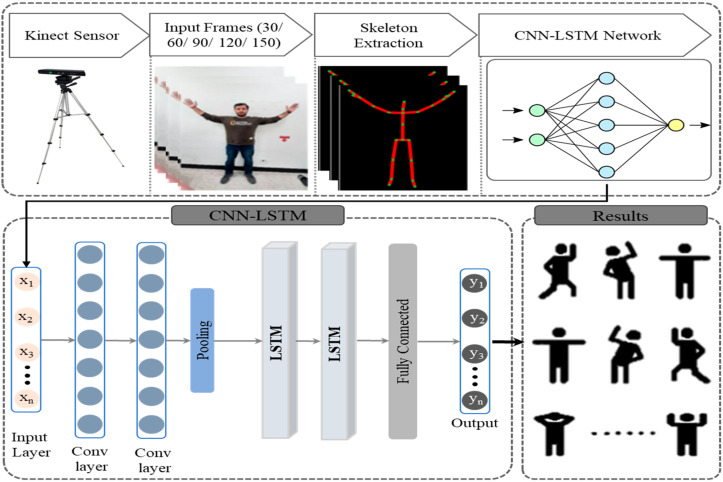
In recent years, Human Activity Recognition (HAR) has become one of the most important research topics in the domains of health and human-machine interaction. Many Artificial intelligence-based models are developed for activity recognition; however, these algorithms fail to extract spatial and temporal features due to which they show poor performance on real-world long-term HAR. Furthermore, in literature, a limited number of datasets are publicly available for physical activities recognition that contains less number of activities. Considering these limitations, we develop a hybrid model by incorporating Convolutional Neural Network (CNN) and Long Short-Term Memory (LSTM) for activity recognition where CNN is used for spatial features extraction and LSTM network is utilized for learning temporal information. Additionally, a new challenging dataset is generated that is collected from 20 participants using the Kinect V2 sensor and contains 12 different classes of human physical activities. An extensive ablation study is performed over different traditional machine learning and deep learning models to obtain the optimum solution for HAR. The accuracy of 90.89% is achieved via the CNN-LSTM technique, which shows that the proposed model is suitable for HAR applications.
Overview
The claims and statistics of this paper haven’t been checked yet.
Free: it reads the open-access text and checks the first 5 claims that cite a source we can check. Create a free account to check every claim.
Integrity signals
Registry
Cites
Statistics
Figures

Verification
Claims the paper makes
The claims and statistics of this paper haven’t been checked yet.
Free: it reads the open-access text and checks the first 5 claims that cite a source we can check. Create a free account to check every claim.
Claims other papers make about this one
Each is checked against this paper’s own text: does it say what the citing paper says it does?
The source backs part of the claim, not all of it — or backs it for a different population, condition or comparison.
In the citing paper
“For example, wearable sensors such as accelerometers, gyroscopes, and magnetometers capture detailed information about a person's movements and posture, whereas cameras capture visual information about the person and their surroundings [114,116,164,165].”
From A Survey of Video Surveillance Systems in Smart City (2023) · cites this paper as [114]
Experimental — accuracy not yet measuredThe cited source says what the claim attributes to it.
In the citing paper
“To combine the strengths of both models, a CNN-LSTM hybrid architecture was developed in [114] to monitor and recognize human actions in indoor environments in 2022 with an accuracy of 90.89% on 30 frames.”
From A Survey of Video Surveillance Systems in Smart City (2023) · cites this paper as [114]
The check wasn’t confident either way, so it gives no verdict — never disputed.
In the citing paper
“Indeed, as mentioned in [114,157], when new types of operations and objects are not labeled or known in advance, unsupervised deep learning techniques can be explored to improve object classification and recognition.”
From A Survey of Video Surveillance Systems in Smart City (2023) · cites this paper as [114]
Experimental — accuracy not yet measured
Self-check
Percentages, sums and reported differences re-computed from the paper’s own numbers.
The self-check needs the paper’s full text.
Citations
Cites
Faster R-CNN: Towards Real-Time Object Detection with Region Proposal Networks
Ren, S., He, K., Girshick, R., & Sun, J. (2017) · IEEE Transactions on Pattern Analysis and Machine Intelligence · doi:10.1109/tpami.2016.2577031 · Cited by 73,472 · cited 1×
“The proposed dataset includes 12 different activities taken from 20 individuals aged between 25–35 years.”
MethodCortes, C., & Vapnik, V. (1995) · Machine Learning · doi:10.1007/bf00994018 · Cited by 59,421
Neural networks and physical systems with emergent collective computational abilities.
Hopfield, J. J. (1982) · Proceedings of the National Academy of Sciences · doi:10.1073/pnas.79.8.2554 · Cited by 19,270 · cited 1×
“To capture the unique features of action or activity, complex machine learning-based models such as various flavors of SVM [22] (Linear SVM (LSVM), Quadratic SVM (QSVM), Cubic SVM (CSVM), Fine Gaussian SVM (FGSVM), Medium Gaussian SVM (MGSVM), Coarse Gaussian SVM (CGSVM)), KNN [23] (Fine KNN (FKNN), Medium KNN (MKNN),…”
BackgroundTHE USE OF MULTIPLE MEASUREMENTS IN TAXONOMIC PROBLEMS
FISHER, R. A. (1936) · Annals of Eugenics · doi:10.1111/j.1469-1809.1936.tb02137.x · Cited by 15,227 · cited 1×
“To capture the unique features of action or activity, complex machine learning-based models such as various flavors of SVM [22] (Linear SVM (LSVM), Quadratic SVM (QSVM), Cubic SVM (CSVM), Fine Gaussian SVM (FGSVM), Medium Gaussian SVM (MGSVM), Coarse Gaussian SVM (CGSVM)), KNN [23] (Fine KNN (FKNN), Medium KNN (MKNN),…”
BackgroundAn Introduction to Kernel and Nearest-Neighbor Nonparametric Regression
Altman, N. S. (1992) · The American Statistician · doi:10.1080/00031305.1992.10475879 · Cited by 5,708 · cited 2×
“…various flavors of SVM [22] (Linear SVM (LSVM), Quadratic SVM (QSVM), Cubic SVM (CSVM), Fine Gaussian SVM (FGSVM), Medium Gaussian SVM (MGSVM), Coarse Gaussian SVM (CGSVM)), KNN [23] SVM is a supervised learning model that strives for maximal margin separation with a little amount of training data.”
MethodPopular Ensemble Methods: An Empirical Study
Opitz, D., & Maclin, R. (1999) · Journal of Artificial Intelligence Research · doi:10.1613/jair.614 · Cited by 2,953 · cited 1×
“To capture the unique features of action or activity, complex machine learning-based models such as various flavors of SVM [22] (Linear SVM (LSVM), Quadratic SVM (QSVM), Cubic SVM (CSVM), Fine Gaussian SVM (FGSVM), Medium Gaussian SVM (MGSVM), Coarse Gaussian SVM (CGSVM)), KNN [23] (Fine KNN (FKNN), Medium KNN (MKNN),…”
BackgroundOn Human Motion Prediction Using Recurrent Neural Networks
Martinez, J., Black, M. J., & Romero, J. (2017) · 2017 IEEE Conference on Computer Vision and Pattern Recognition (CVPR) · doi:10.1109/cvpr.2017.497 · Cited by 984 · cited 1×
“For instance, Julieta et al. [19] focus on human motion by utilizing the recurrent neural network, the goal is time-dependent representations to perform tasks including short-term prediction as well as long-term human motion synthesis.”
BackgroundLi, C., Zhong, Q., Xie, D., & Pu, S. (2018) · Proceedings of the Twenty-Seventh International Joint Conference on Artificial Intelligence · doi:10.24963/ijcai.2018/109 · Cited by 582
Human action recognition using a temporal hierarchy of covariance descriptors on 3D joint locations
Hussein, M. E., Torki, M., Gowayyed, M. A., & El-Saban, M. (2013) · Cited by 507
Beyond English-Centric Multilingual Machine Translation
Fan, A., Bhosale, S., Schwenk, H., Ma, Z., El-Kishky, A., Goyal, S., Baines, M., Çelebi, O., Wenzek, G., Chaudhary, V., et al. (2020) · arXiv (Cornell University) · doi:10.48550/arxiv.2010.11125 · Cited by 452 · cited 1×
“…time such as anomaly recognition [37,38] speech recognition [39,40], person re-identification [41], Energy forecasting [42–45], machine translation [46], and activity recognition from sensor data [47] used a special kind of neural network called Recurrent Neural Network (RNN) specifically designed…”
Method
Research works printed but not linked: 1
- Arthi, 2020, An Efficient Data Augmentation CNN-Network for Skeleton-based Human Action Recognition, IJARTET J., 7, 101
Cited by
The major human AP endonuclease (Ape1) is involved in the nucleotide incision repair pathway
Gros, L. (2004) · Nucleic Acids Research · doi:10.1093/nar/gkh165 · Cited by 209
Human Action Recognition: A Taxonomy-Based Survey, Updates, and Opportunities
Morshed, M. G., Sultana, T., Alam, A., & Lee, Y.-K. (2023) · Sensors · doi:10.3390/s23042182 · Cited by 190
“[170] created a hybrid technique by combining CNN and LSTM, the former of which was used for extracting spatial characteristics and the latter for retrieving temporal features.”
MethodA Survey of Video Surveillance Systems in Smart City
Myagmar-Ochir, Y., & Kim, W. (2023) · Electronics · doi:10.3390/electronics12173567 · Cited by 134
“Examining the hybrid systems outlined in [114,115], it becomes evident that the choice between RNNs and CNNs for human action classification hinges on the nature of the task.”
BackgroundMethodInfluential2D mapping of texture and lattice parameters of dental enamel
Al‐Jawad, M., Steuwer, A., Kilcoyne, S. H., Shore, R. C., Cywiński, R., & Wood, D. J. (2007) · Biomaterials · doi:10.1016/j.biomaterials.2007.02.019 · Cited by 119
Yin, X., Liu, Z., Liu, D., & Ren, X. (2022) · Scientific Reports · doi:10.1038/s41598-022-11880-8 · Cited by 114
“Khan et al. 17 proposed an ensemble model of CNN and LSTM.”
BackgroundMachine Learning in Solid‐State Hydrogen Storage Materials: Challenges and Perspectives
Zhou, P., Zhou, Q., Xiao, X., Fan, X., Zou, Y., Sun, L., Jiang, J., Song, D., & Chen, L. (2024) · Advanced Materials · doi:10.1002/adma.202413430 · Cited by 145
Visual Research Ethics at the Crossroads1
Wiles, R., Clark, A., & Prosser, J. (2011) · SAGE Publications Ltd eBooks · doi:10.4135/9781446268278.n36 · Cited by 86
Human activity recognition using marine predators algorithm with deep learning
Helmi, A. M., Al‐qaness, M. A. A., Dahou, A., & Elaziz, M. A. (2023) · Future Generation Computer Systems · doi:10.1016/j.future.2023.01.006 · Cited by 85
(2016) · doi:10.4324/9781315713373 · Cited by 60
Mahajan, H. B., Uke, N., Pise, P. D., Shahade, M., Dixit, V. G., Bhavsar, S., & Deshpande, S. D. (2022) · Multimedia Tools and Applications · doi:10.1007/s11042-022-14253-5 · Cited by 87
“The recently proposed deep learning-based methods [22, 25, 29, 69] for video-based action recognition have been further studied for the research gap analysis.”
BackgroundMethodResultInfluentialConnecting the indispensable roles of IoT and artificial intelligence in smart cities: A survey
Nguyen, H., Nawara, D., & Kashef, R. F. (2024) · Journal of Information and Intelligence · doi:10.1016/j.jiixd.2024.01.003 · Cited by 95
Raza, A., Qadri, A. M., Akhtar, I., Samee, N. M. A., & Alabdulhafith, M. I. (2023) · IEEE Access · doi:10.1109/access.2023.3320144 · Cited by 73
Omaye, J. D., Ogbuju, E., Ataguba, G., Jaiyeoba, O., Aneke, J., & Oladipo, F. O. (2024) · Artificial Intelligence in Agriculture · doi:10.1016/j.aiia.2024.04.002 · Cited by 94
A Review Paper on Real-Time Video Analysis in Dense Environment for Surveillance System
Tyagi, H., Kumar, V., & Kumar, G. (2022) · International Conference on Fourth Industrial Revolution Based Technology and Practices (ICFIRTP) · doi:10.1109/icfirtp56122.2022.10059434 · Cited by 70
“[37] 2022 Hybrid deep learningbased models performs exceptionally well when recognizing one-person behavior, but it might not be able to do so when dealing with several persons.”
BackgroundReliability of the Dynamic Strength Index in College Athletes
THOMAS, C. R., Jones, P. A., & Comfort, P. (2014) · International Journal of Sports Physiology and Performance · doi:10.1123/ijspp.2014-0255 · Cited by 63
Transfer Learning Approach for Human Activity Recognition Based on Continuous Wavelet Transform
Pavliuk, O., Mishchuk, M., & Strauß, C. (2023) · Algorithms · doi:10.3390/a16020077 · Cited by 69
Cheltha, J. N., Sharma, C., Prashar, D., Khan, A. A., & Kadry, S. (2024) · Image and Vision Computing · doi:10.1016/j.imavis.2024.105234 · Cited by 63
EEG-GPT: Exploring Capabilities of Large Language Models for EEG Classification and Interpretation
Kim, J., Alaa, A., & Bernardo, D. (2025) · International IEEE/EMBS Conference on Neural Engineering · doi:10.1109/ner61569.2025.11589079 · Cited by 67
“When trained on 2% of available train data, EEG-GPT even matches the performance of a deep-learning based approach trained on all available data [19], although it is still outperformed by more recent approaches such as those by Saab et al. and Khan et al. [20, 21].”
MethodRecent trends in human activity recognition – A comparative study
Singh, R. K., Kushwaha, A. K. S., Chandni, & Srivastava, R. (2022) · Cognitive Systems Research · doi:10.1016/j.cogsys.2022.10.003 · Cited by 49
Thakur, D., Dangi, S., & Lalwani, P. (2024) · Biomedical Signal Processing and Control · doi:10.1016/j.bspc.2024.106870 · Cited by 51
Efficient Deep Learning Framework for Fire Detection in Complex Surveillance Environment
Dilshad, N. (2023) · Computer Systems Science and Engineering · doi:10.32604/csse.2023.034475 · Cited by 51
HAR-DeepConvLG: Hybrid deep learning-based model for human activity recognition in IoT applications
Ding, W., Abdel‐Basset, M., & Mohamed, R. (2023) · Information Sciences · doi:10.1016/j.ins.2023.119394 · Cited by 51
Hamdi, M., Senan, E. M., Jadhav, M. E., Olayah, F. A., Awaji, B. H., & Alalayah, K. M. A. (2023) · Diagnostics · doi:10.3390/diagnostics13132258 · Cited by 54
Knowledge discovery in temporal databases
Saraee, M. H. (1995) · doi:10.1049/ic:19950112 · Cited by 46
Mazon, D. M., Groefsema, M., Schomaker, L., & Carloni, R. (2022) · Sensors · doi:10.3390/s22228871 · Cited by 43
“[15] 2022 CNN-LSTM classification Motion tracker (time domain) 90.”
Pritee, Z. T., Anik, M. H., Alam, S. B., Jim, J. R., Kabir, M. M., & Mridha, M. F. (2024) · Computers & Security · doi:10.1016/j.cose.2024.103747 · Cited by 51
Mahmood, T., Cho, S. W., & Park, K. R. (2022) · Expert Systems with Applications · doi:10.1016/j.eswa.2022.117420 · Cited by 40
Machine Learning‐Enhanced Triboelectric Sensing Application
Shang, R., Chen, H., Cai, X., Shi, X., Yang, Y., Wei, X., Wang, J., & Xu, Y. F. (2024) · Advanced Materials Technologies · doi:10.1002/admt.202301316 · Cited by 39
Essahraui, S., Lamaakal, I., Maleh, Y., Makkaoui, K. E., Bouami, M. F., Ouahbi, I., El‐Latif, A. A. A., Almousa, M., & Rodrigues, J. J. P. C. (2025) · IEEE Access · doi:10.1109/access.2025.3589938 · Cited by 44
“Studies such as [237], [238], [239], [240], [241], [242], and [243] have leveraged LSTMs for detecting a variety of human activities, including daily tasks, locomotion, and health-related actions.”
Smart-Sleeve: A Wearable Textile Pressure Sensor Array for Human Activity Recognition
Guang-hua, X., Wan, Q., Deng, W., Guo, T., & Cheng, J. (2022) · Sensors · doi:10.3390/s22051702 · Cited by 40
“Environmental sensors are usually hidden in the surroundings, such as cameras [4] and wireless signaling devices [5–7], which are usually not easily detectable and do not interfere with the normal activities of the user.”
BackgroundMahmood, T., Choi, J., & Park, K. R. (2023) · Journal of King Saud University - Computer and Information Sciences · doi:10.1016/j.jksuci.2023.01.013 · Cited by 39
‘A soundtrack to the insurrection’: street music, marching bands and popular protest
McKay, G. (2007) · Parallax · doi:10.1080/13534640601094817 · Cited by 35
A Radar-Based Human Activity Recognition Using a Novel 3-D Point Cloud Classifier
Yu, Z., Taha, A., Taylor, W., Zahid, A., Rajab, K. Z., Heidari, H., Imran, M. A., & Abbasi, Q. H. (2022) · IEEE Sensors Journal · doi:10.1109/jsen.2022.3198395 · Cited by 37
“On the other hand, Khan et al. [22] proposed a benchmark dataset based on the Kinect V2 sensor that captured 12 classes of human skeleton joints data.”
BackgroundCorpus Tools and Methods, Today and Tomorrow: Incorporating Linguists' Manual Annotations
Smith, N., Hoffmann, S., & Rayson, P. (2007) · Literary and Linguistic Computing · doi:10.1093/llc/fqn004 · Cited by 35
Deep ensemble learning approach for lower limb movement recognition from multichannel sEMG signals
Tokas, P., Semwal, V. B., & Jain, S. (2024) · Neural Computing and Applications · doi:10.1007/s00521-024-09465-9 · Cited by 34
“In [13], the authors have generated a dataset using a Microsoft Kinect V2 sensor for 12 different human activities.”
A Close Look into Human Activity Recognition Models using Deep Learning
Tee, W. Z., Dave, R., Seliya, J., & Vanamala, M. (2022) · International Conference on Computing, Networks and Internet of Things (CNIOT) · doi:10.1109/cniot55862.2022.00043 · Cited by 42
SDHAR-HOME: A Sensor Dataset for Human Activity Recognition at Home
Ramos, R. G., Domingo, J. D., Zalama, E., Gómez‐García‐Bermejo, J., & López, J. (2022) · Sensors · doi:10.3390/s22218109 · Cited by 39
“[37], by implementing the combination of CNN and LSTM networks, the authors are able to recognise 12 physical activities thanks to the spatial positions provided by a Kinect V2 sensor camera.”
MethodBERT for Activity Recognition Using Sequences of Skeleton Features and Data Augmentation with GAN
Ramirez, H., Velastín, S. A., Cuellar-Carrillo, S., Fábregas, E., & Farías, G. (2023) · Sensors · doi:10.3390/s23031400 · Cited by 37
“The work presented in [16] develops a hybrid model by incorporating CNN and LSTM for activity recognition and tests it on a generated dataset, obtaining an accuracy of 90.”
MethodShah, S. H. H., Karlsen, A., Solberg, M., & Hameed, I. A. (2023) · Expert Systems with Applications · doi:10.1016/j.eswa.2023.122482 · Cited by 33
Deep learning models for real-life human activity recognition from smartphone sensor data
Garcia-Gonzalez, D., Rivero, D., Fernández-Blanco, E., & Luaces, M. R. (2023) · Internet of Things · doi:10.1016/j.iot.2023.100925 · Cited by 40
Alikhanov, J., & Kim, H. (2023) · IEEE Access · doi:10.1109/access.2023.3292539 · Cited by 35
“research in the field of human activity recognition [6], [7].”
BackgroundIn-depth analysis of design & development for sensor-based human activity recognition system
Choudhury, N. A., & Soni, B. (2023) · Multimedia Tools and Applications · doi:10.1007/s11042-023-16423-5 · Cited by 30
Vuong, T. H., Doan, T., & Takasu, A. (2023) · Sensors · doi:10.3390/s23249721 · Cited by 33
“These techniques include CNN [20,23,26,29,40], variants of RNNs like LSTM and GRU, and hybrid DL methods [19,27,28,41–43].”
MethodSuspicious Human Activity Recognition From Surveillance Videos Using Deep Learning
Zaidi, M. M., Sampedro, G. A., Almadhor, A. S., Alsubai, S., Hejaili, A. A., Greguš, M., & Abbas, S. (2024) · IEEE Access · doi:10.1109/access.2024.3436653 · Cited by 28
Lamaakal, I., Yahyati, C., Maleh, Y., El Makkaoui, K., Ouahbi, I., El-Latif, A. A. A., Zomorodi, M., & El-Rahiem, B. A. (2025) · Scientific Reports · doi:10.1038/s41598-025-26297-2 · Cited by 26
“Khan et al. 20 developed a hybrid deep learning approach combining CNN and LSTM to address the challenges of HAR.”
Improved Shark Smell Optimization Algorithm for Human Action Recognition
Nasir, I. M., Raza, M., Shah, J. H., Khan, M. A., Nam, Y.-C., & Nam, Y. (2023) · Computers, materials & continua/Computers, materials & continua (Print) · doi:10.32604/cmc.2023.035214 · Cited by 26
“The combined framework of hand-crafted and deep features is also employed by many researchers [7].”
Intelligent Recognition of Multimodal Human Activities for Personal Healthcare
Chakravarthy, S. R. S., Bharanidharan, N., Kumar, V. V., Mahesh, T. R., Bhatia, S., Almusharraf, A. I., & Albalawi, E. M. (2024) · IEEE Access · doi:10.1109/access.2024.3405471 · Cited by 26
Lowland floristic assessment of Pico da Neblina National Park, Brazil
Boubli, J. P. (2002) · Plant Ecology · doi:10.1023/a:1015832811209 · Cited by 26
Wearable Sensor-Based Residual Multifeature Fusion Shrinkage Networks for Human Activity Recognition
Zeng, F., Guo, M., Long, T., Guo, F., & Liu, X. (2024) · Sensors · doi:10.3390/s24030758 · Cited by 28
Intelligent Adaptive Real-Time Monitoring and Recognition System for Human Activities
Thakur, D., Guzzo, A., & Fortino, G. (2024) · IEEE Transactions on Industrial Informatics · doi:10.1109/tii.2024.3431628 · Cited by 25
Modelling match outcomes and decision support for setting a final innings target in test cricket
Scarf, P., & Shi, X. (2005) · IMA Journal of Management Mathematics · doi:10.1093/imaman/dpi010 · Cited by 25
Deep Multi-Scale Features Fusion for Effective Violence Detection and Control Charts Visualization
Mumtaz, N., Ejaz, N., Aladhadh, S., Habib, S., & Lee, M. Y. (2022) · Sensors · doi:10.3390/s22239383 · Cited by 25
“Violence detection (VD) [4,5], broadly falling under the umbrella of the anomaly detection and recognition domain, is a hot topic of research among computer vision experts due to its key role in various applications [6].”
BackgroundLeveraging spatio-temporal features using graph neural networks for human activity recognition
Raj, M. S. S., George, S. N., & Raja, K. B. (2024) · Pattern Recognition · doi:10.1016/j.patcog.2024.110301 · Cited by 24
E-democracy: potential for Political Revolution?
Cullagh, K. M. (2003) · International Journal of Law and Information Technology · doi:10.1093/ijlit/11.2.149 · Cited by 24
Meena, T., & Sarawadekar, K. P. (2023) · IEEE Sensors Journal · doi:10.1109/jsen.2023.3301187 · Cited by 21
“[31] developed a CNN and LSTM hybrid model for the extraction of spatial and temporal features, respectively.”
Meng, W., Zhu, C. J., Liu, H., Liu, Q., & Xie, S. Q. (2024) · IEEE Transactions on Medical Robotics and Bionics · doi:10.1109/tmrb.2024.3385798 · Cited by 22
Wang, K., Saragadam, A., Kaur, J., Dogra, A., Cao, S. C., Ghafurian, M., Butt, Z. A., Abhari, S., Chumachenko, D., & Morita, P. P. (2025) · Internet of Things · doi:10.1016/j.iot.2025.101502 · Cited by 20
A hybrid and context-aware framework for normal and abnormal human behavior recognition
Mojarad, R., Chibani, A., Attal, F., Khodabandelou, G., & Amirat, Y. (2023) · Soft Computing · doi:10.1007/s00500-023-09188-4 · Cited by 19
“Data-driven approaches strongly depend on data, which is usually subject to different imperfections: imprecision (Bloch 2005), uncertainty, ambiguity (Bloch 2005), incompleteness, con-flict, etc Cho (2016) or CNN-LSTM models in Khan et al. (2022).”
Wazwaz, A. A., Amin, K., Semary, N. A., & Ghanem, T. F. (2024) · Journal of Sensor and Actuator Networks · doi:10.3390/jsan13010005 · Cited by 23
Cui, G., & Wang, C. (2025) · PLoS ONE · doi:10.1371/journal.pone.0317414 · Cited by 18
Context-Aware Complex Human Activity Recognition Using Hybrid Deep Learning Models
Omolaja, A., Otebolaku, A., & Alfoudi, A. S. D. (2022) · Applied Sciences · doi:10.3390/app12189305 · Cited by 21
“The hybrid model effectively combines Existing works using this type of hybrid model have proven to provide very good accuracy [23,24]. diverse and important and LSTM to form a CNN–LSTM hybrid model [21–”
BackgroundMethodInfluentialWearable sensors based on artificial intelligence models for human activity recognition
Alarfaj, M., Madini, A. A., Alsafran, A. S., Farag, M. M., Chtourou, S., Afifi, A., Ahmad, A., Rubayyi, O. A., Harbi, A. A., & Thunaian, M. A. (2024) · Frontiers in Artificial Intelligence · doi:10.3389/frai.2024.1424190 · Cited by 22
“…incorporating long short-term memory (LSTM) and bi-directional LSTM have become increasingly popular in recent studies for human activity classification as they are adept at extracting spatial and temporal properties (Hayat et al., 2022; Khan et al., 2022; Li and Wang, 2022; Luwe et al., 2022).”
BackgroundJameer, S., & Syed, H. (2023) · Sensors · doi:10.3390/s23094319 · Cited by 20
“[23] developed a novel hybrid model using deep learning for monitoring and recognizing human activities.”
BackgroundGad, G., Fadlullah, Z. M., Rabie, K. M., & Fouda, M. M. (2023) · International Conference on Communications · doi:10.1109/icc45041.2023.10278987 · Cited by 17
“The work in [10] presented an indoor HAR system based on a hybrid deep learning model that integrates CNN, to extract spatial features, and LSTM to learn temporal patterns.”
BackgroundYang, Z., Li, K., & Huang, Z. (2024) · Engineering Applications of Artificial Intelligence · doi:10.1016/j.engappai.2024.108110 · Cited by 19
Recurrent Network Solutions for Human Posture Recognition Based on Kinect Skeletal Data
Guerra, B. M. V., Ramat, S., Beltrami, G., & Schmid, M. (2023) · Sensors · doi:10.3390/s23115260 · Cited by 17
“As a final remark, the mean accuracy achieved by our best model was generally lower than those found in the reference literature, which is around 90% [18,45,46].”
ResultNeuroHAR: A Neuroevolutionary Method for Human Activity Recognition (HAR) for Health Monitoring
Alam, F., Pławiak, P., Almaghthawi, A., Qazani, M. R. C., Mohanty, S., & Alizadehsani, R. (2024) · IEEE Access · doi:10.1109/access.2024.3441108 · Cited by 20
Personalized Smart Home Automation Using Machine Learning: Predicting User Activities
Gad, M. M., Gad, W. K., Abdelkader, T., & Naik, K. (2025) · Sensors · doi:10.3390/s25196082 · Cited by 17
“• Khan et al. [26] developed a CNN-LSTM hybrid model for HAR, which achieved an accuracy of 90.89%.”
InfluentialCengiz, A. B., Birant, K. U., Cengiz, M., Birant, D., & Baysari, K. (2022) · Symmetry · doi:10.3390/sym14102022 · Cited by 15
Skeletal joint image-based multi-channel fusion network for human activity recognition
Sun, T., Lian, C., Dong, F., Shao, J., Zhang, X., Xiao, Q., Ju, Z., & Zhao, Y. (2025) · Knowledge-Based Systems · doi:10.1016/j.knosys.2025.113232 · Cited by 14
rWISDM: Repaired WISDM, a Public Dataset for Human Activity RecognitionPreprint
Heydarian, M., & Doyle, T. E. (2023) · arXiv (Cornell University) · doi:10.48550/arxiv.2305.10222 · Cited by 16
“[26] created a dataset using Kinect V2 sensor with 20 participants for 12 activities.”
MethodWang, L., Chen, Z., Zou, H., Huang, D., Pan, Y., Cheang, C. F., & Li, J. (2023) · Nondestructive Testing And Evaluation · doi:10.1080/10589759.2023.2274008 · Cited by 15
Encoding human activities using multimodal wearable sensory data
Khan, M. H., Shafiq, H., Farid, M. S., & Grzegorzek, M. (2024) · Expert Systems with Applications · doi:10.1016/j.eswa.2024.125564 · Cited by 13
Boubli, J. P., & Ditchfield, A. D. (2001) · Folia Primatologica · doi:10.1159/000052735 · Cited by 13
Action assessment in rehabilitation: Leveraging machine learning and vision-based analysis
Kryeem, A., Boutboul, N., Bear, I., Raz, S., Eluz, D., Itah, D., Hel-Or, H. Z., & Shimshoni, I. (2024) · Computer Vision and Image Understanding · doi:10.1016/j.cviu.2024.104228 · Cited by 13
Patel, A. D., Jhaveri, R. H., Patel, A. D., Shah, K. A., & Shah, J. H. (2024) · Software Practice and Experience · doi:10.1002/spe.3394 · Cited by 14
“A hybrid model fusing the CNN and LSTM networks to leverage spatial features as well as the temporal features from accelerometer and gyroscope data, i.e., wearable sensor data, is proposed in [56].”
Deep Learning Enabled Computer Aided Diagnosis Model for Lung Cancer using Biomedical CT Images
Alamgeer, M., Mengash, H. A., Marzouk, R., Nour, M. K., Hilal, A. M., Motwakel, A., Zamani, A. S., & Rizwanullah, M. (2022) · Computers, materials & continua/Computers, materials & continua (Print) · doi:10.32604/cmc.2022.027896 · Cited by 12
Efficient Human Gait Activity Recognition Based on Sensor Fusion and Intelligent Stacking Framework
Tarekegn, A. N., Sajjad, M., Cheikh, F. A., Ullah, M., & Muhammad, K. (2023) · IEEE Sensors Journal · doi:10.1109/jsen.2023.3319353 · Cited by 12
“In [29], the hybridization of a CNN and RNN was proposed to explore the advantages of these models for learning the local features and temporal relationships of sensor signals.”
MethodActivity Recognition Using Different Sensor Modalities and Deep Learning
Ascioglu, G., & Şenol, Y. (2023) · Applied Sciences · doi:10.3390/app131910931 · Cited by 12
Human-Aware Collaborative Robots in the Wild: Coping with Uncertainty in Activity Recognition
Yalçinkaya, B., Couceiro, M. S., Soares, S., & Valente, A. L. G. (2023) · Sensors · doi:10.3390/s23073388 · Cited by 12
“The ultimate output is obtained by passing ht to a softmax classifier [57].”
MethodPostmodernization: A Phase We're Going Through? Management in Social Care
Lawler, J. (2005) · The British Journal of Social Work · doi:10.1093/bjsw/bch209 · Cited by 12
Refat, M. A. R., Hossain, M. P., Islam, M. R., Rahman, A., Farid, F. A., Karim, H. B. A., & Miah, A. S. M. (2025) · Discover Applied Sciences · doi:10.1007/s42452-025-07896-0 · Cited by 13
“This study [36] presents a CNN-LSTM model that uses a dataset comprising 12 physical activities performed by 20 participants, highlighting the significance of skeletal joint data for accurate recognition.”
A Multi-Label Based Physical Activity Recognition via Cascade Classifier
Mo, L., Zhu, Y., & Zeng, L. (2023) · Sensors · doi:10.3390/s23052593 · Cited by 12
Multivariate CNN Model for Human Locomotion Activity Recognition with a Wearable Exoskeleton Robot
Son, C.-S., & Kang, W. (2023) · Bioengineering · doi:10.3390/bioengineering10091082 · Cited by 11
“Several recent studies have formulated hybrid architectures by incorporating additional layers, such as long short-term memory (LSTM) [33–36], gated recurrent unit (GRU) [20–22, 37 ], or squeeze-and-excitation squeeze-and-excitation network ( SENet) In this paper, we introduce multivariate single…”
BackgroundGish: a novel activation function for image classification
Kaytan, M., Aydilek, İ. B., & Yeroğlu, C. (2023) · Neural Computing and Applications · doi:10.1007/s00521-023-09035-5 · Cited by 11
Anomaly Detection From Low-Dimensional Latent Manifolds With Home Environmental Sensors
Melgarejo-Meseguer, F.-M., Bleda, A. L., Abbenante, S. E., Gimeno-Blanes, F.-J., Everss, E., Muñoz-Romero, S., Rojo‐Álvarez, J. L., & Maestre, R. (2023) · IEEE Internet of Things Journal · doi:10.1109/jiot.2023.3338697 · Cited by 13
“Convolutional neural network (CNN) can consider the intrinsic temporal structure of the data with certain advantages over the conventional model [19], [20].”
BackgroundAnguita-Molina, M. Á., Cardoso, P. J. S., Rodrigues, J. M. F., Medina-Quero, J., & Polo-Rodríguez, A. (2025) · IEEE Internet of Things Journal · doi:10.1109/jiot.2025.3531316 · Cited by 15
A large-scale TV video and metadata database for French political content analysis and fact-checking
Rayar, F., Delalandre, M., & Le, V.-H. (2022) · International Workshop on Content-Based Multimedia Indexing (CBMI) · doi:10.1145/3549555.3549557 · Cited by 15
Surendran, R., Anitha, J., & Hemanth, D. J. (2023) · PeerJ Computer Science · doi:10.7717/peerj-cs.1396 · Cited by 11
Identification of Human Movement Through a Novel Machine Learning Approach
Fahad, N., Sen, A., Jisha, S. S., Ahmad, S., Mokhlis, H., & Hossain, M. S. (2023) · Innovations in Power and Advanced Computing Technologies (i-PACT) · doi:10.1109/i-pact58649.2023.10434296 · Cited by 10
“So, subfields of AI are the best option to make an automated system [4].”
BackgroundSmart Manufacturing System Using LLM for Human-Robot Collaboration: Applications and Challenges
Younas, M. A., Abdullah, A. H., Din, G. M., Faisal, M., Mudassar, M., & Yasir, A. M. (2025) · European Journal of Theoretical and Applied Sciences · doi:10.59324/ejtas.2025.3(1).21 · Cited by 11
“With the combined action of the activation function, input, output, and forget gates, LSTM can "remember" the historical information of the operator’s actions (Khan, Afzal, & Lee, 2022).”
Identifying User Goals From UI Trajectories
Berkovitch, O., Caduri, S., Kahlon, N., Efros, A., Caciularu, A., & Dagan, I. (2025) · International World Wide Web Conference (WWW) · doi:10.1145/3701716.3717525 · Cited by 17
“Khan et al. [19] uses a neural network trained on 2D skeletal data captured by a motion sensor to classify human poses; Ijaz et al. [16] integrated accelerometer signals along with skeletal data to recognize and categorize nurse activities into 12 distinct types.”
Koreanschi, A., ben, H. M., GUILLEMETTE, O., Francois, M., Tondji, Y., Oliviu, S. G., Mihaela, B. R., & Manuel, F. S. (2016) · INCAS BULLETIN · doi:10.13111/2066-8201.2016.8.1.10 · Cited by 10
Human Action Detection using EfficientNetB3 Model
Gill, K. S., Sharma, A., Anand, V., Sharma, K., & Gupta, R. (2023) · International Conference on Computing Methodologies and Communication (ICCMC) · doi:10.1109/iccmc56507.2023.10083926 · Cited by 11
“89%, demonstrating that the suggested model is appropriate for HAR applications [1].”
BackgroundCha, B., & Vaidya, B. (2024) · Electronics · doi:10.3390/electronics13091739 · Cited by 11
Nursing knowledge and the expansion of day surgery in the United Kingdom
MITCHELL, M. (2005) · Ambulatory Surgery · doi:10.1016/j.ambsur.2005.09.003 · Cited by 10
Effect of Low-Compression Balls on Wheelchair Tennis Match-Play
Sindall, P., Lenton, J. P., Malone, L. A., Douglas, S. M., Cooper, R. A., Hiremath, S. V., Tolfrey, K., & Goosey-Tolfrey, V. L. (2013) · International Journal of Sports Medicine · doi:10.1055/s-0033-1354384 · Cited by 10
Exploring LoRa and Deep Learning-Based Wireless Activity Recognition
Xiao, Y., Chen, Y., Nie, M., Zhu, T., Liu, Z., & Liu, C. (2023) · Electronics · doi:10.3390/electronics12030629 · Cited by 9
Hybrid deep learning model-based human action recognition in indoor environment
Sain, M. K., Laskar, R. H., Singha, J., & Saini, S. (2023) · Robotica · doi:10.1017/s0263574723001327 · Cited by 9
“ConvLSTM Architecture [32]: Next, we applied ConvLSTM [32] to classify our dataset.”
MethodAlotaibi, F. A., Alnfiai, M. M., Al‐Wesabi, F. N., Alduhayyem, M., Hilal, A. M., & Hamza, M. A. (2023) · Journal of Disability Research · doi:10.57197/jdr-2023-0038 · Cited by 10
Metadata
- Authors
- Khan, I. U., Afzal, S., & Lee, J. W.
- Affiliations
- Sejong University (KR)
- Corresponding author
- Lee, Jong Weon
- Venue
- Sensors
- Publisher
- MDPI AG
- Published
- 2022-01-01
- Volume
- 22
- Issue
- 1
- Pages
- 323
- ISSN
- 1424-8220 (ISSN-L)
- PMC
- PMC8749555
- OpenAlex
- W4206103951
- Cited by
- 256
- References
- 51
- Citations by year
- 2026: 25 · 2025: 47 · 2024: 61 · 2023: 65 · 2022: 29
- FWCI
- 16.52
- Type
- journal article
- Language
- en
- Open access
- gold
- doi.org
- Licence
- Locations
- Sensors (publishedVersion, cc-by)
- PubMed Central (publishedVersion, cc-by)
- PubMed (publishedVersion)
- DOAJ (DOAJ: Directory of Open Access Journals) (submittedVersion, cc-by-sa)
- Funders
- National Research Foundation
- Ministry of Trade, Industry and Energy (P0016038, Project No. P0016038)
- Korea Institute for Advancement of Technology (P0016038)
- National Research Foundation of Korea (NRF2017S1A5B6053101)
- Topics
- Physical Sciences › Computer Science › Computer Vision and Pattern Recognition › Context-Aware Activity Recognition Systems
- Physical Sciences › Computer Science › Computer Vision and Pattern Recognition › Human Pose and Action Recognition
- Physical Sciences › Engineering › Biomedical Engineering › Gait Recognition and Analysis
- Keywords
- human activity recognition, CNN-LSTM hybrid model, spatial feature extraction, temporal feature learning, Kinect v2, wearable sensor data
- MeSH terms
- Machine Learning, Deep Learning, Artificial Intelligence, Humans, Human Activities, Neural Networks, Computer
About these checks
Registry, retraction, Cites and statistics results are computed, not judged, with one exception: a printed reference that no index lists is read once by a model before it counts as a citation error. Claims are extracted by a model and kept only when their quote appears verbatim in the text; each cited source is then checked, with a model’s help, for whether it says what the claim relies on. Those verdicts can be wrong — read the claim’s quote and the cited source before relying on one.
Statistics and arithmetic are recomputed, not judged.
Confidence bands are shown only for fields calibrated on our annotated test set. None is calibrated yet, so no band is shown.
What counts as a claim ›How we measure confidence ›How we check this ›
Are you an author, or do you see a problem with this page? Request a review
Data sources
Bibliographic data: Semantic Scholar, OpenAlex, Crossref.
Contains information from the Semantic Scholar Academic Graph Datasets, made available under the ODC Attribution License (ODC-BY 1.0).
Semantic Scholar’s data is described in: Kinney, R., et al. (2023). The Semantic Scholar Open Data Platform. arXiv:2301.10140.
