

Human Activity Recognition via Hybrid Deep Learning Based Model
Open accessThe DOI matches its Crossref record; 50 of the 51 references it cites were found in a registry or an index.
Abstract
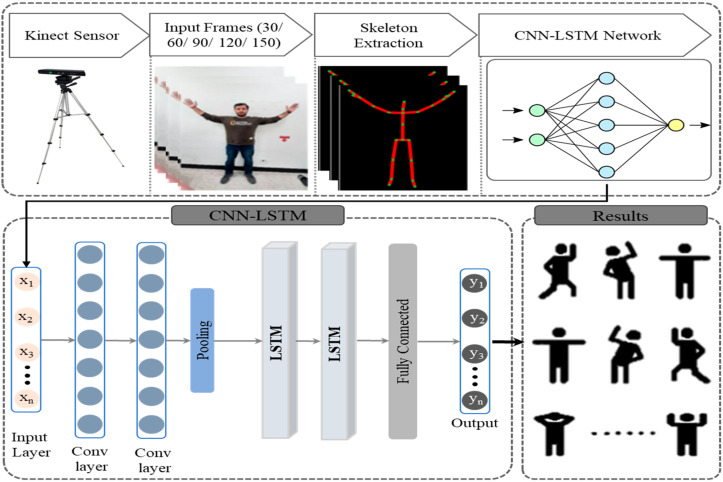
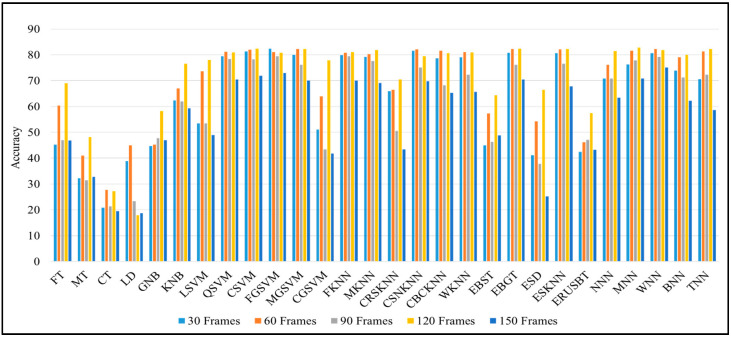
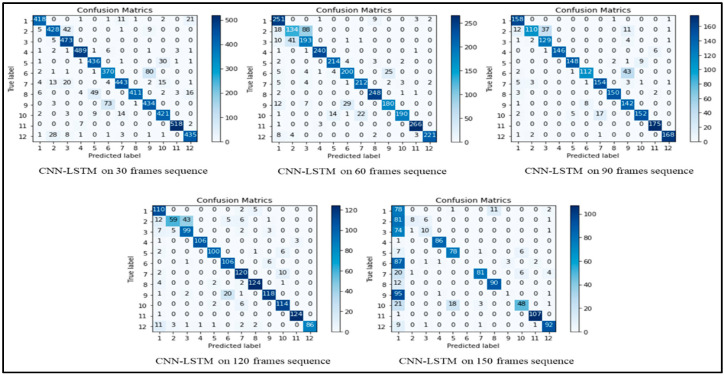
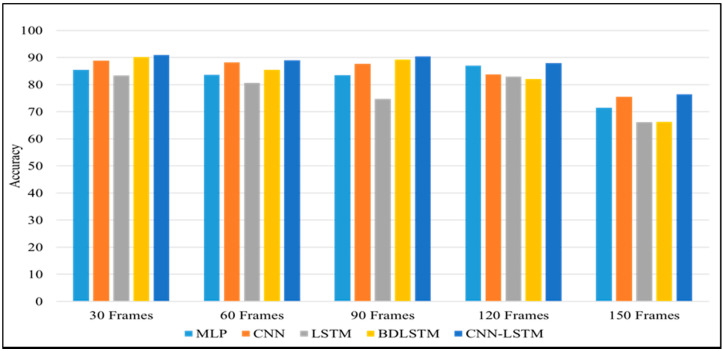
In recent years, Human Activity Recognition (HAR) has become one of the most important research topics in the domains of health and human-machine interaction. Many Artificial intelligence-based models are developed for activity recognition; however, these algorithms fail to extract spatial and temporal features due to which they show poor performance on real-world long-term HAR. Furthermore, in literature, a limited number of datasets are publicly available for physical activities recognition that contains less number of activities. Considering these limitations, we develop a hybrid model by incorporating Convolutional Neural Network (CNN) and Long Short-Term Memory (LSTM) for activity recognition where CNN is used for spatial features extraction and LSTM network is utilized for learning temporal information. Additionally, a new challenging dataset is generated that is collected from 20 participants using the Kinect V2 sensor and contains 12 different classes of human physical activities. An extensive ablation study is performed over different traditional machine learning and deep learning models to obtain the optimum solution for HAR. The accuracy of 90.89% is achieved via the CNN-LSTM technique, which shows that the proposed model is suitable for HAR applications.
Overview
The claims and statistics of this paper haven’t been checked yet.
Free: it reads the open-access text and checks the first 5 claims that cite a source we can check. Create a free account to check every claim.
Integrity signals
Registry
Cites
Statistics
Figures

Verification
Claims the paper makes
The claims and statistics of this paper haven’t been checked yet.
Free: it reads the open-access text and checks the first 5 claims that cite a source we can check. Create a free account to check every claim.
Claims other papers make about this one
Each is checked against this paper’s own text: does it say what the citing paper says it does?
The source backs part of the claim, not all of it — or backs it for a different population, condition or comparison.
In the citing paper
“For example, wearable sensors such as accelerometers, gyroscopes, and magnetometers capture detailed information about a person's movements and posture, whereas cameras capture visual information about the person and their surroundings [114,116,164,165].”
From A Survey of Video Surveillance Systems in Smart City (2023) · cites this paper as [114]
Experimental — accuracy not yet measuredThe cited source says what the claim attributes to it.
In the citing paper
“To combine the strengths of both models, a CNN-LSTM hybrid architecture was developed in [114] to monitor and recognize human actions in indoor environments in 2022 with an accuracy of 90.89% on 30 frames.”
From A Survey of Video Surveillance Systems in Smart City (2023) · cites this paper as [114]
The check wasn’t confident either way, so it gives no verdict — never disputed.
In the citing paper
“Indeed, as mentioned in [114,157], when new types of operations and objects are not labeled or known in advance, unsupervised deep learning techniques can be explored to improve object classification and recognition.”
From A Survey of Video Surveillance Systems in Smart City (2023) · cites this paper as [114]
Experimental — accuracy not yet measured
Self-check
Percentages, sums and reported differences re-computed from the paper’s own numbers.
The self-check needs the paper’s full text.
Citations
Cites
Faster R-CNN: Towards Real-Time Object Detection with Region Proposal Networks
Ren, S., He, K., Girshick, R., & Sun, J. (2017) · IEEE Transactions on Pattern Analysis and Machine Intelligence · doi:10.1109/tpami.2016.2577031 · Cited by 73,472 · cited 1×
“The proposed dataset includes 12 different activities taken from 20 individuals aged between 25–35 years.”
MethodCortes, C., & Vapnik, V. (1995) · Machine Learning · doi:10.1007/bf00994018 · Cited by 59,421
Neural networks and physical systems with emergent collective computational abilities.
Hopfield, J. J. (1982) · Proceedings of the National Academy of Sciences · doi:10.1073/pnas.79.8.2554 · Cited by 19,270 · cited 1×
“To capture the unique features of action or activity, complex machine learning-based models such as various flavors of SVM [22] (Linear SVM (LSVM), Quadratic SVM (QSVM), Cubic SVM (CSVM), Fine Gaussian SVM (FGSVM), Medium Gaussian SVM (MGSVM), Coarse Gaussian SVM (CGSVM)), KNN [23] (Fine KNN (FKNN), Medium KNN (MKNN),…”
BackgroundTHE USE OF MULTIPLE MEASUREMENTS IN TAXONOMIC PROBLEMS
FISHER, R. A. (1936) · Annals of Eugenics · doi:10.1111/j.1469-1809.1936.tb02137.x · Cited by 15,227 · cited 1×
“To capture the unique features of action or activity, complex machine learning-based models such as various flavors of SVM [22] (Linear SVM (LSVM), Quadratic SVM (QSVM), Cubic SVM (CSVM), Fine Gaussian SVM (FGSVM), Medium Gaussian SVM (MGSVM), Coarse Gaussian SVM (CGSVM)), KNN [23] (Fine KNN (FKNN), Medium KNN (MKNN),…”
BackgroundAn Introduction to Kernel and Nearest-Neighbor Nonparametric Regression
Altman, N. S. (1992) · The American Statistician · doi:10.1080/00031305.1992.10475879 · Cited by 5,708 · cited 2×
“…various flavors of SVM [22] (Linear SVM (LSVM), Quadratic SVM (QSVM), Cubic SVM (CSVM), Fine Gaussian SVM (FGSVM), Medium Gaussian SVM (MGSVM), Coarse Gaussian SVM (CGSVM)), KNN [23] SVM is a supervised learning model that strives for maximal margin separation with a little amount of training data.”
MethodPopular Ensemble Methods: An Empirical Study
Opitz, D., & Maclin, R. (1999) · Journal of Artificial Intelligence Research · doi:10.1613/jair.614 · Cited by 2,953 · cited 1×
“To capture the unique features of action or activity, complex machine learning-based models such as various flavors of SVM [22] (Linear SVM (LSVM), Quadratic SVM (QSVM), Cubic SVM (CSVM), Fine Gaussian SVM (FGSVM), Medium Gaussian SVM (MGSVM), Coarse Gaussian SVM (CGSVM)), KNN [23] (Fine KNN (FKNN), Medium KNN (MKNN),…”
BackgroundOn Human Motion Prediction Using Recurrent Neural Networks
Martinez, J., Black, M. J., & Romero, J. (2017) · 2017 IEEE Conference on Computer Vision and Pattern Recognition (CVPR) · doi:10.1109/cvpr.2017.497 · Cited by 984 · cited 1×
“For instance, Julieta et al. [19] focus on human motion by utilizing the recurrent neural network, the goal is time-dependent representations to perform tasks including short-term prediction as well as long-term human motion synthesis.”
BackgroundLi, C., Zhong, Q., Xie, D., & Pu, S. (2018) · Proceedings of the Twenty-Seventh International Joint Conference on Artificial Intelligence · doi:10.24963/ijcai.2018/109 · Cited by 582
Human action recognition using a temporal hierarchy of covariance descriptors on 3D joint locations
Hussein, M. E., Torki, M., Gowayyed, M. A., & El-Saban, M. (2013) · Cited by 507
Beyond English-Centric Multilingual Machine Translation
Fan, A., Bhosale, S., Schwenk, H., Ma, Z., El-Kishky, A., Goyal, S., Baines, M., Çelebi, O., Wenzek, G., Chaudhary, V., et al. (2020) · arXiv (Cornell University) · doi:10.48550/arxiv.2010.11125 · Cited by 452 · cited 1×
“…time such as anomaly recognition [37,38] speech recognition [39,40], person re-identification [41], Energy forecasting [42–45], machine translation [46], and activity recognition from sensor data [47] used a special kind of neural network called Recurrent Neural Network (RNN) specifically designed…”
Method
Research works printed but not linked: 1
- Arthi, 2020, An Efficient Data Augmentation CNN-Network for Skeleton-based Human Action Recognition, IJARTET J., 7, 101
Cited by
Items 201–273 of 273
Selvabharathi, S., Dhanalakshmi, K. S., & Prabhu, P. (2023) · International Conference on Automation, Computing and Renewable Systems (ICACRS) · doi:10.1109/icacrs58579.2023.10405333 · Cited by 1
Advanced Exercise Classification with a Hybrid CNN-GRU Model: Utilising IMU Data from Cell Phones
Zhang, J., Lau, M. C., & Zhu, Z. (2024) · Proceedings of the International Conference of Control, Dynamic systems, and Robotics · doi:10.11159/cdsr24.115 · Cited by 1
Accuracy vs Complexity: A Small Scale Dynamic Neural Networks Case
Dumpis, M., & Navakauskas, D. (2024) · Baltic Journal of Modern Computing · doi:10.22364/bjmc.2024.12.3.07 · Cited by 1
“Additionally, models that mix CNNs with LSTMNNs have been effective in identifying a broad range of activities, reaching an accuracy of 90.89% (Khan et al., 2022).”
BackgroundInfluentialXAttentionHAR Ensemble: Leveraging Cross-Modal Attention for Enhanced Activity Recognition
Sahni, S., Jain, S., & Saritha, S. K. (2024) · International Journal of Pattern Recognition and Artificial Intelligence · doi:10.1142/s0218001424500265 · Cited by 1
A hybrid approach to context based human activity recognition in smart environment using ResBi-LSTM
Soman, S. V., & Angelina, J. J. R. (2024) · Intelligent Buildings International · doi:10.1080/17508975.2024.2437421 · Cited by 1
“Khan, Afzal, and Lee (2022) created a hybrid model for HAR by merging LSTM and CNN, with CNN extracting physical properties and the LSTM network learning temporal information.”
Enhanced Human Activity Recognition Framework for Wearable Devices Based on Explainable AI
Liu, C., Perumal, T., Cheng, J., & Xie, Y. (2024) · IEEE International Symposium on Consumer Electronics (ISCE) · doi:10.1109/isct62336.2024.10791196 · Cited by 2
“The advantage of the CNN architecture is its ability to extract discriminative features, while LSTM can capture temporal information from time series data, thereby enhancing the recognition of human activities [20].”
AI-Powered Human Activity Recognition for Real-Time Detection of Inactive Workers in the Workplace
Sayeed, A. N. A., & Naidu, D. R. (2025) · EPJ Web of Conferences · doi:10.1051/epjconf/202532801053 · Cited by 1
Hospital ratings rise, but ambulance ratings fall
Kmietowicz, Z. (2003) · BMJ · doi:10.1136/bmj.327.7407.119 · Cited by 1
Stepanyan, I. V., & Hameed, S. A. (2023) · Baghdad Science Journal · doi:10.21123/bsj.2023.9087 · Cited by 1
“Because human activity is a work sequence that includes temporal information, the hybrid method of assessing activity is preferred 18-20 .”
MethodBritish Asian Muslim women, multiple spatialities and cosmopolitanism
Held, N. (2014) · Journal of Tourism and Cultural Change · doi:10.1080/14766825.2014.892699
AB1119 Is Pain Disabling Adults with Musculoskeletal Conditions?
Prior, Y., Hammond, A., & Tyson, S. F. (2014) · Annals of the Rheumatic Diseases · doi:10.1136/annrheumdis-2014-eular.3399
Rowlett, P. (2003) · Journal of French Language Studies · doi:10.1017/s0959269503311056
Frade, C. (2006) · European Journal of Sociology · doi:10.1017/s0003975606000063
Bhoi, S. K., & Krishna Prasad, K. (2022) · International Journal of Management Technology and Social Sciences · doi:10.47992/ijmts.2581.6012.0228
Human Activity Recognition Using Relative Relationship between Different Human Body Regions
Kamble, M. V., & Bichkar, R. S. (2022) · International Conference on Augmented Intelligence and Sustainable Systems (ICAISS) · doi:10.1109/icaiss55157.2022.10010770
“Various research papers [24], [25], [26],[27], [28] have employed CNN, RNN, and LSTM or combination to model human activities from video data and were able to produce results that are better or comparable to the state-of-the-art algorithms in some circumstances.”
BackgroundA Comparative Analysis of Multiclass Human Activity Recognition Using LSTM-Based Model
Thakur, U., Vidyarthi, A., & Prajapati, A. (2023) · Lecture notes in networks and systems · doi:10.1007/978-981-99-3716-5_29
A Cuckoo search-based optimized ensemble model (CSOEM) for the analysis of human gait
Thakur, D., & Lalwani, P. (2023) · Journal of Intelligent & Fuzzy Systems · doi:10.3233/jifs-232986
RetractedMultimodal Body Sensor for Recognizing the Human Activity Using DMOA Based FS with DL
Kumar, M. R., Likhitha, A., Komali, A., Keerthana, D., & Gowthami, G. (2023) · Lecture notes in computer science · doi:10.1007/978-3-031-44084-7_1
Cyclic Action Graphs for goal recognition problems with inaccurately initialised fluents
Harman, H., & Simoens, P. (2023) · Knowledge and Information Systems · doi:10.1007/s10115-023-01976-6 · Cited by 1
Human Activity Recognition a Comparison Between Residual Neural Network and Recurrent Neural Network
Anu, K. P., & Benifa, J. V. B. (2024) · Lecture notes in networks and systems · doi:10.1007/978-981-99-8479-4_9
Manjula, S., & Begum, M. S. (2024) · Signals and communication technology · doi:10.1007/978-3-031-47942-7_40
An Embedded System-Based Keypoint Detection Method for the Barthel Index Measurement
Chen, Y.-R., Huang, K.-Y., Chen, P., & Lee, Y.-T. (2024) · International Conference on Applied System Innovation · doi:10.1109/icasi60819.2024.10547808
“With CNN-based behavior recognition approaches [1]-[6], remote Barthel index measurement can be achieved.”
MethodLightweight human activity recognition system for resource constrained environments
Karandikar, M. K., Jain, A., & Srivastava, A. (2024) · Journal of Electronic Imaging · doi:10.1117/1.jei.33.4.043025
“Some proposed methods use hybrid deep learning methods, 23 such as the use of both CNNs and LSTMs, 24 for spatial and temporal feature extraction.”
A Survey on Deep Learning Based Human Activity Recognition System
Thomas, A. L., & Judith, J. E. (2024) · Communications in computer and information science · doi:10.1007/978-3-031-73065-8_10
Leveraging Sequential Deep Learning Models for Detecting Multitude of Human Action Categories
Pranta, K. A. R., Islam, F. M. R., Ahmed, K. F., Saha, P., & Rahman, N. (2024) · IEEE International Conference on Computing, Applications and Systems (COMPAS) · doi:10.1109/compas60761.2024.10797068
“Here the CNN-LSTM architecture surpasses other models, attaining the highest level of accuracy [7].”
Bari, A., Karim, H. B. A., Farid, F. A., Asaduzzaman, M., Amirabdollahian, F., & Mansor, S. B. (2024) · International Conference on Electrical, Communication, and Computer Engineering (ICECCE) · doi:10.1109/icecce63537.2024.10823563
Velantina, V., Manikandan, V., & Manikandan, P. (2024) · International Conference on Contemporary Computing and Informatics (IC3I) · doi:10.1109/ic3i61595.2024.10828875
Liao, L., Ge, Z., & Fu, T. (2025) · Journal of Circuits Systems and Computers · doi:10.1142/s0218126625502421
Badhagouni, S. K., Raju, V., Yoganand, B. V., & Pushkarna, G. (2025) · AIP conference proceedings · doi:10.1063/5.0262819
Smart Phone Sensor Data Fusion: A Joint Learning Approach to Activity Recognition
Jhala, D., Nadiadra, B., Bhatt, C., Bruno, A., & Sorce, S. (2025) · Lecture notes in computer science · doi:10.1007/978-3-031-88217-3_8
Zheng, Y., & Wei, J. (2024) · International Conference on Intelligent Design (ICID) · doi:10.1109/icid64166.2024.11024862
Liu, Z. (2025) · Applied and Computational Engineering · doi:10.54254/2755-2721/2025.mh24964
Khadidos, A. O., & Alsini, R. A. I. (2025) · Journal of the Chinese Institute of Engineers · doi:10.1080/02533839.2025.2557242
“The use of human activity recognition (HAR) systems has witnessed growth in several domains, such as crime behavior identification, smart home technology, and healthcare (Khan, Afzal, and Lee 2022).”
Automated Ergonomic Risk Assessment in Offices Using Computer Vision-Based Activity Recognition
Costillo, C. M. M., Zorrilla, J. M. M., & Mayhua-Quispe, A. (2025) · Lecture notes in computer science · doi:10.1007/978-3-032-09044-7_25
Automated scoring system for virtual simulation operations based on computer vision
Wang, W., Lian, G., Li, H., Wang, T., & Kang, W. (2025) · International Conference on Electrical Engineering and Smart Grid (EESG) · doi:10.1117/12.3094750
“Khan et al. [13] introduced a hybrid deep learning model for HAR, outperforming baselines in accuracy for simulation-based assessments.”
Automated Construction Work Package Decision-Making Model Using RSMeans and LSTM Based Deep Learning
Oh, J. (2022) · OakTrust (Texas A&M University Libraries)
Motion-intensity estimation for upper limb exoskeletons: Optimizing support for dynamic assistance
Zafalon, G. (2024) · Aaltodoc (Aalto University)
Subna, M. P., & Kamalraj, N. (2025) · THE SCIENTIFIC TEMPER · doi:10.58414/scientifictemper.2025.16.12.12
Classification of Physical Fitness Using Neural Networks
Sahoo, S., Sinha, P. K., Shankar, T., Ravi, S., & Marimuthu, R. (2026) · Wiley eBooks · doi:10.1002/9781394336166.ch10
Koyani, D., Javiya, D., Dhol, S., Kanani, N., Thakar, H. A., & Thakkar, A. R. (2026) · Lecture notes in networks and systems · doi:10.1007/978-3-032-15407-1_21
Cao, J., Yan, G., Quan, J., Fan, S., He, C., & Fu, T. (2026) · Lecture notes in electrical engineering · doi:10.1007/978-981-95-6252-7_37
Human Activity Recognition in Domestic Settings Based on Optical Techniques and Ensemble Models
Raza, M. A., Mehmood, N., Siddiqui, H. U. R., Saleem, A. A., Álvarez, R. M., Vera, Y. A. M., & Díez, I. D. L. T. (2026) · Sensors · doi:10.3390/s26051516
Liu, Z., Bin, W. A. N. G., Li, C., Chen, R., Lin, J., & Li, J. (2026) · Bioengineering · doi:10.3390/bioengineering13030284
“Future iterations could integrate gesture recognition with augmented reality [15] or artificial intelligence [16] to further enhance its applicability and functionality in the operating room.”
Deep Learning-Powered Probing Architecture for Intelligent Anomalous Event Tracking
Munirullah, S., & Natarajan, K. (2026) · International Conference on Sentiment Analysis and Deep Learning (ICSADL) · doi:10.1109/icsadl67539.2026.11450549
Design of Physical Education Teaching System Based on Deep Learning
Zhou, L. (2025) · International Conference on Computing, Robotics and System Sciences (ICRSS) · doi:10.1109/icrss67786.2025.00047
“How to effectively improve the performance of character attribute recognition is the focus of this paper [4].”
Θεοδωροπούλου, Γ. (2024) · theses.fr (ABES) · doi:10.70675/c7af6514z89cez4634zad7fzf76f3e162dd0
Moola, R., Hossain, A., & Prasad, C. R. (2026) · Biomedical Signal Processing and Control · doi:10.1016/j.bspc.2026.110303
A Hybrid Framework to Fuse Sensor and Video Data for Human Activity Recognition
Kothandaraman, I., Arunadevi, R., Balasubramani, M., Nandhini, G., Suganthi, R., & Joel, M. R. (2026) · International Conference on Data Science, Agents & Artificial Intelligence (ICDSAAI) · doi:10.1109/icdsaai69492.2026.11505062
LIGHTWEIGHT EDGE-AI FRAMEWORK FOR REAL-TIME SUSPICIOUS ACTIVITY AND EMOTION-AWARE SMART SURVEILLANCE
Nandankar, N. P., & Khonde, S. R. (2026) · ShodhKosh Journal of Visual and Performing Arts · doi:10.29121/shodhkosh.v7.i10s.2026.8118
HYBRID CNN–LSTM-BASED MULTI-BIOMETRIC HUMAN IDENTIFICATION USING FACE AND GAIT
Kumar, A., Jain, S., & Kumar, M. (2026) · ShodhKosh Journal of Visual and Performing Arts · doi:10.29121/shodhkosh.v7.i11s.2026.8268
Optical Flow Approach to Handle Intraclass Variability in Human Activity Recognition
Sain, M. K., Chaudhary, S., Sharma, B., & Singh, D. (2026) · International Conference on Computing for Sustainable Global Development · doi:10.23919/indiacom70271.2026.11526028
“Hybrid ConvLSTM models combine spatial encoding and temporal sequence modeling for improved discrimination [12].”
A Comprehensive Review on Deep Learning Approaches for Smart Surveillance Systems
Garg, A., Gupta, S., & Gulati, P. (2026) · IETE Technical Review · doi:10.1080/02564602.2026.2688073 · Cited by 1
da Silva, T. B. C., Santiago, H. D. C., & Fernandes, B. (2026) · Artificial Intelligence Review · doi:10.1007/s10462-026-11619-1 · Cited by 1
Sushmitha, M., Pravalika, N., Kommaraju, L., & Ramana, K. (2026) · Artificial Intelligence and Emerging Technologies · doi:10.53941/aiet.2026.100008
“CNN–LSTM–Attention [27] reached 96.5% on UCF50.”
InfluentialKumar, Y., Girdhar, K., Oberoi, A., Koul, A., Woźniak, M., & Ijaz, M. F. (2026) · Scientific Reports · doi:10.1038/s41598-026-59240-0
A Lightweight Hybrid Neural Network for Multimodal Human Activity Recognition
Kumar, S. S., Vemulapalli, V., Pravallika, S., Raju, B. N. V. N., Krishna, B. L. V. S. R., & Vikruthi, S. (2026) · International Conference on Innovations in Cybersecurity and Data Science (ICICDS) · doi:10.1109/icicds70526.2026.11604632
“The majority of studies test model performance in laboratory conditions with single type datasets yet they lack proof of performance across different real-world situations which include multiple sensor locations and different user types and activity execution methods [5, 10].”
Long short-term memory based activity detection using skeleton joints data: a systematic review
Kumar, B. S., & Shankar, R. (2026) · IAES International Journal of Artificial Intelligence · doi:10.11591/ijai.v15.i4.pp3026-3035
Chen, C. (2026) · International Conference on Distributed Computing and Electrical Circuits and Electronics (ICDCECE) · doi:10.1109/icdcece68961.2026.11645711
Not only Scale, but also Natural Mapping: Exploring Micro-Movement Locomotion for Embodiment in VR
Kim, M., Ota, T., & Narumi, T. (2026) · ACM Symposium on Applied Perception · doi:10.1145/3821409.3821458
Hybrid Deep Learning for Human Behaviour Analysis with Handwritten Data
Anita, B. M., & Virupakshappa (2026) · International Conference on Smart Systems and Inventive Technology (ICSSIT) · doi:10.1109/icssit69151.2026.11656512
“Furthermore, another successful application of hybrid deep learning models has been in human activity recognition, where they have demonstrated applicability across several fields [5].”
An Ai-Driven Technique for Timely Detection of Risks and Memory Lapses for Elderly Individuals
Kaur, A., & Majumdar, S. (2026) · International Conference on Future Internet of Things and Cloud (FiCloud) · doi:10.1109/ficloud70576.2026.00031
“The use of hybrid deep learning architectures, particularly those combining convolutional neural networks (CNNs) with LSTMs, has shown improved accuracy by capturing both the spatial and temporal aspects of user activity [10],[11].”
Humcareadl: A diverse multimodal dataset and HyMCL-Net for robust human activity recognition
Ashraf, A., Ali, M. H., Ashfaq, N., Khan, M. H., & Farid, M. S. (2026) · Multimedia Tools and Applications · doi:10.1007/s11042-026-21905-3
A Systematic Review of various Fusion Techniques for Human Activity Recognition
Gill, S. K., & Sharma, A. (2024) · International Journal of Intelligent Systems and Applications in Engineering · Cited by 1
Human Activity Recognition using LSTM with depth data
Sinha, K. P., Kumar, P., & Ghosh, R. (2023) · International Journal of Intelligent Systems and Applications in Engineering
Likhith, S. R., & Anjali, R. (2026) · Lecture notes in electrical engineering · doi:10.1007/978-981-95-7449-0_18
Carvalho, M., Rocha, I., Arantes, M., Freitas, A., Soares, J., Baeta, V., Matos, D., Morais, P., & Carvalho, V. H. (2026) · EAI Endorsed Transactions on Digital Transformation of Industrial Processes · doi:10.4108/dtip.15188
“…from handcrafted features and classical classifiers [18], [19] to convolutional and recurrent architectures learned directly from raw signals [20], [21], supporting mobility assessment, rehabilitation and fall detection [22], [23], and, specifically for dementia, wrist accelerometery has even been…”
Digital Human Modeling in Human–Robot Interaction
Manns, M., & Tuli, T. B. (2026) · Springer tracts in advanced robotics · doi:10.1007/978-3-032-19374-2_11
AI-DRIVEN WEARABLE TECHNOLOGY FOR ROUTINE MONITORING IN ELDERLY WITH DEMENTIA
Carvalho, M. D. C. (2026) · CiencIPCA
Integration of data-driven algorithms in digital twins for AEVs
Li, Y., Bohara, B., & Krishnamoorthy, H. S. (2026) · Elsevier eBooks · doi:10.1016/b978-0-443-43962-9.00009-7
Nandankar, N. P., & Khonde, S. R. (2026) · International Conference on Data Intelligence and Smart Communication (IC-DAIS) · doi:10.13052/rp-9788743817109a070
A Lightweight Hybrid Machine Learning Framework for Parameterized Human Behavior Classification
Gupta, J., -, B. K., & Pandey, A. (2026) · International Journal For Multidisciplinary Research · doi:10.36948/ijfmr.2026.v08i05.89733
“CNN-LSTM combinations are especially useful when spatial information and temporal dynamics must be modeled jointly [4], [5].”
A Web-Enabled Computer Vision-Assisted System for University Physical Education
Chen, P. (2026) · International Journal of Web-Based Learning and Teaching Technologies · doi:10.4018/ijwltt.426063
Metadata
- Authors
- Khan, I. U., Afzal, S., & Lee, J. W.
- Affiliations
- Sejong University (KR)
- Corresponding author
- Lee, Jong Weon
- Venue
- Sensors
- Publisher
- MDPI AG
- Published
- 2022-01-01
- Volume
- 22
- Issue
- 1
- Pages
- 323
- ISSN
- 1424-8220 (ISSN-L)
- PMC
- PMC8749555
- OpenAlex
- W4206103951
- Cited by
- 256
- References
- 51
- Citations by year
- 2026: 25 · 2025: 47 · 2024: 61 · 2023: 65 · 2022: 29
- FWCI
- 16.52
- Type
- journal article
- Language
- en
- Open access
- gold
- doi.org
- Licence
- Locations
- Sensors (publishedVersion, cc-by)
- PubMed Central (publishedVersion, cc-by)
- PubMed (publishedVersion)
- DOAJ (DOAJ: Directory of Open Access Journals) (submittedVersion, cc-by-sa)
- Funders
- National Research Foundation
- Ministry of Trade, Industry and Energy (P0016038, Project No. P0016038)
- Korea Institute for Advancement of Technology (P0016038)
- National Research Foundation of Korea (NRF2017S1A5B6053101)
- Topics
- Physical Sciences › Computer Science › Computer Vision and Pattern Recognition › Context-Aware Activity Recognition Systems
- Physical Sciences › Computer Science › Computer Vision and Pattern Recognition › Human Pose and Action Recognition
- Physical Sciences › Engineering › Biomedical Engineering › Gait Recognition and Analysis
- Keywords
- human activity recognition, CNN-LSTM hybrid model, spatial feature extraction, temporal feature learning, Kinect v2, wearable sensor data
- MeSH terms
- Machine Learning, Deep Learning, Artificial Intelligence, Humans, Human Activities, Neural Networks, Computer
About these checks
Registry, retraction, Cites and statistics results are computed, not judged, with one exception: a printed reference that no index lists is read once by a model before it counts as a citation error. Claims are extracted by a model and kept only when their quote appears verbatim in the text; each cited source is then checked, with a model’s help, for whether it says what the claim relies on. Those verdicts can be wrong — read the claim’s quote and the cited source before relying on one.
Statistics and arithmetic are recomputed, not judged.
Confidence bands are shown only for fields calibrated on our annotated test set. None is calibrated yet, so no band is shown.
What counts as a claim ›How we measure confidence ›How we check this ›
Are you an author, or do you see a problem with this page? Request a review
Data sources
Bibliographic data: Semantic Scholar, OpenAlex, Crossref.
Contains information from the Semantic Scholar Academic Graph Datasets, made available under the ODC Attribution License (ODC-BY 1.0).
Semantic Scholar’s data is described in: Kinney, R., et al. (2023). The Semantic Scholar Open Data Platform. arXiv:2301.10140.
