

Inertial-Measurement-Unit-Based Novel Human Activity Recognition Algorithm Using Conformer
Open accessThe DOI matches its Crossref record; 47 of the 47 references it cites were found in a registry or an index.
Abstract
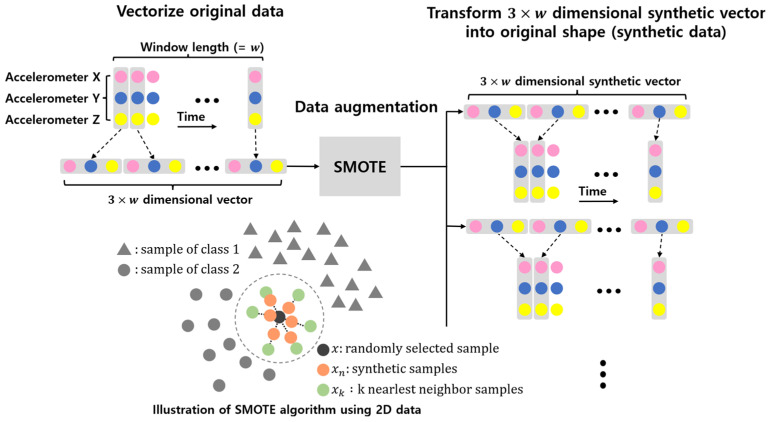
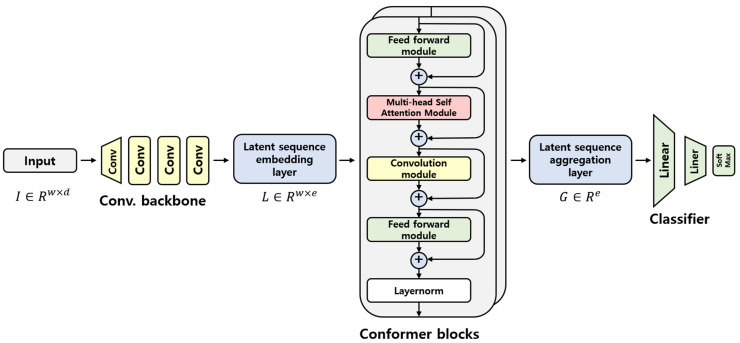
Inertial-measurement-unit (IMU)-based human activity recognition (HAR) studies have improved their performance owing to the latest classification model. In this study, the conformer, which is a state-of-the-art (SOTA) model in the field of speech recognition, is introduced in HAR to improve the performance of the transformer-based HAR model. The transformer model has a multi-head self-attention structure that can extract temporal dependency well, similar to the recurrent neural network (RNN) series while having higher computational efficiency than the RNN series. However, recent HAR studies have shown good performance by combining an RNN-series and convolutional neural network (CNN) model. Therefore, the performance of the transformer-based HAR study can be improved by adding a CNN layer that extracts local features well. The model that improved these points is the conformer-based-model model. To evaluate the proposed model, WISDM, UCI-HAR, and PAMAP2 datasets were used. A synthetic minority oversampling technique was used for the data augmentation algorithm to improve the dataset. From the experiment, the conformer-based HAR model showed better performance than baseline models: the transformer-based-model and the 1D-CNN HAR models. Moreover, the performance of the proposed algorithm was superior to that of algorithms proposed in recent similar studies which do not use RNN-series.
Overview
The claims and statistics of this paper haven’t been checked yet.
Free: it reads the open-access text and checks the first 5 claims that cite a source we can check. Create a free account to check every claim.
Integrity signals
Registry
Cites
Statistics
Figures
Verification
Claims the paper makes
The claims and statistics of this paper haven’t been checked yet.
Free: it reads the open-access text and checks the first 5 claims that cite a source we can check. Create a free account to check every claim.
Claims other papers make about this one
Each is checked against this paper’s own text: does it say what the citing paper says it does?
In the citing paper
“As a result, they achieved SOTA performance on a variety of HAR datasets.”
From TS2ACT: Few-Shot Human Activity Sensing with Cross-Modal Co-Learning (2023) · cites this paper as [25]
Self-check
Percentages, sums and reported differences re-computed from the paper’s own numbers.
The self-check needs the paper’s full text.
Citations
Cites
Vaswani, A., Shazeer, N., Parmar, N., Uszkoreit, J., Jones, L., Gomez, A. N., Kaiser, L., & Polosukhin, I. (2017) · arXiv · doi:10.48550/arxiv.1706.03762 · Cited by 120,404
Hochreiter, S., & Schmidhuber, J. (1997) · Neural Computation · doi:10.1162/neco.1997.9.8.1735 · Cited by 102,318
SMOTE synthetic minority over-sampling technique
Chawla, N. V., Bowyer, K. W., Hall, L. O., & Kegelmeyer, W. P. (2002) · Journal of Artificial Intelligence Research · doi:10.1613/jair.953 · Cited by 32,865
Learning Phrase Representations using RNN Encoder–Decoder for Statistical Machine Translation
Cho, K., van Merrienboer, B., Gulcehre, C., Bahdanau, D., Bougares, F., Schwenk, H., & Bengio, Y. (2014) · Proceedings of the 2014 Conference on Empirical Methods in Natural Language Processing (EMNLP) · doi:10.3115/v1/d14-1179 · Cited by 25,545
Han (2023) · doi:10.1109/tpami.2022.3152247 · Cited by 4,682
Temporal Fusion Transformers for interpretable multi-horizon time series forecasting
Lim, B., Arık, S. Ö., Loeff, N., & Pfister, T. (2021) · International Journal of Forecasting · doi:10.1016/j.ijforecast.2021.03.012 · Cited by 3,291
Conformer: Convolution-augmented Transformer for Speech Recognition
Gulati, A., Qin, J., Chiu, C.-C., Parmar, N., Zhang, Y., Yu, J., Han, W., Wang, S., Zhang, Z., Wu, Y., et al. (2020) · Interspeech 2020 · doi:10.21437/interspeech.2020-3015 · Cited by 3,150
Conformer: Convolution-augmented Transformer for Speech Recognition
Gulati, A., Qin, J., Chiu, C.-C., Parmar, N., Zhang, Y., Yu, J., Han, W., Wang, S., Zhang, Z., Wu, Y., et al. (2020) · arXiv · doi:10.48550/arxiv.2005.08100 · Cited by 3,150 · cited 3×
“Unlike the transformer, however, the conformer incorporates a CNN structure to extract local features with slightly better performance [24–26].”
BackgroundSurvey on deep learning with class imbalance
Johnson, J. M., & Khoshgoftaar, T. M. (2019) · Journal of Big Data · doi:10.1186/s40537-019-0192-5 · Cited by 3,032
Activity recognition using cell phone accelerometers
Kwapisz, J. R., Weiss, G. M., & Moore, S. A. (2011) · ACM SIGKDD Explorations Newsletter · doi:10.1145/1964897.1964918 · Cited by 2,912 · cited 2×
“The execution time of participants’ motions were different from each other, and the data were imbalanced [34].”
Background
Research works printed but not linked: 3
- Kuang, 2018, Comparison of deep feature learning methods for human activity recognition, Appl. Res. Comput., 35, 2815
- Boin, J.B., Roth, N., Doshi, J., Llueca, P., and Borensztein, N. (2020). Multi-class segmentation under severe class imbalance: A case study in roof damage assessment. arXiv.
- Abedin, A., Rezatofighi, H., and Ranasinghe, D.C. (2021). Guided-GAN: Adversarial Representation Learning for Activity Recognition with Wearables. arXiv.
Cited by
Transformer-based models to deal with heterogeneous environments in Human Activity Recognition
Ek, S., Portet, F., & Lalanda, P. (2023) · Personal and Ubiquitous Computing · doi:10.1007/s00779-023-01776-3 · Cited by 100
Chu, X., Kim, S., Cho, Y., & Park, K.-S. (2024) · Electronics · doi:10.3390/electronics13040747 · Cited by 42
Conformer-Based Human Activity Recognition Using Inertial Measurement Units
Seenath, S., & Dharmaraj, M. (2023) · Sensors · doi:10.3390/s23177357 · Cited by 22
TS2ACT: Few-Shot Human Activity Sensing with Cross-Modal Co-Learning
Xia, K., Li, W., Gan, S., & Lu, S. (2023) · Proceedings of the ACM on Interactive, Mobile, Wearable and Ubiquitous Technologies · doi:10.1145/3631445 · Cited by 19
Haresamudram, H., Essa, I., & Plötz, T. (2024) · Sensors · doi:10.3390/s24041238 · Cited by 14
Metadata
- Authors
- Kim, Y.-W., Cho, W.-H., Kim, K.-S., & Lee, S.
- Affiliations
- Inha University (KR)
- Corresponding author
- Lee, Sangmin
- Venue
- Sensors
- Publisher
- MDPI AG
- Published
- 2022-05-23
- Volume
- 22
- Issue
- 10
- Pages
- 3932
- ISSN
- 1424-8220 (ISSN-L)
- PMC
- PMC9144209
- OpenAlex
- W4282928124
- Cited by
- 31
- References
- 46
- Citations by year
- 2026: 3 · 2025: 4 · 2024: 9 · 2023: 13 · 2022: 2
- FWCI
- 2.29
- Type
- journal article
- Language
- en
- Open access
- gold
- doi.org
- Licence
- Locations
- Sensors (publishedVersion, cc-by)
- PubMed Central (publishedVersion, cc-by)
- PubMed (publishedVersion)
- DOAJ (DOAJ: Directory of Open Access Journals) (submittedVersion, cc-by-sa)
- Funders
- Inha University (NRF-2018R1A6A1A03025523)
- Basic Science Research Program of the National Research Foundation of Korea (NRF-2018R1A6A1A03025523)
- Topics
- Physical Sciences › Computer Science › Computer Vision and Pattern Recognition › Context-Aware Activity Recognition Systems
- Physical Sciences › Engineering › Biomedical Engineering › Gait Recognition and Analysis
- Physical Sciences › Computer Science › Signal Processing › Time Series Analysis and Forecasting
- Keywords
- human activity recognition, inertial measurement unit, conformational isomers, transformer models, recurrent neural networks, temporal dependencies, local feature extraction, SMOTE, data augmentation, wearable sensor data
- MeSH terms
- Algorithms, Humans, Human Activities, Neural Networks, Computer
About these checks
Registry, retraction, Cites and statistics results are computed, not judged, with one exception: a printed reference that no index lists is read once by a model before it counts as a citation error. Claims are extracted by a model and kept only when their quote appears verbatim in the text; each cited source is then checked, with a model’s help, for whether it says what the claim relies on. Those verdicts can be wrong — read the claim’s quote and the cited source before relying on one.
Statistics and arithmetic are recomputed, not judged.
Confidence bands are shown only for fields calibrated on our annotated test set. None is calibrated yet, so no band is shown.
What counts as a claim ›How we measure confidence ›How we check this ›
Are you an author, or do you see a problem with this page? Request a review
How to cite
Cite CoChat for the checks on this page, and the paper for its own findings.
- This page
- CoChat. (2026). Citation check: Inertial-Measurement-Unit-Based Novel Human Activity Recognition Algorithm Using Conformer. https://app.cochat.ai/papers/10.3390/s22103932
- The paper
- Kim, Y.-W., Cho, W.-H., Kim, K.-S., & Lee, S. (2022). Inertial-Measurement-Unit-Based Novel Human Activity Recognition Algorithm Using Conformer. Sensors. https://doi.org/10.3390/s22103932
Data sources
Bibliographic data: Semantic Scholar, OpenAlex, Crossref.
Contains information from the Semantic Scholar Academic Graph Datasets, made available under the ODC Attribution License (ODC-BY 1.0).
Semantic Scholar’s data is described in: Kinney, R., et al. (2023). The Semantic Scholar Open Data Platform. arXiv:2301.10140.
