

Effective Techniques for Multimodal Data Fusion: A Comparative Analysis
Open accessThe DOI matches its Crossref record; 31 of the 31 references it cites were found in a registry or an index.
Abstract
Data processing in robotics is currently challenged by the effective building of multimodal and common representations. Tremendous volumes of raw data are available and their smart management is the core concept of multimodal learning in a new paradigm for data fusion. Although several techniques for building multimodal representations have been proven successful, they have not yet been analyzed and compared in a given production setting. This paper explored three of the most common techniques, (1) the late fusion, (2) the early fusion, and (3) the sketch, and compared them in classification tasks. Our paper explored different types of data (modalities) that could be gathered by sensors serving a wide range of sensor applications. Our experiments were conducted on Amazon Reviews, MovieLens25M, and Movie-Lens1M datasets. Their outcomes allowed us to confirm that the choice of fusion technique for building multimodal representation is crucial to obtain the highest possible model performance resulting from the proper modality combination. Consequently, we designed criteria for choosing this optimal data fusion technique.
Overview
The claims and statistics of this paper haven’t been checked yet.
Free: it reads the open-access text and checks the first 5 claims that cite a source we can check. Create a free account to check every claim.
Integrity signals
Registry
Cites
Statistics
Figures
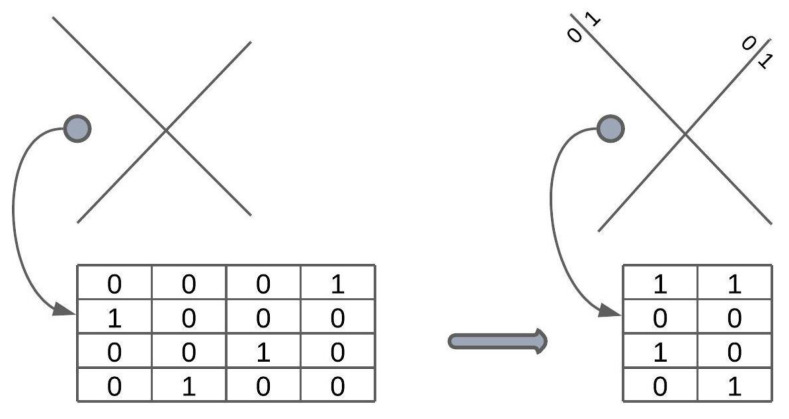
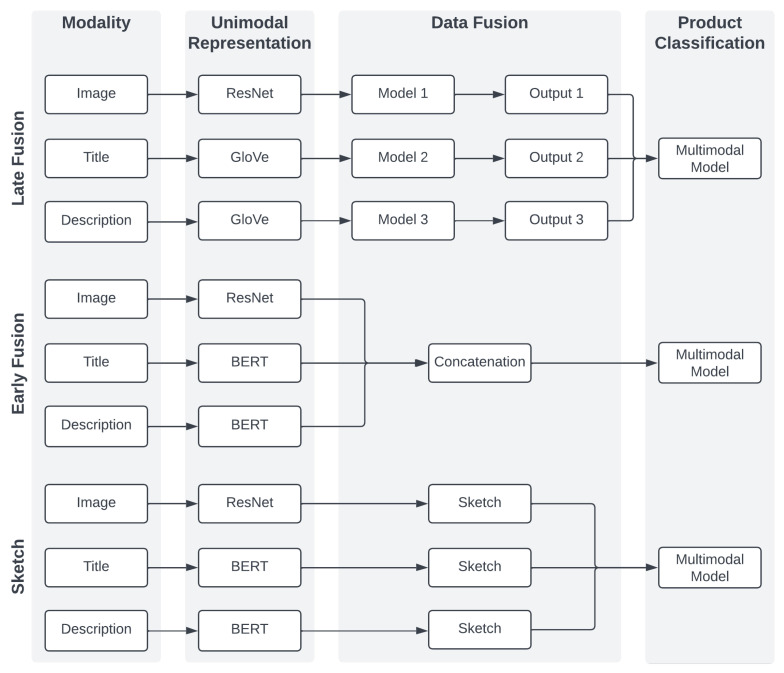
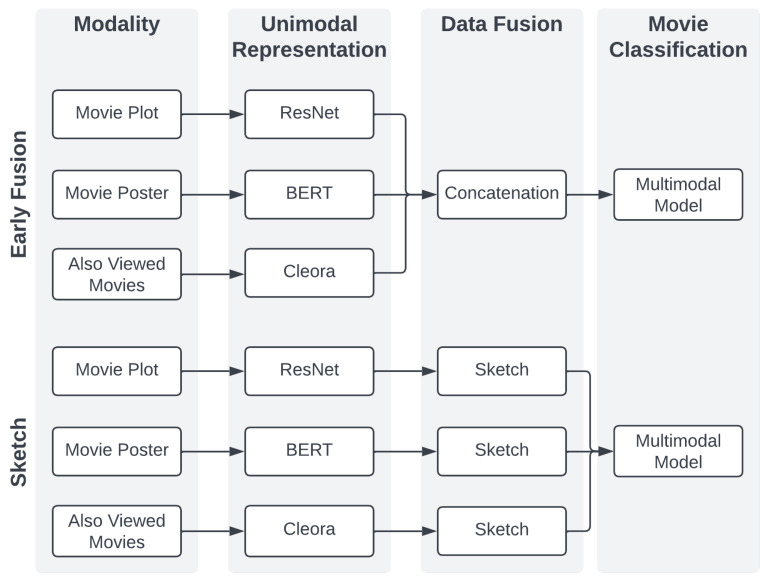
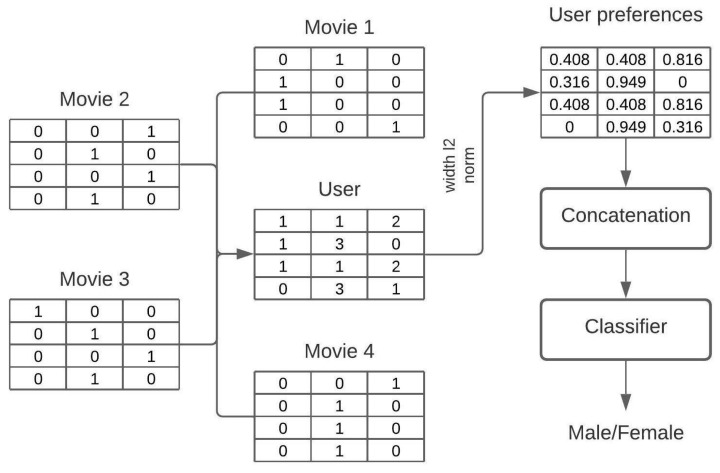
Verification
Claims the paper makes
The claims and statistics of this paper haven’t been checked yet.
Free: it reads the open-access text and checks the first 5 claims that cite a source we can check. Create a free account to check every claim.
Claims other papers make about this one
Each is checked against this paper’s own text: does it say what the citing paper says it does?
The cited source says what the claim attributes to it.
In the citing paper
“the choice of fusion strategy is now recognized as a critical component of model design rather than a secondary implementation detail [7].”
From Benchmarking Multimodal Deep Fusion Strategies for Heterogeneous Neuroimaging and Cognitive Data Using a Controlled Sex Classification Task (2026) · cites this paper as [7]
Self-check
Percentages, sums and reported differences re-computed from the paper’s own numbers.
The self-check needs the paper’s full text.
Citations
Cites
Deep Residual Learning for Image Recognition
He, K., Zhang, X., Ren, S., & Sun, J. (2016) · 2016 IEEE Conference on Computer Vision and Pattern Recognition (CVPR) · doi:10.1109/cvpr.2016.90 · Cited by 235,474 · cited 1×
“The problem of unimodal representation has already been solved with modality-dedicated models, such as BERT [17] for textual data, ResNet [18] for images, etc.”
MethodBERT: Pre-training of Deep Bidirectional Transformers for Language Understanding
Devlin, J., Chang, M.-W., Lee, K., & Toutanova, K. (2018) · arXiv · doi:10.48550/arxiv.1810.04805 · Cited by 73,173
Representation Learning: A Review and New Perspectives
Bengio, Y., Courville, A., & Vincent, P. (2013) · IEEE Transactions on Pattern Analysis and Machine Intelligence · doi:10.1109/tpami.2013.50 · Cited by 13,001 · cited 1×
“Bengio et al. [19] characterized several features that an appropriate vector representation should possess, including: • Smoothness: a transformation should preserve objects similarities,expressed mathe-matically as x ≈ y ⇒ f ( x ) ≈ f ( y ) .”
BackgroundThe MovieLens Datasets: History and Context
Harper, F. M., & Konstan, J. A. (2016) · ACM Transactions on Interactive Intelligent Systems · doi:10.1145/2827872 · Cited by 6,627 · cited 1×
“We conduct experiments on three datasets, Amazon Reviews [7], MovieLens25M, and MovieLens1M [8].”
MethodMultimodal Machine Learning: A Survey and Taxonomy
Baltrusaitis, T., Ahuja, C., & Morency, L.-P. (2019) · IEEE Transactions on Pattern Analysis and Machine Intelligence · doi:10.1109/tpami.2018.2798607 · Cited by 5,018
GLUE: A Multi-Task Benchmark and Analysis Platform for Natural Language Understanding
Wang, A., Singh, A., Michael, J., Hill, F., Levy, O., & Bowman, S. (2018) · Proceedings of the 2018 EMNLP Workshop BlackboxNLP: Analyzing and Interpreting Neural Networks for NLP · doi:10.18653/v1/w18-5446 · Cited by 4,222 · cited 1×
“Designing a multimodal benchmark, similar to GLUE [29] for NLP applications, is crucial for establishing the standards of multimodal representation research.”
BackgroundMultimodal Learning with Deep Boltzmann Machines
Srivastava, N., & Salakhutdinov, R. (2012) · Journal of Machine Learning Research · doi:10.5555/2627435.2697059 · Cited by 1,807 · cited 1×
“[20] identifies more factors that should be taken into account: (1) the similarity between individual modalities should be preserved in their joint representation and (2) robustness to the absence of some modalities; it should still be possible to create multimodal embedding.”
BackgroundHe, R., & McAuley, J. (2016) · Proceedings of the 25th International Conference on World Wide Web · doi:10.1145/2872427.2883037 · Cited by 1,459 · cited 1×
“We conduct experiments on three datasets, Amazon Reviews [7], MovieLens25M, and MovieLens1M [8].”
MethodA survey on deep learning for multimodal data fusion
Gao, J., Li, P., Chen, Z., & Zhang, J. (2020) · Neural Computation · doi:10.1162/neco_a_01273 · Cited by 821 · cited 7×
“A few issues should be taken into account [4] when it comes to fusing several modalities:”
BackgroundMethodInfluentialGandhi, A., Adhvaryu, K., Poria, S., Cambria, E., & Hussain, A. (2023) · Information Fusion · doi:10.1016/j.inffus.2022.09.025 · Cited by 783 · cited 1×
“Furthermore, modalities might naturally coexist, and the analyzed machine learning (ML) problem cannot be solved unless all modalities are considered [5].”
Background
Research works printed but not linked: 3
- 9. Varshney K. Trust in Machine Learning, Manning Publications, Shelter Island, Chapter 4 Data Sources and Biases, Section 4.1 Modalities. [(accessed on 23 March 2021)]. Available online: https://livebook.manning.com/book/trust-in-machine-learning/chapter-4/v-2/
- 14. Rychalska B., Basaj D.B., Dabrowski J., Daniluk M. I know why you like this movie: Interpretable Efficient Multimodal Recommender. arXiv. 20202006.09979
- 26. Wirojwatanakul P., Wangperawong A. Multi-Label Product Categorization Using Multi-Modal Fusion Models. arXiv. 20191907.00420
Cited by
Items 201–220 of 220
Hasan, H. M., García, M. Á., Rashwan, H. A., & Puig, D. (2026) · Computer Vision and Image Understanding · doi:10.1016/j.cviu.2026.104895
Chang, P., Xu, H., Wei, A., Zhu, X., Hong, J., Li, H., Lin, W. Y., & Wu, S. (2026) · International Journal of Fruit Science · doi:10.1080/15538362.2026.2713705
Multimodal Document Classification Across Domains and Methods: A Systematic Review
Aljuhani, H. L., Dahab, M. Y., & Alsenani, Y. S. (2026) · Engineering Technology & Applied Science Research · doi:10.48084/etasr.19175
“Overall, the findings suggest that advanced fusion combined with deep feature extraction provides a strong foundation for accurate, scalable, and generalizable MDC systems [28, 29].”
Integrating the BERT-Deformer Architecture to Optimize Multimodal Translation of Japanese Literature
Shan, L. (2026) · Advanced Electromagnetics · doi:10.7716/aem.v15i3.3175
Enhancing Real-Time Object Detection via Early Fusion of Radar and LiDAR Using CNN-LSTM Networks
Venica, L., Putri, D. I. H., Latifah, F., Kindi, R. M. A., Pratama, M., Hasanah, N., & Wardana, M. K. A. (2026) · International Conference on Smart Mechatronics (ICSMech) · doi:10.1109/icsmech69390.2026.11647244
“…strategies involve trade-offs: early fusion preserves full sensor interactions but is sensitive to temporal misalignment; late fusion processes each modality independently [13] but discards low-level complementary information; mid-level fusion balances both at greater architectural complexity.”
A 28-nm Heterogeneous Processor for Programmable Sensor-Fusion Perception
Pathak, R., Pattnaik, A., Ozatay, M., Jia, H., & Verma, N. (2026) · IEEE Journal of Solid-State Circuits · doi:10.1109/jssc.2026.3725199
“Arangeof perception algorithms across various sensor modalities have been proposed for sensor fusion that can be broadly categorized as early, late, or intermediate fusion [1], [2], [3], [4].”
Wan, X., Yang, D., Hu, H., Liao, J., Wang, Y., Deng, P., Tao, Q., & Wu, Z. (2026) · Microchemical Journal · doi:10.1016/j.microc.2026.119721
Combinatorial AI and nanotechnological approaches for advancing medical sensors
Kapur, U., Adhikari, D., Tripathi, H., & Gabrani, R. (2026) · Elsevier eBooks · doi:10.1016/b978-0-443-45321-2.00003-5
Alfattni, G. (2026) · Healthcare · doi:10.3390/healthcare14193216 · Cited by 1
Odhiambo, F. S. (2025) · SU+ Digital Repository (Strathmore University)
Light-ED: Lightweight Multimodal Emotion Detection using Enhanced EfficientNet
Jha, W., Wang, M., Alim, U., & Kirsman, Z. (2026) · INTERNATIONAL CONFERENCE ON MULTIMODAL INTERACTION · doi:10.1145/3776574.3831221
Lean and Green: Computational Efficiency and Nudging for Sustainable Fashion Recommendation
Cossatin, A. G. (2025) · Institutional Research Information System University of Turin (University of Turin)
Huang, H., Chen, L., Chen, J., Hyun, J., Loftus, J., Melmed, K. R., Orringer, D. A., Frontera, J., Dehkharghani, S., Masurkar, A. V., et al. (2026) · Research Square · doi:10.21203/rs.3.rs-11130462/v1
Zhao, J., Cai, Q., Xing, F., Duan, Z., & Du, H. (2025) · International Conference on Mechanical Automation and Engineering Applications (ICMAEA) · doi:10.1109/icmaea64564.2025.11725768
“By using this formulation, the network can improve classification and localization accuracy by dynamically prioritizing channels based on their contribution to defect detection [19].”
A Multimodal Fusion Approach to Predict Short Video Dissemination Efficiency
WenJing, L., BoYu, L., Sindiramutty, S. R. A., Shaik, S. A., & Sarkar, B. (2026) · Lecture notes in networks and systems · doi:10.1007/978-3-032-41317-8_30
Multimodal Fusion for Uncertainty-Aware Emotion Recognition in Conversations
Stereciu, T., Gebeyehu, T. A., & Tashu, T. M. (2026) · Lecture notes in computer science · doi:10.1007/978-981-92-6910-5_3
Rajathi, G. I., Nisha, U. B., Abdullah, R. Y., Posonia, A. M., & Anwar, M. M. (2026) · Scientific Reports · doi:10.1038/s41598-026-76930-x
Deep Learning for Crystal System Classification from XRD Using HKL Planes
Hapsari, A. W. D., Cahaya, A. B., & Handoko, D. (2026) · Electrical Power, Electronics, Communications, Controls and Informatics Seminar (EECCIS) · doi:10.1109/eeccis68982.2026.11750515
“Recent research has also shown that fusion mechanisms, particularly those utilizing attention, are effective in combining heterogeneous modalities and providing increased discriminatory power [22].”
Krogstie, J. (2026) · Springer eBooks · doi:10.1007/978-3-032-42129-6_4
Pavan, K., Khan, A., Singh, A., Pawar, D. S., & Ganapathy, N. (2026) · Engineering Applications of Artificial Intelligence · doi:10.1016/j.engappai.2026.116635
Metadata
- Authors
- Pawłowski, M., Wróblewska, A., & Sysko-Romańczuk, S.
- Affiliations
- Warsaw University of Technology (PL)
- Corresponding author
- Pawłowski, Maciej
- Wróblewska, Anna
- Venue
- Sensors
- Publisher
- MDPI AG
- Published
- 2023-02-21
- Volume
- 23
- Issue
- 5
- Pages
- 2381
- ISSN
- 1424-8220 (ISSN-L)
- PMC
- PMC10007548
- OpenAlex
- W4321497840
- Cited by
- 180
- References
- 30
- Citations by year
- 2026: 50 · 2025: 94 · 2024: 30 · 2023: 6
- FWCI
- 16.31
- Type
- journal article
- Language
- en
- Open access
- gold
- doi.org
- Licence
- Locations
- Sensors (publishedVersion, cc-by)
- PubMed Central (publishedVersion, cc-by)
- PubMed (publishedVersion)
- arXiv (Cornell University) (submittedVersion)
- DOAJ (DOAJ: Directory of Open Access Journals) (submittedVersion, cc-by-sa)
- arXiv (Cornell University) (cc-by)
- Funders
- Centre for Priority Research Area Artificial Intelligence and Robotics of Warsaw University of Technology within the Excellence Initiative: Research University (IDUB) programme (1820/27/Z01/POB2/2021, POIR.01.01.01-00-0066/22)
- National Centre for Research and Development in Poland, Smart Growth Operational Program for 2014-2020, Digital Innovations (1820/27/Z01/POB2/2021, POIR.01.01.01-00-0066/22)
- Topics
- Physical Sciences › Computer Science › Computer Vision and Pattern Recognition › Multimodal Machine Learning Applications
- Physical Sciences › Engineering › Media Technology › Advanced Image Fusion Techniques
- Social Sciences › Psychology › Experimental and Cognitive Psychology › Multisensory perception and integration
- Keywords
- multimodal fusion, decision fusion, feature-level fusion, multimodal representation learning, classification, sensor data, recommender systems, Amazon reviews, MovieLens
About these checks
Registry, retraction, Cites and statistics results are computed, not judged, with one exception: a printed reference that no index lists is read once by a model before it counts as a citation error. Claims are extracted by a model and kept only when their quote appears verbatim in the text; each cited source is then checked, with a model’s help, for whether it says what the claim relies on. Those verdicts can be wrong — read the claim’s quote and the cited source before relying on one.
Statistics and arithmetic are recomputed, not judged.
Confidence bands are shown only for fields calibrated on our annotated test set. None is calibrated yet, so no band is shown.
What counts as a claim ›How we measure confidence ›How we check this ›
Are you an author, or do you see a problem with this page? Request a review
Data sources
Bibliographic data: Semantic Scholar, OpenAlex, Crossref.
Contains information from the Semantic Scholar Academic Graph Datasets, made available under the ODC Attribution License (ODC-BY 1.0).
Semantic Scholar’s data is described in: Kinney, R., et al. (2023). The Semantic Scholar Open Data Platform. arXiv:2301.10140.
