

The DOI matches its Crossref record; 77 of the 79 references it cites were found in a registry or an index, and 2 are not checked yet; none of the 85 sources its claims cite is checked for support yet.
Ageing, Sex Differences, and REDs Risk in Endurance Runners: An Integrated Cross-Sectional Study Protocol
Open accessAbstract
Endurance performance is influenced by age- and sex-specific physiological determinants, while emerging evidence indicates an increasing prevalence of Relative Energy Deficiency in Sport (REDs) among both young and master endurance runners. Despite its clinical relevance, limited data exist on how long-term endurance training modulates REDs risk, skeletal muscle characteristics, and physiological ageing in comparison with inactive individuals. Methods: This cross-sectional study protocol will examine 112 participants stratified by sex, age (20–35 vs. 65–80 years), and training status (endurance runners vs. inactive controls). Cardiorespiratory fitness (VO2max) is defined as the primary outcome. Secondary outcomes include body composition, musculoskeletal function, biochemical and hormonal markers, and REDs-related screening variables. Assessments will comprise cardiorespiratory testing, DXA-based bone and body composition analysis, isometric knee dynamometry, mobility testing, validated REDs screening tools (LEAF-Q, LEAM-Q, and IOC REDs CAT2), seven-day dietary and training monitoring, venous blood sampling, and skeletal muscle biopsies from the vastus lateralis. Results: This study is designed to generate an integrated overview of physiological, nutritional, metabolic, and muscle-cell characteristics across sex-, age-, and training-specific subgroups. Conclusions: This protocol provides comprehensive insight into how ageing and sex influence endurance physiology and REDs susceptibility and whether long-term endurance training preserves functional capacity across the lifespan. The findings aim to support evidence-based screening, prevention, and targeted interventions for REDs in endurance athletes.
Checked 2026-11-14 · 2 references not checked yet
Overview
CoChat Summary
TL;DR
This cross-sectional study protocol will examine 112 participants stratified by sex, age (20–35 vs. 65–80 years), and training status (endurance runners vs. inactive controls) to assess cardiorespiratory fitness and REDs-related risk. It aims to clarify how ageing and sex influence endurance physiology, musculoskeletal and bone health, and REDs susceptibility, but reports no empirical results.
Key findings
- No results are reported; the paper is a protocol. The primary outcome is estimated VO2max, with secondary outcomes including body composition, musculoskeletal function, biochemical and hormonal markers, and REDs-related screening variables.
- The a priori sample size is n = 112 total, corresponding to 14 participants per each of eight sex × age × training-status groups, calculated for an omnibus factorial ANOVA (α = 0.05, power = 0.90, Cohen’s f ≈ 0.42).
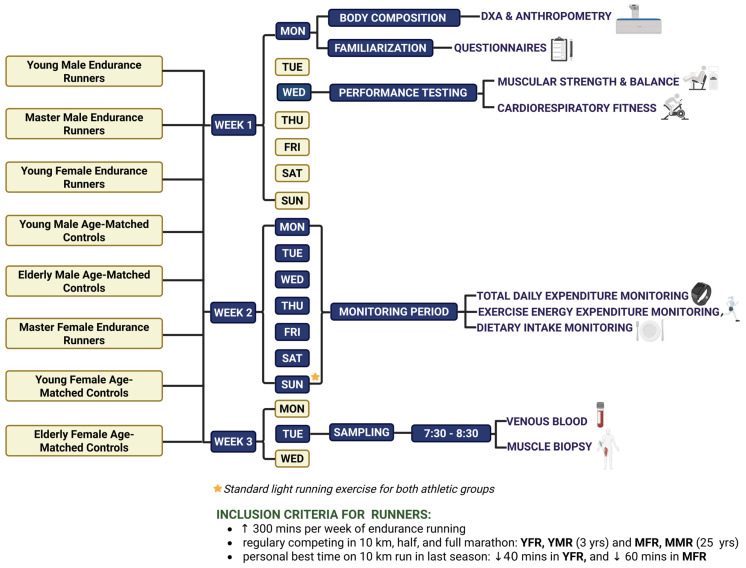
- Assessments include incremental cycling VO2max, DXA bone/body composition, isometric knee dynamometry, Y-Balance testing, LEAF-Q/LEAM-Q/IOC REDs CAT2 screening, seven-day dietary/training monitoring, actigraphy, venous blood sampling, and vastus lateralis muscle biopsies.
- The working hypothesis is that master endurance runners may show equal or lower prevalence of “high-risk” REDs screening profiles than younger endurance runners, while still potentially exhibiting specific REDs-related indicators such as low fat-free mass or altered endocrine/bone markers.
Methods
- Cross-sectional protocol developed in accordance with SPIRIT guidelines; 112 participants will be enrolled across eight groups by sex, age (young adult 20–35 years; master/elderly 65–80 years), and athletic status (endurance runners vs. inactive controls). Endurance runners include elite-level Slovak athletes actively competing nationally/internationally, with performance benchmarks of ≤35 min (young) and ≤55 min (masters) in a 10 km run.
- Primary outcome: estimated VO2max from a continuous incremental cycling test using the ACSM metabolic equation; secondary/exploratory outcomes include DXA body composition and bone parameters, isometric knee dynamometry, mobility, REDs screening tools (LEAF-Q, LEAM-Q, IOC REDs CAT2), seven-day dietary and training monitoring, wrist actigraphy, blood biomarkers, and muscle biopsy analyses (immunohistochemistry, electron microscopy, Western blot, qPCR, glycogen).
- Statistical analysis: factorial ANOVA with sex, age category, and training status as fixed factors; post hoc comparisons with correction where significant; effect sizes reported as partial eta squared and Cohen’s d; exploratory outcomes interpreted as hypothesis-generating; significance set at p < 0.05.
Limitations
- Stated: the cross-sectional design and single one-week monitoring period limit the ability to capture long-term physiological and health changes; selection bias is acknowledged because master endurance runners represent a highly motivated, health-conscious “healthy survivor” subgroup, limiting generalisability to the broader ageing population.
- Stated: VO2max is estimated indirectly from maximal cycling power output, which may systematically underestimate aerobic capacity in endurance runners compared with treadmill running, and cycling efficiency may vary by age and sex; REDs screening tools rely on self-reported symptoms and may be vulnerable to recall bias.
- Stated: the large number of assessed outcomes increases the likelihood that some findings will remain primarily descriptive, and the design does not allow longitudinal monitoring of training load, dietary patterns, hormonal fluctuations, or menstrual-cycle variability. Evident: as a protocol, no outcome data or conclusions can yet be drawn.
Model-written summary. Check it against the paper before relying on it.
Integrity signals
Registry
Cites
Statistics
Figures
Verification
Claims the paper makes
0 Valid · 1 Not valid · 48 Not checked · 35 Own results and interpretations
None of the sources cited for this claim have been checked yet.
In the paper
“This performance disparity is primarily attributed to sex-specific physiological characteristics, including higher maximal oxygen uptake (VO2max), greater cardiac stroke volume, elevated haemoglobin concentrations, and larger skeletal muscle mass in men, which collectively enhance oxygen transport and utilisation during prolonged exercise.”
§ Ageing, Sex Differences, and REDs Risk in Endurance Runners: An Integrated Cross-Sectional Study Protocol > 1. Introduction
What the sources say
- Not checked yetcites [1] Hunter, 2024, Sex Differences in Human Performance, J. Physiol. source
- Not checked yetcites [2] Besson, 2022, Sex Differences in Endurance Running, Sports Med. source
- Not checked yetcites [3] Senefeld, 2024, Hormonal Basis of Biological Sex Differences in Human Athletic Performance, Endocrinology source
plainstates a cause- Asserted: passes — The authors put it forward as true.
- Checkable: passes — It can be checked against evidence.
- Load-bearing: unclear — It is unclear whether the paper’s conclusions depend on it.
- Based: passes — The paper gives a reason why it holds.
None of the sources cited for this claim have been checked yet.
In the paper
“Across all levels of competition, male runners typically outperform female runners in events ranging from middle-distance to ultramarathons.”
§ Ageing, Sex Differences, and REDs Risk in Endurance Runners: An Integrated Cross-Sectional Study Protocol > 1. Introduction
What the sources say
- Not checked yetcites [1] Hunter, 2024, Sex Differences in Human Performance, J. Physiol. source
- Not checked yetcites [2] Besson, 2022, Sex Differences in Endurance Running, Sports Med. source
- Not checked yetcites [3] Senefeld, 2024, Hormonal Basis of Biological Sex Differences in Human Athletic Performance, Endocrinology source
plainstates an association- Asserted: passes — The authors put it forward as true.
- Checkable: passes — It can be checked against evidence.
- Load-bearing: unclear — It is unclear whether the paper’s conclusions depend on it.
- Based: passes — The paper gives a reason why it holds.
None of the sources cited for this claim have been checked yet.
In the paper
“Female runners exhibit sex-specific biomechanical and metabolic characteristics, including a greater reliance on lipid oxidation during submaximal exercise”
§ Ageing, Sex Differences, and REDs Risk in Endurance Runners: An Integrated Cross-Sectional Study Protocol > 1. Introduction
What the sources say
- Not checked yetcites [4] Hallam, L.C., and Amorim, F.T. (2022). Expanding the Gap: An Updated Look into Sex Differences in Running Performance. Front. Physiol., 12. source
- Not checked yetcites [5] Tiller, 2021, Do Sex Differences in Physiology Confer a Female Advantage in Ultra-Endurance Sport?, Sports Med. source
plainstates an association- Asserted: passes — The authors put it forward as true.
- Checkable: passes — It can be checked against evidence.
- Load-bearing: unclear — It is unclear whether the paper’s conclusions depend on it.
- Based: passes — The paper gives a reason why it holds.
None of the sources cited for this claim have been checked yet.
In the paper
“Master athletes experience a progressive decline in physiological capacity, primarily driven by reductions in VO2max, maximal heart rate, stroke volume, and skeletal muscle mass.”
§ Ageing, Sex Differences, and REDs Risk in Endurance Runners: An Integrated Cross-Sectional Study Protocol > 1. Introduction
What the sources say
- Not checked yetcites [5] Tiller, 2021, Do Sex Differences in Physiology Confer a Female Advantage in Ultra-Endurance Sport?, Sports Med. source
- Not checked yetcites [7] Berezanskaya, J., and Best, T.M. (2023). Effects of Exercise and Aging in the Masters-Level Athlete. Endurance Sports Medicine: A Clinical Guide, Springer. source
- Not checked yetcites [8] Vajda, M., Oreská, Ľ., Černáčková, A., Čupka, M., Tirpáková, V., Cvečka, J., and Sedliak, M. (2022). Aging and Possible Benefits or Negatives of Lifelong Endurance Running. Int. J. Environ. Res. Public Health, 19. source
plainstates a cause- Asserted: passes — The authors put it forward as true.
- Checkable: passes — It can be checked against evidence.
- Load-bearing: unclear — It is unclear whether the paper’s conclusions depend on it.
- Based: passes — The paper gives a reason why it holds.
None of the sources cited for this claim have been checked yet.
In the paper
“whereas DXA will serve as the reference method for detailed regional body composition, fat-free mass (FFM), and all bone-related outcomes [22,23].”
§ Ageing, Sex Differences, and REDs Risk in Endurance Runners: An Integrated Cross-Sectional Study Protocol > 2. Materials and Methods > 2.6. Secondary Outcomes
What the sources say
- Not checked yetcites [22] Kyle, 2004, Bioelectrical Impedance Analysis—Part I: Review of Principles and Methods, Clin. Nutr. source
- Not checked yetcites [23] Ling, 2011, Accuracy of Direct Segmental Multi-Frequency Bioimpedance Analysis in the Assessment of Total Body and Segmental Body Composition in Middle-Aged Adult Population, Clin. Nutr. source
plain- Asserted: passes — The authors put it forward as true.
- Checkable: passes — It can be checked against evidence.
- Load-bearing: passes — The paper’s conclusions depend on it.
- Based: passes — The paper gives a reason why it holds.
14 more claims
Create a free account to see all 84 claims and to verify the 85 references still open.
- Probably not a substantial claim. 48
- It may state two separate claims as one. 29
Self-check
Percentages, sums and reported differences re-computed from the paper’s own numbers.
Each contradiction between two passages listed here was confirmed by an independent check.
Rated minor: it would not touch a result — a value no result rests on, a p-value that stays on the same side of the significance level, or a conflict that is clerical, resolved elsewhere in the paper, or outside its own findings.
In the paper
§ Ageing, Sex Differences, and REDs Risk in Endurance Runners: An Integrated Cross-Sectional Study Protocol > 3. Discussion > 3.3. Limitations of the Study
“Additionally, the REDs screening tools used (LEAF-Q, LEAM-Q, and IOC REDs CAT2) rely only on self-reported symptoms.”
§ Ageing, Sex Differences, and REDs Risk in Endurance Runners: An Integrated Cross-Sectional Study Protocol > 2. Materials and Methods > 2.9. Screening Outcomes (REDS/LEA Screening and Symptom-Based Risk Stratification)
“IOC REDs CAT2 is a three-step model, integrating (1) validated screening questionnaires or clinical interviews, (2) a severity or risk assessment based on the accumulation of primary and secondary indicators (e.g., biomarkers, BMD, and injury history), and (3) expert clinical evaluation and management where indicated [14].”
Rated minor: it would not touch a result — a value no result rests on, a p-value that stays on the same side of the significance level, or a conflict that is clerical, resolved elsewhere in the paper, or outside its own findings.
In the paper
§ Ageing, Sex Differences, and REDs Risk in Endurance Runners: An Integrated Cross-Sectional Study Protocol > 2. Materials and Methods > 2.3. Study Subjects
“Control groups will comprise non-athletic individuals matched by sex and age, reporting <150 min of moderate and <75 of vigorous weekly activity during the past five years.”
§ Ageing, Sex Differences, and REDs Risk in Endurance Runners: An Integrated Cross-Sectional Study Protocol > 2. Materials and Methods > 2.3. Study Subjects
“Physically inactive participants must report ≤150 min·week−1 of moderate-intensity activity and ≤75 min·week−1 of vigorous-intensity activity over the same period.”
Citations
Cites
World Health Organization 2020 guidelines on physical activity and sedentary behaviour
Bull, F. C., Al-Ansari, S. S., Biddle, S., Borodulin, K., Buman, M. P., Cardon, G., Carty, C., Chaput, J.-P., Chastin, S., Chou, R., et al. (2020) · British Journal of Sports Medicine · doi:10.1136/bjsports-2020-102955 · Cited by 11,657
Bioelectrical impedance analysis?part I: review of principles and methods
KYLE, U. (2004) · Clinical Nutrition · doi:10.1016/j.clnu.2004.06.004 · Cited by 3,200
Ross, R., Blair, S. N., Arena, R., Church, T. S., Després, J.-P., Franklin, B. A., Haskell, W. L., Kaminsky, L. A., Levine, B. D., Lavie, C. J., et al. (2016) · Circulation · doi:10.1161/cir.0000000000000461 · Cited by 2,486
Limiting factors for maximum oxygen uptake and determinants of endurance performance
BASSETT, D. R. (2000) · Medicine & Science in Sports & Exercise · doi:10.1097/00005768-200001000-00012 · Cited by 2,410
Aagaard, P., Simonsen, E. B., Andersen, J. L., Magnusson, P., & Dyhre-Poulsen, P. (2002) · Journal of Applied Physiology · doi:10.1152/japplphysiol.00283.2002 · Cited by 1,844
Mountjoy, M., Sundgot-Borgen, J., Burke, L., Carter, S., Constantini, N., Lebrun, C., Meyer, N., Sherman, R., Steffen, K., Budgett, R., et al. (2014) · British Journal of Sports Medicine · doi:10.1136/bjsports-2014-093502 · Cited by 1,469
Rate of force development: physiological and methodological considerations
Maffiuletti, N. A., Aagaard, P., Blazevich, A. J., Folland, J., Tillin, N., & Duchateau, J. (2016) · European Journal of Applied Physiology · doi:10.1007/s00421-016-3346-6 · Cited by 1,424
Thomas, D. T., Erdman, K. A., & Burke, L. M. (2016) · Journal of the Academy of Nutrition and Dietetics · doi:10.1016/j.jand.2015.12.006 · Cited by 1,359
Use of RPE-Based Training Load in Soccer
IMPELLIZZERI, F. M., RAMPININI, E., COUTTS, A. J., SASSI, A., & MARCORA, S. M. (2004) · Medicine & Science in Sports & Exercise · doi:10.1249/01.mss.0000128199.23901.2f · Cited by 1,179
Mountjoy, M., Ackerman, K. E., Bailey, D. M., Burke, L. M., Constantini, N., Hackney, A. C., Heikura, I. A., Melin, A., Pensgaard, A. M., Stellingwerff, T., et al. (2023) · British Journal of Sports Medicine · doi:10.1136/bjsports-2023-106994 · Cited by 974
Research works printed but not linked: 4
- American College of Sports Medicine (2025). ACSM’s Guidelines for Exercise Testing and Prescription, Lippincott Williams & Wilkins.
- Bajer, 2019, Nutrition Timing and Macronutrient Intake in Endurance Athletes, Acta Facult. Educ. Phys. Univ. Comen., 59, 134
- Evans, 1982, Suction Applied to a Muscle Biopsy Maximizes Sample Size, Med. Sci. Sports Exerc., 14, 101
- Murach, 2021, Muscle Fiber Types and the Myonuclear Domain: A Reconsideration of Funda-mental Principles, Muscle Nerve, 63, 455
Cited by
Still being checked.
Metadata
- Authors
- Oreská, Ľ., Kundeková, B., Varga, L., Stebelová, K., Okuliarová, M., Payer, J., & Sedliak, M.
- Affiliations
- Comenius University Bratislava (SK)
- University Hospital Bratislava (SK)
- ORCID
- Venue
- Sports
- Publisher
- MDPI AG
- Published
- 2026-03-19
- Volume
- 14
- Issue
- 3
- Pages
- 121
- ISSN
- 2075-4663 (ISSN-L)
- PMC
- PMC13030092
- OpenAlex
- W7138934842
- Semantic Scholar
- 4a805b1d9444ee59fb72afff891258fce4864658
- Cited by
- 0
- References
- 77
- FWCI
- 0.00
- Type
- journal article
- Language
- en
- Open access
- gold
- doi.org
- Licence
- Locations
- Sports (publishedVersion, cc-by)
- Preprints.org (submittedVersion, cc-by)
- PubMed Central (publishedVersion, cc-by)
- PubMed (publishedVersion)
- DOAJ (DOAJ: Directory of Open Access Journals) (submittedVersion, cc-by-sa)
- Funders
- Slovak Research and Development Agency grant (APVV-21-0164)
- Vedecká grantová agentúra Ministerstva školstva, výskumu, vývoja a mládeže Slovenskej republiky a Slovenskej akadémie vied VEGA grant (1/0554/24)
- Vedecká grantová agentúra Ministerstva školstva, výskumu, vývoja a mládeže Slovenskej repubiky a Slovenskej akadémie vied VEGA grant (1/0482/23)
- Topics
- Health Sciences › Medicine › Orthopedics and Sports Medicine › Sports Performance and Training
- Health Sciences › Medicine › Physiology (medical) › Cardiovascular and exercise physiology
- Health Sciences › Nursing › Nutrition and Dietetics › Muscle metabolism and nutrition
- Keywords
- relative energy deficiency in sport, endurance runners, aging, sex differences, master athletes, cardiorespiratory fitness, VO2max, body composition, musculoskeletal function, LEAF-Q, dietary intake, hormonal markers, vastus lateralis
About these checks
Registry, retraction, Cites and statistics results are computed, not judged, with one exception: a printed reference that no index lists is read once by a model before it counts as a citation error. Claims are extracted by a model and kept only when their quote appears verbatim in the text; each cited source is then checked, with a model’s help, for whether it says what the claim relies on. Those verdicts can be wrong — read the claim’s quote and the cited source before relying on one.
A language model drew the claims from the paper on 2026-11-14, under version 3 of the claim definition (model deepseek-v4.1-flash, prompt extract-v3).
A second model labelled each claim on 2026-11-14 (model jev-1.13-20260917, definition revision gold-guideline-v0.2).
Statistics and arithmetic are recomputed, not judged.
Confidence bands are shown only for fields calibrated on our annotated test set. None is calibrated yet, so no band is shown.
What counts as a claim ›How we measure confidence ›How we check this ›
Are you an author, or do you see a problem with this page? Request a review
How to cite
Cite CoChat for the checks on this page, and the paper for its own findings.
- This page
- CoChat. (2026). Citation check: Ageing, Sex Differences, and REDs Risk in Endurance Runners: An Integrated Cross-Sectional Study Protocol. https://app.cochat.ai/papers/10.3390/sports14030121
- The paper
- Oreská, Ľ., Kundeková, B., Varga, L., Stebelová, K., Okuliarová, M., Payer, J., & Sedliak, M. (2026). Ageing, Sex Differences, and REDs Risk in Endurance Runners: An Integrated Cross-Sectional Study Protocol. Sports. https://doi.org/10.3390/sports14030121
Data sources
Bibliographic data: Semantic Scholar, OpenAlex, Crossref.
Contains information from the Semantic Scholar Academic Graph Datasets, made available under the ODC Attribution License (ODC-BY 1.0).
Semantic Scholar’s data is described in: Kinney, R., et al. (2023). The Semantic Scholar Open Data Platform. arXiv:2301.10140.
