

The Impact of Environmental Factors on Academic Performance of University Students Taking Online Classes during the COVID-19 Pandemic in Mexico
Open accessThe DOI matches its Crossref record; 81 of the 84 references it cites were found in a registry or an index.
Abstract
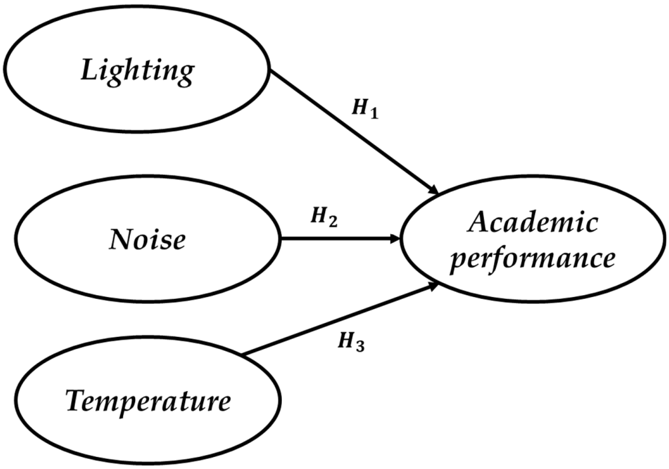
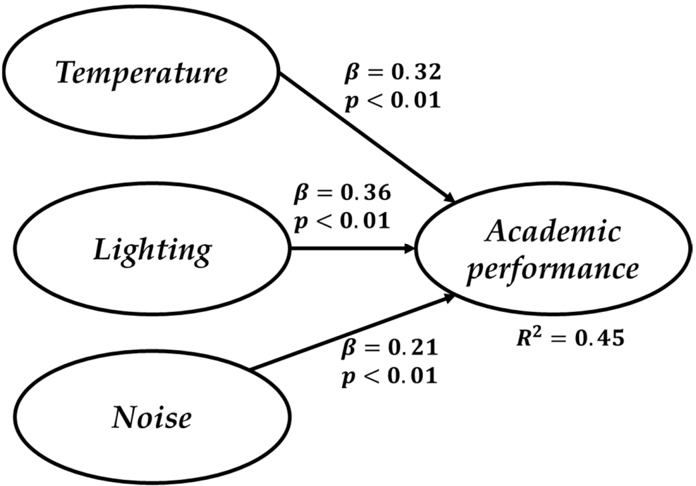
The COVID-19 pandemic and the quarantine period determined that university students (human resource) in Mexico had adopted the online class modality, which required them to adapt themselves to new technologies and environmental conditions that are different from classrooms at their university. Specifically, these new environmental conditions can be uncomfortable and have an impact on the students’ academic performance. Consequently, the present study aims to determine the impact that the lighting, noise, and temperature levels (independent variables) have on academic performance (dependent variable) in university students during the COVID-19 pandemic. To do this, a questionnaire was developed, which was applied to 206 university students online, and a structural equation model was built that integrates the four variables through three hypotheses, which were statistically validated through the partial least squares method. Results showed that temperature, lighting, and noise have significant direct effects on university students’ academic performance. As a conclusion, it was obtained that the three independent variables have an impact in the sustainability of university students (human resource).
Overview
The claims and statistics of this paper haven’t been checked yet.
Free: it reads the open-access text and checks the first 5 claims that cite a source we can check. Create a free account to check every claim.
Integrity signals
Registry
Cites
Statistics
Figures
Verification
Claims the paper makes
The claims and statistics of this paper haven’t been checked yet.
Free: it reads the open-access text and checks the first 5 claims that cite a source we can check. Create a free account to check every claim.
Claims other papers make about this one
Each is checked against this paper’s own text: does it say what the citing paper says it does?
The source backs part of the claim, not all of it — or backs it for a different population, condition or comparison.
In the citing paper
“These findings support the findings of other studies that reported an increase in students' grades when they studied online [42-44].”
From Impact of online learning on student's performance and engagement: a systematic review (2024) · cites this paper as [42]
Experimental — accuracy not yet measuredThe cited source says what the claim attributes to it.
In the citing paper
“Another author compared the impact of environmental conditions at home and student academic performance, and it was found that students who had poor lighting conditions or those who were exposed to noisy environments performed poorly, this suggests that online learners need proper indoor lighting, ventilation, and a quiet environment for proper learning [42]”
From Impact of online learning on student's performance and engagement: a systematic review (2024) · cites this paper as [42]
Self-check
Percentages, sums and reported differences re-computed from the paper’s own numbers.
The self-check needs the paper’s full text.
Citations
Cites
Declaration of Helsinki. Ethical Principles for Medical Research Involving Human Subjects
(2014) · Jahrbuch für Wissenschaft und Ethik · doi:10.1515/jwiet-2014-0117 · Cited by 2,473
Impacts of the COVID-19 pandemic on life of higher education students: A global perspective
Aristovnik, A., Keržič, D., Ravšelj, D., Tomaževič, N., & Umek, L. (2020) · Sustainability · doi:10.3390/su12208438 · Cited by 2,047
Online learning amid the COVID-19 pandemic: Students perspectives
Adnan, M. (2020) · Journal of Pedagogical Sociology and Psychology · doi:10.33902/jpsp.2020261309 · Cited by 1,920 · cited 1×
“Similarly, Adnan and Anwar [32] studied the attitudes of college students in Pakistan towards online classes during the COVID-19 pandemic.”
BackgroundMitigating the wider health effects of covid-19 pandemic response
Douglas, M., Katikireddi, S. V., Taulbut, M., McKee, M., & McCartney, G. (2020) · BMJ · doi:10.1136/bmj.m1557 · Cited by 1,105 · cited 1×
“This situation has caused employees from different companies and labor sectors around the world to work from home [17,18].”
BackgroundEffect of COVID-19 on the Performance of Grade 12 Students: Implications for STEM Education
Sintema, E. J. (2020) · Eurasia Journal of Mathematics, Science and Technology Education · doi:10.29333/ejmste/7893 · Cited by 813 · cited 1×
“Additionally, Sintema [36] studied the effects of the COVID-19 pandemic on academic performance on students of secondary schools in Zambia.”
BackgroundInfluence of COVID-19 confinement on students’ performance in higher education
Gonzalez, T., de la Rubia, M. A., Hincz, K. P., Comas-Lopez, M., Subirats, L., Fort, S., & Sacha, G. M. (2020) · PLOS ONE · doi:10.1371/journal.pone.0239490 · Cited by 743 · cited 2×
“[31] found that this confinement had a significant positive effect on the academic performance of students, which helped to improve students’ learning strategies to a more continuous habit, improving their efficiency.”
BackgroundEbner, M., & Holzinger, A. (2007) · Computers & Education · doi:10.1016/j.compedu.2005.11.026 · Cited by 660 · cited 1×
“This can be done through game-based learning [88,89], since it promotes learning through an entertaining way and fosters student motivation to increase engagement in the educational process [90].”
BackgroundDemuyakor, J. (2020) · Online Journal of Communication and Media Technologies · doi:10.29333/ojcmt/8286 · Cited by 482
The resilience of the Spanish health system against the COVID-19 pandemic
Legido-Quigley, H., Mateos-García, J. T., Campos, V. R., Gea-Sánchez, M., Muntaner, C., & McKee, M. (2020) · The Lancet Public Health · doi:10.1016/s2468-2667(20)30060-8 · Cited by 452
Does noise affect learning? A short review on noise effects on cognitive performance in children
Klatte, M., Bergström, K., & Lachmann, T. (2013) · Frontiers in Psychology · doi:10.3389/fpsyg.2013.00578 · Cited by 446
Research works printed but not linked: 5
- 14. Siddiqui, T.M.; Wali, A.; Khan, H.; Khan, M.; Zafar, F. Assessment of knowledge, practice, and work environment related to ergonomics among dental students and dental practitioners. Int. J. Contemp. Dent. Med. Rev. 2016, 2016, 40316. [CrossRef]
- 21. Omidiandost, A.; Sohrabi, Y.; Poursadeghiyan, M.; Yarmohammadi, H.; Mosavi, A. Evaluation of general and local lighting as an environmental ergonomics factor in different parts of a hospital in the city of Kermanshah in 2015. Technol. J. Eng. Appl. Sci. 2015, 5, 255-259.
- 22. Nava, R.; Castro, J.; Rojas, L.; Gómez, M. Evaluación ergonómica de los Puestos de Trabajo del Área Administrativa. REDIELUZ 2015, 3, 27-35.
- 35. Kimani, G.N.; Kara, A.M.; Njagi, L.W. Teacher factors influencing students' academic achievement in secondary schools. Int. J. Educ. Res. 2013, 1, 1-14.
- 81. Egbu, C.O., Lou, E., Eds.; ARCOM: Leeds, UK, 2010; pp. 1447-1456.
Cited by
Salas‐Pilco, S. Z., Yang, Y., & Zhang, Z. (2022) · British Journal of Educational Technology · doi:10.1111/bjet.13190 · Cited by 411
Baltà-Salvador, R., Olmedo-Torre, N., Peña, M., & Renta-Davids, A.-I. (2021) · Education and Information Technologies · doi:10.1007/s10639-021-10593-1 · Cited by 212
The role of IT-based technologies on the management of human resources in the COVID-19 era
Vahdat, S. (2022) · Kybernetes · doi:10.1108/k-04-2021-0333 · Cited by 195
Impact of online learning on student's performance and engagement: a systematic review
Akpen, C. N., Asaolu, S., Atobatele, S., Okagbue, H., & Sampson, S. (2024) · Discover Education · doi:10.1007/s44217-024-00253-0 · Cited by 205
“These findings support the findings of other studies that reported an increase in students’ grades when they studied online [42–44].”
Keržič, D., Alex, J. K., Pamela Balbontín Alvarado, R., Bezerra, D. D. S., Cheraghi, M., Dobrowolska, B., Fagbamigbe, A. F., Faris, M. E., França, T., González-Fernández, B., et al. (2021) · PLOS ONE · doi:10.1371/journal.pone.0258807 · Cited by 185
“During the COVID-19 pandemic, environmental aspects like temperature, lighting and noise have been identified as significant determinants of students’ e-learning performance [42].”
BackgroundStudents academic and social concerns during COVID-19 pandemic
Al‐Maskari, A., Al-Riyami, T., & Kunjumuhammed, S. K. (2021) · Education and Information Technologies · doi:10.1007/s10639-021-10592-2 · Cited by 137
Gumasing, M. J. J., & Castro, F. M. F. (2023) · Sustainability · doi:10.3390/su15031970 · Cited by 97
AlMallahi, M. N., Swailmeen, Y. A., Abdelkareem, M. A., Olabi, A. G., & Elgendi, M. (2024) · Energy Conversion and Management X · doi:10.1016/j.ecmx.2024.100553 · Cited by 61
Liu, K., Yao, J., Tao, D., & Yang, T. (2023) · Education and Information Technologies · doi:10.1007/s10639-023-11833-2 · Cited by 75
“Other environmental factors, including lighting, noise, and temperature were also found to be associated with 1 3 Education and Information Technologies (2023) 28:15949–15968 student online learning performance during the pandemic (Realyvásquez-Vargas et al., 2020).”
BackgroundStudent Modeling and Analysis in Adaptive Instructional Systems
Liang, J., Hare, R., Chang, T., Xu, F., Tang, Y. G., Wang, F., Peng, S., & Lei, M. (2022) · IEEE Access · doi:10.1109/access.2022.3178744 · Cited by 45
“Realyvasquez-Vargas’ et al. (2020) recently studied the impact of learning context on student performance in an online class during the COVID-19 pandemic, and found that lighting, noise, and temperature have significant direct effects on student academic performance [87].”
BackgroundGreen, Z. A. (2022) · Journal of School and Educational Psychology · doi:10.47602/josep.v2i1.17 · Cited by 45
“Several studies have also indicated a decline in students’ academic performance during the pandemic (e.g., Elhadary et al., 2020; Green et al., 2021b; Hashemi, 2021; Realyvásquez-Vargas et al., 2020).”
ResultTleuken, A., Türkyılmaz, A., Unger, K., Tokazhanov, G., El‐Thalji, I., Mostafa, M. Y., Güney, M., & Karaca, F. (2021) · Building and Environment · doi:10.1016/j.buildenv.2021.108567 · Cited by 31
How the support that students receive during online learning influences their academic performance
Machado, J. J. G., Ávila, M. M., Dospinescu, N., & Dospinescu, O. (2024) · Education and Information Technologies · doi:10.1007/s10639-024-12639-6 · Cited by 42
“Academic performance was measured by means of an adaptation of the scale proposed by Realyvásquez-Vargas et al. (2020), with eight items on a five-point Likert-type scale.”
Abdullah, N. A., Shamsi, N. A., Jenatabadi, H. S., Ng, B., & Mentri, K. A. C. (2022) · Sustainability · doi:10.3390/su14137694 · Cited by 40
Anthonysamy, L., & Singh, P. (2022) · Heliyon · doi:10.1016/j.heliyon.2022.e12198 · Cited by 37
“…shown that the study environment does have a significant impact on students ’ scholastic achievement because an ergonomically designed study area for online classes, such as quiet space, and temperature-controlled rooms, to mention a few, can help improve the students ’ scholastic achievement [40].”
Acheampong, J. O. (2023) · Cogent Education · doi:10.1080/2331186x.2023.2186011 · Cited by 37
Flores, M. D. R. D., Cisneros, M. A. I., & Rogel, R. M. N. (2023) · Revista Iberoamericana de Educación Superior · doi:10.22201/iisue.20072872e.2023.39.1532 · Cited by 49
Integrating wellness into curricula using the ten dimensions of wellness as a framework
Gawlik, K. S., Teall, A. M., Zeno, R., Newtz, C., Conrad, K., Kolcun, K., Bobek, H., Deerhake, A., Sullivan, K., Rengers, B., et al. (2023) · Journal of Professional Nursing · doi:10.1016/j.profnurs.2023.11.006 · Cited by 26
Adu, K. O., Badaru, K. A., Duku, N., & Adu, E. O. (2022) · Research in Social Sciences and Technology · doi:10.46303/ressat.2022.5 · Cited by 19
“The environment, which surrounded the young students, was not conducive to learning, and that affected them negatively (Realyvásquez-Vargas et al., 2020).”
BackgroundHigher Education in Mexico: The Effects and Consequences of the COVID-19 Pandemic
Chans, G. M., Orona-Návar, A., Orona-Návar, C., & Sánchez-Rodríguez, E. (2023) · Sustainability · doi:10.3390/su15129476 · Cited by 17
Ali, F., Yasar, B., Khan, U., Ali, L., & Ryu, K. (2024) · Journal of Hospitality Leisure Sport & Tourism Education · doi:10.1016/j.jhlste.2024.100478 · Cited by 33
Tleuken, A., Tokazhanov, G., Serikbay, A.-B., Zhalgasbayev, K., Güney, M., Türkyılmaz, A., & Karaca, F. (2021) · Buildings · doi:10.3390/buildings11120663 · Cited by 18
Efectos diferenciados del COVID-19 en estudiantes universitarios
Veracruzana, U., Otero, A., & Otero, A. (2022) · Revista Innova Educación · doi:10.35622/j.rie.2022.03.003 · Cited by 40
“En otro estudio encontraron que la intensidad de la luz, la temperatura y el ruido ejercieron un efecto negativo en el aprendizaje de 206 estudiantes universitarios (Realy et al., 2020).”
BackgroundRahman, M. H., Mutsuddi, P., Roy, S. K., Amin, M. A., & Jannat, F. (2020) · South Asian Journal of Social Studies and Economics · doi:10.9734/sajsse/2020/v8i430218 · Cited by 28
“ICT is both a system and a mechanism that enables, without limiting space or time, the exchange, redirection, and receipt of information on a global scale [5,6].”
BackgroundEconomic growth and quality of education: Evidence from the national high school exam in Vietnam
Le, D. V., & Tran, T. Q. (2023) · International Journal of Educational Development · doi:10.1016/j.ijedudev.2023.102947 · Cited by 25
Serrano, J. O., & Reyes, M. E. S. (2022) · Current Psychology · doi:10.1007/s12144-022-03823-3 · Cited by 27
“At the onset, the participants in this study admitted that their distress was triggered by their academic concerns, such as increased workload (Realyvásquez-Vargas et al., 2020), the volume of assignments given (Al-Salman & Haider, 2021), and lack of guidance in every aspect of their lives.”
BackgroundThe Analysis of Classroom Management Challenges Faced by Teachers in Online Classrooms
Adsız, M., & Dinçer, S. (2025) · TechTrends · doi:10.1007/s11528-025-01042-8 · Cited by 41
Covid-19 Pandemisinde Hemşirelik Öğrencilerinin Eğitimi: Uzaktan Eğitim Süreci ve Etkileri
KARAMAN, F., ÇAKMAK, S., & YEREBAKAN, A. N. (2021) · İstanbul Gelişim Üniversitesi Sağlık Bilimleri Dergisi · doi:10.38079/igusabder.982350 · Cited by 13
Sato, S. N., Condés, E., Villanueva, A. R., Chiarella, P., Tornero-Aguilera, J. F., Beltrán-Velasco, A. I., & Clemente‐Suárez, V. J. (2022) · International Journal of Environmental Research and Public Health · doi:10.3390/ijerph192214729 · Cited by 20
“This requires students at all educational stages to use cognitive resources that are not available in all cases; therefore, students’ performances are damaged [37].”
BackgroundRomero, P., Amaro, V. V., Rubio, S., & García-Cuevas, M. T. M. (2024) · Education Sciences · doi:10.3390/educsci14121340 · Cited by 17
Wang, Y., Zhang, Y., Wang, J., Ge, W., Wang, L., Jia, N., Li, S., & Li, D. (2024) · BMC Public Health · doi:10.1186/s12889-024-19744-8 · Cited by 13
Elvina, E., Ritonga, M., & Lahmi, A. (2021) · Jurnal Tarbiyatuna · doi:10.31603/tarbiyatuna.v12i2.4996 · Cited by 22
“Children's learning ability is affected by motivating factors in the environment (Vuslat, 2010; Realyvásquez-Vargas et al., 2020; Kovas et al., 2015).”
BackgroundYang, J., Xiang, L., Zheng, S., & Liang, H. (2022) · International Journal of Environmental Research and Public Health · doi:10.3390/ijerph191610151 · Cited by 20
“Most likely, the reason for this is that the shift to online learning affected the academic performance of students and the increased workload caused plenty of intellectual fatigue [31].”
BackgroundSato, S. N., Condés, E., Villanueva, A. R., Miranda, P. O., Chiarella, P., Tornero-Aguilera, J. F., & Clemente‐Suárez, V. J. (2022) · Journal of risk and financial management · doi:10.3390/jrfm15120555 · Cited by 15
“Studies demonstrated that most of the students agreed that the sessions were intellectually challenging, that the instructors were dynamic, and encouraged students to participate (Realyvásquez-Vargas et al. 2020).”
BackgroundMotivation and satisfaction in online learning during COVID-19 pandemic: A systematic review
Aznam, N., Perdana, R., Jumadi, J., Nurcahyo, H., & Wiyatmo, Y. (2022) · International Journal of Evaluation and Research in Education (IJERE) · doi:10.11591/ijere.v11i2.21961 · Cited by 19
On the average horizontal illuminance in rooms with one or two point light sources
Mangkuto, R. A., Nurul Jamala, B., & Paramita, B. (2023) · Architectural Science Review · doi:10.1080/00038628.2023.2223153 · Cited by 9
“Indoor room lighting thus becomes an important to consider from the perspectives of ergonomic, performance and comfort (McKee and Hedge 2022; Realyvásquez-Vargas et al. 2020; Suresh2020 ; Umishio et al. 2022; Yunita and Dewi 2022).”
BackgroundLow, S., Nash, R., Butler-Henderson, K. A., & Lloyd, S. (2021) · Journal of University Teaching and Learning Practice · doi:10.53761/1.18.8.4 · Cited by 9
Pilotti, M., Alaoui, K. E., Abdelsalam, H., & Khan, R. (2023) · Sustainability · doi:10.3390/su15097664 · Cited by 14
The impact of virtual learning on Multimedia University student performance: a cross-sectional study
Tai, H. T., Liyen, L., & Ping, L. Y. (2021) · F1000Research · doi:10.12688/f1000research.72881.1 · Cited by 7
Liu, J., Jiang, Z., Luo, J., & He, W. (2023) · Psychology in the Schools · doi:10.1002/pits.23018 · Cited by 8
Uyun, M., Bahriah, Y., Zulhijra, Z., Ningsih, I. U., & Fitriani, F. (2023) · European Journal of Educational Research · doi:10.12973/eu-jer.12.3.1509 · Cited by 8
“All variables in this study can affect student learning outcomes and motivation (Realyvásquez-Vargas et al., 2020).”
BackgroundİDE, D., & GÜNDÜZ, T. (2021) · Ergonomi · doi:10.33439/ergonomi.935728 · Cited by 7
Lopres, J. R., Niadas, G. Y., Minez, G. P., Lopres, G. M., Gutierrez, M. I., Quiap, A. M. Q., & Bangot, S. R. O. (2023) · International Journal of Learning Teaching and Educational Research · doi:10.26803/ijlter.22.5.9 · Cited by 12
Hartson, K. R., Della, L. J., King, K. M., Liu, S., Chatman, J. M., & Rhodes, R. E. (2024) · Western Journal of Nursing Research · doi:10.1177/01939459241253218 · Cited by 7
“During this time, students reported online fatigue 38 and increased risk for lone-liness.”
BackgroundLatip, M. S. A., Latip, S. N. N. A., Tamrin, M. B., & Rahim, F. A. (2024) · Journal of Applied Research in Higher Education · doi:10.1108/jarhe-01-2024-0052 · Cited by 16
Kuan, F. C. Y., & Lee, S. W. (2022) · Public Administration and Policy · doi:10.1108/pap-08-2022-0100 · Cited by 11
Okoro, C., Takawira, O., & Baur, P. W. (2021) · Journal of University Teaching and Learning Practice · doi:10.53761/1.18.8.3 · Cited by 10
Environmental Exposures in Singapore Schools: An Ecological Study
Periyakoil, D., Das, H., Miller, C. C., Spanos, C. J., & Prata, N. (2021) · International Journal of Environmental Research and Public Health · doi:10.3390/ijerph18041843 · Cited by 6
“As suggested by a 2020 study in Mexico about how environmental exposures (light, noise, and temperature) affect student performance, ergonomically designing classrooms to provide optimal temperature, humidity, and noise levels would be a strong step towards improving environmental comfort standards in schools [11].”
BackgroundJabin, S. (2025) · Health Science Reports · doi:10.1002/hsr2.70673 · Cited by 13
“Research has proved that social disconnection in distance education can lead to a weak motivation structure, negative academic effects, and increased anxiety and depression feeling [6, 29].”
Villa, M. A. C., Díaz-Marín, I. J., Prada, E. T. P., la Rosa, A. D., & Cruz, G. I. N. (2023) · Healthcare · doi:10.3390/healthcare11142024 · Cited by 13
Factors Influencing Site Selection for Higher Education Institutes: A Meta-Analysis
Lou, Y., Azadi, H., & Witlox, F. (2024) · Land · doi:10.3390/land13122123 · Cited by 7
E-learning on History learning: Aspect of material, teacher, learning environment, and student
Jamiludin, J., & Darnawati, D. (2022) · International Journal of Evaluation and Research in Education (IJERE) · doi:10.11591/ijere.v11i2.22471 · Cited by 14
Othman, M. I., Najib, M. N. M., & Sulaiman, S. (2023) · International Journal of Modern Education · doi:10.35631/ijmoe.517019 · Cited by 8
“Ariyananda et al. (2022) reported that one fourth of their respondents did not have personal study rooms whilst lighting, temperature and noise adversely impacted university students’ academic performance significantly (Realyvasquez-Vargas et al., 2020).”
BackgroundAbdolahi, F. H., Kar, M. K., Heydari, P., & Varmazyar, S. (2022) · Journal of Occupational Health and Epidemiology · doi:10.61186/johe.11.4.311 · Cited by 5
Okeke, C. I. O., Ugwuanyi, C. S., & Shawe, T. G. J. (2021) · Lincoln (University of Nebraska) · Cited by 7
Li, L., Wu, B., & Patwary, A. K. (2022) · Frontiers in Psychology · doi:10.3389/fpsyg.2022.872516 · Cited by 6
“Consequently, the COVID-19 pandemic has brought considerable changes in the overall academic environment, making the students uncomfortable to cope with the new academic environment and badly impacting the students’ academic performance (Vargas et al., 2020).”
BackgroundThe Relationship Between Physical Ergonomic and Students Academic Performance: A Conceptual Paper
Latip, S. N. N. A., & Tamrin, M. (2023) · International Journal of Academic Research in Progressive Education and Development · doi:10.6007/ijarped/v12-i3/18246 · Cited by 4
Unshadowing the Stories of Yesterday’s Failed Battle of Let Examinees
Olvina, B. J., Basadre, K. C., Penarejo, R., & Ngo, C. G. (2023) · International Journal Corner of Educational Research · doi:10.54012/ijcer.v3i1.242 · Cited by 8
Garba, S. A., & Abdulhamid, L. (2024) · Sustainability · doi:10.3390/su16177754 · Cited by 12
Impact of grading system on student academic performance during the COVID-19 pandemic
Pogrebnikov, A. K., Shestakov, V. N., & Yakunin, Y. Y. (2021) · Perspectives of science and education · doi:10.32744/pse.2021.4.5 · Cited by 4
Teaching High-Performance Computing in Developing Countries: A Case Study in Mexican Universities
Trejo-Sánchez, J. A., Hernandez-Lopez, F. J., Zapata, M. U., Martínez, J. L. L., Fajardo‐Delgado, D., & Pacheco, J. C. R. (2022) · IEEE International Symposium on Parallel & Distributed Processing, Workshops and Phd Forum · doi:10.1109/ipdpsw55747.2022.00066 · Cited by 4
da Silva, L. B., Melo, C. J. B., de Souza, A. G. L., & de Oliveira, L. G. (2024) · International Journal of Environmental Research and Public Health · doi:10.3390/ijerph21070941 · Cited by 5
“Among the main concerns associated with the internal environment of offices is the quality of the internal environment, which encompasses the parameters of thermal comfort (TC), lighting levels, noise levels, and air quality [14–17].”
BackgroundExploring the Interest of Bachelor of Physical Education Students in Online Learning: A Case Study
Macasling, M. C., Luar, V. G., Alap, M. M., Cabalse, M. G., Tantog, A. J., & Alayon, M. F. (2023) · Canadian Journal of Educational and Social Studies · doi:10.53103/cjess.v3i1.125 · Cited by 3
Magay, M. M. V. F., & Gorospe, J. D. (2022) · International Journal of Educational Research & Social Sciences · doi:10.51601/ijersc.v3i2.329 · Cited by 4
Mu, J., & Kang, J. (2023) · Frontiers in Psychology · doi:10.3389/fpsyg.2023.1106741 · Cited by 5
Chan, I. Y. S., & Chen, H. (2023) · Buildings · doi:10.3390/buildings13051321 · Cited by 4
Shukur, I. (2023) · OTS Canadian Journal · doi:10.58840/ots.v2i7.37 · Cited by 36
“Realyvásquez-Vargas et al. (2020) found that throughout the course of a school year, IB students showed higher levels of critical thinking, problem solving, and creativity.”
BackgroundBuilt environment usability and freshmen’s coping skills: the mediating effect of place attachment
Samimi, P. M., Mousapour, B., Asli, A. A., & Patiar, A. (2023) · Architectural Science Review · doi:10.1080/00038628.2023.2240291 · Cited by 5
“Using the preferred levels of lighting, noise and temperature enhance students’ academic performance and satisfaction (Lechner et al. 2021; Realyvásquez-Vargas et al. 2020); having that considered, the ability to control these environmental factors will improve students’ adaptation and coping…”
BackgroundNeamhom, T., & Chumprasittichok, T. (2024) · Journal of Health Management · doi:10.1177/09720634231225017 · Cited by 3
“Moreover, much related research has shown that students face new conditions of university life that consequently impact their academic performance (Aristovnik et al., 2020; Demuyakor, 2020; Haider & Al-salman, 2020; Realyvásquez-Vargas et al., 2020).”
BackgroundThe Effect of STEM-Based Robotic Coding Education on Primary School Students’ Decision-Making Skills
Meral, M., Yalçın, S. A., Çakır, Z., & SAMUR, E. (2024) · Kuramsal Eğitimbilim · doi:10.30831/akukeg.1355818 · Cited by 6
Impact of COVID-19 on the Nature of Academic Work in Colleges of Education in Ghana
Adzaku, S. D. Y., & Adzakpa, H. D. (2022) · Technium Social Sciences Journal · doi:10.47577/tssj.v27i1.5308 · Cited by 3
Hoang, P. N., Samara, M., Shannawi, S., Dayupay, J. P., Jarrah, H. Y., Olvide, C., Layco, E. P., Solina, A. M., Maglente, S. S., Luna, A. R. F., et al. (2022) · International Journal of Learning Teaching and Educational Research · doi:10.26803/ijlter.21.9.23 · Cited by 9
Baafi, R. K. A. (2021) · Eötvös Loránd Tudományegyetem · doi:10.15476/elte.2021.063 · Cited by 5
Yan, T., Yu, H., & Tang, J. (2024) · Behavioral Sciences · doi:10.3390/bs14111073 · Cited by 8
“Yet, contrary to the implications from Realyv á squez-Vargas et al. [128] that facilitating conditions can indirectly enhance academic performance by improving the educational environment, this study did not observe a direct impact on academic performance.”
Becher, A., Slobodin, O., Manevich-Malul, G., Abu-Kishk, H., Abu‐Rabia‐Queder, S., & Pinson, H. (2025) · Journal of Computing in Higher Education · doi:10.1007/s12528-025-09433-9 · Cited by 2
“…temporal contexts, as well as the skills for managing them (e.g., time available for learning, regulation of time, balancing time of synchronous and asynchronous learning), emerged as crucial for sustaining ERO-L (Aristovnik et al., 2020; Koh & Daniel, 2022; Realyvásquez-Vargas et al., 2020).”
Kule, A. M., Muhammad, T., Bagiwa, Z. L., Aja, L., & Otitoju, A. M. (2025) · Open Research Africa · doi:10.12688/openresafrica.16239.1 · Cited by 2
Tegero, M. C. (2022) · International Journal of Research Publications · doi:10.47119/ijrp1001011520223169 · Cited by 2
Taleb, O. K., Abdullah, S., Siti‐Azrin, A. H., Baharuddin, K. A., & Abusafia, A. H. (2023) · International Journal of Environmental Research and Public Health · doi:10.3390/ijerph20021494 · Cited by 4
“Mahdy (2020) demonstrated that the lockdown imposed as a result of the COVID-19 pandemic had varying degrees of impact on most students’ academic performance [3], as they were required to adapt themselves to new environmental conditions, such as lighting, noise, temperature (LNT) and technologies, that are different f…”
BackgroundMethodResultInfluentialStatistical methods to estimate the impact of remote teaching on university students’ performance
Bacci, S., Bertaccini, B., Sarto, S. D., Grilli, L., & Rampichini, C. (2023) · Quality & Quantity · doi:10.1007/s11135-023-01612-z · Cited by 5
“…suitable devices and stable and fast internet connection; difficulty to keep attention during the lesson; lack of private and exclusive spaces to attend lessons, and environmental features (e.g., lighting, noise, temperature) not specifically designed for learning (Realyvásquez-Vargas et al. 2020).”
BackgroundAssessment of the Impact of Distance Education on Students’ IQ
Gaidelys, V., Cibulskas, G., Čiūtienė, R., Miliauskas, S., & Gaideliene, E. (2023) · Education Sciences · doi:10.3390/educsci13040359 · Cited by 3
Owino, A. M. (2023) · Journal of Strategic Management · doi:10.53819/81018102t2191 · Cited by 6
Blended learning in human anatomy education in undergraduate medical programmes: A review
Paththinige, C. S., & Marambe, K. N. (2023) · Sri Lanka Anatomy Journal · doi:10.4038/slaj.v7i1.158 · Cited by 2
“…the impact of students’ level of engagement with online content on their performance, and it is likely that not only the course-related factors, but also some external factors affect the students’ level of engagement in online content, having an indirect effect on the student’s performance (19,34).”
BackgroundCandela, G. A. V., & Granda, G. K. A. (2023) · Ciencia Latina Revista Científica Multidisciplinar · doi:10.37811/cl_rcm.v7i5.8552 · Cited by 2
Looi, Z. N., Song, P. C., Lim, H. T., & Looi, S. Y. (2024) · Lecture notes on data engineering and communications technologies · doi:10.1007/978-981-97-0293-0_23 · Cited by 4
Busari, S. A., Adebiyi, J. A., & Sitiris, M. (2025) · Journal of Islamic accounting and business research · doi:10.1108/jiabr-03-2023-0098 · Cited by 2
Online learning during the COVID pandemic lockdown: A cross sectional study among medical students
Ariyananda, P. L., Chin, J. H., Raman, R. K., Athif, A. L., Tan, Y. Y., & Hafiz, M. (2022) · The Asia Pacific Scholar · doi:10.29060/taps.2022-7-3/sc2715 · Cited by 2
Khatib, A. S. E. (2023) · Revista de Gestão e Secretariado (Management and Administrative Professional Review) · doi:10.7769/gesec.v14i6.2392 · Cited by 3
Comparison Of Academic Achievement For Course Practice Before Pandemic Vs During Pandemic
Ladjar, M. A. B., & Babang, V. M. M. F. (2022) · Kinestetik Jurnal Ilmiah Pendidikan Jasmani · doi:10.33369/jk.v6i1.19922 · Cited by 2
Brown, T., Robinson, L., Gledhill, K., Yu, M., Isbel, S. T., Greber, C., Parsons, D. N., & Etherington, J. (2022) · Scandinavian Journal of Occupational Therapy · doi:10.1080/11038128.2022.2123854 · Cited by 4
Geng, J., Xun, S., Yang, J., & Yang, N. (2022) · Sustainability · doi:10.3390/su142114070 · Cited by 2
A set of essentials for online learning: CSE-SET
Kanchana, J. D., Amarasinghe, G., Nanayakkara, V., & Perera, A. S. (2023) · Discover Education · doi:10.1007/s44217-023-00037-y · Cited by 3
“Learners require an environment with adequate lighting, a comfortable temperature, and minimal noise disruption [59].”
BackgroundDifferentiated effects of COVID-19 on university students
Veracruzana, U., Mercado, R., & Otero, A. (2022) · Revista Innova Educación · doi:10.35622/j.rie.2022.03.003.en · Cited by 1
Setapa, M., Mamat, M., Zin, S. M., Ramli, N. H., Siddiq, D. M., Khumayah, S., Nuryanti, M., & Hadiyati, S. N. (2023) · WSEAS TRANSACTIONS ON BUSINESS AND ECONOMICS · doi:10.37394/23207.2023.20.200 · Cited by 2
Rodríguez-Orona, M. A., Maldonado-Macías, A. A., Armendáriz, C. O. B., Gutiérrez-Hernández, M. G., Realyvásquez-Vargas, A., & Arellano, J. L. H. (2026) · Ergonomics · doi:10.1080/00140139.2026.2740201 · Cited by 1
Self-citationMalini, H. (2021) · Utamax Journal of Ultimate Research and Trends in Education · doi:10.31849/utamax.v3i3.7071 · Cited by 1
Vento, L. I. C., Camones, R. T. H., Palacios, H. E. G., Andía, M. F. S., & Sánchez, M. A. R. (2022) · Dilemas contemporáneos Educación Política y Valores · doi:10.46377/dilemas.v9i2.3126 · Cited by 1
Bailón, M. V. J., Urrego, V. C. S., & Ramírez, J. Z. (2023) · Código Científico Revista de Investigación · doi:10.55813/gaea/ccri/v4/n1/141 · Cited by 1
Impact of Online Education Learning During Covid 19 on Children's Academic Performance
Mishra, S., Srivastava, S., Kharote, V., Pushp, A., Gautam, R. S., & Rastogi, S. (2024) · doi:10.1109/iccds60734.2024.10560420 · Cited by 1
“Using a difference-in-differences method, it was discovered that students receiving online instruction outperformed their peers in terms of academic performance by 0.22 standard deviations [10], [11].”
MethodInfluentialComunicación y colaboración en línea: La clave para la educación del futuro
Jiménez, A. F. (2025) · Revista de Comunicación de la SEECI · doi:10.15198/seeci.2025.58.e902 · Cited by 3
Neziri, I., Ahmeti, K., & Memeti, A. (2021) · Communications in computer and information science · doi:10.1007/978-3-030-78645-8_15 · Cited by 1
Metadata
- Authors
- Realyvásquez-Vargas, A., Maldonado-Macías, A. A., Arredondo-Soto, K. C., Baez-Lopez, Y., Carrillo-Gutiérrez, T., & Hernández-Escobedo, G.
- Affiliations
- Tecnológico Nacional de México (MX)
- Universidad Autónoma de Ciudad Juárez (MX)
- Universidad Autónoma de Baja California (MX)
- Corresponding author
- Realyvásquez-Vargas, Arturo
- ORCID
- Venue
- Sustainability
- Publisher
- MDPI AG
- Published
- 2020-11-05
- Volume
- 12
- Issue
- 21
- Pages
- 9194
- ISSN
- 2071-1050 (ISSN-L)
- OpenAlex
- W3097409186
- Cited by
- 154
- References
- 84
- Citations by year
- 2026: 9 · 2025: 11 · 2024: 24 · 2023: 47 · 2022: 41 · 2021: 21 · 2020: 1
- FWCI
- 41.67
- Type
- journal article
- Language
- en
- Open access
- gold
- doi.org
- Licence
- Locations
- Sustainability (publishedVersion, cc-by)
- RePEc: Research Papers in Economics (submittedVersion)
- DOAJ (DOAJ: Directory of Open Access Journals) (submittedVersion, cc-by-sa)
- Funders
- Tecnológico Nacional de México
- Consejo Nacional de Ciencia y Tecnología
- Universidad Autónoma de Baja California
- Topics
- Social Sciences › Education › Education during COVID-19 pandemic
- Social Sciences › Education › Educational Outcomes and Influences
- Social Sciences › Education › Educational Environments and Student Outcomes
- Keywords
- academic performance, university students, online courses, COVID-19 pandemic, lighting, noise, indoor temperature, learning environment, human resource sustainability, Mexico
About these checks
Registry, retraction, Cites and statistics results are computed, not judged, with one exception: a printed reference that no index lists is read once by a model before it counts as a citation error. Claims are extracted by a model and kept only when their quote appears verbatim in the text; each cited source is then checked, with a model’s help, for whether it says what the claim relies on. Those verdicts can be wrong — read the claim’s quote and the cited source before relying on one.
Statistics and arithmetic are recomputed, not judged.
Confidence bands are shown only for fields calibrated on our annotated test set. None is calibrated yet, so no band is shown.
What counts as a claim ›How we measure confidence ›How we check this ›
Are you an author, or do you see a problem with this page? Request a review
Data sources
Bibliographic data: Semantic Scholar, OpenAlex, Crossref.
Contains information from the Semantic Scholar Academic Graph Datasets, made available under the ODC Attribution License (ODC-BY 1.0).
Semantic Scholar’s data is described in: Kinney, R., et al. (2023). The Semantic Scholar Open Data Platform. arXiv:2301.10140.
