

Corporate Concentration and Technological Change in the Global Seed Industry
Open accessThe DOI matches its Crossref record; 37 of the 38 references it cites were found in a registry or an index.
Abstract
In the past three decades, the seed sector has experienced, and is now again experiencing, corporate concentration trends. The fallout of this consolidation is the subject of numerous concerns. However, the seed sector is rather poorly understood. Thus, it is useful to understand it better and to investigate the potential impact on the agri-food chain of the trend toward increased corporate concentration. The first part of this paper presents the main characteristics of the global seed sector, its stakeholders, and its size in the agri-food chain. Next, the corporate consolidation trends of the seed industry over the past two years are examined. The technological evolution of the seed sector is also briefly presented. In the last part of this paper, the fallout of recent mergers and acquisitions in the seed industry are analyzed. Opposing views are expressed on the impact of these mergers and acquisitions in the agri-food chain: while certain stakeholders worry about the risk of food power by the biggest companies, some others expect useful innovations.
Overview
The claims and statistics of this paper haven’t been checked yet.
Free: it reads the open-access text and checks the first 5 claims that cite a source we can check. Create a free account to check every claim.
Integrity signals
Registry
Cites
Statistics
Figures
Verification
Claims the paper makes
The claims and statistics of this paper haven’t been checked yet.
Free: it reads the open-access text and checks the first 5 claims that cite a source we can check. Create a free account to check every claim.
Claims other papers make about this one
Each is checked against this paper’s own text: does it say what the citing paper says it does?
The cited source says what the claim attributes to it.
In the citing paper
“Measurement of a concentration ratio depends on knowing the overall size of the market, which is not always easily available and is often an estimate (Bonny 2017).”
From Corporate concentration and power matter for agency in food systems (2025) · cites this paper as Bonny 2017
Self-check
Percentages, sums and reported differences re-computed from the paper’s own numbers.
The self-check needs the paper’s full text.
Citations
Cites
Myers, J. P., Antoniou, M. N., Blumberg, B., Carroll, L., Colborn, T., Everett, L. G., Hansen, M., Landrigan, P. J., Lanphear, B. P., Mesnage, R., et al. (2016) · Environmental Health · doi:10.1186/s12940-016-0117-0 · Cited by 903
Corporate Power in Global Agrifood Governance
(2009) · The MIT Press eBooks · doi:10.7551/mitpress/9780262012751.001.0001 · Cited by 492
Precision genome engineering and agriculture: opportunities and regulatory challenges
Voytas, D. F., & Gao, C. (2014) · PLoS Biology · doi:10.1371/journal.pbio.1001877 · Cited by 458
Public Acceptance of Plant Biotechnology and GM Crops
Lucht, J. (2015) · Viruses · doi:10.3390/v7082819 · Cited by 409 · cited 1×
“In addition, food products from authorized GE crops could be rejected by consumers if there are many articles presenting them as hazardous, as the case has been for GM food products [65,66].”
BackgroundTarazona, J. V., Court-Marques, D., Tiramani, M., Reich, H., Pfeil, R., Istace, F., & Crivellente, F. (2017) · Archives of Toxicology · doi:10.1007/s00204-017-1962-5 · Cited by 402 · cited 1×
“For example, in the past few years, glyphosate, which is the most widely used pesticide and furthermore is associated with more than 80% of GM crops, has been at the heart of a controversy about its carcinogenic risks [41,42].”
BackgroundDeployment of new biotechnologies in plant breeding
Lusser, M., Parisi, C., Plan, D., & Rodríguez-Cerezo, E. (2012) · Nature Biotechnology · doi:10.1038/nbt.2142 · Cited by 342
Perspectives on the agrochemical industry and agrochemical discovery
Sparks, T. C., & Lorsbach, B. A. (2017) · Pest Management Science · doi:10.1002/ps.4457 · Cited by 293 · cited 1×
“Therefore, regulatory processes for pesticides and GMOs are tightening [40], and are subject to polemics in a number of countries.”
BackgroundThe Regulatory Status of Genome‐edited Crops
Wolt, J. D., Wang, K., & Yang, B. (2016) · Plant Biotechnology Journal · doi:10.1111/pbi.12444 · Cited by 283
Hartung, F., & Schiemann, J. (2014) · The Plant Journal · doi:10.1111/tpj.12413 · Cited by 277 · cited 2×
“If gene-edited (GE) plants are considered as GMOs, the cost corresponding to the regulatory aspects will be higher [65], which will favor the largest companies to the detriment of SMEs.”
BackgroundVisualizing Consolidation in the Global Seed Industry: 1996–2008
Howard, P. H. (2009) · Sustainability · doi:10.3390/su1041266 · Cited by 231 · cited 1×
“In addition, there is the risk of an increase in the dependence of SMEs on the three most important seed companies because of the numerous patents held by the latter, and because of licensing agreements [6,8,29,52].”
Background
Research works printed but not linked: 8
- Keller, M.; Gabsi, R. The ISF (International Seed federation) Rules for Trade. In Proceedings of the Congress of AFSTA (African Seed Trade Association), Nairobi, Kenya, 3 March 2016.
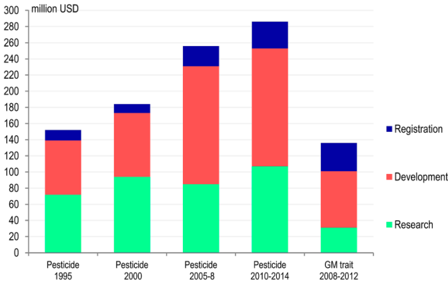
- Phillips McDougall. The Cost of New Agrochemical Product Discovery, Development and Registration in 1995, 2000, 2005-8 and 2010 to 2014;
- IMAA. Number and Value and Largest Mergers, Acquisitions and Alliances Transactions by Year, 1985-2017; IMAA (Institute of Mergers, Acquisitions and Alliances), Webster University: Vienna, Austria, 2017; Available online: https://imaa-institute.org/m-and-a-statistics-transaction-type/ (accessed on 11 July 2017).
- Jorasch, P. How Much Plant Breeding Innovation is Politically Intended? Eur. Seed 2017, 3, 2016. Available online: http://european-seed.com/much-plant-breeding-innovation-politically-intended/ (accessed on 11 July 2017).
- Stucke, M.E.; Grunes, A.P. An Antitrust Review of a Bayer-Monsanto Merger; The Konkurrenz Group: Washington, DC, USA, 2016.
- Bayer; Monsanto. Joint Statement: Monsanto, Bayer CEOs Meet with New Administration. Bayer, Monsanto Press Release 17 January 2017. Available online: https://www.advancingtogether.com/en/ir-media/press- releases/ (accessed on 11 July 2017).
- Robin, M.M. The World According to Monsanto: Pollution, Corruption, and the Control of the World's Food Supply; The New Press: New York, NY, USA, 2008; p. 384.
- Bayer. Advancing together. Bayer to Acquire Monsanto. Creating a Global Leader in Agriculture. Available online: http://www.press.bayer.com/baynews/baynews.nsf/id/Bayer-Offers-to-Acquire-Monsanto-to- Create-a-Global-Leader-in-Agriculture (accessed on 7 September 2017).
Cited by
Items 101–120 of 120
Horticultural Technology Trends in the Korean Seed Industry
Yu, G.-E., Kim, S., Choi, J.-W., Kwon, S.-J., & Kim, C. (2020) · Horticultural Science and Technology · doi:10.7235/hort.20200012
Sytuacja przemysłu nasiennego i hodowli roślin na Świecie i w Unii Europejskiej
Chomontowski, C., & Podlaski, S. (2021) · Biuletyn Instytutu Hodowli i Aklimatyzacji Roślin · doi:10.37317/biul-2021-0002
Social Finance for Sustainable Food Systems
Stephens, P. (2021) · UWSpace (University of Waterloo) · doi:10.13140/rg.2.2.17527.55202
Les rôles de la formation et de la recherche
Bricas, N., Fournier, S., Lepiller, O., & Valette, É. (2021) · Éditions Quæ eBooks · doi:10.35690/978-2-7592-3353-3/c21
Introduction. L’alimentation dans toutes ses dimensions
Bricas, N., Conaré, D., & Walser, M. (2021) · Éditions Quæ eBooks · doi:10.35690/978-2-7592-3353-3/ci
L’évolution des habitudes alimentaires
Bricas, N., & Walser, M. (2021) · Éditions Quæ eBooks · doi:10.35690/978-2-7592-3353-3/c6 · Cited by 1
L'alimentation pour se relier à soi
Walser, M., Fournier, T., & Bricas, N. (2021) · Éditions Quæ eBooks · doi:10.35690/978-2-7592-3353-3/c1 · Cited by 2
Pourquoi une approche écologique de l’alimentation ?
Walser, M., Bricas, N., & Conaré, D. (2021) · Éditions Quæ eBooks · doi:10.35690/978-2-7592-3353-3/c8
Fischler, C. (2021) · Éditions Quæ eBooks · doi:10.35690/978-2-7592-3353-3/cp
Retail Mergers and Acquisitions, and Specialty Crop Producers: Evidence from California
Volpe, R., Alman, M., Cai, X., & Stevens, A. (2022) · Sustainability · doi:10.3390/su14073876
Storosko, I. (2022) · Carleton University's Institutional Repository (MacOdrum Library, Carleton University) · doi:10.22215/etd/2022-15236 · Cited by 2
Disease Resistance and Seed Production in Two Common New England Grain Legumes
von Wettberg, E., Brefo, E., Hart, J., Kretzler, B., & Sassi, G. (2023) · Springer eBooks · doi:10.1007/978-981-99-3358-7_14
Vera, F. S. (2024) · AIBR Revista de Antropologia Iberoamericana · doi:10.11156/aibr.180305
Wang, N., Ma, Y., Choi, Y., & Kang, S. (2025) · Sustainability · doi:10.3390/su17083346 · Cited by 3
Freytes, C., Bril-Mascarenhas, T., Gianibelli, T., & O’Farrell, J. (2025) · Business and Politics · doi:10.1017/bap.2025.4
“…R&D and testing, and a local and global regulatory environment with low entry barriers. https://doi.org/10.1017/bap.2025.4 Published online by Cambridge University Press classified as non-GMO events, skipping thereby the regulatory approval processes of conventional transgenesis (Bonny 2017).”
InfluentialPublic Policies Affecting the Seed Industry and Their Role in the Market Working
Zecca, F. (2025) · Springer proceedings in business and economics · doi:10.1007/978-3-031-86660-9_24
Tetteh, A. Y., Donnelly, R. F., & Kausch, A. P. (2025) · In Vitro Cellular & Developmental Biology - Plant · doi:10.1007/s11627-025-10519-3
“Global agricultural seed markets are now dominated by a small number of large multinational corporations (Bonny 2017; Clapp 2018, 2021).”
Public engagement with science: tempering our expectations
de Melo‐Martín, I., & Intemann, K. K. (2025) · Synthese · doi:10.1007/s11229-025-05398-5
“For instance, while GMO research has often been promoted as meeting a broad social need, e.g., food security, many of those most affected by food insecurity disagree (Bonny, 2017; Lacey, 2015).”
The making and unmaking of the Bacillus thuringiensis cotton assemblage in South Punjab, Pakistan
Zuberi, M., Spies, M., & Nielsen, J. Ø. (2026) · Geoforum · doi:10.1016/j.geoforum.2026.104578
Metadata
- Authors
- Bonny, S.
- Affiliations
- AgroParisTech (FR)
- Corresponding author
- Bonny, Sylvie
- Venue
- Sustainability
- Publisher
- MDPI AG
- Published
- 2017-09-14
- Volume
- 9
- Issue
- 9
- Pages
- 1632
- ISSN
- 2071-1050 (ISSN-L)
- OpenAlex
- W2754564638
- Cited by
- 121
- References
- 38
- Citations by year
- 2026: 4 · 2025: 12 · 2024: 7 · 2023: 17 · 2022: 14 · 2021: 45 · 2020: 12 · 2019: 6 · 2018: 4
- FWCI
- 15.83
- Type
- journal article
- Language
- en
- Open access
- gold
- doi.org
- Licence
- Locations
- Sustainability (publishedVersion, cc-by)
- RePEc: Research Papers in Economics (submittedVersion)
- SSRN Electronic Journal (submittedVersion)
- HAL (submittedVersion, cc-by)
- DOAJ (DOAJ: Directory of Open Access Journals) (submittedVersion, cc-by-sa)
- Topics
- Social Sciences › Development › Agriculture, Land Use, Rural Development
- Life Sciences › Agricultural and Biological Sciences › Plant Science › Genetically Modified Organisms Research
- Social Sciences › Economics, Econometrics and Finance › Economics and Econometrics › Merger and Competition Analysis
- Keywords
- seed industry, business concentration, mergers and acquisitions, technological change, agri-food chain, food power, agricultural innovation
About these checks
Registry, retraction, Cites and statistics results are computed, not judged, with one exception: a printed reference that no index lists is read once by a model before it counts as a citation error. Claims are extracted by a model and kept only when their quote appears verbatim in the text; each cited source is then checked, with a model’s help, for whether it says what the claim relies on. Those verdicts can be wrong — read the claim’s quote and the cited source before relying on one.
Statistics and arithmetic are recomputed, not judged.
Confidence bands are shown only for fields calibrated on our annotated test set. None is calibrated yet, so no band is shown.
What counts as a claim ›How we measure confidence ›How we check this ›
Are you an author, or do you see a problem with this page? Request a review
Data sources
Bibliographic data: Semantic Scholar, OpenAlex, Crossref.
Contains information from the Semantic Scholar Academic Graph Datasets, made available under the ODC Attribution License (ODC-BY 1.0).
Semantic Scholar’s data is described in: Kinney, R., et al. (2023). The Semantic Scholar Open Data Platform. arXiv:2301.10140.
