

Application of Machine Learning and Deep Learning Techniques for Enhanced Insider Threat Detection in Cybersecurity: Bibliometric Review
Open accessThe DOI matches its Crossref record; 50 of the 50 references it cites were found in a registry or an index; 7 of the 48 sources its claims cite were checked for support.
Abstract
This study presents a bibliometric review of 325 peer-reviewed publications from 2015 to 2025 to examine how machine learning and deep learning techniques for insider threat detection have evolved.
Overview
CoChat Summary
TL;DR
This bibliometric review maps 325 peer-reviewed publications (2015–2025) on machine learning and deep learning for insider threat detection, showing a shift from classical ML toward deep learning and hybrid architectures. It frames the field's evolution through "symmetry," arguing that progress requires balancing detection accuracy against interpretability, reproducibility, and real-world applicability.
Key findings
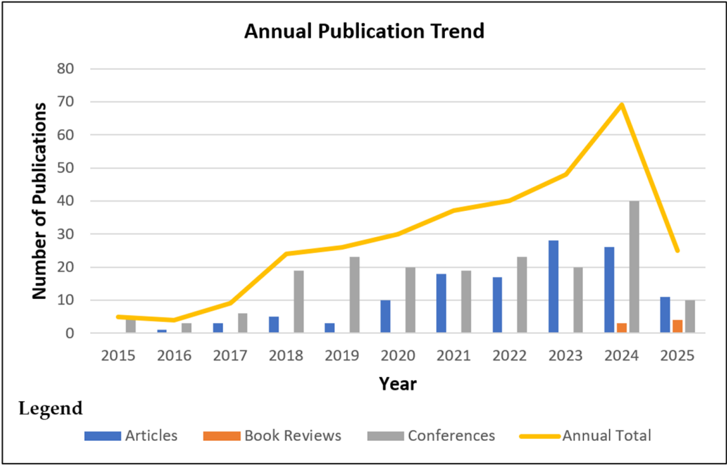
- Research output grew steadily, with a compound annual growth rate of ~33.9% from 2015 to 2024; publication volume peaked at 69 entries in 2024 (40 conference papers, 26 journal articles, 3 book chapters), up from 5 conference papers in 2015. Growth was fastest in 2015–2018 (~68.7% annually), tapering to ~21.6% in 2019–2024.
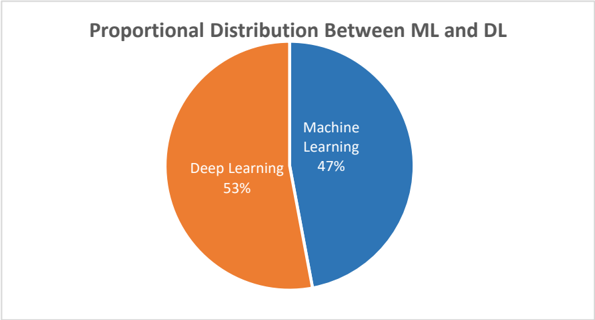
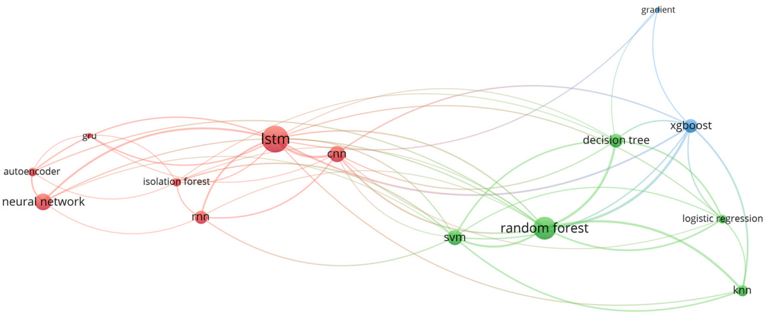
- Deep learning accounts for 53% of documented algorithmic usage versus 47% for traditional ML. The most frequent algorithms were LSTM (49 occurrences, 16.12%), Neural Network (41, 13.49%), Random Forest (40, 13.16%), CNN (29, 9.54%), and SVM (27, 8.88%).
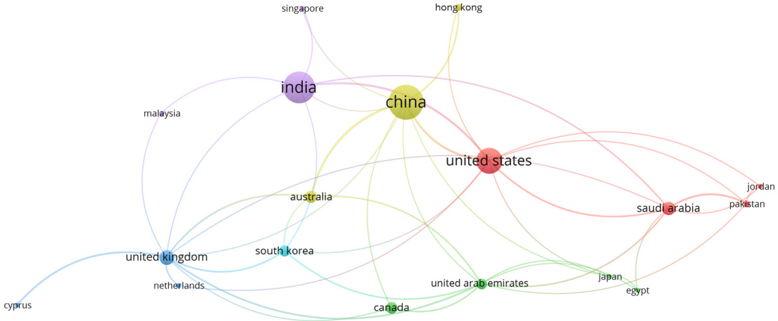
- China leads country output with 78 publications (9 international collaborations), followed by India with 67 (7) and the United States with 38 (11). The US had the most international collaborations despite ranking third in volume.
- Hybrid models are prominent: Decision Tree–Random Forest, Random Forest–XGBoost, and CNN-LSTM each appeared 10 times (9.17% of hybrid occurrences). The paper recommends BiLSTM-VAE hybrids with explainable AI as a promising future trajectory.
Methods
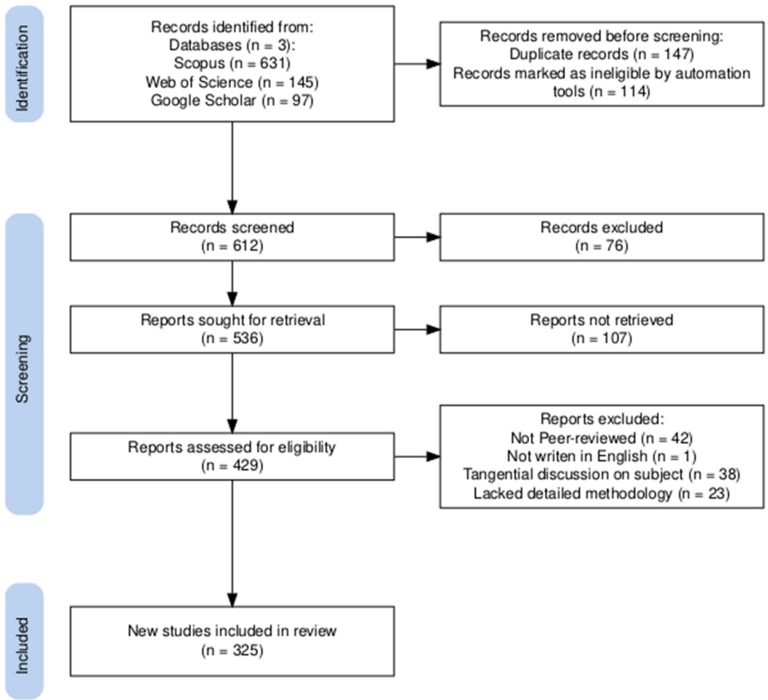
- Bibliometric review design. Three databases (Scopus, Web of Science, Google Scholar) were searched on 26 May 2025, yielding 873 publications; after limiting to English-language Computer Science conference papers, articles, and book chapters, 612 records remained; after screening, 325 publications (289 Scopus, 17 WoS, 19 Google Scholar) met inclusion criteria.
- A Boolean keyword query combined insider-threat terms with ML/DL terms across titles, abstracts, and keywords, restricted to 2015–2025.
- Analysis used VOSviewer 1.6.20 for co-authorship, co-citation, keyword co-occurrence, and thematic clustering, with reported thresholds (minimum 15 keyword occurrences, 46 author citations, 4 co-authorship links) and sensitivity analyses varying thresholds.
Limitations
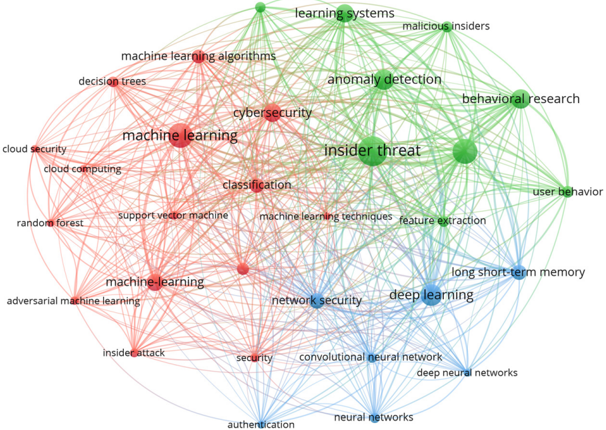
- Stated: reliance on three databases may omit relevant publications or grey literature; query construction may exclude works using non-standard terminology; citation-based indicators favor older, well-cited publications over recent innovations; VOSviewer clustering is sensitive to normalization and threshold settings, though sensitivity analysis confirmed the dominant thematic clusters (ML-centric, DL-centric, behavioral/XAI-focused) remained stable.
- Stated: the combined biases may skew thematic conclusions by amplifying established perspectives while underrepresenting emerging ones; the authors recommend altmetric indicators and temporal segmentation as mitigations.
- Evident from the text: the review is descriptive and bibliometric rather than experimental, so it reports publication and co-occurrence frequencies rather than validated detection performance; several sections (e.g., 4.1, 4.3, 4.5.1) appear truncated in the provided text, and the abstract's claim of "325 peer-reviewed publications" is qualified by the inclusion of non-peer-reviewed industry reports (Verizon DBIR, Ponemon, IBM) in the data sources.
Model-written summary. Check it against the paper before relying on it.
Integrity signals
Registry
Cites
Statistics
Figures
Verification
Claims the paper makes
7 Valid · 10 Not valid · 22 Not checked · 162 Own results and interpretations
The cited sources support only part of this claim — read each source’s verdict below.
In the paper
“These scholars frequently contribute to hybrid model architectures that blend statistical learning with deep generative or sequencebased techniques, as reflected in [35,50].”
§ Application of Machine Learning and Deep Learning Techniques for Enhanced Insider Threat Detection in Cybersecurity: Bibliometric Review > 4.2. Influential Authors Through Co-Citation Network Dynamics (RQ2a)
What the sources say
- Not checked — no full text of the sourcecites [35] Ganfure, G.O., Wu, C.F., Chang, Y.H., and Shih, W.K. (2020, January 9–10). DeepGuard: Deep Generative User-behavior Analytics for Ransomware Detection. Proceedings of the 2020 IEEE International Conference on Intelligence and Security Informatics (ISI), Arlington, VA, USA. source
- Partly supportedcites [50] Kumar, 2024, Blockchain and explainable AI for enhanced decision making in cyber threat detection, Softw. Pract. Exp. sourceExperimental — accuracy not yet measured
Our copy does show a hybrid deep sequence-based architecture: Section 3.3 and 3.3.4 describe a stacked/parallel LSTM pipeline with a multi-head self-attention mechanism, and Section 3.4 layers the SHAP (cooperative-game-theoretic, additive-feature-attribution) explainer on top of it, with blockchain consensus in the framework. That covers the 'sequence-based' half of the claim. However, nothing in our copy describes a deep GENERATIVE model (no GAN/VAE/autoencoder-generative component is proposed), nor does the paper characterise its contribution as blending statistical learning with deep learning — Section 5.1 calls it an 'end-to-end deep learning approach'. The claim's assertion that these scholars 'frequently contribute' to such architectures is a productivity pattern no passage of this single paper states. (LLM, conf=0.65)
plainstates an association- Asserted: passes — The authors put it forward as true.
- Checkable: passes — It can be checked against evidence.
- Load-bearing: unclear — It is unclear whether the paper’s conclusions depend on it.
- Based: passes — The paper gives a reason why it holds.
A result the paper reports from its own data — it cites no other source for it, so there is none to check. The quote shows it is in the paper.
In the paper
“This was distributed proportionally between conference papers (20) and journal articles (10).”
§ Application of Machine Learning and Deep Learning Techniques for Enhanced Insider Threat Detection in Cybersecurity: Bibliometric Review > 4.1. Evolution of Insider Threat Detection Research (RQ1)
plain- Asserted: passes — The authors put it forward as true.
- Checkable: passes — It can be checked against evidence.
- Load-bearing: unclear — It is unclear whether the paper’s conclusions depend on it.
- Based: passes — The paper gives a reason why it holds.
A result the paper reports from its own data — it cites no other source for it, so there is none to check. The quote shows it is in the paper.
In the paper
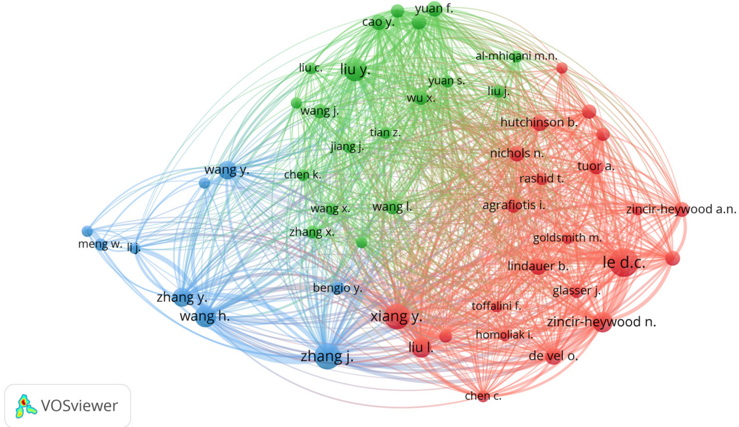
“Authors such as Le D.C., Zincir-Heywood A.N., Lindauer B., and Glasser J. are central figures in this context.”
§ Application of Machine Learning and Deep Learning Techniques for Enhanced Insider Threat Detection in Cybersecurity: Bibliometric Review > 4.2. Influential Authors Through Co-Citation Network Dynamics (RQ2a)
plain- Asserted: passes — The authors put it forward as true.
- Checkable: passes — It can be checked against evidence.
- Load-bearing: unclear — It is unclear whether the paper’s conclusions depend on it.
- Based: passes — The paper gives a reason why it holds.
A result the paper reports from its own data — it cites no other source for it, so there is none to check. The quote shows it is in the paper.
In the paper
“A phase of rapid advancement occurred between 2020 and 2023, as shown in Figure 2, with the publication count rising to 30 in 2020.”
§ Application of Machine Learning and Deep Learning Techniques for Enhanced Insider Threat Detection in Cybersecurity: Bibliometric Review > 4.1. Evolution of Insider Threat Detection Research (RQ1)
plain- Asserted: passes — The authors put it forward as true.
- Checkable: passes — It can be checked against evidence.
- Load-bearing: unclear — It is unclear whether the paper’s conclusions depend on it.
- Based: passes — The paper gives a reason why it holds.
A result the paper reports from its own data — it cites no other source for it, so there is none to check. The quote shows it is in the paper.
In the paper
“After the screening and eligibility assessment, a total of 325 publications (289 from Scopus, 17 from Web of Science, and 19 from Google Scholar) met the inclusion criteria and were selected for review.”
§ Application of Machine Learning and Deep Learning Techniques for Enhanced Insider Threat Detection in Cybersecurity: Bibliometric Review > 3. Methodology
plain- Asserted: passes — The authors put it forward as true.
- Checkable: passes — It can be checked against evidence.
- Load-bearing: passes — The paper’s conclusions depend on it.
- Based: passes — The paper gives a reason why it holds.
90 more claims
Create a free account to see all 201 claims and to verify the 5 references still open.
- It may state two separate claims as one. 75
- Probably not a substantial claim. 51
- Borderline: one of the tests for a substantial claim is unclear. 2
- The quote only partly states this claim. 3
Self-check
Percentages, sums and reported differences re-computed from the paper’s own numbers.
Each contradiction between two passages listed here was confirmed by an independent check.
Rated minor: it would not touch a result — a value no result rests on, a p-value that stays on the same side of the significance level, or a conflict that is clerical, resolved elsewhere in the paper, or outside its own findings.
In the paper
§ Application of Machine Learning and Deep Learning Techniques for Enhanced Insider Threat Detection in Cybersecurity: Bibliometric Review > 4.1. Evolution of Insider Threat Detection Research (RQ1)
“This period also marked the first evidence of LSTM-based model proposals, indicating a move toward temporal behavior modeling techniques, with notable publications like [25,37].”
§ Application of Machine Learning and Deep Learning Techniques for Enhanced Insider Threat Detection in Cybersecurity: Bibliometric Review > References
“37. Saaudi, A.; Al-Ibadi, Z.; Tong, Y.; Farkas, C. Insider threats detection using CNN-LSTM model. In Proceedings of the 2018 International Conference on Computational Science and Computational Intelligence (CSCI), Las Vegas, NV, USA, 12-14 December 2018; pp. 94-99. [CrossRef]”
Rated minor: it would not touch a result — a value no result rests on, a p-value that stays on the same side of the significance level, or a conflict that is clerical, resolved elsewhere in the paper, or outside its own findings.
In the paper
§ Application of Machine Learning and Deep Learning Techniques for Enhanced Insider Threat Detection in Cybersecurity: Bibliometric Review > 4.1. Evolution of Insider Threat Detection Research (RQ1)
“In 2018, a remarkable shift occurred when the publication volume increased to 24, representing over 250% rise compared to the previous year.”
§ Application of Machine Learning and Deep Learning Techniques for Enhanced Insider Threat Detection in Cybersecurity: Bibliometric Review > 4.1. Evolution of Insider Threat Detection Research (RQ1)
“This trend was short-lived, as the upward trend resumed in 2017, with nine publications, all of which were conference papers.”
Citations
Cites
Hochreiter, S., & Schmidhuber, J. (1997) · Neural Computation · doi:10.1162/neco.1997.9.8.1735 · Cited by 102,318
Learning representations by back-propagating errors
Rumelhart, D. E., Hinton, G. E., & Williams, R. J. (1986) · Nature · doi:10.1038/323533a0 · Cited by 31,892
Auto-Encoding Variational Bayes
Kingma, D. P., & Welling, M. (2013) · arXiv · doi:10.48550/arxiv.1312.6114 · Cited by 20,067
Peeking Inside the Black-Box: A Survey on Explainable Artificial Intelligence (XAI)
Adadi, A., & Berrada, M. (2018) · IEEE Access · doi:10.1109/access.2018.2870052 · Cited by 6,294
Denning, D. E. (1987) · IEEE Transactions on Software Engineering · doi:10.1109/tse.1987.232894 · Cited by 3,427
Explainable Artificial Intelligence Applications in Cyber Security: State-of-the-Art in Research
Zhang, Z., Hamadi, H. A., Damiani, E., Yeun, C. Y., & Taher, F. (2022) · IEEE Access · doi:10.1109/access.2022.3204051 · Cited by 450
Denning, D. E. (1986) · 1986 IEEE Symposium on Security and Privacy · doi:10.1109/sp.1986.10010 · Cited by 337
Insider Threat Detection with Deep Neural Network
Yuan, F., Cao, Y., Shang, Y., Liu, Y., Tan, J., & Fang, B. (2018) · Lecture Notes in Computer Science · doi:10.1007/978-3-319-93698-7_4 · Cited by 168
Anomaly Detection for Insider Threats Using Unsupervised Ensembles
Le, D. C., & Zincir-Heywood, N. (2021) · IEEE Transactions on Network and Service Management · doi:10.1109/tnsm.2021.3071928 · Cited by 147
Behavioral Based Insider Threat Detection Using Deep Learning
Nasir, R., Afzal, M., Latif, R., & Iqbal, W. (2021) · IEEE Access · doi:10.1109/access.2021.3118297 · Cited by 146
User Behavior Analytics for Anomaly Detection Using LSTM Autoencoder - Insider Threat Detection
Sharma, B., Pokharel, P., & Joshi, B. (2020) · Proceedings of the 11th International Conference on Advances in Information Technology · doi:10.1145/3406601.3406610 · Cited by 130
Black Box Attacks on Explainable Artificial Intelligence(XAI) methods in Cyber Security
Kuppa, A., & Le-Khac, N.-A. (2020) · 2020 International Joint Conference on Neural Networks (IJCNN) · doi:10.1109/ijcnn48605.2020.9206780 · Cited by 123
Insider Threat Detection Using a Graph-Based Approach
Eberle, W., Graves, J., & Holder, L. (2010) · Journal of Applied Security Research · doi:10.1080/19361610.2011.529413 · Cited by 118
Insider Threat Detection Using Machine Learning Approach
Bin Sarhan, B., & Altwaijry, N. (2022) · Applied Sciences · doi:10.3390/app13010259 · Cited by 111
Blockchain and explainable AI for enhanced decision making in cyber threat detection
Kumar, P., Javeed, D., Kumar, R., & Islam, A. K. M. N. (2024) · Software: Practice and Experience · doi:10.1002/spe.3319 · Cited by 58
Insider Threat Detection using Deep Autoencoder and Variational Autoencoder Neural Networks
Pantelidis, E., Bendiab, G., Shiaeles, S., & Kolokotronis, N. (2021) · 2021 IEEE International Conference on Cyber Security and Resilience (CSR) · doi:10.1109/csr51186.2021.9527925 · Cited by 55
Hunting for Insider Threats Using LSTM-Based Anomaly Detection
Villarreal-Vasquez, M., Modelo-Howard, G., Dube, S., & Bhargava, B. (2023) · IEEE Transactions on Dependable and Secure Computing · doi:10.1109/tdsc.2021.3135639 · Cited by 52
Robust Anomaly-Based Insider Threat Detection Using Graph Neural Network
Xiao, J., Yang, L., Zhong, F., Wang, X., Chen, H., & Li, D. (2023) · IEEE Transactions on Network and Service Management · doi:10.1109/tnsm.2022.3222635 · Cited by 48
Insider Threat Detection Using Graph-Based Approaches
Eberle, W., & Holder, L. B. (2009) · Cybersecurity Applications & Technology Conference for Homeland Security (CATCH) · doi:10.1109/catch.2009.7 · Cited by 39
Suganya, M., & Sasipraba, T. (2023) · Journal of Cloud Computing · doi:10.1186/s13677-023-00442-6 · Cited by 36
DANTE: Predicting Insider Threat using LSTM on system logs
Ma, Q., & Rastogi, N. (2020) · 2020 IEEE 19th International Conference on Trust, Security and Privacy in Computing and Communications (TrustCom) · doi:10.1109/trustcom50675.2020.00153 · Cited by 30
Insider Threats Detection Using CNN-LSTM Model
Saaudi, A., Al-Ibadi, Z., Tong, Y., & Farkas, C. (2018) · 2018 International Conference on Computational Science and Computational Intelligence (CSCI) · doi:10.1109/csci46756.2018.00025 · Cited by 22
Deep Temporal Graph Infomax for Imbalanced Insider Threat Detection
Gao, P., Zhang, H., Wang, M., Yang, W., Wei, X., Lv, Z., & Ma, Z. (2023) · Journal of Computer Information Systems · doi:10.1080/08874417.2023.2267510 · Cited by 21
Bhasha, S. J., & Panda, S. (2024) · Cybernetics & Systems · doi:10.1080/01969722.2024.2343982 · Cited by 19
Insider Threat Detection Based on User Behaviour Analysis
Singh, M., Mehtre, B. M., & Sangeetha, S. (2020) · Communications in Computer and Information Science · doi:10.1007/978-981-15-6318-8_45 · Cited by 18
DeepGuard: Deep Generative User-behavior Analytics for Ransomware Detection
Ganfure, G. O., Wu, C.-F., Chang, Y.-H., & Shih, W.-K. (2020) · 2020 IEEE International Conference on Intelligence and Security Informatics (ISI) · doi:10.1109/isi49825.2020.9280508 · Cited by 18
SENTINEL: Insider Threat Detection Based on Multi-Timescale User Behavior Interaction Graph Learning
Xiao, F., Chen, S., Chen, S. J., Ma, Y., He, H., & Yang, J. (2024) · IEEE Transactions on Network Science and Engineering · doi:10.1109/tnse.2024.3519155 · Cited by 18
Exploring Adversarial Properties of Insider Threat Detection
Le, D. C., & Zincir-Heywood, N. (2020) · 2020 IEEE Conference on Communications and Network Security (CNS) · doi:10.1109/cns48642.2020.9162254 · Cited by 17
Padmavathi, G., Shanmugapriya, D., & Asha, S. (2022) · 2022 9th International Conference on Computing for Sustainable Global Development (INDIACom) · doi:10.23919/indiacom54597.2022.9763205 · Cited by 15
Comparative Evaluation of VAEs, VAE-GANs and AAEs for Anomaly Detection in Network Intrusion Data
Mohamed, M. E. (2023) · EMITTER International Journal of Engineering Technology · doi:10.24003/emitter.v11i2.817 · Cited by 15
Detecting an Insider Threat and Analysis of XGBoost using Hyperparameter tuning
Mamidanna, S. K., Reddy, C. R. K., & Gujju, A. (2022) · 2022 International Conference on Advances in Computing, Communication and Applied Informatics (ACCAI) · doi:10.1109/accai53970.2022.9752509 · Cited by 14
Multi-source data fusion for insider threat detection using residual networks
Ge, D., Zhong, S., & Chen, K. (2022) · doi:10.1109/cecit58139.2022.00069 · Cited by 13
An insider user authentication method based on improved temporal convolutional network
Tao, X., Yu, Y., Fu, L., Liu, J., & Zhang, Y. (2023) · High-Confidence Computing · doi:10.1016/j.hcc.2023.100169 · Cited by 10
Contrastive Learning for Insider Threat Detection
Vinay, M. S., Yuan, S., & Wu, X. (2022) · Lecture Notes in Computer Science · doi:10.1007/978-3-031-00123-9_32 · Cited by 9
Detection of Insider Attacks in Distributed Projected Subgradient Algorithms
Wu, S. X., Li, G., Zhang, S., & Lin, X. (2021) · IEEE Transactions on Cognitive Communications and Networking · doi:10.1109/tccn.2021.3105554 · Cited by 8
Insider Detection using Deep Autoencoder and Variational Autoencoder Neural NetworksPreprint
Pantelidis, E., Bendiab, G., Shiaeles, S. N., & Kolokotronis, N. (2021) · arXiv (Cornell University) · doi:10.48550/arxiv.2109.02568 · Cited by 8
Classification with LSTM Networks in User Behaviour Analytics with Unbalanced Environment
Parshutin, S., Kirshners, A., Kornijenko, Y., Zabiniako, V., Gasparovica-Asite, M., & Rozkalns, A. (2021) · Automatic Control and Computer Sciences · doi:10.3103/s0146411621010077 · Cited by 7
Peinado, V., Valiente, C., Contreras, A., Trucharte, A., & Vázquez, C. (2024) · Personality and Individual Differences · doi:10.1016/j.paid.2024.112782 · Cited by 5
Variational Autoencoders (VAEs) for Anomaly Detection
Tahir, S. (2024) · Advances in Digital Crime, Forensics, and Cyber Terrorism · doi:10.4018/979-8-3693-8944-7.ch009 · Cited by 4
CNN-LSTM-Based Insider Threat Detection Model
Yang, M., Yi, J., Zhu, H., & Tan, L. (2025) · 2025 International Conference on Electrical Automation and Artificial Intelligence (ICEAAI) · doi:10.1109/iceaai64185.2025.10957184 · Cited by 4
Unsupervised Learning for Insider Threat Prediction: A Behavioral Analysis Approach
Mehmood, R., Singh, P., & Jeffery, Z. (2024) · International Conference on Security of Information and Networks (SIN) · doi:10.1109/sin63213.2024.10871807 · Cited by 4
Class Balancing for Fraud Detection in Point Of Sale Systems
Hines, C., & Youssef, A. (2019) · 2019 IEEE International Conference on Big Data (Big Data) · doi:10.1109/bigdata47090.2019.9006040 · Cited by 3
Tracing Privilege Misuse Through Behavioral Anomaly Detection in Geometric Spaces
Düssel, P., Luo, S., Flegel, U., Dietrich, S., & Meier, M. (2020) · International Workshop on Systematic Approaches to Digital Forensic Engineering (SADFE) · doi:10.1109/sadfe51007.2020.00012 · Cited by 3
Enhancing Threat Detection and Response Through Cloud-Native Security Solutions
Kumar, S., & Raju, S. (2024) · 2024 International Conference on Engineering and Emerging Technologies (ICEET) · doi:10.1109/iceet65156.2024.10913498 · Cited by 3
Deep Learning-Based Solution for Intrusion Detection in the Internet of Things
Chaurasia, A., Mishra, A., Rao, U. P., & Kumar, A. (2023) · Communications in computer and information science · doi:10.1007/978-3-031-48984-6_7 · Cited by 2
Analyze Organizational Internal Threats Using Machine Learning
Jing, Y., Jiang, C., Chen, W., & Xu, Y. (2023) · International Conference on Applied Machine Learning (ICAML) · doi:10.1109/icaml60083.2023.00013 · Cited by 2
Silent Threats: Monitoring Insider Risks in Healthcare Sector
Lavanya, P., Raman, V. S. V., Gosakan, S. S., Glory, H. A., & Sriram, V. S. S. (2024) · Communications in computer and information science · doi:10.1007/978-981-97-9743-1_14 · Cited by 2
Insider Threat Detection in User Activity Data Using Optimized LSTM-AE
Kumar, M. K., Kumari, S., Bharathi, M., Lavanya, P., Glory, H. A., & Sriram, V. S. S. (2025) · Lecture Notes on Data Engineering and Communications Technologies · doi:10.1007/978-981-96-0451-7_21 · Cited by 2
Empowering Cloud Security Through Advanced Monitoring and Analytics Techniques
Kumar, T., Minakshi, & Joshi, K. (2025) · Risk-Based Approach to Secure Cloud Migration · doi:10.4018/979-8-3693-7137-4.ch007 · Cited by 2
Mahalakshmi, V., Garg, A., M M, R., Diwakar, M., Vigenesh, M., & Verma, R. (2024) · 2024 IEEE 2nd International Conference on Innovations in High Speed Communication and Signal Processing (IHCSP) · doi:10.1109/ihcsp63227.2024.10960117 · Cited by 1
Research works printed but not linked: 2
- Manikandan, S.P., Kumar, K.A., Vardhan, T.S.H., Thanigaivel, G., Venkataramanaiah, B., and Reddy, S.P.V.V. (2024, January 17–18). Detecting Insider Threats in Cybersecurity Using Machine Learning. Proceedings of the 5th International Conference on IoT Based Control Networks and Intelligent Systems (ICICNIS), Bengaluru, India.
- Kexiong, F., Jiang, Z., Lin, S., Weiping, W., Yong, C., and Fan, Z. (2022, January 17–19). A Graph Convolution Neural Network Based Method for Insider Threat Detection. Proceedings of the 2022 IEEE Intl Conf on Parallel & Distributed Processing with Applications, Big Data & Cloud Computing, Sustainable Computing & Communications, Social Computing & Networking, Melbourne, Australia.
Cited by
Gemeda, K. A., Hailu, S., Abebe, M., Kemal, A., Silassie, S. W., Tseghai, A., Haile, G., Tamirat, B., Bitew, W., Regassa, D., et al. (2026) · Discover Artificial Intelligence · doi:10.1007/s44163-026-01029-1 · Cited by 9
Tenali, R. K., & Chamundeeswari, V. V. (2025) · International Conference on Intelligent Computing, Information and Control Systems (ICOIICS) · doi:10.1109/icoiics67115.2025.11390400 · Cited by 10
Tenali, R. K., & Potnuri, A. (2026) · Lecture notes in networks and systems · doi:10.1007/978-3-032-28304-7_28
CausalXBoost: A Causal Explainable CatBoost Framework for Insider Threat Detection
Jayaraman, V., Harvin Krishnan, H., Vishaal, R. G. S., Aishwarya, B., Parthasarathy, S., & Kavitha, R. (2026) · International Conference Computational Vision and Bio Inspired Computing · doi:10.1109/iccvbic71195.2026.11689492
“Machine learning (ML) and deep learning (DL) techniques could surpass these issues by effectively identifying insider threat [8][9].”
AI Revolutionizing Applications Worldwide
Lizy, R. F. S., & Tyagi, A. K. (2026) · doi:10.1002/9781394399222.ch14
Metadata
- Authors
- Ofori, H. K., Bell-Dzide, K., Brown-Acquaye, W. L., Lempogo, F., Frimpong, S. O., Agbehadji, I. E., & Millham, R. C.
- Affiliations
- Ghana Communication Technology University (GH)
- Faculty of Computing & Information Systems, Ghana Communication Technology University, Accra North PMB 100, Ghana
- Department of Mobile & Pervasive Computing, Ghana Communication Technology University, Accra North PMB 100, Ghana
- University of Energy and Natural Resources (GH)
- Durban University of Technology (ZA)
- Corresponding author
- Ofori, Hillary Kwame
- ORCID
- Venue
- Symmetry
- Publisher
- MDPI AG
- Published
- 2025-10-11
- Volume
- 17
- Issue
- 10
- Pages
- 1704
- ISSN
- 2073-8994 (ISSN-L)
- OpenAlex
- W4415129785
- Cited by
- 7
- References
- 46
- Citations by year
- 2026: 6 · 2025: 1
- FWCI
- 2.93
- Type
- journal article
- Language
- en
- Open access
- gold
- doi.org
- Licence
- Locations
- Symmetry (publishedVersion, cc-by)
- Funders
- National Key R&D Program of China (2023YFE0110200)
- National Research Foundation of South Africa (151178)
- Topics
- Physical Sciences › Computer Science › Computer Networks and Communications › Network Security and Intrusion Detection
- Physical Sciences › Computer Science › Information Systems › Information and Cyber Security
- Physical Sciences › Computer Science › Artificial Intelligence › Privacy-Preserving Technologies in Data
- Keywords
- insider threat detection, machine learning, deep learning, cybersecurity, bidirectional LSTM, variational autoencoder, explainable AI, behavior-based detection, false positive reduction, research trends
About these checks
Registry, retraction, Cites and statistics results are computed, not judged, with one exception: a printed reference that no index lists is read once by a model before it counts as a citation error. Claims are extracted by a model and kept only when their quote appears verbatim in the text; each cited source is then checked, with a model’s help, for whether it says what the claim relies on. Those verdicts can be wrong — read the claim’s quote and the cited source before relying on one.
The claim verdicts this report counts are experimental: their accuracy is not yet measured.
A language model drew the claims from the paper on 2026-10-10, under version 3 of the claim definition (model deepseek-v4.1-flash, prompt extract-v3).
A second model labelled each claim on 2026-10-10 (model jev-1.13-20260917, definition revision gold-guideline-v0.2).
Cited sources are checked with a language model’s help (qwen3.8-omni-flash).
Statistics and arithmetic are recomputed, not judged.
Confidence bands are shown only for fields calibrated on our annotated test set. None is calibrated yet, so no band is shown.
What counts as a claim ›How we measure confidence ›How we check this ›
Are you an author, or do you see a problem with this page? Request a review
Data sources
Bibliographic data: Semantic Scholar, OpenAlex, Crossref.
Contains information from the Semantic Scholar Academic Graph Datasets, made available under the ODC Attribution License (ODC-BY 1.0).
Semantic Scholar’s data is described in: Kinney, R., et al. (2023). The Semantic Scholar Open Data Platform. arXiv:2301.10140.
