

VR in Tourism: A New Call for Virtual Tourism Experience amid and after the COVID-19 Pandemic
Open accessThe DOI matches its Crossref record; 81 of the 82 references it cites were found in a registry or an index.
Abstract
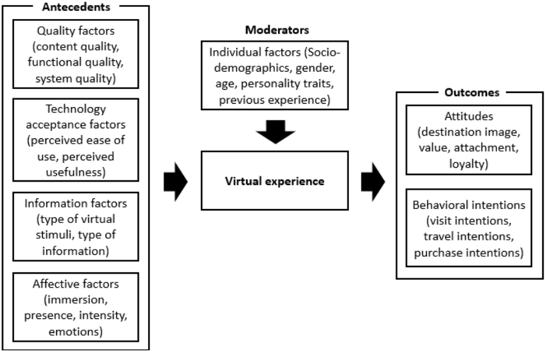
Virtual reality has become a more common phenomenon in both destination marketing and on-site experience. The recent challenges such as overtourism and the COVID-19 pandemic have created a pressing need to examine virtual tourism as an alternative to traditional travel. This conceptual article aims at clarifying virtual experience in tourism, discussing the main antecedents and outcomes of virtual experience, and proposing a conceptual model of virtual tourism experience. The review of the literature revealed that virtual experience in tourism is influenced by factors related to information, quality, technology acceptance, and affective involvement and has significant effects on tourists’ attitudes and behavioral intentions. This paper contributes to knowledge and practice by classifying the main groups of factors influencing virtual tourism experience, introducing the conceptual model, discussing opportunities for future research, and providing recommendations for tourism practitioners.
Overview
The claims and statistics of this paper haven’t been checked yet.
Free: it reads the open-access text and checks the first 5 claims that cite a source we can check. Create a free account to check every claim.
Integrity signals
Registry
Cites
Statistics
Figures
Verification
Claims the paper makes
The claims and statistics of this paper haven’t been checked yet.
Free: it reads the open-access text and checks the first 5 claims that cite a source we can check. Create a free account to check every claim.
Claims other papers make about this one
Each is checked against this paper’s own text: does it say what the citing paper says it does?
The cited source says what the claim attributes to it.
In the citing paper
“Commonly, variables like immersion and telepresence are regarded as antecedents (see Godovykh et al., 2022), and have thus been assessed concerning their direct impact (or 'main effect') on behavioral intentions (e.g., Algharabat & Dennis, 2010; Disztinger et al., 2017; Wang et al., 2021).”
From People's Intentions to Use Metaverse Technology: Investigating the Role of Gratifications and Perceptions (2024) · cites this paper as Godovykh et al., 2022
Self-check
Percentages, sums and reported differences re-computed from the paper’s own numbers.
The self-check needs the paper’s full text.
Citations
Cites
The theory of planned behavior
Ajzen, I. (1991) · Organizational Behavior and Human Decision Processes · doi:10.1016/0749-5978(91)90020-t · Cited by 90,587
User Acceptance of Information Technology: Toward A Unified View1
Venkatesh, V., Morris, M. G., Davis, G. B., & Davis, F. D. (2003) · MIS Quarterly · doi:10.2307/30036540 · Cited by 45,035 · cited 1×
“Another frequently cited framework is the unified theory of acceptance and use of technology (UTAUT), wherein performance expectancy, effort expectancy, social influence, and facilitating conditions impact behavioral intention and use behavior, with gender, age, experience, and voluntariness of use as moderating influ…”
BackgroundRemediation: Understanding New Media
Bolter, J. D. (1999) · Corporate Communications: An International Journal · doi:10.1108/ccij.1999.4.4.208.1 · Cited by 2,914
Tourism and COVID-19: Impacts and implications for advancing and resetting industry and research
Sigala, M. (2020) · Journal of Business Research · doi:10.1016/j.jbusres.2020.06.015 · Cited by 2,274 · cited 1×
“Crises can provide a “transfor-mative opportunity” for rethinking industry and academic work, driving change, and sparking paradigm shifts [91].”
Enhancing Our Lives with Immersive Virtual Reality
Slater, M., & Sanchez-Vives, M. V. (2016) · Frontiers in Robotics and AI · doi:10.3389/frobt.2016.00074 · Cited by 1,993 · cited 1×
“These experiences may not be a replacement for physical travel, but they can be viewed instead as “another form” of travel rather than merely a substitute [69].”
BackgroundVirtual reality: Applications and implications for tourism
Guttentag, D. A. (2010) · Tourism Management · doi:10.1016/j.tourman.2009.07.003 · Cited by 1,747 · cited 1×
“Virtual travel can be understood as a way to enhance tourism experiences or an alternative type of tourism [65,67,68].”
BackgroundImmersive Interfaces for Engagement and Learning
Dede, C. (2009) · Science · doi:10.1126/science.1167311 · Cited by 1,707 · cited 1×
“For instance, Dede [74] found that interactive media could utilize immersion through the senses, through actions not possible in the real world, and through symbolism, triggering psychological associations; virtual tourism environments might use these concepts as well as the potential outcomes he…”
The impact of virtual, augmented and mixed reality technologies on the customer experience
Flavián, C., Ibáñez-Sánchez, S., & Orús, C. (2019) · Journal of Business Research · doi:10.1016/j.jbusres.2018.10.050 · Cited by 1,442 · cited 1×
“[46] suggested that virtual experience brings additional value to the customer purchase journey.”
BackgroundKim, M. J., Lee, C.-K., & Jung, T. (2020) · Journal of Travel Research · doi:10.1177/0047287518818915 · Cited by 1,333 · cited 1×
“…can lead to outcomes that connect to this model such as attitude changes [8,56,63,64], overall behavioral intentions [2,14,54], use intentions [63], purchase intentions [56,64], visit intentions [7,8,10,40,56,57], revisit intentions [60], intention to recommend [60], and continued use [66].”
Virtual reality, presence, and attitude change: Empirical evidence from tourism
Tussyadiah, I. P., Wang, D., Jung, T. H., & tom Dieck, M. C. (2018) · Tourism Management · doi:10.1016/j.tourman.2017.12.003 · Cited by 1,294 · cited 6×
“Sites utilize technologies as strategic business decisions because virtual tourism has been an effective tool in evoking emotion and visit intention towards the real place [6–8].”
Influential
Research works printed but not linked: 5
- Jung, T.H.; tom Dieck, M.C.; Lee, H.; Chung, N. Effects of virtual reality and augmented reality on visitor experiences in museums. In Information and Communication Technologies in Tourism; Inversini, A., Schegg, R., Eds.; Springer: Berlin/Heidelberg, Germany, 2016; pp. 621-635.
- Schofield, G.; Beale, G.; Beale, N.; Fell, M.; Hadley, D.; Hook, J.; Murphy, D.; Richards, J.; Thresh, L. Viking VR: Designing a virtual reality experience for a museum. In Proceedings of the 2018 Designing Interactive Systems Conference, Hong Kong, China, 9-13 June 2018; pp. 805-815.
- Baudrillard, J. Simulacrum and Simulation; Glaser, S.F., Translator; University of Michigan Press: Ann Arbor, MI, USA, 1994.
- Sussmann, S.; Vanhegan, H. Virtual Reality and the Tourism Product Substitution or Complement? ECIS 2000 Proceedings, 117. 2000. Available online: https://aisel.aisnet.org/ecis2000/117 (accessed on 22 February 2022).
- Green, M.C.; Brock, T.C. The role of transportation in the persuasiveness of public industry and research. J. Bus. Res. 2000, 117, 312-321.
Cited by
Tourism in the digital frontier: a study on user continuance intention in the metaverse
Jo, H. (2023) · Information Technology & Tourism · doi:10.1007/s40558-023-00257-w · Cited by 75
Gamification in tourism research: A systematic review, current insights, and future research avenues
Pradhan, D., Malik, G., & Vishwakarma, P. (2023) · Journal Of Vacation Marketing · doi:10.1177/13567667231188879 · Cited by 80
“Through gami fi cation, the industry kept travelers connected, provided them with virtual exploration opportunities, and inspired future travel when restrictions eased (Godovykh et al., 2022).”
Examining the potential of virtual and augmented reality in enhancing tourism experiences
Shukla, V., Rana, S., & Prashar, S. (2024) · The Bottom Line Managing Library Finances · doi:10.1108/bl-05-2023-0139 · Cited by 72
Bosone, M., & Nocca, F. (2022) · Sustainability · doi:10.3390/su141912218 · Cited by 65
Tan, K., Hii, I. S. H., Zhu, W., Leong, C., & Lin, E. (2022) · Asia Pacific Journal of Marketing and Logistics · doi:10.1108/apjml-05-2022-0417 · Cited by 60
Metadata
- Authors
- Godovykh, M., Baker, C., & Fyall, A.
- Affiliations
- University of Central Florida (US)
- Corresponding author
- Godovykh, Maksim
- Venue
- Tourism and Hospitality
- Publisher
- MDPI AG
- Published
- 2022-02-23
- Volume
- 3
- Issue
- 1
- Pages
- 265-275
- ISSN
- 2673-5768 (ISSN-L)
- OpenAlex
- W4213453630
- Cited by
- 108
- References
- 82
- Citations by year
- 2026: 16 · 2025: 39 · 2024: 26 · 2023: 20 · 2022: 7
- FWCI
- 33.09
- Type
- journal article
- Language
- en
- Open access
- gold
- doi.org
- Licence
- Locations
- Tourism and Hospitality (publishedVersion, cc-by)
- Journal of International Crisis and Risk Communication Research (submittedVersion, cc-by)
- RePEc: Research Papers in Economics (submittedVersion)
- DOAJ (DOAJ: Directory of Open Access Journals) (submittedVersion, cc-by-sa)
- Topics
- Social Sciences › Business, Management and Accounting › Tourism, Leisure and Hospitality Management › Diverse Aspects of Tourism Research
- Physical Sciences › Computer Science › Human-Computer Interaction › Virtual Reality Applications and Impacts
- Social Sciences › Business, Management and Accounting › Marketing › Digital Marketing and Social Media
- Keywords
- virtual reality, COVID-19 pandemic, overtourism, tourism promotion, technology acceptance, emotional engagement, tourist attitudes, behavioral intention, conceptual model, virtual tourism
About these checks
Registry, retraction, Cites and statistics results are computed, not judged, with one exception: a printed reference that no index lists is read once by a model before it counts as a citation error. Claims are extracted by a model and kept only when their quote appears verbatim in the text; each cited source is then checked, with a model’s help, for whether it says what the claim relies on. Those verdicts can be wrong — read the claim’s quote and the cited source before relying on one.
Statistics and arithmetic are recomputed, not judged.
Confidence bands are shown only for fields calibrated on our annotated test set. None is calibrated yet, so no band is shown.
What counts as a claim ›How we measure confidence ›How we check this ›
Are you an author, or do you see a problem with this page? Request a review
How to cite
Cite CoChat for the checks on this page, and the paper for its own findings.
- This page
- CoChat. (2026). Citation check: VR in Tourism: A New Call for Virtual Tourism Experience amid and after the COVID-19 Pandemic. https://app.cochat.ai/papers/10.3390/tourhosp3010018
- The paper
- Godovykh, M., Baker, C., & Fyall, A. (2022). VR in Tourism: A New Call for Virtual Tourism Experience amid and after the COVID-19 Pandemic. Tourism and Hospitality. https://doi.org/10.3390/tourhosp3010018
Data sources
Bibliographic data: Semantic Scholar, OpenAlex, Crossref.
Contains information from the Semantic Scholar Academic Graph Datasets, made available under the ODC Attribution License (ODC-BY 1.0).
Semantic Scholar’s data is described in: Kinney, R., et al. (2023). The Semantic Scholar Open Data Platform. arXiv:2301.10140.
