

VR in Tourism: A New Call for Virtual Tourism Experience amid and after the COVID-19 Pandemic
Open accessThe DOI matches its Crossref record; 81 of the 82 references it cites were found in a registry or an index.
Abstract
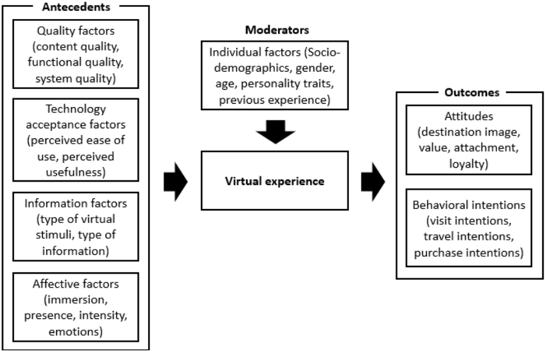
Virtual reality has become a more common phenomenon in both destination marketing and on-site experience. The recent challenges such as overtourism and the COVID-19 pandemic have created a pressing need to examine virtual tourism as an alternative to traditional travel. This conceptual article aims at clarifying virtual experience in tourism, discussing the main antecedents and outcomes of virtual experience, and proposing a conceptual model of virtual tourism experience. The review of the literature revealed that virtual experience in tourism is influenced by factors related to information, quality, technology acceptance, and affective involvement and has significant effects on tourists’ attitudes and behavioral intentions. This paper contributes to knowledge and practice by classifying the main groups of factors influencing virtual tourism experience, introducing the conceptual model, discussing opportunities for future research, and providing recommendations for tourism practitioners.
Overview
The claims and statistics of this paper haven’t been checked yet.
Free: it reads the open-access text and checks the first 5 claims that cite a source we can check. Create a free account to check every claim.
Integrity signals
Registry
Cites
Statistics
Figures
Verification
Claims the paper makes
The claims and statistics of this paper haven’t been checked yet.
Free: it reads the open-access text and checks the first 5 claims that cite a source we can check. Create a free account to check every claim.
Claims other papers make about this one
Each is checked against this paper’s own text: does it say what the citing paper says it does?
The cited source says what the claim attributes to it.
In the citing paper
“Commonly, variables like immersion and telepresence are regarded as antecedents (see Godovykh et al., 2022), and have thus been assessed concerning their direct impact (or 'main effect') on behavioral intentions (e.g., Algharabat & Dennis, 2010; Disztinger et al., 2017; Wang et al., 2021).”
From People's Intentions to Use Metaverse Technology: Investigating the Role of Gratifications and Perceptions (2024) · cites this paper as Godovykh et al., 2022
Self-check
Percentages, sums and reported differences re-computed from the paper’s own numbers.
The self-check needs the paper’s full text.
Citations
Cites
The theory of planned behavior
Ajzen, I. (1991) · Organizational Behavior and Human Decision Processes · doi:10.1016/0749-5978(91)90020-t · Cited by 134,657
User Acceptance of Information Technology: Toward A Unified View1
Venkatesh, V., Morris, M. G., Davis, G. B., & Davis, F. D. (2003) · MIS Quarterly · doi:10.2307/30036540 · Cited by 45,035 · cited 1×
“Another frequently cited framework is the unified theory of acceptance and use of technology (UTAUT), wherein performance expectancy, effort expectancy, social influence, and facilitating conditions impact behavioral intention and use behavior, with gender, age, experience, and voluntariness of use as moderating influ…”
BackgroundRemediation: Understanding New Media
Bolter, J. D. (1999) · Corporate Communications: An International Journal · doi:10.1108/ccij.1999.4.4.208.1 · Cited by 2,914
Tourism and COVID-19: Impacts and implications for advancing and resetting industry and research
Sigala, M. (2020) · Journal of Business Research · doi:10.1016/j.jbusres.2020.06.015 · Cited by 2,274 · cited 1×
“Crises can provide a “transfor-mative opportunity” for rethinking industry and academic work, driving change, and sparking paradigm shifts [91].”
Enhancing Our Lives with Immersive Virtual Reality
Slater, M., & Sanchez-Vives, M. V. (2016) · Frontiers in Robotics and AI · doi:10.3389/frobt.2016.00074 · Cited by 1,993 · cited 1×
“These experiences may not be a replacement for physical travel, but they can be viewed instead as “another form” of travel rather than merely a substitute [69].”
BackgroundVirtual reality: Applications and implications for tourism
Guttentag, D. A. (2010) · Tourism Management · doi:10.1016/j.tourman.2009.07.003 · Cited by 1,747 · cited 1×
“Virtual travel can be understood as a way to enhance tourism experiences or an alternative type of tourism [65,67,68].”
BackgroundImmersive Interfaces for Engagement and Learning
Dede, C. (2009) · Science · doi:10.1126/science.1167311 · Cited by 1,707 · cited 1×
“For instance, Dede [74] found that interactive media could utilize immersion through the senses, through actions not possible in the real world, and through symbolism, triggering psychological associations; virtual tourism environments might use these concepts as well as the potential outcomes he…”
The impact of virtual, augmented and mixed reality technologies on the customer experience
Flavián, C., Ibáñez-Sánchez, S., & Orús, C. (2019) · Journal of Business Research · doi:10.1016/j.jbusres.2018.10.050 · Cited by 1,442 · cited 1×
“[46] suggested that virtual experience brings additional value to the customer purchase journey.”
BackgroundKim, M. J., Lee, C.-K., & Jung, T. (2020) · Journal of Travel Research · doi:10.1177/0047287518818915 · Cited by 1,333 · cited 1×
“…can lead to outcomes that connect to this model such as attitude changes [8,56,63,64], overall behavioral intentions [2,14,54], use intentions [63], purchase intentions [56,64], visit intentions [7,8,10,40,56,57], revisit intentions [60], intention to recommend [60], and continued use [66].”
Virtual reality, presence, and attitude change: Empirical evidence from tourism
Tussyadiah, I. P., Wang, D., Jung, T. H., & tom Dieck, M. C. (2018) · Tourism Management · doi:10.1016/j.tourman.2017.12.003 · Cited by 1,294 · cited 6×
“Sites utilize technologies as strategic business decisions because virtual tourism has been an effective tool in evoking emotion and visit intention towards the real place [6–8].”
Influential
Research works printed but not linked: 5
- Jung, T.H.; tom Dieck, M.C.; Lee, H.; Chung, N. Effects of virtual reality and augmented reality on visitor experiences in museums. In Information and Communication Technologies in Tourism; Inversini, A., Schegg, R., Eds.; Springer: Berlin/Heidelberg, Germany, 2016; pp. 621-635.
- Schofield, G.; Beale, G.; Beale, N.; Fell, M.; Hadley, D.; Hook, J.; Murphy, D.; Richards, J.; Thresh, L. Viking VR: Designing a virtual reality experience for a museum. In Proceedings of the 2018 Designing Interactive Systems Conference, Hong Kong, China, 9-13 June 2018; pp. 805-815.
- Baudrillard, J. Simulacrum and Simulation; Glaser, S.F., Translator; University of Michigan Press: Ann Arbor, MI, USA, 1994.
- Sussmann, S.; Vanhegan, H. Virtual Reality and the Tourism Product Substitution or Complement? ECIS 2000 Proceedings, 117. 2000. Available online: https://aisel.aisnet.org/ecis2000/117 (accessed on 22 February 2022).
- Green, M.C.; Brock, T.C. The role of transportation in the persuasiveness of public industry and research. J. Bus. Res. 2000, 117, 312-321.
Cited by
Tourism in the digital frontier: a study on user continuance intention in the metaverse
Jo, H. (2023) · Information Technology & Tourism · doi:10.1007/s40558-023-00257-w · Cited by 75
Gamification in tourism research: A systematic review, current insights, and future research avenues
Pradhan, D., Malik, G., & Vishwakarma, P. (2023) · Journal Of Vacation Marketing · doi:10.1177/13567667231188879 · Cited by 81
“Through gami fi cation, the industry kept travelers connected, provided them with virtual exploration opportunities, and inspired future travel when restrictions eased (Godovykh et al., 2022).”
Examining the potential of virtual and augmented reality in enhancing tourism experiences
Shukla, V., Rana, S., & Prashar, S. (2024) · The Bottom Line Managing Library Finances · doi:10.1108/bl-05-2023-0139 · Cited by 73
Bosone, M., & Nocca, F. (2022) · Sustainability · doi:10.3390/su141912218 · Cited by 65
Tan, K., Hii, I. S. H., Zhu, W., Leong, C., & Lin, E. (2022) · Asia Pacific Journal of Marketing and Logistics · doi:10.1108/apjml-05-2022-0417 · Cited by 60
How does virtual tourism involvement impact the social education effect of cultural heritage?
Ji, F., Wang, F., & Wu, B. (2023) · Journal of Destination Marketing & Management · doi:10.1016/j.jdmm.2023.100779 · Cited by 67
Tang, R. (2022) · Asia Pacific Journal of Tourism Research · doi:10.1080/10941665.2023.2174033 · Cited by 51
“…by the flattening of economic organizations (Li & Jain, 2022), the business models innovation brought by the networking of information technology, and the experience scenarios innovation brought by VR/ AR technology are all conducive to high-quality tourism development (Godovykh et al., 2022).”
BackgroundThe Theoretical Background of Virtual Reality and Its Implications for the Tourism Industry
Polishchuk, E., Bujdosó, Z., Archi, Y. E., Benbba, B., Zhu, K., & Dávid, L. D. (2023) · Sustainability · doi:10.3390/su151310534 · Cited by 57
“In [36], M. Godovykh, C. Carissa Baker, and A. Fyall offered a model that includes different antecedent factors of virtual experience, including quality, technology acceptance, information, and affective factors.”
BackgroundMahmoud, A. B., Fuxman, L., Asaad, Y., & Solakis, K. (2024) · International Journal of Contemporary Hospitality Management · doi:10.1108/ijchm-09-2023-1515 · Cited by 50
Examining the Impact of the Fear of Missing Out on Museum Visit Intentions
Uslu, A., & Tosun, P. (2023) · Journal of Hospitality & Tourism Research · doi:10.1177/10963480231168608 · Cited by 51
“For example, many people have virtually seen the Louvre Museum during the COVID-19 pandemic (Godovykh et al., 2022; Louvre, 2022; Lu et al., 2022).”
InfluentialSousa, N., Jorge, F., Teixeira, M. S., Losada, N., Melo, M., & Bessa, M. (2023) · Sustainability · doi:10.3390/su15118725 · Cited by 42
Lu, M.-P., & Kosim, Z. B. (2022) · Journal of Financial Services Marketing · doi:10.1057/s41264-022-00182-9 · Cited by 43
“Meanwhile, e-learning (Maphosa et al. 2020; Raza et al. 2021; Qiao et al. 2021); tourism (Pinto et al. 2022; Chang et al. 2022; Godovykh et al. 2022); mobile food delivery (Puriwat and Tripopsakul 2021a); and online shopping (Erjavec and Manfreda 2022) are among the studies that use the UTAUT model…”
Rafdinal, W., Wibisono, N., & Setiawati, L. (2024) · Journal of Hospitality and Tourism Insights · doi:10.1108/jhti-11-2023-0835 · Cited by 34
Tan, K., Yeap, P. F., Cheong, K. C.-K., & Loganathan, S. R. (2025) · Business Process Management Journal · doi:10.1108/bpmj-11-2024-1086 · Cited by 37
Virtual Reality (VR) and Augmented Reality (AR) in Tourism and Hospitality. A Systematic Evaluation
Tsimakis, A., Sotiropoulou, I., Telonis, G., Halkiopoulos, C., & Boutsinas, B. (2024) · Springer proceedings in business and economics · doi:10.1007/978-3-031-54338-8_5 · Cited by 32
Zhang, T., & Xiong, S. (2024) · Acta Psychologica · doi:10.1016/j.actpsy.2024.104541 · Cited by 29
Exploring Sustainable Tourism Through Virtual Travel: Generation Z’s Perspectives
Mavrin, I., Turșie, C., & Matichescu, M. L. (2024) · Sustainability · doi:10.3390/su162410858 · Cited by 23
Digital Technologies for Sustainable Agritourism and Human Development
Muwani, T. S., Marime, S., Ranganai, N., & Mutipforo, G. (2024) · CABI eBooks · doi:10.1079/9781800623705.0014 · Cited by 20
Smart Experience and Green Health Tourism: The Moderating Role of Content Marketing
sardari, Z. A., Mohamadabadi, T. A., Nazarian-Jashnabadi, J., Tesoriere, G., & Campisi, T. (2024) · Sustainability · doi:10.3390/su16114546 · Cited by 25
How virtual reality can affect gen Z tourists’ intention to visit halal tourism: a TAM-SOR approach
Susilowati, F. D., Ridlwan, A. A., Timur, Y. P., Fikriyah, K., Mardhiyah, D., Ismail, A., & Rofiqo, A. (2025) · Journal of Islamic marketing · doi:10.1108/jima-05-2025-0309 · Cited by 22
Drivers of VR Adoption by Generation Z: Education, Entertainment, and Perceived Marketing Impact
Surugiu, C., Grădinaru, C., & Surugiu, M.-R. (2025) · Administrative Sciences · doi:10.3390/admsci15020041 · Cited by 20
Rafdinal, W., Wibisono, N., Setiawati, L., & Juniarti, C. (2025) · Journal of Hospitality and Tourism Insights · doi:10.1108/jhti-08-2024-0796 · Cited by 16
Technologies of virtual reality in the field of tourism
Manzyuk, V. V., Zaborovskyy, V. V., & Kopcha, I. I. (2024) · Uzhhorod National University Herald Series Law · doi:10.24144/2307-3322.2024.82.1.62 · Cited by 16
“Туризм ніколи повністю не повернеться у свій попередній стан і необхідно провести суттєві зміни у дослідженнях туризму та управлінні туризмом, пов’язані з віртуалізацією туристичного досвіду, щоб відповісти на серйозні проблеми, які чекають цю сферу попереду [29].”
Tamim, Z. H., Akter, B., Rahman, M. S., Kaiser, M. S., Rahman, M. A., Ogliari, E., & Tanasiev, V. (2025) · Sustainable Cities and Society Advances · doi:10.1016/j.scsadv.2025.100007 · Cited by 16
Jiang, C., Moghavvemi, S., & Phoong, S. W. (2025) · Information Technology & Tourism · doi:10.1007/s40558-025-00320-8 · Cited by 21
“The integration of VR by museum prioritizes sustainability efforts (Godovykh et al. 2022) and offers an effective means to mitigate negative impacts associated with traditional tourism practices (Caciora et al. 2021 ; Go and Kang 2023 ).”
Marougkas, A., Troussas, C., Krouska, A., & Sgouropoulou, C. (2025) · Smart Learning Environments · doi:10.1186/s40561-025-00392-3 · Cited by 18
Aarabe, M., Bouizgar, M., Khizzou, N. B., Alla, L., & Benjelloun, A. S. (2024) · Advances in hospitality, tourism and the services industry (AHTSI) book series · doi:10.4018/979-8-3693-7021-6.ch010 · Cited by 14
Hamid, S., Ali, R., Sujood, S., Jameel, S. T., Azhar, M., & Siddiqui, S. (2023) · Tourism and hospitality management · doi:10.20867/thm.29.3.10 · Cited by 15
“The pandemic heightened the importance of developing virtual tourism spaces to benefit the tourism business (Godovykh et al., 2022).”
InfluentialMetaverse in Tourism and Hospitality: A Framework‐Based Systematic Review
Debnath, C., & Srivastava, A. (2025) · Human Behavior and Emerging Technologies · doi:10.1155/hbe2/6662141 · Cited by 12
Omran, W., Casais, B., & Ramos, R. F. (2025) · International Journal of Human-Computer Interaction · doi:10.1080/10447318.2025.2470293 · Cited by 11
“Previous research indicated that when tourists perceive elevated levels of VR/AR as beneficial and entertaining experiences, it will enhance technology satisfaction and increase engagement with these apps (Godovykh et al., 2022).”
Artificial Intelligence Techniques in Egyptian Hotels: Current Status and Prospective
Abass, M. N. (2023) · Egyptian journal of tourism and hospitality/Egyptian journal of tourism and hospitality · doi:10.21608/ejth.2023.303527 · Cited by 15
“(Godovykh et al., 2022) MR encourages users to experience and interact with hotel services whilst in the real world by integrating engaging ways of narrative to involve guests.”
BackgroundThe Virtual Wild: Exploring the Intersection of Virtual Reality and Natural Environments
Grassini, S., & Ratcliffe, E. (2023) · Springer eBooks · doi:10.1007/978-3-031-40783-3_17 · Cited by 11
Hospitality Art Experience Model: The Effects of Visual Art on Guests’ Attitudes and Behavior
Godovykh, M. (2024) · Tourism and Hospitality · doi:10.3390/tourhosp5020027 · Cited by 9
“In addition, emerging technologies such as virtual reality (VR), augmented reality (AR), and artificial intelligence (AI) can enhance the study of art in tourism and hospitality [55,56].”
BackgroundSelf-citationVirtual Reality in Tourism Research: A Thematic Literature Review
Rifqi, H. M. (2025) · SBS Journal of Applied Business Research · doi:10.70301/jour/sbs-jabr/2025/13/2/3 · Cited by 11
Tan, G.-S., Ahmad, Z., & Aziz, K. A. (2025) · Tourism and Hospitality · doi:10.3390/tourhosp6040192 · Cited by 9
Al-Said, K. M., Vanina, E., & Pavlovskaya, O. (2024) · Education and Information Technologies · doi:10.1007/s10639-024-12798-6 · Cited by 8
“The implementation of electronic passports streamlines check‑in and registra‑ tion procedures, ensuring safety and efficiency for travelers (Godovykh et al., 2022).”
Liker, L., Barić, D., Hadžić, A. P., & Bačnar, D. (2025) · Applied Sciences · doi:10.3390/app15073786 · Cited by 10
Ali Ariff, A. A., Ismi, M. F., Mohd Tajul Hasnan, M. T. I., Wan Mahadi, W. M. Z., Azmy, M. S., Ramli, S. A., & Alias, N. U. A. U. (2024) · UiTM Institutional Repositories (Universiti Teknologi MARA) · doi:10.24191/bej.v21ispecial · Cited by 8
Senalasari, W., Setiawati, L., & Wibisono, N. (2022) · Advances in Social Science, Education and Humanities Research/Advances in social science, education and humanities research · doi:10.2991/978-2-494069-83-1_38 · Cited by 11
Marketing responses to overtourism: A strategic mapping and diagnostic review
Najafi, M., & Costa, C. (2026) · Journal Of Vacation Marketing · doi:10.1177/13567667261423653 · Cited by 7
“Digital storytelling and VR tools have further supported this change by highlighting lesser-known or low-impact experiences (Godovykh et al., 2022).”
Zhou, L., Zhou, H., Cui, X., & Zhao, J. (2025) · Information · doi:10.3390/info16060484 · Cited by 9
“This advanced functionality enables rapid prototyping and visualization of proposed environmental modifications, facilitating comprehensive impact assessment protocols [6].”
Zarouali, B. (2024) · PRESENCE: Virtual and Augmented Reality · doi:10.1162/pres_a_00415 · Cited by 6
“Commonly, variables like immersion and telepresence are regarded as antecedents (see Godovykh et al., 2022), and have thus been assessed concerning their direct impact (or “main effect”) on behavioral intentions (e.g., Algharabat & Dennis, 2010; Disztinger et al., 2017).”
Beyond authenticity: scale development and validation for virtual authenticity
Gao, B. W., Li, Y., Bu, N. T., & Zhu, C. Z. G. (2025) · Current Issues in Tourism · doi:10.1080/13683500.2025.2488033 · Cited by 6
“…et al. (2020), an early adopter of the perception of authenticity, empirically explored the impact on visitor psychological mechanisms and behaviour in virtual experiences, Godovykh et al. (2022) and then drove the development of authenticity in virtual information technology tourism experiences.”
Rashidin, M. S. (2025) · Italian Journal of Marketing · doi:10.1007/s43039-025-00113-1 · Cited by 7
Metaverse Tourism: An Overview of Early Adopters’ Drivers and Anticipated Value for End-Users
Kontis, A.-P., & Ioannidis, S. A. K. (2025) · Tourism and Hospitality · doi:10.3390/tourhosp6020086 · Cited by 8
Virtual Reality Software: empowering tourism marketing through technology
dos Santos, V. S., Porte, M. D. S., de Medeiros, J. J. D. S. B., & Filho, J. A. A. (2024) · Current Issues in Tourism · doi:10.1080/13683500.2024.2398060 · Cited by 9
“It elevates entertainment through simulations set in both enclosed and open spaces (Godovykh et al., 2022), fostering innovation in attractions and diversifying the tourist offerings with information technologies, thereby augmenting the overall experiential value (Shahab et al., 2022).”
Sousa, N., González, M. E. A., Losada, N., & Melo, M. (2025) · Tourism & Management Studies · doi:10.18089/tms.20250204 · Cited by 5
To, W. M., Gao, J. H., & Yu, B. T. W. (2026) · Tourism and Hospitality · doi:10.3390/tourhosp7060169 · Cited by 5
“By enabling virtual visits, this technology enhances accessibility and educational engagement without requiring a physical presence (Zeng et al., 2022), which proved crucial during crises such as the COVID-19 pandemic (Godovykh et al., 2022).”
The Rise of Virtual Tour in Tourism: A Bibliometric Review and Future Research Agenda
Rosli, N., Johar, E. R., Zaki, H. O., & Fernandez, D. F. M. F. (2023) · International Journal of Academic Research in Business and Social Sciences · doi:10.6007/ijarbss/v13-i2/16278 · Cited by 9
“Tourism sites, ranging from museums to zoos to theme parks, utilize a variety of methods to communicate with the visitors, such as 360 videos, mixed reality experiences, and virtual tour spaces (Godovykh et al., 2022).”
Haron, H. I. C., Abdullah, H., Tajuddin, S. A. F. S. A., & Rahim, N. A. A. A. (2023) · International Journal of Sustainable Development and Planning · doi:10.18280/ijsdp.180605 · Cited by 6
“By offering pre-visit virtual experiences, tourism brands can significantly enhance the overall tourism brand experience [80].”
BackgroundAnanta, B. D. B., Sholahuddin, M. F. T., & Waloyo, A. A. (2024) · English Learning Innovation · doi:10.22219/englie.v5i1.30537 · Cited by 5
Tourism in the virtual age: Predicting the adoption of virtual reality applications in tourism
Politeknik Negeri Bandung, I., Wibisono, N., Rafdinal, W., Politeknik Negeri Bandung, I., Setiawati, L., & Politeknik Negeri Bandung, I. (2024) · International Journal of Applied Sciences in Tourism and Events · doi:10.31940/ijaste.v8i1.9-23 · Cited by 5
Bafadhal, A. S., Hanafiah, M. H., & Anuar, F. I. (2025) · Current Issues in Tourism · doi:10.1080/13683500.2025.2534460 · Cited by 7
Siri, A., Nuzzo, A. D., & Marchesini, S. (2023) · Open Research Europe · doi:10.12688/openreseurope.15321.1 · Cited by 6
Ray, A., Patra, S. K., & Rastogi, A. (2025) · Asia Pacific Journal of Tourism Research · doi:10.1080/10941665.2025.2545381 · Cited by 4
“…reality (VR), augmented reality (AR), and other immersive technologies to create simulated travel experiences, allowing individuals to explore destinations and engage with cultural and historical sites without the need to physically travel to that place (Godovykh et al., 2022; Wu et al., 2020).”
Ahmed, T., & Rifat, M. H. I. (2025) · Turyzm/Tourism · doi:10.18778/0867-5856.2025.11 · Cited by 4
“On the other hand, excessively idealized representations also widen the difference between virtual and real global accounts, resulting in dissonance and reduced satisfaction (Godovykh et al., 2022).”
Li, M. W., Kim, Y. R., Liu, A., Scarles, C., & Chen, J. L. (2026) · Tourism Review · doi:10.1108/tr-08-2025-0927 · Cited by 3
., P. P., & Verma, P. (2026) · Spanish Journal of Marketing - ESIC · doi:10.1108/sjme-09-2024-0261 · Cited by 3
Does Virtual Reality Marketing Affect User Stickiness in Virtual Reality Tourism? Mediating Analysis
Alam, S. S., Alshohail, M., Kokash, H. A., Ahmed, S., Khattak, A. N., & Haq, M. R. (2025) · Journal of Quality Assurance in Hospitality & Tourism · doi:10.1080/1528008x.2025.2490636 · Cited by 4
Habeeb, A. S., Balasubramanian, K., & Tavakoli, R. (2025) · Emerald Group Publishing Limited eBooks · doi:10.1108/978-1-83662-586-520251014 · Cited by 3
The impact of travel live streaming on tourists’ travel intention on the spot
Zhang, Z., Qin, M., Li, Z., & Zhu, H. (2025) · PLoS ONE · doi:10.1371/journal.pone.0333811 · Cited by 6
“Research shows that virtual experience can enhance the sense of reality of tourists in virtual scenes and improve their satisfaction and loyalty [25].”
Qin, T., & Chen, M. (2025) · Tourism and Hospitality · doi:10.3390/tourhosp6030140 · Cited by 4
Virtual Tour Design and Implementation Kiara Artha Park Bandung Tourism Location
Kurniawan, R., & Ramadhan, T. M. (2023) · CoreID Journal · doi:10.60005/coreid.v1i1.5 · Cited by 4
“For a more immersive and realistic experience, you can use Virtual Reality devices (VR) [5][6].”
BackgroundMethodChen, H. (2025) · International Journal of Systems Assurance Engineering and Management · doi:10.1007/s13198-025-02824-2 · Cited by 2
“With the development of information technology, some domestic tourism provinces and tourist attractions have carried out digital construction and gained great economic effect and valuable experience in practice (Lepkyi et al. 2021; Fino et al. 2020; Nemtinov et al. 2020; Godovykh et al. 2022).”
Evaluating the Usability and Engagement of a Gamified, Desktop, Virtual Art Appreciation Module
Li, S., Nasri, N. M., & Norman, H. (2025) · Multimodal Technologies and Interaction · doi:10.3390/mti9060053 · Cited by 2
“Due to the immersive and interactive features of virtual reality, it has been rapidly applied to various fields, such as education [3], the military [4], medicine [5], and tourism [6].”
The Future and Research Directions of Tourism and Hospitality Marketing in Indonesia
Halim, D. K., & Pramesti, D. S. (2025) · Springer eBooks · doi:10.1007/978-981-96-2567-3_47 · Cited by 4
de Sousa, S. J. A., Mendes-Filho, L., & Júnior, S. M. (2026) · International Journal of Event and Festival Management · doi:10.1108/ijefm-09-2025-0148 · Cited by 2
5D Virtual Reality and Tourists’ Visit Intentions: The Role of Inherent Innovativeness
Rifqi, H. M., & Frimpong, K. (2026) · Journal of Tourism and Services · doi:10.29036/mhmb7x03 · Cited by 2
“By facilitating immersive pre-travel engagement and mitigating the environmental impact of overtourism (Godovykh et al., 2022; Lu et al., 2022), 5DVR can support more intelligent and responsible tourism practices.”
Implementation of Finite State Automata on e-Knows Telegram Chatbot
Alam, C. N., & Firdaus, I. (2023) · CoreID Journal · doi:10.60005/coreid.v1i1.3 · Cited by 2
“Finite state automata are a very useful tool in designing lexical analyzers, which are parts of the compiler that group characters into tokens, which are the smallest units such as names, variables, and keywords [5].”
Understanding Virtual Reality Experience Quality as Drive Intention to Visit in Tourism
Rahayu, K. S., Astuti, E. S., Kusumawati, A., & Pangеstuti, Е. (2023) · Advances in Social Science, Education and Humanities Research/Advances in social science, education and humanities research · doi:10.2991/978-2-38476-090-9_36 · Cited by 2
Sense of confinement and preferences of virtually-delivered tourism offerings: A tale of two stories
Liu, Y., & Lehto, X. Y. (2024) · Journal of Destination Marketing & Management · doi:10.1016/j.jdmm.2024.100964 · Cited by 2
Evaluating The Impact of Innovative Technologies on The Management of Tour Services
Хархаліс, Т., Bohatyryova, G., Morhulets, O., Овдіюк, О. М., & Tebenko, V. (2025) · African Journal Of Applied Research · doi:10.26437/ajar.v11i1.831 · Cited by 2
Wijayanto, G., Bilgies, A. F., Rivai, Y., Rama, R., & Novandalina, A. (2024) · Dinasti International Journal of Education Management And Social Science · doi:10.38035/dijemss.v5i4.2486 · Cited by 2
Homestay Initiative: Building a Resilient Pathway for Garden Communities in Darjeeling's Tea Tourism
Das, R., Singh, A., & Roy, K. (2025) · IGI Global eBooks · doi:10.4018/979-8-3373-0427-4.ch010 · Cited by 2
Filieri, R., Milone, F. L., Paolucci, E., & Raguseo, E. (2024) · IEEE Transactions on Engineering Management · doi:10.1109/tem.2024.3383464 · Cited by 1
“These studies use exploratory and quantitative approaches and focus on determinants such as regional travel restrictions [8], [29], host cleanliness information ([41]), and consequences such as the movement of people, behavioral intentions, leisure participation, and P2P demand.”
BackgroundInfluentialDevelopment of metaverse techniques during and post COVID-19 era
Sridhar, S., Nanthini, N., Priya, A., & Latha, G. C. P. (2024) · Elsevier eBooks · doi:10.1016/b978-0-443-13565-1.00012-9 · Cited by 1
Berjelajah dalam Sensasi: Wisata Virtual Sebagai Hiburan Praktis Pemuda Urban
Hasbullah, A. W., & Sujibto, B. J. (2025) · Jurnal Studi Pemuda · doi:10.22146/studipemudaugm.94663 · Cited by 1
Zahar, N. F. A. M., Harun, S. N., Shaharudin, E. S., Caisarina, I., & Ghani, A. (2025) · Built Environment Journal · doi:10.24191/bej.v21isi.1562 · Cited by 1
Aplicaciones de la Inteligencia Artificial en la Administración de las Organizaciones
Zezzatti, A. O., Contreras-Masse, R., Castellanos, H. G., Escalante, A. Y. R., de Santiago, J. R. E., Aragonés, O. F. L., Ruiz, D. P. T., Márquez, P. C., Bustillos, E. V., Ruiz, J. C. V. R. V., et al. (2025) · doi:10.23913/9786078830541 · Cited by 2
Nilashi, M., & Abumalloh, R. A. (2025) · International Journal of Human-Computer Interaction · doi:10.1080/10447318.2025.2559049 · Cited by 1
“VR technology significantly impacted the tourism industry in the event of the COVID-19 pandemic (Godovykh et al., 2022; Lu et al., 2022).”
ENHANCING VISITOR EXPERIENCE: EXPLORING VIRTUAL PERSPECTIVES IN MUSEUMS
Surugiu, M.-R., Surugiu, C., & Mazilescu, R. (2024) · Revista de turism - studii și cercetări în turism · doi:10.4316/rdt.38.2799 · Cited by 1
Qiao, G., Shao, Z., Weng, L., & Yang, L. (2025) · Journal of Travel Research · doi:10.1177/00472875251401915 · Cited by 2
Sinag, J. R., Maaño, R. A., Jaballa, J. P. R., Labitigan, R. A. L., Atajar, B. J. M., & Herrera, M. D. (2025) · IEEE International Conference on Computing (ICOCO) · doi:10.1109/icoco67189.2025.11334065 · Cited by 1
“VR apps allow users to engage with digital worlds that replicate the visual, aural, and occasionally tactile aspects of a tourist destination [4].”
Alkurdi, I. K., Alananzeh, O. A., Qaddhat, R., HAIJAWI, L. S., & Alhasanat, S. A. (2023) · Journal of Environmental Management and Tourism · doi:10.14505/jemt.14.4(68).18 · Cited by 1
Mhango, L. B., & Dias, C. V. (2023) · Atna Journal of Tourism Studies · doi:10.12727/ajts.30.4 · Cited by 1
“…digital tourism (Gaur et al, 2021, Bethune et al, 2022, Wan et al, 2022) Media, branding, and communication (Li et al, 2021, Thirumaran et al, 2021, Godovykh et al, 2022, Pongsakornrungsilp et al, 2021) Innovation in tourism products (Wan et al, 2022, Prasetya et al, 2022, Li et al, 2022) Market…”
BackgroundSmart Access to the Past: Studying Digital Applications for Interaction with Cultural Heritage
Tarek, S. (2023) · Proceedings of the international conference of contemporary affairs in architecture and urbanism-ICCAUA. · doi:10.38027/iccaua2023en0186 · Cited by 1
Baltacı, F., & Dang, A. (2023) · Springer proceedings in business and economics · doi:10.1007/978-981-99-0197-5_5 · Cited by 1
Literacy for the future! : Lessons from foresight case studies
Gáspár, T. (2023) · doi:10.29180/9786156342560_1 · Cited by 2
Rahman, A. A., Murad, K., & Adnan, W. H. (2023) · International Journal of Education Psychology and Counseling · doi:10.35631/ijepc.852014 · Cited by 2
Virtual Reality for Environmental Engineering and Sustainability
Amshavalli, R. S., Kanipriya, M., Sheryl Oliver, A., Priyanka, N., Jayalakshmi, P., S., A. R. P., & Sheena, B. G. (2024) · Advances in computer and electrical engineering book series · doi:10.4018/979-8-3693-5613-5.ch013 · Cited by 1
Rahman, A. A. (2025) · The Asian Journal of Professional and Business Studies/The Asian Journal of Professional & Business Studies · doi:10.61688/ajpbs.v6i1.401 · Cited by 1
An eye to the future: Defining a framework for the VR tourism experience.
Gharibi, N. (2023) · Open Access Victoria University of Wellington | Te Herenga Waka (Figshare) · doi:10.26686/wgtn.24188835 · Cited by 2
User experience proposal for mobile interactive experiences in cultural heritage and learning
Antonica, M., Borobar, A., Rotaru, O., & Vert, S. (2022) · RoCHI - International Conference on Human-Computer Interaction (RoCHI) · doi:10.37789/rochi.2022.1.1.3
Science Mapping on Tourism and Technology: A Bibliometric Approach
Ferreira, M., Pereira, S., Araújo, S., & Lopes, S. F. (2022) · Communications in computer and information science · doi:10.1007/978-3-031-20316-9_20
Cheikh, A. B., Salem, H. H., & Kotersi, A. (2023) · Advances in finance, accounting, and economics book series · doi:10.4018/978-1-6684-6766-4.ch005
Foresight in Research : Case studies on future issues and methods
Gáspár, T. (2023) · doi:10.29180/9786156342560 · Cited by 2
Exploring the Impact of Some Types of Virtual Tours on Data Center Design Proficiency
Shipriaa, N. M. A. M. (2024) · Journal of Electrical Systems · doi:10.52783/jes.2200
استخدام الواقع الافتراضي لإحياء مهرجان العام الجديد ( مهرجان wpt-rnpt): منظور السائح المصري الداخلي
المنحلى, س., & فكرى, إ. (2024) · مجلة کلية السياحة والفنادق - جامعة مدينة السادات · doi:10.21608/mfth.2024.355032
ЦИФРОВА ТРАНСФОРМАЦІЯ ТУРИСТИЧНОЇ ДІЯЛЬНОСТІ
Stepanov, V. Y. (2024) · Успіхи і досягнення у науці · doi:10.52058/3041-1254-2024-9(9)-847-857
The Mechanism of Virtual Tourism in Directing Visit Intention
Hendriana, E., So, I. G., Ahmad, N. H., Abdinagoro, S. B., & Gui, A. (2025) · doi:10.1109/it64745.2025.10930258
“DMOs have used virtual tours to introduce destinations to potential visitors and gained popularity during the COVID-19 pandemic due to the restriction of people's mobility [1].”
Metadata
- Authors
- Godovykh, M., Baker, C., & Fyall, A.
- Affiliations
- University of Central Florida (US)
- Corresponding author
- Godovykh, Maksim
- Venue
- Tourism and Hospitality
- Publisher
- MDPI AG
- Published
- 2022-02-23
- Volume
- 3
- Issue
- 1
- Pages
- 265-275
- ISSN
- 2673-5768 (ISSN-L)
- OpenAlex
- W4213453630
- Cited by
- 108
- References
- 82
- Citations by year
- 2026: 16 · 2025: 39 · 2024: 26 · 2023: 20 · 2022: 7
- FWCI
- 33.09
- Type
- journal article
- Language
- en
- Open access
- gold
- doi.org
- Licence
- Locations
- Tourism and Hospitality (publishedVersion, cc-by)
- Journal of International Crisis and Risk Communication Research (submittedVersion, cc-by)
- RePEc: Research Papers in Economics (submittedVersion)
- DOAJ (DOAJ: Directory of Open Access Journals) (submittedVersion, cc-by-sa)
- Topics
- Social Sciences › Business, Management and Accounting › Tourism, Leisure and Hospitality Management › Diverse Aspects of Tourism Research
- Physical Sciences › Computer Science › Human-Computer Interaction › Virtual Reality Applications and Impacts
- Social Sciences › Business, Management and Accounting › Marketing › Digital Marketing and Social Media
- Keywords
- virtual reality, COVID-19 pandemic, overtourism, tourism promotion, technology acceptance, emotional engagement, tourist attitudes, behavioral intention, conceptual model, virtual tourism
About these checks
Registry, retraction, Cites and statistics results are computed, not judged, with one exception: a printed reference that no index lists is read once by a model before it counts as a citation error. Claims are extracted by a model and kept only when their quote appears verbatim in the text; each cited source is then checked, with a model’s help, for whether it says what the claim relies on. Those verdicts can be wrong — read the claim’s quote and the cited source before relying on one.
Statistics and arithmetic are recomputed, not judged.
Confidence bands are shown only for fields calibrated on our annotated test set. None is calibrated yet, so no band is shown.
What counts as a claim ›How we measure confidence ›How we check this ›
Are you an author, or do you see a problem with this page? Request a review
Data sources
Bibliographic data: Semantic Scholar, OpenAlex, Crossref.
Contains information from the Semantic Scholar Academic Graph Datasets, made available under the ODC Attribution License (ODC-BY 1.0).
Semantic Scholar’s data is described in: Kinney, R., et al. (2023). The Semantic Scholar Open Data Platform. arXiv:2301.10140.
