

VR in Tourism: A New Call for Virtual Tourism Experience amid and after the COVID-19 Pandemic
Open accessThe DOI matches its Crossref record; 81 of the 82 references it cites were found in a registry or an index.
Abstract
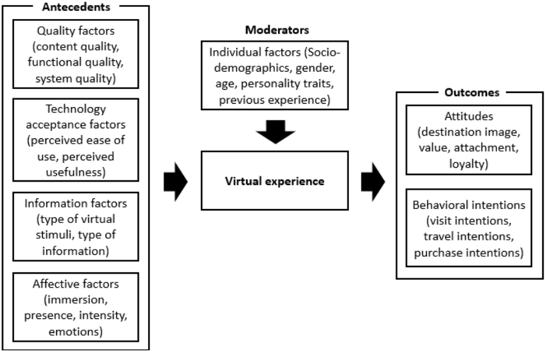
Virtual reality has become a more common phenomenon in both destination marketing and on-site experience. The recent challenges such as overtourism and the COVID-19 pandemic have created a pressing need to examine virtual tourism as an alternative to traditional travel. This conceptual article aims at clarifying virtual experience in tourism, discussing the main antecedents and outcomes of virtual experience, and proposing a conceptual model of virtual tourism experience. The review of the literature revealed that virtual experience in tourism is influenced by factors related to information, quality, technology acceptance, and affective involvement and has significant effects on tourists’ attitudes and behavioral intentions. This paper contributes to knowledge and practice by classifying the main groups of factors influencing virtual tourism experience, introducing the conceptual model, discussing opportunities for future research, and providing recommendations for tourism practitioners.
Overview
The claims and statistics of this paper haven’t been checked yet.
Free: it reads the open-access text and checks the first 5 claims that cite a source we can check. Create a free account to check every claim.
Integrity signals
Registry
Cites
Statistics
Figures
Verification
Claims the paper makes
The claims and statistics of this paper haven’t been checked yet.
Free: it reads the open-access text and checks the first 5 claims that cite a source we can check. Create a free account to check every claim.
Claims other papers make about this one
Each is checked against this paper’s own text: does it say what the citing paper says it does?
The cited source says what the claim attributes to it.
In the citing paper
“Commonly, variables like immersion and telepresence are regarded as antecedents (see Godovykh et al., 2022), and have thus been assessed concerning their direct impact (or 'main effect') on behavioral intentions (e.g., Algharabat & Dennis, 2010; Disztinger et al., 2017; Wang et al., 2021).”
From People's Intentions to Use Metaverse Technology: Investigating the Role of Gratifications and Perceptions (2024) · cites this paper as Godovykh et al., 2022
Self-check
Percentages, sums and reported differences re-computed from the paper’s own numbers.
The self-check needs the paper’s full text.
Citations
Cites
The theory of planned behavior
Ajzen, I. (1991) · Organizational Behavior and Human Decision Processes · doi:10.1016/0749-5978(91)90020-t · Cited by 134,657
User Acceptance of Information Technology: Toward A Unified View1
Venkatesh, V., Morris, M. G., Davis, G. B., & Davis, F. D. (2003) · MIS Quarterly · doi:10.2307/30036540 · Cited by 45,035 · cited 1×
“Another frequently cited framework is the unified theory of acceptance and use of technology (UTAUT), wherein performance expectancy, effort expectancy, social influence, and facilitating conditions impact behavioral intention and use behavior, with gender, age, experience, and voluntariness of use as moderating influ…”
BackgroundRemediation: Understanding New Media
Bolter, J. D. (1999) · Corporate Communications: An International Journal · doi:10.1108/ccij.1999.4.4.208.1 · Cited by 2,914
Tourism and COVID-19: Impacts and implications for advancing and resetting industry and research
Sigala, M. (2020) · Journal of Business Research · doi:10.1016/j.jbusres.2020.06.015 · Cited by 2,274 · cited 1×
“Crises can provide a “transfor-mative opportunity” for rethinking industry and academic work, driving change, and sparking paradigm shifts [91].”
Enhancing Our Lives with Immersive Virtual Reality
Slater, M., & Sanchez-Vives, M. V. (2016) · Frontiers in Robotics and AI · doi:10.3389/frobt.2016.00074 · Cited by 1,993 · cited 1×
“These experiences may not be a replacement for physical travel, but they can be viewed instead as “another form” of travel rather than merely a substitute [69].”
BackgroundVirtual reality: Applications and implications for tourism
Guttentag, D. A. (2010) · Tourism Management · doi:10.1016/j.tourman.2009.07.003 · Cited by 1,747 · cited 1×
“Virtual travel can be understood as a way to enhance tourism experiences or an alternative type of tourism [65,67,68].”
BackgroundImmersive Interfaces for Engagement and Learning
Dede, C. (2009) · Science · doi:10.1126/science.1167311 · Cited by 1,707 · cited 1×
“For instance, Dede [74] found that interactive media could utilize immersion through the senses, through actions not possible in the real world, and through symbolism, triggering psychological associations; virtual tourism environments might use these concepts as well as the potential outcomes he…”
The impact of virtual, augmented and mixed reality technologies on the customer experience
Flavián, C., Ibáñez-Sánchez, S., & Orús, C. (2019) · Journal of Business Research · doi:10.1016/j.jbusres.2018.10.050 · Cited by 1,442 · cited 1×
“[46] suggested that virtual experience brings additional value to the customer purchase journey.”
BackgroundKim, M. J., Lee, C.-K., & Jung, T. (2020) · Journal of Travel Research · doi:10.1177/0047287518818915 · Cited by 1,333 · cited 1×
“…can lead to outcomes that connect to this model such as attitude changes [8,56,63,64], overall behavioral intentions [2,14,54], use intentions [63], purchase intentions [56,64], visit intentions [7,8,10,40,56,57], revisit intentions [60], intention to recommend [60], and continued use [66].”
Virtual reality, presence, and attitude change: Empirical evidence from tourism
Tussyadiah, I. P., Wang, D., Jung, T. H., & tom Dieck, M. C. (2018) · Tourism Management · doi:10.1016/j.tourman.2017.12.003 · Cited by 1,294 · cited 6×
“Sites utilize technologies as strategic business decisions because virtual tourism has been an effective tool in evoking emotion and visit intention towards the real place [6–8].”
InfluentialA grounded investigation of game immersion
Brown, E., & Cairns, P. (2004) · CHI '04 Extended Abstracts on Human Factors in Computing Systems · doi:10.1145/985921.986048 · Cited by 1,159 · cited 1×
“Likewise, Brown and Cairns’ [75] levels of immersion (engagement, engrossment, total immersion) could be helpful constructs in tourism.”
BackgroundYung, R., & Khoo-Lattimore, C. (2019) · Current Issues in Tourism · doi:10.1080/13683500.2017.1417359 · Cited by 1,000 · cited 3×
“VR is traditionally defined as a computer-generated environment where the user has an opportunity to immerse, look around, and control the experience [31].”
Impact of COVID-19 on the travel and tourism industry
Škare, M., Soriano, D. R., & Porada-Rochoń, M. (2021) · Technological Forecasting and Social Change · doi:10.1016/j.techfore.2020.120469 · Cited by 908 · cited 1×
“The primary barriers likely to hinder tourism recovery include, among others, the closing of international borders, international travel bans, bankruptcies of tourism providers, and tourists’ risk perceptions [24–26].”
Loureiro, S. M. C., Guerreiro, J., & Ali, F. (2020) · Tourism Management · doi:10.1016/j.tourman.2019.104028 · Cited by 659 · cited 1×
“Technologies such as 3D virtual worlds and VR are revolutionizing the way people experience travel and tourism-related products [5].”
BackgroundHuang, Y. C., Backman, K. F., Backman, S. J., & Chang, L. L. (2016) · International Journal of Tourism Research · doi:10.1002/jtr.2038 · Cited by 637 · cited 4×
“…studies, virtual experience can lead to outcomes that connect to this model such as attitude changes [8,56,63,64], overall behavioral intentions [2,14,54], use intentions [63], purchase intentions [56,64], visit intentions [7,8,10,40,56,57], revisit intentions [60], intention to recommend [60],…”
InfluentialBeyond virtual museums: Experiencing immersive virtual reality in real museums
Carrozzino, M., & Bergamasco, M. (2010) · Journal of Cultural Heritage · doi:10.1016/j.culher.2010.04.001 · Cited by 589 · cited 1×
“The museum sector, in particular, has experimented with virtual experiences in the past to positive effect [11–17].”
Virtual reality presence as a preamble of tourism experience: The role of mental imagery
Bogicevic, V., Seo, S., Kandampully, J. A., Liu, S. Q., & Rudd, N. A. (2019) · Tourism Management · doi:10.1016/j.tourman.2019.02.009 · Cited by 548 · cited 1×
“A recent study by Bogicevic et al. [47] found that pre-visit virtual experience leads to higher levels of tourism brand experience.”
A hedonic motivation model in virtual reality tourism: Comparing visitors and non-visitors
Kim, M. J., & Hall, C. M. (2019) · International Journal of Information Management · doi:10.1016/j.ijinfomgt.2018.11.016 · Cited by 531 · cited 1×
“…can lead to outcomes that connect to this model such as attitude changes [8,56,63,64], overall behavioral intentions [2,14,54], use intentions [63], purchase intentions [56,64], visit intentions [7,8,10,40,56,57], revisit intentions [60], intention to recommend [60], and continued use [66].”
With or without you? Interaction and immersion in a virtual reality experience
Hudson, S., Matson-Barkat, S., Pallamin, N., & Jegou, G. (2019) · Journal of Business Research · doi:10.1016/j.jbusres.2018.10.062 · Cited by 530 · cited 2×
“Virtual experiences, especially those with immersive and social interaction features, can increase guest satisfaction and loyalty [45].”
Experiencing immersive virtual reality in museums
Lee, H., Jung, T. H., tom Dieck, M. C., & Chung, N. (2020) · Information & Management · doi:10.1016/j.im.2019.103229 · Cited by 478 · cited 2×
“…studies, virtual experience can lead to outcomes that connect to this model such as attitude changes [8,56,63,64], overall behavioral intentions [2,14,54], use intentions [63], purchase intentions [56,64], visit intentions [7,8,10,40,56,57], revisit intentions [60], intention to recommend [60],…”
COVID-19 cripples global restaurant and hospitality industry
Dube, K., Nhamo, G., & Chikodzi, D. (2021) · Current Issues in Tourism · doi:10.1080/13683500.2020.1773416 · Cited by 431 · cited 1×
“The primary barriers likely to hinder tourism recovery include, among others, the closing of international borders, international travel bans, bankruptcies of tourism providers, and tourists’ risk perceptions [24–26].”
Exploring user acceptance of 3D virtual worlds in travel and tourism marketing
Huang, Y.-C., Backman, S. J., Backman, K. F., & Moore, D. (2013) · Tourism Management · doi:10.1016/j.tourman.2012.09.009 · Cited by 430 · cited 2×
“…virtual experience can lead to outcomes that connect to this model such as attitude changes [8,56,63,64], overall behavioral intentions [2,14,54], use intentions [63], purchase intentions [56,64], visit intentions [7,8,10,40,56,57], revisit intentions [60], intention to recommend [60], and…”
Effects of virtual reality on theme park visitors' experience and behaviors: A presence perspective
Wei, W., Qi, R., & Zhang, L. (2019) · Tourism Management · doi:10.1016/j.tourman.2018.10.024 · Cited by 406 · cited 3×
“…can lead to outcomes that connect to this model such as attitude changes [8,56,63,64], overall behavioral intentions [2,14,54], use intentions [63], purchase intentions [56,64], visit intentions [7,8,10,40,56,57], revisit intentions [60], intention to recommend [60], and continued use [66].”
The phenomena of overtourism: A review
Dodds, R., & Butler, R. (2019) · International Journal of Tourism Cities · doi:10.1108/ijtc-06-2019-0090 · Cited by 398 · cited 2×
“Overtourism, more than any other single issue in recent years, has exhibited the most salient negative impacts on tourism, including social, cultural, and environmental costs for the residents with anti-tourism protests witnessed in many popular destinations [28].”
BackgroundEl-Said, O., & Aziz, H. (2022) · Journal of Travel Research · doi:10.1177/0047287521997567 · Cited by 384 · cited 3×
“Virtual tours of historic sites and attractions were especially common during the pandemic with ancient Egyptian sites, Petra, the British Museum, the Louvre Museum, Frida Kahlo’s house, the White House, and others [21].”
BackgroundDesigning tourism experiences for inner transformation
Sheldon, P. J. (2020) · Annals of Tourism Research · doi:10.1016/j.annals.2020.102935 · Cited by 362 · cited 1×
“One more promising direction of future interdisciplinary research in using virtual tourism experience is the exploration of important health [86], transformation [87,88], and wellbeing outcomes [89,90] of tourism activities.”
BackgroundCustomer experience in tourism: A review of definitions, components, and measurements
Godovykh, M., & Tasci, A. D. A. (2020) · Tourism Management Perspectives · doi:10.1016/j.tmp.2020.100694 · Cited by 359
Self-citationThe potential of virtual tourism in the recovery of tourism industry during the COVID-19 pandemic
Lu, J., Xiao, X., Xu, Z., Wang, C., Zhang, M., & Zhou, Y. (2022) · Current Issues in Tourism · doi:10.1080/13683500.2021.1959526 · Cited by 350 · cited 1×
“During the pandemic and even after it subsides, virtual tourism allows for safe, accessible options that keep the place on the mind and may likewise assist in tourism recovery post-pandemic [21,22].”
BackgroundJung, T. H., & tom Dieck, M. C. (2017) · Journal of Place Management and Development · doi:10.1108/jpmd-07-2016-0045 · Cited by 330 · cited 2×
“tiple technology usage could lead to value co-creation in each phase of the visit [76].”
BackgroundDestination Culture: Tourism, Museums, and Heritage
Kirshenblatt-Gimblett, B. (1999) · University of California Press eBooks · doi:10.1525/9780520919488 · Cited by 328
Trunfio, M., Lucia, M. D., Campana, S., & Magnelli, A. (2022) · Journal of Heritage Tourism · doi:10.1080/1743873x.2020.1850742 · Cited by 321 · cited 1×
“, the world’s first photographic exhibit) can be recreated with these technologies [16,17].”
BackgroundQuality of virtual reality and its impacts on behavioral intention
Lee, M., Lee, S. A., Jeong, M., & Oh, H. (2020) · International Journal of Hospitality Management · doi:10.1016/j.ijhm.2020.102595 · Cited by 320 · cited 2×
“Another common theme in the literature is that of quality [40,59,60], as low-quality experiences may provide less realism.”
BackgroundExploring the role of next-generation virtual technologies in destination marketing
Marasco, A., Buonincontri, P., van Niekerk, M., Orlowski, M., & Okumus, F. (2018) · Journal of Destination Marketing & Management · doi:10.1016/j.jdmm.2017.12.002 · Cited by 315 · cited 3×
“Different qualities that lead to immersion, including flow and interactivity [10], sensory fidelity [57], and emotional involvement [58], have also been found to be significant.”
The virtual threat to travel and tourism
Cheong, R. (1995) · Tourism Management · doi:10.1016/0261-5177(95)00049-t · Cited by 292 · cited 1×
“The notion that virtual travel not only has advantages to traditional travel but that it poses a threat to tourism because it will completely displace physical travel [42] echoes the concerns of postmodern critics that simulation is more appealing than reality [43,44].”
BackgroundVirtual reality and tourism: fact or fantasy?
Williams, P., & Hobson, J. P. (1995) · Tourism Management · doi:10.1016/0261-5177(95)00050-x · Cited by 288
Exploring well-being as a tourism product resource
Pyke, S., Hartwell, H., Blake, A., & Hemingway, A. (2016) · Tourism Management · doi:10.1016/j.tourman.2016.02.004 · Cited by 272 · cited 1×
“One more promising direction of future interdisciplinary research in using virtual tourism experience is the exploration of important health [86], transformation [87,88], and wellbeing outcomes [89,90] of tourism activities.”
BackgroundYung, R., Khoo-Lattimore, C., & Potter, L. E. (2021) · Current Issues in Tourism · doi:10.1080/13683500.2020.1820454 · Cited by 261 · cited 5×
“Different qualities that lead to immersion, including flow and interactivity [10], sensory fidelity [57], and emotional involvement [58], have also been found to be significant.”
InfluentialVirtual destination image: Testing a telepresence model
Hyun, M. Y., & O'Keefe, R. M. (2012) · Journal of Business Research · doi:10.1016/j.jbusres.2011.07.011 · Cited by 257 · cited 2×
“Similarly, those who study presence [8,56,57] or telepresence [3,10] as a core concept observe it as an antecedent of effective virtual experience.”
BackgroundMartins, J., Gonçalves, R., Branco, F., Barbosa, L., Melo, M., & Bessa, M. (2017) · Journal of Destination Marketing & Management · doi:10.1016/j.jdmm.2017.02.002 · Cited by 199 · cited 2×
“In some cases, virtual techniques are used to augment visitor experience at the site, for example, adding a multi-sensory VR presentation in a wine tourism location [39].”
BackgroundMethodVirtual Reality and Implications for Destination Marketing
Griffin, T., Giberson, J., Lee, S. H., Guttentag, D. A., Kandaurova, M., Sergueeva, K., & Dimanche, F. (2017) · Scholarworks (University of Massachusetts Amherst) · Cited by 195
Antecedents and outcomes of health risk perceptions in tourism, following the COVID-19 pandemic
Godovykh, M., Pizam, A., & Bahja, F. (2021) · Tourism Review · doi:10.1108/tr-06-2020-0257 · Cited by 185
Self-citationLo, W. H., & Cheng, K. L. B. (2020) · Information Technology & Tourism · doi:10.1007/s40558-020-00190-2 · Cited by 184 · cited 3×
“Similarly, those who study presence [8,56,57] or telepresence [3,10] as a core concept observe it as an antecedent of effective virtual experience.”
Evaluations of pleasurable experiences: The peak-end rule
DO, A. M., RUPERT, A. V., & WOLFORD, G. (2008) · Psychonomic Bulletin & Review · doi:10.3758/pbr.15.1.96 · Cited by 183 · cited 1×
“Virtual reality scenarios make it possible for investigators to design and test outcomes of different destination situations by placing peak experiences at different time points [79,80], segmenting visitors by sociodemographic and personality characteristics [81], and introducing the effects of different affective sti…”
BackgroundLeung, X. Y., Lyu, J., & Bai, B. (2019) · International Journal of Hospitality Management · doi:10.1016/j.ijhm.2019.102391 · Cited by 179 · cited 3×
“The learning component of virtual experience is accounted for in literature, including understanding material [64], the information search process [4], and the ability to make informed decisions and initiate travel arrangements [65].”
Technology acceptance of virtual reality for travel planning
Disztinger, P., Schlögl, S., & Groth, A. (2017) · Information and Communication Technologies in Tourism 2017 · doi:10.1007/978-3-319-51168-9_19 · Cited by 178 · cited 1×
“For example, literature based on the technology acceptance model use that framework’s antecedents of perceived ease of use and perceived usefulness [53–55], or a study focused on experiential dimensions uses those for its attributes [14].”
Virtual reality tourism experiences: Addiction and isolation
Merkx, C., & Nawijn, J. (2021) · Tourism Management · doi:10.1016/j.tourman.2021.104394 · Cited by 166 · cited 1×
“Intention to use VR in the tourism sector increased during the COVID-19 pandemic, as it was perceived to be a less risky, more prudent, and affordable substitute for traditional travel [18,19].”
Background“Too true to be good?” when virtual reality decreases interest in actual reality
Deng, X., Unnava, H. R., & Lee, H. (2018) · Journal of Business Research · doi:10.1016/j.jbusres.2018.11.008 · Cited by 164 · cited 1×
“Deng et al. [41] found that VR websites might negatively influence visit intentions.”
Errichiello, L., Micera, R., Atzeni, M., & Del Chiappa, G. (2019) · International Journal of Tourism Research · doi:10.1002/jtr.2283 · Cited by 163 · cited 1×
“Importantly, no significant differences between physical presence and virtual experience were found for tourists’ emotional engagement, spatial presence, and behavioral intentions [12,52].”
Schiopu, A. F., Hornoiu, R. I., Padurean, M. A., & Nica, A.-M. (2021) · Telematics and Informatics · doi:10.1016/j.tele.2021.101575 · Cited by 160 · cited 2×
“Intention to use VR in the tourism sector increased during the COVID-19 pandemic, as it was perceived to be a less risky, more prudent, and affordable substitute for traditional travel [18,19].”
BackgroundConceptualizing Destination Resilience From a Multilevel Perspective
Amore, A., Prayag, G., & Hall, C. M. (2018) · Tourism Review International · doi:10.3727/154427218x15369305779010 · Cited by 156 · cited 1×
“Destination resilience factors, traditionally described in the literature as the capacity of tourism systems to resist negative impacts [29], have become powerless in the face of overtourism, environmental destruction, and global pandemics, with them collectively serving as a catalyst for change in the future marketin…”
BackgroundAugmented Reality and Virtual Reality
Han, D., Weber-Sabil, J., Bastiaansen, M., Mitas, O., Lub, X., Dieck, M. C. T., & Jung, T. H. (2019) · Progress in IS · doi:10.1007/978-3-030-06246-0 · Cited by 156
Virtual Reality as a Travel Substitution Tool During COVID-19
Sarkady, D., Neuburger, L., & Egger, R. (2021) · Springer eBooks · doi:10.1007/978-3-030-65785-7_44 · Cited by 155 · cited 1×
“For example, literature based on the technology acceptance model use that framework’s antecedents of perceived ease of use and perceived usefulness [53–55], or a study focused on experiential dimensions uses those for its attributes [14].”
Wagler, A., & Hanus, M. D. (2018) · Communication Research Reports · doi:10.1080/08824096.2018.1525350 · Cited by 151 · cited 1×
“Importantly, no significant differences between physical presence and virtual experience were found for tourists’ emotional engagement, spatial presence, and behavioral intentions [12,52].”
Progress on technology use in tourism
Cai, W., Richter, S., & McKenna, B. (2019) · Journal of Hospitality and Tourism Technology · doi:10.1108/jhtt-07-2018-0068 · Cited by 143 · cited 1×
“The technology acceptance model (TAM), modeled on the Theory of Planned Behavior [70], is the most common theoretical foundation employed in research to explain the behavioral outcomes of virtual experience [31,71].”
BackgroundDoes VR Tourism Enhance Users’ Experience?
Lee, W., & Kim, Y. H. (2021) · Sustainability · doi:10.3390/su13020806 · Cited by 143 · cited 5×
“Different qualities that lead to immersion, including flow and interactivity [10], sensory fidelity [57], and emotional involvement [58], have also been found to be significant.”
InfluentialA critique of “Response Bias” in the tourism, travel and hospitality research
Yüksel, A. (2016) · Tourism Management · doi:10.1016/j.tourman.2016.08.003 · Cited by 133 · cited 1×
“In addition, the commonly applied self-reported retrospective evaluations of tourists’ experience are biased by social desirability, extreme responding, recency effect, memory limitations, respondents’ inability to verbalize their feelings, and other response biases [32].”
BackgroundPresence and Immersion in Virtual Reality
Berkman, M. I., & Akan, E. (2019) · Encyclopedia of Computer Graphics and Games · doi:10.1007/978-3-319-08234-9_162-1 · Cited by 132 · cited 1×
“The level of presence (the perception of being in and feeling connected to the virtual environment) is related to the processing of virtual stimuli by the human sensory system and depends on external stimuli, subjective components of experience, and the user’s individual characteristics [34,35].”
BackgroundZheng, C., Chen, Z., Zhang, Y., & Guo, Y. (2021) · Journal of Travel Research · doi:10.1177/00472875211042671 · Cited by 132 · cited 3×
“…can lead to outcomes that connect to this model such as attitude changes [8,56,63,64], overall behavioral intentions [2,14,54], use intentions [63], purchase intentions [56,64], visit intentions [7,8,10,40,56,57], revisit intentions [60], intention to recommend [60], and continued use [66].”
Godovykh, M., & Ridderstaat, J. R. (2020) · Journal of Destination Marketing & Management · doi:10.1016/j.jdmm.2020.100462 · Cited by 129 · cited 1×
“One more promising direction of future interdisciplinary research in using virtual tourism experience is the exploration of important health [86], transformation [87,88], and wellbeing outcomes [89,90] of tourism activities.”
Self-citationVirtual Reality: An Innovative Tool in Destinations’ Marketing
Rainoldi, M., Driescher, V., Lisnevska, A., Zvereva, D., Stavinska, A., Relota, J., & Egger, R. (2018) · The Gaze Journal of Tourism and Hospitality · doi:10.3126/gaze.v9i0.19721 · Cited by 123 · cited 4×
“The learning component of virtual experience is accounted for in literature, including understanding material [64], the information search process [4], and the ability to make informed decisions and initiate travel arrangements [65].”
InfluentialHuang, Y., Backman, S. J., & Backman, K. F. (2012) · Journal of Hospitality and Tourism Technology · doi:10.1108/17579881211206507 · Cited by 113 · cited 1×
“Three-dimensional virtual worlds such as Second Life have also been considered in research, with functions such as marketing, virtual tours, and hosting virtual embassies [37,38].”
BackgroundA sense of self: The role of presence in virtual environments
McCreery, M. P., Schrader, P. G., Krach, S. K., & Boone, R. (2013) · Computers in Human Behavior · doi:10.1016/j.chb.2013.02.002 · Cited by 99 · cited 1×
“The level of presence (the perception of being in and feeling connected to the virtual environment) is related to the processing of virtual stimuli by the human sensory system and depends on external stimuli, subjective components of experience, and the user’s individual characteristics [34,35].”
BackgroundAn empirical modeling of transformation process through trip experiences
Tasci, A. D. A., & Godovykh, M. (2021) · Tourism Management · doi:10.1016/j.tourman.2021.104332 · Cited by 93 · cited 1×
“One more promising direction of future interdisciplinary research in using virtual tourism experience is the exploration of important health [86], transformation [87,88], and wellbeing outcomes [89,90] of tourism activities.”
BackgroundSelf-citationEmotionalise Me: Self-reporting and Arousal Measurements in Virtual Tourism Environments
Beck, J., & Egger, R. (2017) · Springer eBooks · doi:10.1007/978-3-319-72923-7_1 · Cited by 91 · cited 4×
“Technologies represented in virtual reality range from 360 ◦ videos, VR, AR, and virtual meetings to the digital world as a persistent virtual environment, which can be broadly classified based on the levels of immersion, presence, and complexity [6].”
InfluentialGodovykh, M., Ridderstaat, J. R., & Fyall, A. (2021) · Tourism Economics · doi:10.1177/13548166211041227 · Cited by 84 · cited 1×
“One more promising direction of future interdisciplinary research in using virtual tourism experience is the exploration of important health [86], transformation [87,88], and wellbeing outcomes [89,90] of tourism activities.”
Self-citationThresholds: Embedding Virtual Reality in the Museum
Tennent, P., Martindale, S., Benford, S., Darzentas, D., Brundell, P., & Collishaw, M. (2020) · Journal on Computing and Cultural Heritage · doi:10.1145/3369394 · Cited by 84
Virtual Reality in Tourism: Is it ‘Real’ Enough?
Rauscher, M., Humpe, A., & Brehm, L. (2020) · Academica Turistica · doi:10.26493/2335-4194.13.127-138 · Cited by 81 · cited 1×
“Though the question of authenticity, or whether the simulation is “real enough”, remains an issue [9], VR in tourism spaces is only growing more prominent.”
The influence of post-visit emotions on destination loyalty
Godovykh, M., & Tasci, A. D. A. (2020) · Tourism Review · doi:10.1108/tr-01-2020-0025 · Cited by 78 · cited 1×
“Virtual reality scenarios make it possible for investigators to design and test outcomes of different destination situations by placing peak experiences at different time points [79,80], segmenting visitors by sociodemographic and personality characteristics [81], and introducing the effects of different affective sti…”
BackgroundSelf-citationDeterminants of consumers' response to pay-what-you-want pricing strategy on the Internet
Weisstein, F. L., Kukar‐Kinney, M., & Monroe, K. B. (2016) · Journal of Business Research · doi:10.1016/j.jbusres.2016.04.005 · Cited by 77 · cited 1×
“The further development of virtual destinations might make it possible to test different pricing models, including pay-what-you-want strategies, which currently remain underexplored in tourism research [83].”
Marchiori, E., Niforatos, E., & Preto, L. (2018) · Information Technology & Tourism · doi:10.1007/s40558-018-0104-0 · Cited by 70 · cited 2×
“Another heart rate experiment [62] found that characteristics of VR can lead to strong memories.”
BackgroundHow to Avoid a COVID-19 Research Paper Tsunami? A Tourism System Approach
Bausch, T., Gartner, W. C., & Ortanderl, F. (2020) · Journal of Travel Research · doi:10.1177/0047287520972805 · Cited by 68
Framing the past: How virtual experience affects bodily description of artefacts
Franco, P. D. G. D., Matthews, J. L., & Matlock, T. (2015) · Journal of Cultural Heritage · doi:10.1016/j.culher.2015.04.006 · Cited by 34
Satisfaction vs experienced utility: current issues and opportunities
Godovykh, M., & Tasci, A. D. A. (2020) · Current Issues in Tourism · doi:10.1080/13683500.2020.1769573 · Cited by 33 · cited 1×
“The current period of time is ideal for inviting people to visit virtual destinations, which combine advantages of realism and immersion with opportunities to design new travel scenarios and apply different subjective and objective measures of the visitor experience [85].”
BackgroundSelf-citationOvertourism: a result of the Janus-faced character of the tourism industry
Avond, G., Bacari, C., Limea, I., Séraphin, H., Gowreesunkar, V. G., & Mhanna, R. (2019) · Worldwide Hospitality and Tourism Themes · doi:10.1108/whatt-06-2019-0039 · Cited by 32 · cited 1×
“Several actions have been proposed to combat overtourism, for instance, limiting access, demarketing, price increases, and other on-site interventions [30]; however, a reconceptualization of tourism itself may also be beneficial.”
BackgroundVirtual tourism: use of “second life” for destination marketing
Mascho, E., & Singh, N. (2013) · Anatolia · doi:10.1080/13032917.2013.815644 · Cited by 28 · cited 1×
“Three-dimensional virtual worlds such as Second Life have also been considered in research, with functions such as marketing, virtual tours, and hosting virtual embassies [37,38].”
Virtual Reality in Tourism: Centennials Acceptance
Rejón‐Guardia, F., García-Sastre, M. A., Orfila‐Sintes, F., & Vadell, J. B. G. (2020) · Tourism Analysis · doi:10.3727/108354220x15758301241837 · Cited by 19 · cited 3×
“Others found emotional involvement as an outcome [54,58] or pointed to specific emotions such as enjoyment [2,8,63].”
BackgroundAftermath of pandemic Covid-19 on tourism industry: A review on virtual tourism platform
Rahim, N. Z. A., Nasaruddin, N. I. S., Shah, N. B. A., Halim, F. H., Samah, K. A. F. A., Saman, F. I., & Rum, S. F. M. (2021) · AIP conference proceedings · doi:10.1063/5.0052855 · Cited by 18 · cited 2×
“Advertising shifted to virtual platforms, providing opportunities for engagement and new experiences in the midst of the pandemic [20].”
BackgroundGodovykh, M., & Hahm, J. J. (2020) · Journal of Convention & Event Tourism · doi:10.1080/15470148.2020.1760159 · Cited by 16 · cited 1×
“…possible for investigators to design and test outcomes of different destination situations by placing peak experiences at different time points [79,80], segmenting visitors by sociodemographic and personality characteristics [81], and introducing the effects of different affective stimuli before,…”
Self-citationBafadhal, A. S., & Hendrawan, M. R. (2019) · Annual International Conference of Business and Public Administration (AICoBPA) · doi:10.2991/aicobpa-18.2019.12 · Cited by 13 · cited 2×
“, VR glasses, head mount display), based on the type of simulation and degree of user’s abstraction from the real world [1].”
BackgroundVirtual Tourism in a Game Environment: Untangling Judged Affordances and Sense of Place
Tjøstheim, I., & Waterworth, J. A. (2020) · Lecture notes in computer science · doi:10.1007/978-3-030-50164-8_14 · Cited by 10 · cited 1×
“In another study [51], telepresence (allowing one to feel present in a place that is not the physical location one is in) can predict one’s user experience with virtual environments still giving the perception of “being there”.”
BackgroundWolff‐Hughes, D. L., Conroy, R., McClain, J. J., Nilsen, W., & Riley, W. T. (2018) · Translational Behavioral Medicine · doi:10.1093/tbm/ibx036 · Cited by 6
Memorable Tourism Experience: Formative Conceptualization and Tests Of Sociodemographic Moderators
Shabnam, S., Quaddus, M., Ali, M. B., & Shanka, T. (2021) · Tourism Analysis · doi:10.3727/108354221x16187814403128 · Cited by 6 · cited 1×
“Virtual reality scenarios make it possible for investigators to design and test outcomes of different destination situations by placing peak experiences at different time points [79,80], segmenting visitors by sociodemographic and personality characteristics [81], and introducing the effects of different affective sti…”
Background
Research works printed but not linked: 5
- Jung, T.H.; tom Dieck, M.C.; Lee, H.; Chung, N. Effects of virtual reality and augmented reality on visitor experiences in museums. In Information and Communication Technologies in Tourism; Inversini, A., Schegg, R., Eds.; Springer: Berlin/Heidelberg, Germany, 2016; pp. 621-635.
- Schofield, G.; Beale, G.; Beale, N.; Fell, M.; Hadley, D.; Hook, J.; Murphy, D.; Richards, J.; Thresh, L. Viking VR: Designing a virtual reality experience for a museum. In Proceedings of the 2018 Designing Interactive Systems Conference, Hong Kong, China, 9-13 June 2018; pp. 805-815.
- Baudrillard, J. Simulacrum and Simulation; Glaser, S.F., Translator; University of Michigan Press: Ann Arbor, MI, USA, 1994.
- Sussmann, S.; Vanhegan, H. Virtual Reality and the Tourism Product Substitution or Complement? ECIS 2000 Proceedings, 117. 2000. Available online: https://aisel.aisnet.org/ecis2000/117 (accessed on 22 February 2022).
- Green, M.C.; Brock, T.C. The role of transportation in the persuasiveness of public industry and research. J. Bus. Res. 2000, 117, 312-321.
Cited by
Tourism in the digital frontier: a study on user continuance intention in the metaverse
Jo, H. (2023) · Information Technology & Tourism · doi:10.1007/s40558-023-00257-w · Cited by 75
Gamification in tourism research: A systematic review, current insights, and future research avenues
Pradhan, D., Malik, G., & Vishwakarma, P. (2023) · Journal Of Vacation Marketing · doi:10.1177/13567667231188879 · Cited by 81
“Through gami fi cation, the industry kept travelers connected, provided them with virtual exploration opportunities, and inspired future travel when restrictions eased (Godovykh et al., 2022).”
Examining the potential of virtual and augmented reality in enhancing tourism experiences
Shukla, V., Rana, S., & Prashar, S. (2024) · The Bottom Line Managing Library Finances · doi:10.1108/bl-05-2023-0139 · Cited by 73
Bosone, M., & Nocca, F. (2022) · Sustainability · doi:10.3390/su141912218 · Cited by 65
Tan, K., Hii, I. S. H., Zhu, W., Leong, C., & Lin, E. (2022) · Asia Pacific Journal of Marketing and Logistics · doi:10.1108/apjml-05-2022-0417 · Cited by 60
Metadata
- Authors
- Godovykh, M., Baker, C., & Fyall, A.
- Affiliations
- University of Central Florida (US)
- Corresponding author
- Godovykh, Maksim
- Venue
- Tourism and Hospitality
- Publisher
- MDPI AG
- Published
- 2022-02-23
- Volume
- 3
- Issue
- 1
- Pages
- 265-275
- ISSN
- 2673-5768 (ISSN-L)
- OpenAlex
- W4213453630
- Cited by
- 108
- References
- 82
- Citations by year
- 2026: 16 · 2025: 39 · 2024: 26 · 2023: 20 · 2022: 7
- FWCI
- 33.09
- Type
- journal article
- Language
- en
- Open access
- gold
- doi.org
- Licence
- Locations
- Tourism and Hospitality (publishedVersion, cc-by)
- Journal of International Crisis and Risk Communication Research (submittedVersion, cc-by)
- RePEc: Research Papers in Economics (submittedVersion)
- DOAJ (DOAJ: Directory of Open Access Journals) (submittedVersion, cc-by-sa)
- Topics
- Social Sciences › Business, Management and Accounting › Tourism, Leisure and Hospitality Management › Diverse Aspects of Tourism Research
- Physical Sciences › Computer Science › Human-Computer Interaction › Virtual Reality Applications and Impacts
- Social Sciences › Business, Management and Accounting › Marketing › Digital Marketing and Social Media
- Keywords
- virtual reality, COVID-19 pandemic, overtourism, tourism promotion, technology acceptance, emotional engagement, tourist attitudes, behavioral intention, conceptual model, virtual tourism
About these checks
Registry, retraction, Cites and statistics results are computed, not judged, with one exception: a printed reference that no index lists is read once by a model before it counts as a citation error. Claims are extracted by a model and kept only when their quote appears verbatim in the text; each cited source is then checked, with a model’s help, for whether it says what the claim relies on. Those verdicts can be wrong — read the claim’s quote and the cited source before relying on one.
Statistics and arithmetic are recomputed, not judged.
Confidence bands are shown only for fields calibrated on our annotated test set. None is calibrated yet, so no band is shown.
What counts as a claim ›How we measure confidence ›How we check this ›
Are you an author, or do you see a problem with this page? Request a review
Data sources
Bibliographic data: Semantic Scholar, OpenAlex, Crossref.
Contains information from the Semantic Scholar Academic Graph Datasets, made available under the ODC Attribution License (ODC-BY 1.0).
Semantic Scholar’s data is described in: Kinney, R., et al. (2023). The Semantic Scholar Open Data Platform. arXiv:2301.10140.
