

VR in Tourism: A New Call for Virtual Tourism Experience amid and after the COVID-19 Pandemic
Open accessThe DOI matches its Crossref record; 81 of the 82 references it cites were found in a registry or an index.
Abstract
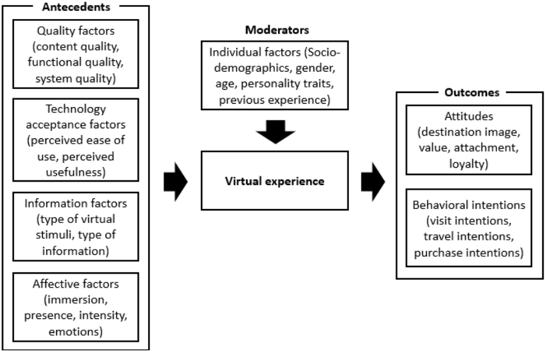
Virtual reality has become a more common phenomenon in both destination marketing and on-site experience. The recent challenges such as overtourism and the COVID-19 pandemic have created a pressing need to examine virtual tourism as an alternative to traditional travel. This conceptual article aims at clarifying virtual experience in tourism, discussing the main antecedents and outcomes of virtual experience, and proposing a conceptual model of virtual tourism experience. The review of the literature revealed that virtual experience in tourism is influenced by factors related to information, quality, technology acceptance, and affective involvement and has significant effects on tourists’ attitudes and behavioral intentions. This paper contributes to knowledge and practice by classifying the main groups of factors influencing virtual tourism experience, introducing the conceptual model, discussing opportunities for future research, and providing recommendations for tourism practitioners.
Overview
The claims and statistics of this paper haven’t been checked yet.
Free: it reads the open-access text and checks the first 5 claims that cite a source we can check. Create a free account to check every claim.
Integrity signals
Registry
Cites
Statistics
Figures
Verification
Claims the paper makes
The claims and statistics of this paper haven’t been checked yet.
Free: it reads the open-access text and checks the first 5 claims that cite a source we can check. Create a free account to check every claim.
Claims other papers make about this one
Each is checked against this paper’s own text: does it say what the citing paper says it does?
The cited source says what the claim attributes to it.
In the citing paper
“Commonly, variables like immersion and telepresence are regarded as antecedents (see Godovykh et al., 2022), and have thus been assessed concerning their direct impact (or 'main effect') on behavioral intentions (e.g., Algharabat & Dennis, 2010; Disztinger et al., 2017; Wang et al., 2021).”
From People's Intentions to Use Metaverse Technology: Investigating the Role of Gratifications and Perceptions (2024) · cites this paper as Godovykh et al., 2022
Self-check
Percentages, sums and reported differences re-computed from the paper’s own numbers.
The self-check needs the paper’s full text.
Citations
Cites
The theory of planned behavior
Ajzen, I. (1991) · Organizational Behavior and Human Decision Processes · doi:10.1016/0749-5978(91)90020-t · Cited by 134,657
User Acceptance of Information Technology: Toward A Unified View1
Venkatesh, V., Morris, M. G., Davis, G. B., & Davis, F. D. (2003) · MIS Quarterly · doi:10.2307/30036540 · Cited by 45,035 · cited 1×
“Another frequently cited framework is the unified theory of acceptance and use of technology (UTAUT), wherein performance expectancy, effort expectancy, social influence, and facilitating conditions impact behavioral intention and use behavior, with gender, age, experience, and voluntariness of use as moderating influ…”
BackgroundRemediation: Understanding New Media
Bolter, J. D. (1999) · Corporate Communications: An International Journal · doi:10.1108/ccij.1999.4.4.208.1 · Cited by 2,914
Tourism and COVID-19: Impacts and implications for advancing and resetting industry and research
Sigala, M. (2020) · Journal of Business Research · doi:10.1016/j.jbusres.2020.06.015 · Cited by 2,274 · cited 1×
“Crises can provide a “transfor-mative opportunity” for rethinking industry and academic work, driving change, and sparking paradigm shifts [91].”
Enhancing Our Lives with Immersive Virtual Reality
Slater, M., & Sanchez-Vives, M. V. (2016) · Frontiers in Robotics and AI · doi:10.3389/frobt.2016.00074 · Cited by 1,993 · cited 1×
“These experiences may not be a replacement for physical travel, but they can be viewed instead as “another form” of travel rather than merely a substitute [69].”
BackgroundVirtual reality: Applications and implications for tourism
Guttentag, D. A. (2010) · Tourism Management · doi:10.1016/j.tourman.2009.07.003 · Cited by 1,747 · cited 1×
“Virtual travel can be understood as a way to enhance tourism experiences or an alternative type of tourism [65,67,68].”
BackgroundImmersive Interfaces for Engagement and Learning
Dede, C. (2009) · Science · doi:10.1126/science.1167311 · Cited by 1,707 · cited 1×
“For instance, Dede [74] found that interactive media could utilize immersion through the senses, through actions not possible in the real world, and through symbolism, triggering psychological associations; virtual tourism environments might use these concepts as well as the potential outcomes he…”
The impact of virtual, augmented and mixed reality technologies on the customer experience
Flavián, C., Ibáñez-Sánchez, S., & Orús, C. (2019) · Journal of Business Research · doi:10.1016/j.jbusres.2018.10.050 · Cited by 1,442 · cited 1×
“[46] suggested that virtual experience brings additional value to the customer purchase journey.”
BackgroundKim, M. J., Lee, C.-K., & Jung, T. (2020) · Journal of Travel Research · doi:10.1177/0047287518818915 · Cited by 1,333 · cited 1×
“…can lead to outcomes that connect to this model such as attitude changes [8,56,63,64], overall behavioral intentions [2,14,54], use intentions [63], purchase intentions [56,64], visit intentions [7,8,10,40,56,57], revisit intentions [60], intention to recommend [60], and continued use [66].”
Virtual reality, presence, and attitude change: Empirical evidence from tourism
Tussyadiah, I. P., Wang, D., Jung, T. H., & tom Dieck, M. C. (2018) · Tourism Management · doi:10.1016/j.tourman.2017.12.003 · Cited by 1,294 · cited 6×
“Sites utilize technologies as strategic business decisions because virtual tourism has been an effective tool in evoking emotion and visit intention towards the real place [6–8].”
Influential
Research works printed but not linked: 5
- Jung, T.H.; tom Dieck, M.C.; Lee, H.; Chung, N. Effects of virtual reality and augmented reality on visitor experiences in museums. In Information and Communication Technologies in Tourism; Inversini, A., Schegg, R., Eds.; Springer: Berlin/Heidelberg, Germany, 2016; pp. 621-635.
- Schofield, G.; Beale, G.; Beale, N.; Fell, M.; Hadley, D.; Hook, J.; Murphy, D.; Richards, J.; Thresh, L. Viking VR: Designing a virtual reality experience for a museum. In Proceedings of the 2018 Designing Interactive Systems Conference, Hong Kong, China, 9-13 June 2018; pp. 805-815.
- Baudrillard, J. Simulacrum and Simulation; Glaser, S.F., Translator; University of Michigan Press: Ann Arbor, MI, USA, 1994.
- Sussmann, S.; Vanhegan, H. Virtual Reality and the Tourism Product Substitution or Complement? ECIS 2000 Proceedings, 117. 2000. Available online: https://aisel.aisnet.org/ecis2000/117 (accessed on 22 February 2022).
- Green, M.C.; Brock, T.C. The role of transportation in the persuasiveness of public industry and research. J. Bus. Res. 2000, 117, 312-321.
Cited by
Items 101–132 of 132
Digital Tourism Marketing as a Potential Catalyst for Transformative Experiences
Murto, M., Ahlstén, M., & Vento, E. (2025) · Springer proceedings in business and economics · doi:10.1007/978-3-031-83705-0_20 · Cited by 1
Impact of Emerging Technologies on the Perception of Tourist Experience: A Theoretical Exploration
Aarabe, M., Khizzou, N. B., Bouizgar, M., Alla, L., & Benjelloun, A. S. (2025) · International Conference on Innovative Research in Applied Science, Engineering and Technology (IRASET) · doi:10.1109/iraset64571.2025.11008327
“In their seminal work, Godovykh et al. (2022) identified four overarching categories of antecedents of virtual experiences: quality factors (content, functional, system), technology acceptance factors (perceived usefulness and ease), information factors (virtual stimuli and types of information),…”
InfluentialHashem, T. N., Ahmad, A., Alotoum, F. J., & Suleiman, H. S. L. (2025) · Advances in hospitality, tourism and the services industry (AHTSI) book series · doi:10.4018/979-8-3693-3196-5.ch003
Adawiyah, W. R., Pramuka, B. A., Badriah, L. S., & Islam, S. (2024) · IEEE Technology & Engineering Management Conference - Asia Pacific (TEMSCON-ASPAC) · doi:10.1109/temscon-aspac62480.2024.11024893
“According to a systematic literature assessment, the expansion of virtual and augmented reality tourist study can be attributed to the need for more theory-based research in these fields [11].”
The Revolutionary Power of Virtual Tourism and Metaverse Innovation for a Better Tourism World
Nag, A., Kumar, V., Sood, E., & Kapoor, N. (2025) · Springer eBooks · doi:10.1007/978-3-031-96299-8_10
Modern positive experience opportunities offered by metaverse
Di, Z. (2024) · LUTPub (LUT University)
Pinto de Sousa, N. A. (2024) · Investigo Institutional repository of UVigo (Universidade de Vigo)
Abdul Rahman, A., Murad, K., & Adnan, W. H. (2023) · UiTM Institutional Repositories (Universiti Teknologi MARA) · Cited by 1
Actitudes hacia la adopción tecnológica para la accesibilidad turística en personas con discapacidad
Apaza-Panca, C. M., Epiquén, A. C., Nole, I. V. M., Noriega, C. S., Ramos, E. J. H., Taboada, M. M. M., Alvarado, E. E. P., Canova, J. M. V., & Calopino, A. B. O. (2025) · Revista Científica de Ciencia Ingeniería y Tecnología de la UNF - Turicarami · doi:10.57063/rcittur.v1i1.181
Tilak, G., Anute, N., Suke, S. P., Dabade, T. D., Limbore, N. V., Pawar, P., & Dharmadhikari, S. (2025) · ShodhKosh Journal of Visual and Performing Arts · doi:10.29121/shodhkosh.v6.i3s.2025.6968
Investigating the VR Rollercoaster Experience by Applying AI Models to Biometric Data
Nalli, G., Dafoulas, G. A., Tsiakara, A., Mistry, K., Walker, B., Margolis, M., & Melton, N. (2025) · Communications in computer and information science · doi:10.1007/978-3-032-11355-9_30
Kouroupi, N., Metaxas, T., & Diamantis, D. (2026) · Springer eBooks · doi:10.1007/978-3-032-03492-2_7
Customer Engagement in the Metaverse: A Systematic Review Using PRISMA Methodology
Thomas, B., & Stanley, E. (2026) · Studies in systems, decision and control · doi:10.1007/978-3-032-10016-0_87
Channgam, S., Jarunopratam, W., Gedkhaw, E., Soodtoetong, N., & Nilsook, P. (2025) · International Conference on Educational Communications and Technology (ICTAECT) · doi:10.1109/ictaect67351.2025.11391255
“Therefore, the idea of simulating real tourist attractions into the online world [5] has emerged by using virtual reality technology to integrate this reality.”
Olajuwon-Ige, O., & Briggs, E. (2026) · Journal of Business Research · doi:10.1016/j.jbusres.2026.116169
Virtual journeys, real emotions: Investigating awe in VR tourism experiences
Gharibi, N., Yeoman, I. S., Reichenberger, I., & Ali, F. (2026) · Annals of Tourism Research Empirical Insights · doi:10.1016/j.annale.2026.100214
Ortet, C. P., Costa, L. V., & Veloso, A. I. (2026) · SN Computer Science · doi:10.1007/s42979-026-05072-8
Khoa, B. T., & Huynh, A.-V. (2025) · International Conference on Sustaining Heritage (ICSH) · doi:10.1109/icsh68040.2025.11548060
“Flow Experience (FLO) was measured using a four-item scale adapted from Tussyadiah , et al. [4], Godovykh , et al. [16].”
InfluentialSmart tourism potential mapping using geospatial and MCDM in the southern Caspian Sea region of Iran
BidarighMehr, Z., & Mehrjou, M. (2026) · Discover Sustainability · doi:10.1007/s43621-026-03922-2
“0.841 Berdibekova et al., [18]; Chera-panukorn and Sugunnasil [23]; Cuong et al., [26]; Fan et al., [37]; Fyall et al., [43]; Godovykh et al., [45]; Jain [60]; Mishra et al., [84]; Napitupulu et al., [88]; Nzeku and Duffett [93]; Orbelyan [95]; Sánchez-Franco and Martín ‐ Velicia [111]; Sun et al.,…”
InfluentialThigamparan, R., Perera, C. N., Guruge, K., Herath, H. M. K. K. M. B., & Yasakethu, S. L. P. (2026) · Entertainment Computing · doi:10.1016/j.entcom.2026.101178
Choi, E., & Mou, J. (2026) · Data Science and Management · doi:10.1016/j.dsm.2026.100192 · Cited by 1
Virtual reality in tourism and sustainable community development: A decolonial governance framework
Wang, P. Q. (2026) · Community Development · doi:10.1080/15575330.2026.2699215
Gkintoni, E., Telonis, G., Τσάρτας, Π., & Boutsinas, B. (2026) · Springer proceedings in business and economics · doi:10.1007/978-3-032-33052-9_7
An Integrated Framework for Experiential Learning and Digital Storytelling in Educational Tourism
Laksmi, P. A. S., Pratidnya, A. A. D. A., Weca, N. P. I. T., & Hochgeschurz, L. (2026) · Global Journal of Education Finance and Management · doi:10.65150/ep-gjefm/v2e8/2026-03
Laksmi, P. A. S., Wirawan, P. E., Dharmanegara, I. B. A., Pemayun, T. B., Massie, G. G. P., & Rainanda, A. A. I. A. (2026) · European Journal of Sustainable Development Research · doi:10.29333/ejosdr/19104
“VR allows users to experience immersive and interactive environmental simulations without having to be physically present (Godovykh et al., 2022).”
Istiqomah, S. U., & Abas, N. I. (2026) · Proceeding ISETH (International Summit on Science Technology and Humanity) · doi:10.23917/iseth.7056
“The adoption of this technology has accelerated significantly in the post-COVID-19 era, where mobility restrictions have driven the rapid integration of virtual solutions in tourism promotion (Godovykh, Baker, and Fyall 2022).”
Immersive virtual tourist behavior: a systematic literature review and S-O-R-based typology
Mishra, M., Jain, K., & Sahny, S. (2026) · Information Technology & Tourism · doi:10.1007/s40558-026-00409-8
“For instance, overtourism (Godovykh et al. 2022 ) is a significant concern when the num - ber of tourists exceeds a destination’s ability to handle them (Adie et al. 2020 ).”
Wibisono, N., Rafdinal, W., Senalasari, W., & Hardiyanto, N. (2026) · International Journal of Hospitality & Tourism Administration · doi:10.1080/15256480.2026.2738158
Digital-based critical success factors in the Italian hospitality business
Chiappa, G. D., & Rashidin, M. S. (2024) · Piccola Impresa / Small Business · doi:10.14596/pisb.4312 · Cited by 2
Philip, B., Mathew, G. A., & Sebastian, R. T. (2026) · Consumer Behavior in Tourism and Hospitality · doi:10.1108/cbth-09-2025-0277
Tourism After Tourism: How COVID-19 Changed Tourism Service Sector Professions
Korstanje, M. E. (2026) · Springer eBooks · doi:10.1007/978-3-032-24548-9_11
Sousa, N., Silva, R., & Sánchez‐Escobedo, M. C. (2026) · Springer eBooks · doi:10.1007/978-3-032-13941-2_3
Metadata
- Authors
- Godovykh, M., Baker, C., & Fyall, A.
- Affiliations
- University of Central Florida (US)
- Corresponding author
- Godovykh, Maksim
- Venue
- Tourism and Hospitality
- Publisher
- MDPI AG
- Published
- 2022-02-23
- Volume
- 3
- Issue
- 1
- Pages
- 265-275
- ISSN
- 2673-5768 (ISSN-L)
- OpenAlex
- W4213453630
- Cited by
- 108
- References
- 82
- Citations by year
- 2026: 16 · 2025: 39 · 2024: 26 · 2023: 20 · 2022: 7
- FWCI
- 33.09
- Type
- journal article
- Language
- en
- Open access
- gold
- doi.org
- Licence
- Locations
- Tourism and Hospitality (publishedVersion, cc-by)
- Journal of International Crisis and Risk Communication Research (submittedVersion, cc-by)
- RePEc: Research Papers in Economics (submittedVersion)
- DOAJ (DOAJ: Directory of Open Access Journals) (submittedVersion, cc-by-sa)
- Topics
- Social Sciences › Business, Management and Accounting › Tourism, Leisure and Hospitality Management › Diverse Aspects of Tourism Research
- Physical Sciences › Computer Science › Human-Computer Interaction › Virtual Reality Applications and Impacts
- Social Sciences › Business, Management and Accounting › Marketing › Digital Marketing and Social Media
- Keywords
- virtual reality, COVID-19 pandemic, overtourism, tourism promotion, technology acceptance, emotional engagement, tourist attitudes, behavioral intention, conceptual model, virtual tourism
About these checks
Registry, retraction, Cites and statistics results are computed, not judged, with one exception: a printed reference that no index lists is read once by a model before it counts as a citation error. Claims are extracted by a model and kept only when their quote appears verbatim in the text; each cited source is then checked, with a model’s help, for whether it says what the claim relies on. Those verdicts can be wrong — read the claim’s quote and the cited source before relying on one.
Statistics and arithmetic are recomputed, not judged.
Confidence bands are shown only for fields calibrated on our annotated test set. None is calibrated yet, so no band is shown.
What counts as a claim ›How we measure confidence ›How we check this ›
Are you an author, or do you see a problem with this page? Request a review
Data sources
Bibliographic data: Semantic Scholar, OpenAlex, Crossref.
Contains information from the Semantic Scholar Academic Graph Datasets, made available under the ODC Attribution License (ODC-BY 1.0).
Semantic Scholar’s data is described in: Kinney, R., et al. (2023). The Semantic Scholar Open Data Platform. arXiv:2301.10140.
