

A Scoping Assessment of Implemented Toxicokinetic Models of Per- and Polyfluoro-Alkyl Substances, with a Focus on One-Compartment Models
Open accessThe DOI matches its Crossref record; 106 of the 106 references it cites were found in a registry or an index.
Abstract
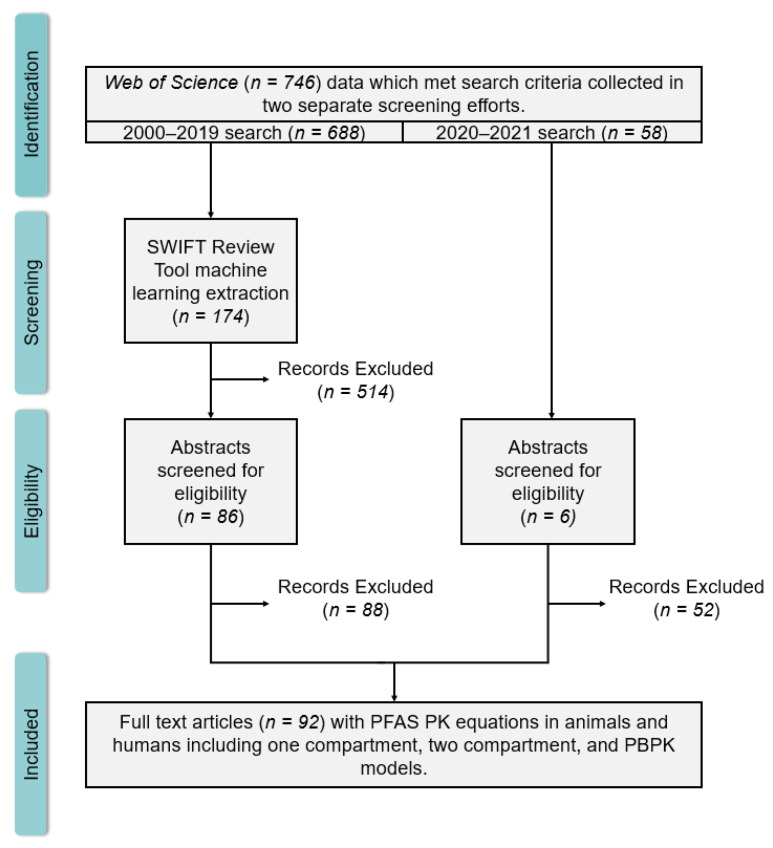
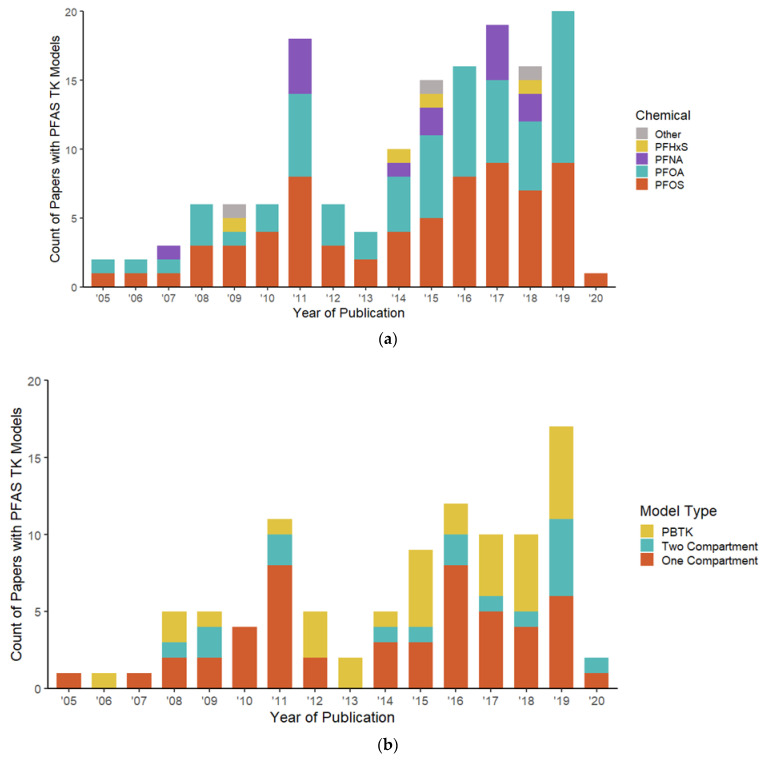
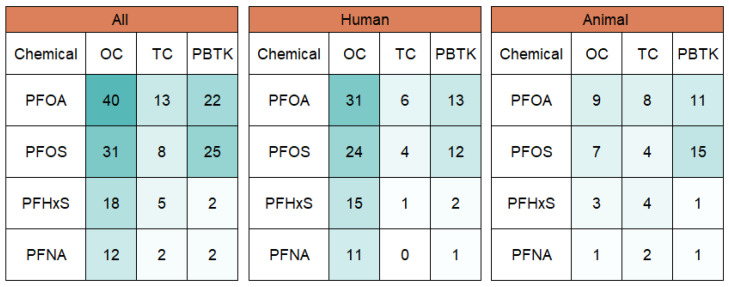
Toxicokinetic (TK) models have been used for decades to estimate concentrations of per-and polyfluoroalkyl substances (PFAS) in serum. However, model complexity has varied across studies depending on the application and the state of the science. This scoping effort seeks to systematically map the current landscape of PFAS TK models by categorizing different trends and similarities across model type, PFAS, and use scenario. A literature review using Web of Science and SWIFT-Review was used to identify TK models used for PFAS. The assessment covered publications from 2005–2020. PFOA, the PFAS for which most models were designed, was included in 69 of the 92 papers, followed by PFOS with 60, PFHxS with 22, and PFNA with 15. Only 4 of the 92 papers did not include analysis of PFOA, PFOS, PFNA, or PFHxS. Within the corpus, 50 papers contained a one-compartment model, 17 two-compartment models were found, and 33 used physiologically based pharmacokinetic (PBTK) models. The scoping assessment suggests that scientific interest has centered around two chemicals—PFOA and PFOS—and most analyses use one-compartment models in human exposure scenarios.
Overview
The claims and statistics of this paper haven’t been checked yet.
Free: it reads the open-access text and checks the first 5 claims that cite a source we can check. Create a free account to check every claim.
Integrity signals
Registry
Cites
Statistics
Figures
Verification
Claims the paper makes
The claims and statistics of this paper haven’t been checked yet.
Free: it reads the open-access text and checks the first 5 claims that cite a source we can check. Create a free account to check every claim.
Claims other papers make about this one
Each is checked against this paper’s own text: does it say what the citing paper says it does?
The source backs part of the claim, not all of it — or backs it for a different population, condition or comparison.
In the citing paper
“The long half-lives observed for these compounds should be interpreted considering their chemical properties, which contribute to their resistance against metabolic degradation and varying solubility (East et al., 2023).”
From Estimation of per- and polyfluoroalkyl substances (PFAS) half-lives in human studies: a systematic review and meta-analysis (2024) · cites this paper as East et al., 2023
Experimental — accuracy not yet measuredThe source backs part of the claim, not all of it — or backs it for a different population, condition or comparison.
In the citing paper
“This model is often adopted in pharmacokinetics, toxicology, and environmental science to estimate parameters such as half-life, clearance, and steady-state concentration”
From Estimation of per- and polyfluoroalkyl substances (PFAS) half-lives in human studies: a systematic review and meta-analysis (2024) · cites this paper as East et al., 2023
Experimental — accuracy not yet measuredThe cited source says what the claim attributes to it.
In the citing paper
“While a onecompartment model with first-order elimination may oversimplify the complex processes occurring in real-world systems, it provides a useful approximation for understanding and predicting the behaviour of substances in terms of their change in concentrations over time.”
From Estimation of per- and polyfluoroalkyl substances (PFAS) half-lives in human studies: a systematic review and meta-analysis (2024) · cites this paper as East et al., 2023
Self-check
Percentages, sums and reported differences re-computed from the paper’s own numbers.
The self-check needs the paper’s full text.
Citations
Cites
Fast unfolding of communities in large networks
Blondel, V. D., Guillaume, J.-L., Lambiotte, R., & Lefebvre, E. (2008) · Journal of Statistical Mechanics: Theory and Experiment · doi:10.1088/1742-5468/2008/10/p10008 · Cited by 21,424 · cited 1×
“The Louvain clustering algorithm [41] has been shown to be an optimal algorithm for community detection [42].”
Methodbibliometrix: An R-tool for comprehensive science mapping analysis
Aria, M., & Cuccurullo, C. (2017) · Journal of Informetrics · doi:10.1016/j.joi.2017.08.007 · Cited by 16,064 · cited 7×
“To analyze the bibliometric relationships between the authors of the included studies, the R Package Bibliometrix [38,39] and the corresponding RShiny application Biblioshiny [38] were used.”
BackgroundMethodInfluentialGraph drawing by force‐directed placement
Fruchterman, T. M. J., & Reingold, E. M. (1991) · Software: Practice and Experience · doi:10.1002/spe.4380211102 · Cited by 6,352 · cited 8×
“To analyze the bibliometric relationships between the authors of the included studies, the R Package Bibliometrix [38,39] and the corresponding RShiny application Biblioshiny [38] were used.”
MethodInfluentialCo‐citation in the scientific literature: A new measure of the relationship between two documents
Small, H. (1973) · Journal of the American Society for Information Science · doi:10.1002/asi.4630240406 · Cited by 5,345 · cited 3×
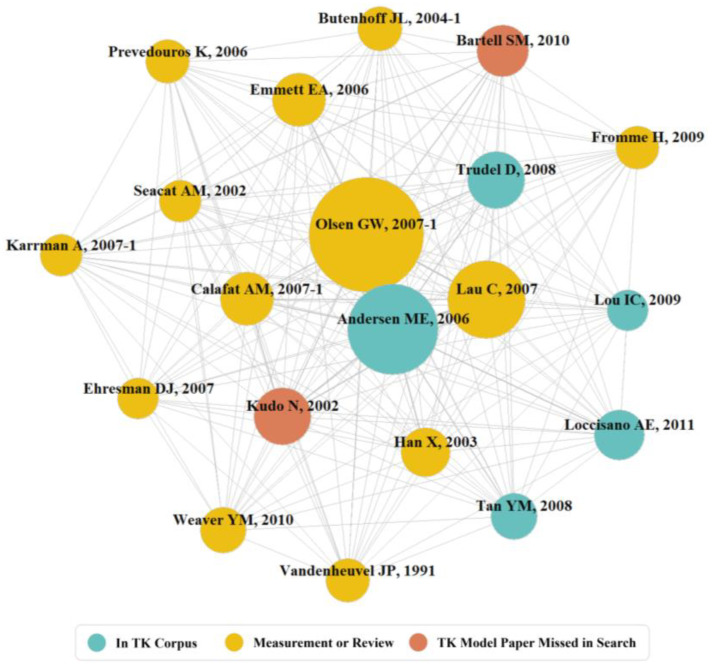
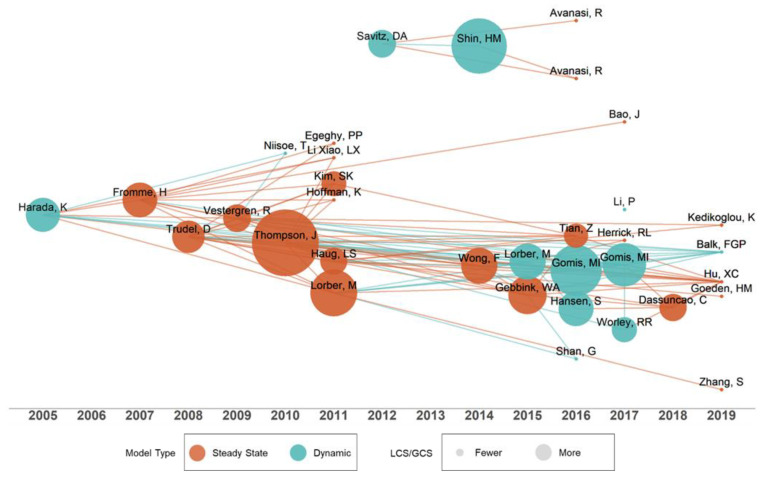
“mapping we applied methods to contextualize the papers retrieved from the scheme in Figure 1; namely, a co-citation network [38,40] based on the 2670 references of our corpus”
MethodBuck, R. C., Franklin, J., Berger, U., Conder, J. M., Cousins, I. T., de Voogt, P., Jensen, A. A., Kannan, K., Mabury, S. A., & van Leeuwen, S. P. (2011) · Integrated Environmental Assessment and Management · doi:10.1002/ieam.258 · Cited by 4,641 · cited 2×
“PFOS and PFOA are the long chain perfluoroalkyl acids most often reported in the scientific literature [5,17].”
BackgroundGlobal Distribution of Perfluorooctane Sulfonate in Wildlife
Giesy, J. P., & Kannan, K. (2001) · Environmental Science & Technology · doi:10.1021/es001834k · Cited by 2,750 · cited 1×
“Consequently, a broad range of these substances have been detected in the environment, wildlife, and humans [7,8].”
BackgroundPerfluoroalkyl Acids: A Review of Monitoring and Toxicological Findings
Lau, C., Anitole, K., Hodes, C., Lai, D., Pfahles-Hutchens, A., & Seed, J. (2007) · Toxicological Sciences · doi:10.1093/toxsci/kfm128 · Cited by 2,620
Sources, fate and transport of perfluorocarboxylates
Prevedouros, K., Cousins, I. T., Buck, R. C., & Korzeniowski, S. H. (2006) · Environmental Science & Technology · doi:10.1021/es0512475 · Cited by 2,594 · cited 1×
“5 310 No Measurement Evaluated PFAS concentration across human blood-based matrices (blood, plasma, serum) Prevedouros K, 2006 [4] 10.”
BackgroundFenton, S. E., Ducatman, A., Boobis, A., DeWitt, J. C., Lau, C., Ng, C., Smith, J. S., & Roberts, S. M. (2020) · Environmental Toxicology and Chemistry · doi:10.1002/etc.4890 · Cited by 2,445 · cited 3×
“Epidemiological studies suggest an association between these legacy PFAS chemicals and immune suppression, thyroid disease, high cholesterol, ulcerative colitis, kidney cancer, testicular cancer, breast cancer, hypertension during pregnancy, decreased weight at birth, and increased risk of miscarriage [15,16].”
BackgroundOlsen, G. W., Burris, J. M., Ehresman, D. J., Froehlich, J. W., Seacat, A. M., Butenhoff, J. L., & Zobel, L. R. (2007) · Environmental Health Perspectives · doi:10.1289/ehp.10009 · Cited by 2,049 · cited 3×
“[56] and used by both Lorber and Egeghy [69] and Egeghy and Lorber [73].”
Method
Research works printed but not linked: 4
- Khalil N. Lee M. Steenland K. Epidemiological findings Toxicological Effects of Perfluoroalkyl and Polyfluoroalkyl Substances Springer Berlin, Germany 2015 305 335
- Kudo N. Metabolism and pharmacokinetics Toxicological Effects of Perfluoroalkyl and Polyfluoroalkyl Substances Springer Berlin, Germany 2015 151 175
- Balakrishnan H. Deo N. Detecting communities using bibliographic metrics Proceedings of GrC 2006 293 298 Available online: https://www.eecs.ucf.edu/~deo/deo/IEEE-GrC.pdf (accessed on 2 February 2023)
- EPA Notification of a Public Meetings of the Science Advisory Board Per- and Polyfluoroalkyl Substances (PFAS) Review Panel Fed. Reg. 2021 86 62526
Cited by
Rosato, I., Bonato, T., Fletcher, T., Batzella, E., & Canova, C. (2024) · Environmental Research · doi:10.1016/j.envres.2023.117743 · Cited by 273
Singh, K., Kumar, N., Yadav, A. K., Singh, R. D., & Kumar, K. (2023) · Chemical Engineering Journal · doi:10.1016/j.cej.2023.145064 · Cited by 141
Occurrence of Major Perfluorinated Alkylate Substances in Human Blood and Target Organs
Nielsen, F., Fischer, F. C., Leth, P. M., & Grandjean, P. (2023) · Environmental Science & Technology · doi:10.1021/acs.est.3c06499 · Cited by 107
Kreutz, A., Chang, X., Högberg, H. T., & Wetmore, B. A. (2024) · Human Genomics · doi:10.1186/s40246-024-00691-9 · Cited by 32
“More general PBTK models for PFAS have been built as well, with many of these based on the U.S. population as this was the initial site of PFAS production [167].”
Zhu, Y., Qu, Z., Yang, L., Jia, Y., Zhang, Y., & Zhu, L. Y. (2025) · Environmental Science & Technology · doi:10.1021/acs.est.4c10349 · Cited by 30
Metadata
- Authors
- East, A., Dawson, D. E., Brady, S., Vallero, D. A., & Tornero-Velez, R.
- Affiliations
- Oak Ridge Associated Universities (US)
- Environmental Protection Agency (US)
- U.S. Environmental Protection Agency, Office of Research and Development, Center for Computational Toxicology and Exposure, 109 T.W. Alexander Drive, Research Triangle Park, NC 27709, USA
- Venue
- Toxics
- Publisher
- MDPI AG
- Published
- 2023-02-09
- Volume
- 11
- Issue
- 2
- Pages
- 163
- ISSN
- 2305-6304 (ISSN-L)
- PMC
- PMC9964825
- OpenAlex
- W4319982332
- Cited by
- 14
- References
- 106
- Citations by year
- 2026: 1 · 2025: 3 · 2024: 6 · 2023: 4
- FWCI
- 0.32
- Type
- journal article
- Language
- en
- Open access
- gold
- doi.org
- Licence
- Locations
- Toxics (publishedVersion, cc-by)
- PubMed Central (publishedVersion, cc-by)
- PubMed (publishedVersion)
- DOAJ (DOAJ: Directory of Open Access Journals) (submittedVersion, cc-by-sa)
- Funders
- The United States Environmental Protection Agency (EPA)
- Topics
- Physical Sciences › Environmental Science › Environmental Chemistry › Per- and polyfluoroalkyl substances research
- Physical Sciences › Environmental Science › Health, Toxicology and Mutagenesis › Toxic Organic Pollutants Impact
- Physical Sciences › Environmental Science › Water Science and Technology › Fluoride Effects and Removal
- Keywords
- per- and polyfluoroalkyl substances, toxicokinetic modeling, one-compartment model, physiologically based toxicokinetic model, perfluorooctanoic acid, PFOS, PFHxS, PFNA, serum PFAS concentrations, human exposure, model complexity
About these checks
Registry, retraction, Cites and statistics results are computed, not judged, with one exception: a printed reference that no index lists is read once by a model before it counts as a citation error. Claims are extracted by a model and kept only when their quote appears verbatim in the text; each cited source is then checked, with a model’s help, for whether it says what the claim relies on. Those verdicts can be wrong — read the claim’s quote and the cited source before relying on one.
Statistics and arithmetic are recomputed, not judged.
Confidence bands are shown only for fields calibrated on our annotated test set. None is calibrated yet, so no band is shown.
What counts as a claim ›How we measure confidence ›How we check this ›
Are you an author, or do you see a problem with this page? Request a review
Data sources
Bibliographic data: Semantic Scholar, OpenAlex, Crossref.
Contains information from the Semantic Scholar Academic Graph Datasets, made available under the ODC Attribution License (ODC-BY 1.0).
Semantic Scholar’s data is described in: Kinney, R., et al. (2023). The Semantic Scholar Open Data Platform. arXiv:2301.10140.
