

Impact of Antidepressants on Cytokine Production of Depressed Patients in Vitro
Open accessThe DOI matches its Crossref record; 64 of the 65 references it cites were found in a registry or an index.
Abstract
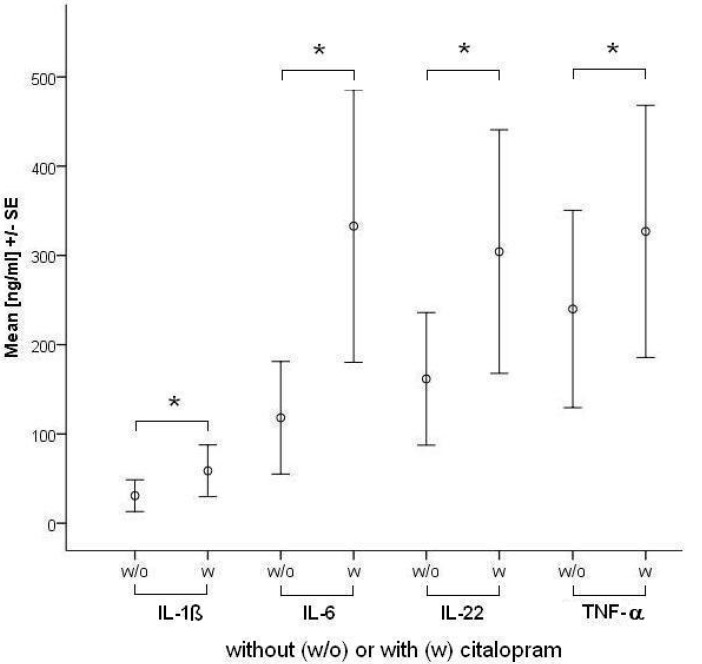
The interplay between immune and nervous systems plays a pivotal role in the pathophysiology of depression. In depressive episodes, patients show increased production of pro-inflammatory cytokines such as interleukin (IL)-1β and tumor necrosis factor (TNF)-α. There is limited information on the effect of antidepressant drugs on cytokines, most studies report on a limited sample of cytokines and none have reported effects on IL-22. We systematically investigated the effect of three antidepressant drugs, citalopram, escitalopram and mirtazapine, on secretion of cytokines IL-1β, IL-2, IL-4, IL-6, IL-17, IL-22 and TNF-α in a whole blood assay in vitro, using murine anti-human CD3 monoclonal antibody OKT3, and 5C3 monoclonal antibody against CD40, to stimulate T and B cells respectively. Citalopram increased production of IL-1β, IL-6, TNF-α and IL-22. Mirtazapine increased IL-1β, TNF-α and IL-22. Escitalopram decreased IL-17 levels. The influence of antidepressants on IL-2 and IL-4 levels was not significant for all three drugs. Compared to escitalopram, citalopram led to higher levels of IL-1β, IL-6, IL-17 and IL-22; and mirtazapine to higher levels of IL-1β, IL-17, IL-22 and TNF-α. Mirtazapine and citalopram increased IL-22 production. The differing profile of cytokine production may relate to differences in therapeutic effects, risk of relapse and side effects.
Overview
The claims and statistics of this paper haven’t been checked yet.
Free: it reads the open-access text and checks the first 5 claims that cite a source we can check. Create a free account to check every claim.
Integrity signals
Registry
Cites
Statistics
Figures
Verification
Claims the paper makes
The claims and statistics of this paper haven’t been checked yet.
Free: it reads the open-access text and checks the first 5 claims that cite a source we can check. Create a free account to check every claim.
Claims other papers make about this one
Each is checked against this paper’s own text: does it say what the citing paper says it does?
The source backs part of the claim, not all of it — or backs it for a different population, condition or comparison.
In the citing paper
“in an in vitro investigation of citalopram, mirtazapine, and escitalopram stimulation of cytokine production, researchers have shown that Citalopram and Mirtazapine increased inflammatory cytokine production, whereas escitalopram administration decreased cytokine concentrations (Munzer et al., 2013).”
From A Review of the Relationship between Proinflammatory Cytokines and Major Depressive Disorder (2014) · cites this paper as Munzer et al., 2013
Experimental — accuracy not yet measuredThe cited source says what the claim attributes to it.
In the citing paper
“What in vitro studies clearly show, however, is that antidepressants (69), antipsychotics (208) and mood stabilizers (209) have a direct influence on cytokine production within the blood.”
From Cytokine Research in Depression: Principles, Challenges, and Open Questions (2019) · cites this paper as [69]
The cited source says what the claim attributes to it.
In the citing paper
“However, the SSRI citalopram increased the production of IL-1β, IL-6, and TNF-α in another in vitro study (69).”
From Cytokine Research in Depression: Principles, Challenges, and Open Questions (2019) · cites this paper as [69]
The cited source says what the claim attributes to it.
In the citing paper
“Although some studies have demonstrated that antidepressants decrease inflammatory cytokines (38, 39), others report either no effect (31, 40, 41) or even increased levels (42, 43).”
From Individual differences in the peripheral immune system promote resilience versus susceptibility to social stress (2014) · cites this paper as [43]
The cited source says what the claim attributes to it.
In the citing paper
“Indeed, the literature describing the effects of standard antidepressants on systemic inflammation is highly mixed.”
From Individual differences in the peripheral immune system promote resilience versus susceptibility to social stress (2014) · cites this paper as [43]
2 more claims about this paper
Create a free account to see every claim other papers make about this one.
Self-check
Percentages, sums and reported differences re-computed from the paper’s own numbers.
The self-check needs the paper’s full text.
Citations
Cites
An inventory for measuring depression
BECK, A. T. (1961) · Archives of General Psychiatry · doi:10.1001/archpsyc.1961.01710120031004 · Cited by 38,032 · cited 2×
“Baseline Mean (SD) BDI was 17.5 (7.7) and HAMD 28.7 (9.6).”
MethodInfluentialHamilton, M. (1960) · Journal of Neurology, Neurosurgery & Psychiatry · doi:10.1136/jnnp.23.1.56 · Cited by 32,817 · cited 1×
“At admission, diagnosis of major depression was confirmed on the Structured Clinical Interview for DSM-IV (SKID-I) [55], and symptom severity on the Beck Depression Inventory (BDI) [56] and Hamilton Depression Rating Scale (HDRS) [57].”
MethodMolecular Mechanisms of Depression: Perspectives on New Treatment Strategies
Lang, U. E., & Borgwardt, S. (2013) · Cellular Physiology and Biochemistry · doi:10.1159/000350094 · Cited by 8,475
Scoville, W. B. (1949) · Journal of neurosurgery · doi:10.3171/jns.1949.6.1.0065 · Cited by 7,381
A distinct lineage of CD4 T cells regulates tissue inflammation by producing interleukin 17
Park, H., Li, Z., Yang, X. O., Chang, S. H., Nurieva, R., Wang, Y.-H., Wang, Y., Hood, L., Zhu, Z., Tian, Q., et al. (2005) · Nature Immunology · doi:10.1038/ni1261 · Cited by 4,265 · cited 2×
“This is of note, because T helper type 17 (TH17) cells which produce IL-17 and IL-22 are implicated in numerous immune and inflammatory processes [22–24].”
BackgroundCipriani, A., Furukawa, T. A., Salanti, G., Geddes, J. R., Higgins, J. P., Churchill, R., Watanabe, N., Nakagawa, A., Omori, I. M., McGuire, H., et al. (2009) · The Lancet · doi:10.1016/s0140-6736(09)60046-5 · Cited by 1,654 · cited 1×
“effectiveness as well as side effects into account [33].”
BackgroundImmune system to brain signaling: Neuropsychopharmacological implications
Capuron, L., & Miller, A. H. (2011) · Pharmacology & Therapeutics · doi:10.1016/j.pharmthera.2011.01.014 · Cited by 1,195 · cited 1×
“Particularly important are cytokine-induced changes in metabolism of the monoamines dopamine, noradrenalin and serotonin, in midbrain nuclei with widespread projections [7–9].”
BackgroundMünster, R. D. (1999) · Zeitschrift für Klinische Psychologie und Psychotherapie · doi:10.1026//0084-5345.28.1.68 · Cited by 1,010
Hannestad, J., DellaGioia, N., & Bloch, M. (2011) · Neuropsychopharmacology · doi:10.1038/npp.2011.132 · Cited by 914 · cited 1×
“A meta-analysis on the effect of antidepressant medication on serum levels of inflammatory cytokines in vivo for example showed that, overall, while pharmacological antidepressant treatment reduces depressive symptoms, it does not influence TNF-α levels, reduces levels of IL-1β and possibly reduces those of IL-6, too…”
BackgroundMüller, N., Schwarz, M. J., Dehning, S., Douhe, A., Cerovecki, A., Goldstein-Müller, B., Spellmann, I., Hetzel, G., Maino, K., Kleindienst, N., et al. (2006) · Molecular Psychiatry · doi:10.1038/sj.mp.4001805 · Cited by 794 · cited 1×
“A significant therapeutic effect of celecoxib in major depression was also found in a randomized, double-blind pilot add-on study of reboxetine and celecoxib versus reboxetine and placebo [20].”
Background
Research works printed but not linked: 3
- 43. Liu, S.J.; Zhou, W.; Kennedy, R.H. Suppression of b-adrenergic responsiveness of L-type Ca2+ current by IL-1b in rat ventricular myocytes. Am. J. Physiol. 1999 , 276 , 141-148.
- 47. Weschenfelder, J.; Sander, C.; Kluge, M.; Kirkby, K.C.; Himmerich, H. The influence of cytokines on wakefulness regulation: clinical relevance, mechanisms and methodological problems. Psychiatr. Danub. 2012 , 24 , 112-126.
- 59. Seidel, A.; Arolt, V.; Hunstiger, M.; Rink, L.; Behnisch, A.; Kirchner, H. Cytokine production and serum proteins in depression. Scand. J. Immunol. 1995 , 41 , 534-538. · DOI · Paper page
Cited by
Items 101–114 of 114
Zou, Z., Zhang, Y., Huang, Y., Wang, J., Zhou, B., & Chen, H.-F. (2023) · World Journal of Psychiatry · doi:10.5498/wjp.v13.i8.524 · Cited by 2
Hancock, J., Sirbu, C., & Kerr, P. L. (2024) · Advances in neurobiology · doi:10.1007/978-3-031-45493-6_21 · Cited by 1
Petrozzi, B. P., Lamadé, E. K., Hübner, N., Zippelius, J., Neumann, E., & Sammer, G. (2025) · Biomarkers in Neuropsychiatry · doi:10.1016/j.bionps.2025.100121 · Cited by 1
Interlinking antidepressants and the immune system
Lisowska, K. A., Pietruczuk, K., & Szałach, Ł. P. (2021) · Elsevier eBooks · doi:10.1016/b978-0-12-817933-8.00050-5 · Cited by 1
The two sides of the coin of psychosocial stress: evaluation by positron emission tomography
Feltes, P. K. (2018) · University of Groningen research database (University of Groningen / Centre for Information Technology)
Small fiber neuropathy: from underlying conditions to treatment
Greef, D. T. T. (2019) · Research Publications (Maastricht University) · doi:10.26481/dis.20190315bg
Akbayır, E., Şen, M., Arsoy, E., Türkoğlu, R., Yılmaz, V., & Tüzün, E. (2021) · Journal of Multiple Sclerosis Research · doi:10.4274/jmsr.galenos.2021.2021.8-3
Faculty Opinions recommendation of Self-rated depression and eye diseases: The Beijing Eye Study.
Galor, A., & Aggarwal, S. (2018) · Faculty Opinions – Post-Publication Peer Review of the Biomedical Literature · doi:10.3410/f.733796938.793554009
Metabolic stress and antipsychotic treatment induced gene expression alterations in human cell
Kálmán, S. (2016) · SZTE Repository of Dissertations (University of Szeged) · doi:10.14232/phd.2988
Innate lymphoid cells in depression: Current status and perspectives
Madeshiya, A. K., & Pillai, A. (2022) · Biomarkers in Neuropsychiatry · doi:10.1016/j.bionps.2022.100055
Li, X., Liu, T., Mo, X., Wang, R., Kong, X., Shao, R., McIntyre, R. S., So, K., & Lin, K. (2022) · Research Square · doi:10.21203/rs.3.rs-2031269/v1
The association between depression and anxiety with COVID-19 outcomes.
Miller, E. (2021) · ThinkIR: The University of Louisville's Institutional Repository (University of Louisville) · doi:10.18297/etd/3790
“A study that treated in vitro of whole blood cultures with selective serotonin reuptake inhibitors (SSRIs) and mirtazapine, tetracyclic antidepressant, increased the production of cytokines [61].”
BackgroundBalcı, A., Çakır, D. A., KÖSE, S. B. E., & Erkekoğlu, P. (2026) · Journal of Applied Toxicology · doi:10.1002/jat.70083
“…IL-1β decreases and possibly IL-6 decreases with antidepressant treatment, whereas TNF-α is often unchanged overall, with SSRI-specific reductions in subgroups (Hannestad et al. 2011) yet aligns with in vitro immune cell studies demonstrating increased cytokine production (Munzer et al. 2013).”
Pramanik, A., Sarkar, D., Mondal, P., Saha, J., Mahanti, K., Mahato, M., Majumdar, S., Pramanik, A., & Bhattacharyya, S. (2026) · British Journal of Pharmacology · doi:10.1111/bph.70722
Metadata
- Authors
- Munzer, A., Sack, U., Mergl, R., Schönherr, J., Petersein, C., Bartsch, S., Kirkby, K., Bauer, K., & Himmerich, H.
- Affiliations
- Leipzig University (DE)
- University of Tasmania (AU)
- Corresponding author
- Himmerich, Hubertus
- Venue
- Toxins
- Publisher
- MDPI AG
- Published
- 2013-11-19
- Volume
- 5
- Issue
- 11
- Pages
- 2227-2240
- ISSN
- 2072-6651 (ISSN-L)
- PMC
- PMC3847723
- OpenAlex
- W2120334173
- Cited by
- 114
- References
- 65
- Citations by year
- 2026: 4 · 2025: 4 · 2024: 6 · 2023: 8 · 2022: 9 · 2021: 15 · 2020: 5 · 2019: 10 · 2018: 9 · 2017: 10 · 2016: 14 · 2015: 13 · 2014: 7
- FWCI
- 3.81
- Type
- journal article
- Language
- en
- Open access
- gold
- doi.org
- Licence
- Locations
- Toxins (publishedVersion, cc-by)
- Europe PMC (PubMed Central) (publishedVersion, cc-by)
- PubMed Central (publishedVersion, cc-by)
- PubMed (publishedVersion)
- eCite Digital Repository (University of Tasmania) (submittedVersion, cc-by)
- DOAJ (DOAJ: Directory of Open Access Journals) (submittedVersion, cc-by-sa)
- Figshare (submittedVersion, cc-by)
- Funders
- Bristol-Myers Squibb
- Eli Lilly and Company
- AstraZeneca
- Servier
- H. Lundbeck A/S
- Topics
- Life Sciences › Neuroscience › Biological Psychiatry › Tryptophan and brain disorders
- Health Sciences › Medicine › Pharmacology (medical) › Treatment of Major Depression
- Life Sciences › Neuroscience › Behavioral Neuroscience › Stress Responses and Cortisol
- Keywords
- antidepressants, depression, cytokine production, citalopram, escitalopram, mirtazapine, IL-22, IL-1β, TNF-α, IL-17, interleukin-6, IL-4, interleukin-2, inflammatory cytokines, neuroimmunology, whole blood stimulation, OKT3, CD40
- MeSH terms
- Mirtazapine, Interleukin-22, Adult, Antidepressive Agents, Depression, Female, Humans, Interleukin-2, Interleukins, Male, Mianserin, Middle Aged, Tumor Necrosis Factor-alpha, Citalopram, Interleukin-4, Interleukin-6, Cytokines, Muromonab-CD3, CD40 Antigens, Interleukin-17, Interleukin-1beta
About these checks
Registry, retraction, Cites and statistics results are computed, not judged, with one exception: a printed reference that no index lists is read once by a model before it counts as a citation error. Claims are extracted by a model and kept only when their quote appears verbatim in the text; each cited source is then checked, with a model’s help, for whether it says what the claim relies on. Those verdicts can be wrong — read the claim’s quote and the cited source before relying on one.
Statistics and arithmetic are recomputed, not judged.
Confidence bands are shown only for fields calibrated on our annotated test set. None is calibrated yet, so no band is shown.
What counts as a claim ›How we measure confidence ›How we check this ›
Are you an author, or do you see a problem with this page? Request a review
Data sources
Bibliographic data: Semantic Scholar, OpenAlex, Crossref.
Contains information from the Semantic Scholar Academic Graph Datasets, made available under the ODC Attribution License (ODC-BY 1.0).
Semantic Scholar’s data is described in: Kinney, R., et al. (2023). The Semantic Scholar Open Data Platform. arXiv:2301.10140.
