

Impact of Antidepressants on Cytokine Production of Depressed Patients in Vitro
Open accessThe DOI matches its Crossref record; 64 of the 65 references it cites were found in a registry or an index.
Abstract
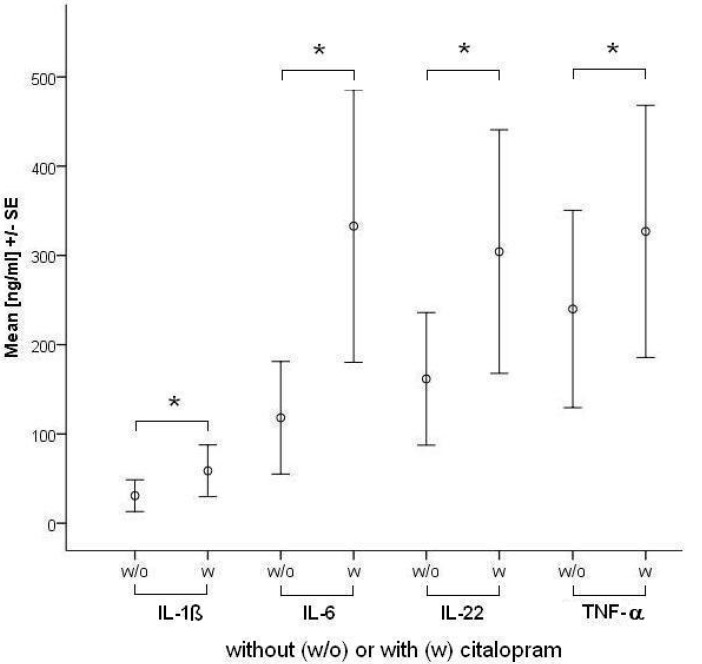
The interplay between immune and nervous systems plays a pivotal role in the pathophysiology of depression. In depressive episodes, patients show increased production of pro-inflammatory cytokines such as interleukin (IL)-1β and tumor necrosis factor (TNF)-α. There is limited information on the effect of antidepressant drugs on cytokines, most studies report on a limited sample of cytokines and none have reported effects on IL-22. We systematically investigated the effect of three antidepressant drugs, citalopram, escitalopram and mirtazapine, on secretion of cytokines IL-1β, IL-2, IL-4, IL-6, IL-17, IL-22 and TNF-α in a whole blood assay in vitro, using murine anti-human CD3 monoclonal antibody OKT3, and 5C3 monoclonal antibody against CD40, to stimulate T and B cells respectively. Citalopram increased production of IL-1β, IL-6, TNF-α and IL-22. Mirtazapine increased IL-1β, TNF-α and IL-22. Escitalopram decreased IL-17 levels. The influence of antidepressants on IL-2 and IL-4 levels was not significant for all three drugs. Compared to escitalopram, citalopram led to higher levels of IL-1β, IL-6, IL-17 and IL-22; and mirtazapine to higher levels of IL-1β, IL-17, IL-22 and TNF-α. Mirtazapine and citalopram increased IL-22 production. The differing profile of cytokine production may relate to differences in therapeutic effects, risk of relapse and side effects.
Overview
The claims and statistics of this paper haven’t been checked yet.
Free: it reads the open-access text and checks the first 5 claims that cite a source we can check. Create a free account to check every claim.
Integrity signals
Registry
Cites
Statistics
Figures
Verification
Claims the paper makes
The claims and statistics of this paper haven’t been checked yet.
Free: it reads the open-access text and checks the first 5 claims that cite a source we can check. Create a free account to check every claim.
Claims other papers make about this one
Each is checked against this paper’s own text: does it say what the citing paper says it does?
The source backs part of the claim, not all of it — or backs it for a different population, condition or comparison.
In the citing paper
“in an in vitro investigation of citalopram, mirtazapine, and escitalopram stimulation of cytokine production, researchers have shown that Citalopram and Mirtazapine increased inflammatory cytokine production, whereas escitalopram administration decreased cytokine concentrations (Munzer et al., 2013).”
From A Review of the Relationship between Proinflammatory Cytokines and Major Depressive Disorder (2014) · cites this paper as Munzer et al., 2013
Experimental — accuracy not yet measuredThe cited source says what the claim attributes to it.
In the citing paper
“What in vitro studies clearly show, however, is that antidepressants (69), antipsychotics (208) and mood stabilizers (209) have a direct influence on cytokine production within the blood.”
From Cytokine Research in Depression: Principles, Challenges, and Open Questions (2019) · cites this paper as [69]
The cited source says what the claim attributes to it.
In the citing paper
“However, the SSRI citalopram increased the production of IL-1β, IL-6, and TNF-α in another in vitro study (69).”
From Cytokine Research in Depression: Principles, Challenges, and Open Questions (2019) · cites this paper as [69]
The cited source says what the claim attributes to it.
In the citing paper
“Although some studies have demonstrated that antidepressants decrease inflammatory cytokines (38, 39), others report either no effect (31, 40, 41) or even increased levels (42, 43).”
From Individual differences in the peripheral immune system promote resilience versus susceptibility to social stress (2014) · cites this paper as [43]
The cited source says what the claim attributes to it.
In the citing paper
“Indeed, the literature describing the effects of standard antidepressants on systemic inflammation is highly mixed.”
From Individual differences in the peripheral immune system promote resilience versus susceptibility to social stress (2014) · cites this paper as [43]
2 more claims about this paper
Create a free account to see every claim other papers make about this one.
Self-check
Percentages, sums and reported differences re-computed from the paper’s own numbers.
The self-check needs the paper’s full text.
Citations
Cites
An inventory for measuring depression
BECK, A. T. (1961) · Archives of General Psychiatry · doi:10.1001/archpsyc.1961.01710120031004 · Cited by 38,032 · cited 2×
“Baseline Mean (SD) BDI was 17.5 (7.7) and HAMD 28.7 (9.6).”
MethodInfluentialHamilton, M. (1960) · Journal of Neurology, Neurosurgery & Psychiatry · doi:10.1136/jnnp.23.1.56 · Cited by 32,817 · cited 1×
“At admission, diagnosis of major depression was confirmed on the Structured Clinical Interview for DSM-IV (SKID-I) [55], and symptom severity on the Beck Depression Inventory (BDI) [56] and Hamilton Depression Rating Scale (HDRS) [57].”
MethodMolecular Mechanisms of Depression: Perspectives on New Treatment Strategies
Lang, U. E., & Borgwardt, S. (2013) · Cellular Physiology and Biochemistry · doi:10.1159/000350094 · Cited by 8,475
Scoville, W. B. (1949) · Journal of neurosurgery · doi:10.3171/jns.1949.6.1.0065 · Cited by 7,381
A distinct lineage of CD4 T cells regulates tissue inflammation by producing interleukin 17
Park, H., Li, Z., Yang, X. O., Chang, S. H., Nurieva, R., Wang, Y.-H., Wang, Y., Hood, L., Zhu, Z., Tian, Q., et al. (2005) · Nature Immunology · doi:10.1038/ni1261 · Cited by 4,265 · cited 2×
“This is of note, because T helper type 17 (TH17) cells which produce IL-17 and IL-22 are implicated in numerous immune and inflammatory processes [22–24].”
BackgroundCipriani, A., Furukawa, T. A., Salanti, G., Geddes, J. R., Higgins, J. P., Churchill, R., Watanabe, N., Nakagawa, A., Omori, I. M., McGuire, H., et al. (2009) · The Lancet · doi:10.1016/s0140-6736(09)60046-5 · Cited by 1,654 · cited 1×
“effectiveness as well as side effects into account [33].”
BackgroundImmune system to brain signaling: Neuropsychopharmacological implications
Capuron, L., & Miller, A. H. (2011) · Pharmacology & Therapeutics · doi:10.1016/j.pharmthera.2011.01.014 · Cited by 1,195 · cited 1×
“Particularly important are cytokine-induced changes in metabolism of the monoamines dopamine, noradrenalin and serotonin, in midbrain nuclei with widespread projections [7–9].”
BackgroundMünster, R. D. (1999) · Zeitschrift für Klinische Psychologie und Psychotherapie · doi:10.1026//0084-5345.28.1.68 · Cited by 1,010
Hannestad, J., DellaGioia, N., & Bloch, M. (2011) · Neuropsychopharmacology · doi:10.1038/npp.2011.132 · Cited by 914 · cited 1×
“A meta-analysis on the effect of antidepressant medication on serum levels of inflammatory cytokines in vivo for example showed that, overall, while pharmacological antidepressant treatment reduces depressive symptoms, it does not influence TNF-α levels, reduces levels of IL-1β and possibly reduces those of IL-6, too…”
BackgroundMüller, N., Schwarz, M. J., Dehning, S., Douhe, A., Cerovecki, A., Goldstein-Müller, B., Spellmann, I., Hetzel, G., Maino, K., Kleindienst, N., et al. (2006) · Molecular Psychiatry · doi:10.1038/sj.mp.4001805 · Cited by 794 · cited 1×
“A significant therapeutic effect of celecoxib in major depression was also found in a randomized, double-blind pilot add-on study of reboxetine and celecoxib versus reboxetine and placebo [20].”
BackgroundCytokine, Sickness Behavior, and Depression
Dantzer, R. (2009) · Immunology and Allergy Clinics of North America · doi:10.1016/j.iac.2009.02.002 · Cited by 789 · cited 1×
“It is presumed that pro-inflammatory cytokines trigger sickness behavior [3] and may therefore be relevant in the development of depression.”
BackgroundDepression and sickness behavior are Janus-faced responses to shared inflammatory pathways
Maes, M., Berk, M., Goehler, L., Song, C., Anderson, G., Gałecki, P., & Leonard, B. (2012) · BMC Medicine · doi:10.1186/1741-7015-10-66 · Cited by 629 · cited 1×
“In clinical depression, these inflammatory pathways may be sensitized, leading to oxidative and nitrosative stress to lipids, proteins, and deoxyribonucleic acid [6], and culminating in progressive neuronal damage.”
BackgroundThe AGNP-TDM Expert Group Consensus Guidelines: Therapeutic Drug Monitoring in Psychiatry
Baumann, P., Hiemke, C., Ulrich, S., Eckermann, G., Gaertner, I., Gerlach, M., Kuss, H.-J., Laux, G., Müller-Oerlinghausen, B., Rao, M. L., et al. (2004) · Pharmacopsychiatry · doi:10.1055/s-2004-832687 · Cited by 419
Akhondzadeh, S., Jafari, S., Raisi, F., Nasehi, A. A., Ghoreishi, A., Salehi, B., Mohebbi-Rasa, S., Raznahan, M., & Kamalipour, A. (2009) · Depression and Anxiety · doi:10.1002/da.20589 · Cited by 397 · cited 1×
“For example, the combination of the SSRI fluoxetine and the cyclooxygenase-2 (COX-2) inhibitor celecoxib had a greater benefit than monotherapy with fluoxetine alone [19].”
BackgroundTh17 Cell, the New Player of Neuroinflammatory Process in Multiple Sclerosis
Jadidi‐Niaragh, F., & Mirshafiey, A. (2011) · Scandinavian Journal of Immunology · doi:10.1111/j.1365-3083.2011.02536.x · Cited by 384 · cited 1×
“Moreover, IL-22 has been implicated in several inflammatory processes of the nervous system such as Guillain-Barré syndrome [26], West Nile encephalitis [27] and multiple sclerosis (MS) [28].”
BackgroundThe AGNP-TDM Expert Group Consensus Guidelines: Therapeutic Drug Monitoring in Psychiatry
Gaertner, I., Baumann, P., Hiemke, C., Ulrich, S., Eckermann, G., Gerlach, M., Kuss, H., Laux, G., Müller-Oerlinghausen, B., Rao, M., et al. (2005) · Pharmacopsychiatry · doi:10.1055/s-2005-862645 · Cited by 343
(2008) · PubMed · Cited by 325
Cytokines as modulators of the hypothalamus-pituitary-adrenal axis
Besedovsky, H. O., Del Rey, A., Klusman, I., Furukawa, H., Monge Arditi, G., & Kabiersch, A. (1991) · The Journal of Steroid Biochemistry and Molecular Biology · doi:10.1016/0960-0760(91)90284-c · Cited by 314 · cited 1×
“In addition, IL-1β, IL-6 and TNF-α induce cortisol hypersecretion, directly by stimulating the hypothalamic-pituitary-adrenal (HPA)-axis [13], and indirectly by modifying the sensitivity of the glucocorticoid receptor [14].”
BackgroundVieweg, W. V. R., Hasnain, M., Howland, R. H., Hettema, J. M., Kogut, C., Wood, M. A., & Pandurangi, A. K. (2012) · The American Journal of Medicine · doi:10.1016/j.amjmed.2011.12.002 · Cited by 270
Sánchez, C., Bergqvist, P. B. F., Brennum, L. T., Gupta, S., Hogg, S., Larsen, A., & Wiborg, O. (2003) · Psychopharmacology · doi:10.1007/s00213-002-1364-z · Cited by 265 · cited 2×
“Our finding that citalopram leads to higher levels of the wide range of pro-inflammatory agents IL-1β, IL-6, IL-17, IL-22 and TNF-α may explain the weaker antidepressant efficacy of citalopram compared to escitalopram [31–34].”
BackgroundCytokine Production and Serum Proteins in Depression
SEIDEL, A., AROLT, V., HUNSTIGER, M., RINK, L., BEHNISCH, A., & KIRCHNER, H. (1995) · Scandinavian Journal of Immunology · doi:10.1111/j.1365-3083.1995.tb03604.x · Cited by 244 · cited 1×
“The whole blood assay was performed as described previously [58,59].”
MethodGazewood, J. D., Richards, D., & Clebak, K. T. (2013) · PubMed · Cited by 211
Depression, comorbidities and the TNF-α system
Himmerich, H., Fulda, S., Linseisen, J., Seiler, H., Wolfram, G., Himmerich, S., Gedrich, K., Kloiber, S., Lucae, S., Ising, M., et al. (2008) · European Psychiatry · doi:10.1016/j.eurpsy.2008.03.013 · Cited by 181
Self-citationLi, Y., Xiao, B., Qiu, W., Yang, L., Hu, B., Tian, X., & Yang, H. (2010) · Journal of Affective Disorders · doi:10.1016/j.jad.2009.10.018 · Cited by 163 · cited 1×
“healthy controls [54] and it could, in turn, be demonstrated that antidepressant treatment leads to an elevation of these cells [17].”
BackgroundA whole-blood technique for testing production of human interferon by leukocytes
Kirchner, H., Kleinicke, C., & Digel, W. (1982) · Journal of Immunological Methods · doi:10.1016/0022-1759(82)90195-8 · Cited by 163 · cited 1×
“The whole blood assay was performed as described previously [58,59].”
MethodInterleukin-17-producing T helper cells in autoimmunity
Hemdan, N. Y. A., Birkenmeier, G., Wichmann, G., El-Saad, A. M. A., Krieger, T., Conrad, K., & Sack, U. (2010) · Autoimmunity Reviews · doi:10.1016/j.autrev.2010.07.003 · Cited by 158
Self-citationThe role of Th17 lymphocytes in the autoimmune and chronic inflammatory diseases
Murdaca, G., Colombo, B. M., & Puppo, F. (2011) · Internal and Emergency Medicine · doi:10.1007/s11739-011-0517-7 · Cited by 158 · cited 2×
“This is of note, because T helper type 17 (TH17) cells which produce IL-17 and IL-22 are implicated in numerous immune and inflammatory processes [22–24].”
BackgroundRegulation of the Human Serotonin Transporter by Interleukin-1β
Ramamoorthy, S., Ramamoorthy, J. D., Prasad, P. D., Bhat, G. K., Mahesh, V. B., Leibach, F. H., & Ganapathy, V. (1995) · Biochemical and Biophysical Research Communications · doi:10.1006/bbrc.1995.2659 · Cited by 156 · cited 1×
“and TNF-α stimulate the gene expression of serotonin reuptake transporters [10] and IL-1β and IFN-γ stimulate enzymes such as indolamine-2,3-dioxygenase (IDO) [11].”
BackgroundCytokines as biomarkers in depressive disorder: current standing and prospects
Lichtblau, N., Schmidt, F. M., Schumann, R., Kirkby, K. C., & Himmerich, H. (2013) · International Review of Psychiatry · doi:10.3109/09540261.2013.813442 · Cited by 155 · cited 7×
“Increased pro-inflammatory cytokines, including interleukin (IL)-1β, IL-6, tumor necrosis factor (TNF)-α and interferon (IFN)-γ, seem to play an important role in this respect [1,2].”
BackgroundInfluentialSelf-citationKaprielian, R., Wickenden, A. D., Kassiri, Z., Parker, T. G., Liu, P. P., & Backx*, P. H. (1999) · The Journal of Physiology · doi:10.1111/j.1469-7793.1999.0229z.x · Cited by 148 · cited 1×
“For example, it is known that pro-inflammatory cytokines influence the sensitivity of β-adrenergic receptors [42] as well as calcium [43] and potassium [44] channels, which may contribute to cardiac”
BackgroundKraus, T., Haack, M., Schuld, A., Hinze-Selch, D., Koethe, D., & Pollmächer, T. (2002) · Pharmacopsychiatry · doi:10.1055/s-2002-36390 · Cited by 144 · cited 1×
“been reported to increase the plasma concentration of TNF-α and its soluble receptors (TNF-R) p55 and p75 in depressed patients [49].”
BackgroundEscitalopram in the treatment of major depressive disorder: A meta-analysis
Kennedy, S. H., Andersen, H. F., & Thase, M. E. (2009) · Current Medical Research and Opinion · doi:10.1185/03007990802622726 · Cited by 140 · cited 1×
“Escitalopram compared to citalopram has been reported as having greater efficacy, fewer side effects, and greater cost-effectiveness due to higher relapse prevention and reduced hospital stay [31–36].”
BackgroundFrucht, S. J. (2004) · The Neurologist · doi:10.1097/01.nrl.0000131146.08278.a5 · Cited by 139
Avitsur, R., & Yirmiya, R. (1999) · Pharmacology Biochemistry and Behavior · doi:10.1016/s0091-3057(99)00165-3 · Cited by 131 · cited 1×
“infection, which exposes the mother and the fetus to dangers such as spontaneous abortion, preterm labor and maternal mortality [48].”
BackgroundThe TNF-α System: Functional Aspects in Depression, Narcolepsy and Psychopharmacology
Berthold-Losleben, M., & Himmerich, H. (2008) · Current Neuropharmacology · doi:10.2174/157015908785777238 · Cited by 119 · cited 1×
“Particularly important are cytokine-induced changes in metabolism of the monoamines dopamine, noradrenalin and serotonin, in midbrain nuclei with widespread projections [7–9].”
BackgroundSelf-citationEmerging role of interleukin-22 in autoimmune diseases
Pan, H.-F., Li, X.-P., Zheng, S. G., & Ye, D.-Q. (2013) · Cytokine & Growth Factor Reviews · doi:10.1016/j.cytogfr.2012.07.002 · Cited by 117 · cited 1×
“Studies have indicated the importance of IL-22 in host defense and in the development and pathogenesis of several autoimmune diseases [25].”
BackgroundRegulatory T cells increased while IL-1β decreased during antidepressant therapy
Himmerich, H., Milenović, S., Fulda, S., Plümäkers, B., Sheldrick, A. J., Michel, T. M., Kircher, T., & Rink, L. (2010) · Journal of Psychiatric Research · doi:10.1016/j.jpsychires.2010.03.005 · Cited by 116 · cited 3×
“regulatory T cells (Tregs) have been reported during antidepressant treatment [17].”
BackgroundSelf-citationInflammation, Serotonin and Major Depression
Catena-Dell’Osso, M., Rotella, F., Dell’Osso, A., Fagiolini, A., & Marazziti, D. (2013) · Current Drug Targets · doi:10.2174/13894501113149990154 · Cited by 107 · cited 1×
“which can cause depressive disorders [12].”
Interplay between pro-inflammatory cytokines and growth factors in depressive illnesses
Audet, M.-C., & Anisman, H. (2013) · Frontiers in Cellular Neuroscience · doi:10.3389/fncel.2013.00068 · Cited by 104 · cited 1×
“serve as biomarkers in individualised treatment of depressive disorders [16].”
BackgroundImpact of mood stabilizers and antiepileptic drugs on cytokine production in-vitro
Himmerich, H., Bartsch, S., Hamer, H., Mergl, R., Schönherr, J., Petersein, C., Munzer, A., Kirkby, K. C., Bauer, K., & Sack, U. (2013) · Journal of Psychiatric Research · doi:10.1016/j.jpsychires.2013.07.026 · Cited by 100
Self-citationThe role of anti-inflammatory treatment in psychiatric disorders.
Müller, N. (2013) · PubMed · Cited by 95
Glucocorticoids inhibitGATA‐3 phosphorylation and activity in T cells
Liberman, A. C., Druker, J., Refojo, D., Holsboer, F., & Arzt, E. (2009) · The FASEB Journal · doi:10.1096/fj.08-121236 · Cited by 87 · cited 1×
“The hormone systems such as the glucocorticoid system also exert an important influence on the immune system as well as on brain function [52,53].”
Background[Parkinson disease. Update in 1999].
Veciana, J. M. G., & Bojarsky, J. K. (1999) · PubMed · Cited by 87
IL-17 and IL-22 in Cerebrospinal Fluid and Plasma Are Elevated in Guillain-Barré Syndrome
Li, S., Yu, M., Li, H., Zhang, H., & Jiang, Y. (2012) · Mediators of Inflammation · doi:10.1155/2012/260473 · Cited by 85
The role of inflammatory cytokines on the aetiopathogenesis of depression
Makhija, K., & Karunakaran, S. (2013) · Australian & New Zealand Journal of Psychiatry · doi:10.1177/0004867413488220 · Cited by 76 · cited 2×
“However, the complex pathology of depression [14] suggests that a composite biomarker would be required to incorporate, for example, cytokines, stress hormones and psychopathological measures [1].”
BackgroundIL-22 Signaling Contributes to West Nile Encephalitis Pathogenesis
Wang, P., Bai, F., Zenewicz, L. A., Dai, J., Gate, D., Cheng, G., Yang, L., Qian, F., Yuan, X., Montgomery, R. R., et al. (2012) · PLoS ONE · doi:10.1371/journal.pone.0044153 · Cited by 73 · cited 1×
“Moreover, IL-22 has been implicated in several inflammatory processes of the nervous system such as Guillain-Barré syndrome [26], West Nile encephalitis [27] and multiple sclerosis (MS) [28].”
BackgroundPound, J. D., Challa, A., Holder, M. J., Armitage, R. J., Dower, S., Fanslow, W. C., Kikutani, H., Paulie, S., Gregory, C. D., & Gordon, J. (1999) · International Immunology · doi:10.1093/intimm/11.1.11 · Cited by 62
Humanization of the murine anti-human CD3 monoclonal antibody OKT3
Adair, J. R., Athwal, D. S., Bodmer, M. W., Bright, S. M., Collins, A. M., Pulito, V. L., Rao, P. E., Reedman, R., Rothermel, A. L., Xu, D., et al. (1994) · Human Antibodies · doi:10.3233/hab-1994-51-206 · Cited by 60
Schilström, B., Konradsson‐Geuken, Å., Ivanov, V., Gertow, J., Feltmann, K., Marcus, M. M., Jardemark, K., & Svensson, T. H. (2011) · Synapse · doi:10.1002/syn.20853 · Cited by 54 · cited 1×
“Escitalopram binds to an allosteric site on the serotonin transporter, which further enhances the blockade of serotonin reuptake, whereas R-citalopram antagonizes this positive allosteric modulation [38].”
BackgroundGenome-wide pharmacogenomic study of citalopram-induced side effects in STAR*D
Adkins, D. E., Clark, S. L., Åberg, K., Hettema, J. M., Bukszár, J., McClay, J. L., Souza, R. P., & van den Oord, E. J. C. G. (2012) · Translational Psychiatry · doi:10.1038/tp.2012.57 · Cited by 52
Efficacy of escitalopram compared to citalopram: a meta-analysis
Montgomery, S., Hansen, T., & Kasper, S. (2011) · The International Journal of Neuropsychopharmacology · doi:10.1017/s146114571000115x · Cited by 52 · cited 2×
“Our finding that citalopram leads to higher levels of the wide range of pro-inflammatory agents IL-1β, IL-6, IL-17, IL-22 and TNF-α may explain the weaker antidepressant efficacy of citalopram compared to escitalopram [31–34].”
BackgroundIsing, M., Lauer, C. J., Holsboer, F., & Modell, S. (2004) · Journal of Psychiatric Research · doi:10.1016/j.jpsychires.2004.04.009 · Cited by 51 · cited 1×
“The hormone systems such as the glucocorticoid system also exert an important influence on the immune system as well as on brain function [52,53].”
BackgroundImmunologische Aspekte bei depressiven Störungen
Müller, N., & Schwarz, M. (2007) · Der Nervenarzt · doi:10.1007/s00115-007-2311-3 · Cited by 50
Liu, S. J., Zhou, W., & Kennedy, R. H. (1999) · American Journal of Physiology-Heart and Circulatory Physiology · doi:10.1152/ajpheart.1999.276.1.h141 · Cited by 49
Die Bedeutung des TNF-α-Systems für Erkrankungen des Gehirns
Himmerich, H., Berthold-Losleben, M., & Pollmächer, T. (2009) · Fortschritte der Neurologie · Psychiatrie · doi:10.1055/s-0028-1109420 · Cited by 49
Self-citationRozanski, G. J., & Witt, R. C. (1994) · American Journal of Physiology-Heart and Circulatory Physiology · doi:10.1152/ajpheart.1994.267.5.h1753 · Cited by 47
Involvement of genetic factors in bipolar disorders: current status.
Weschenfelder, J., Sander, C., Kluge, M., Kirkby, K. C., & Himmerich, H. (2012) · PubMed · Cited by 43
Self-citationIFN-γ Reduction by Tricyclic Antidepressants
Himmerich, H., Fulda, S., Sheldrick, A. J., Plümäkers, B., & Rink, L. (2010) · The International Journal of Psychiatry in Medicine · doi:10.2190/pm.40.4.e · Cited by 29
Self-citationFriedman, E. S., Wisniewski, S. R., Gilmer, W., Nierenberg, A. A., Rush, A. J., Fava, M., Zisook, S., Balasubramani, G. K., & Trivedi, M. H. (2009) · Depression and Anxiety · doi:10.1002/da.20568 · Cited by 29 · cited 2×
“Interestingly, this was the patient group that experienced more frequent, intense, and burdensome adverse effects [39].”
BackgroundLeonard, B. E., & Taylor, D. M. (2010) · Journal of Psychopharmacology · doi:10.1177/0269881109349835 · Cited by 27 · cited 2×
“Our finding that citalopram leads to higher levels of the wide range of pro-inflammatory agents IL-1β, IL-6, IL-17, IL-22 and TNF-α may explain the weaker antidepressant efficacy of citalopram compared to escitalopram [31–34].”
BackgroundChoice of Treatment with Antidepressants: Influencing Factors
Himmerich, H., & W. Wranik, D. (2012) · Current Pharmaceutical Design · doi:10.2174/138161212803523653 · Cited by 21 · cited 1×
“Escitalopram compared to citalopram has been reported as having greater efficacy, fewer side effects, and greater cost-effectiveness due to higher relapse prevention and reduced hospital stay [31–36].”
BackgroundSelf-citationMovement disorders in patients with multiple sclerosis
Shneyder, N., Harris, M. K., & Minagar, A. (2011) · Handbook of clinical neurology · doi:10.1016/b978-0-444-52014-2.00023-9 · Cited by 18 · cited 1×
“Tremor is also seen as a symptom of Parkinson’s disease [45] and MS [46], and cytokines such as IL-1β and TNF-α seem to play a role in the development of both.”
BackgroundHeiser, P., Lanquillon, S., Krieg, J.-C., & Vedder, H. (2008) · European Neuropsychopharmacology · doi:10.1016/j.euroneuro.2008.07.003 · Cited by 11 · cited 1×
“Indeed, pro-inflammatory cytokines have been found to be elevated in the blood of depressed patients [4], and following in vitro stimulation, lymphocytes of depressed patients showed significantly stronger activation of production of IL-1β, IL-6 and TNF-α compared to normal controls [5].”
BackgroundInfluentialHimmerich, H., Schuld, A., & Pollmächer, T. (2004) · Psychiatrische Praxis. Supplement · doi:10.1055/s-2004-828475 · Cited by 9 · cited 1×
“It was hypothesized that these changes in the TNF-α system typically appear during therapy with drugs associated with weight gain [50].”
BackgroundSelf-citation
Research works printed but not linked: 3
- 43. Liu, S.J.; Zhou, W.; Kennedy, R.H. Suppression of b-adrenergic responsiveness of L-type Ca2+ current by IL-1b in rat ventricular myocytes. Am. J. Physiol. 1999 , 276 , 141-148.
- 47. Weschenfelder, J.; Sander, C.; Kluge, M.; Kirkby, K.C.; Himmerich, H. The influence of cytokines on wakefulness regulation: clinical relevance, mechanisms and methodological problems. Psychiatr. Danub. 2012 , 24 , 112-126.
- 59. Seidel, A.; Arolt, V.; Hunstiger, M.; Rink, L.; Behnisch, A.; Kirchner, H. Cytokine production and serum proteins in depression. Scand. J. Immunol. 1995 , 41 , 534-538. · DOI · Paper page
Cited by
Hodes, G. E., Pfau, M. L., Leboeuf, M., Golden, S. A., Christoffel, D. J., Bregman, D., Rebusi, N., Heshmati, M., Aleyasin, H., Warren, B. L., et al. (2014) · Proceedings of the National Academy of Sciences · doi:10.1073/pnas.1415191111 · Cited by 692
“Although some studies have demonstrated that antidepressants decrease inflammatory cytokines (38, 39), others report either no effect (31, 40, 41) or even increased levels (42, 43).”
BackgroundThe Role of Inflammation in Depression and Fatigue
Lee, C.-H., & Giuliani, F. (2019) · Frontiers in Immunology · doi:10.3389/fimmu.2019.01696 · Cited by 640
“Human: increased inflammatory activation (109)”
BackgroundA Review of the Relationship between Proinflammatory Cytokines and Major Depressive Disorder
Young, J. J., Bruno, D., & Pomara, N. (2014) · Journal of Affective Disorders · doi:10.1016/j.jad.2014.07.032 · Cited by 422
“For example, in an in vitro investigation of citalopram, mirtazapine, and escitalopram stimulation of cytokine production, researchers have shown that Citalopram andMirtazapine increased inflammatory cytokine production, whereas escitalopram administration decreased cytokine concentrations (Munzer et al., 2013).”
BackgroundImmune and neuroendocrine mechanisms of stress vulnerability and resilience
Ménard, C., Pfau, M. L., Hodes, G. E., & Russo, S. J. (2017) · Neuropsychopharmacology · doi:10.1038/npp.2016.90 · Cited by 374
Dopamine, Immunity, and Disease
Channer, B., Matt, S. M., Nickoloff-Bybel, E. A., Pappa, V., Agarwal, Y., Wickman, J., & Gaskill, P. J. (2023) · Pharmacological Reviews · doi:10.1124/pharmrev.122.000618 · Cited by 308
Metadata
- Authors
- Munzer, A., Sack, U., Mergl, R., Schönherr, J., Petersein, C., Bartsch, S., Kirkby, K., Bauer, K., & Himmerich, H.
- Affiliations
- Leipzig University (DE)
- University of Tasmania (AU)
- Corresponding author
- Himmerich, Hubertus
- Venue
- Toxins
- Publisher
- MDPI AG
- Published
- 2013-11-19
- Volume
- 5
- Issue
- 11
- Pages
- 2227-2240
- ISSN
- 2072-6651 (ISSN-L)
- PMC
- PMC3847723
- OpenAlex
- W2120334173
- Cited by
- 114
- References
- 65
- Citations by year
- 2026: 4 · 2025: 4 · 2024: 6 · 2023: 8 · 2022: 9 · 2021: 15 · 2020: 5 · 2019: 10 · 2018: 9 · 2017: 10 · 2016: 14 · 2015: 13 · 2014: 7
- FWCI
- 3.81
- Type
- journal article
- Language
- en
- Open access
- gold
- doi.org
- Licence
- Locations
- Toxins (publishedVersion, cc-by)
- Europe PMC (PubMed Central) (publishedVersion, cc-by)
- PubMed Central (publishedVersion, cc-by)
- PubMed (publishedVersion)
- eCite Digital Repository (University of Tasmania) (submittedVersion, cc-by)
- DOAJ (DOAJ: Directory of Open Access Journals) (submittedVersion, cc-by-sa)
- Figshare (submittedVersion, cc-by)
- Funders
- Bristol-Myers Squibb
- Eli Lilly and Company
- AstraZeneca
- Servier
- H. Lundbeck A/S
- Topics
- Life Sciences › Neuroscience › Biological Psychiatry › Tryptophan and brain disorders
- Health Sciences › Medicine › Pharmacology (medical) › Treatment of Major Depression
- Life Sciences › Neuroscience › Behavioral Neuroscience › Stress Responses and Cortisol
- Keywords
- antidepressants, depression, cytokine production, citalopram, escitalopram, mirtazapine, IL-22, IL-1β, TNF-α, IL-17, interleukin-6, IL-4, interleukin-2, inflammatory cytokines, neuroimmunology, whole blood stimulation, OKT3, CD40
- MeSH terms
- Mirtazapine, Interleukin-22, Adult, Antidepressive Agents, Depression, Female, Humans, Interleukin-2, Interleukins, Male, Mianserin, Middle Aged, Tumor Necrosis Factor-alpha, Citalopram, Interleukin-4, Interleukin-6, Cytokines, Muromonab-CD3, CD40 Antigens, Interleukin-17, Interleukin-1beta
About these checks
Registry, retraction, Cites and statistics results are computed, not judged, with one exception: a printed reference that no index lists is read once by a model before it counts as a citation error. Claims are extracted by a model and kept only when their quote appears verbatim in the text; each cited source is then checked, with a model’s help, for whether it says what the claim relies on. Those verdicts can be wrong — read the claim’s quote and the cited source before relying on one.
Statistics and arithmetic are recomputed, not judged.
Confidence bands are shown only for fields calibrated on our annotated test set. None is calibrated yet, so no band is shown.
What counts as a claim ›How we measure confidence ›How we check this ›
Are you an author, or do you see a problem with this page? Request a review
Data sources
Bibliographic data: Semantic Scholar, OpenAlex, Crossref.
Contains information from the Semantic Scholar Academic Graph Datasets, made available under the ODC Attribution License (ODC-BY 1.0).
Semantic Scholar’s data is described in: Kinney, R., et al. (2023). The Semantic Scholar Open Data Platform. arXiv:2301.10140.
