

Impact of Antidepressants on Cytokine Production of Depressed Patients in Vitro
Open accessThe DOI matches its Crossref record; 64 of the 65 references it cites were found in a registry or an index.
Abstract
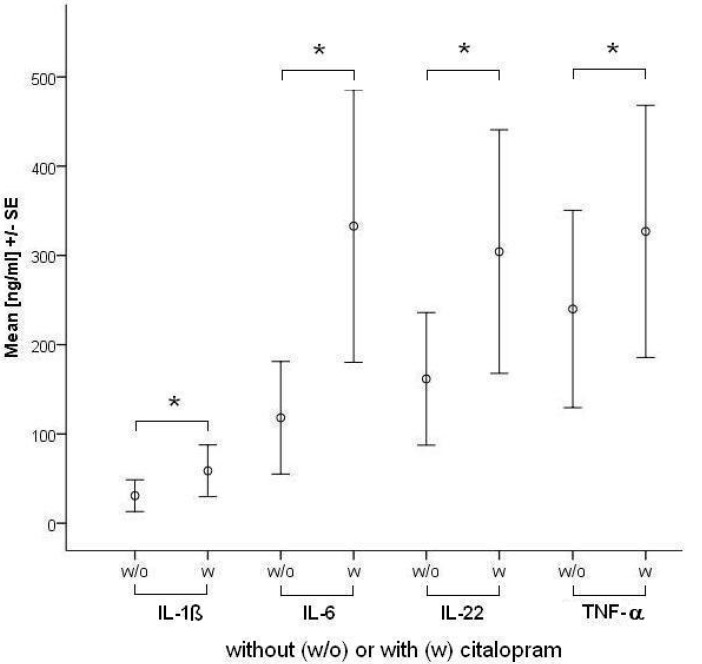
The interplay between immune and nervous systems plays a pivotal role in the pathophysiology of depression. In depressive episodes, patients show increased production of pro-inflammatory cytokines such as interleukin (IL)-1β and tumor necrosis factor (TNF)-α. There is limited information on the effect of antidepressant drugs on cytokines, most studies report on a limited sample of cytokines and none have reported effects on IL-22. We systematically investigated the effect of three antidepressant drugs, citalopram, escitalopram and mirtazapine, on secretion of cytokines IL-1β, IL-2, IL-4, IL-6, IL-17, IL-22 and TNF-α in a whole blood assay in vitro, using murine anti-human CD3 monoclonal antibody OKT3, and 5C3 monoclonal antibody against CD40, to stimulate T and B cells respectively. Citalopram increased production of IL-1β, IL-6, TNF-α and IL-22. Mirtazapine increased IL-1β, TNF-α and IL-22. Escitalopram decreased IL-17 levels. The influence of antidepressants on IL-2 and IL-4 levels was not significant for all three drugs. Compared to escitalopram, citalopram led to higher levels of IL-1β, IL-6, IL-17 and IL-22; and mirtazapine to higher levels of IL-1β, IL-17, IL-22 and TNF-α. Mirtazapine and citalopram increased IL-22 production. The differing profile of cytokine production may relate to differences in therapeutic effects, risk of relapse and side effects.
Overview
The claims and statistics of this paper haven’t been checked yet.
Free: it reads the open-access text and checks the first 5 claims that cite a source we can check. Create a free account to check every claim.
Integrity signals
Registry
Cites
Statistics
Figures
Verification
Claims the paper makes
The claims and statistics of this paper haven’t been checked yet.
Free: it reads the open-access text and checks the first 5 claims that cite a source we can check. Create a free account to check every claim.
Claims other papers make about this one
Each is checked against this paper’s own text: does it say what the citing paper says it does?
The source backs part of the claim, not all of it — or backs it for a different population, condition or comparison.
In the citing paper
“in an in vitro investigation of citalopram, mirtazapine, and escitalopram stimulation of cytokine production, researchers have shown that Citalopram and Mirtazapine increased inflammatory cytokine production, whereas escitalopram administration decreased cytokine concentrations (Munzer et al., 2013).”
From A Review of the Relationship between Proinflammatory Cytokines and Major Depressive Disorder (2014) · cites this paper as Munzer et al., 2013
Experimental — accuracy not yet measuredThe cited source says what the claim attributes to it.
In the citing paper
“What in vitro studies clearly show, however, is that antidepressants (69), antipsychotics (208) and mood stabilizers (209) have a direct influence on cytokine production within the blood.”
From Cytokine Research in Depression: Principles, Challenges, and Open Questions (2019) · cites this paper as [69]
The cited source says what the claim attributes to it.
In the citing paper
“However, the SSRI citalopram increased the production of IL-1β, IL-6, and TNF-α in another in vitro study (69).”
From Cytokine Research in Depression: Principles, Challenges, and Open Questions (2019) · cites this paper as [69]
The cited source says what the claim attributes to it.
In the citing paper
“Although some studies have demonstrated that antidepressants decrease inflammatory cytokines (38, 39), others report either no effect (31, 40, 41) or even increased levels (42, 43).”
From Individual differences in the peripheral immune system promote resilience versus susceptibility to social stress (2014) · cites this paper as [43]
The cited source says what the claim attributes to it.
In the citing paper
“Indeed, the literature describing the effects of standard antidepressants on systemic inflammation is highly mixed.”
From Individual differences in the peripheral immune system promote resilience versus susceptibility to social stress (2014) · cites this paper as [43]
2 more claims about this paper
Create a free account to see every claim other papers make about this one.
Self-check
Percentages, sums and reported differences re-computed from the paper’s own numbers.
The self-check needs the paper’s full text.
Citations
Cites
An inventory for measuring depression
BECK, A. T. (1961) · Archives of General Psychiatry · doi:10.1001/archpsyc.1961.01710120031004 · Cited by 38,032 · cited 2×
“Baseline Mean (SD) BDI was 17.5 (7.7) and HAMD 28.7 (9.6).”
MethodInfluentialHamilton, M. (1960) · Journal of Neurology, Neurosurgery & Psychiatry · doi:10.1136/jnnp.23.1.56 · Cited by 32,817 · cited 1×
“At admission, diagnosis of major depression was confirmed on the Structured Clinical Interview for DSM-IV (SKID-I) [55], and symptom severity on the Beck Depression Inventory (BDI) [56] and Hamilton Depression Rating Scale (HDRS) [57].”
MethodMolecular Mechanisms of Depression: Perspectives on New Treatment Strategies
Lang, U. E., & Borgwardt, S. (2013) · Cellular Physiology and Biochemistry · doi:10.1159/000350094 · Cited by 8,475
Scoville, W. B. (1949) · Journal of neurosurgery · doi:10.3171/jns.1949.6.1.0065 · Cited by 7,381
A distinct lineage of CD4 T cells regulates tissue inflammation by producing interleukin 17
Park, H., Li, Z., Yang, X. O., Chang, S. H., Nurieva, R., Wang, Y.-H., Wang, Y., Hood, L., Zhu, Z., Tian, Q., et al. (2005) · Nature Immunology · doi:10.1038/ni1261 · Cited by 4,265 · cited 2×
“This is of note, because T helper type 17 (TH17) cells which produce IL-17 and IL-22 are implicated in numerous immune and inflammatory processes [22–24].”
BackgroundCipriani, A., Furukawa, T. A., Salanti, G., Geddes, J. R., Higgins, J. P., Churchill, R., Watanabe, N., Nakagawa, A., Omori, I. M., McGuire, H., et al. (2009) · The Lancet · doi:10.1016/s0140-6736(09)60046-5 · Cited by 1,654 · cited 1×
“effectiveness as well as side effects into account [33].”
BackgroundImmune system to brain signaling: Neuropsychopharmacological implications
Capuron, L., & Miller, A. H. (2011) · Pharmacology & Therapeutics · doi:10.1016/j.pharmthera.2011.01.014 · Cited by 1,195 · cited 1×
“Particularly important are cytokine-induced changes in metabolism of the monoamines dopamine, noradrenalin and serotonin, in midbrain nuclei with widespread projections [7–9].”
BackgroundMünster, R. D. (1999) · Zeitschrift für Klinische Psychologie und Psychotherapie · doi:10.1026//0084-5345.28.1.68 · Cited by 1,010
Hannestad, J., DellaGioia, N., & Bloch, M. (2011) · Neuropsychopharmacology · doi:10.1038/npp.2011.132 · Cited by 914 · cited 1×
“A meta-analysis on the effect of antidepressant medication on serum levels of inflammatory cytokines in vivo for example showed that, overall, while pharmacological antidepressant treatment reduces depressive symptoms, it does not influence TNF-α levels, reduces levels of IL-1β and possibly reduces those of IL-6, too…”
BackgroundMüller, N., Schwarz, M. J., Dehning, S., Douhe, A., Cerovecki, A., Goldstein-Müller, B., Spellmann, I., Hetzel, G., Maino, K., Kleindienst, N., et al. (2006) · Molecular Psychiatry · doi:10.1038/sj.mp.4001805 · Cited by 794 · cited 1×
“A significant therapeutic effect of celecoxib in major depression was also found in a randomized, double-blind pilot add-on study of reboxetine and celecoxib versus reboxetine and placebo [20].”
Background
Research works printed but not linked: 3
- 43. Liu, S.J.; Zhou, W.; Kennedy, R.H. Suppression of b-adrenergic responsiveness of L-type Ca2+ current by IL-1b in rat ventricular myocytes. Am. J. Physiol. 1999 , 276 , 141-148.
- 47. Weschenfelder, J.; Sander, C.; Kluge, M.; Kirkby, K.C.; Himmerich, H. The influence of cytokines on wakefulness regulation: clinical relevance, mechanisms and methodological problems. Psychiatr. Danub. 2012 , 24 , 112-126.
- 59. Seidel, A.; Arolt, V.; Hunstiger, M.; Rink, L.; Behnisch, A.; Kirchner, H. Cytokine production and serum proteins in depression. Scand. J. Immunol. 1995 , 41 , 534-538. · DOI · Paper page
Cited by
Hodes, G. E., Pfau, M. L., Leboeuf, M., Golden, S. A., Christoffel, D. J., Bregman, D., Rebusi, N., Heshmati, M., Aleyasin, H., Warren, B. L., et al. (2014) · Proceedings of the National Academy of Sciences · doi:10.1073/pnas.1415191111 · Cited by 692
“Although some studies have demonstrated that antidepressants decrease inflammatory cytokines (38, 39), others report either no effect (31, 40, 41) or even increased levels (42, 43).”
BackgroundThe Role of Inflammation in Depression and Fatigue
Lee, C.-H., & Giuliani, F. (2019) · Frontiers in Immunology · doi:10.3389/fimmu.2019.01696 · Cited by 640
“Human: increased inflammatory activation (109)”
BackgroundA Review of the Relationship between Proinflammatory Cytokines and Major Depressive Disorder
Young, J. J., Bruno, D., & Pomara, N. (2014) · Journal of Affective Disorders · doi:10.1016/j.jad.2014.07.032 · Cited by 422
“For example, in an in vitro investigation of citalopram, mirtazapine, and escitalopram stimulation of cytokine production, researchers have shown that Citalopram andMirtazapine increased inflammatory cytokine production, whereas escitalopram administration decreased cytokine concentrations (Munzer et al., 2013).”
BackgroundImmune and neuroendocrine mechanisms of stress vulnerability and resilience
Ménard, C., Pfau, M. L., Hodes, G. E., & Russo, S. J. (2017) · Neuropsychopharmacology · doi:10.1038/npp.2016.90 · Cited by 374
Dopamine, Immunity, and Disease
Channer, B., Matt, S. M., Nickoloff-Bybel, E. A., Pappa, V., Agarwal, Y., Wickman, J., & Gaskill, P. J. (2023) · Pharmacological Reviews · doi:10.1124/pharmrev.122.000618 · Cited by 308
Cytokine Research in Depression: Principles, Challenges, and Open Questions
Himmerich, H., Patsalos, O., Lichtblau, N., Ibrahim, M. A. A., & Dalton, B. (2019) · Frontiers in Psychiatry · doi:10.3389/fpsyt.2019.00030 · Cited by 313
Self-citationKopschina Feltes, P., Doorduin, J., Klein, H. C., Juárez-Orozco, L. E., Dierckx, R. A., Moriguchi-Jeckel, C. M., & de Vries, E. F. (2017) · Journal of Psychopharmacology · doi:10.1177/0269881117711708 · Cited by 279
“…such as C-reactive protein (CRP) (Jokela et al., 2015; Valkanova et al., 2013) Munzer et al. (2013) even suggested that, besides, for example, stress hormones and psychopathological measures, cytokines may serve as biomarkers for individualized treatment of depression (Munzer et al., 2013).”
BackgroundInfluentialA meta-analysis of cytokine concentrations in eating disorders
Dalton, B., Bartholdy, S., Robinson, L., Solmi, M., Ibrahim, M. A. A., Breen, G., Schmidt, U., & Himmerich, H. (2018) · Journal of Psychiatric Research · doi:10.1016/j.jpsychires.2018.06.002 · Cited by 197
Self-citationBaumeister, D., Ciufolini, S., & Mondelli, V. (2016) · Psychopharmacology · doi:10.1007/s00213-015-4044-5 · Cited by 183
Therapeutic Strategies for Treatment of Inflammation-related Depression
Adzic, M., Brkic, Z., Mitic, M., Francija, E., Jovicic, M. J., Radulovic, J., & Maric, N. P. (2018) · Current Neuropharmacology · doi:10.2174/1570159x15666170828163048 · Cited by 156
“A series of in vitro experiments suggested that ADs decrease pro-inflammatory, and increase anti-inflammatory cytokines in human blood samples mainly by enhancing monoaminergic transmission, particularly serotonergic [79-83].”
BackgroundAl-Hakeim, H. K., Al-Rammahi, D. A., & Al-Dujaili, A. H. (2015) · Journal of Affective Disorders · doi:10.1016/j.jad.2015.04.044 · Cited by 152
Neurobiology of resilience in depression: immune and vascular insights from human and animal studies
Dudek, K. A., Dion‐Albert, L., Kaufmann, F. N., Tuck, E., Lebel, M., & Menard, C. (2021) · European Journal of Neuroscience · doi:10.1111/ejn.14547 · Cited by 151
“Human studies have reported contradictory results regarding the anti‐inflammatory effect of current antidepressants (Hannestad et al., 2011; Kubera et al., 2001; Munzer et al., 2013; Mutlu et al., 2012), reinforcing the need for further investigation addressing the potential antidepressant activity of anti‐inflammator…”
ResultThe Relationship Between the Gut Microbiome-Immune System-Brain Axis and Major Depressive Disorder
Foster, J. A., Baker, G. B., & Dursun, S. M. (2021) · Frontiers in Neurology · doi:10.3389/fneur.2021.721126 · Cited by 145
“Several antidepressants have been reported to have anti-inflammatory effects and/or to reduce levels of proinflammatory cytokines in a variety of animal models and macrophages (9, 16–20), although not all studies agree (21, 22).”
BackgroundNovel neuroimmunologic therapeutics in depression: A clinical perspective on what we know so far
Roman, M., & Irwin, M. R. (2020) · Brain, Behavior, and Immunity · doi:10.1016/j.bbi.2019.09.016 · Cited by 132
“Rather, cytokine levels were variously increased or decreased depending on the particular antidepressant in question (Munzer et al., 2013).”
BackgroundDavami, M., Baharlou, R., Ahmadi Vasmehjani, A., Ghanizadeh, A., Keshtkar, M., Dezhkam, I., & Atashzar, M. (2016) · Basic and Clinical Neuroscience Journal · doi:10.15412/j.bcn.03070207 · Cited by 124
“Furthermore, escitalopram also decrease IL-17 levels in patients with depression (Munzer et al., 2013).”
BackgroundWeight gain and metabolic changes during treatment with antipsychotics and antidepressants
Himmerich, H., Minkwitz, J., & Kirkby, K. (2015) · Endocrine, Metabolic & Immune Disorders-Drug Targets · doi:10.2174/1871530315666150623092031 · Cited by 122
Self-citationPro- and anti-inflammatory biomarkers and traumatic brain injury outcomes: A review
Rodney, T. W., Osier, N. D., & Gill, J. (2018) · Cytokine · doi:10.1016/j.cyto.2018.01.012 · Cited by 130
The Relationship between Stress, Inflammation, and Depression
Kim, I. B., Lee, J.-H., & Park, S. (2022) · Biomedicines · doi:10.3390/biomedicines10081929 · Cited by 144
Antidepressants- and antipsychotics-induced hepatotoxicity
Todorović Vukotić, N., Đorđević, J., Pejić, S., Đorđević, N., & Pajović, S. B. (2021) · Archives of Toxicology · doi:10.1007/s00204-020-02963-4 · Cited by 114
Caso, J. R., MacDowell, K. S., González-Pinto, A., García, S., de Diego-Adeliño, J., Carceller-Sindreu, M., Sarramea, F., Caballero-Villarraso, J., Gracia-García, P., De la Cámara, C., et al. (2021) · Translational Psychiatry · doi:10.1038/s41398-021-01755-3 · Cited by 107
“3E) and higher plasma levels of IL-6 (Fig.”
BackgroundInfluentialInflammatory Markers in Anorexia Nervosa: An Exploratory Study
Dalton, B., Campbell, I. C., Chung, R., Breen, G., Schmidt, U., & Himmerich, H. (2018) · Nutrients · doi:10.3390/nu10111573 · Cited by 95
Self-citationSlyepchenko, A., Maes, M., Köhler, C. A., Anderson, G., Quevedo, J., Alves, G. S., Berk, M., Fernandes, B. S., & Carvalho, A. F. (2016) · Neuroscience & Biobehavioral Reviews · doi:10.1016/j.neubiorev.2016.02.002 · Cited by 89
Altered Serum Levels of TNF-α, IL-6, and IL-18 in Depressive Disorder Patients
Fan, N., Luo, Y., Ou, Y., & He, H. (2017) · Human Psychopharmacology: Clinical and Experimental · doi:10.1002/hup.2588 · Cited by 85
“Interaction between immune system and CNS have a pivotal role to the pathophysiology of depression (Munzer et al., 2013; Raedler, 2011; Schiepers, Wichers, & Maes, 2005).”
BackgroundAn Overview on Chemotherapy-induced Cognitive Impairment and Potential Role of Antidepressants
Das, A., Ranadive, N., Kinra, M., Nampoothiri, M., Arora, D. S., & Mudgal, J. (2020) · Current Neuropharmacology · doi:10.2174/1570159x18666200221113842 · Cited by 102
“In a preclinical study of antidepressants, results showed that citalopram was pro-inflammatory by elevating cytokine levels (IL-1Β, TNFα, IL-22) while escitalopram was anti-inflammatory by lowering IL-17 [80].”
BackgroundThe effect of proinflammatory cytokines in Cognitive Behavioral Therapy
Moreira, F. P., Cardoso, T. D. A., Mondin, T. C., Souza, L. D. D. M., Silva, R., Jansen, K., Oses, J. P., & Wiener, C. D. (2015) · Journal of Neuroimmunology · doi:10.1016/j.jneuroim.2015.06.004 · Cited by 77
Schmidt, F. M., Schröder, T., Kirkby, K. C., Sander, C., Suslow, T., Holdt, L. M., Teupser, D., Hegerl, U., & Himmerich, H. (2016) · Psychiatry Research · doi:10.1016/j.psychres.2016.02.052 · Cited by 74
“…cytokine levels in-vivo and in-vitro but with equivocal changes reported in the few longitudinal studies examining treatment responders (Kraus et al., 2002; Hinze-Selch et al., 2000; Himmerich et al., 2010; Hannestad et al., 2011; Janssen et al., 2010; Petersein et al., 2015; Munzer et al., 2013).”
Self-citationMrugacz, M., Ostrowska, L., Bryl, A., Szulc, A., Żelazowska‐Rutkowska, B., & Mrugacz, G. (2017) · Advances in Medical Sciences · doi:10.1016/j.advms.2017.03.003 · Cited by 78
“Escitalopram decreased IL-17 levels [35].”
Inflammation and Immune Regulation as Potential Drug Targets in Antidepressant Treatment
Schmidt, F. M., Kirkby, K. C., & Lichtblau, N. (2016) · Current Neuropharmacology · doi:10.2174/1570159x14666160115130414 · Cited by 82
“In-vitro-analyses of human blood samples also showed that antidepressants as a class did not unidirectionally lower cytokine concentrations but variously increased or decreased cytokine levels, depending on the antidepressant administered [56].”
BackgroundSelf-citationIs there Progress? An Overview of Selecting Biomarker Candidates for Major Depressive Disorder
Young, J. J., Silber, T., Bruno, D., Galatzer-Levy, I. R., Pomara, N., & Marmar, C. R. (2016) · Frontiers in Psychiatry · doi:10.3389/fpsyt.2016.00072 · Cited by 71
“In contrast to the relatively limiting findings of individual inflammatory analyte concentrations as biomarkers for depression, inflammatory markers have potential use as state markers by characterizing treatment response to antidepressants (94, 95).”
BackgroundAdolescent-Onset Depression: Are Obesity and Inflammation Developmental Mechanisms or Outcomes?
Byrne, M. L., O’brien-simpson, N. M., Mitchell, S., & Allen, N. B. (2015) · Child Psychiatry & Human Development · doi:10.1007/s10578-014-0524-9 · Cited by 82
Zhao, J., Luo, D., Liang, Z., Lao, L., & Rong, J. (2016) · Molecular Neurobiology · doi:10.1007/s12035-016-9870-x · Cited by 70
“Moreover, various NSAIDs could unexpectedly diminish the effectiveness of SSRI antidepressants [6, 7].”
BackgroundManosso, L. M., Camargo, A., Dafré, A. L., & Rodrigues, A. L. S. (2020) · Nutritional Neuroscience · doi:10.1080/1028415x.2020.1853417 · Cited by 69
Sodium valproate and clozapine induced neutropenia: A case control study using register data
Malik, S., Lally, J., Ajnakina, O., Pritchard, M., Krivoy, A., Gaughran, F., Shetty, H., Flanagan, R. J., & MacCabe, J. H. (2017) · Schizophrenia Research · doi:10.1016/j.schres.2017.08.041 · Cited by 69
“SSRIs have been shown in some studies to increase IL-6 (Munzer et al. 2013) which may promote granulocyte production, though this evidence for a pro-inflammatory effect is inconsistent (Kenis and Maes 2002).”
BackgroundGut Bacteria and Neuropsychiatric Disorders
Dicks, L. M. T., Hurn, D., & Hermanus, D. (2021) · Microorganisms · doi:10.3390/microorganisms9122583 · Cited by 70
“Although studies done on animals and macrophages have shown that some antidepressants have anti-inflammatory properties [96–101], this is not supported by all studies [102,103].”
ResultKomori, T. (2017) · Neuropsychiatry · doi:10.4172/neuropsychiatry.1000180 · Cited by 58
“In a whole blood assay in vitro, both citalopram and escitalopram increased IL-1β in depressed patients [24].”
BackgroundMaes, M. H. J., Nowak, G., Caso, J. R., Leza, J. C., Song, C., Kubera, M., Klein, H. C., Gałecki, P., Noto, C. D. S., Glaab, E., et al. (2015) · Molecular Neurobiology · doi:10.1007/s12035-015-9183-5 · Cited by 53
Himmerich, H., Bartsch, S., Hamer, H. M., Mergl, R., Schönherr, J., Petersein, C., Munzer, A., Kirkby, K. C., Bauer, K., & Sack, U. (2014) · Oxidative Medicine and Cellular Longevity · doi:10.1155/2014/806162 · Cited by 55
“This approach has successfully been tested for investigating the effect of antidepressants on cytokine production in vitro [91].”
BackgroundSelf-citationWang, Q., Dong, X., Wang, Y., Liu, M., Sun, A., Li, N., lin, Y., Geng, Z., Jin, Y., & Li, X. (2017) · International Journal of Developmental Neuroscience · doi:10.1016/j.ijdevneu.2017.07.007 · Cited by 46
“In addition, ES decreases IL-17 levels in depressed patients (Munzer et al., 2013).”
BackgroundSelf-rated depression and eye diseases: The Beijing Eye Study
Jonas, J. B., Wei, W. B., Xu, L., Rietschel, M., Streit, F., & Wang, Y. X. (2018) · PLoS ONE · doi:10.1371/journal.pone.0202132 · Cited by 48
Xu, Y., Liang, J., Sun, Y., Zhang, Y., Shan, F., Ge, J., & Xia, Q. (2023) · International Immunopharmacology · doi:10.1016/j.intimp.2023.110108 · Cited by 41
Becerril‐Villanueva, E., Pérez‐Sánchez, G., Álvarez-Herrera, S., Girón‐Pérez, M. I., Arreola, R., Cruz-Fuentes, C. S., Palacios, L., de la Peña, F. R., & Pavón, L. (2019) · Mediators of Inflammation · doi:10.1155/2019/9130868 · Cited by 49
“Interestingly, there is a study in vitro that reports that citalopram affects the levels of IL-17 in peripheral mononuclear cells from adult MDD patients [33].”
BackgroundImpact of lithium alone and in combination with antidepressants on cytokine production in vitro
Petersein, C., Sack, U., Mergl, R., Schönherr, J., Schmidt, F. M., Lichtblau, N., Kirkby, K. C., Bauer, K., & Himmerich, H. (2015) · Journal of Neural Transmission · doi:10.1007/s00702-014-1328-6 · Cited by 40
Self-citationNeupane, S. P., Lien, L., Martínez, P., Aukrust, P., Ueland, T., Mollnes, T. E., Hestad, K. A., & Bramness, J. G. (2014) · CNS Neuroscience & Therapeutics · doi:10.1111/cns.12303 · Cited by 45
Increased levels of plasma IL-1b and BDNF can predict resistant depression patients
Uint, L., Bastos, G. M., Thurow, H. S., Borges, J. B., Hirata, T. D. C., França, J. Í. D., Hirata, M. H., & Sousa, A. (2019) · Revista da Associação Médica Brasileira · doi:10.1590/1806-9282.65.3.361 · Cited by 48
The Cytokine IL-17A as a Marker of Treatment Resistance in Major Depressive Disorder?
Nothdurfter, C., Milenkovic, V. M., Sarubin, N., Hilbert, S., Manook, A., Weigl, J., Almeqbaali, K., Wetzel, C. H., Rupprecht, R., & Baghai, T. C. (2021) · European Journal of Neuroscience · doi:10.1111/ejn.14636 · Cited by 38
“They found that citalopram and mirtazapine increased IL-17 levels, while escitalopram leads to a decrease of this cytokine (Munzer et al., 2013).”
BackgroundXia, M., Lü, J., Lan, J., Teng, T., Shiao, R., Sun, H., Jin, Z., Liu, X., Wang, J., Wu, H., et al. (2024) · Immunity · doi:10.1016/j.immuni.2024.11.008 · Cited by 46
Neuropathic Pain due to Small Fiber Neuropathy in Aging: Current Management and Future Prospects
Brouwer, B. A., de Greef, B. T. A., Hoeijmakers, J. G. J., Geerts, M., van Kleef, M., Merkies, I. S. J., & Faber, C. G. (2015) · Drugs & Aging · doi:10.1007/s40266-015-0283-8 · Cited by 43
“Other presumed effects are anti-inflammatory, increasing and decreasing cytokine production, and potentiation of opioid analgesia [54–56].”
BackgroundSchmidt, F. M., Kirkby, K. C., & Himmerich, H. (2014) · PubMed · Cited by 47
Self-citationHuman dermal fibroblasts in psychiatry research
Kalman, J. L., Garbett, K. A., Janka, Z., & Mirnics, K. (2016) · Neuroscience · doi:10.1016/j.neuroscience.2016.01.067 · Cited by 48
“In addition, the number and function of circulating leukocytes are affected by the psychopharmacological treatment (Munzer et al., 2013; Tourjman et al., 2013).”
BackgroundPantović-Stefanović, M., Petronijević, N., Dunjić-Kostić, B., Velimirović, M., Nikolić, T., Jurišić, V., Lačković, M., Damjanović, A., Totić-Poznanović, S., Jovanović, A., et al. (2016) · The World Journal of Biological Psychiatry · doi:10.1080/15622975.2016.1259498 · Cited by 40
Interplay of Itch and Psyche in Psoriasis: An Update
Reich, A., Mędrek, K., & Szepietowski, J. C. (2014) · Acta Dermato Venereologica · doi:10.2340/00015555-2374 · Cited by 36
T helper cells in depression: central role of Th17 cells
Ghosh, R., Mitra, P., Kumar, P. V. S. N. K., Goyal, T., & Sharma, P. (2021) · Critical Reviews in Clinical Laboratory Sciences · doi:10.1080/10408363.2021.1965535 · Cited by 38
“Another antidepressant, an SSRI known as escitalopram, was also reported to cause a decrease in levels of IL-17 [160].”
BackgroundElevated Levels of Serum IL-17A in Community-Dwelling Women with Higher Depressive Symptoms
Tsuboi, H., Sakakibara, H., Minamida, Y., Tsujiguchi, H., Matsunaga, M., Hara, A., & Nakamura, H. (2018) · Behavioral Sciences · doi:10.3390/bs8110102 · Cited by 34
“Studies about anti-depressant-SSRI treatment of depression revealed decreased peripheral IL-17 levels by some SSRIs [10,11].”
BackgroundPersonalized Medicine Using Neuroimmunological Biomarkers in Depressive Disorders
Chi, S., & Lee, M. (2021) · Journal of Personalized Medicine · doi:10.3390/jpm11020114 · Cited by 33
“Mixed IL-6 Mixed results [5,15] Yes [9] Decrease [11,13,15] IL-22 Increase [12] IFN-α Yes [23] -”
BackgroundResultInfluentialGadad, B. S., Jha, M. K., Grannemann, B. D., Mayes, T. L., & Trivedi, M. H. (2017) · Journal of Psychiatric Research · doi:10.1016/j.jpsychires.2017.05.012 · Cited by 30
“Several reports demonstrate that MDD patients, as compared to healthy controls, have elevated levels of inflammatory cytokines during depressive episodes, including interleukin (IL) 1, IL-6, IL-8, IL-10, interferon-gamma (IFN-g) and tumor necrosis factor-alpha (TNFa) (Kenis and Maes, 2002; Maes et al., 1999; Munzer et…”
BackgroundGu, J., Xu, Y.-W., Feng, L.-P., Dong, J., Zhao, L., Liu, C., Wang, H., Zhang, X., Song, C., & Wang, C. (2021) · Brain Research Bulletin · doi:10.1016/j.brainresbull.2021.10.005 · Cited by 33
Plasma IL-17A levels in patients with late-life depression
Saraykar, S., Cao, B., Barroso, L., Pereira, K. S., Bertola, L., Nicolau, M. D. S., Ferreira, J. D. R., Dias, N. S., Vieira, É. L. M., Teixeira, A. L., et al. (2017) · Brazilian Journal of Psychiatry · doi:10.1590/1516-4446-2017-2299 · Cited by 27
Moulton, C. D., Malys, M. K., Hopkins, C. W. P., Rokakis, A. S., Young, A. H., & Powell, N. (2024) · European Archives of Psychiatry and Clinical Neuroscience · doi:10.1007/s00406-024-01864-2 · Cited by 32
“Although this finding should be cautioned by the low number of studies involved, these results have face validity, as SSRI antidepressants have been found to reduce plasma concentrations of IL-17A [34, 78].”
Long, N. E. D., Barry, E. J., Pinelli, C. J., Wood, G. A., Hardy, D. B., Morrison, K. M., Taylor, V. H., Gerstein, H. C., & Holloway, A. C. (2015) · Toxicology and Applied Pharmacology · doi:10.1016/j.taap.2015.03.006 · Cited by 27
“There have been reports that SSRI antidepressants can increase the production of these cytokines in vitro (Munzer et al., 2013), but the effects of exposure to these drugs during fetal development on inflammatory markers in postnatal life has not been determined.”
BackgroundPark, H.-J., Shim, H. S., Kim, J. Y., Kim, J. Y., Park, S. K., & Shim, I. (2015) · Evidence-based Complementary and Alternative Medicine · doi:10.1155/2015/197459 · Cited by 25
“The increase of proinflammatory cytokine coexists with psychological complaints, which can include depression and anxiety [76–79].”
BackgroundBrunoni, A. R., Machado‐Vieira, R., Sampaio-Júnior, B., Vieira, É. L. M., Valiengo, L. D. C. L., Benseñor, I. M., Lotufo, P. A., Carvalho, A. F., Cho, H. J., Gattaz, W. F., et al. (2015) · Journal of Affective Disorders · doi:10.1016/j.jad.2015.07.006 · Cited by 26
In immune defense: redefining the role of the immune system in chronic disease
Rubinow, K. B., & Rubinow, D. R. (2017) · Dialogues in Clinical Neuroscience · doi:10.31887/dcns.2017.19.1/drubinow · Cited by 28
Reduced MIP-1β as a Trait Marker and Reduced IL-7 and IL-12 as State Markers of Anorexia Nervosa
Keeler, J. L., Patsalos, O., Chung, R., Schmidt, U. H., Breen, G. D., Treasure, J. L., Himmerich, H., & Dalton, B. (2021) · Journal of Personalized Medicine · doi:10.3390/jpm11080814 · Cited by 27
“Furthermore, antipsychotic and antidepressant medication, which is used to treat these comorbidities, has also been reported to lead to changes of cytokine production and signalling in vivo [18,19] and in vitro [20,21].”
BackgroundSelf-citationParoxetine modulates immune responses by activating a JAK2/STAT3 signaling pathway
Kabiri, M., Hemmatpour, A., Zare, F., Hadinedoushan, H., & Karimollah, A. (2020) · Journal of Biochemical and Molecular Toxicology · doi:10.1002/jbt.22464 · Cited by 21
Toll-like receptor 2 (TLR2)-deficiency impairs male mouse recovery from a depression-like state
Medina-Rodriguez, E. M., Cheng, Y., Michalek, S. M., Beurel, E., & Jope, R. S. (2020) · Brain Behavior and Immunity · doi:10.1016/j.bbi.2020.05.068 · Cited by 18
“Furthermore, antidepressant drugs have been shown to increase certain cytokines (Kenis and Maes, 2002; Munzer et al., 2013; Warner-Schmidt et al., 2011), further indicating that the role of inflammation in depression is complex and not well-defined.”
BackgroundLi, X., Liu, T., Mo, X., Wang, R., Kong, X., Shao, R., McIntyre, R. S., So, K., & Lin, K. (2023) · Neural Regeneration Research · doi:10.4103/1673-5374.389360 · Cited by 21
“This result is in accordance with a previous study, which reported that escitalopram reduced the peripheral level of IL-17 during therapy (Munzer et al., 2013).”
ResultImmunomudulatory effects of hydroalcoholic extract of Hypericum perforatum.
Froushani, S. M. A., Galee, H. E. G., Khamisabadi, M., & Lotfallahzade, B. (2015) · Europe PMC (PubMed Central) · Cited by 18
The role of interleukin genes in the course of depression
Talarowska, M. E., Szemraj, J., & Gałecki, P. (2016) · Open Medicine · doi:10.1515/med-2016-0009 · Cited by 18
Abelaira, H. M., Rosa, T., de Moura, A. B., Andrade, N. M., Martinello, N. S., Maciel, L. R., Botelho, M. E. M., Borba, L. A., Chede, B. C., Arent, C. O., et al. (2022) · Molecular Neurobiology · doi:10.1007/s12035-021-02718-x · Cited by 18
Vasileva, L. V., Ivanovska, M. V., Murdjeva, M. A., Saracheva, K. E., & Georgiev, M. I. (2019) · Food and Chemical Toxicology · doi:10.1016/j.fct.2019.03.004 · Cited by 16
“structure of citalopram (a racemic mixture of R- and S-stereoisomers) compared to escitalopram (an active S-enantiomer of citalopram; Munzer et al., 2013).”
BackgroundBertollo, A. G., Mingoti, M. E. D., de Medeiros, J., da Silva, G. B., Capoani, G. T., Lindemann, H., Cassol, J. V., Manica, D., de Oliveira, T., Garcez, M. L., et al. (2024) · Molecular Neurobiology · doi:10.1007/s12035-024-04198-1 · Cited by 19
What goes around comes around: novel pharmacological targets in the gut–brain axis
González‐Arancibia, C., Escobar-Luna, J., Barrera-Bugueño, C., Díaz-Zepeda, C., González-Toro, M. P., Olavarría‐Ramírez, L., Zanelli-Massai, F., Gotteland, M., Bravo, J. A., & Julio‐Pieper, M. (2016) · Therapeutic Advances in Gastroenterology · doi:10.1177/1756283x16630718 · Cited by 18
The Historical Development of Immunoendocrine Concepts of Psychiatric Disorders and Their Therapy
Steinberg, H., Kirkby, K. C., & Himmerich, H. (2015) · International Journal of Molecular Sciences · doi:10.3390/ijms161226136 · Cited by 21
“However, there are few recent in vitro investigations that found that at least some antidepressants even increase the production of pro-inflammatory cytokines [154,155].”
BackgroundSelf-citationAl‐Hakeim, H. K., Twayej, A. J., & Al-Dujaili, A. H. (2018) · Neurology Psychiatry and Brain Research · doi:10.1016/j.npbr.2018.10.001 · Cited by 20
Ruiz-Guerrero, F., Gómez, J. G., Gonzalez, P. B., García, J. G., Miguel, A. B., Giraldo, G. C., García‐Unzueta, M. T., & del Barrio, A. G. (2022) · Psychiatry Research · doi:10.1016/j.psychres.2022.114449 · Cited by 15
Elevated Serum IL-2 Levels are Associated With Major Depressive Disorder: A Case-Control Study
Suhee, F. I., Shahriar, M., Islam, S. M. A., Bhuiyan, M. A., & Islam, M. R. (2023) · Clinical Pathology · doi:10.1177/2632010x231180797 · Cited by 17
Alharthy, S. A., Zughaibi, T. A., Vij, P., Tabrez, S. S. M., Almashjary, M. N., Alharthi, S., Alamri, T. A., Alghamdi, B. S., Harakeh, S., Azhari, S. A., et al. (2023) · Toxicology Mechanisms and Methods · doi:10.1080/15376516.2023.2231530 · Cited by 13
Ruiz-Guerrero, F., del Barrio, A. G., de la Torre‐Luque, A., Ayad‐Ahmed, W., Beato‐Fernández, L., Montes, F. P., León-Velasco, M., MacDowell, K. S., Leza, J. C., Carrasco, J. L., et al. (2023) · Psychoneuroendocrinology · doi:10.1016/j.psyneuen.2023.106383 · Cited by 13
A systematic review of in vitro cytokine production in eating disorders
Dalton, B., Whitmore, V., Patsalos, O., Ibrahim, M. A. A., Schmidt, U. H., & Himmerich, H. (2018) · Molecular and Cellular Endocrinology · doi:10.1016/j.mce.2018.10.006 · Cited by 13
Self-citationBogdán, M., Siloşi, I., Șurlin, P., Tica, A. A., Tica, O. S., Bălşeanu, T. A., Rauten, A. M., & Camen, A. (2015) · Europe PMC (PubMed Central) · Cited by 11
Kuo, W.-Y., Huang, K., Kuan, Y., Chang, Y.-C., Tsai, T., & Lee, C. (2022) · Frontiers in Medicine · doi:10.3389/fmed.2022.740182 · Cited by 11
Ajisebiola, B. S., Alamu, P. I., James, A. S., & Adeyi, A. O. (2022) · Toxins · doi:10.3390/toxins14060378 · Cited by 10
“Reports from other related studies have detailed that elevated release of IL1-β and TNF-α induces inflammatory lesions, disrupts spermatogenesis [48], or causes other pathophysiological diseases [49].”
BackgroundLima, R., Monteiro, S., Gomes, E. D., Vasconcelos, N. L., Assunção-Silva, R. C., Morais, M., Salgado, A. J., & Silva, N. A. (2020) · International Journal of Molecular Sciences · doi:10.3390/ijms21145062 · Cited by 8
“However, treatment also increased the proinflammatory cytokine IL-1β, demonstrating that its immunomodulatory effect is not restricted to promoting an anti-inflammatory phenotype.”
BackgroundResultInfluentialMatt, S. M. (2021) · Brain Behavior & Immunity - Health · doi:10.1016/j.bbih.2021.100353 · Cited by 8
Keeler, J. L., Bovenberg, C., Himmerich, H., Treasure, J. L., Carter, B., Schmidt, U. H., & Dalton, B. (2025) · Communications Medicine · doi:10.1038/s43856-025-01122-z · Cited by 9
“AN anorexianervosa, BMI bodymassindex, DASS Depression,AnxietyandStressScale, ED eating disorder, EDE-Q EatingDisorderExamination-Questionnaire. medications 18 , time of sampling (circadian rhythms) 90 – 92 , and fasting status/ dietary habits 93 .”
Self-citationLabaka, A., Gómez-Lázaro, E., Goñi‐Balentziaga, O., Pérez-Tejada, J., Vegas, Ó., & Garmendia, L. (2021) · Stress · doi:10.1080/10253890.2021.1895111 · Cited by 8
Oliveira, T. D. Q., Filho, A. J. M. C., Jucá, P. M., Soares, M. V. R., Cunha, N. L., Vieira, C. F. X., Filho, C. V. J. G., Viana, G. D. A., de Oliveira, G. M. F., Macêdo, D. S., et al. (2021) · Behavioural Brain Research · doi:10.1016/j.bbr.2021.113667 · Cited by 9
Kozłowska, E., Żelechowska, P., Wysokiński, A., Rasmus, P., Łucka, A., & Brzezińska‐Błaszczyk, E. (2019) · Journal of Investigative Medicine · doi:10.1136/jim-2018-000964 · Cited by 6
Tomas-Aragones, L., Gieler, U., & Linder, M. D. (2016) · Acta Dermato Venereologica · doi:10.2340/00015555-2497 · Cited by 6
Soloey-Nilsen, H., Nygaard-Odeh, K., Kristiansen, M. G., Kvig, E. I., Brekke, O., Mollnes, T. E., Berk, M., Reitan, S. K., & Øiesvold, T. (2023) · Clinical Psychopharmacology and Neuroscience · doi:10.9758/cpn.23.1091 · Cited by 4
“They do however also have immune regulatory properties, being both pro-and anti-inflammatory [38,39].”
BackgroundThe Role of Interleukin-17A (IL-17A) in Depression
Fathalizadeh, J., Fathalizadeh, H., Mirzabeigi, M., Hakimi, H., & Arababadi, M. K. (2016) · Iranian Red Crescent Medical Journal · doi:10.5812/ircmj.24972 · Cited by 5
Huang, C.-C., Chu, H., Lin, Y., Tsai, C., Liang, C., & Yeh, T. (2023) · Journal of Medical Sciences · doi:10.4103/jmedsci.jmedsci_124_23 · Cited by 3
Animal models for hepatoxicity
Singh, G., & Sharma, R. (2021) · Elsevier eBooks · doi:10.1016/b978-0-323-90583-1.00007-6 · Cited by 3
Ilanges, A., Xia, M., Lü, J., Chen, L., Shiao, R., Wang, C., Jin, Z., Feng, R., Qi, Q., Han, Y., et al. (2022) · bioRxiv (Cold Spring Harbor Laboratory) · doi:10.1101/2022.09.16.508224 · Cited by 4
“Indeed, the antidepressants citalopram and mirtazapine have been shown to 14/36 induce IL-22 from human leukocytes in vitro (Munzer et al. , 2013), suggesting that IL-22 might contribute to the therapeutic effects of these drugs.”
BackgroundA cross talk on the role of contemporary biomarkers in depression
Vyas, A., & Doshi, G. (2024) · Biomarkers · doi:10.1080/1354750x.2024.2308834 · Cited by 2
“…like citalopram or mirtazapine cause an increase in il-22 production. il-22 il-21 has recently gained interest in the depression research field (Munzer et al. 2013). it has been observed that peripherally produced cytokines affect the brain through three pathways: humoral, neural, and cellular…”
BackgroundEffect of Antidepressants on Non-alcoholic Fatty Liver Disease and their Underlying Mechanism
Peng, H., Qing, Y., Han, L., Fu, S., Li, J., Wang, S., Liu, D., Liu, L., & Tan, Y. (2024) · Current Medicinal Chemistry · doi:10.2174/0109298673317281240828170031 · Cited by 2
Tariq, U., Asghar, W., Javed, K., Hameed, A., Butt, M. S., & Khalid, N. (2025) · Journal of Agriculture and Food Research · doi:10.1016/j.jafr.2025.102005 · Cited by 2
Bertollo, A. G., Soares, S. J. B., Amaral, S. S., de Medeiros, J., Nicolleti, A. O. A., Ibrahim, H. J., Kreuz, K. M., Schuh, L. A., da Silva, B. V., Mingoti, M. E. D., et al. (2025) · Molecular Biology Reports · doi:10.1007/s11033-025-10576-2 · Cited by 2
“…in the literature, especially when looking at the escitalopram group, which is widely used in research with animal models and acts both in reducing depressive-like behaviors and in acting on critical biological mechanisms for neuronal pro - tection and reduction of inflammation [16 , 17 , 19].”
A dual pharmacological effect of escitalopram on alveolar bone loss in periodontitis
Girondo, R. M. F., Franchin, M., Ikegaki, M., Bruzadelli, R. F. D., Nais, A. A. C., Malavazi, L. M., Bueno‐Silva, B., Benso, B., Murata, R. M., Abdalla, H. B., et al. (2026) · International Immunopharmacology · doi:10.1016/j.intimp.2026.116377 · Cited by 1
Markers of neuroinflammation in the CSF of patients with difficult to treat psychiatric disease
Jiang, J. X., Shvetcov, A., Fewings, N., Gatt, P. N., Dervish, S., Garber, J. Y., Silsby, M., Fois, A. F., Duma, S. R., Bandodkar, S., et al. (2026) · Frontiers in Psychiatry · doi:10.3389/fpsyt.2026.1665447 · Cited by 1
Metadata
- Authors
- Munzer, A., Sack, U., Mergl, R., Schönherr, J., Petersein, C., Bartsch, S., Kirkby, K., Bauer, K., & Himmerich, H.
- Affiliations
- Leipzig University (DE)
- University of Tasmania (AU)
- Corresponding author
- Himmerich, Hubertus
- Venue
- Toxins
- Publisher
- MDPI AG
- Published
- 2013-11-19
- Volume
- 5
- Issue
- 11
- Pages
- 2227-2240
- ISSN
- 2072-6651 (ISSN-L)
- PMC
- PMC3847723
- OpenAlex
- W2120334173
- Cited by
- 114
- References
- 65
- Citations by year
- 2026: 4 · 2025: 4 · 2024: 6 · 2023: 8 · 2022: 9 · 2021: 15 · 2020: 5 · 2019: 10 · 2018: 9 · 2017: 10 · 2016: 14 · 2015: 13 · 2014: 7
- FWCI
- 3.81
- Type
- journal article
- Language
- en
- Open access
- gold
- doi.org
- Licence
- Locations
- Toxins (publishedVersion, cc-by)
- Europe PMC (PubMed Central) (publishedVersion, cc-by)
- PubMed Central (publishedVersion, cc-by)
- PubMed (publishedVersion)
- eCite Digital Repository (University of Tasmania) (submittedVersion, cc-by)
- DOAJ (DOAJ: Directory of Open Access Journals) (submittedVersion, cc-by-sa)
- Figshare (submittedVersion, cc-by)
- Funders
- Bristol-Myers Squibb
- Eli Lilly and Company
- AstraZeneca
- Servier
- H. Lundbeck A/S
- Topics
- Life Sciences › Neuroscience › Biological Psychiatry › Tryptophan and brain disorders
- Health Sciences › Medicine › Pharmacology (medical) › Treatment of Major Depression
- Life Sciences › Neuroscience › Behavioral Neuroscience › Stress Responses and Cortisol
- Keywords
- antidepressants, depression, cytokine production, citalopram, escitalopram, mirtazapine, IL-22, IL-1β, TNF-α, IL-17, interleukin-6, IL-4, interleukin-2, inflammatory cytokines, neuroimmunology, whole blood stimulation, OKT3, CD40
- MeSH terms
- Mirtazapine, Interleukin-22, Adult, Antidepressive Agents, Depression, Female, Humans, Interleukin-2, Interleukins, Male, Mianserin, Middle Aged, Tumor Necrosis Factor-alpha, Citalopram, Interleukin-4, Interleukin-6, Cytokines, Muromonab-CD3, CD40 Antigens, Interleukin-17, Interleukin-1beta
About these checks
Registry, retraction, Cites and statistics results are computed, not judged, with one exception: a printed reference that no index lists is read once by a model before it counts as a citation error. Claims are extracted by a model and kept only when their quote appears verbatim in the text; each cited source is then checked, with a model’s help, for whether it says what the claim relies on. Those verdicts can be wrong — read the claim’s quote and the cited source before relying on one.
Statistics and arithmetic are recomputed, not judged.
Confidence bands are shown only for fields calibrated on our annotated test set. None is calibrated yet, so no band is shown.
What counts as a claim ›How we measure confidence ›How we check this ›
Are you an author, or do you see a problem with this page? Request a review
Data sources
Bibliographic data: Semantic Scholar, OpenAlex, Crossref.
Contains information from the Semantic Scholar Academic Graph Datasets, made available under the ODC Attribution License (ODC-BY 1.0).
Semantic Scholar’s data is described in: Kinney, R., et al. (2023). The Semantic Scholar Open Data Platform. arXiv:2301.10140.
