

The DOI matches its Crossref record; 193 of the 199 references it cites were found in a registry or an index.
The Biology of Pichia membranifaciens Killer Toxins
Open accessAbstract
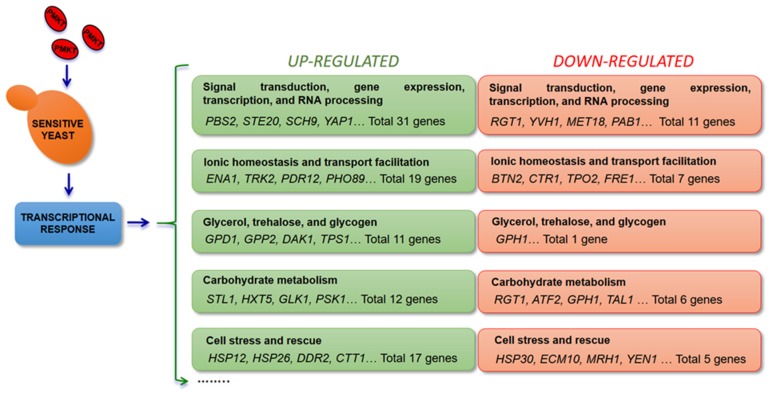
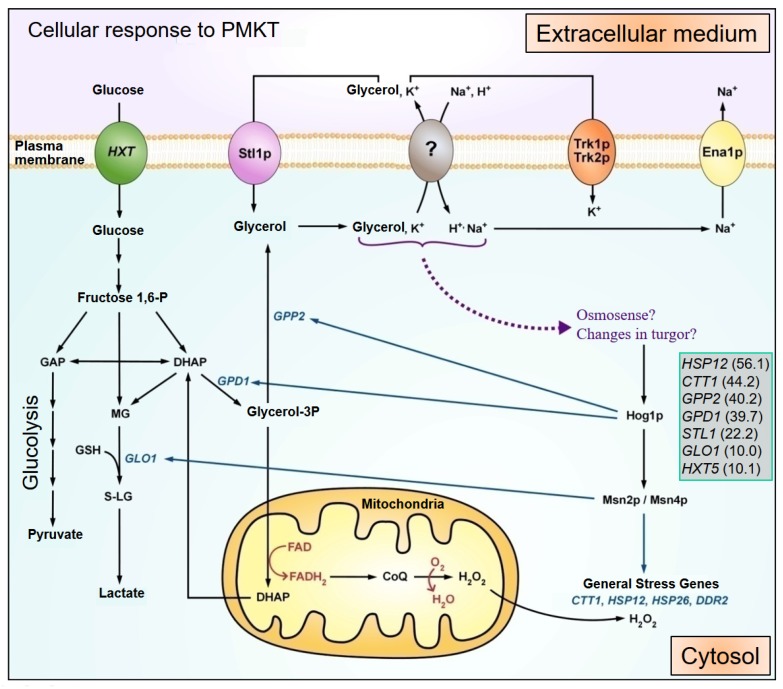
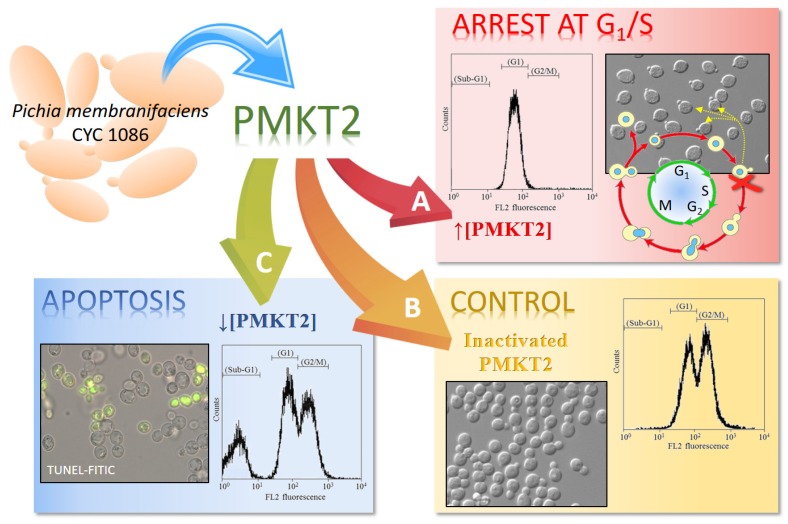
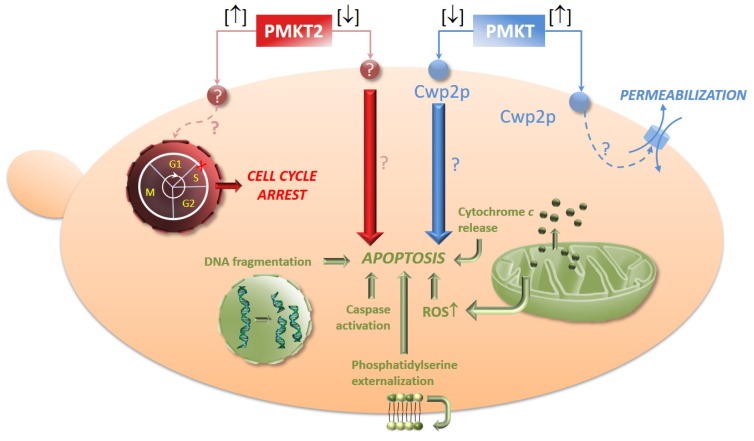
The killer phenomenon is defined as the ability of some yeast to secrete toxins that are lethal to other sensitive yeasts and filamentous fungi. Since the discovery of strains of Saccharomyces cerevisiae capable of secreting killer toxins, much information has been gained regarding killer toxins and this fact has substantially contributed knowledge on fundamental aspects of cell biology and yeast genetics. The killer phenomenon has been studied in Pichia membranifaciens for several years, during which two toxins have been described. PMKT and PMKT2 are proteins of low molecular mass that bind to primary receptors located in the cell wall structure of sensitive yeast cells, linear (1→6)-β-d-glucans and mannoproteins for PMKT and PMKT2, respectively. Cwp2p also acts as a secondary receptor for PMKT. Killing of sensitive cells by PMKT is characterized by ionic movements across plasma membrane and an acidification of the intracellular pH triggering an activation of the High Osmolarity Glycerol (HOG) pathway. On the contrary, our investigations showed a mechanism of killing in which cells are arrested at an early S-phase by high concentrations of PMKT2. However, we concluded that induced mortality at low PMKT2 doses and also PMKT is indeed of an apoptotic nature. Killer yeasts and their toxins have found potential applications in several fields: in food and beverage production, as biocontrol agents, in yeast bio-typing, and as novel antimycotic agents. Accordingly, several applications have been found for P. membranifaciens killer toxins, ranging from pre- and post-harvest biocontrol of plant pathogens to applications during wine fermentation and ageing (inhibition of Botrytis cinerea, Brettanomyces bruxellensis, etc.).
Overview
The claims and statistics of this paper haven’t been checked yet.
Run the check — free, no account needed. It reads the open-access text and checks the sources it cites.
Integrity signals
Registry
Cites
Statistics
Figures
Verification
Claims the paper makes
The claims and statistics of this paper haven’t been checked yet.
Run the check — free, no account needed. It reads the open-access text and checks the sources it cites.
Claims other papers make about this one
Each is checked against this paper’s own text: does it say what the citing paper says it does?
The source backs part of the claim, not all of it — or backs it for a different population, condition or comparison.
In the citing paper
“The most prominent toxins produced by many biocontrol yeast strains are proteinaceous killer toxins (Supplementary Table 1)”
From Biocontrol yeasts: mechanisms and applications (2019) · cites this paper as Belda et al. 2017
Experimental — accuracy not yet measured
Self-check
Percentages, sums and reported differences re-computed from the paper’s own numbers.
The self-check needs the paper’s full text.
Citations
Cites
Cell Wall Assembly in Saccharomyces cerevisiae
Lesage, G., & Bussey, H. (2006) · Microbiology and Molecular Biology Reviews · doi:10.1128/mmbr.00038-05 · Cited by 849
Cell Wall Architecture in Yeast: New Structure and New Challenges
Lipke, P. N., & Ovalle, R. (1998) · Journal of Bacteriology · doi:10.1128/jb.180.15.3735-3740.1998 · Cited by 701
The Transcriptional Response of Saccharomyces cerevisiae to Osmotic Shock
Rep, M., Krantz, M., Thevelein, J. M., & Hohmann, S. (2000) · Journal of Biological Chemistry · doi:10.1074/jbc.275.12.8290 · Cited by 554
Improving industrial yeast strains: exploiting natural and artificial diversity
Steensels, J., Snoek, T., Meersman, E., Nicolino, M. P., Voordeckers, K., & Verstrepen, K. J. (2014) · FEMS Microbiology Reviews · doi:10.1111/1574-6976.12073 · Cited by 513
The Yeasts, a Taxonomic Study, 5th ed
Kurtzman, C. P., Fell, J. W., & Boekhout, T. (2011) · Data Archiving and Networked Services (DANS) · Cited by 446
Biodiversity and Ecophysiology of Yeasts
Péter, G., & Rosa, C. A. (2006) · Springer eBooks · doi:10.1007/3-540-30985-3 · Cited by 424
Enjalbert, B., Smith, D. A., Cornell, M. J., Alam, I., Nicholls, S., Brown, A. J. P., & Quinn, J. (2006) · Molecular Biology of the Cell · doi:10.1091/mbc.e05-06-0501 · Cited by 381
Magliani, W., Conti, S., Gerloni, M., Bertolotti, D., & Polonelli, L. (1997) · Clinical Microbiology Reviews · doi:10.1128/cmr.10.3.369 · Cited by 322
Yeast viral killer toxins: lethality and self-protection
Schmitt, M. J., & Breinig, F. (2006) · Nature Reviews Microbiology · doi:10.1038/nrmicro1347 · Cited by 314
Alonso-Monge, R., Navarro-García, F., Román, E., Negredo, A. I., Eisman, B., Nombela, C., & Pla, J. (2003) · Eukaryotic Cell · doi:10.1128/ec.2.2.351-361.2003 · Cited by 308
Research works printed but not linked: 4
- Hansen, 1904, Grundlinien zur Systematik der Saccharomyceten, Zentralbl. Bakteriol. Parasitenk. Abt. II, 12, 529
- Deak, T., and Beuchat, L. (1996). Handbook of Food Spoilage Yeasts, Crc Series in Contemporary Food Science, CRC Press. [2nd ed.].
- Ohta, 1984, Production, purification and characterization of HYI, an antiyeast substance, produced by Hansenula saturnus, Agric. Biol. Chem., 48, 903
- Keszthelyi, 2006, Characterisation of anticryptococcal Fc-1 toxin of Filobasidium capsuligenum, Acta Biol. Szeged., 50, 155
Cited by
Sorted by citations
Biocontrol yeasts: mechanisms and applications
Freimoser, F. M., Rueda-Mejia, M. P., Tilocca, B., & Migheli, Q. (2019) · World Journal of Microbiology and Biotechnology · doi:10.1007/s11274-019-2728-4 · Cited by 462
Zhang, X., Li, B., Zhang, Z., Chen, Y., & Tian, S. (2020) · Journal of Fungi · doi:10.3390/jof6030158 · Cited by 234
Effect of Pichia on shaping the fermentation microbial community of sauce-flavor Baijiu
Zhang, H., Wang, L., Tan, Y., Wang, H., Yang, F., Chen, L., Hao, F., Lv, X., Du, H., & Xu, Y. (2020) · International Journal of Food Microbiology · doi:10.1016/j.ijfoodmicro.2020.108898 · Cited by 210
Mechanisms of Action of Microbial Biocontrol Agents against Botrytis cinerea
Roca-Couso, R., Flores‐Félix, J. D., & Rivas, R. (2021) · Journal of Fungi · doi:10.3390/jof7121045 · Cited by 202
High Potential of Pichia kluyveri and Other Pichia Species in Wine Technology
Vicente, J., Calderón, F., Santos, A., Marquina, D., & Benito, S. (2021) · International Journal of Molecular Sciences · doi:10.3390/ijms22031196 · Cited by 169
Self-citationYeast killer toxins: from ecological significance to application
Mannazzu, I., Domizio, P., Carboni, G., Zara, S., Zara, G., Comitini, F., Budroni, M., & Ciani, M. (2019) · Critical Reviews in Biotechnology · doi:10.1080/07388551.2019.1601679 · Cited by 135
Liu, T., Li, Y., Sadiq, F. A., Yang, H., Gu, J., Yuan, L., Lee, Y. K., & He, G. (2017) · Food Chemistry · doi:10.1016/j.foodchem.2017.09.081 · Cited by 118
Hernández-Fernández, M., Cordero-Bueso, G., Ruiz-Muñoz, M., & Cantoral, J. M. (2021) · Plants · doi:10.3390/plants10050822 · Cited by 111
Zhang, H., Godana, E. A., Sui, Y., Yang, Q., Zhang, X., & Zhao, L. (2020) · Critical Reviews in Microbiology · doi:10.1080/1040841x.2020.1794793 · Cited by 109
Kowalska, J., Krzymińska, J., & Tyburski, J. (2022) · Agriculture · doi:10.3390/agriculture12091404 · Cited by 106
Yeast Interactions and Molecular Mechanisms in Wine Fermentation: A Comprehensive Review
Comitini, F., Agarbati, A., Canonico, L., & Ciani, M. (2021) · International Journal of Molecular Sciences · doi:10.3390/ijms22147754 · Cited by 105
Godana, E. A., Yang, Q., Wang, K., Zhang, H., Zhang, X., Zhao, L., Abdelhai, M. H., & Ngea, G. L. N. (2020) · LWT · doi:10.1016/j.lwt.2020.109188 · Cited by 104
Dutraive, O., Benito, S., Fritsch, S., Beisert, B., Patz, C.-D., & Rauhut, D. (2019) · Fermentation · doi:10.3390/fermentation5030079 · Cited by 102
Natural Antifungal Peptides/Proteins as Model for Novel Food Preservatives
Thery, T. L. C., Lynch, K. M., & Arendt, E. K. (2019) · Comprehensive Reviews in Food Science and Food Safety · doi:10.1111/1541-4337.12480 · Cited by 81
Hernández-Montiel, L. G., Droby, S., Preciado-Rangel, P., Rivas-García, T., González-Estrada, R. R., Gutiérrez–Martínez, P., & Ávila-Quezada, G. D. (2021) · Plants · doi:10.3390/plants10122641 · Cited by 72
The revenge of Zygosaccharomyces yeasts in food biotechnology and applied microbiology
Solieri, L. (2021) · World Journal of Microbiology and Biotechnology · doi:10.1007/s11274-021-03066-7 · Cited by 61
Bioprotection strategies in winemaking
Gianvito, P. D., Englezos, V., Rantsiou, K., & Cocolin, L. (2022) · International Journal of Food Microbiology · doi:10.1016/j.ijfoodmicro.2022.109532 · Cited by 61
Starter cultures as biocontrol strategy to prevent Brettanomyces bruxellensis proliferation in wine
Berbegal, C., Spano, G., Fragasso, M., Grieco, F., Russo, P., & Capozzi, V. (2017) · Applied Microbiology and Biotechnology · doi:10.1007/s00253-017-8666-x · Cited by 60
Rocha-Arriaga, C., Espinal‐Centeno, A., Martínez-Sánchez, S., Caballero-Pérez, J., Alcaraz, L. D., & Cruz‐Ramírez, A. (2020) · Microbiological Research · doi:10.1016/j.micres.2020.126593 · Cited by 52
Yeast Killer Toxin K28: Biology and Unique Strategy of Host Cell Intoxication and Killing
Becker, B., & Schmitt, M. (2017) · Toxins · doi:10.3390/toxins9100333 · Cited by 50
Bio-protection in oenology by Metschnikowia pulcherrima: from field results to scientific inquiry
Puyo, M., Simonin, S., Bach, B., Klein, G., Alexandre, H., & Tourdot‐Maréchal, R. (2023) · Frontiers in Microbiology · doi:10.3389/fmicb.2023.1252973 · Cited by 48
Alkalbani, N. S., Osaili, T. M. I., Al‐Nabulsi, A. A., Obaid, R. S., Olaimat, A. N., Liu, S., & Ayyash, M. M. (2022) · Journal of Fungi · doi:10.3390/jof8050544 · Cited by 47
Use of Autochthonous Yeasts and Bacteria in Order to Control Brettanomyces bruxellensis in Wine
Berbegal, C., Garofalo, C., Russo, P., Pati, S., Capozzi, V., & Spano, G. (2017) · Fermentation · doi:10.3390/fermentation3040065 · Cited by 39
Ezzouggari, R., Bahhou, J., Taoussi, M., Kallali, N. S., Aberkani, K., Barka, E. A., & Lahlali, R. (2024) · Agronomy · doi:10.3390/agronomy14020288 · Cited by 37
Yeasts prevent ochratoxin A contamination in coffee by displacing Aspergillus carbonarius
de Souza, M. L., Ribeiro, L. S., Miguel, M. G. D. C. P., Batista, L. R., Schwan, R. F., de Medeiros, F. H. V., & Silva, C. F. (2020) · Biological Control · doi:10.1016/j.biocontrol.2020.104512 · Cited by 36
Li, Z., Liu, Q., Wu, C., Yuan, Y., Ni, X., Wu, T., Chang, R., & Wang, Y. (2024) · Horticultural Plant Journal · doi:10.1016/j.hpj.2023.12.003 · Cited by 34
A Systematic Survey of Characteristic Features of Yeast Cell Death Triggered by External Factors
Grosfeld, E. V., Bidiuk, V. A., Mitkevich, O. V., Ghazy, E. S. M. O., Kushnirov, V. V., & Alexandrov, A. I. (2021) · Journal of Fungi · doi:10.3390/jof7110886 · Cited by 36
Rahman, F. U., Zhu, Q., Wu, Z., Li, X., Chen, W., Xiong, T., & Zhu, X. (2024) · Postharvest Biology and Technology · doi:10.1016/j.postharvbio.2024.113055 · Cited by 31
Yeast Killer Toxins: Fundamentals and Applications
Schaffrath, R., Meinhardt, F., & Klassen, R. (2018) · Springer eBooks · doi:10.1007/978-3-319-71740-1_3 · Cited by 31
Guo, H., Xu, Y., Chen, H., Si, X., Zhou, M., & Zhu, E. (2024) · Food Packaging and Shelf Life · doi:10.1016/j.fpsl.2024.101258 · Cited by 30
Villalba, M. L., Mazzucco, M. B., Lopes, C. A., Ganga, M. A., & Sangorrín, M. P. (2020) · International Journal of Food Microbiology · doi:10.1016/j.ijfoodmicro.2020.108714 · Cited by 29
Gao, C., Zhang, Y., Li, H., Gao, Q., Cheng, Y., Ogunyemi, S. O., & Guan, J. (2022) · BMC Microbiology · doi:10.1186/s12866-022-02653-4 · Cited by 27
Ramírez, M., Velázquez, R., López‐Piñeiro, A., Naranjo, B., Roig, F. J., & Lloréns, C. (2017) · Toxins · doi:10.3390/toxins9090292 · Cited by 27
Use of Non-Saccharomyces Yeasts in Red Winemaking
Ciani, M., & Comitini, F. (2019) · Elsevier eBooks · doi:10.1016/b978-0-12-814399-5.00004-9 · Cited by 27
Killer yeasts: expanding frontiers in the age of synthetic biology
Billerbeck, S., Walker, R. S. K., & Pretorius, I. S. (2024) · Trends in biotechnology · doi:10.1016/j.tibtech.2024.03.003 · Cited by 26
Csoma, H., Kállai, Z., Antunovics, Z., Czentye, K., & Sipiczki, M. (2020) · Microorganisms · doi:10.3390/microorganisms9010019 · Cited by 26
Penland, M., Pawtowski, A., Pioli, A., Maillard, M.-B., Debaets, S., Deutsch, S., Falentin, H., Mounier, J., & Coton, M. (2022) · Food Research International · doi:10.1016/j.foodres.2022.111069 · Cited by 26
Li, X., Chen, O., Wang, W., Deng, L., Yao, S., Ming, J., Zhang, H., & Zeng, K. (2025) · International Journal of Food Microbiology · doi:10.1016/j.ijfoodmicro.2025.111093 · Cited by 23
Antimicrobial mechanisms and applications of yeasts
Gil-Rodríguez, A. M., & García-Gutiérrez, E. (2020) · Advances in applied microbiology · doi:10.1016/bs.aambs.2020.11.002 · Cited by 21
Biocontrol and Enzymatic Activity of Non-Saccharomyces Wine Yeasts: Improvements in Winemaking
Martín, M. C., Prendes, L. P., de Ambrosini, V. I. M., & Merín, M. G. (2024) · Fermentation · doi:10.3390/fermentation10040218 · Cited by 21
Georgescu, A.-M., Corbu, V. M., & Csutak, O. E. (2024) · Current Issues in Molecular Biology · doi:10.3390/cimb46050285 · Cited by 21
Gioia, M. D., Russo, P., Simone, N. D., Grieco, F., Spano, G., Capozzi, V., & Fragasso, M. (2022) · Applied Sciences · doi:10.3390/app122412760 · Cited by 24
Etesami, H. (2024) · Journal of Environmental Management · doi:10.1016/j.jenvman.2024.123102 · Cited by 20
Lemos, W. J. F., Treu, L., Duarte, V. D. S., Carlot, M., Nadai, C., Campanaro, S., Giacomini, A., & Corich, V. (2017) · Genome Announcements · doi:10.1128/genomea.00788-17 · Cited by 16
The Characterization of a Novel Virus Discovered in the Yeast Pichia membranifaciens
Lee, M. D., Creagh, J. W., Fredericks, L. R., Crabtree, A., Patel, J. S., & Rowley, P. A. (2022) · Viruses · doi:10.3390/v14030594 · Cited by 16
de Ullivarri, M. F., Bulacios, G. A., Navarro, S. A., Lanza, L., Mendoza, L. M., & Chalón, M. C. (2020) · Medical Mycology · doi:10.1093/mmy/myaa011 · Cited by 15
Yeast and nonyeast fungi: the hidden allies in pulque fermentation
Rocha-Arriaga, C., & Cruz‐Ramírez, A. (2022) · Current Opinion in Food Science · doi:10.1016/j.cofs.2022.100878 · Cited by 14
Smokeless tobacco consumption induces dysbiosis of oral mycobiome: a pilot study
Sajid, M., Sharma, P., Srivastava, S., Hariprasad, R., Singh, H., & Bharadwaj, M. (2022) · Applied Microbiology and Biotechnology · doi:10.1007/s00253-022-12096-6 · Cited by 14
Review: application of Pichia membranifaciens in controlling postharvest fungal diseases of fruits
Zhang, H., Luo, W., Wang, S., Deng, L., & Zeng, K. (2024) · Journal of Future Foods · doi:10.1016/j.jfutfo.2024.05.002 · Cited by 13
Vepštaitė‐Monstavičė, I., Lukša, J., Apšegaitė, V., Mozūraitis, R., Lisicinas, R., Stanevičienė, R., Blažytė‐Čereškienė, L., Serva, S., & Servienė, E. (2025) · Foods · doi:10.3390/foods14020288 · Cited by 13
Footprint of Nonconventional Yeasts and Their Contribution in Alcoholic Fermentations
Ciani, M., Canonico, L., Oro, L., & Comitini, F. (2019) · Elsevier eBooks · doi:10.1016/b978-0-12-816678-9.00014-x · Cited by 13
Sajid, M., Srivastava, S., Yadav, R. K., Singh, H., Singh, S., & Bharadwaj, M. (2022) · Microbiology Spectrum · doi:10.1128/spectrum.02273-21 · Cited by 13
Mazzucco, M. B., Ganga, M. A., & Sangorrín, M. P. (2019) · Antonie van Leeuwenhoek · doi:10.1007/s10482-019-01231-5 · Cited by 13
Specificity Determination in Saccharomyces cerevisiae Killer Virus Systems
Aitmanaitė, L., Konovalovas, A., Medvedevas, P., Servienė, E., & Serva, S. (2021) · Microorganisms · doi:10.3390/microorganisms9020236 · Cited by 12
Rêgo, E. S. B., Santos, D. L., Hernández-Macedo, M. L., Padilha, F. F., & López, J. A. (2022) · Process Biochemistry · doi:10.1016/j.procbio.2022.07.016 · Cited by 11
Agarbati, A., Ciani, M., Esin, S., Agnolucci, M., Marcheggiani, F., Tiano, L., & Comitini, F. (2023) · International Journal of Molecular Sciences · doi:10.3390/ijms24021309 · Cited by 10
Discovery of a rapidly evolving yeast defense factor, KTD1 , against the secreted killer toxin K28
Andreev, I., Laidlaw, K. M. E., Giovanetti, S. M., Urtecho, G., Shriner, D., Bloom, J. S., MacDonald, C., & Sadhu, M. J. (2023) · Proceedings of the National Academy of Sciences · doi:10.1073/pnas.2217194120 · Cited by 10
Eidt, G., Koehler, A., Cortivo, P. R. D., Ayub, M. A. Z., Flôres, S. H., & Arthur, R. A. (2023) · Food Bioscience · doi:10.1016/j.fbio.2023.103182 · Cited by 10
Acosta‐García, E. D., Páez‐Lerma, J. B., Moreno‐Jiménez, M. R., Rojas‐Contreras, J. A., & Soto-Cruz, N. O. (2023) · International Journal of Food Science & Technology · doi:10.1111/ijfs.16784 · Cited by 9
Amorim-Rodrigues, M., Brandão, R. L., Cássio, F., & Lucas, C. (2024) · Frontiers in Fungal Biology · doi:10.3389/ffunb.2024.1463860 · Cited by 9
Screening for Antagonistic Yeasts to Manage Alternaria spp. in Organic Farming
Kowalska, J., Krzymińska, J., Matysiak, K., & Jakubowska, M. (2022) · Agriculture · doi:10.3390/agriculture12101693 · Cited by 8
Dynamic modelling of the killing mechanism of action by virus-infected yeasts
Sheppard, S., & Dikicioǧlu, D. (2019) · Journal of The Royal Society Interface · doi:10.1098/rsif.2019.0064 · Cited by 8
Olana, R. C., Haituk, S., Karunarathna, A., & Cumagun, C. J. R. (2025) · Journal of Phytopathology · doi:10.1111/jph.70097 · Cited by 7
Killer yeast in winemaking: A comprehensive review
Dana, F. E., Hayar, S., & Alexandre, H. (2025) · Food Bioscience · doi:10.1016/j.fbio.2025.107631 · Cited by 7
Fungal Community Composition and Function Associated with Loose Smokeless Tobacco Products
Sajid, M., Srivastava, S., Yadav, R. K., Joshi, L., & Bharadwaj, M. (2023) · Current Microbiology · doi:10.1007/s00284-023-03237-9 · Cited by 7
Mardanov, A. V., Gruzdev, E. V., Beletsky, A. V., Ivanova, E. V., Shalamitskiy, M. Y., Tanashchuk, T. N., & Ravin, N. V. (2023) · Fermentation · doi:10.3390/fermentation9040367 · Cited by 7
al., H. E., Al-Qaysi, S. A. S., & Hameed, S. T. (2019) · Baghdad Science Journal · doi:10.21123/bsj.2019.16.1(suppl.).0140 · Cited by 7
van Wyk, N., von Wallbrunn, C., Swiegers, J. H., & Pretorius, I. S. (2020) · Elsevier eBooks · doi:10.1016/b978-0-12-819990-9.00007-x · Cited by 9
A strain of mycovirus AaVV1 mediates hypovirulence of Alternaria species
Wang, Y. R., Chen, Y., Li, C. X., Li, X. G., Zhu, J. Z., & Zhong, J. (2025) · Pesticide Biochemistry and Physiology · doi:10.1016/j.pestbp.2025.106576 · Cited by 6
The Killer Saccharomyces cerevisiae Toxin: From Origin to Biomedical Research
Molina-Vera, C., Morales‐Tlalpan, V., Chavez-Vega, A., Uribe-López, J., Trujillo-Barrientos, J., Campos‐Guillén, J., Chávez‐Servín, J. L., García-Gasca, T., & Saldaña, C. (2024) · Microorganisms · doi:10.3390/microorganisms12122481 · Cited by 6
Alaniz, M. J. L., Vergara, S. C., Mestre, M. V., Vázquez, F., Mancha-Agresti, P. D. C., & Maturano, Y. P. (2025) · Frontiers in Industrial Microbiology · doi:10.3389/finmi.2025.1494334 · Cited by 5
Isolation of Saccharomycopsis species from plant material
Dost, C., Michling, F., Kaimenyi, D. K., Rij, M., & Wendland, J. (2024) · Microbiological Research · doi:10.1016/j.micres.2024.127691 · Cited by 5
Bi, Y. C. T., Kouakou-Kouamé, C. A., N’guessan, F. K., Djè, M. K., & Montēt, D. (2021) · World Journal of Microbiology and Biotechnology · doi:10.1007/s11274-020-02990-4 · Cited by 5
Lukša, J., Celitan, E., Servienė, E., & Serva, S. (2022) · Viruses · doi:10.3390/v14112345 · Cited by 5
Electrospun Biocarriers with Immobilized Yeasts for Eco-Friendly Biocontrol of Fusarium graminearum
Tsekova, P., Petkova, M., Spasova, M., & Stoilova, O. (2025) · Agronomy · doi:10.3390/agronomy15071541 · Cited by 4
Llanos-Gómez, K. J., Aime, M. C., Rascón, J., Ananco, O., Huamán-Pilco, J., Cruz, S. M. O., Leiva, S., & Díaz‐Valderrama, J. R. (2026) · Mycological Progress · doi:10.1007/s11557-026-02124-4 · Cited by 4
Strausbaugh, C. A. (2019) · Canadian Journal of Plant Pathology · doi:10.1080/07060661.2019.1668857 · Cited by 4
Murad, A. S., Zuhairi, N. ‘., Aspar, M. A. S. M., & Azhar, M. A. (2024) · Asia-Pacific Journal of Molecular Biology and Biotechnology · doi:10.35118/apjmbb.2024.032.1.12 · Cited by 3
Tzamourani, A. P., Lytra, G., Goulioti, E., Gammacurta, M., Marchal, A., Evangelou, A., Arapitsas, P., Kotseridis, Y., Paraskevopoulos, I., & Dimopoulou, M. (2025) · ACS Food Science & Technology · doi:10.1021/acsfoodscitech.5c00145 · Cited by 3
Yeast as a Source of Metabolites for Agricultural Applications
Hassan, M. G., Gupta, V., Sharma, A., Jamwal, G., Gupta, S. K., & Razdan, V. K. (2025) · Fungal biology · doi:10.1007/978-3-031-76587-2_2 · Cited by 2
Novel killer yeasts and toxins from the gardens of fungus-growing ants
Bizarria, R., Creagh, J. W., dos Santos, R. A. C., Givens, L. L., Coss, S. A., Badigian, T. J., Chavez, A. V., Tekle, R. T., Fredstrom, N., Ytreberg, F. M., et al. (2026) · Applied and Environmental Microbiology · doi:10.1128/aem.02246-25 · Cited by 2
Noor, N. H., Shafiq, S. A., & Zaid, A. (2024) · Plant Science Today · doi:10.14719/pst.3970 · Cited by 1
Kaneki, M., Ohira, C., Magami, T., Hamauzu, A., Inaba, Y., Togase, H., & Fukuyama, T. (2025) · Biomedicines · doi:10.3390/biomedicines13102536 · Cited by 1
Killer Yeasts And Their Application
Błaszczyk, U. (2019) · Postępy Mikrobiologii - Advancements of Microbiology · doi:10.21307/pm-2019.58.4.455 · Cited by 1
Pigao, K., O’Donnell, R., Osborne, J., & Curtin, C. D. (2021) · American Journal of Enology and Viticulture · doi:10.5344/ajev.2021.20071 · Cited by 2
Шагалова, В. А., Vustin, M. M., & Машенцева, Н. Г. (2023) · Хранение и переработка сельхозсырья · doi:10.36107/spfp.2023.440 · Cited by 1
Endophytic Fungi: Biocontrol Agents for Postharvest Disease-Causing Pathogenic Fungi
Bagum, J., & Banerjee, D. (2025) · Springer eBooks · doi:10.1007/978-981-97-8804-0_14 · Cited by 1
Nguyen, T.-D., Duong, H.-N., Nguyen, P.-T., Nguyen, P.-T., Nguyen, H.-H., Nguyen, T.-T., Pham, H. T. D., Truong, D., & Nguyen, H. (2025) · World Journal of Microbiology and Biotechnology · doi:10.1007/s11274-025-04311-z · Cited by 1
Vepštaitė‐Monstavičė, I., Lukša, J., & Servienė, E. (2021) · Zemdirbyste-Agriculture · doi:10.13080/z-a.2021.108.040 · Cited by 1
Pitt, J. I., & Hocking, A. D. (2022) · Springer eBooks · doi:10.1007/978-3-030-85640-3_10 · Cited by 2
Understanding the killing mechanism of action by virus-infected yeasts
Sheppard, S., & Dikicioǧlu, D. (2019) · Access Microbiology · doi:10.1099/acmi.ac2019.po0034
Muzaev, D. M., Rumyantsev, A. M., Shanaa, O. A., & Sambuk, E. V. (2020) · Ecological genetics · doi:10.17816/ecogen17719
Possibilities of using yeast in biological plant protection
Mazurkiewicz‐Zapałowicz, K., Ryplewska, R., Biedunkiewicz, A., Łopusiewicz, Ł., Gawińska-Urbanowicz, H., & Krzymińska, J. (2021) · Progress in Plant Protection · doi:10.14199/ppp-2021-035
Brettanomyces( Dekkera )and Ethyl Phenols
Grainger, K. (2021) · Wiley eBooks · doi:10.1002/9781118979082.ch4
Efficient microorganisms increases the yield of four strawberry cultivars
Chiomento, J. L. T., Costa, V. B., Junior, G. O., Fante, R., Trentin, T. D. S., Júnior, F. W. R., & Petry, C. (2025) · Scientia Plena · doi:10.14808/sci.plena.2025.090204
Lopes, L. A. M. N., da Silva, A. P. J., dos Santos, M. H., Costa, J. F. D. O., & Leal, G. A. (2025) · Journal of Plant Diseases and Protection · doi:10.1007/s41348-025-01162-6
Killer Yeast as a Novel Tool in Biotechnology: Advances in Targeted Antimicrobial Strategies
Öztürk, H. (2025) · International Journal of Agriculture Environment and Food Sciences · doi:10.31015/2025.si.11
Babaoğlu, A. S., Demirci, T., Karakaya, M., & Ünal, K. (2025) · Journal of the Science of Food and Agriculture · doi:10.1002/jsfa.70390
Spoilage traits and control of Brettanomyces bruxellensis: advances and implications for winemaking
Cotriscau, D., Wilks, S. A., Delaherche, A., Durand‐Dubief, M., & Jiranek, V. (2025) · Trends in Food Science & Technology · doi:10.1016/j.tifs.2025.105513 · Cited by 1
Metadata
- Authors
- Belda, I., Ruiz, J., Alonso, A., Marquina, D., & Santos, A.
- Affiliations
- Universidad Complutense de Madrid (ES)
- Department of Microbiology, Biology Faculty, Complutense University of Madrid, 28040 Madrid, Spain
- Corresponding author
- Santos, Antonio
- Venue
- Toxins
- Publisher
- MDPI AG
- Published
- 2017-03-23
- Volume
- 9
- Issue
- 4
- Pages
- 112
- ISSN
- 2072-6651 (ISSN-L)
- PMC
- PMC5408186
- OpenAlex
- W2603690755
- Cited by
- 111
- References
- 199
- Citations by year
- 2026: 9 · 2025: 16 · 2024: 15 · 2023: 8 · 2022: 16 · 2021: 14 · 2020: 13 · 2019: 13 · 2018: 1 · 2017: 6
- FWCI
- 0.84
- Type
- journal article
- Language
- en
- Open access
- gold
- doi.org
- Licence
- Locations
- Toxins (publishedVersion, cc-by)
- PubMed Central (publishedVersion, cc-by)
- PubMed (publishedVersion)
- Library Open Repository (Universidad Complutense Madrid) (submittedVersion, cc-by)
- Funders
- European Community (AIR CT93-0830)
- Universidad Complutense-Community of Madrid (PR1/03-11632, CCG07-UCM/AGR-2612, GR45/06, GR69/06, GR74/07, GR58/08, GR35/10-A)
- CDTI-MINECO-Centre for the Development of Industrial Technology (IDI-20130192, IDI-20140448, IDI-20160102)
- Topics
- Life Sciences › Biochemistry, Genetics and Molecular Biology › Molecular Biology › Fungal and yeast genetics research
- Life Sciences › Immunology and Microbiology › Microbiology › Yeasts and Rust Fungi Studies
- Life Sciences › Immunology and Microbiology › Virology › Plant and Fungal Interactions Research
- Keywords
- Pichia membranifaciens, killer toxin, (1→6)-β-D-glucan, mannoproteins, plasma membrane ion transport, HOG pathway, S phase arrest, apoptosis, biological control agents, Botrytis cinerea, Brettanomyces bruxellensis, wine fermentation, antifungal agents
- MeSH terms
- Humans, Pichia, Killer Factors, Yeast
About these checks
Registry, retraction, Cites and statistics results are computed, not judged, with one exception: a printed reference that no index lists is read once by a model before it counts as a citation error. Claims are extracted by a model and kept only when their quote appears verbatim in the text; each cited source is then checked, with a model’s help, for whether it says what the claim relies on. Those verdicts can be wrong — read the claim’s quote and the cited source before relying on one.
Statistics and arithmetic are recomputed, not judged.
Confidence bands are shown only for fields calibrated on our annotated test set. None is calibrated yet, so no band is shown.
What counts as a claim ›How we measure confidence ›How we check this ›
Are you an author, or do you see a problem with this page? Request a review
