

The DOI matches its Crossref record; 158 of the 165 references it cites were found in a registry or an index.
The Role of Indoleamine 2, 3-Dioxygenase in Immune Suppression and Autoimmunity
Open accessAbstract
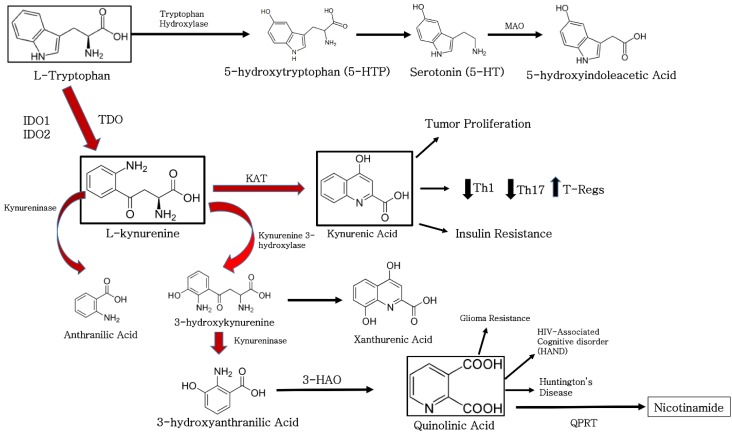
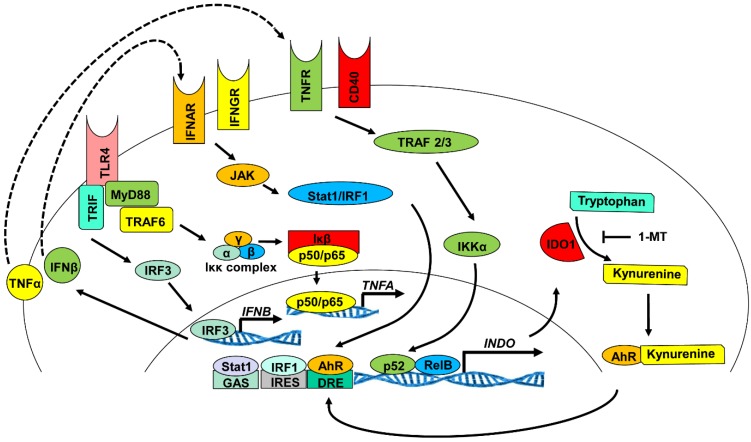
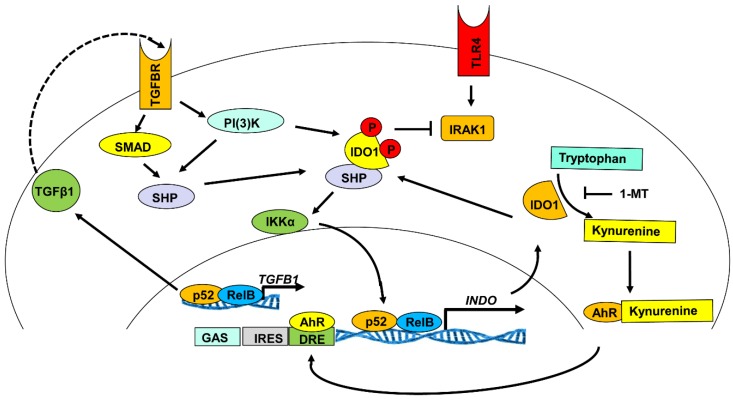
Indoleamine 2, 3-dioxygenase (IDO) is the first and rate limiting catabolic enzyme in the degradation pathway of the essential amino acid tryptophan. By cleaving the aromatic indole ring of tryptophan, IDO initiates the production of a variety of tryptophan degradation products called “kynurenines” that are known to exert important immuno-regulatory functions. Because tryptophan must be supplied in the diet, regulation of tryptophan catabolism may exert profound effects by activating or inhibiting metabolism and immune responses. Important for survival, the regulation of IDO biosynthesis and its activity in cells of the immune system can critically alter their responses to immunological insults, such as infection, autoimmunity and cancer. In this review, we assess how IDO-mediated catabolism of tryptophan can modulate the immune system to arrest inflammation, suppress immunity to cancer and inhibit allergy, autoimmunity and the rejection of transplanted tissues. Finally, we examine how vaccines may enhance immune suppression of autoimmunity through the upregulation of IDO biosynthesis in human dendritic cells.
Overview
The claims and statistics of this paper haven’t been checked yet.
Run the check — free, no account needed. It reads the open-access text and checks the sources it cites.
Integrity signals
Registry
Cites
Statistics
Figures
Verification
Claims the paper makes
The claims and statistics of this paper haven’t been checked yet.
Run the check — free, no account needed. It reads the open-access text and checks the sources it cites.
Claims other papers make about this one
Each is checked against this paper’s own text: does it say what the citing paper says it does?
The cited source says what the claim attributes to it.
In the citing paper
“Increased IDO expression is responsible for the catabolism of TRP in the KYN degradation pathway [36] and is canonically upregulated by inflammatory mechanisms [37,38].”
Self-check
Percentages, sums and reported differences re-computed from the paper’s own numbers.
The self-check needs the paper’s full text.
Citations
Cites
Multilineage potential of adult human mesenchymal stem cells
Pittenger, M. F., Mackay, A. M., Beck, S. C., Jaiswal, R. K., Douglas, R., Mosca, J. D., Moorman, M. A., Simonetti, D. W., Craig, S., & Marshak, D. R. (1999) · Science · doi:10.1126/science.284.5411.143 · Cited by 21,052 · cited 1×
“Mesenchymal stem cells provide a basis for improved tissue regeneration and gene therapy [17,18].”
BackgroundMechanisms of TGF-β Signaling from Cell Membrane to the Nucleus
Shi, Y., & Massagué, J. (2003) · Cell · doi:10.1016/s0092-8674(03)00432-x · Cited by 5,860 · cited 3×
“Several molecular stimuli and signaling pathways were shown to induce the transcription and translation of metabolically-active IDO1 enzyme [35,40,50].”
BackgroundMechanisms of Diabetic Complications
Forbes, J. M., & Cooper, M. E. (2013) · Physiological Reviews · doi:10.1152/physrev.00045.2011 · Cited by 2,890 · cited 2×
“About 80% of patients are women with a 2–5-times greater risk of autoimmune disease onset among African, Hispanic and Native American women than those of European descent [119,137,143–145].”
BackgroundPrevention of Allogeneic Fetal Rejection by Tryptophan Catabolism
Munn, D. H., Zhou, M., Attwood, J. T., Bondarev, I. E., Conway, S. J., Marshall, B., Brown, C. C., & Mellor, A. L. (1998) · Science · doi:10.1126/science.281.5380.1191 · Cited by 2,589 · cited 1×
“confirming that placental cells synthesizing IDO1 can protect the mammalian fetus from maternal T-cell attack [15,16].”
BackgroundUyttenhove, C., Pilotte, L., Théate, I., Stroobant, V., Colau, D., Parmentier, N., Boon, T., & Van den Eynde, B. J. (2003) · Nature Medicine · doi:10.1038/nm934 · Cited by 2,305 · cited 1×
“A connection between elevated urinary tryptophan catabolites and bladder cancer was first reported in the 1950s [105].”
BackgroundBone Marrow Stromal Stem Cells: Nature, Biology, and Potential Applications
Bianco, P., Riminucci, M., Gronthos, S., & Robey, P. G. (2001) · Stem Cells · doi:10.1634/stemcells.19-3-180 · Cited by 1,944 · cited 1×
“Mesenchymal stem cells provide a basis for improved tissue regeneration and gene therapy [17,18].”
BackgroundAn endogenous tumour-promoting ligand of the human aryl hydrocarbon receptor
Opitz, C. A., Litzenburger, U. M., Sahm, F., Ott, M., Tritschler, I., Trump, S., Schumacher, T., Jestaedt, L., Schrenk, D., Weller, M., et al. (2011) · Nature · doi:10.1038/nature10491 · Cited by 1,898 · cited 1×
“The aryl hydrocarbon receptor (AhR) was shown to cause immune suppression after binding dioxin [70].”
BackgroundAn Interaction between Kynurenine and the Aryl Hydrocarbon Receptor Can Generate Regulatory T Cells
Mezrich, J. D., Fechner, J. H., Zhang, X., Johnson, B. P., Burlingham, W. J., & Bradfield, C. A. (2010) · The Journal of Immunology · doi:10.4049/jimmunol.0903670 · Cited by 1,674 · cited 2×
“Interestingly, kynurenines produced from IDO’s enzymatic activity can also bind and activate as an endogenous ligand, AhR [53,54].”
BackgroundEpidemiology and estimated population burden of selected autoimmune diseases in the United States
Jacobson, D. L., Gange, S. J., Rose, N. R., & Graham, N. M. H. (1997) · Clinical Immunology and Immunopathology · doi:10.1006/clin.1997.4412 · Cited by 1,667 · cited 2×
“self-antigens were shown to prevent uveitis, multiple sclerosis and type 1 diabetes in animal models of autoimmunity [124,131,132,142,153].”
BackgroundEisenbarth (1986) · doi:10.1056/nejm198605223142106 · Cited by 1,659 · cited 1×
“Type 1 diabetes (T1D) is a well-studied prototypic tissue-specific autoimmune disease resulting from auto-reactive lymphocyte destruction of the pancreatic islet insulin-producing -cells [34,134–137].”
Background
Cited by
Sorted by citations
Items 301–316 of 316
Lê, Đ. H., Nguyen, N. T. K., & Nguyễn, N. (2026) · TNU Journal of Science and Technology · doi:10.34238/tnu-jst.13683
“Indoleamine 2,3-dioxygenase (IDO) catalyzes tryptophan degradation into kynurenine and related metabolites, contributing to immune suppression by limiting T-cell activity and generating immunoregulatory byproducts [4].”
Molecular Insights and Therapeutic Innovations in Cervical Cancer: Emerging Drug Targets
Debnath, A., Singh, R., Mazumder, R., Dua, A., Tyagi, P., & Singh, A. K. (2026) · Advances in pharmacological and pharmaceutical sciences · doi:10.1155/adpp/1452252
Rewiring the Lymphatic Landscape: Disorders, Remodeling, and Cancer Progression
Kumar, S., Adhikari, U., & Singh, B. B. (2025) · Lymphatics · doi:10.3390/lymphatics3040037
“Cytokines such as TGF-β , IL-10, and IDO (indoleamine 2,3-dioxygenase) further suppress this, creating an environment that shuts down normal immune functions [113,114].”
Fekry, M., Elgohary, Y., Abd-Elaziz, H. R., Hassan, T. H., & Ahmed, M. M. (2025) · Cytopathology · doi:10.1111/cyt.70037
Sabarish, R., Lavu, V., Vettriselvi, V., Ambady, R., & K., B. (2025) · Open Dentistry Journal · doi:10.2174/0118742106417795251013155631
Świątek, G., Nowakowska-Gołacka, J., Słomińska-Wojewódzka, M., Glac, W., Harackiewicz, O., Kurowska-Rucińska, E., & Wrona, D. (2025) · International Journal of Molecular Sciences · doi:10.3390/ijms26199397
“The IDO1 enzyme that catalyzes tryptophan (l-Trp) degradation together with the kynurenine pathway [6] is induced by pro-inflammatory cytokines during chronic inflammation, e.g., in the case of aging and age-associated diseases [7–10].”
InfluentialEbokaiwe, A. P., Alilonu, D. O., Kalu, W. O., & Obimma, J. N. (2024) · Alcoholism Treatment Quarterly · doi:10.1080/07347324.2024.2445314
“The splenic toxicity of the lymphocyte due to perturbation in the antioxidant/oxidative stress redox was evident in recent studies (Jacques et al., 2015; Qu et al., 2019; Zhao & Zhang, 2018).”
Oral Administration of Piperine Ameliorates Experimental Autoimmune Uveitis
Ghavami, A., Froushani, S. M. A., & Tehrani, A. (2024) · Inflammation · doi:10.1007/s10753-024-02131-1
“[39].”
Saeed, F., & Jasim, R. (2023) · Ukrainian Biochemical Journal · doi:10.15407/ubj95.04.017
Noulsri, E., & Lerdwana, S. (2022) · Medical Hypotheses · doi:10.1016/j.mehy.2022.110907
Kadam, M. M., & Al-Abady, Z. (2022) · International Journal of Health Sciences · doi:10.53730/ijhs.v6ns1.7655
“It is thought to play a role in a variety of pathophysiological processes, including antimicrobial and antitumor defense, neuropathology, immune-regulation, antioxidant activity, and autoimmunity suppression (22).”
BackgroundUnicha, M. S. N., Artama, W. T., & Nastiti, N. I. (2022) · Indonesian Journal of Tropical and Infectious Disease · doi:10.20473/ijtid.v10i1.32119
Restructuring of the Immune Contexture Improves Checkpoint Blockade Efficacy in Murine Lung CancerPreprint
Ebelt, N., Zuniga, E., Marzagalli, M., Zamloot, V., Blazar, B., Salgia, R., & Manuel, E. R. (2020) · bioRxiv · doi:10.1101/2020.10.09.332387
“MDSCs suppress T cell activation and proliferation through upregulation of reactive oxygen species (ROS) and arginase, as well as indoleamine 2,3-dioxygenase (IDO) [22-24] which suppresses T-cell function by converting essential tryptophan into suppressive kynurenines [25].”
BackgroundHUMAN PAPILLOMAVIRUS INFECTION IN WOMEN FROM CÂMPULUNG AREA, ARGES COUNTY, IN 2018-2019
Deliu, I., Opriş, L. P., & Petrovici-Daschevici, C. (2020) · Current Trends in Natural Sciences · doi:10.47068/ctns.2020.v9i17.040
“The HPV can evade the cytotoxic action of NK cells al o by changes of IDO (indoleamine 2,3- Dioxygenase) immunosuppressive enzyme (Amador-Molina et al., 2013; Mbongue et al., 2015).”
BackgroundCatoia, J., Bianchi, P. K. F. D. C., Bruno, C., Carniatto, C. H. D. O., Leandro, R. M., Poscai, A. N., de Lima, A. R., & Kfoury, J. (2016) · doi:10.1590/s0100-736x2016000400015
Systemic and local regulation of experimental arthritis by IFN-α, dendritic cells and uridine
Narendra, S. C. (2017) · Linköping University medical dissertations · doi:10.3384/diss.diva-136238
“However, IDO1 is not vital for regulation of self-tolerance as IDO1 knock out mice (IDO) do not die from autoimmune responses [167].”
Metadata
- Authors
- Mbongue, J., Nicholas, D., Torrez, T., Kim, N.-S., Firek, A., & Langridge, W.
- Affiliations
- Loma Linda University (US)
- California Baptist University (US)
- Jerry L. Pettis Memorial VA Medical Center (US)
- Corresponding author
- Langridge, William
- Venue
- Vaccines
- Publisher
- MDPI AG
- Published
- 2015-09-10
- Volume
- 3
- Issue
- 3
- Pages
- 703-729
- ISSN
- 2076-393X (ISSN-L)
- PMC
- PMC4586474
- OpenAlex
- W2101376945
- Cited by
- 351
- References
- 165
- Citations by year
- 2026: 18 · 2025: 32 · 2024: 32 · 2023: 39 · 2022: 43 · 2021: 39 · 2020: 47 · 2019: 34 · 2018: 39 · 2017: 16 · 2016: 11 · 2015: 1
- FWCI
- 1.26
- Type
- journal article
- Language
- en
- Open access
- gold
- dx.doi.org
- Licence
- Locations
- Vaccines (publishedVersion, cc-by)
- Europe PMC (PubMed Central) (publishedVersion, cc-by)
- PubMed Central (publishedVersion, cc-by)
- PubMed (publishedVersion)
- DOAJ (DOAJ: Directory of Open Access Journals) (submittedVersion, cc-by-sa)
- Funders
- Loma Linda University
- National Institutes of Health (DK-99-013)
- National Institute of General Medical Sciences (R25GM060507)
- National Institute on Minority Health and Health Disparities (P20MD006988)
- Topics
- Life Sciences › Neuroscience › Biological Psychiatry › Tryptophan and brain disorders
- Life Sciences › Immunology and Microbiology › Immunology › Immunotherapy and Immune Responses
- Life Sciences › Immunology and Microbiology › Immunology › T-cell and B-cell Immunology
- Keywords
- indoleamine 2,3-dioxygenase, tryptophan catabolism, kynurenine, immunosuppression, autoimmunity, dendritic cells, tumor immunosuppression, allergy, graft rejection, inflammation, vaccine adjuvants, tryptophan metabolism
About these checks
Registry, retraction, Cites and statistics results are computed, not judged, with one exception: a printed reference that no index lists is read once by a model before it counts as a citation error. Claims are extracted by a model and kept only when their quote appears verbatim in the text; each cited source is then checked, with a model’s help, for whether it says what the claim relies on. Those verdicts can be wrong — read the claim’s quote and the cited source before relying on one.
Statistics and arithmetic are recomputed, not judged.
Confidence bands are shown only for fields calibrated on our annotated test set. None is calibrated yet, so no band is shown.
What counts as a claim ›How we measure confidence ›How we check this ›
Are you an author, or do you see a problem with this page? Request a review
