

The DOI matches its Crossref record; 89 of the 89 references it cites were found in a registry or an index.
Health effects of protein intake in healthy adults: a systematic literature review
Open accessAbstract
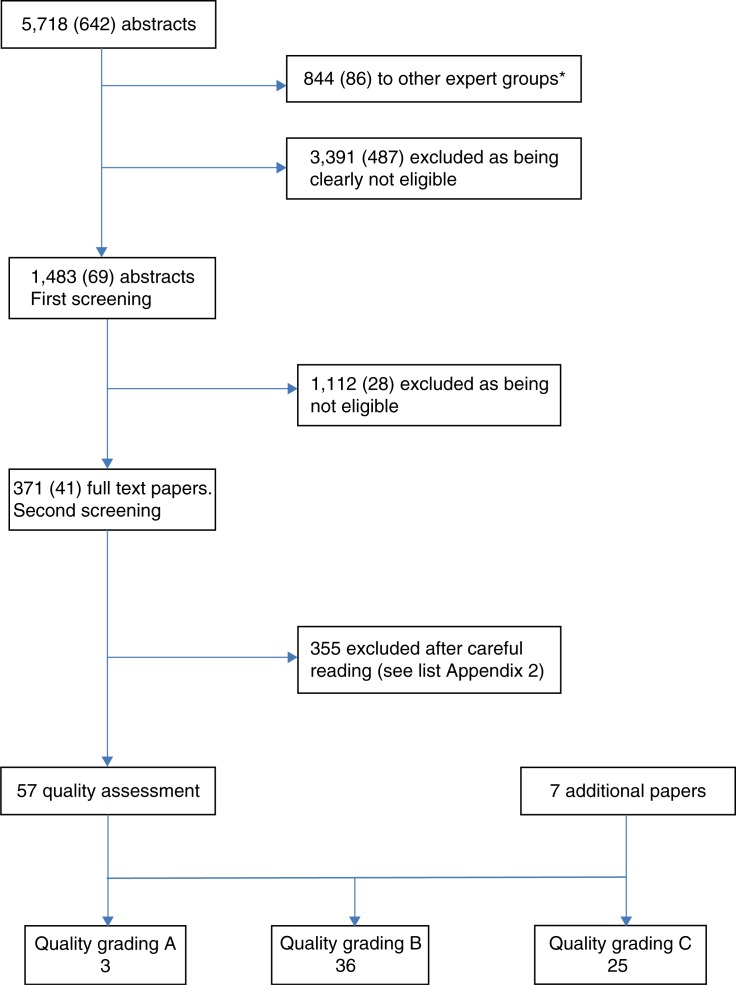
The purpose of this systematic review is to assess the evidence behind the dietary requirement of protein and to assess the health effects of varying protein intake in healthy adults. The literature search covered the years 2000–2011. Prospective cohort, case-control, and intervention studies were included. Out of a total of 5,718 abstracts, 412 full papers were identified as potentially relevant, and after careful scrutiny, 64 papers were quality graded as A (highest), B, or C. The grade of evidence was classified as convincing, probable, suggestive or inconclusive. The evidence is assessed as: probable for an estimated average requirement of 0.66 g good-quality protein/kg body weight (BW)/day based on nitrogen balance studies, suggestive for a relationship between increased all-cause mortality risk and long-term low-carbohydrate–high-protein (LCHP) diets; but inconclusive for a relationship between all-cause mortality risk and protein intake per se; suggestive for an inverse relationship between cardiovascular mortality and vegetable protein intake; inconclusive for relationships between cancer mortality and cancer diseases, respectively, and protein intake; inconclusive for a relationship between cardiovascular diseases and total protein intake; suggestive for an inverse relationship between blood pressure (BP) and vegetable protein; probable to convincing for an inverse relationship between soya protein intake and LDL cholesterol; inconclusive for a relationship between protein intake and bone health, energy intake, BW control, body composition, renal function, and risk of kidney stones, respectively; suggestive for a relationship between increased risk of type 2 diabetes (T2D) and long-term LCHP-high-fat diets; inconclusive for impact of physical training on protein requirement; and suggestive for effect of physical training on whole-body protein retention. In conclusion, the evidence is assessed as probable regarding the estimated requirement based on nitrogen balance studies, and suggestive to inconclusive for protein intake and mortality and morbidity. Vegetable protein intake was associated with decreased risk in many studies. Potentially adverse effects of a protein intake exceeding 20–23 E% remain to be investigated. Keywords: protein requirement; nitrogen balance; animal protein; vegetable protein; mortality; chronic disease; Nordic nutrition recommendations (Published: 30 July 2013) Citation: Food & Nutrition Research 2013. 57: 21245 - http://dx.doi.org/10.3402/fnr.v57i0.21245 Access the supplementary material to this article – see Supplementary files under Article Tools online. Special Issue: This paper is part of the Nordic Nutrition Recommendations - The NNR5 project. More papers from this issue can be found at http://www.foodandnutritionresearch.net
Overview
The claims and statistics of this paper haven’t been checked yet.
Run the check — free, no account needed. It reads the open-access text and checks the sources it cites.
Integrity signals
Registry
Cites
Statistics
Figures
Verification
Claims the paper makes
The claims and statistics of this paper haven’t been checked yet.
Run the check — free, no account needed. It reads the open-access text and checks the sources it cites.
Claims other papers make about this one
Each is checked against this paper’s own text: does it say what the citing paper says it does?
In the citing paper
“Empagliflozin and canagliflozin (the latter given at a higher dose than that approved for use in Japan) are shown to significantly reduce the risk of macroangiopathy in patients at high risk of cardiovascular events 32 , 33 .”
From Japanese clinical practice guideline for diabetes 2019 (2020) · cites this paper as [32]
In the citing paper
“SGLT2 inhibitors tend to be associated with such adverse effects as an increased frequency of genital infection and fluid loss‐related events 32 , 34 .”
From Japanese clinical practice guideline for diabetes 2019 (2020) · cites this paper as [32]
In the citing paper
“Intensive insulin therapy has been shown to be effective in preventing the onset of macroangiopathy in type 2 diabetes 9 , 31 , 32 .”
From Japanese clinical practice guideline for diabetes 2019 (2020) · cites this paper as [32]
Self-check
Percentages, sums and reported differences re-computed from the paper’s own numbers.
The self-check needs the paper’s full text.
Citations
Cites
A Clinical Trial of the Effects of Dietary Patterns on Blood Pressure
Appel, L. J., Moore, T. J., Obarzanek, E., Vollmer, W. M., Svetkey, L. P., Sacks, F. M., Bray, G. A., Vogt, T. M., Cutler, J. A., Windhauser, M. M., et al. (1997) · New England Journal of Medicine · doi:10.1056/nejm199704173361601 · Cited by 5,981
Food, nutrition, physical activity, and the prevention of cancer: a global perspective
Marmot, M. G., Atinmo, T., Byers, T., Chen, J., Hirohata, T., Jackson, A., James, W., Kolonel, L. N., Kumanyika, S., Leitzmann, C., et al. (2008) · Choice Reviews Online · doi:10.5860/choice.45-5024 · Cited by 5,368
American College of Sports Medicine position stand
Otis, C. L. (1997) · Medical Entomology and Zoology · Cited by 4,407
Principles of nutritional assessment
(1990) · Choice Reviews Online · doi:10.5860/choice.27-6362 · Cited by 2,766
Energy and protein requirements*
Pacey, A., & Payne, P. (2019) · Routledge eBooks · doi:10.4324/9780429036279-4 · Cited by 2,545
Principles Of Nutritional Assessment
Gibson, R. S. (2005) · doi:10.1093/oso/9780195171693.001.0001 · Cited by 1,887
Energy and protein requirements : report of a Joint FAO/WHO/UNU Expert Consultation
Fao, J., Energy, U. E. C. O., & Requirements, P. (1985) · Medical Entomology and Zoology · Cited by 1,857
Lazcano-Ponce, E. C. (2009) · Salud Pública de México · Cited by 1,669
Black, A. (2000) · International Journal of Obesity · doi:10.1038/sj.ijo.0801376 · Cited by 1,490
Appel, L. J., Sacks, F. M., Carey, V. J., Obarzanek, E., Swain, J. F., Miller, E. R., Conlin, P. R., Erlinger, T. P., Rosner, B. A., Laranjo, N. M., et al. (2005) · JAMA · doi:10.1001/jama.294.19.2455 · Cited by 1,170
Research works printed but not linked: 2
- Mayne ST, 2001, Cancer Epidemiol Biomarkers Prev, 10, 1055
- Summerbell CD, 2009, Int J Obes, 33, S1
Cited by
Sorted by citations
Dietary protein intake and human health
Wu, G. (2016) · Food & Function · doi:10.1039/c5fo01530h · Cited by 748
Japanese clinical practice guideline for diabetes 2019
Araki, E., Goto, A., Kondo, T., Noda, M., Noto, H., Origasa, H., Osawa, H., Taguchi, A., Tanizawa, Y., Tobe, K., et al. (2020) · Diabetology International · doi:10.1007/s13340-020-00439-5 · Cited by 545
Nordic Nutrition Recommendations 2023
Blomhoff, R., Andersen, R., Arnesen, E., Christensen, J. J., Eneroth, H., Erkkola, M., Gudanaviciene, I., Halldorsson, T. I., Høyer-Lund, A., Lemming, E. W., et al. (2023) · Nordic Council of Ministers eBooks · doi:10.6027/nord2023-003 · Cited by 455
Nutrition and Kidney Stone Disease
Siener, R. (2021) · Nutrients · doi:10.3390/nu13061917 · Cited by 379
Japanese Clinical Practice Guideline for Diabetes 2019
Araki, E., Goto, A., Kondo, T., Noda, M., Noto, H., Origasa, H., Osawa, H., Taguchi, A., Tanizawa, Y., Tobe, K., et al. (2020) · Journal of Diabetes Investigation · doi:10.1111/jdi.13306 · Cited by 346
Metadata
- Authors
- Pedersen, A. N., Kondrup, J., & Børsheim, E.
- Affiliations
- Technical University of Denmark (DK)
- Copenhagen University Hospital (DK)
- The University of Texas Medical Branch at Galveston (US)
- Corresponding author
- Pedersen, Agnes N.
- ORCID
- Børsheim, Elisabet
- Venue
- Food & Nutrition Research
- Publisher
- SNF Swedish Nutrition Foundation
- Published
- 2013-01
- Volume
- 57
- Issue
- 1
- Pages
- 21245
- ISSN
- 1654-661X (ISSN-L)
- 1654-6628
- PMC
- PMC3730112
- OpenAlex
- W2022177344
- Cited by
- 167
- References
- 89
- Citations by year
- 2026: 6 · 2025: 5 · 2024: 7 · 2023: 13 · 2022: 7 · 2021: 14 · 2020: 19 · 2019: 10 · 2018: 13 · 2017: 19 · 2016: 26 · 2015: 13 · 2014: 11 · 2013: 2
- FWCI
- 1.99
- Type
- journal article
- Language
- en
- Open access
- gold
- doi.org
- Licence
- cc-by
- Locations
- Food & Nutrition Research (publishedVersion, cc-by)
- Europe PMC (PubMed Central) (publishedVersion, cc-by)
- PubMed Central (publishedVersion, cc-by)
- PubMed (publishedVersion)
- DOAJ (DOAJ: Directory of Open Access Journals) (submittedVersion, cc-by-sa)
- Topics
- Health Sciences › Nursing › Nutrition and Dietetics › Muscle metabolism and nutrition
- Health Sciences › Medicine › Public Health, Environmental and Occupational Health › Nutritional Studies and Diet
- Health Sciences › Medicine › Physiology (medical) › Diet and metabolism studies
- Keywords
- protein intake, protein requirements, nitrogen balance, plant proteins, animal protein, all-cause mortality, cardiovascular mortality, cancer mortality, type 2 diabetes, LDL cholesterol, blood pressure, bone health, kidney stones, renal function, body composition, weight management, exercise training, protein retention, high-protein low-carbohydrate diet, Nordic Nutrition Recommendations, healthy adults, energy intake, body weight
About these checks
Registry, retraction, Cites and statistics results are computed, not judged, with one exception: a printed reference that no index lists is read once by a model before it counts as a citation error. Claims are extracted by a model and kept only when their quote appears verbatim in the text; each cited source is then checked, with a model’s help, for whether it says what the claim relies on. Those verdicts can be wrong — read the claim’s quote and the cited source before relying on one.
Statistics and arithmetic are recomputed, not judged.
Confidence bands are shown only for fields calibrated on our annotated test set. None is calibrated yet, so no band is shown.
What counts as a claim ›How we measure confidence ›How we check this ›
Are you an author, or do you see a problem with this page? Request a review
