

The DOI matches its Crossref record; 144 of the 144 references it cites were found in a registry or an index.
Fueling the caries process: carbohydrate metabolism and gene regulation by Streptococcus mutans
Open accessAbstract
The nature of the oral cavity and host behaviors has mandated that the oral microbiota evolve mechanisms for coping with environmental fluctuations, especially changes in the type and availability of carbohydrates. In the case of human dental caries, the presence of excess carbohydrates is often responsible for altering the local environment to be more favorable for species associated with the initiation and progression of disease, including Streptococcus mutans. Some of the earliest endeavors to understand how cariogenic species respond to environmental perturbations were carried out using chemostat cultivation, which provides fine control over culture conditions and bacterial behaviors. The development of genome-scale methodologies has allowed for the combination of sophisticated cultivation technologies with genome-level analysis to more thoroughly probe how bacterial pathogens respond to environmental stimuli. Recent investigations in S. mutans and other closely related streptococci have begun to reveal that carbohydrate metabolism can drastically impact pathogenic potential and highlight the important influence that nutrient acquisition has on the success of pathogens; inside and outside of the oral cavity. Collectively, research into pathogenic streptococci, which have evolved in close association with the human host, has begun to unveil the essential nature of careful orchestration of carbohydrate acquisition and catabolism to allow the organisms to persist and, when conditions allow, initiate or worsen disease.
Overview
The claims and statistics of this paper haven’t been checked yet.
Run the check — free, no account needed. It reads the open-access text and checks the sources it cites.
Integrity signals
Registry
Cites
Statistics
Figures
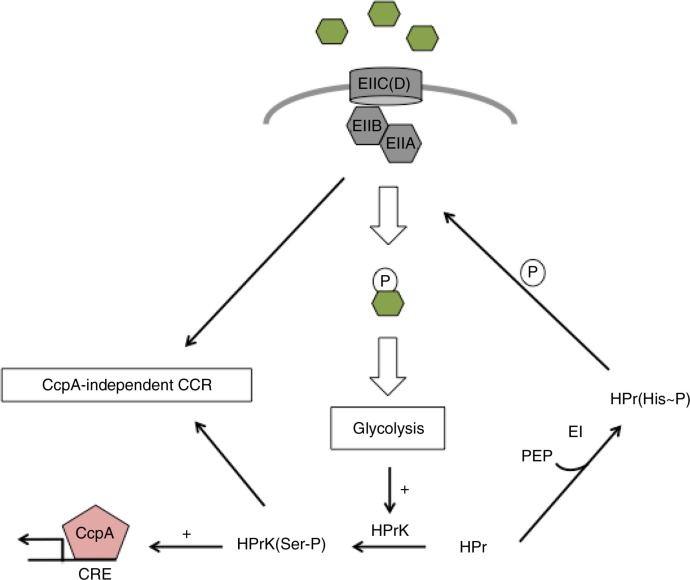
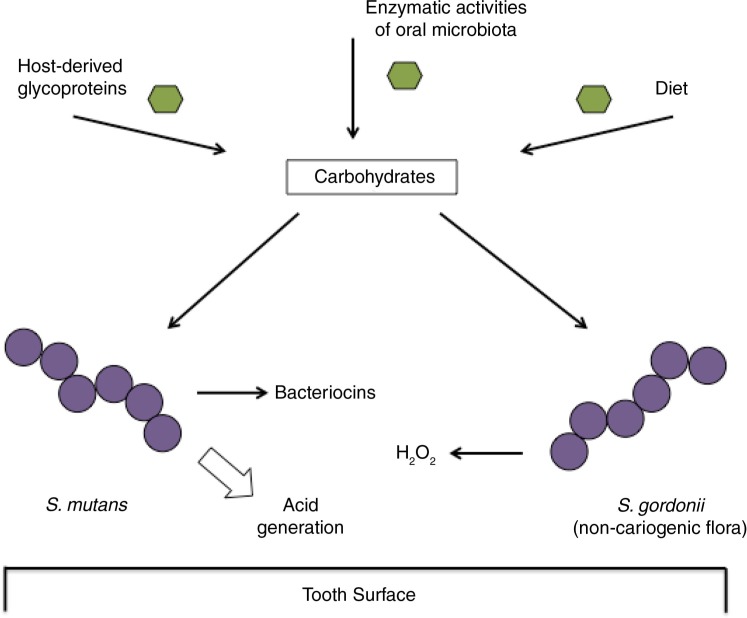
Verification
Claims the paper makes
The claims and statistics of this paper haven’t been checked yet.
Run the check — free, no account needed. It reads the open-access text and checks the sources it cites.
Claims other papers make about this one
Each is checked against this paper’s own text: does it say what the citing paper says it does?
In the citing paper
“The saccharolytic bacteria include Streptococcus, Actinomyces, and Veillonella, which have the unique ability to degrade carbohydrates via the Embden−Meyerhof−Pernas pathway, producing acidic by-products including lactate, acetate, ethanol, and formate [1,82].”
From A Cross-Talk between Diet and the Oral Microbiome: Balance of Nutrition on Inflammation and Immune System’s Response during Periodontitis (2022) · cites this paper as [1]
In the citing paper
“While diet influences the oral microbiome,22, 24, 26 recent data indicate that the oral microbiome influences the dietary preferences of its host.”
From The oral microbiome: Role of key organisms and complex networks in oral health and disease (2021) · cites this paper as [22]
In the citing paper
“Diet provides nutritional resources for the oral microbiota and also serves as a selective pressure by enriching for organisms best adapted to utilize specific host‐derived dietary resources.22”
From The oral microbiome: Role of key organisms and complex networks in oral health and disease (2021) · cites this paper as [22]
In the citing paper
“Such changes in diet were paralleled by pathologic changes to the oral microbiota, including greater representation of acid‐producing and acid‐tolerant organisms and periodontal pathogens.17, 22, 24, 25”
From The oral microbiome: Role of key organisms and complex networks in oral health and disease (2021) · cites this paper as [22]
In the citing paper
“Carbohydrate use by S mutans is a well‐recognized feature in the pathogenicity of dental caries.”
From The oral microbiome: Role of key organisms and complex networks in oral health and disease (2021) · cites this paper as [22]
In the citing paper
“Saccharolytic bacteria, including Streptococcus, Actinomyces, and Veillonella species, degrade carbohydrates via the Embden‐Meyerhof‐Parnas pathways to produce acidic by‐products, including lactate, acetate, ethanol, and formate, which cause demineralization of dental enamel and the development of carious lesions.”
From The oral microbiome: Role of key organisms and complex networks in oral health and disease (2021) · cites this paper as [22]
Self-check
Percentages, sums and reported differences re-computed from the paper’s own numbers.
The self-check needs the paper’s full text.
Citations
Cites
Role of Streptococcus mutans in human dental decay
Loesche, W. J. (1986) · Microbiological Reviews · doi:10.1128/mr.50.4.353-380.1986 · Cited by 3,360
Dewhirst, F. E., Chen, T., Izard, J., Paster, B. J., Tanner, A. C. R., Yu, W.-H., Lakshmanan, A., & Wade, W. G. (2010) · Journal of Bacteriology · doi:10.1128/jb.00542-10 · Cited by 3,352
A review of saliva: normal composition, flow, and function.
Humphrey, S. P., & Williamson, R. (2001) · The Journal of prosthetic dentistry (Print) · doi:10.1067/mpr.2001.113778 · Cited by 2,276 · cited 1×
“Human saliva serves a primary role in maintaining the health of oral sites, and the unique proteins and finely tuned buffering capacity of these fluids greatly impact the composition of the oral microbiota, in many cases preferentially selecting for the survival of non-cariogenic organisms (73).”
BackgroundPhosphoenolpyruvate:carbohydrate phosphotransferase systems of bacteria
Postma, P. W., Lengeler, J. W., & Jacobson, G. R. (1993) · Microbiological Reviews · doi:10.1128/mr.57.3.543-594.1993 · Cited by 1,802
Evolution, consequences and future of plant and animal domestication
Diamond, J. M. (2002) · Nature · doi:10.1038/nature01019 · Cited by 1,772
Deutscher, J., Francke, C., & Postma, P. W. (2006) · Microbiology and Molecular Biology Reviews · doi:10.1128/mmbr.00024-06 · Cited by 1,411 · cited 14×
“However, inactivation of the ccpA gene in S. mutans almost never results in alleviation of CCR.”
BackgroundInfluentialAre dental diseases examples of ecological catastrophes?
Marsh, P. D. (2003) · Microbiology · doi:10.1099/mic.0.26082-0 · Cited by 1,256 · cited 2×
“Further studies of the physiology and cariogenic potential of oral microbial pathogens have altered our understanding of how carious lesions originate and modified the strategy for preventing carious lesions from directly eliminating carious bacteria from the oral cavity to reestablishing a balance in the ecology betw…”
BackgroundBowen, W. H., & Koo, H. (2011) · Caries Research · doi:10.1159/000324598 · Cited by 1,085 · cited 1×
“mutans on the smooth surfaces of the tooth (86).”
BackgroundGenome sequence of Streptococcus mutans UA159, a cariogenic dental pathogen
Ajdić, D., McShan, W. M., McLaughlin, R. E., Savić, G., Chang, J. S., Carson, M. B., Primeaux, C., Tian, R., Kenton, S., Jia, H., et al. (2002) · Proceedings of the National Academy of Sciences · doi:10.1073/pnas.172501299 · Cited by 1,013
Control of gene expression by a natural metabolite-responsive ribozyme
Winkler, W. C., Nahvi, A., Roth, A., Collins, J. A., & Breaker, R. R. (2004) · Nature · doi:10.1038/nature02362 · Cited by 976 · cited 1×
“coli and other members of Enterobacteriaceae (103, 104), or by a metabolitebinding ribozyme in many Gram-positive organisms (105, 106).”
Background
Research works printed but not linked: 3
- Loesche WJ. Role ofStreptococcus mutansin human dental decay. Microbiol Rev. 1986; 50: 353–80. [PubMed Abstract] [PubMed CentralFull Text]. · DOI · Paper page
- Monod J, 1950, Ann Inst Pasteur (Paris), 79, 390
- Walker G, 1983, Glucosyltransferases, glucans, sucrose and dental caries (Sp. Suppl. Chemical Senses), 179
Cited by
Sorted by citations
Oral Biofilms: Pathogens, Matrix, and Polymicrobial Interactions in Microenvironments
Bowen, W. H., Burne, R. A., Wu, H., & Koo, H. (2018) · Trends in Microbiology · doi:10.1016/j.tim.2017.09.008 · Cited by 1,059
“In low-carbohydrate conditions, a pyruvate-formate lyase funnels the pyruvate to acetate and formate, gaining an additional ATP, compared to the lactate pathway [73].”
BackgroundFan, X., Alekseyenko, A. V., Wu, J., Peters, B. A., Jacobs, E. J., Gapstur, S. M., Purdue, M. P., Abnet, C. C., Stolzenberg-Solomon, R., Miller, G., et al. (2018) · Gut · doi:10.1136/gutjnl-2016-312580 · Cited by 702
The oral microbiome: Role of key organisms and complex networks in oral health and disease
Sedghi, L., DiMassa, V., Harrington, A., Lynch, S. V., & Kapila, Y. L. (2021) · Periodontology 2000 · doi:10.1111/prd.12393 · Cited by 755
Dental biofilm: ecological interactions in health and disease
Marsh, P., & Zaura, E. (2017) · Journal Of Clinical Periodontology · doi:10.1111/jcpe.12679 · Cited by 569
Periodontal Disease: The Good, The Bad, and The Unknown
Sedghi, L. M., Bacino, M. S., & Kapila, Y. L. (2021) · Frontiers in Cellular and Infection Microbiology · doi:10.3389/fcimb.2021.766944 · Cited by 409
Metadata
- Authors
- Moye, Z. D., Zeng, L., & Burne, R. A.
- Affiliations
- University of Florida (US)
- Corresponding author
- Burne, Robert A.
- Venue
- Journal of Oral Microbiology
- Publisher
- Informa UK Limited
- Published
- 2014-01-01
- Volume
- 6
- Issue
- 1
- Pages
- 24878
- ISSN
- 2000-2297 (ISSN-L)
- PMC
- PMC4157138
- OpenAlex
- W2100691159
- Cited by
- 164
- References
- 142
- Citations by year
- 2026: 13 · 2025: 17 · 2024: 17 · 2023: 17 · 2022: 19 · 2021: 13 · 2020: 15 · 2019: 10 · 2018: 12 · 2017: 10 · 2016: 15 · 2015: 5 · 2014: 1
- FWCI
- 1.74
- Type
- journal article
- Language
- en
- Open access
- gold
- doi.org
- Licence
- cc-by-nc-nd
- Locations
- Journal of Oral Microbiology (publishedVersion, cc-by-nc-nd)
- PubMed Central (publishedVersion, cc-by-nc-nd)
- PubMed (publishedVersion)
- DOAJ (DOAJ: Directory of Open Access Journals) (submittedVersion)
- Funders
- National Institute of Allergy and Infectious Diseases (T32AI007110)
- National Institute of Dental and Craniofacial Research (DE12236, R01DE019783, T90DE021990, R01DE012236)
- Topics
- Health Sciences › Dentistry › Periodontics › Oral microbiology and periodontitis research
- Life Sciences › Biochemistry, Genetics and Molecular Biology › Genetics › Bacterial Genetics and Biotechnology
- Health Sciences › Dentistry › General Dentistry › Dental Health and Care Utilization
- Keywords
- Streptococcus mutans, dental caries, carbohydrate metabolism, gene expression regulation, oral microbiota, chemostat cultivation, nutrient acquisition, bacterial pathogenicity, host-pathogen interaction, carbohydrate catabolism
About these checks
Registry, retraction, Cites and statistics results are computed, not judged, with one exception: a printed reference that no index lists is read once by a model before it counts as a citation error. Claims are extracted by a model and kept only when their quote appears verbatim in the text; each cited source is then checked, with a model’s help, for whether it says what the claim relies on. Those verdicts can be wrong — read the claim’s quote and the cited source before relying on one.
Statistics and arithmetic are recomputed, not judged.
Confidence bands are shown only for fields calibrated on our annotated test set. None is calibrated yet, so no band is shown.
What counts as a claim ›How we measure confidence ›How we check this ›
Are you an author, or do you see a problem with this page? Request a review
