

The DOI matches its Crossref record; 106 of the 107 references it cites were found in a registry or an index.
Iron overload and immunity.
Open accessAbstract
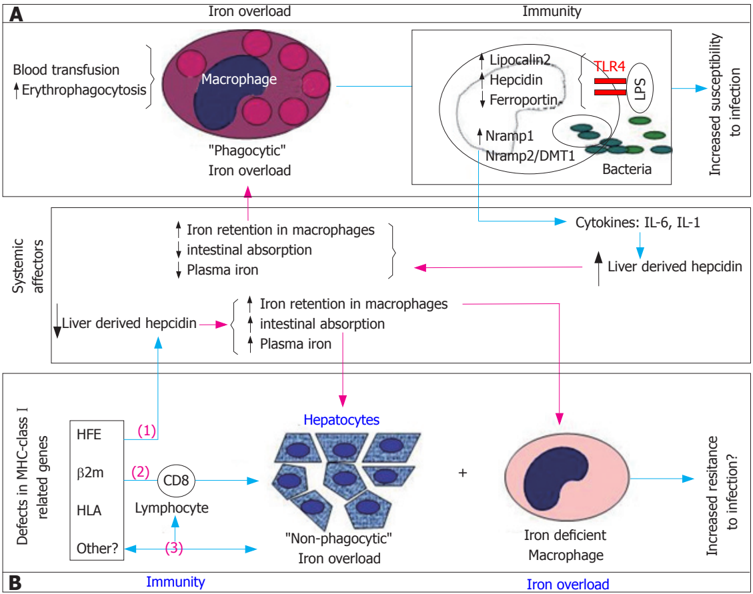
Progress in the characterization of genes involved in the control of iron homeostasis in humans and in mice has improved the definition of iron overload and of the cells affected by it. The cell involved in iron overload with the greatest effect on immunity is the macrophage. Intriguing evidence has emerged, however, in the last 12 years indicating that parenchymal iron overload is linked to genes classically associated with the immune system. This review offers an update of the genes and proteins relevant to iron metabolism expressed in cells of the innate immune system, and addresses the question of how this system is affected in clinical situations of iron overload. The relationship between iron and the major cells of adaptive immunity, the T lymphocytes, will also be reviewed. Most studies addressing this last question in humans were performed in the clinical model of Hereditary Hemochromatosis. Data will also be reviewed demonstrating how the disruption of molecules essentially involved in adaptive immune responses result in the spontaneous development of iron overload and how they act as modifiers of iron overload.
Overview
The claims and statistics of this paper haven’t been checked yet.
Run the check — free, no account needed. It reads the open-access text and checks the sources it cites.
Integrity signals
Registry
Cites
Statistics
Figures
Verification
Claims the paper makes
The claims and statistics of this paper haven’t been checked yet.
Run the check — free, no account needed. It reads the open-access text and checks the sources it cites.
Claims other papers make about this one
Each is checked against this paper’s own text: does it say what the citing paper says it does?
In the citing paper
“Previous studies support the notion that optimal immunity operates within a range of physiological Fe concentrations [41].”
From Host Iron Withholding Demands Siderophore Utilization for Candida glabrata to Survive Macrophage Killing (2011) · cites this paper as [41]
Self-check
Percentages, sums and reported differences re-computed from the paper’s own numbers.
The self-check needs the paper’s full text.
Citations
Cites
Takeda, K., Kaisho, T., & Akira, S. (2003) · Annual Review of Immunology · doi:10.1146/annurev.immunol.21.120601.141126 · Cited by 6,143
Tolerance, Danger and the Extended Family
Matzinger, P. (1994) · Annual Review of Immunology · doi:10.1146/annurev.iy.12.040194.005015 · Cited by 5,107
Targeting Hypoxia-Inducible Factors for the Treatment of Anemia in Chronic Kidney Disease Patients
Locatelli, F., Fishbane, S. N., Block, G. A., & Macdougall, I. C. (2017) · American Journal of Nephrology · doi:10.1159/000455166 · Cited by 4,836
Hepcidin Regulates Cellular Iron Efflux by Binding to Ferroportin and Inducing Its Internalization
Nemeth, E., Tuttle, M. S., Powelson, J., Vaughn, M. B., Donovan, A., Ward, D. M., Ganz, T., & Kaplan, J. (2004) · Science · doi:10.1126/science.1104742 · Cited by 4,803
A novel MHC class I-like gene is mutated in patients with hereditary haemochromatosis
Feder, J. N., Gnirke, A., Thomas, W., Tsuchihashi, Z., Ruddy, D. A., Basava, A., Dormishian, F., Domingo, R., Ellis, M. C., Fullan, A., et al. (1996) · Nature Genetics · doi:10.1038/ng0896-399 · Cited by 3,664
Approaching the asymptote? Evolution and revolution in immunology.Preprint
Janeway, C. (1989) · Cold Spring Harbor Symposia on Quantitative Biology · doi:10.1101/sqb.1989.054.01.003 · Cited by 3,396
Cloning and characterization of a mammalian proton-coupled metal-ion transporter
Gunshin, H., Mackenzie, B., Berger, U. V., Gunshin, Y., Romero, M. F., Boron, W. F., Nussberger, S., Gollan, J. L., & Hediger, M. A. (1997) · Nature · doi:10.1038/41343 · Cited by 3,166
Nemeth, E., Rivera, S., Gabayan, V., Keller, C., Taudorf, S., Pedersen, B. K., & Ganz, T. (2004) · Journal of Clinical Investigation · doi:10.1172/jci200420945 · Cited by 2,650
IDENTIFICATION OF A NOVEL CELL TYPE IN PERIPHERAL LYMPHOID ORGANS OF MICE
Steinman, R. M., & Cohn, Z. A. (1973) · The Journal of Experimental Medicine · doi:10.1084/jem.137.5.1142 · Cited by 2,443
Hepcidin, a urinary antimicrobial peptide synthesized in the liver
Park, C. H., Valore, E. V., Waring, A. J., & Ganz, T. (2001) · Journal of Biological Chemistry · doi:10.1074/jbc.m008922200 · Cited by 2,168
Research works printed but not linked: 9
- Fischer R, Debbabi H, Dubarry M, Boyaka P, Tomé D. Regulation of physiological and pathological Th1 and Th2 responses by lactoferrin. Biochem Cell Biol 2006; 84: 303-311
- Porto G et al . Iron overload and immunity presentation. Nature 1990; 346: 751-754
- Goetz DH, Holmes MA, Borregaard N, Bluhm ME, Raymond K N , S t r o n g R K . T h e n e u t r o p h i l l i p o c a l i n N G A L i s a bacteriostatic agent that interferes with siderophore-mediated iron acquisition. Mol Cell 2002; 10: 1033-1043
- De Sousa M. The Immunology of Iron Overload. In: De Sousa M and Brock J eds. Iron in Immunity, Cancer and Inflammation. John Wiley & Sons Ltd 1989: 247-258
- De Sousa M. Lymphocyte Circulation. Experimental & Clinical Aspects. John Wiley & Sons, New York 1981: 201-216
- Grady RW, Akbar AN, Giardina PJ, Hilgartner MW, de Sousa M. Disproportionate lymphoid cell subsets in thalassaemia m a j o r : t h e r e l a t i v e c o n t r i b u t i splenectomy. Br J Haematol 1985; 59: 713-724
- Miranda CJ, Makui H, Andrews NC, Santos MM. Contributions o f b e t a 2 -m i c r o g l -lymphocytes to iron regulation: insights from HfeRag1(-/-) and beta2mRag1(-/-) double knock-out mice. Blood 2004; 103: 2847-2849
- Pérarnau B, Saron MF, Reina San Martin B, Bervas N, Ong H, Soloski MJ, Smith AG, Ure JM, Gairin JE, Lemonnier FA. Single H2Kb, H2Db and double H2KbDb knockout mice: peripheral CD8+ T cell repertoire and anti-lymphocytic choriomeningitis virus cytolytic responses. Eur J Immunol 1999; 29: 1243-1252
- De Sousa M. Iron and the Lymphomyeloid System: A Growing Knowledge. In: De Sousa M and Brock J eds. Iron in Immunity, Cancer and Inflammation. John Wiley & Sons Ltd. 1989: 3-16 97
Cited by
Sorted by citations
The struggle for iron - a metal at the host-pathogen interface: Iron at the host-pathogen interface
Nairz, M., Schroll, A., Sonnweber, T., & Weiss, G. (2010) · Cellular Microbiology · doi:10.1111/j.1462-5822.2010.01529.x · Cited by 398
Diet in the Pathogenesis and Treatment of Inflammatory Bowel Diseases
Lee, D. Y., Albenberg, L. G., Compher, C. W., Baldassano, R. N., Piccoli, D. A., Lewis, J. D., & Wu, G. D. (2015) · Gastroenterology · doi:10.1053/j.gastro.2015.01.007 · Cited by 388
Infections in Patients with Multiple Myeloma in the Era of High‐Dose Therapy and Novel Agents
Nucci, M., & Anaissie, E. (2009) · Clinical Infectious Diseases · doi:10.1086/605664 · Cited by 347
“Conditioning regimen for HCT, post-engraftment Decrease in CMI, very severe in allogeneic HCT if severe GVHD [33] HSV, VZV, CMV, PJP; aspergillosis and other moulds in allogeneic HCT TPM-SMX prophylaxis for PJP; if severe GVHD, monitor serum CMV by PCR or antigenemia, Aspergillus galactomannan antigen Iron overload [3…”
Bone loss caused by iron overload in a murine model: importance of oxidative stress.
Tsay, J., Yang, Z., Ross, F., Cunningham-Rundles, S., Lin, H., Coleman, R. M., Mayer-Kuckuk, P., Doty, S. B., Grady, R., Giardina, P., et al. (2010) · Blood · doi:10.1182/blood-2009-12-260083 · Cited by 336
Iron at the interface of immunity and infection
Nairz, M., Haschka, D., Demetz, E., & Weiss, G. (2014) · Frontiers in Pharmacology · doi:10.3389/fphar.2014.00152 · Cited by 325
Metadata
- Authors
- Porto, G.
- Affiliations
- Instituto de Biologia Molecular e Celular (PT)
- Corresponding author
- Porto, Graça
- ORCID
- Porto, Graça
- Venue
- World Journal of Gastroenterology
- Publisher
- Baishideng Publishing Group Inc.
- Published
- 2007
- Volume
- 13
- Issue
- 35
- Pages
- 4707
- ISSN
- 1007-9327 (ISSN-L)
- PMC
- PMC4611192
- OpenAlex
- W2126983810
- Cited by
- 140
- References
- 107
- Citations by year
- 2026: 4 · 2025: 5 · 2024: 6 · 2023: 4 · 2022: 5 · 2021: 8 · 2020: 6 · 2019: 9 · 2018: 7 · 2017: 8 · 2016: 10 · 2015: 6 · 2014: 6 · 2013: 10 · 2012: 5
- FWCI
- 1.40
- Type
- journal article
- Language
- en
- Open access
- hybrid
- doi.org
- Licence
- cc-by-nc
- Locations
- World Journal of Gastroenterology (publishedVersion, cc-by-nc)
- PubMed Central (publishedVersion)
- PubMed (publishedVersion)
- Portuguese National Funding Agency for Science, Research and Technology (RCAAP Project by FCT) (submittedVersion, other-oa)
- Topics
- Health Sciences › Medicine › Hematology › Iron Metabolism and Disorders
- Life Sciences › Neuroscience › Neurology › Neurological diseases and metabolism
- Health Sciences › Nursing › Nutrition and Dietetics › Trace Elements in Health
- Keywords
- iron overload, iron homeostasis, innate immunity, macrophages, T cells, adaptive immunity, hereditary hemochromatosis, iron metabolism genes
- MeSH terms
- Hemochromatosis Protein, Animals, Genes, MHC Class I, Homeostasis, Humans, Immunity, Innate, Iron, Membrane Proteins, Histocompatibility Antigens Class I, Iron Overload, Mice
About these checks
Registry, retraction, Cites and statistics results are computed, not judged, with one exception: a printed reference that no index lists is read once by a model before it counts as a citation error. Claims are extracted by a model and kept only when their quote appears verbatim in the text; each cited source is then checked, with a model’s help, for whether it says what the claim relies on. Those verdicts can be wrong — read the claim’s quote and the cited source before relying on one.
Statistics and arithmetic are recomputed, not judged.
Confidence bands are shown only for fields calibrated on our annotated test set. None is calibrated yet, so no band is shown.
What counts as a claim ›How we measure confidence ›How we check this ›
Are you an author, or do you see a problem with this page? Request a review
