

Processing of Task-Irrelevant Race Information is Associated with Diminished Cognitive Control in Black and White Individuals
Open accessThe DOI matches its Crossref record; 126 of the 126 references it cites were found in a registry or an index.
Abstract
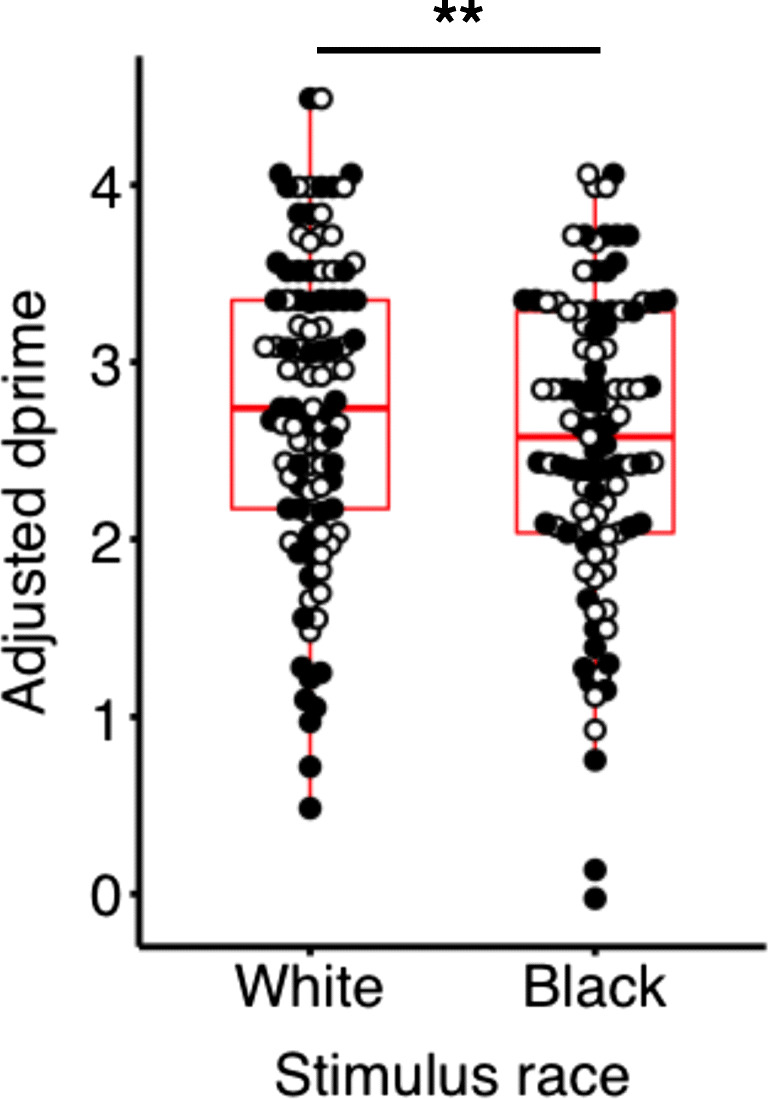
The race of an individual is a salient physical feature that is rapidly processed by the brain and can bias our perceptions of others. How the race of others explicitly impacts our actions toward them during intergroup contexts is not well understood. In the current study, we examined how task-irrelevant race information influences cognitive control in a go/no-go task in a community sample of Black (n = 54) and White (n = 51) participants. We examined the neural correlates of behavioral effects using functional magnetic resonance imaging and explored the influence of implicit racial attitudes on brain-behavior associations. Both Black and White participants showed more cognitive control failures, as indexed by dprime, to Black versus White faces, despite the irrelevance of race to the task demands. This behavioral pattern was paralleled by greater activity to Black faces in the fusiform face area, implicated in processing face and in-group information, and lateral orbitofrontal cortex, associated with resolving stimulus-response conflict. Exploratory brain-behavior associations suggest different patterns in Black and White individuals. Black participants exhibited a negative association between fusiform activity and response time during impulsive errors to Black faces, whereas White participants showed a positive association between lateral OFC activity and cognitive control performance to Black faces when accounting for implicit racial associations. Together our findings propose that attention to race information is associated with diminished cognitive control that may be driven by different mechanisms for Black and White individuals.
Overview
The claims and statistics of this paper haven’t been checked yet.
Free: it reads the open-access text and checks the first 5 claims that cite a source we can check. Create a free account to check every claim.
Integrity signals
Registry
Cites
Statistics
Figures


Verification
Claims the paper makes
The claims and statistics of this paper haven’t been checked yet.
Free: it reads the open-access text and checks the first 5 claims that cite a source we can check. Create a free account to check every claim.
Claims other papers make about this one
Each is checked against this paper’s own text: does it say what the citing paper says it does?
The source backs part of the claim, not all of it — or backs it for a different population, condition or comparison.
In the citing paper
“This region is involved in executing cognitive control within the context of emotion (Kuusinen et al., 2018; Rubien-Thomas et al., 2021).”
From Family-based care buffers the stress sensitizing effect of early deprivation on executive functioning difficulties in adolescence (2023) · cites this paper as Rubien-Thomas et al., 2021
Experimental — accuracy not yet measured
Self-check
Percentages, sums and reported differences re-computed from the paper’s own numbers.
The self-check needs the paper’s full text.
Citations
Cites
R: A Language and Environment for Statistical Computing
R Core Team (2025) · doi:10.32614/r.manuals · Cited by 352,181
Fitting Linear Mixed-Effects Models Using lme4
Bates, D., Mächler, M., Bolker, B., & Walker, S. (2015) · Journal of Statistical Software · doi:10.18637/jss.v067.i01 · Cited by 86,835
Information Theory and an Extension of the Maximum Likelihood Principle
Akaike, H. (1998) · Springer Series in Statistics · doi:10.1007/978-1-4612-1694-0_15 · Cited by 17,781
Desikan, R. S., Ségonne, F., Fischl, B., Quinn, B. T., Dickerson, B. C., Blacker, D., Buckner, R. L., Dale, A. M., Maguire, R. P., Hyman, B. T., et al. (2006) · NeuroImage · doi:10.1016/j.neuroimage.2006.01.021 · Cited by 13,324 · cited 1×
“Percent signal change in the Black versus White faces contrast was extracted from neuroanatomically defined ROIs in “bilateral temporal fusiform cortex” and “right frontal orbital cortex” using the Harvard-Oxford atlas (Desikan et al., 2006).”
MethodAn Integrative Theory of Prefrontal Cortex Function
Miller, E. K., & Cohen, J. D. (2001) · Annual Review of Neuroscience · doi:10.1146/annurev.neuro.24.1.167 · Cited by 12,803
Measuring individual differences in implicit cognition: the implicit association test
Greenwald, A. G., McGhee, D. E., & Schwartz, J. L. K. (1998) · Journal of Personality and Social Psychology · doi:10.1037/0022-3514.74.6.1464 · Cited by 9,210
The fusiform face area: a module in human extrastriate cortex specialized for face perception
Kanwisher, N., McDermott, J., & Chun, M. M. (1997) · The Journal of Neuroscience · doi:10.1523/jneurosci.17-11-04302.1997 · Cited by 7,738 · cited 3×
“processing of faces (Kanwisher et al., 1997; McCarthy et al., 1997) and social categories (Van Bavel et al.”
BackgroundUnderstanding and using the Implicit Association Test: I. An improved scoring algorithm.
Greenwald, A. G., Nosek, B. A., & Banaji, M. R. (2003) · Journal of Personality and Social Psychology · doi:10.1037/0022-3514.85.2.197 · Cited by 5,815
Social categorization and intergroup behaviour
Tajfel, H., Billig, M. G., Bundy, R. P., & Flament, C. (1971) · European Journal of Social Psychology · doi:10.1002/ejsp.2420010202 · Cited by 5,562
The minimal preprocessing pipelines for the Human Connectome Project
Glasser, M. F., Sotiropoulos, S. N., Wilson, J. A., Coalson, T. S., Fischl, B., Andersson, J. L., Xu, J., Jbabdi, S., Webster, M., Polimeni, J. R., et al. (2013) · NeuroImage · doi:10.1016/j.neuroimage.2013.04.127 · Cited by 5,253
Cited by
Wade, M., McLaughlin, K. A., Buzzell, G. A., Fox, N. A., Zeanah, C. H., & Nelson, C. A. (2023) · Child Development · doi:10.1111/cdev.13863 · Cited by 12
Stereotypes disrupt probabilistic category learning.
Derreumaux, Y., Elder, J., Suri, G., Ben-Zeev, A., Quimby, T., & Hughes, B. (2023) · Journal of Experimental Psychology General · doi:10.1037/xge0001335 · Cited by 6
Self-citationRubien-Thomas, E., Berrian, N., Rapuano, K. M., Skalaban, L. J., Cervera, A., Nardos, B., Cohen, A. O., Lowrey, A., Daumeyer, N. M., Watts, R., et al. (2023) · Cognitive Affective & Behavioral Neuroscience · doi:10.3758/s13415-022-01056-2 · Cited by 6
Self-citationLiu, X., Liu, H., Kendrick, K. M., Montag, C., & Becker, B. (2024) · bioRxiv (Cold Spring Harbor Laboratory) · doi:10.1101/2024.06.13.598945 · Cited by 3
National identity reconfigures brain responses from “them” to “us”
Leng, K. S. H., Nasser, N. S., Esposito, G., & Chen, S. A. (2026) · Proceedings of the National Academy of Sciences · doi:10.1073/pnas.2531563123 · Cited by 1
Metadata
- Authors
- Rubien-Thomas, E., Berrian, N., Cervera, A., Nardos, B., Cohen, A. O., Lowrey, A., Daumeyer, N. M., Camp, N. P., Hughes, B. L., Eberhardt, J. L., Taylor-Thompson, K. A., Fair, D. A., Richeson, J. A., & Casey, B. J.
- Affiliations
- Yale University (US)
- Columbia University (US)
- Oregon Health & Science University (US)
- New York University (US)
- University of Michigan (US)
- University of California, Riverside (US)
- Stanford University (US)
- Corresponding author
- Rubien-Thomas, Estée
- ORCID
- Venue
- Cognitive, Affective, & Behavioral Neuroscience
- Published
- 2021-05-03
- Volume
- 21
- Issue
- 3
- Pages
- 625-638
- ISSN
- 1530-7026 (ISSN-L)
- 1531-135X
- PMC
- PMC8208919
- OpenAlex
- W3157325191
- Cited by
- 6
- References
- 126
- Citations by year
- 2026: 2 · 2024: 1 · 2023: 2 · 2022: 1
- FWCI
- 1.39
- Type
- journal article
- Language
- en
- Open access
- hybrid
- doi.org
- Licence
- cc-by
- creativecommons.org/licenses/by/4.0 (tdm)
- creativecommons.org/licenses/by/4.0 (vor)
- Locations
- Cognitive Affective & Behavioral Neuroscience (publishedVersion, cc-by)
- PubMed Central (publishedVersion, cc-by)
- PubMed (publishedVersion)
- Funders
- National Science Foundation
- John D. and Catherine T. MacArthur Foundation
- Vanderbilt University
- Topics
- Social Sciences › Sociology and Political Science › Social and Intergroup Psychology
- Life Sciences › Neuroscience › Cognitive Neuroscience › Face Recognition and Perception
- Life Sciences › Neuroscience › Cognitive Neuroscience › Neural and Behavioral Psychology Studies
- Keywords
- cognitive control, go/no-go task, implicit racial attitudes, fusiform face area, lateral orbitofrontal cortex, face processing, intergroup bias, black-white disparities, stimulus-response conflict
- MeSH terms
- Brain, Brain Mapping, Cognition, Humans, Magnetic Resonance Imaging, Reaction Time
About these checks
Registry, retraction, Cites and statistics results are computed, not judged, with one exception: a printed reference that no index lists is read once by a model before it counts as a citation error. Claims are extracted by a model and kept only when their quote appears verbatim in the text; each cited source is then checked, with a model’s help, for whether it says what the claim relies on. Those verdicts can be wrong — read the claim’s quote and the cited source before relying on one.
Statistics and arithmetic are recomputed, not judged.
Confidence bands are shown only for fields calibrated on our annotated test set. None is calibrated yet, so no band is shown.
What counts as a claim ›How we measure confidence ›How we check this ›
Are you an author, or do you see a problem with this page? Request a review
How to cite
Cite CoChat for the checks on this page, and the paper for its own findings.
- This page
- CoChat. (2026). Citation check: Processing of Task-Irrelevant Race Information is Associated with Diminished Cognitive Control in Black and White Individuals. https://app.cochat.ai/papers/10.3758/s13415-021-00896-8
- The paper
- Rubien-Thomas, E., Berrian, N., Cervera, A., Nardos, B., Cohen, A. O., Lowrey, A., Daumeyer, N. M., Camp, N. P., Hughes, B. L., Eberhardt, J. L., Taylor-Thompson, K. A., Fair, D. A., Richeson, J. A., & Casey, B. J. (2021). Processing of Task-Irrelevant Race Information is Associated with Diminished Cognitive Control in Black and White Individuals. Cognitive, Affective, & Behavioral Neuroscience. https://doi.org/10.3758/s13415-021-00896-8
Data sources
Bibliographic data: Semantic Scholar, OpenAlex, Crossref.
Contains information from the Semantic Scholar Academic Graph Datasets, made available under the ODC Attribution License (ODC-BY 1.0).
Semantic Scholar’s data is described in: Kinney, R., et al. (2023). The Semantic Scholar Open Data Platform. arXiv:2301.10140.
