

Processing of Task-Irrelevant Race Information is Associated with Diminished Cognitive Control in Black and White Individuals
Open accessThe DOI matches its Crossref record; 124 of the 126 references it cites were found in a registry or an index.
Abstract
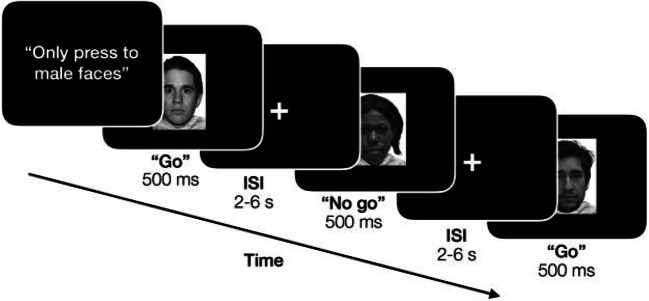
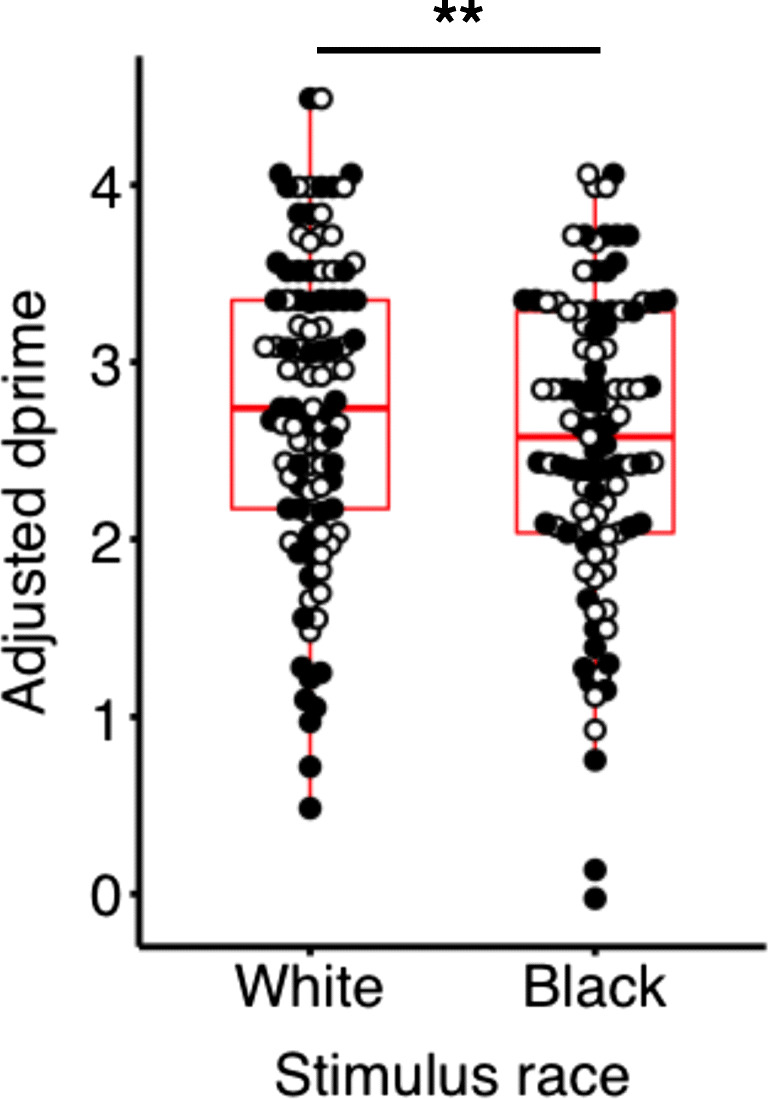
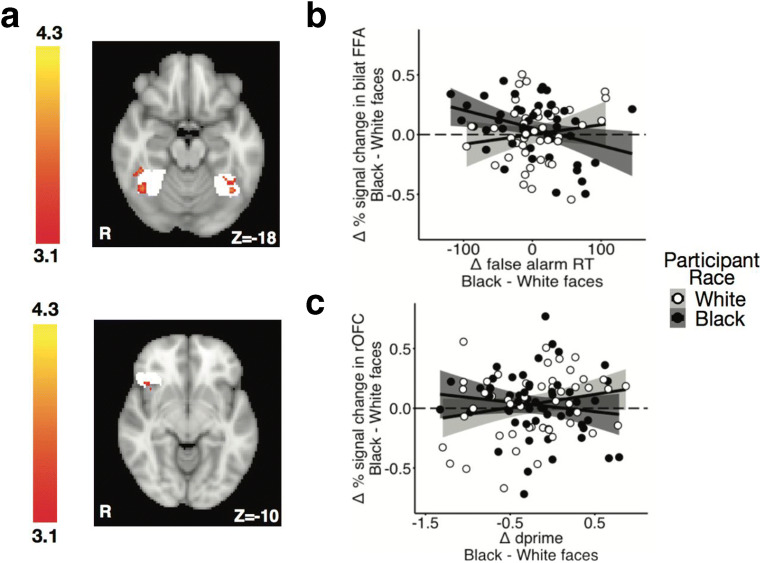
The race of an individual is a salient physical feature that is rapidly processed by the brain and can bias our perceptions of others. How the race of others explicitly impacts our actions toward them during intergroup contexts is not well understood. In the current study, we examined how task-irrelevant race information influences cognitive control in a go/no-go task in a community sample of Black (n = 54) and White (n = 51) participants. We examined the neural correlates of behavioral effects using functional magnetic resonance imaging and explored the influence of implicit racial attitudes on brain-behavior associations. Both Black and White participants showed more cognitive control failures, as indexed by dprime, to Black versus White faces, despite the irrelevance of race to the task demands. This behavioral pattern was paralleled by greater activity to Black faces in the fusiform face area, implicated in processing face and in-group information, and lateral orbitofrontal cortex, associated with resolving stimulus-response conflict. Exploratory brain-behavior associations suggest different patterns in Black and White individuals. Black participants exhibited a negative association between fusiform activity and response time during impulsive errors to Black faces, whereas White participants showed a positive association between lateral OFC activity and cognitive control performance to Black faces when accounting for implicit racial associations. Together our findings propose that attention to race information is associated with diminished cognitive control that may be driven by different mechanisms for Black and White individuals.
Overview
The claims and statistics of this paper haven’t been checked yet.
Free: it reads the open-access text and checks the first 5 claims that cite a source we can check. Create a free account to check every claim.
Integrity signals
Registry
Cites
Statistics
Figures
Verification
Claims the paper makes
The claims and statistics of this paper haven’t been checked yet.
Free: it reads the open-access text and checks the first 5 claims that cite a source we can check. Create a free account to check every claim.
Claims other papers make about this one
Each is checked against this paper’s own text: does it say what the citing paper says it does?
The source backs part of the claim, not all of it — or backs it for a different population, condition or comparison.
In the citing paper
“This region is involved in executing cognitive control within the context of emotion (Kuusinen et al., 2018; Rubien-Thomas et al., 2021).”
From Family-based care buffers the stress sensitizing effect of early deprivation on executive functioning difficulties in adolescence (2023) · cites this paper as Rubien-Thomas et al., 2021
Experimental — accuracy not yet measured
Self-check
Percentages, sums and reported differences re-computed from the paper’s own numbers.
The self-check needs the paper’s full text.
Citations
Cites
R: A Language and Environment for Statistical Computing
R Core Team (2025) · doi:10.32614/r.manuals · Cited by 352,181
Fitting Linear Mixed-Effects Models Using lme4
Bates, D., Mächler, M., Bolker, B., & Walker, S. (2015) · Journal of Statistical Software · doi:10.18637/jss.v067.i01 · Cited by 86,835
Information Theory and an Extension of the Maximum Likelihood Principle
Akaike, H. (1998) · Springer Series in Statistics · doi:10.1007/978-1-4612-1694-0_15 · Cited by 17,781
Desikan, R. S., Ségonne, F., Fischl, B., Quinn, B. T., Dickerson, B. C., Blacker, D., Buckner, R. L., Dale, A. M., Maguire, R. P., Hyman, B. T., et al. (2006) · NeuroImage · doi:10.1016/j.neuroimage.2006.01.021 · Cited by 13,324 · cited 1×
“Percent signal change in the Black versus White faces contrast was extracted from neuroanatomically defined ROIs in “bilateral temporal fusiform cortex” and “right frontal orbital cortex” using the Harvard-Oxford atlas (Desikan et al., 2006).”
MethodAn Integrative Theory of Prefrontal Cortex Function
Miller, E. K., & Cohen, J. D. (2001) · Annual Review of Neuroscience · doi:10.1146/annurev.neuro.24.1.167 · Cited by 12,803 · cited 1×
“Cognitive control is the ability to suppress inappropriate thoughts, emotions, and actions in favor of goal-oriented ones (Casey, 2015; Miller & Cohen, 2001).”
BackgroundMeasuring individual differences in implicit cognition: the implicit association test
Greenwald, A. G., McGhee, D. E., & Schwartz, J. L. K. (1998) · Journal of Personality and Social Psychology · doi:10.1037/0022-3514.74.6.1464 · Cited by 9,210
The fusiform face area: a module in human extrastriate cortex specialized for face perception
Kanwisher, N., McDermott, J., & Chun, M. M. (1997) · The Journal of Neuroscience · doi:10.1523/jneurosci.17-11-04302.1997 · Cited by 7,738 · cited 3×
“processing of faces (Kanwisher et al., 1997; McCarthy et al., 1997) and social categories (Van Bavel et al.”
BackgroundUnderstanding and using the Implicit Association Test: I. An improved scoring algorithm.
Greenwald, A. G., Nosek, B. A., & Banaji, M. R. (2003) · Journal of Personality and Social Psychology · doi:10.1037/0022-3514.85.2.197 · Cited by 5,815
Social categorization and intergroup behaviour
Tajfel, H., Billig, M. G., Bundy, R. P., & Flament, C. (1971) · European Journal of Social Psychology · doi:10.1002/ejsp.2420010202 · Cited by 5,562
The minimal preprocessing pipelines for the Human Connectome Project
Glasser, M. F., Sotiropoulos, S. N., Wilson, J. A., Coalson, T. S., Fischl, B., Andersson, J. L., Xu, J., Jbabdi, S., Webster, M., Polimeni, J. R., et al. (2013) · NeuroImage · doi:10.1016/j.neuroimage.2013.04.127 · Cited by 5,253
Methods to detect, characterize, and remove motion artifact in resting state fMRI
Power, J. D., Mitra, A., Laumann, T. O., Snyder, A. Z., Schlaggar, B. L., & Petersen, S. E. (2014) · NeuroImage · doi:10.1016/j.neuroimage.2013.08.048 · Cited by 3,748 · cited 1×
“Volumes with greater than 0.9-mm frame-wise displacement were excluded from analyses, as well the neighboring volume before and after (Power et al., 2014).”
MethodInfluentialThe NimStim set of facial expressions: Judgments from untrained research participants.
Tottenham, N., Tanaka, J. W., Leon, A. C., McCarry, T., Nurse, M., Hare, T. A., Marcus, D. J., Westerlund, A., Casey, B., & Nelson, C. (2009) · Psychiatry Research · doi:10.1016/j.psychres.2008.05.006 · Cited by 3,454
Self-citationEvaluating Effect Size in Psychological Research: Sense and Nonsense
Funder, D. C., & Ozer, D. J. (2019) · Advances in Methods and Practices in Psychological Science · doi:10.1177/2515245919847202 · Cited by 3,295 · cited 1×
“However, there is an evolving focus on the implications of small effect sizes, where a single observation of a psychological process can have a consequential impact when accumulated repeatedly over time (Funder & Ozer, 2019; Götz et al., 2021).”
BackgroundTemporal Autocorrelation in Univariate Linear Modeling of FMRI Data
Woolrich, M. W., Ripley, B. D., Brady, M., & Smith, S. M. (2001) · NeuroImage · doi:10.1006/nimg.2001.0931 · Cited by 2,852
Calculation of signal detection theory measures
Stanislaw, H., & Todorov, N. (1999) · Behavior Research Methods, Instruments, & Computers · doi:10.3758/bf03207704 · Cited by 2,673
Emotion drives attention: Detecting the snake in the grass.
Öhman, A., Flykt, A., & Esteves, F. (2001) · Journal of Experimental Psychology: General · doi:10.1037/0096-3445.130.3.466 · Cited by 2,542
The Adolescent Brain Cognitive Development (ABCD) study: Imaging acquisition across 21 sites
Casey, B. J., Cannonier, T., Conley, M. I., Cohen, A. O., Barch, D. M., Heitzeg, M. M., Soules, M. E., Teslovich, T., Dellarco, D. V., Garavan, H., et al. (2018) · Developmental Cognitive Neuroscience · doi:10.1016/j.dcn.2018.03.001 · Cited by 2,204
Self-citationConfidence Intervals from Normalized Data: A correction to Cousineau (2005)
Morey, R. D. (2008) · Tutorials in Quantitative Methods for Psychology · doi:10.20982/tqmp.04.2.p061 · Cited by 1,997
Multilevel linear modelling for FMRI group analysis using Bayesian inference
Woolrich, M. W., Behrens, T. E. J., Beckmann, C. F., Jenkinson, M., & Smith, S. M. (2004) · NeuroImage · doi:10.1016/j.neuroimage.2003.12.023 · Cited by 1,728
The fusiform face area: a cortical region specialized for the perception of faces
Kanwisher, N., & Yovel, G. (2006) · Philosophical Transactions of the Royal Society B: Biological Sciences · doi:10.1098/rstb.2006.1934 · Cited by 1,718
Effects of Attention and Emotion on Face Processing in the Human Brain
Vuilleumier, P., Armony, J. L., Driver, J., & Dolan, R. J. (2001) · Neuron · doi:10.1016/s0896-6273(01)00328-2 · Cited by 1,664 · cited 2×
“More recent work associates the orbitofrontal cortex with attentional control (Vuilleumier et al., 2001) and resolving stimulus-response conflict (Mansouri et al., 2014), both components of cognitive control processes.”
BackgroundDiffusion decision model: Current issues and history
Ratcliff, R., Smith, P. L., Brown, S. D., & McKoon, G. (2016) · Trends in Cognitive Sciences · doi:10.1016/j.tics.2016.01.007 · Cited by 1,630
Racial stereotypes of one hundred college students.
Katz, D., & Braly, K. (1933) · The Journal of Abnormal and Social Psychology · doi:10.1037/h0074049 · Cited by 1,476
Harvesting implicit group attitudes and beliefs from a demonstration web site.
Nosek, B. A., Banaji, M. R., & Greenwald, A. G. (2002) · Group Dynamics: Theory, Research, and Practice · doi:10.1037/1089-2699.6.1.101 · Cited by 1,321
Macmillan, N. A., & Creelman, C. D. (2004) · doi:10.4324/9781410611147 · Cited by 1,269
Seeing Black: Race, Crime, and Visual Processing.
Eberhardt, J. L., Goff, P. A., Purdie, V. J., & Davies, P. G. (2004) · Journal of Personality and Social Psychology · doi:10.1037/0022-3514.87.6.876 · Cited by 1,208 · cited 2×
“…capture attention more quickly than White faces (Bean et al., 2012; Donders et al., 2008; Ito & Urland, 2003; Trawalter et al., 2008) and prime the detection of stereotype-congruent objects (e.g., guns indicating danger; Eberhardt et al., 2004; Payne, 2001; Payne et al., 2002; Todd et al., 2016).”
BackgroundSelf-citationThe police officer's dilemma: Using ethnicity to disambiguate potentially threatening individuals.
Correll, J., Park, B., Judd, C. M., & Wittenbrink, B. (2002) · Journal of Personality and Social Psychology · doi:10.1037/0022-3514.83.6.1314 · Cited by 1,175 · cited 5×
“…& Krendl, 2016, 2016; Ratner et al., 2013; Ronquillo et al., 2007; Stolier & Freeman, 2016; Van Bavel et al., 2008), and in threatening contexts (Correll et al., 2002), less work has examined whether task-embedded race information directly diminishes cognitive control to cues in more benign…”
BackgroundResultInfluentialCottrell, C. A., & Neuberg, S. L. (2005) · Journal of Personality and Social Psychology · doi:10.1037/0022-3514.88.5.770 · Cited by 1,160
Prejudice and perception: The role of automatic and controlled processes in misperceiving a weapon.
Payne, B. K. (2001) · Journal of Personality and Social Psychology · doi:10.1037//0022-3514.81.2.181 · Cited by 1,150
The essence of innocence: Consequences of dehumanizing Black children.
Goff, P. A., Jackson, M. C., Di Leone, B. A. L., Culotta, C. M., & DiTomasso, N. A. (2014) · Journal of Personality and Social Psychology · doi:10.1037/a0035663 · Cited by 1,134
Face-specific processing in the human fusiform gyrus
McCarthy, G., Puce, A., Gore, J. C., & Allison, T. (1997) · Journal of Cognitive Neuroscience · doi:10.1162/jocn.1997.9.5.605 · Cited by 1,127 · cited 2×
“Functional neuroimaging (fMRI) studies examining the processing of race have focused in part on the Fusiform Face Area (FFA), a brain region associated with early and rapid visual processing of faces (Kanwisher et al., 1997; McCarthy et al., 1997) and social categories (Van Bavel et al., 2008).”
BackgroundA developmental functional MRI study of prefrontal activation during performance of a go-no-go task
Casey, B. J., Trainor, R. J., Orendi, J. L., Schubert, A. B., Nystrom, L. E., Giedd, J. N., Castellanos, F. X., Haxby, J. V., Noll, D. C., Cohen, J. D., et al. (1997) · Journal of Cognitive Neuroscience · doi:10.1162/jocn.1997.9.6.835 · Cited by 1,106 · cited 2×
“The patterns of activation to Black versus White faces also revealed race sensitivity in the right lOFC, a neural structure implicated in stimulus-response conflict and response inhibition (Bryden & Roesch, 2015; Casey et al., 1997; Iversen & Mishkin, 1970; Jones & Mishkin, 1972).”
BackgroundResultSelf-citationEgner, T., & Hirsch, J. (2005) · Nature Neuroscience · doi:10.1038/nn1594 · Cited by 1,090
Categorical and contextual bases of person memory and stereotyping.
Taylor, S. E., Fiske, S. T., Etcoff, N. L., & Ruderman, A. J. (1978) · Journal of Personality and Social Psychology · doi:10.1037//0022-3514.36.7.778 · Cited by 1,028
Performance on Indirect Measures of Race Evaluation Predicts Amygdala Activation
Phelps, E. A., O'Connor, K. J., Cunningham, W. A., Funayama, E. S., Gatenby, J. C., Gore, J. C., & Banaji, M. R. (2000) · Journal of Cognitive Neuroscience · doi:10.1162/089892900562552 · Cited by 1,001 · cited 1×
“Associations with implicit attitudes extend to higher-order cognition, where implicit racial attitudes moderate brain activity and cognitive control performance in the presence of race information (Brosch et al., 2013; Phelps et al., 2000; Richeson et al., 2003, 2005).”
BackgroundCorrections for extreme proportions and their biasing effects on estimated values ofd′
Hautus, M. J. (1995) · Behavior Research Methods, Instruments, & Computers · doi:10.3758/bf03203619 · Cited by 894
Elliott, R. (2000) · Cerebral Cortex · doi:10.1093/cercor/10.3.308 · Cited by 887
Functional MRI : an introduction to methods
Jezzard, P., Matthews, P. M., & Smith, S. M. (2002) · Cited by 883
Limbic lesions and the problem of stimulus—Reinforcement associations
Jones, B., & Mishkin, M. (1972) · Experimental Neurology · doi:10.1016/0014-4886(72)90030-1 · Cited by 868
Psychosocial stress reversibly disrupts prefrontal processing and attentional control
Liston, C., McEwen, B. S., & Casey, B. J. (2009) · Proceedings of the National Academy of Sciences · doi:10.1073/pnas.0807041106 · Cited by 859
Self-citationStatistical analysis of activation images
Worsley, K. J. (2001) · Functional Magnetic Resonance Imaging · doi:10.1093/acprof:oso/9780192630711.003.0014 · Cited by 803
Iversen, S., & Mishkin, M. (1970) · Experimental Brain Research · doi:10.1007/bf00237911 · Cited by 759
Stress weakens prefrontal networks: molecular insults to higher cognition
Arnsten, A. F. T. (2015) · Nature Neuroscience · doi:10.1038/nn.4087 · Cited by 752 · cited 1×
“The interpretation of Black faces precipitating stress is in accordance with findings demonstrating that threat manipulations alter prefrontal connectivity and function (Arnsten, 2015; Lindström & Bohlin, 2012; Liston et al., 2009).”
ResultBeyond simple models of self-control to circuit-based accounts of adolescent behavior
Casey, B. J. (2015) · Annual Review of Psychology · doi:10.1146/annurev-psych-010814-015156 · Cited by 742 · cited 1×
“Cognitive control is the ability to suppress inappropriate thoughts, emotions, and actions in favor of goal-oriented ones (Casey, 2015; Miller & Cohen, 2001).”
BackgroundSelf-citationDuncan, B. L. (1976) · Journal of Personality and Social Psychology · doi:10.1037//0022-3514.34.4.590 · Cited by 712
Ito, T. A., & Urland, G. R. (2003) · Journal of Personality and Social Psychology · doi:10.1037/0022-3514.85.4.616 · Cited by 697 · cited 3×
“Experiments using event-related potentials demonstrate that the brain processes race and out-group information early and rapidly (Amodio, 2014; Walker et al., 2008), before the processing of other salient social categories, such as gender (Ito & Urland, 2003; Ito & Urland, 2005).”
BackgroundMethodSeparable Neural Components in the Processing of Black and White Faces
Cunningham, W. A., Johnson, M. K., Raye, C. L., Gatenby, J. C., Gore, J. C., & Banaji, M. R. (2004) · Psychological Science · doi:10.1111/j.0956-7976.2004.00760.x · Cited by 689
A dynamic interactive theory of person construal.
Freeman, J. B., & Ambady, N. (2011) · Psychological Review · doi:10.1037/a0022327 · Cited by 609
The neuroscience of prejudice and stereotyping
Amodio, D. M. (2014) · Nature Reviews Neuroscience · doi:10.1038/nrn3800 · Cited by 559
When Prejudice Does Not Pay: Effects of Interracial Contact on Executive Function
Richeson, J. A., & Shelton, J. N. (2003) · Psychological Science · doi:10.1111/1467-9280.03437 · Cited by 538 · cited 1×
“…control performance in response to Black cues (Bartholow et al., 2006; Correll et al., 2002, 2006; Donders et al., 2008; Richeson et al., 2003; Richeson & Shelton, 2003; Senholzi et al., 2015), which is paralleled by altered engagement of prefrontal circuitry (Amodio et al., 2004; Brown et…”
BackgroundSelf-citationSmall Effects: The Indispensable Foundation for a Cumulative Psychological Science
Götz, F. M., Gosling, S. D., & Rentfrow, P. J. (2022) · Perspectives on Psychological Science · doi:10.1177/1745691620984483 · Cited by 538
On the fading of social stereotypes: Studies in three generations of college students.
Karlins, M., Coffman, T. L., & Walters, G. (1969) · Journal of Personality and Social Psychology · doi:10.1037/h0027994 · Cited by 534
Korolczuk, I., Burle, B., Coull, J. T., & Śmigasiewicz, K. (2021) · Journal of Cognitive Neuroscience · doi:10.1162/jocn_a_01795 · Cited by 528
Us and them: Social categorization and the process of intergroup bias.
Perdue, C. W., Dovidio, J. F., Gurtman, M. B., & Tyler, R. B. (1990) · Journal of Personality and Social Psychology · doi:10.1037/0022-3514.59.3.475 · Cited by 527
Frontostriatal maturation predicts cognitive control failure to appetitive cues in adolescents
Somerville, L. H., Hare, T., & Casey, B. J. (2011) · Journal of Cognitive Neuroscience · doi:10.1162/jocn.2010.21572 · Cited by 523
Self-citationAn In-Group Becomes Part of the Self: Response Time Evidence
Smith, E. R., & Henry, S. (1996) · Personality and Social Psychology Bulletin · doi:10.1177/0146167296226008 · Cited by 522
Differential responses in the fusiform region to same-race and other-race faces
Golby, A. J., Gabrieli, J. D. E., Chiao, J. Y., & Eberhardt, J. L. (2001) · Nature Neuroscience · doi:10.1038/90565 · Cited by 496
Self-citationSignal detection theory and human memory.
Banks, W. P. (1970) · Psychological Bulletin · doi:10.1037/h0029531 · Cited by 473
Cognitive Representations of Black Americans: Reexploring the Role of Skin Tone
Maddox, K. B., & Gray, S. A. (2002) · Personality and Social Psychology Bulletin · doi:10.1177/0146167202282010 · Cited by 457
Differential response in the human amygdala to racial outgroup vs ingroup face stimuli
Hart, A. J., Whalen, P. J., Shin, L. M., McInerney, S. C., Fischer, H., & Rauch, S. L. (2000) · NeuroReport · doi:10.1097/00001756-200008030-00004 · Cited by 454
Sui, J., He, X., & Humphreys, G. W. (2012) · Journal of Experimental Psychology: Human Perception and Performance · doi:10.1037/a0029792 · Cited by 441
Neural substrates of facial emotion processing using fMRI
Kesler/West, M. L., Andersen, A. H., Smith, C. D., Avison, M. J., Davis, C. E., Kryscio, R. J., & Blonder, L. X. (2001) · Cognitive Brain Research · doi:10.1016/s0926-6410(00)00073-2 · Cited by 437
Stereotype persistence and change among college students.
Gilbert, G. M. (1951) · The Journal of Abnormal and Social Psychology · doi:10.1037/h0053696 · Cited by 412
An fMRI investigation of the impact of interracial contact on executive function
Richeson, J. A., Baird, A. A., Gordon, H. L., Heatherton, T. F., Wyland, C. L., Trawalter, S., & Shelton, J. N. (2003) · Nature Neuroscience · doi:10.1038/nn1156 · Cited by 412
Self-citationRace is gendered: How covarying phenotypes and stereotypes bias sex categorization.
Johnson, K. L., Freeman, J. B., & Pauker, K. (2012) · Journal of Personality and Social Psychology · doi:10.1037/a0025335 · Cited by 388
The Neural Substrates of In-Group Bias: A Functional Magnetic Resonance Imaging Investigation
Van Bavel, J. J., Packer, D. J., & Cunningham, W. A. (2008) · Psychological Science · doi:10.1111/j.1467-9280.2008.02214.x · Cited by 385
Chikazoe, J., Jimura, K., Hirose, S., Yamashita, K.-I., Miyashita, Y., & Konishi, S. (2009) · The Journal of Neuroscience · doi:10.1523/jneurosci.3645-09.2009 · Cited by 366
Lieberman, M. D., Hariri, A., Jarcho, J. M., Eisenberger, N. I., & Bookheimer, S. Y. (2005) · Nature Neuroscience · doi:10.1038/nn1465 · Cited by 362
Ambiguity in Social Categorization: The Role of Prejudice and Facial Affect in Race Categorization
Hugenberg, K., & Bodenhausen, G. V. (2004) · Psychological Science · doi:10.1111/j.0956-7976.2004.00680.x · Cited by 360
Cosmides, L., Tooby, J., & Kurzban, R. (2003) · Trends in Cognitive Sciences · doi:10.1016/s1364-6613(03)00057-3 · Cited by 358
Neural Signals for the Detection of Unintentional Race Bias
Amodio, D. M., Harmon-Jones, E., Devine, P. G., Curtin, J. J., Hartley, S. L., & Covert, A. E. (2004) · Psychological Science · doi:10.1111/j.0963-7214.2004.01502003.x · Cited by 352
Ito, T. A., & Urland, G. R. (2005) · Cognitive, Affective, & Behavioral Neuroscience · doi:10.3758/cabn.5.1.21 · Cited by 349
Journal of Statistics Education
(2007) · Encyclopedia of Measurement and Statistics · doi:10.4135/9781412952644.n236 · Cited by 348
Correll, J., Urland, G. R., & Ito, T. A. (2006) · Journal of Experimental Social Psychology · doi:10.1016/j.jesp.2005.02.006 · Cited by 344
Steinbeis, N., Bernhardt, B. C., & Singer, T. (2012) · Neuron · doi:10.1016/j.neuron.2011.12.027 · Cited by 298 · cited 1×
“It is thought to be vital to successfully negotiating diverse emotional and social contexts (Cohen et al., 2016; Steinbeis et al., 2012) that require redirecting attention or withholding inappropriate responses.”
BackgroundDistortions in the perceived lightness of faces: The role of race categories.
Levin, D. T., & Banaji, M. R. (2006) · Journal of Experimental Psychology: General · doi:10.1037/0096-3445.135.4.501 · Cited by 262
Toward a Social Psychology of Race and Race Relations for the Twenty-First Century
Richeson, J. A., & Sommers, S. R. (2016) · Annual Review of Psychology · doi:10.1146/annurev-psych-010213-115115 · Cited by 240
Self-citationAttending to threat: Race-based patterns of selective attention
Trawalter, S., Todd, A. R., Baird, A. A., & Richeson, J. A. (2008) · Journal of Experimental Social Psychology · doi:10.1016/j.jesp.2008.03.006 · Cited by 216
Self-citationPayne, B. K., Lambert, A. J., & Jacoby, L. L. (2002) · Journal of Experimental Social Psychology · doi:10.1016/s0022-1031(02)00006-9 · Cited by 211
Multiple cues in social perception: The time course of processing race and facial expression
Kubota, J. T., & Ito, T. A. (2007) · Journal of Experimental Social Psychology · doi:10.1016/j.jesp.2006.10.023 · Cited by 207 · cited 2×
“…with our first hypothesis and previous research, which demonstrates increased attention and diminished cognitive control in response to Black cues (Bean et al., 2012; Correll et al., 2002, 2006; Donders et al., 2008; Kubota & Ito, 2007; Richeson et al., 2003, 2005; Trawalter et al., 2008).”
BackgroundResultKey Results of Interaction Models with Centering
Afshartous, D., & Preston, R. A. (2011) · Journal of Statistics Education · doi:10.1080/10691898.2011.11889620 · Cited by 186
The elusive tradeoff: Speed vs accuracy in visual discrimination tasks
Swensson, R. G. (1972) · Perception & Psychophysics · doi:10.3758/bf03212837 · Cited by 171
Van Bavel, J. J., Packer, D. J., & Cunningham, W. A. (2011) · Journal of Cognitive Neuroscience · doi:10.1162/jocn_a_00016 · Cited by 169
Does Seeing Faces of Young Black Boys Facilitate the Identification of Threatening Stimuli?
Todd, A. R., Thiem, K. C., & Neel, R. (2016) · Psychological Science · doi:10.1177/0956797615624492 · Cited by 166 · cited 1×
“…capture attention more quickly than White faces (Bean et al., 2012; Donders et al., 2008; Ito & Urland, 2003; Trawalter et al., 2008) and prime the detection of stereotype-congruent objects (e.g., guns indicating danger; Eberhardt et al., 2004; Payne, 2001; Payne et al., 2002; Todd et al., 2016).”
BackgroundNeural pattern similarity reveals the inherent intersection of social categories
Stolier, R. M., & Freeman, J. B. (2016) · Nature Neuroscience · doi:10.1038/nn.4296 · Cited by 161
Richeson, J. A., Trawalter, S., & Shelton, J. N. (2005) · Social Cognition · doi:10.1521/soco.2005.23.4.336 · Cited by 156
Self-citationBartholow, B. D., Dickter, C. L., & Sestir, M. A. (2006) · Journal of Personality and Social Psychology · doi:10.1037/0022-3514.90.2.272 · Cited by 155
Social contact and other-race face processing in the human brain
Walker, P. M., Silvert, L., Hewstone, M., & Nobre, A. C. (2008) · Social Cognitive and Affective Neuroscience · doi:10.1093/scan/nsm035 · Cited by 152
A perceptual discrimination investigation of the own‐race effect and intergroup experience
Walker, P. M., & Hewstone, M. (2006) · Applied Cognitive Psychology · doi:10.1002/acp.1191 · Cited by 152
The racially diverse affective expression (RADIATE) face stimulus set
Conley, M. I., Dellarco, D. V., Rubien-Thomas, E., Cohen, A. O., Cervera, A., Tottenham, N., & Casey, B. (2018) · Psychiatry Research · doi:10.1016/j.psychres.2018.04.066 · Cited by 150
Self-citationModeling the Effects of Perceptual Load: Saliency, Competitive Interactions, and Top-Down Biases
Neokleous, K., Shimi, A., & Avraamides, M. N. (2016) · Frontiers in Psychology · doi:10.3389/fpsyg.2016.00001 · Cited by 144
The effects of skin tone on race-related amygdala activity: an fMRI investigation
Ronquillo, J., Denson, T. F., Lickel, B., Lu, Z.-L., Nandy, A., & Maddox, K. B. (2007) · Social Cognitive and Affective Neuroscience · doi:10.1093/scan/nsl043 · Cited by 141
Optimal go/no-go ratios to maximize false alarms
Young, M. E., Sutherland, S. C., & McCoy, A. W. (2017) · Behavior Research Methods · doi:10.3758/s13428-017-0923-5 · Cited by 134
Dissociation of face-selective cortical responses by attention
Furey, M. L., Tanskanen, T., Beauchamp, M. S., Avikainen, S., Uutela, K., Hari, R., & Haxby, J. V. (2006) · Proceedings of the National Academy of Sciences · doi:10.1073/pnas.0510124103 · Cited by 128
Danger stereotypes predict racially biased attentional allocation
Donders, N. C., Correll, J., & Wittenbrink, B. (2008) · Journal of Experimental Social Psychology · doi:10.1016/j.jesp.2008.04.002 · Cited by 120
Coats, S., Smith, E. R., Claypool, H. M., & Banner, M. J. (2000) · Journal of Experimental Social Psychology · doi:10.1006/jesp.1999.1416 · Cited by 114
Implicit Race Bias Decreases the Similarity of Neural Representations of Black and White Faces
Brosch, T., Bar-David, E., & Phelps, E. A. (2013) · Psychological Science · doi:10.1177/0956797612451465 · Cited by 103
Ofan, R. H., Rubin, N., & Amodio, D. M. (2011) · Journal of Cognitive Neuroscience · doi:10.1162/jocn_a_00014 · Cited by 98
Rodeheffer, C. D., Hill, S. E., & Lord, C. G. (2012) · Psychological Science · doi:10.1177/0956797612450892 · Cited by 98
Multivoxel Patterns in Fusiform Face Area Differentiate Faces by Sex and Race
Contreras, J. M., Banaji, M. R., & Mitchell, J. P. (2013) · PLoS ONE · doi:10.1371/journal.pone.0069684 · Cited by 97
Executive Control Signals in Orbitofrontal Cortex during Response Inhibition
Bryden, D. W., & Roesch, M. R. (2015) · The Journal of Neuroscience · doi:10.1523/jneurosci.3587-14.2015 · Cited by 89
Gilbert, S. J., Swencionis, J. K., & Amodio, D. M. (2012) · Neuropsychologia · doi:10.1016/j.neuropsychologia.2012.09.002 · Cited by 87
Exploring Task- and Student-Related Factors in the Method of Propositional Manipulation (MPM)
Leppink, J., Broers, N. J., Imbos, T., van der Vleuten, C. P. M., & Berger, M. P. F. (2011) · Journal of Statistics Education · doi:10.1080/10691898.2011.11889603 · Cited by 83
Lindström, B. R., & Bohlin, G. (2012) · Emotion · doi:10.1037/a0027305 · Cited by 73
Following in the Wake of Anger: When Not Discriminating Is Discriminating
Shapiro, J. R., Ackerman, J. M., Neuberg, S. L., Maner, J. K., Becker, D. V., & Kenrick, D. T. (2009) · Personality and Social Psychology Bulletin · doi:10.1177/0146167209339627 · Cited by 72
Neural adaptation to faces reveals racial outgroup homogeneity effects in early perception
Hughes, B., Camp, N. P., Gomez, J., Natu, V. S., Grill-Spector, K., & Eberhardt, J. L. (2019) · Proceedings of the National Academy of Sciences · doi:10.1073/pnas.1822084116 · Cited by 72
Self-citationNeural correlates of own- and other-race face perception: Spatial and temporal response differences
Natu, V. S., Raboy, D., & O’Toole, A. J. (2010) · NeuroImage · doi:10.1016/j.neuroimage.2010.10.006 · Cited by 71
Ratner, K. G., Kaul, C., & Van Bavel, J. J. (2013) · Social Cognitive and Affective Neuroscience · doi:10.1093/scan/nss063 · Cited by 64
The Essential Role of Primate Orbitofrontal Cortex in Conflict-Induced Executive Control Adjustment
Mansouri, F. A., Buckley, M. J., & Tanaka, K. (2014) · Journal of Neuroscience · doi:10.1523/jneurosci.1637-14.2014 · Cited by 63
Racial identification modulates default network activity for same and other races
Mathur, V. A., Harada, T., & Chiao, J. Y. (2012) · Human Brain Mapping · doi:10.1002/hbm.21330 · Cited by 61
Individual differences in signal detection
Ingham, J. G. (1970) · Acta Psychologica · doi:10.1016/0001-6918(70)90003-x · Cited by 55
The Impact of Emotional States on Cognitive Control Circuitry and Function
Cohen, A. O., Dellarco, D. V., Breiner, K., Helion, C., Heller, A. S., Rahdar, A., Pedersen, G., Chein, J., Dyke, J. P., Galvan, A., et al. (2016) · Journal of Cognitive Neuroscience · doi:10.1162/jocn_a_00906 · Cited by 54
Self-citationOfan, R. H., Rubin, N., & Amodio, D. M. (2014) · Social Cognitive and Affective Neuroscience · doi:10.1093/scan/nst087 · Cited by 53
The Effects of Face Inversion and Face Race on the P100 ERP
Colombatto, C., & McCarthy, G. (2017) · Journal of Cognitive Neuroscience · doi:10.1162/jocn_a_01079 · Cited by 52
Cognitive control, attention, and the other race effect in memory
Brown, T. I., Uncapher, M. R., Chow, T. E., Eberhardt, J. L., & Wagner, A. D. (2017) · PLOS ONE · doi:10.1371/journal.pone.0173579 · Cited by 51
Self-citationPrejudice Concerns and Race-Based Attentional Bias: New Evidence From Eyetracking
Bean, M. G., Slaten, D. G., Horton, W. S., Murphy, M. C., Todd, A. R., & Richeson, J. A. (2012) · Social Psychological and Personality Science · doi:10.1177/1948550612436983 · Cited by 50
Self-citationBrain activation underlying threat detection to targets of different races
Senholzi, K. B., Depue, B. E., Correll, J., Banich, M. T., & Ito, T. A. (2015) · Social Neuroscience · doi:10.1080/17470919.2015.1091380 · Cited by 39
Rapid race perception despite individuation and accuracy goals
Kubota, J. T., & Ito, T. A. (2016) · Social Neuroscience · doi:10.1080/17470919.2016.1182585 · Cited by 35
Dynamic representations of race: processing goals shape race decoding in the fusiform gyri
Kaul, C., Ratner, K. G., & Bavel, J. J. V. (2012) · Social Cognitive and Affective Neuroscience · doi:10.1093/scan/nss138 · Cited by 32
Small effects: The indispensable foundation for a cumulative psychological sciencePreprint
Götz, F. M., Gosling, S. D., & Rentfrow, P. J. (2021) · doi:10.31234/osf.io/hzrxf · Cited by 28
Neural Correlates of Racial Ingroup Bias in Observing Computer-Animated Social Encounters
Katsumi, Y., & Dolcos, S. M. (2018) · Frontiers in Human Neuroscience · doi:10.3389/fnhum.2017.00632 · Cited by 25
Skinner, A. L., & Haas, I. J. (2016) · Frontiers in Psychology · doi:10.3389/fpsyg.2016.01057 · Cited by 23
Kleider‐Offutt, H. M., Bond, A. D., Williams, S. E., & Bohil, C. J. (2018) · Memory & Cognition · doi:10.3758/s13421-018-0801-0 · Cited by 21
Human Face-Selective Cortex Does Not Distinguish between Members of a Racial Outgroup
Reggev, N., Brodie, K., Cikara, M., & Mitchell, J. P. (2020) · eNeuro · doi:10.1523/eneuro.0431-19.2020 · Cited by 18
Dynamic neural mechanisms underlie race disparities in social cognition
Cassidy, B. S., & Krendl, A. C. (2016) · NeuroImage · doi:10.1016/j.neuroimage.2016.02.043 · Cited by 17
(2022) · doi:10.1162/jocn
Cited by
Wade, M., McLaughlin, K. A., Buzzell, G. A., Fox, N. A., Zeanah, C. H., & Nelson, C. A. (2023) · Child Development · doi:10.1111/cdev.13863 · Cited by 12
Stereotypes disrupt probabilistic category learning.
Derreumaux, Y., Elder, J., Suri, G., Ben-Zeev, A., Quimby, T., & Hughes, B. (2023) · Journal of Experimental Psychology General · doi:10.1037/xge0001335 · Cited by 6
Self-citationRubien-Thomas, E., Berrian, N., Rapuano, K. M., Skalaban, L. J., Cervera, A., Nardos, B., Cohen, A. O., Lowrey, A., Daumeyer, N. M., Watts, R., et al. (2023) · Cognitive Affective & Behavioral Neuroscience · doi:10.3758/s13415-022-01056-2 · Cited by 6
Self-citationLiu, X., Liu, H., Kendrick, K. M., Montag, C., & Becker, B. (2024) · bioRxiv (Cold Spring Harbor Laboratory) · doi:10.1101/2024.06.13.598945 · Cited by 3
National identity reconfigures brain responses from “them” to “us”
Leng, K. S. H., Nasser, N. S., Esposito, G., & Chen, S. A. (2026) · Proceedings of the National Academy of Sciences · doi:10.1073/pnas.2531563123 · Cited by 1
Metadata
- Authors
- Rubien-Thomas, E., Berrian, N., Cervera, A., Nardos, B., Cohen, A. O., Lowrey, A., Daumeyer, N. M., Camp, N. P., Hughes, B. L., Eberhardt, J. L., Taylor-Thompson, K. A., Fair, D. A., Richeson, J. A., & Casey, B. J.
- Affiliations
- Yale University (US)
- Columbia University (US)
- Oregon Health & Science University (US)
- New York University (US)
- University of Michigan (US)
- University of California, Riverside (US)
- Stanford University (US)
- Corresponding author
- Rubien-Thomas, Estée
- ORCID
- Venue
- Cognitive, Affective, & Behavioral Neuroscience
- Published
- 2021-05-03
- Volume
- 21
- Issue
- 3
- Pages
- 625-638
- ISSN
- 1530-7026 (ISSN-L)
- 1531-135X
- PMC
- PMC8208919
- OpenAlex
- W3157325191
- Cited by
- 6
- References
- 126
- Citations by year
- 2026: 2 · 2024: 1 · 2023: 2 · 2022: 1
- FWCI
- 1.39
- Type
- journal article
- Language
- en
- Open access
- hybrid
- doi.org
- Licence
- cc-by
- creativecommons.org/licenses/by/4.0 (tdm)
- creativecommons.org/licenses/by/4.0 (vor)
- Locations
- Cognitive Affective & Behavioral Neuroscience (publishedVersion, cc-by)
- PubMed Central (publishedVersion, cc-by)
- PubMed (publishedVersion)
- Funders
- National Science Foundation
- John D. and Catherine T. MacArthur Foundation
- Vanderbilt University
- Topics
- Social Sciences › Sociology and Political Science › Social and Intergroup Psychology
- Life Sciences › Neuroscience › Cognitive Neuroscience › Face Recognition and Perception
- Life Sciences › Neuroscience › Cognitive Neuroscience › Neural and Behavioral Psychology Studies
- Keywords
- cognitive control, go/no-go task, implicit racial attitudes, fusiform face area, lateral orbitofrontal cortex, face processing, intergroup bias, black-white disparities, stimulus-response conflict
- MeSH terms
- Brain, Brain Mapping, Cognition, Humans, Magnetic Resonance Imaging, Reaction Time
About these checks
Registry, retraction, Cites and statistics results are computed, not judged, with one exception: a printed reference that no index lists is read once by a model before it counts as a citation error. Claims are extracted by a model and kept only when their quote appears verbatim in the text; each cited source is then checked, with a model’s help, for whether it says what the claim relies on. Those verdicts can be wrong — read the claim’s quote and the cited source before relying on one.
Statistics and arithmetic are recomputed, not judged.
Confidence bands are shown only for fields calibrated on our annotated test set. None is calibrated yet, so no band is shown.
What counts as a claim ›How we measure confidence ›How we check this ›
Are you an author, or do you see a problem with this page? Request a review
Data sources
Bibliographic data: Semantic Scholar, OpenAlex, Crossref.
Contains information from the Semantic Scholar Academic Graph Datasets, made available under the ODC Attribution License (ODC-BY 1.0).
Semantic Scholar’s data is described in: Kinney, R., et al. (2023). The Semantic Scholar Open Data Platform. arXiv:2301.10140.
