

Parsing eye-tracking data of variable quality to provide accurate fixation duration estimates in infants and adults
Open accessThe DOI matches its Crossref record; 86 of the 91 references it cites were found in a registry or an index.
Abstract
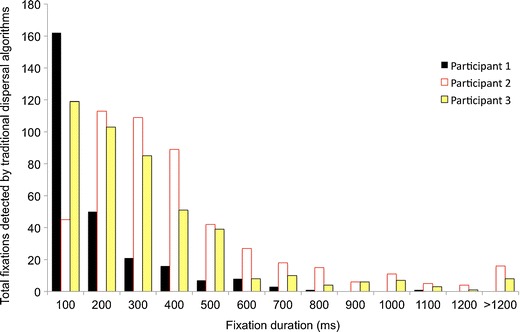
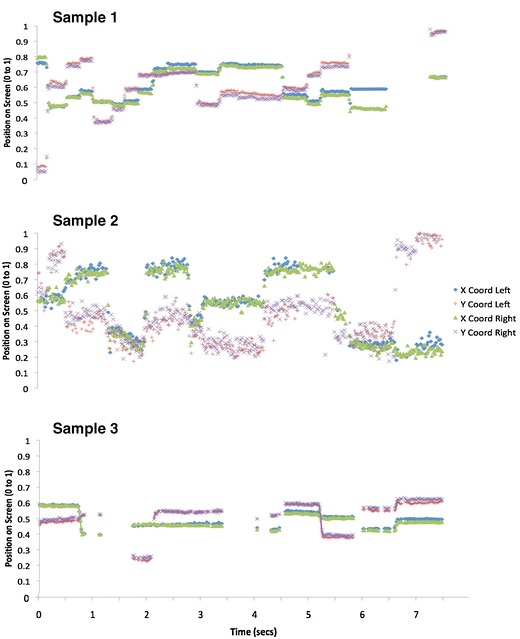
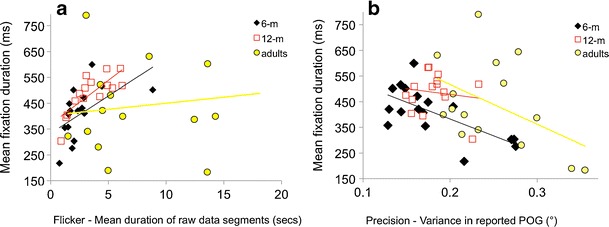
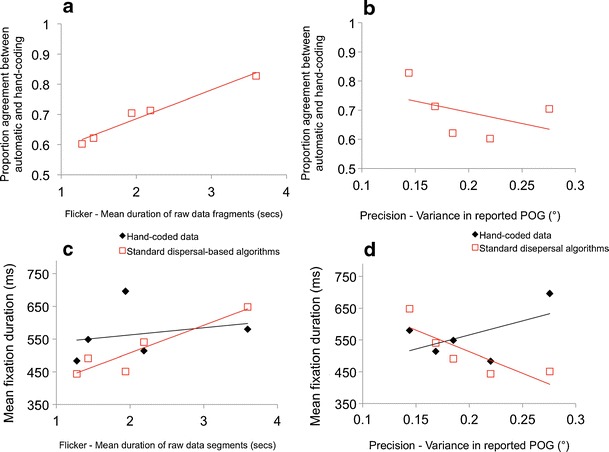
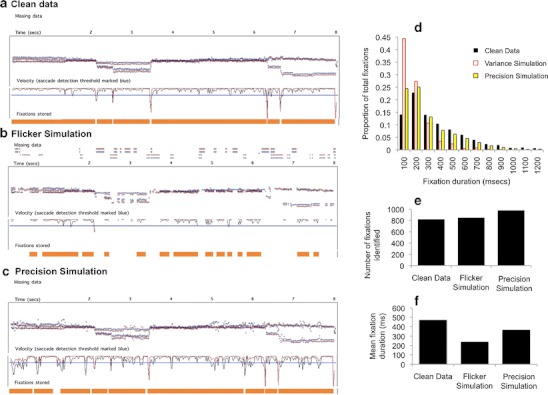
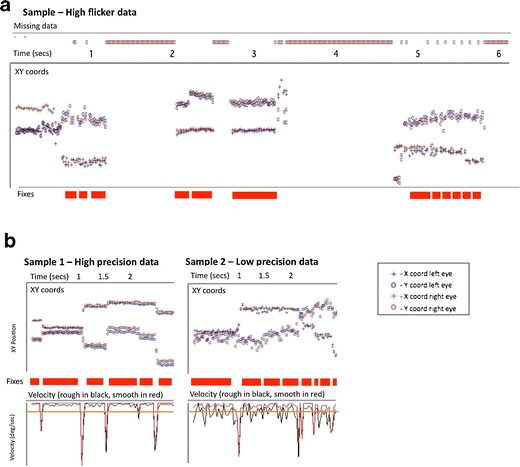
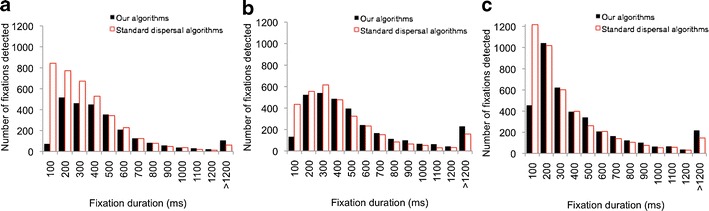
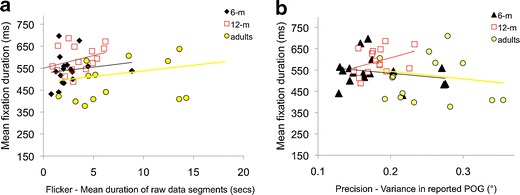
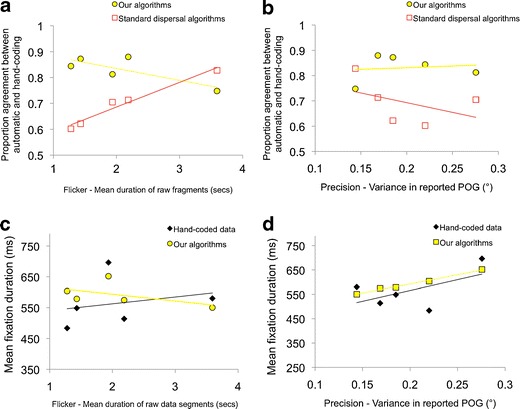
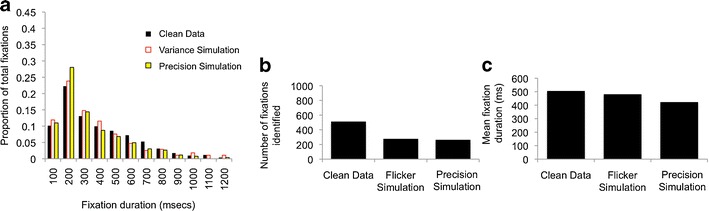
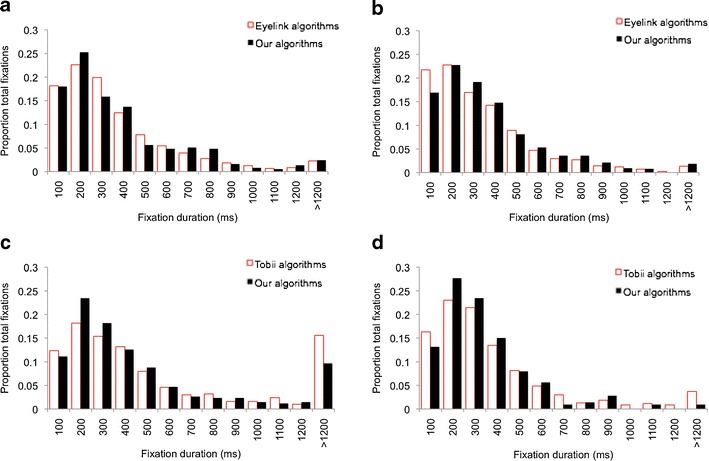
Researchers studying infants' spontaneous allocation of attention have traditionally relied on hand-coding infants' direction of gaze from videos; these techniques have low temporal and spatial resolution and are labor intensive. Eye-tracking technology potentially allows for much more precise measurement of how attention is allocated at the subsecond scale, but a number of technical and methodological issues have given rise to caution about the quality and reliability of high temporal resolution data obtained from infants. We present analyses suggesting that when standard dispersal-based fixation detection algorithms are used to parse eye-tracking data obtained from infants, the results appear to be heavily influenced by interindividual variations in data quality. We discuss the causes of these artifacts, including fragmentary fixations arising from flickery or unreliable contact with the eyetracker and variable degrees of imprecision in reported position of gaze. We also present new algorithms designed to cope with these problems by including a number of new post hoc verification checks to identify and eliminate fixations that may be artifactual. We assess the results of our algorithms by testing their reliability using a variety of methods and on several data sets. We contend that, with appropriate data analysis methods, fixation duration can be a reliable and stable measure in infants. We conclude by discussing ways in which studying fixation durations during unconstrained orienting may offer insights into the relationship between attention and learning in naturalistic settings.
Overview
The claims and statistics of this paper haven’t been checked yet.
Free: it reads the open-access text and checks the first 5 claims that cite a source we can check. Create a free account to check every claim.
Integrity signals
Registry
Cites
Statistics
Figures
Verification
Claims the paper makes
The claims and statistics of this paper haven’t been checked yet.
Free: it reads the open-access text and checks the first 5 claims that cite a source we can check. Create a free account to check every claim.
Claims other papers make about this one
Each is checked against this paper’s own text: does it say what the citing paper says it does?
The cited source says what the claim attributes to it.
In the citing paper
“Of those participants who attended the visit and from whom it was possible to record eyetracking data (HR-noASD 32, HR-ASD 15, LR 49) we found for a subset (HR-no-ASD 2) that the data obtained was too limited or of too poor quality for usable fixation durations to be returned by our parsing algorithm (see ref. 33 and SM pp 7-8 for further discussions of this issue).”
From Shorter spontaneous fixation durations in infants with later emerging autism (2015) · cites this paper as [33]
In the citing paper
“This fixation parsing procedure was designed in response to analyses33 indicating that the fixation detection algorithms traditionally supplied with eyetrackers perform poorly on the variable quality eyetracker data obtained from infants (see also Ref. 32).”
From Shorter spontaneous fixation durations in infants with later emerging autism (2015) · cites this paper as [33]
Self-check
Percentages, sums and reported differences re-computed from the paper’s own numbers.
The self-check needs the paper’s full text.
Citations
Cites
Eye movements in reading and information processing: 20 years of research
Rayner, K. (1998) · Psychological Bulletin · doi:10.1037/0033-2909.124.3.372 · Cited by 7,979 · cited 1×
“A substantial body of research with adults has pointed to the validity and reliability of fixation durations as an index of online cognitive processing (see, e.g., Nuthmann et al., 2010; Rayner, 1998).”
BackgroundComputational modelling of visual attention
Itti, L., & Koch, C. (2001) · Nature Reviews Neuroscience · doi:10.1038/35058500 · Cited by 4,733 · cited 2×
“Free viewing”
BackgroundIARBUS, A. L. (1967) · Medical Entomology and Zoology · Cited by 3,319
Yarbus, A. L. (1967) · doi:10.1007/978-1-4899-5379-7 · Cited by 3,304 · cited 1×
“Within the adult literature, research has suggested that bottom-up visual features of scenes such as edges and motion (Itti & Koch, 2001), luminance (Loftus, 1985), or blur (Mannan, Ruddock, & Wooding, 1995) can influence fixation duration, as well as top-down factors such as viewing task and personal preference (Hend…”
BackgroundEye Tracking: A comprehensive guide to methods and measures
Holmqvist, K., Nyström, M., Andersson, R., Dewhurst, R. J., Jarodzka, H. M., & van de Weijer, J. (2015) · Lund University Publications (Lund University) · Cited by 2,919
Social cognition, joint attention, and communicative competence from 9 to 15 months of age.
Carpenter, M., Nagell, K., Tomasello, M., Butterworth, G., & Moore, C. (1998) · Monographs of the Society for Research in Child Development · doi:10.2307/1166214 · Cited by 2,727
Eye Tracking Methodology: Theory and Practice
Duchowski, A. T. (2003) · Springer eBooks · doi:10.1007/978-1-4471-3750-4 · Cited by 2,242 · cited 2×
“There are three standard measures used to separate fixations from other eye movement events: dispersal, velocity, and acceleration (for more detailed reviews, see Duchowski, 2007; Nyström & Holmqvist.”
MethodFast bilateral filtering for the display of high-dynamic-range images
Durand, F., & Dorsey, J. (2002) · Proceedings of the 29th annual conference on Computer graphics and interactive techniques · doi:10.1145/566570.566574 · Cited by 1,547
Eye Tracking Methodology; Theory and Practice
(2007) · Qualitative Market Research: An International Journal · doi:10.1108/13522750710740862 · Cited by 1,313
Bayesian surprise attracts human attention
Itti, L., & Baldi, P. (2009) · Vision Research · doi:10.1016/j.visres.2008.09.007 · Cited by 1,224 · cited 3×
“…factors (such as the rate of change of lowlevel information at the point fixated) versus endogenous factors (such as the semantic content at the point fixated— e.g. face vs. nonface) (cf. Berg et al., 2009; Frank et al., 2009; Itti & Baldi, 2009; Mital, Smith, Hill, & Henderson, 2010)?”
BackgroundResult
Research works printed but not linked: 4
- Dekker, T.M., Smith, T.J., Mital, P.K. & Karmiloff-Smith, A. (under review). The debate on childhood screen exposure: An in-depth eye-tracking comparison of infant DVDs. Manuscript under review.
- Scerif, G., Cornish, K., Wilding, J., Driver, J., & Karmiloff-Smith, A. (2005). Early attention difficulties in fragile X syndrome: Underlying mechanisms and developmental trajectories. Journal of Cognitive Neuroscience, 220-221.
- Shic, F., Chawarska, K. and Scassellati, B. (2008). The incomplete fixation measure, Proceedings of the 2008 symposium on Eye tracking research & applications, Savannah, Georgia: ACM, 2008, pp. 111-114.
- Wass, S. V. (2011). Gaze-contingent concentration training for infants. PhD Thesis. Birkbeck, University of London.
Cited by
Items 101–153 of 153
Motor-Independent Cognitive Testing in Motor Degenerative Diseases
Schmitz‐Peiffer, H., Aust, E., Linse, K., Rueger, W., Joos, M., Löhle, M., Storch, A., & Hermann, A. (2022) · Journal of Clinical Medicine · doi:10.3390/jcm11030814 · Cited by 7
“The dwell delay and dwell time scores were chosen according to previously published recommendations [17,18].”
MethodBache, C., Springer, A., Noack, H., Stadler, W., Kopp, F., Lindenberger, U., & Werkle‐Bergner, M. (2017) · Frontiers in Psychology · doi:10.3389/fpsyg.2017.01170 · Cited by 8
“Moreover, comparing common categorization algorithms, it has been shown that results for fixations and saccades vary to such an extent that automated categorization may not always return meaningful results (Komogortsev et al., 2010; see Wass et al., 2013, for calculation of data quality post hoc).”
BackgroundTo covet what we see: Autistic traits modulate the relationship between looking and choosing
Hedger, N., & Chakrabarti, B. (2020) · Autism Research · doi:10.1002/aur.2349 · Cited by 7
“Consequently, such restricted interest stimuli may co-opt the reward circuitry typically allocated to social stimuli (Watson et al., 2015) and hijack the typical trajectory of social-seeking behaviors.”
BackgroundInfants’ Selective Visual Attention Is Dependent on Maternal Affect and Emotional Context
Juvrud, J., Haas, S., Fox, N. A., & Gredebäck, G. (2021) · Frontiers in Psychology · doi:10.3389/fpsyg.2021.700272 · Cited by 7
“The remaining predictor variable of infants’ context was maternal negative affect (PANAS), defined as a continuous fixed effect in our model.”
BackgroundMethodInfluentialColour perception changes with basic colour word comprehension
Forbes, S. H., & Plunkett, K. (2023) · Developmental Science · doi:10.1111/desc.13406 · Cited by 11
Idrees, A. R., Kraft, R., Winter, M. R., Küchler, A., Baumeister, H., Reilly, R., Reichert, M., & Pryss, R. C. (2023) · Journal of Ambient Intelligence and Humanized Computing · doi:10.1007/s12652-023-04635-4 · Cited by 9
“Fixation duration: The average fixation duration can be an indicator of cognitive load (Wass et al. 2013).”
BackgroundPupillometry in Developmental Psychology
Hepach, R. (2024) · Springer eBooks · doi:10.1007/978-3-031-54896-3_3 · Cited by 8
Vision Diagnostics and Treatment System for Children with Disabilities
Kasprowski, P., & Harȩżlak, K. (2018) · Journal of Healthcare Engineering · doi:10.1155/2018/9481328 · Cited by 6
The fundamentals of eye tracking, Part 7: Determining data quality
Niehorster, D., Nyström, M., Hessels, R., Benjamins, J., Andersson, R., & Hooge, I. (2026) · Behavior Research Methods · doi:10.3758/s13428-026-03039-4 · Cited by 6
Foraging and inertia: Understanding the developmental dynamics of overt visual attention
Wass, S. V., Amadó, M. P., Northrop, T., Haresign, I. M., & Phillips, E. (2024) · Neuroscience & Biobehavioral Reviews · doi:10.1016/j.neubiorev.2024.105991 · Cited by 5
“These ‘micro-level ’ attention behaviours are generally studied using fixation detection algorithms built into eye-trackers (Hessels et al., 2017, 2018; Wass et al., 2013, 2014).”
Self-citationRoss‐Sheehy, S., Eschman, B., & Reynolds, E. (2022) · PLoS ONE · doi:10.1371/journal.pone.0274113 · Cited by 5
“To address this question, it will be necessary to utilize eye tracking to visualize individual fixations and saccades, as it has higher spatial and temporal resolution compared to using human observers [33, 34].”
BackgroundFu, X., Platt, E., Shic, F., & Bradshaw, J. L. (2024) · Journal of Autism and Developmental Disorders · doi:10.1007/s10803-024-06360-z · Cited by 5
“Low robustness is related to shorter fixation durations (Wass et al., 2013, 2014, 2015 ).”
InfluentialMulder, H., van Houdt, C. A., van der Ham, I. J. M., der Stigchel, S. V., & Oudgenoeg‐Paz, O. (2020) · Brain Sciences · doi:10.3390/brainsci10050279 · Cited by 8
“Missing data were manually interpolated when missing duration was <150 ms, and the location of the last fixation before the missing was the same as the location as the first fixation after the missing (see [29]).”
MethodThe Effect of Stimulus Size and Eccentricity on Attention Shift Latencies
Kulke, L. (2017) · Vision · doi:10.3390/vision1040025 · Cited by 5
AUTOMATIC DETECTION OF NYSTAGMUS IN BEDSIDE VOG RECORDINGS FROM PATIENTS WITH VERTIGO
Punuganti, S. A. (2019) · Cited by 4
Kleberg, J. L., Hallman, A. E. Z., Astenvald, R., Nordgren, A., Falck‐Ytter, T., & van den Berg, R. (2025) · Behavior Research Methods · doi:10.3758/s13428-025-02903-z · Cited by 3
“For example, Wass et al. (2013) found that higher sample-to-sample variability in infant data could lead to apparently shorter duration of classified fixations.”
Longer looks for language: Novel labels lengthen fixation duration for 2-year-old children
LaTourrette, A. S., Novack, M. A., & Waxman, S. R. (2023) · Journal of Experimental Child Psychology · doi:10.1016/j.jecp.2023.105754 · Cited by 3
“Fixations were defined as lasting a minimum of 80 ms (Wass et al., 2013).”
Inspirational Stimuli Attain Visual Allocation: Examining Design Ideation with Eye-Tracking
Dybvik, H., Abelson, F. G., Aalto, P., Goucher-Lambert, K., & Steinert, M. (2023) · Springer eBooks · doi:10.1007/978-3-031-20418-0_28 · Cited by 4
The Use of Eye-Tracking in the Investigation of Prelinguistic Infants: A Review
Francois Jennifer, R., Coufal, K. L., & Chaparro, B. S. (2018) · Annals of Cognitive Science · doi:10.36959/447/342 · Cited by 5
The development of gaze following in monolingual and bilingual infants: A multi-lab studyPreprint
Byers‐Heinlein, K., Tsui, R. K. Y., van Renswoude, D. R., Black, A. K., Barr, R., Brown, A., Durrant, S., Gampe, A., Gonzalez‐Gomez, N., Hay, J. F., et al. (2020) · PsyArXiv (OSF Preprints) · doi:10.31234/osf.io/sgfhv · Cited by 3
Automated Infant Eye Tracking: A Systematic Historical Review
Nyström, P., Ziavras, A. N., Makashvili, T., Juslin, A., Lehtonen, V., Riis, A., & Gredebäck, G. (2025) · Infancy · doi:10.1111/infa.70031 · Cited by 3
“Analysis packages (Nyström et al. 2016; van Renswoude et al. 2018; Wass et al. 2013), dependent variables (e.g. Hepach 2024) and factors influencing the data (Hessels et al. 2015) are also well described.”
Errorless Psychomotor Training Modulates Visuomotor Behaviors Among Older Adults
Fan, M., & Wong, T. W. L. (2020) · GeroPsych · doi:10.1024/1662-9647/a000254 · Cited by 2
The effect of emotional uncertainty on attentional bias toward neutral infant faces in adults
Li, Y. L., Cheng, G., Wu, X. H., Dai, H. Y., & Jia, Y. (2022) · Developmental Psychobiology · doi:10.1002/dev.22335 · Cited by 2
Essex, C., Bedford, R., Gliga, T., & Smith, T. J. (2025) · Developmental Science · doi:10.1111/desc.70008 · Cited by 5
Self-citationBernard, C., Depierreux, A., Huet, V., & Mascaro, O. (2025) · Child Development · doi:10.1111/cdev.14267 · Cited by 2
“Two rectangular AOIs of 457 × 514 pixels centered on the unfamiliar objects were used.”
InfluentialMalik, A., Leung, T. S., Zhang, S., Zeng, G., Maylott, S. E., Bainter, S. A., Messinger, D. S., Paukner, A., & Simpson, E. A. (2025) · Developmental Psychobiology · doi:10.1002/dev.70054 · Cited by 2
A New Method for Studying Statistical Learning in Young Children
Kavakcı, M., & Dollaghan, C. A. (2019) · Journal of Speech Language and Hearing Research · doi:10.1044/2019_jslhr-l-18-0165 · Cited by 3
Haskins, A. J., Mentch, J., Wicklin, C. V., Choi, Y. B., & Robertson, C. E. (2022) · Journal of Autism and Developmental Disorders · doi:10.1007/s10803-022-05850-2 · Cited by 2
“For all remaining trials, gaze location was determined by rectifying head and eye coordinates, and fixations were defined from raw gaze data (Peterson et al., 2016; Wass et al., 2013), both using custom analysis scripts in MAT-LAB.”
Zaharieva, M. S., Kucharský, Š., Colonnesi, C., Gu, T., Jo, S., Luttenbacher, I., Mannsdörfer, L., Matetovici, M., Mickute, U., Raijmakers, M. E. J., et al. (2021) · PsyArXiv (OSF Preprints) · doi:10.31234/osf.io/bdtx9 · Cited by 4
A constructivist lens of eye-tracking in special populations
Nelson, R. L., Arrington, L. E., Firouzshahi, N., Hunt, P. A., Percle, A., Damico, H. L., & Damico, J. S. (2022) · Elsevier eBooks · doi:10.1016/b978-0-12-818630-5.07093-7 · Cited by 2
The effects of errorless psychomotor training in the Y balance lower limb reaching task
Fan, M., & Wong, T. W. L. (2023) · Psychological Research · doi:10.1007/s00426-023-01831-x · Cited by 2
“The duration and location of the fixation indicated the distribution of attention (Wass et al., 2013).”
Effect of aging on the visuomotor control during continuous bimanual movement
Kiani, K., Patel, M., & Fu, Q. (2025) · Frontiers in Aging Neuroscience · doi:10.3389/fnagi.2025.1525535 · Cited by 1
Where Do Clinicians Look When Viewing Videofluoroscopic Swallow Studies? A Pilot Eye-Tracking Study
Ensar, B., & Searl, J. P. (2025) · American Journal of Speech-Language Pathology · doi:10.1044/2025_ajslp-25-00092 · Cited by 1
Jostrup, E., Claesdotter‐Knutsson, E., Tallberg, P., Söderlund, G. B. W., Gustafsson, P., & Nyström, M. (2025) · Brain Disorders · doi:10.1016/j.dscb.2025.100289 · Cited by 1
High and low-scope errors: the mistakes teachers notice when assessing texts
Furer, Y., Gottschling, S., Brucker, B., & Praetorius, A.-K. (2026) · Reading and Writing · doi:10.1007/s11145-025-10750-9 · Cited by 1
Florea, C., Florea, L., & Vertan, C. (2018) · Elsevier eBooks · doi:10.1016/b978-0-12-813445-0.00002-2 · Cited by 3
Lozano, I., Campos, R., & Carmona, M. B. (2018) · ACM Symposium on Eye Tracking Research and Applications (ETRA) · doi:10.1145/3204493.3207423 · Cited by 1
“One possibility we are considering is to apply to raw data specific algorithms specifically designed to correct infants’ sources of "noise" when testing infants with stimuli containing speech and faces (see, for instance, [Wass et al. 2012] and [Hessels et al. 2016]).”
BackgroundRemembering What We've Seen: The Hippocampus and Relational Memory
Koenig, S. (2017) · ResearchWorks at the University of Washington (University of Washington) · Cited by 4
Visual Development of Chinese Children, Studied with Eye-Tracking Technology
Liu, J., & Lei, X. (2019) · Visual Anthropology · doi:10.1080/08949468.2019.1603033
XII Festival de Ópera de la A. B. A. O.: "Rigoletto"
de Tejada, F. L. L. (1963) · Ritmo
de Haan, M. D. H., & Johnson, M. H. (2015) · Wiley eBooks · doi:10.1002/9781394259083.refs
Исаева, Е. Р., Mukhitova, Y. V., & Dmitriev, P. I. (2024) · Психология и Психотехника · doi:10.7256/2454-0722.2024.1.69668 · Cited by 1
Ali, M., Huang, P.-J., & Cardona-Rivera, R. E. (2025) · IEEE International Conference on Artificial Intelligence and eXtended and Virtual Reality (AIxVR) · doi:10.1109/aixvr63409.2025.00011
“Fixation times vary between people and depend on various factors [21]; we adopted a fixation period of 500 ms, considered a longer fixation range in the literature.”
Nayar, K., Shic, F., Winston, M., & Losh, M. C. (2022) · Figshare · doi:10.6084/m9.figshare.19711190
Determiner Asymmetry in Arabic–English Code-Switching: Behavioral and Eye-Tracking Evidence
Shim, J. Y., Leung, T. T.-C., & Kim, H. (2026) · International Journal of Bilingualism · doi:10.1177/13670069261490719
Influence of Viewing Distance on User Visual Attention in Screen-Based Interactions
Yin, K., Shan, Y., Pan, Z., Song, Y., Zhang, H., & Li, X. (2026) · International Journal of Human-Computer Interaction · doi:10.1080/10447318.2026.2648804
Ruiz, G. T., Cabrera-Pérez, L., Ruiz-Morales, G., Garcia-Diaz, S., Toribio-Ruano, I., & Caletrío, Á. B. (2026) · Ear and Hearing · doi:10.1097/aud.0000000000001841
Cross-domain evaluation and fine-tuned adaptation of iCatcher+ for Korean infant gaze data
Madhavan, R., Lee, J., Lee, D., Jung, J.-H., & Ko, E.-S. (2026) · Infant Behavior and Development · doi:10.1016/j.infbeh.2026.102198
Investigating the role of adaptive multimodal Interface in take-over performance
Merlhiot, G. (2026) · Transportation Research Part F Traffic Psychology and Behaviour · doi:10.1016/j.trf.2026.103674
Lazy or Efficient? Towards Accessible Eye-Tracking Event Detection Using LLMs ETRA024
Guo, D., Abdrabou, Y., & Kasneci, E. (2026) · Proceedings of the ACM on Human-Computer Interaction · doi:10.1145/3806038
“…rate [Engbert and Kliegl 2003] or noise level [Nyström and Holmqvist 2010], multi-threshold models that combine velocity and acceleration cues [Wass et al. 2013], and hybrid thresholding that combine velocity and dispersion criteria for improved temporal stability and noise robustness as in…”
Motion perception and biological motion processing in adults born with extremely low birth weight
Johansson, M., Kochukhova, O., Heyman, M., Montgomery, C., Diderholm, B., & Kaul, Y. F. (2026) · Scientific Reports · doi:10.1038/s41598-026-58361-w
Wang, L., Shi, Y., Yuan, F., Geng, X., Meng, Z., Wang, Y., So, H., & Wong, P. C. M. (2026) · Autism · doi:10.1177/13623613261480732
“In contrast, “Eye Contact” yielded the lowest ICC, consistent with previous research showing that gaze-related behaviors are inherently difficult to code from videos due to subtle timing differences, occlusions, and camera angle variability (Venker et al., 2020; Wass et al., 2013).”
Metadata
- Authors
- Wass, S. V., Smith, T. J., & Johnson, M. H.
- Affiliations
- University of London (GB)
- Corresponding author
- Wass, S. V.
- Venue
- Behavior Research Methods
- Published
- 2012-09-06
- Volume
- 45
- Issue
- 1
- Pages
- 229-250
- ISSN
- 1554-351X (ISSN-L)
- 1554-3528
- PMC
- PMC3578727
- OpenAlex
- W2072416967
- Cited by
- 154
- References
- 91
- Citations by year
- 2026: 11 · 2025: 10 · 2024: 5 · 2023: 9 · 2022: 16 · 2021: 13 · 2020: 14 · 2019: 18 · 2018: 19 · 2017: 10 · 2016: 4 · 2015: 7 · 2014: 15 · 2013: 2
- FWCI
- 14.10
- Type
- journal article
- Language
- en
- Open access
- hybrid
- doi.org
- Licence
- cc-by
- Locations
- Behavior Research Methods (publishedVersion, cc-by)
- Europe PMC (PubMed Central) (publishedVersion)
- PubMed Central (publishedVersion, cc-by)
- PubMed (publishedVersion)
- BIROn (Birkbeck, University of London) (acceptedVersion)
- University of the Arts London Research Online (University of the Arts London) (acceptedVersion)
- Topics
- Physical Sciences › Computer Science › Human-Computer Interaction › Gaze Tracking and Assistive Technology
- Physical Sciences › Computer Science › Computer Vision and Pattern Recognition › Visual Attention and Saliency Detection
- Life Sciences › Neuroscience › Cognitive Neuroscience › Visual perception and processing mechanisms
- Keywords
- fixation duration, data quality, artifact removal, gaze direction, attention allocation, interindividual variability, reliability statistics
- MeSH terms
- Adult, Algorithms, Analysis of Variance, Attention, Differential Threshold, False Positive Reactions, Fixation, Ocular, Humans, Infant, Models, Biological, Saccades, Software Design, Time Factors, Reproducibility of Results, Artifacts, Eye Movement Measurements
About these checks
Registry, retraction, Cites and statistics results are computed, not judged, with one exception: a printed reference that no index lists is read once by a model before it counts as a citation error. Claims are extracted by a model and kept only when their quote appears verbatim in the text; each cited source is then checked, with a model’s help, for whether it says what the claim relies on. Those verdicts can be wrong — read the claim’s quote and the cited source before relying on one.
Statistics and arithmetic are recomputed, not judged.
Confidence bands are shown only for fields calibrated on our annotated test set. None is calibrated yet, so no band is shown.
What counts as a claim ›How we measure confidence ›How we check this ›
Are you an author, or do you see a problem with this page? Request a review
Data sources
Bibliographic data: Semantic Scholar, OpenAlex, Crossref.
Contains information from the Semantic Scholar Academic Graph Datasets, made available under the ODC Attribution License (ODC-BY 1.0).
Semantic Scholar’s data is described in: Kinney, R., et al. (2023). The Semantic Scholar Open Data Platform. arXiv:2301.10140.
