

Parsing eye-tracking data of variable quality to provide accurate fixation duration estimates in infants and adults
Open accessThe DOI matches its Crossref record; 86 of the 91 references it cites were found in a registry or an index.
Abstract
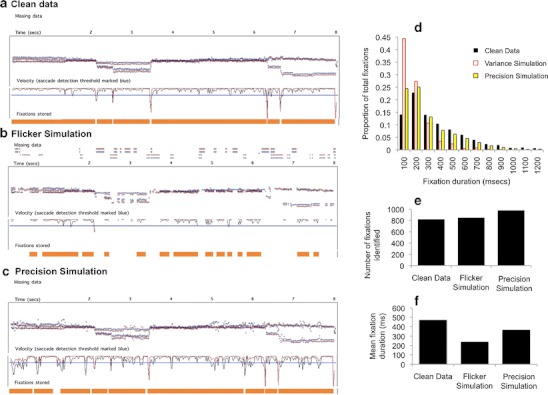
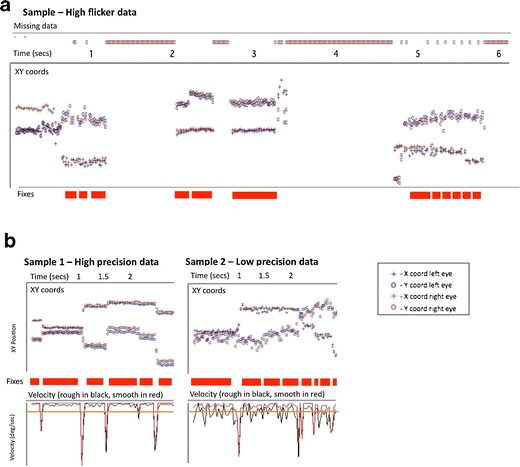
Researchers studying infants' spontaneous allocation of attention have traditionally relied on hand-coding infants' direction of gaze from videos; these techniques have low temporal and spatial resolution and are labor intensive. Eye-tracking technology potentially allows for much more precise measurement of how attention is allocated at the subsecond scale, but a number of technical and methodological issues have given rise to caution about the quality and reliability of high temporal resolution data obtained from infants. We present analyses suggesting that when standard dispersal-based fixation detection algorithms are used to parse eye-tracking data obtained from infants, the results appear to be heavily influenced by interindividual variations in data quality. We discuss the causes of these artifacts, including fragmentary fixations arising from flickery or unreliable contact with the eyetracker and variable degrees of imprecision in reported position of gaze. We also present new algorithms designed to cope with these problems by including a number of new post hoc verification checks to identify and eliminate fixations that may be artifactual. We assess the results of our algorithms by testing their reliability using a variety of methods and on several data sets. We contend that, with appropriate data analysis methods, fixation duration can be a reliable and stable measure in infants. We conclude by discussing ways in which studying fixation durations during unconstrained orienting may offer insights into the relationship between attention and learning in naturalistic settings.
Overview
The claims and statistics of this paper haven’t been checked yet.
Free: it reads the open-access text and checks the first 5 claims that cite a source we can check. Create a free account to check every claim.
Integrity signals
Registry
Cites
Statistics
Figures
Verification
Claims the paper makes
The claims and statistics of this paper haven’t been checked yet.
Free: it reads the open-access text and checks the first 5 claims that cite a source we can check. Create a free account to check every claim.
Claims other papers make about this one
Each is checked against this paper’s own text: does it say what the citing paper says it does?
The cited source says what the claim attributes to it.
In the citing paper
“Of those participants who attended the visit and from whom it was possible to record eyetracking data (HR-noASD 32, HR-ASD 15, LR 49) we found for a subset (HR-no-ASD 2) that the data obtained was too limited or of too poor quality for usable fixation durations to be returned by our parsing algorithm (see ref. 33 and SM pp 7-8 for further discussions of this issue).”
From Shorter spontaneous fixation durations in infants with later emerging autism (2015) · cites this paper as [33]
In the citing paper
“This fixation parsing procedure was designed in response to analyses33 indicating that the fixation detection algorithms traditionally supplied with eyetrackers perform poorly on the variable quality eyetracker data obtained from infants (see also Ref. 32).”
From Shorter spontaneous fixation durations in infants with later emerging autism (2015) · cites this paper as [33]
Self-check
Percentages, sums and reported differences re-computed from the paper’s own numbers.
The self-check needs the paper’s full text.
Citations
Cites
Eye movements in reading and information processing: 20 years of research
Rayner, K. (1998) · Psychological Bulletin · doi:10.1037/0033-2909.124.3.372 · Cited by 7,979 · cited 1×
“A substantial body of research with adults has pointed to the validity and reliability of fixation durations as an index of online cognitive processing (see, e.g., Nuthmann et al., 2010; Rayner, 1998).”
BackgroundComputational modelling of visual attention
Itti, L., & Koch, C. (2001) · Nature Reviews Neuroscience · doi:10.1038/35058500 · Cited by 4,733 · cited 2×
“Free viewing”
BackgroundIARBUS, A. L. (1967) · Medical Entomology and Zoology · Cited by 3,319
Yarbus, A. L. (1967) · doi:10.1007/978-1-4899-5379-7 · Cited by 3,304 · cited 1×
“Within the adult literature, research has suggested that bottom-up visual features of scenes such as edges and motion (Itti & Koch, 2001), luminance (Loftus, 1985), or blur (Mannan, Ruddock, & Wooding, 1995) can influence fixation duration, as well as top-down factors such as viewing task and personal preference (Hend…”
BackgroundEye Tracking: A comprehensive guide to methods and measures
Holmqvist, K., Nyström, M., Andersson, R., Dewhurst, R. J., Jarodzka, H. M., & van de Weijer, J. (2015) · Lund University Publications (Lund University) · Cited by 2,919
Social cognition, joint attention, and communicative competence from 9 to 15 months of age.
Carpenter, M., Nagell, K., Tomasello, M., Butterworth, G., & Moore, C. (1998) · Monographs of the Society for Research in Child Development · doi:10.2307/1166214 · Cited by 2,727
Eye Tracking Methodology: Theory and Practice
Duchowski, A. T. (2003) · Springer eBooks · doi:10.1007/978-1-4471-3750-4 · Cited by 2,242 · cited 2×
“There are three standard measures used to separate fixations from other eye movement events: dispersal, velocity, and acceleration (for more detailed reviews, see Duchowski, 2007; Nyström & Holmqvist.”
MethodFast bilateral filtering for the display of high-dynamic-range images
Durand, F., & Dorsey, J. (2002) · Proceedings of the 29th annual conference on Computer graphics and interactive techniques · doi:10.1145/566570.566574 · Cited by 1,547
Eye Tracking Methodology; Theory and Practice
(2007) · Qualitative Market Research: An International Journal · doi:10.1108/13522750710740862 · Cited by 1,313
Bayesian surprise attracts human attention
Itti, L., & Baldi, P. (2009) · Vision Research · doi:10.1016/j.visres.2008.09.007 · Cited by 1,224 · cited 3×
“…factors (such as the rate of change of lowlevel information at the point fixated) versus endogenous factors (such as the semantic content at the point fixated— e.g. face vs. nonface) (cf. Berg et al., 2009; Frank et al., 2009; Itti & Baldi, 2009; Mital, Smith, Hill, & Henderson, 2010)?”
BackgroundResultFast bilateral filtering for the display of high-dynamic-range images
Durand, F., & Dorsey, J. (2002) · ACM Transactions on Graphics · doi:10.1145/566654.566574 · Cited by 1,003
Attention, Joint Attention, and Social Cognition
Mundy, P., & Newell, L. (2007) · Current Directions in Psychological Science · doi:10.1111/j.1467-8721.2007.00518.x · Cited by 898
Visual Experience in Infants: Decreased Attention to Familiar Patterns Relative to Novel Ones
Fantz, R. L. (1964) · Science · doi:10.1126/science.146.3644.668 · Cited by 889 · cited 1×
“Researchers studying infant behavior have traditionally used methods such as habituation/dishabituation to make inferences about infant cognition (Fantz, 1964).”
MethodInternational Journal of Psychology
(2018) · International Journal of Psychology · doi:10.1002/(issn)1464-066x · Cited by 818
Saccadic suppression: A review and an analysis.
Matin, E. (1974) · Psychological Bulletin · doi:10.1037/h0037368 · Cited by 790 · cited 1×
“Fixations are separated by rapid, ballistic eye movements (saccades), during which visual sensitivity is suppressed to avoid the perception of blur as the image rapidly sweeps across the retina (Matin, 1974).”
BackgroundEye Movements: Cognition and Visual Perception
Biederman, I., Fisher, D. F., Monty, R. A., & Senders, J. W. (1982) · The American Journal of Psychology · doi:10.2307/1422144 · Cited by 740
The effects of semantic consistency on eye movements during complex scene viewing.
Henderson, J. M., Weeks, P. A., Jr., & Hollingworth, A. (1999) · Journal of Experimental Psychology: Human Perception and Performance · doi:10.1037//0096-1523.25.1.210 · Cited by 713
An adaptive algorithm for fixation, saccade, and glissade detection in eyetracking data
Nyström, M., & Holmqvist, K. (2010) · Behavior Research Methods · doi:10.3758/brm.42.1.188 · Cited by 663 · cited 7×
“…a variable velocity threshold that changed contingent on the reliability of the reported POG on a participant-by-participant basis (cf. Behrens, MacKeben, & Schroeder-Preikschat, 2010; Nyström & Holmqvist, 2010; Tole & Young, 1981; van der Lans et al., 2011; discussed in Holmqvist et al., 2011).”
BackgroundMethodResultInfluentialCortical Maturation and the Development of Visual Attention in Early Infancy
Johnson, M. H. (1990) · Journal of Cognitive Neuroscience · doi:10.1162/jocn.1990.2.2.81 · Cited by 584 · cited 2×
“Free viewing”
BackgroundSelf-citationEye Movements: Cognition and Visual Perception
(2017) · Routledge eBooks · doi:10.4324/9781315437415 · Cited by 555
Johnson, M. H., Posner, M. I., & Rothbart, M. K. (1991) · Journal of Cognitive Neuroscience · doi:10.1162/jocn.1991.3.4.335 · Cited by 535
Self-citationAslin, R. N. (2007) · Developmental Science · doi:10.1111/j.1467-7687.2007.00563.x · Cited by 510 · cited 2×
“Free viewing”
BackgroundEye movements and visual cognition : scene perception and reading
Rayner, K. (2011) · Medical Entomology and Zoology · Cited by 503
Clustering of Gaze During Dynamic Scene Viewing is Predicted by Motion
Mital, P. K., Smith, T. J., Hill, R. L., & Henderson, J. M. (2011) · Cognitive Computation · doi:10.1007/s12559-010-9074-z · Cited by 468
Self-citationA dynamical model of saccade generation in reading based on spatially distributed lexical processing
Engbert, R., Longtin, A., & Kliegl, R. (2002) · Vision Research · doi:10.1016/s0042-6989(01)00301-7 · Cited by 420
Development of infants’ attention to faces during the first year
Frank, M. C., Vul, E., & Johnson, S. P. (2009) · Cognition · doi:10.1016/j.cognition.2008.11.010 · Cited by 417 · cited 3×
“This algorithm eliminates jitter in fixation while preserving saccades (Frank et al., 2009).”
BackgroundLooking and ActingVision and eye movements in natural behaviour
Land, M., & Tatler, B. (2009) · Oxford University Press eBooks · doi:10.1093/acprof:oso/9780198570943.001.0001 · Cited by 400 · cited 1×
“…array, such as a natural visual scene or a sparse screen-based display, we spontaneously manifest a sequence of eye movements in order to ensure that light from objects of interest is projected onto the most sensitive part of the retina, the fovea (Holmqvist et al., 2011; Land & Tatler, 2009).”
BackgroundSwettenham, J., Baron-Cohen, S., Charman, T., Cox, A., Baird, G., Drew, A., Rees, L., & Wheelwright, S. (1998) · Journal of Child Psychology and Psychiatry · doi:10.1017/s0021963098002595 · Cited by 398 · cited 2×
“Researchers wishing to study infants’ spontaneous attention deployment in real-world settings have traditionally done this by video taping infants playing in naturalistic contexts and by hand-coding their direction of gaze post hoc (e.g., Choudhury & Gorman, 2000; Kannass & Oakes, 2008; Swettenham et al., 1998).”
BackgroundDefinition and Computation of Oculomotor Measures in the Study of Cognitive Processes
Inhoff, A. W., & Radach, R. (1998) · Eye Guidance in Reading and Scene Perception · doi:10.1016/b978-008043361-5/50003-1 · Cited by 315 · cited 3×
“The threshold we used of 100 ms is higher than is sometimes used (e.g., Tatler & Vincent, 2008, 50 ms), although lower than that used by others (e.g., de Barbaro et al., 2011, 230 ms; Irwin, 1992, 150 ms; see Inhoff & Radach, 1998, for a discussion of this issue).”
BackgroundMethodEye Tracking in Infancy Research
Gredebäck, G., Johnson, S., & von Hofsten, C. (2009) · Developmental Neuropsychology · doi:10.1080/87565640903325758 · Cited by 308
Atkinson, J. (2002) · Oxford University Press eBooks · doi:10.1093/acprof:oso/9780198525998.001.0001 · Cited by 302 · cited 3×
“We assume that this individual's eye is stable during fixation, because from the infant oculomotor literature, we were able to find no reports of such high-frequency (50 Hz) “jitter” in infant eye movement behavior (Atkinson, 2000; Bronson, 1990, 1994; Johnson, 2010; see also Holmqvist et al., 2011), and our own video…”
BackgroundDefining the temporal threshold for ocular fixation in free-viewing visuocognitive tasks
Manor, B. R., & Gordon, E. (2003) · Journal of Neuroscience Methods · doi:10.1016/s0165-0270(03)00151-1 · Cited by 300 · cited 1×
“…these very short, preprogrammed fixations (Inhoff & Radach, 1998; Nuthmann et al., 2010; Volkman, 1986; although this remains controversial, see Irwin, 1992; Manor & Gordon, 2003), we felt that studying fixations of <100 ms was beyond the limits of the accuracy of the eyetracker we were using.”
BackgroundDisengaging visual attention in the infant and adult
Hood, B. M., & Atkinson, J. (1993) · Infant Behavior and Development · doi:10.1016/0163-6383(93)80001-o · Cited by 300 · cited 3×
“Free viewing”
BackgroundRose, S. A., Feldman, J. F., & Jankowski, J. J. (2011) · Developmental Science · doi:10.1111/j.1467-7687.2011.01068.x · Cited by 287
Visual orienting in the early broader autism phenotype: disengagement and facilitation
Elsabbagh, M., Volein, A., Holmboe, K., Tucker, L., Csibra, G., Baron‐Cohen, S., Bolton, P., Charman, T., Baird, G., & Johnson, M. H. (2009) · Journal of Child Psychology and Psychiatry · doi:10.1111/j.1469-7610.2008.02051.x · Cited by 279 · cited 4×
“…within a number of disorder groups (e.g. Cornish, Cole, Longhi, KarmiloffSmith, & Scerif, 2012a, 2012b; Cornish, Scerif, & Karmiloff-Smith, 2007; Elsabbagh et al., 2009; Holmboe et al., 2009; Scerif, Cornish, Wilding, Driver, & KarmiloffSmith, 2005; van deWeijer-Bergsma, Wijnroks, & Jongmans,…”
BackgroundInfluentialSelf-citationHeuristic filtering and reliable calibration methods for video-based pupil-tracking systems
Stampe, D. M. (1993) · Behavior Research Methods, Instruments, & Computers · doi:10.3758/bf03204486 · Cited by 276 · cited 1×
“First, following Stampe (1993), these data were smoothed using a bilateral filtering algorithm written by Ed Vul (Frank, Vul, & Johnson, 2009; based on Durand & Dorsey, 2002).”
MethodHead-Mounted Eye Tracking: A New Method to Describe Infant Looking
Franchak, J. M., Kretch, K. S., Soska, K. C., & Adolph, K. E. (2011) · Child Development · doi:10.1111/j.1467-8624.2011.01670.x · Cited by 271
Not your mother’s view: the dynamics of toddler visual experience
Smith, L. B., Yu, C., & Pereira, A. F. (2011) · Developmental Science · doi:10.1111/j.1467-7687.2009.00947.x · Cited by 250 · cited 2×
“The ultimate aim of research in this field is to link attention as measured using nonnaturalistic, individual-trial experiments with attention in “the wild” (Smith et al., 2011).”
BackgroundVolkmann, F. C. (1986) · Vision Research · doi:10.1016/0042-6989(86)90164-1 · Cited by 245
Colombo, J., & Mitchell, D. W. (2009) · Neurobiology of Learning and Memory · doi:10.1016/j.nlm.2008.06.002 · Cited by 237 · cited 2×
“…way of assessing whether infants perceive that a stimulus has changed (for example, whether they can discern the difference between seven colored circles and eight); measuring the rate of change of looks over time is also useful as an index of infants’ speed of learning (Colombo & Mitchell, 2009).”
BackgroundDevelopment of attention and distractibility in the first 4 years of life.
Ruff, H. A., & Capozzoli, M. C. (2003) · Developmental Psychology · doi:10.1037/0012-1649.39.5.877 · Cited by 232 · cited 2×
“A more typical temporal resolution for video coding is 1 Hz (Kannass & Oakes, 2008; Ruff & Capozzoli, 2003; Wass, 2011; Wass, Porayska-Pomsta, & Johnson, 2011), although resolutions as low as 0.2 Hz (i.e., one sample every 5 s) are also sometimes reported.”
BackgroundInfluentialCRISP: A computational model of fixation durations in scene viewing.
Nuthmann, A., Smith, T. J., Engbert, R., & Henderson, J. M. (2010) · Psychological Review · doi:10.1037/a0018924 · Cited by 223 · cited 4×
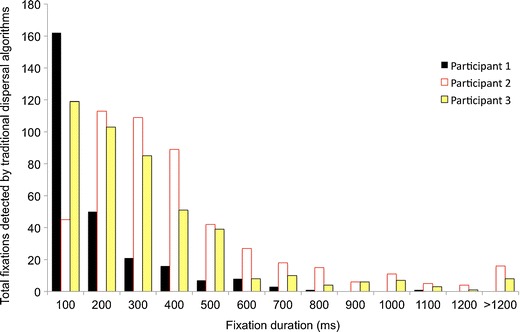
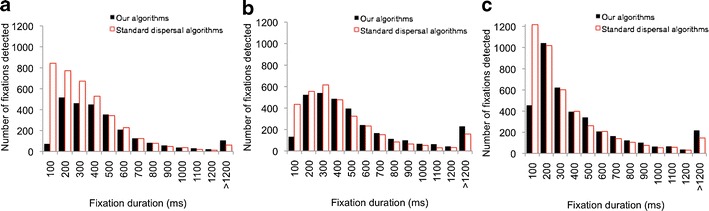
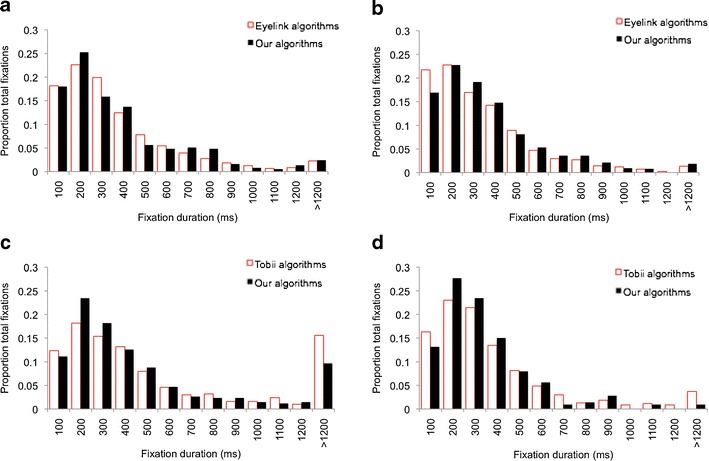
“The shape of this distribution is broadly similar to the distributions of fixation durations described in the adult literature (e.g., Henderson, Chanceaux, & Smith, 2009; Nuthmann et al., 2010; Nyström & Holmqvist, 2010; Tatler & Vincent, 2008).”
BackgroundMethodInfluentialSelf-citationTraining Attentional Control in Infancy
Wass, S., Porayska-Pomsta, K., & Johnson, M. H. (2011) · Current Biology · doi:10.1016/j.cub.2011.08.004 · Cited by 199 · cited 2×
“…differences in attention control relate to the relative importance of endogenous versus exogenous factors in guiding gaze location (cf. de Barbaro et al., 2011; Frick, Colombo, & Saxon, 1999; Rose, Feldman, & Jankowski, 2011; Rose, Feldman, Jankowski, & Van Rossem, 2008, 2011; Wass et al., 2011)?”
BackgroundSelf-citationFixation identification: The optimum threshold for a dispersion algorithm
Blignaut, P. (2009) · Attention, Perception, & Psychophysics · doi:10.3758/app.71.4.881 · Cited by 196 · cited 7×
“These findings agree with those of other authors who have questioned the reliability of standard dispersal-based fixation detection algorithms (Blignaut, 2009; Camilli, Nacchia, Terenzi, & Di Nocera, 2008; Karsh & Breitenbach, 1983; Shic et al., 2008, 2009).”
BackgroundResultInfluentialAttention development in infants and preschool children born preterm: A review
van de Weijer-Bergsma, E., Wijnroks, L., & Jongmans, M. J. (2008) · Infant Behavior and Development · doi:10.1016/j.infbeh.2007.12.003 · Cited by 196 · cited 1×
“…a variable velocity threshold that changed contingent on the reliability of the reported POG on a participant-by-participant basis (cf. Behrens, MacKeben, & Schroeder-Preikschat, 2010; Nyström & Holmqvist, 2010; Tole & Young, 1981; van der Lans et al., 2011; discussed in Holmqvist et al., 2011).”
BackgroundRuddock, K. H., Wooding, D. S., & Mannan, S. (1995) · Spatial Vision · doi:10.1163/156856895x00052 · Cited by 194
A Cognitive Approach to the Development of Early Language
Rose, S. A., Feldman, J. F., & Jankowski, J. J. (2009) · Child Development · doi:10.1111/j.1467-8624.2008.01250.x · Cited by 188 · cited 1×
“Longitudinal correlations have been documented, for example, between early attention control and subsequent language acquisition (Rose et al., 2008, 2009), but the possible causal pathways underlying these correlations remain largely unexplored.”
BackgroundWade, N., & Tatler, B. (2005) · Oxford University Press eBooks · doi:10.1093/acprof:oso/9780198566175.001.0001 · Cited by 184 · cited 1×
“Methods for recording eye movements have been around for over a hundred years (Wade & Tatler, 2005), but only with the relatively recent advent of high-speed infrared (IR) cameras and fast computers has eye tracking become noninvasive enough to be used with infants.”
BackgroundTracing syndrome-specific trajectories of attention across the lifespan.
CORNISH, K., SCERIF, G., & KARMILOFFSMITH, A. (2007) · Cortex · doi:10.1016/s0010-9452(08)70497-0 · Cited by 178
Visually guided navigation: Head-mounted eye-tracking of natural locomotion in children and adults
Franchak, J. M., & Adolph, K. E. (2010) · Vision Research · doi:10.1016/j.visres.2010.09.024 · Cited by 175
Henderson, J. M., Chanceaux, M., & Smith, T. J. (2009) · Journal of Vision · doi:10.1167/9.1.32 · Cited by 162 · cited 1×
“Free viewing”
Self-citationFree viewing of dynamic stimuli by humans and monkeys
Berg, D. J., Boehnke, S. E., Marino, R. A., Munoz, D. P., & Itti, L. (2009) · Journal of Vision · doi:10.1167/9.5.19 · Cited by 161 · cited 2×
“…factors (such as the rate of change of lowlevel information at the point fixated) versus endogenous factors (such as the semantic content at the point fixated— e.g. face vs. nonface) (cf. Berg et al., 2009; Frank et al., 2009; Itti & Baldi, 2009; Mital, Smith, Hill, & Henderson, 2010)?”
BackgroundResultIndividual and Developmental Differences in Disengagement of Fixation in Early Infancy
Frick, J. E., Colombo, J., & Saxon, T. F. (1999) · Child Development · doi:10.1111/1467-8624.00039 · Cited by 155 · cited 1×
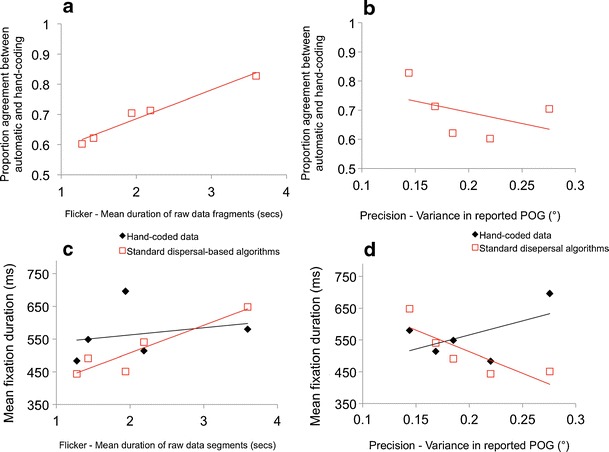
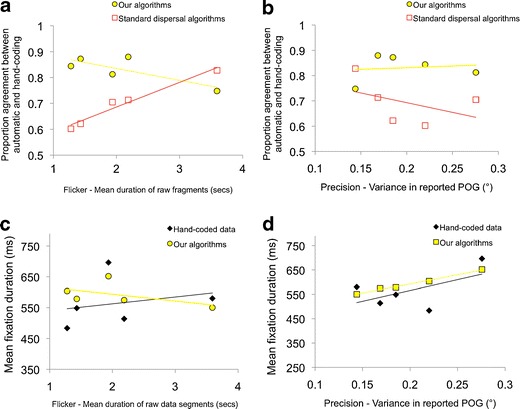
“They show that some substantial differences do still exist between the results of our algorithms and those of the hand-coding, which may be attributable to the small volume of data that has been processed in this analysis.”
ResultInfant Eyes: A Window on Cognitive Development
Aslin, R. Ν. (2011) · Infancy · doi:10.1111/j.1532-7078.2011.00097.x · Cited by 152 · cited 1×
“Given the limitations of traditional methods, the advent of eyetrackers has brought a number of changes to the study of infant cognition (Aslin, 2012; Gredebäck, Johnson, & van Hofsten, 2010; Morgante, Zolfaghari, & Johnson, 2012; Oakes, 2011).”
Eye Movements and Psychological Functions: International Views
Salthouse, T. A., Groner, R., Menz, C., Fisher, D., & Monty, R. A. (1984) · The American Journal of Psychology · doi:10.2307/1422178 · Cited by 149 · cited 2×
“These findings agree with those of other authors who have questioned the reliability of standard dispersal-based fixation detection algorithms (Blignaut, 2009; Camilli, Nacchia, Terenzi, & Di Nocera, 2008; Karsh & Breitenbach, 1983; Shic et al., 2008, 2009).”
BackgroundResultDevelopmental cognitive neuroscience
Blakemore, S., Dahl, R. E., Uta Frith, A., & Pine, D. S. (2010) · Developmental Cognitive Neuroscience · doi:10.1016/j.dcn.2010.08.003 · Cited by 149
Advances in Eye Tracking in Infancy Research
Oakes, L. M. (2011) · Infancy · doi:10.1111/j.1532-7078.2011.00101.x · Cited by 129 · cited 1×
“Given the limitations of traditional methods, the advent of eyetrackers has brought a number of changes to the study of infant cognition (Aslin, 2012; Gredebäck, Johnson, & van Hofsten, 2010; Morgante, Zolfaghari, & Johnson, 2012; Oakes, 2011).”
Visual Memory Within and Across Fixations
Irwin, D. E. (1992) · Springer series in neuropsychology · doi:10.1007/978-1-4612-2852-3_9 · Cited by 126 · cited 2×
“The threshold we used of 100 ms is higher than is sometimes used (e.g., Tatler & Vincent, 2008, 50 ms), although lower than that used by others (e.g., de Barbaro et al., 2011, 230 ms; Irwin, 1992, 150 ms; see Inhoff & Radach, 1998, for a discussion of this issue).”
BackgroundMethodNature of Variability in Saccades
Smeets, J. B. J., & Hooge, I. T. C. (2003) · Journal of Neurophysiology · doi:10.1152/jn.01075.2002 · Cited by 123 · cited 1×
“We decided to set the velocity threshold at 35ºs-1, which is similar to that used by some researchers (e.g., Tatler & Vincent, 2008) but much lower than that used by others (e.g., Smeets & Hooge, 2003).”
MethodA cognitive cascade in infancy: Pathways from prematurity to later mental development
Rose, S. A., Feldman, J. F., Jankowski, J. J., & Rossem, R. V. (2007) · Intelligence · doi:10.1016/j.intell.2007.07.003 · Cited by 117 · cited 2×
“Longitudinal correlations have been documented, for example, between early attention control and subsequent language acquisition (Rose et al., 2008, 2009), but the possible causal pathways underlying these correlations remain largely unexplored.”
BackgroundMethodvan der Lans, R., Wedel, M., & Pieters, R. G. M. (2010) · Behavior Research Methods · doi:10.3758/s13428-010-0031-2 · Cited by 115
The incomplete fixation measure
Shic, F., Scassellati, B. M., & Chawarska, K. (2008) · ACM Symposium on Eye Tracking Research and Applications (ETRA) · doi:10.1145/1344471.1344500 · Cited by 111 · cited 2×
“Shic et al. (2008) showed that changing the user-definable parameters of a distance-dispersal algorithm can lead to different patterns of between-group or between-individual differences in mean fixation duration.”
BackgroundResultPicture perception: Effects of luminance on available information and information-extraction rate.
Loftus, G. R. (1985) · Journal of Experimental Psychology: General · doi:10.1037//0096-3445.114.3.342 · Cited by 106 · cited 2×
“Within the adult literature, research has suggested that bottom-up visual features of scenes such as edges and motion (Itti & Koch, 2001), luminance (Loftus, 1985), or blur (Mannan, Ruddock, & Wooding, 1995) can influence fixation duration, as well as top-down factors such as viewing task and personal preference (Hend…”
BackgroundVisual Memory for Objects in Natural Scenes: From Fixations to Object Files
Tatler, B. W., Gilchrist, I. D., & Land, M. F. (2005) · The Quarterly Journal of Experimental Psychology Section A · doi:10.1080/02724980443000430 · Cited by 101 · cited 1×
“Free viewing”
Changes in infants' visual scanning across the 2- to 14-week age period
Bronson, G. W. (1990) · Journal of Experimental Child Psychology · doi:10.1016/0022-0965(90)90051-9 · Cited by 98 · cited 4×
“When infants of 1– 2 months examine static visual stimuli, they tend to view each stimulus in a series of long fixations that are located close together (Bronson, 1990).”
BackgroundMethodInfluentialThe Development of Attention and Its Relations to Language in Infancy and Toddlerhood
Kannass, K. N., & Oakes, L. M. (2008) · Journal of Cognition and Development · doi:10.1080/15248370802022696 · Cited by 96 · cited 3×
“A more typical temporal resolution for video coding is 1 Hz (Kannass & Oakes, 2008; Ruff & Capozzoli, 2003; Wass, 2011; Wass, Porayska-Pomsta, & Johnson, 2011), although resolutions as low as 0.2 Hz (i.e., one sample every 5 s) are also sometimes reported.”
BackgroundInfluentialA Critical Test of Temporal and Spatial Accuracy of the Tobii T60XL Eye Tracker
Morgante, J. D., Zolfaghari, R., & Johnson, S. P. (2012) · Infancy · doi:10.1111/j.1532-7078.2011.00089.x · Cited by 93
Henderson, J. M., & Smith, T. J. (2009) · Visual Cognition · doi:10.1080/13506280802685552 · Cited by 91 · cited 1×
“Research has also suggested the existence of an internal stochastic timer mechanism that triggers saccades irrespective of immediate processing (Engbert, Longtin, & Kliegl, 2002; Henderson & Smith, 2009).”
BackgroundSelf-citationRose, S. A., Feldman, J. F., Jankowski, J. J., & Rossem, R. V. (2011) · Intelligence · doi:10.1016/j.intell.2011.03.003 · Cited by 75 · cited 1×
“A more typical temporal resolution for video coding is 1 Hz (Kannass & Oakes, 2008; Ruff & Capozzoli, 2003; Wass, 2011; Wass, Porayska-Pomsta, & Johnson, 2011), although resolutions as low as 0.2 Hz (i.e., one sample every 5 s) are also sometimes reported.”
BackgroundInfluentialFixation-identification in dynamic scenes: comparing an automated algorithm to manual coding
Munn, S. M., Stefano, L., & Pelz, J. B. (2008) · Symposium on Applied Perception in Graphics and Visualization (APGV) · doi:10.1145/1394281.1394287 · Cited by 74
Behrens, F., MacKeben, M., & Schröder‐Preikschat, W. (2010) · Behavior Research Methods · doi:10.3758/brm.42.3.701 · Cited by 70 · cited 2×
“Velocity-based algorithms can either use one fixed velocity criterion (e.g., 30°/s; SR Research; Eyelink User Manual, 2005) or have a variable velocity threshold set according to the level of noise in the data (e.g., Behrens et al., 2010).”
Infants' Transitions toward Adult-Like Scanning
Bronson, G. W. (1994) · Child Development · doi:10.1111/j.1467-8624.1994.tb00815.x · Cited by 68 · cited 5×
“By 3–4 months, however, they show a more controlled, strategic method for scanning static stimuli, with a greater proportion of shorter (<500 ms) fixations (Bronson, 1994; see also Hunnius Geuze, & van Geert, 2006).”
BackgroundMethodInfluentialInfants' Transitions toward Adult-Like Scanning
Bronson, G. W. (1994) · Child Development · doi:10.2307/1131497 · Cited by 68
The early development of visual attention and its implications for social and cognitive development
Hunnius, S. (2007) · Progress in brain research · doi:10.1016/s0079-6123(07)64010-2 · Cited by 67 · cited 2×
“The change in orienting style is thought to be mediated by a reduction in the early difficulties that infants encounter with disengaging their attention—known as “sticky fixation” or “obligatory attention” (Hood & Atkinson, 1993; see also Atkinson, 2000; Hunnius, 2007; Johnson, 1993, 2010; Johnson, Posner, & Rothbart,…”
BackgroundThe relationship between sustained attention and cognitive performance in 17-24-month old toddlers
Choudhury, N., & Gorman, K. S. (2000) · Infant and Child Development · doi:10.1002/1522-7219(200009)9:3<127::aid-icd225>3.0.co;2-5 · Cited by 67 · cited 1×
“…to study infants’ spontaneous attention deployment in real-world settings have traditionally done this by video taping infants playing in naturalistic contexts and by hand-coding their direction of gaze post hoc (e.g., Choudhury & Gorman, 2000; Kannass & Oakes, 2008; Swettenham et al., 1998).”
BackgroundOperational Problems in Analysing Eye Movements
Widdel, H. (1984) · Advances in psychology · doi:10.1016/s0166-4115(08)61814-2 · Cited by 63 · cited 1×
“Karsh and Breitenbach (1983) showed that varying the parameters of a fixation detection algorithm led to qualitative differences in the scan patterns that emerged (see also Widdel, 1984).”
BackgroundASTEF: A simple tool for examining fixations
Camilli, M., Nacchia, R., Terenzi, M., & Nocera, F. D. (2008) · Behavior Research Methods · doi:10.3758/brm.40.2.373 · Cited by 61 · cited 1×
“Thus, for example, increasing the velocity threshold would lead to small saccades passing just subthreshold, and a variable velocity threshold would lead to saccades of this magnitude passing undetected for some participants but not for others (Blignaut, 2009; Camilli et al., 2008).”
BackgroundCornish, K., Cole, V., Longhi, E., Karmiloff-Smith, A., & Scerif, G. (2013) · Development and Psychopathology · doi:10.1017/s0954579412001113 · Cited by 60
Cornish, K., Cole, V., Longhi, E., Karmiloff-Smith, A., & Scerif, G. (2012) · American Journal on Intellectual and Developmental Disabilities · doi:10.1352/1944-7558-117.2.103 · Cited by 58
Hunnius, S., Geuze, R. H., & van Geert, P. L. C. (2005) · Infant Behavior and Development · doi:10.1016/j.infbeh.2005.08.007 · Cited by 55
Frontal cortex functioning in the infant broader autism phenotype
Holmboe, K., Elsabbagh, M., Volein, Á., Tucker, L. A., Baron‐Cohen, S., Bolton, P., Charman, T., & Johnson, M. H. (2010) · Infant Behavior and Development · doi:10.1016/j.infbeh.2010.05.004 · Cited by 49 · cited 2×
“…groups (e.g. Cornish, Cole, Longhi, KarmiloffSmith, & Scerif, 2012a, 2012b; Cornish, Scerif, & Karmiloff-Smith, 2007; Elsabbagh et al., 2009; Holmboe et al., 2009; Scerif, Cornish, Wilding, Driver, & KarmiloffSmith, 2005; van deWeijer-Bergsma, Wijnroks, & Jongmans, 2008), but it remains…”
BackgroundSelf-citationInfant Eye-Tracking in the Context of Goal-Directed Actions
Corbetta, D. M., Guan, Y., & Williams, J. L. (2011) · Infancy · doi:10.1111/j.1532-7078.2011.0093.x · Cited by 49
Dodge-Ing the Issue: Dodge, Javal, Hering, and the Measurement of Saccades in Eye-Movement Research
Wade, N. J., Tatler, B. W., & Heller, D. (2003) · Perception · doi:10.1068/p3470 · Cited by 37 · cited 1×
“Free viewing”
de Barbaro, K., Chiba, A., & Deák, G. O. (2011) · Developmental Science · doi:10.1111/j.1467-7687.2011.01066.x · Cited by 34 · cited 3×
“The threshold we used of 100 ms is higher than is sometimes used (e.g., Tatler & Vincent, 2008, 50 ms), although lower than that used by others (e.g., de Barbaro et al., 2011, 230 ms; Irwin, 1992, 150 ms; see Inhoff & Radach, 1998, for a discussion of this issue).”
BackgroundMethodOccurrence and Function of Very Short Fixation Durations in Reading
Radach, R. R., Heller, D., & Inhoff, A. W. (1999) · Springer eBooks · doi:10.1007/978-1-4757-3054-8_46 · Cited by 21
Visual attention in natural scenes:a probabilistic perspective
Tatler, B. W., & Vincent, B. (2008) · Discovery Research Portal (University of Dundee) · doi:10.1080/00207594.2008.10108483 · Cited by 8 · cited 5×
“…(Loftus, 1985), or blur (Mannan, Ruddock, & Wooding, 1995) can influence fixation duration, as well as top-down factors such as viewing task and personal preference (Henderson, Weeks, & Hollingworth, 1999; Yarbus, 1967; see also Nuthmann, Smith, Engbert, & Henderson, 2010; Tatler & Vincent, 2008).”
BackgroundMethodInfluential
Research works printed but not linked: 4
- Dekker, T.M., Smith, T.J., Mital, P.K. & Karmiloff-Smith, A. (under review). The debate on childhood screen exposure: An in-depth eye-tracking comparison of infant DVDs. Manuscript under review.
- Scerif, G., Cornish, K., Wilding, J., Driver, J., & Karmiloff-Smith, A. (2005). Early attention difficulties in fragile X syndrome: Underlying mechanisms and developmental trajectories. Journal of Cognitive Neuroscience, 220-221.
- Shic, F., Chawarska, K. and Scassellati, B. (2008). The incomplete fixation measure, Proceedings of the 2008 symposium on Eye tracking research & applications, Savannah, Georgia: ACM, 2008, pp. 111-114.
- Wass, S. V. (2011). Gaze-contingent concentration training for infants. PhD Thesis. Birkbeck, University of London.
Cited by
Best practices in eye tracking research
Carter, B. T., & Luke, S. G. (2020) · International Journal of Psychophysiology · doi:10.1016/j.ijpsycho.2020.05.010 · Cited by 659
“There is a multitude of open access software packages designed to process eye tracking data as well (de Urabain et al., 2015; Frame et al., 2019; Hessels et al., 2017; Houpt et al., 2018; Komogortsev and Karpov, 2013; Leppänen et al., 2015; Niehorster et al., 2020a; Pedrotti et al., 2011; Scurr et al., 2014; Sogo, 201…”
MethodVisual social attention in autism spectrum disorder: Insights from eye tracking studies
Guillon, Q., Hadjikhani, N., Baduel, S., & Rogé, B. (2014) · Neuroscience & Biobehavioral Reviews · doi:10.1016/j.neubiorev.2014.03.013 · Cited by 504
Seeing faces is necessary for face-domain formation
Arcaro, M. J., Schade, P. F., Vincent, J. L., Ponce, C. R., & Livingstone, M. S. (2017) · Nature Neuroscience · doi:10.1038/nn.4635 · Cited by 308
Noise-robust fixation detection in eye movement data: Identification by two-means clustering (I2MC)
Hessels, R. S., Niehorster, D. C., Kemner, C., & Hooge, I. T. C. (2017) · Behavior Research Methods · doi:10.3758/s13428-016-0822-1 · Cited by 202
“…has shown that increased noise amplitude may affect the number of fixations, and consequently the fixation durations (Holmqvist et al., 2012; Wass et al., 2013), we calculated the numbers of fixations, mean fixation durations, and standard deviations of the fixation durations for all noise…”
BackgroundMethodInfluentialKing, A. J., Bol, N., Cummins, R. G., & John, K. K. (2019) · Communication Methods and Measures · doi:10.1080/19312458.2018.1558194 · Cited by 196
“Strategies for managing missing data include general approaches advocated in the literature outside of eye tracking (e.g., Howard et al., 2015), as well as specific strategies/approaches for eye tracking (e.g., Hornof & Halverson, 2002; Wass et al., 2013).”
BackgroundMethod
Metadata
- Authors
- Wass, S. V., Smith, T. J., & Johnson, M. H.
- Affiliations
- University of London (GB)
- Corresponding author
- Wass, S. V.
- Venue
- Behavior Research Methods
- Published
- 2012-09-06
- Volume
- 45
- Issue
- 1
- Pages
- 229-250
- ISSN
- 1554-351X (ISSN-L)
- 1554-3528
- PMC
- PMC3578727
- OpenAlex
- W2072416967
- Cited by
- 154
- References
- 91
- Citations by year
- 2026: 11 · 2025: 10 · 2024: 5 · 2023: 9 · 2022: 16 · 2021: 13 · 2020: 14 · 2019: 18 · 2018: 19 · 2017: 10 · 2016: 4 · 2015: 7 · 2014: 15 · 2013: 2
- FWCI
- 14.10
- Type
- journal article
- Language
- en
- Open access
- hybrid
- doi.org
- Licence
- cc-by
- Locations
- Behavior Research Methods (publishedVersion, cc-by)
- Europe PMC (PubMed Central) (publishedVersion)
- PubMed Central (publishedVersion, cc-by)
- PubMed (publishedVersion)
- BIROn (Birkbeck, University of London) (acceptedVersion)
- University of the Arts London Research Online (University of the Arts London) (acceptedVersion)
- Topics
- Physical Sciences › Computer Science › Human-Computer Interaction › Gaze Tracking and Assistive Technology
- Physical Sciences › Computer Science › Computer Vision and Pattern Recognition › Visual Attention and Saliency Detection
- Life Sciences › Neuroscience › Cognitive Neuroscience › Visual perception and processing mechanisms
- Keywords
- fixation duration, data quality, artifact removal, gaze direction, attention allocation, interindividual variability, reliability statistics
- MeSH terms
- Adult, Algorithms, Analysis of Variance, Attention, Differential Threshold, False Positive Reactions, Fixation, Ocular, Humans, Infant, Models, Biological, Saccades, Software Design, Time Factors, Reproducibility of Results, Artifacts, Eye Movement Measurements
About these checks
Registry, retraction, Cites and statistics results are computed, not judged, with one exception: a printed reference that no index lists is read once by a model before it counts as a citation error. Claims are extracted by a model and kept only when their quote appears verbatim in the text; each cited source is then checked, with a model’s help, for whether it says what the claim relies on. Those verdicts can be wrong — read the claim’s quote and the cited source before relying on one.
Statistics and arithmetic are recomputed, not judged.
Confidence bands are shown only for fields calibrated on our annotated test set. None is calibrated yet, so no band is shown.
What counts as a claim ›How we measure confidence ›How we check this ›
Are you an author, or do you see a problem with this page? Request a review
Data sources
Bibliographic data: Semantic Scholar, OpenAlex, Crossref.
Contains information from the Semantic Scholar Academic Graph Datasets, made available under the ODC Attribution License (ODC-BY 1.0).
Semantic Scholar’s data is described in: Kinney, R., et al. (2023). The Semantic Scholar Open Data Platform. arXiv:2301.10140.
