

Parsing eye-tracking data of variable quality to provide accurate fixation duration estimates in infants and adults
Open accessThe DOI matches its Crossref record; 86 of the 91 references it cites were found in a registry or an index.
Abstract
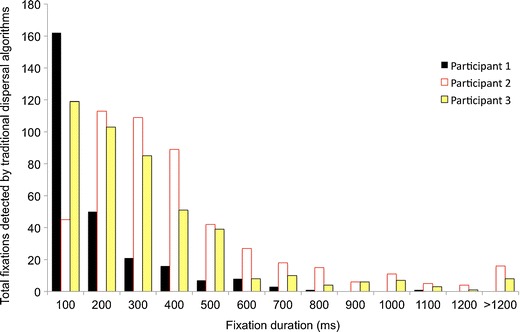
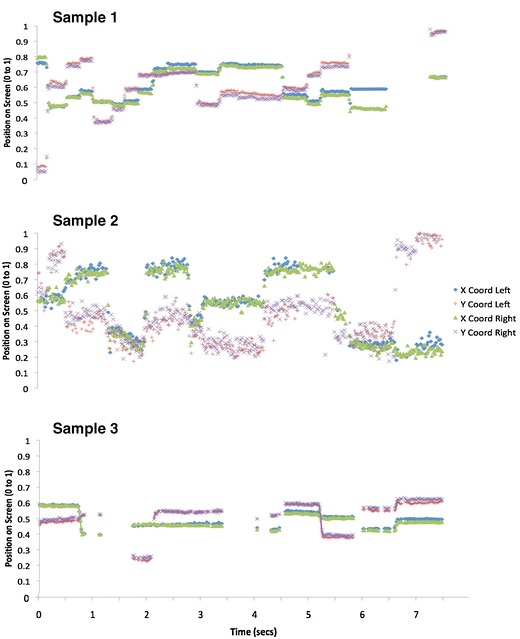
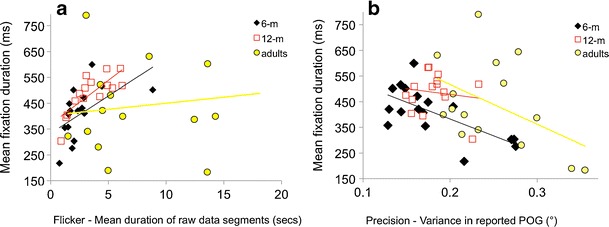
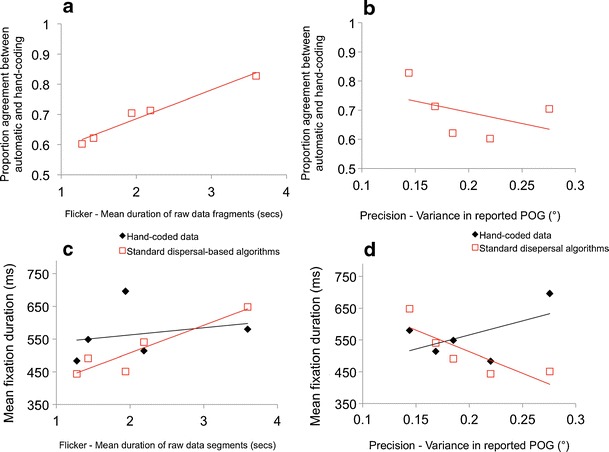
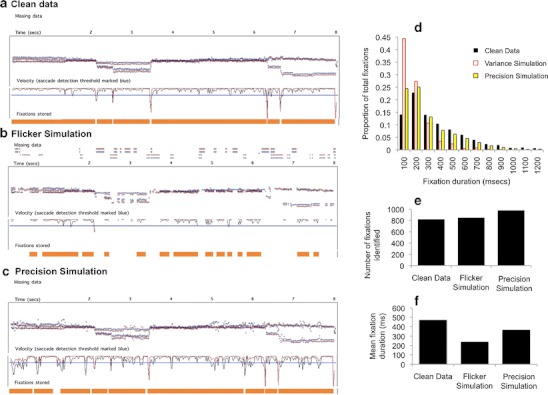
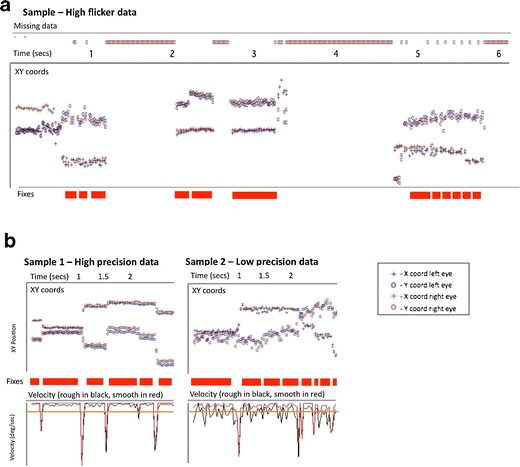
Researchers studying infants' spontaneous allocation of attention have traditionally relied on hand-coding infants' direction of gaze from videos; these techniques have low temporal and spatial resolution and are labor intensive. Eye-tracking technology potentially allows for much more precise measurement of how attention is allocated at the subsecond scale, but a number of technical and methodological issues have given rise to caution about the quality and reliability of high temporal resolution data obtained from infants. We present analyses suggesting that when standard dispersal-based fixation detection algorithms are used to parse eye-tracking data obtained from infants, the results appear to be heavily influenced by interindividual variations in data quality. We discuss the causes of these artifacts, including fragmentary fixations arising from flickery or unreliable contact with the eyetracker and variable degrees of imprecision in reported position of gaze. We also present new algorithms designed to cope with these problems by including a number of new post hoc verification checks to identify and eliminate fixations that may be artifactual. We assess the results of our algorithms by testing their reliability using a variety of methods and on several data sets. We contend that, with appropriate data analysis methods, fixation duration can be a reliable and stable measure in infants. We conclude by discussing ways in which studying fixation durations during unconstrained orienting may offer insights into the relationship between attention and learning in naturalistic settings.
Overview
The claims and statistics of this paper haven’t been checked yet.
Free: it reads the open-access text and checks the first 5 claims that cite a source we can check. Create a free account to check every claim.
Integrity signals
Registry
Cites
Statistics
Figures
Verification
Claims the paper makes
The claims and statistics of this paper haven’t been checked yet.
Free: it reads the open-access text and checks the first 5 claims that cite a source we can check. Create a free account to check every claim.
Claims other papers make about this one
Each is checked against this paper’s own text: does it say what the citing paper says it does?
The cited source says what the claim attributes to it.
In the citing paper
“Of those participants who attended the visit and from whom it was possible to record eyetracking data (HR-noASD 32, HR-ASD 15, LR 49) we found for a subset (HR-no-ASD 2) that the data obtained was too limited or of too poor quality for usable fixation durations to be returned by our parsing algorithm (see ref. 33 and SM pp 7-8 for further discussions of this issue).”
From Shorter spontaneous fixation durations in infants with later emerging autism (2015) · cites this paper as [33]
In the citing paper
“This fixation parsing procedure was designed in response to analyses33 indicating that the fixation detection algorithms traditionally supplied with eyetrackers perform poorly on the variable quality eyetracker data obtained from infants (see also Ref. 32).”
From Shorter spontaneous fixation durations in infants with later emerging autism (2015) · cites this paper as [33]
Self-check
Percentages, sums and reported differences re-computed from the paper’s own numbers.
The self-check needs the paper’s full text.
Citations
Cites
Eye movements in reading and information processing: 20 years of research
Rayner, K. (1998) · Psychological Bulletin · doi:10.1037/0033-2909.124.3.372 · Cited by 7,979 · cited 1×
“A substantial body of research with adults has pointed to the validity and reliability of fixation durations as an index of online cognitive processing (see, e.g., Nuthmann et al., 2010; Rayner, 1998).”
BackgroundComputational modelling of visual attention
Itti, L., & Koch, C. (2001) · Nature Reviews Neuroscience · doi:10.1038/35058500 · Cited by 4,733 · cited 2×
“Free viewing”
BackgroundIARBUS, A. L. (1967) · Medical Entomology and Zoology · Cited by 3,319
Yarbus, A. L. (1967) · doi:10.1007/978-1-4899-5379-7 · Cited by 3,304 · cited 1×
“Within the adult literature, research has suggested that bottom-up visual features of scenes such as edges and motion (Itti & Koch, 2001), luminance (Loftus, 1985), or blur (Mannan, Ruddock, & Wooding, 1995) can influence fixation duration, as well as top-down factors such as viewing task and personal preference (Hend…”
BackgroundEye Tracking: A comprehensive guide to methods and measures
Holmqvist, K., Nyström, M., Andersson, R., Dewhurst, R. J., Jarodzka, H. M., & van de Weijer, J. (2015) · Lund University Publications (Lund University) · Cited by 2,919
Social cognition, joint attention, and communicative competence from 9 to 15 months of age.
Carpenter, M., Nagell, K., Tomasello, M., Butterworth, G., & Moore, C. (1998) · Monographs of the Society for Research in Child Development · doi:10.2307/1166214 · Cited by 2,727
Eye Tracking Methodology: Theory and Practice
Duchowski, A. T. (2003) · Springer eBooks · doi:10.1007/978-1-4471-3750-4 · Cited by 2,242 · cited 2×
“There are three standard measures used to separate fixations from other eye movement events: dispersal, velocity, and acceleration (for more detailed reviews, see Duchowski, 2007; Nyström & Holmqvist.”
MethodFast bilateral filtering for the display of high-dynamic-range images
Durand, F., & Dorsey, J. (2002) · Proceedings of the 29th annual conference on Computer graphics and interactive techniques · doi:10.1145/566570.566574 · Cited by 1,547
Eye Tracking Methodology; Theory and Practice
(2007) · Qualitative Market Research: An International Journal · doi:10.1108/13522750710740862 · Cited by 1,313
Bayesian surprise attracts human attention
Itti, L., & Baldi, P. (2009) · Vision Research · doi:10.1016/j.visres.2008.09.007 · Cited by 1,224 · cited 3×
“…factors (such as the rate of change of lowlevel information at the point fixated) versus endogenous factors (such as the semantic content at the point fixated— e.g. face vs. nonface) (cf. Berg et al., 2009; Frank et al., 2009; Itti & Baldi, 2009; Mital, Smith, Hill, & Henderson, 2010)?”
BackgroundResult
Research works printed but not linked: 4
- Dekker, T.M., Smith, T.J., Mital, P.K. & Karmiloff-Smith, A. (under review). The debate on childhood screen exposure: An in-depth eye-tracking comparison of infant DVDs. Manuscript under review.
- Scerif, G., Cornish, K., Wilding, J., Driver, J., & Karmiloff-Smith, A. (2005). Early attention difficulties in fragile X syndrome: Underlying mechanisms and developmental trajectories. Journal of Cognitive Neuroscience, 220-221.
- Shic, F., Chawarska, K. and Scassellati, B. (2008). The incomplete fixation measure, Proceedings of the 2008 symposium on Eye tracking research & applications, Savannah, Georgia: ACM, 2008, pp. 111-114.
- Wass, S. V. (2011). Gaze-contingent concentration training for infants. PhD Thesis. Birkbeck, University of London.
Cited by
Best practices in eye tracking research
Carter, B. T., & Luke, S. G. (2020) · International Journal of Psychophysiology · doi:10.1016/j.ijpsycho.2020.05.010 · Cited by 659
“There is a multitude of open access software packages designed to process eye tracking data as well (de Urabain et al., 2015; Frame et al., 2019; Hessels et al., 2017; Houpt et al., 2018; Komogortsev and Karpov, 2013; Leppänen et al., 2015; Niehorster et al., 2020a; Pedrotti et al., 2011; Scurr et al., 2014; Sogo, 201…”
MethodVisual social attention in autism spectrum disorder: Insights from eye tracking studies
Guillon, Q., Hadjikhani, N., Baduel, S., & Rogé, B. (2014) · Neuroscience & Biobehavioral Reviews · doi:10.1016/j.neubiorev.2014.03.013 · Cited by 504
Seeing faces is necessary for face-domain formation
Arcaro, M. J., Schade, P. F., Vincent, J. L., Ponce, C. R., & Livingstone, M. S. (2017) · Nature Neuroscience · doi:10.1038/nn.4635 · Cited by 308
Noise-robust fixation detection in eye movement data: Identification by two-means clustering (I2MC)
Hessels, R. S., Niehorster, D. C., Kemner, C., & Hooge, I. T. C. (2017) · Behavior Research Methods · doi:10.3758/s13428-016-0822-1 · Cited by 202
“…has shown that increased noise amplitude may affect the number of fixations, and consequently the fixation durations (Holmqvist et al., 2012; Wass et al., 2013), we calculated the numbers of fixations, mean fixation durations, and standard deviations of the fixation durations for all noise…”
BackgroundMethodInfluentialKing, A. J., Bol, N., Cummins, R. G., & John, K. K. (2019) · Communication Methods and Measures · doi:10.1080/19312458.2018.1558194 · Cited by 196
“Strategies for managing missing data include general approaches advocated in the literature outside of eye tracking (e.g., Howard et al., 2015), as well as specific strategies/approaches for eye tracking (e.g., Hornof & Halverson, 2002; Wass et al., 2013).”
BackgroundMethodRETRACTED ARTICLE: Eye tracking: empirical foundations for a minimal reporting guideline
Holmqvist, K., Örbom, S. L., Hooge, I. T. C., Niehorster, D. C., Alexander, R. G., Andersson, R., Benjamins, J. S., Blignaut, P., Brouwer, A.-M., Chuang, L. L., et al. (2022) · Behavior Research Methods · doi:10.3758/s13428-021-01762-8 · Cited by 167
RetractedSmith, L. B., Yu, C., Yoshida, H., & Fausey, C. M. (2015) · Journal of Cognition and Development · doi:10.1080/15248372.2014.933430 · Cited by 159
“Further, although psychological significance of fixations has been studied in adults (e.g., Nuthmann, Smith, Engbert, & Henderson, 2010), little is known about the meaning of the non-adult-like frequencies and durations of infant and toddler fixations (see Wass et al., 2013).”
BackgroundWass, S. V., Forssman, L., & Leppänen, J. (2014) · Infancy · doi:10.1111/infa.12055 · Cited by 146
“Our findings here can be compared with our previous findings on how data quality relates to fixation durations as parsed using the standard dispersal-based parsing algorithms supplied with most eye-trackers (Wass et al., 2013).”
InfluentialSelf-citationShorter spontaneous fixation durations in infants with later emerging autism
Wass, S. V., Jones, E. J. H., Gliga, T., Smith, T. J., Charman, T., Johnson, M. H., BASIS team, Baron-Cohen, S., Bedford, R., Bolton, P., et al. (2015) · Scientific Reports · doi:10.1038/srep08284 · Cited by 134
Self-citationEye tracking in developmental cognitive neuroscience – The good, the bad and the ugly
Hessels, R. S., & Hooge, I. T. C. (2019) · Developmental Cognitive Neuroscience · doi:10.1016/j.dcn.2019.100710 · Cited by 171
Hessels, R. S., Andersson, R., Hooge, I. T. C., Nyström, M., & Kemner, C. (2015) · Infancy · doi:10.1111/infa.12093 · Cited by 131
“The number of fixations may then apparently increase (Wass, Smith, & Johnson, 2013).”
Papageorgiou, K. A., Smith, T. J., Wu, R., Johnson, M. H., Kirkham, N. Z., & Ronald, A. (2014) · Psychological Science · doi:10.1177/0956797614531295 · Cited by 114
“This was because infant eye-tracking data are generally of poorer quality (less precise and with more lost samples) compared with adult data (Wass et al., 2013).”
BackgroundMethodResultInfluentialSelf-citationMoore, A., Wozniak, M., Yousef, A., Barnes, C. C., Cha, D., Courchesne, E., & Pierce, K. (2018) · Molecular Autism · doi:10.1186/s13229-018-0202-z · Cited by 131
“This use of large, simple AOIs facilitated correct measurement of the infant/toddler population, who can yield data with accuracy below levels reported for adults under optimal conditions [50].”
BackgroundDevelopment of the macaque face-patch system
Livingstone, M. S., Vincent, J. L., Arcaro, M. J., Srihasam, K., Schade, P. F., & Savage, T. (2017) · Nature Communications · doi:10.1038/ncomms14897 · Cited by 110
Individual differences in face-looking behavior generalize from the lab to the world
Peterson, M., Lin, J., Zaun, I., & Kanwisher, N. (2016) · Journal of Vision · doi:10.1167/16.7.12 · Cited by 118
Dalrymple, K. A., Manner, M. D., Harmelink, K. A., Teska, E. P., & Elison, J. T. (2018) · Frontiers in Psychology · doi:10.3389/fpsyg.2018.00803 · Cited by 112
“Others have addressed issues of robustness (Wass et al., 2013) and temporal precision (Morgante et al., 2012).”
BackgroundMethodInfluentialEffects of Vocabulary Size on Online Lexical Processing by Preschoolers
Law, F. F., & Edwards, J. (2014) · Language Learning and Development · doi:10.1080/15475441.2014.961066 · Cited by 100
Wass, S. V., & Smith, T. J. (2014) · Infancy · doi:10.1111/infa.12049 · Cited by 83
Self-citationGazepath: An eye-tracking analysis tool that accounts for individual differences and data quality
van Renswoude, D. R., Raijmakers, M. E. J., Koornneef, A. W., Johnson, S. P., Hunnius, S., & Visser, I. (2017) · Behavior Research Methods · doi:10.3758/s13428-017-0909-3 · Cited by 90
“Data quality is characterized by precision and robustness (Wass, Smith, & Johnson, 2013).”
BackgroundMethodInfluentialEarly Development of Visual Attention: Change, Stability, and Longitudinal Associations
Hendry, A. J., Johnson, M. H., & Holmboe, K. (2019) · Annual Review of Developmental Psychology · doi:10.1146/annurev-devpsych-121318-085114 · Cited by 107
“Wass et al. (2013) demonstrated that with appropriate data analysis methods that take into account artifacts caused by, for example, infant movement and precision accuracy of the eye-tracker, fixation duration can be a reliable measure in infants.”
BackgroundSelf-citationIntact perception but abnormal orientation towards face-like objects in young children with ASD
Guillon, Q., Rogé, B., Afzali, M. H., Baduel, S., Kruck, J., & Hadjikhani, N. K. (2016) · Scientific Reports · doi:10.1038/srep22119 · Cited by 87
König, S. D., & Buffalo, E. A. (2014) · Journal of Neuroscience Methods · doi:10.1016/j.jneumeth.2014.01.032 · Cited by 82
“Variants and combinations of these algorithms include mechanisms to correct for errors in eye tracking such as blinks and other temporary losses of signal (Wass et al., 2013).”
BackgroundPredicting cybersickness based on user’s gaze behaviors in HMD-based virtual reality
Chang, E., Kim, H. T., & Yoo, B. (2021) · Journal of Computational Design and Engineering · doi:10.1093/jcde/qwab010 · Cited by 90
Widely applicable MATLAB routines for automated analysis of saccadic reaction times
Leppänen, J. M., Forssman, L., Kaatiala, J., Yrttiaho, S., & Wass, S. V. (2014) · Behavior Research Methods · doi:10.3758/s13428-014-0473-z · Cited by 87
“…the first two in requiring an active process of attention disengagement from the stimulus at fixation prior to the movement of the point of gaze to the new stimulus and, therefore, saccadic reaction times in this condition are typically longer data collected from infants (Wass et al., 2013, 2014).”
BackgroundMethodSelf-citationVisualization and Analysis of Eye Movement Data from Children with Typical and Atypical Development
Falck‐Ytter, T., von Hofsten, C., Gillberg, C., & Fernell, E. (2013) · Journal of Autism and Developmental Disorders · doi:10.1007/s10803-013-1776-0 · Cited by 74
An Open Conversation on Using Eye-Gaze Methods in Studies of Neurodevelopmental Disorders
Venker, C. E., & Kover, S. T. (2015) · Journal of Speech Language and Hearing Research · doi:10.1044/2015_jslhr-l-14-0304 · Cited by 65
“It is particularly beneficial to the research community when researchers share new procedures they have developed to address limitations of default processing algorithms (Wass et al., 2013).”
BackgroundNayar, K., Shic, F., Winston, M., & Losh, M. C. (2022) · Molecular Autism · doi:10.1186/s13229-022-00490-w · Cited by 63
“No signi cant group differences emerged for social and non-social regressive xations (F(2,53) = .”
BackgroundMethodResultInfluentialSun, H. Q., Loh, J., & Roberts, A. C. (2019) · AERA Open · doi:10.1177/2332858419848431 · Cited by 75
Falck‐Ytter, T., Thorup, E., & Bölte, S. (2014) · Journal of Autism and Developmental Disorders · doi:10.1007/s10803-014-2278-4 · Cited by 62
“Fixation duration measures can be influenced by data quality, which may vary among child groups (Wass et al. 2013).”
BackgroundEye tracking mouse for human computer interaction
Lupu, R. G., Ungureanu, F., & Siriteanu, V. (2013) · E-Health and Bioengineering Conference (EHB) · doi:10.1109/ehb.2013.6707244 · Cited by 51
Automatic Detection of Attention Shifts in Infancy: Eye Tracking in the Fixation Shift Paradigm
Kulke, L., Atkinson, J., & Braddick, O. (2015) · PLoS ONE · doi:10.1371/journal.pone.0142505 · Cited by 63
“Modern eye-trackers can measure infants’ eye-movements with relatively good spatial and temporal accuracy [23,25].”
BackgroundActive vision in immersive, 360° real-world environments
Haskins, A. J., Mentch, J., Botch, T. L., & Robertson, C. E. (2020) · Scientific Reports · doi:10.1038/s41598-020-71125-4 · Cited by 55
Duan, H., Shen, W., Min, X., Tu, D., Li, J., & Zhai, G. (2022) · ACM International Conference on Multimedia (ACM MM) · doi:10.1145/3503161.3547955 · Cited by 55
“Fixations with durations shorter than 100 ms are excluded [44, 53].”
BackgroundGraFIX: A semiautomatic approach for parsing low- and high-quality eye-tracking data
Saez de Urabain, I. R., Johnson, M. H., & Smith, T. J. (2015) · Behavior Research Methods · doi:10.3758/s13428-014-0456-0 · Cited by 43
“The parameters that we used for the Wass et al. (2013) algorithms and the I-VT filter were, if applicable, the same as for GraFIX algorithms in low-quality data.”
BackgroundMethodInfluentialSelf-citationSteffan, A., Zimmer, L., Arias‐Trejo, N., Bohn, M., Ben, R. D., Flores-Coronado, M. A., Franchin, L., Garbisch, I., Wiesmann, C. G., Hamlin, J. K., et al. (2023) · Infancy · doi:10.1111/infa.12564 · Cited by 61
Holden, J. G., Cosnard, A., Laurens, B., Asselineau, J., Biotti, D., Cubizolle, S., Dupouy, S., Formaglio, M., Koric, L., Seassau, M., et al. (2018) · Journal of Alzheimer s Disease · doi:10.3233/jad-180082 · Cited by 48
“of ocular-motor events [15, 18-22] particularly in special populations such as infants and the elderly [21], the second step was designed to be maximally sensitive to group differences: automatically coded saccades were manually verified and adjusted when appropriate to increase”
Venker, C. E., Pomper, R., Mahr, T., Edwards, J., Saffran, J. R., & Weismer, S. E. (2019) · Autism Research · doi:10.1002/aur.2225 · Cited by 51
Young EFL learners' processing of multimodal input: Examining learners’ eye movements
Tragant, E., & Pellicer‐Sánchez, A. (2018) · System · doi:10.1016/j.system.2018.12.002 · Cited by 59
Cross-situational and ostensive word learning in children with and without autism spectrum disorder
Venker, C. E. (2018) · Cognition · doi:10.1016/j.cognition.2018.10.025 · Cited by 45
“Following prior work (e.g., Mahr, McMillan, Saffran, Ellis Weismer, & Edwards, 2015; Wass, Smith, & Johnson, 2013), segments of missing data up to 150 ms were interpolated if the child was looking at the same AOI before and after the missing data occurred.”
Stuart, S., Galna, B., Lord, S., Rochester, L., & Godfrey, A. (2014) · Annual International Conference of the IEEE Engineering in Medicine and Biology Society (EMBC) · doi:10.1109/embc.2014.6944931 · Cited by 37
How to choose the size of facial areas of interest in interactive eye tracking
Vehlen, A., Standard, W., & Domes, G. (2022) · PLoS ONE · doi:10.1371/journal.pone.0263594 · Cited by 41
“such cases, fixation classification is already affected by the reduced precision [24] and thus indirectly influences the gaze classification performance.”
Backgroundde Urabain, I. R. S., Nuthmann, A., Johnson, M. H., & Smith, T. J. (2017) · Vision Research · doi:10.1016/j.visres.2016.10.015 · Cited by 40
Self-citationSex Differences in Social Attention in Infants at Risk for Autism
Kleberg, J. L., Nyström, P., Bölte, S., & Falck‐Ytter, T. (2018) · Journal of Autism and Developmental Disorders · doi:10.1007/s10803-018-3799-z · Cited by 47
Hierarchical Eye-Tracking Data Analytics for Human Fatigue Detection at a Traffic Control Center
Li, F., Chen, C., Xu, G., & Khoo, L. (2020) · IEEE Transactions on Human-Machine Systems · doi:10.1109/thms.2020.3016088 · Cited by 39
“mark a set of consecutive points within a particular dispersion as a fixation [31].”
BackgroundMethodInfluentialTraces across the body: the influence of music-dance synchrony on the observation of dance
Woolhouse, M. H., & Lai, R. (2014) · Frontiers in Human Neuroscience · doi:10.3389/fnhum.2014.00965 · Cited by 46
“…effects of the eye-tracking system and possible artifacts of its data-parsing algorithm, fixations below 100 ms were omitted from the analysis; for discussion on the relative merits of omitting fixation durations below a certain threshold and data-processing algorithms, see Wass et al. (2013).”
MethodAhtola, E., Stjerna, S., Yrttiaho, S., Nelson, C. A., Leppänen, J. M., & Vanhatalo, S. (2014) · PLoS ONE · doi:10.1371/journal.pone.0097299 · Cited by 36
“However, the practice of such analyses is still complicated by several limitations that surround current eye tracking technologies and affect data quality [16]–[20], and may require several verification routines to be implemented successfully in poorly cooperating participants [21].”
BackgroundFaster eye movements in children with autism spectrum disorder
Kovarski, K., Siwiaszczyk, M., Malvy, J., Batty, M., & Latinus, M. (2018) · Autism Research · doi:10.1002/aur.2054 · Cited by 36
Real‐world scene perception in infants: What factors guide attention allocation?
van Renswoude, D. R., Visser, I., Raijmakers, M. E. J., Tsang, T., & Johnson, S. P. (2019) · Infancy · doi:10.1111/infa.12308 · Cited by 39
“Infants' raw gaze signals are known to be noisy (Wass, Smith, & Johnson, 2013) and correlated with outcome measures such as age (Wass, Forssman, & Leppänen, 2014).”
Nayar, K., Kang, X., Xing, J., Gordon, P. C., Wong, P. C. M., & Losh, M. C. (2021) · Scientific Reports · doi:10.1038/s41598-021-91911-y · Cited by 34
Kwong, J. W., Cai, L. Z., Azad, A. D., Lorenz, H. P., Khosla, R. K., Lee, G., & Nazerali, R. S. (2019) · Annals of Plastic Surgery · doi:10.1097/sap.0000000000001911 · Cited by 31
Beyond screen time: Using head-mounted eye tracking to study natural behavior
Franchak, J. M., & Yu, C. (2022) · Advances in child development and behavior · doi:10.1016/bs.acdb.2021.11.001 · Cited by 39
Gaze patterns during scene processing in typical adults and adults with autism spectrum disorders
Rigby, S. N., Stoesz, B. M., & Jakobson, L. S. (2016) · Research in Autism · doi:10.1016/j.rasd.2016.01.012 · Cited by 34
Autistic differences in the temporal dynamics of social attention
Hedger, N., & Chakrabarti, B. (2021) · Autism · doi:10.1177/1362361321998573 · Cited by 36
Developmental changes in natural scene viewing in infancy.
Pomaranski, K. I., Hayes, T. R., Kwon, M., Henderson, J. M., & Oakes, L. M. (2021) · Developmental Psychology · doi:10.1037/dev0001020 · Cited by 31
Lee, M., Nayar, K., Maltman, N., Hamburger, D., Martin, G. E., Gordon, P. C., & Losh, M. C. (2019) · Journal of Autism and Developmental Disorders · doi:10.1007/s10803-019-03969-3 · Cited by 31
Zettersten, M., Yurovsky, D., Xu, T. L., Uner, S., Tsui, A. S. M., Schneider, R. M., Saleh, A. N., Meylan, S. C., Marchman, V. A., Mankewitz, J., et al. (2022) · Behavior Research Methods · doi:10.3758/s13428-022-01906-4 · Cited by 34
Visual attention control differences in 12-month-old preterm infants
Downes, M., Kelly, D. J., Day, K. L., Marlow, N., & de Haan, M. D. H. (2018) · Infant Behavior and Development · doi:10.1016/j.infbeh.2018.01.002 · Cited by 35
“Eye-tracking methodology complements behavioural fi ndings as it is less prone to human error and has higher spatial and temporal resolution than traditional behavioural looking methods (Wass, Smith, & Johnson, 2012).”
Measuring the Spatial Noise of a Low-Cost Eye Tracker to Enhance Fixation Detection
Ooms, K., & Krassanakis, V. (2018) · Journal of Imaging · doi:10.3390/jimaging4080096 · Cited by 34
“Typical literature refers the values of 100–200 ms [3,65], 100–150 ms [68], 150 ms [69], while in other studies report also the value of 80 ms as the minimum value [70].”
BackgroundImplementing mobile eye tracking in psychological research: A practical guide
Fu, X., Franchak, J. M., MacNeill, L. A., Gunther, K. E., Borjon, J. I., Yurkovic‐Harding, J., Harding, S., Bradshaw, J. L., & Pérez‐Edgar, K. E. (2024) · Behavior Research Methods · doi:10.3758/s13428-024-02473-6 · Cited by 38
“Less precise gaze data bias the parcellation of fixations and saccades, as they may erroneously suggest shifts in gaze locations when in fact the gaze remains stable (Wass et al., 2013, 2014).”
BackgroundMikalef, P., Sharma, K., Chatterjee, S., Chaudhuri, R., Parida, V., & Gupta, S. (2023) · Decision Support Systems · doi:10.1016/j.dss.2023.114039 · Cited by 34
The Importance of Networking in Autism Gaze Analysis
Guillon, Q., Afzali, M. H., Rogé, B., Baduel, S., Kruck, J., & Hadjikhani, N. K. (2015) · PLoS ONE · doi:10.1371/journal.pone.0141191 · Cited by 29
“[34] using a saccade velocity threshold of 35°/s and a minimum fixation duration threshold of 100 milliseconds.”
MethodThe Role of Co‐Occurrence Statistics in Developing Semantic Knowledge
Unger, L., Vales, C., & Fisher, A. V. (2020) · Cognitive Science · doi:10.1111/cogs.12894 · Cited by 30
Schlegelmilch, K., & Wertz, A. E. (2019) · Infancy · doi:10.1111/infa.12294 · Cited by 27
“Investigations of accuracy and precision with infants were thus far conducted with Tobii eye-tracking technology (Hessels et al., 2015a; Morgante et al., 2012; Wass et al., 2013; Wass et al., 2014).”
MethodThe development of gaze following in monolingual and bilingual infants: A multi‐laboratory study
Byers‐Heinlein, K., Tsui, R. K. Y., van Renswoude, D. R., Black, A. K., Barr, R., Brown, A., Colomer, M., Durrant, S., Gampe, A., Gonzalez‐Gomez, N., et al. (2020) · Infancy · doi:10.1111/infa.12360 · Cited by 26
de Kloe, Y., Hooge, I. T. C., Kemner, C., Niehorster, D. C., Nyström, M., & Hessels, R. S. (2021) · Infancy · doi:10.1111/infa.12441 · Cited by 23
Yow, W. Q., & Sridhar, P. K. (2019) · AERA Open · doi:10.1177/2332858419878126 · Cited by 31
Ruiz, G. T., Rey-Martínez, J. A., Caletrío, Á. B., Matiñó-Soler, E., & Pérez‐Fernández, N. (2018) · Ear and Hearing · doi:10.1097/aud.0000000000000576 · Cited by 21
Demystifying infant vocal imitation: The roles of mouth looking and speaker’s gaze
Imafuku, M., Kanakogi, Y., Butler, D. L., & Myowa, M. (2019) · Developmental Science · doi:10.1111/desc.12825 · Cited by 27
The temporal dynamics of infants' joint attention: Effects of others' gaze cues and manual actions
Boyer, T. W., Harding, S., & Bertenthal, B. I. (2019) · Cognition · doi:10.1016/j.cognition.2019.104151 · Cited by 29
Deep Learning-Based Real-Time Driver Cognitive Distraction Detection
Fresta, M., Bellotti, F., Bochenko, I., Lazzaroni, L., Merlhiot, G., Tango, F., & Berta, R. (2025) · IEEE Access · doi:10.1109/access.2025.3539392 · Cited by 27
Relevance of Artifact Removal and Number of Stimuli for Video Head Impulse Test Examination
Ruiz, G. T., Rey-Martínez, J. A., Matiñó-Soler, E., Caletrío, Á. B., Martín-Sanz, E., & Pérez‐Fernández, N. (2020) · Ear and Hearing · doi:10.1097/aud.0000000000000849 · Cited by 18
“The multivariable differences between saccades and other eye movements have been validated in multistage adaptive protocols to detect their onset and termination accurately (Wass et al. 2013; König & Buffalo 2014; Berg et al. 2009; Ito et al. 2011).”
BackgroundBoth dog and human faces are explored abnormally by young children with autism spectrum disorders
Guillon, Q., Hadjikhani, N. K., Baduel, S., Kruck, J., Arnaud, M., & Rogé, B. (2014) · Neuroreport · doi:10.1097/wnr.0000000000000257 · Cited by 18
Development of scene knowledge: Evidence from explicit and implicit scene knowledge measures
Öhlschläger, S., & Võ, M. L. ‐. (2020) · Journal of Experimental Child Psychology · doi:10.1016/j.jecp.2019.104782 · Cited by 27
Topology for gaze analyses - Raw data segmentation
Hein, O., & Zangemeister, W. H. (2017) · Journal of Eye Movement Research · doi:10.16910/jemr.10.1.1 · Cited by 21
Altered sense of gaze leading in autism
Grynszpan, O., Bouteiller, J., Grynszpan, S., Barillier, F. L., Martin, J., & Nadel, J. (2019) · Research in Autism · doi:10.1016/j.rasd.2019.101441 · Cited by 17
Dog eye movements are slower than human eye movements
Park, S. Y., Bacelar, C. E., & Holmqvist, K. (2020) · Journal of Eye Movement Research · doi:10.16910/jemr.12.8.4 · Cited by 18
On relationships between fixation identification algorithms and fractal box counting methods
Wang, Q., Kim, E., Chawarska, K., Scassellati, B. M., Zucker, S. W., & Shic, F. (2014) · ACM Symposium on Eye Tracking Research and Applications (ETRA) · doi:10.1145/2578153.2578161 · Cited by 15
Eye movements, attention, and expert knowledge in the observation of Bharatanatyam dance
Ponmanadiyil, R., & Woolhouse, M. H. (2018) · Journal of Eye Movement Research · doi:10.16910/jemr.11.2.11 · Cited by 18
“This result strongly aligns with the findings of Woolhouse and Lai (2014), who, perhaps counter-intuitively, found that the feet of the dancer in their experiment attracted the least fixations.”
ResultBacon, D., Weaver, H., & Saffran, J. R. (2021) · Frontiers in Psychology · doi:10.3389/fpsyg.2021.703839 · Cited by 19
“Frontiers in Psychology | www.frontiersin.org 9 September 2021 | Volume 12 | Article 703839 different from accuracy in the in-lab data collected in Yurovsky and Frank (2017) [b = −0.151; t(1, 165.880) = −3.417; p < 0.003], Yurovsky et al.”
BackgroundInfluentialBallieux, H., Tomalski, P., Kushnerneko, E., Johnson, M. H., Karmiloff‐Smith, A., & Moore, D. G. (2015) · Infant and Child Development · doi:10.1002/icd.1914 · Cited by 15
Self-citationPhysiological regulation and social-emotional processing in female carriers of the FMR1 premutation
Winston, M., Nayar, K., Hogan, A. L., Barstein, J., Valle, C. L., Sharp, K., Berry‐Kravis, E., & Losh, M. C. (2019) · Physiology & Behavior · doi:10.1016/j.physbeh.2019.112746 · Cited by 14
“Noise reduction occurred using a moving average window of three samples [77].”
MethodA Novel Method to Investigate How Dimensions Interact to Inform Perceptual Salience in Infancy
Rogers, M., Franklin, A., & Knoblauch, K. (2018) · Infancy · doi:10.1111/infa.12260 · Cited by 16
“When the colour or luminance of an object varies, infants are not able to individuate the object until 11.5 months (Wilcox, 1999), but with covariation, infants aged 7.5 months are able to complete this task (Woods & Wilcox, 2010).”
BackgroundInfluentialImafuku, M., Kawai, M., Niwa, F., Shinya, Y., & Myowa, M. (2021) · Infancy · doi:10.1111/infa.12402 · Cited by 16
Average fixation duration in infancy: Stability and predictive utility
White, H., Heck, A., Jubran, R., Chroust, A. J., & Bhatt, R. S. (2022) · Infancy · doi:10.1111/infa.12483 · Cited by 14
Zeng, G., Simpson, E. A., & Paukner, A. (2023) · Behavior Research Methods · doi:10.3758/s13428-022-02056-3 · Cited by 13
“…and follow instructions, and more likely to move during testing, which generates unstable data and reduces data quality (e.g., poorer accuracy and precision, more error and data loss; for a review: Hessels & Hooge, 2019; Wass et al., 2013 in human infants; Hopper et al., 2021 in primates).”
InfluentialMatMouse: A Mouse Movements Tracking and Analysis Toolbox for Visual Search Experiments
Krassanakis, V., & Kesidis, A. L. (2020) · Multimodal Technologies and Interaction · doi:10.3390/mti4040083 · Cited by 12
“Additionally, in comparison to mouse movements, fixation events have a minimum duration (the value of 80 msec is reported as the minimum duration threshold according to the literature [36]).”
BackgroundPérez, D. L., Radkowska, A., Rączaszek‐Leonardi, J., Tomalski, P., & The TALBY Study Team (2018) · Journal of Vision · doi:10.1167/18.13.5 · Cited by 14
Lewis, D. E., Smith, N. A., Spalding, J. L., & Valente, D. L. (2017) · Ear and Hearing · doi:10.1097/aud.0000000000000534 · Cited by 12
Evidence of ordinal position encoding of sequences extracted from continuous speech
Fló, A. (2021) · Cognition · doi:10.1016/j.cognition.2021.104646 · Cited by 13
Learned Labels Shape Pre‐speech Infants’ Object Representations
Twomey, K. E., & Westermann, G. (2017) · Infancy · doi:10.1111/infa.12201 · Cited by 14
A cross-cultural study of visual attention in autism spectrum disorder
Nayar, K., Kang, X., Winston, M., Wong, P. C. M., & Losh, M. C. (2022) · Child Neuropsychology · doi:10.1080/09297049.2022.2094904 · Cited by 10
“Consistent with prior research (Wass et al., 2013), we set parameters before exporting gaze data to account for potential data loss, consistent with the built-in I-VT fixation filter in Tobii Studio, and, briefly, included, 1) fixations based on the strict average across both eyes; 2) a velocity threshold of 35 degree…”
MethodJuvrud, J., Haas, S., Lindskog, M., Astor, K., Namgyel, S. C., Wangmo, T., Wangchuk, Dorjee, S., Tshering, K. P., & Gredebäck, G. (2021) · Developmental Science · doi:10.1111/desc.13203 · Cited by 15
“When the infant fixated anywhere within the target in each visual search (100 ms) (Wass et al., 2013), a short gaze-contingent reward animation and chime played (2000 ms).”
What Gaze Tells Us About Personality
Challal, T. A., & Grynszpan, O. (2018) · International Conference on Human-Agent Interaction (HAI) · doi:10.1145/3284432.3284455 · Cited by 14
Stone, A., & Bosworth, R. G. (2019) · Journal of Visualized Experiments · doi:10.3791/59581 · Cited by 14
Eschman, B., Todd, J. T., Sarafraz, A., Edgar, E. V., Petrulla, V., McNew, M. E., Gomez, W., & Bahrick, L. E. (2022) · Frontiers in Psychology · doi:10.3389/fpsyg.2021.731618 · Cited by 11
Singh, J., & Sarkar, P. K. (2023) · International Journal on Interactive Design and Manufacturing (IJIDeM) · doi:10.1007/s12008-023-01656-3 · Cited by 15
“Noise reduction techniques were applied to filter out unreliable data points [100].”
How to improve data quality in dog eye tracking
Park, S. Y., Holmqvist, K., Niehorster, D. C., Huber, L., & Virányi, Z. (2022) · Behavior Research Methods · doi:10.3758/s13428-022-01788-6 · Cited by 10
Zivan, M., Morag, I., Yarmolovsky, J., & Geva, R. (2021) · Frontiers in Psychiatry · doi:10.3389/fpsyt.2021.646838 · Cited by 10
Chen, S., Wu, X., & Li, Y. (2021) · International Journal of Human-Computer Interaction · doi:10.1080/10447318.2021.1994212 · Cited by 9
“Fixation duration (Wass et al., 2013), saccade, blink rate, and pupil dilation variability (Annerer-Walcher et al., 2020) are the most commonly used eye tracking metrics.”
BackgroundMethodVisual short-term memory guides infants’ visual attention
Mitsven, S. G., Cantrell, L. M., Luck, S. J., & Oakes, L. M. (2018) · Cognition · doi:10.1016/j.cognition.2018.04.016 · Cited by 9
Metadata
- Authors
- Wass, S. V., Smith, T. J., & Johnson, M. H.
- Affiliations
- University of London (GB)
- Corresponding author
- Wass, S. V.
- Venue
- Behavior Research Methods
- Published
- 2012-09-06
- Volume
- 45
- Issue
- 1
- Pages
- 229-250
- ISSN
- 1554-351X (ISSN-L)
- 1554-3528
- PMC
- PMC3578727
- OpenAlex
- W2072416967
- Cited by
- 154
- References
- 91
- Citations by year
- 2026: 11 · 2025: 10 · 2024: 5 · 2023: 9 · 2022: 16 · 2021: 13 · 2020: 14 · 2019: 18 · 2018: 19 · 2017: 10 · 2016: 4 · 2015: 7 · 2014: 15 · 2013: 2
- FWCI
- 14.10
- Type
- journal article
- Language
- en
- Open access
- hybrid
- doi.org
- Licence
- cc-by
- Locations
- Behavior Research Methods (publishedVersion, cc-by)
- Europe PMC (PubMed Central) (publishedVersion)
- PubMed Central (publishedVersion, cc-by)
- PubMed (publishedVersion)
- BIROn (Birkbeck, University of London) (acceptedVersion)
- University of the Arts London Research Online (University of the Arts London) (acceptedVersion)
- Topics
- Physical Sciences › Computer Science › Human-Computer Interaction › Gaze Tracking and Assistive Technology
- Physical Sciences › Computer Science › Computer Vision and Pattern Recognition › Visual Attention and Saliency Detection
- Life Sciences › Neuroscience › Cognitive Neuroscience › Visual perception and processing mechanisms
- Keywords
- fixation duration, data quality, artifact removal, gaze direction, attention allocation, interindividual variability, reliability statistics
- MeSH terms
- Adult, Algorithms, Analysis of Variance, Attention, Differential Threshold, False Positive Reactions, Fixation, Ocular, Humans, Infant, Models, Biological, Saccades, Software Design, Time Factors, Reproducibility of Results, Artifacts, Eye Movement Measurements
About these checks
Registry, retraction, Cites and statistics results are computed, not judged, with one exception: a printed reference that no index lists is read once by a model before it counts as a citation error. Claims are extracted by a model and kept only when their quote appears verbatim in the text; each cited source is then checked, with a model’s help, for whether it says what the claim relies on. Those verdicts can be wrong — read the claim’s quote and the cited source before relying on one.
Statistics and arithmetic are recomputed, not judged.
Confidence bands are shown only for fields calibrated on our annotated test set. None is calibrated yet, so no band is shown.
What counts as a claim ›How we measure confidence ›How we check this ›
Are you an author, or do you see a problem with this page? Request a review
Data sources
Bibliographic data: Semantic Scholar, OpenAlex, Crossref.
Contains information from the Semantic Scholar Academic Graph Datasets, made available under the ODC Attribution License (ODC-BY 1.0).
Semantic Scholar’s data is described in: Kinney, R., et al. (2023). The Semantic Scholar Open Data Platform. arXiv:2301.10140.
