

Statistical and methodological problems with concreteness and other semantic variables: A list memory experiment case study
Open accessThe DOI matches its Crossref record; 42 of the 42 references it cites were found in a registry or an index.
Abstract
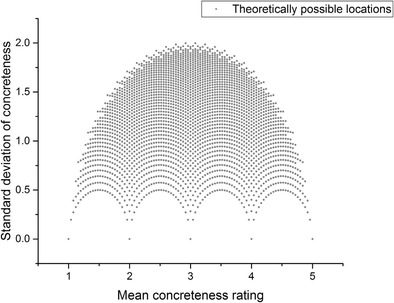
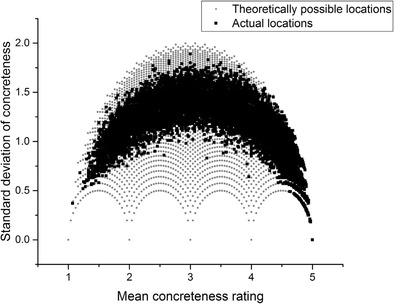
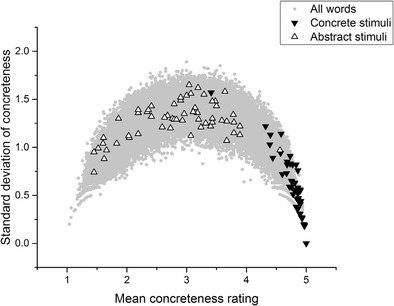
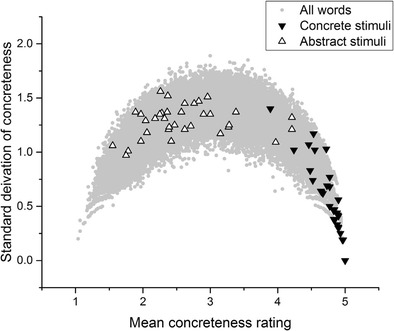
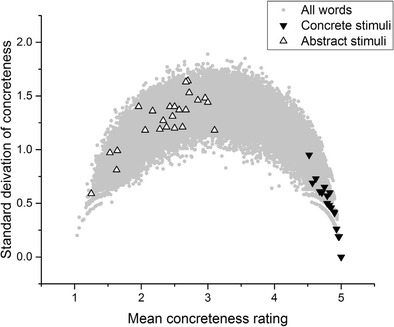
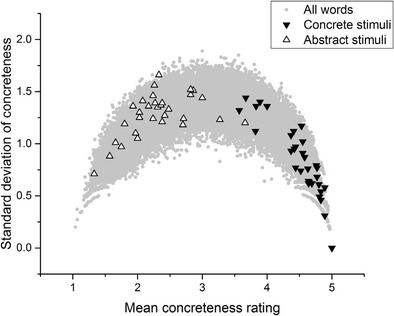
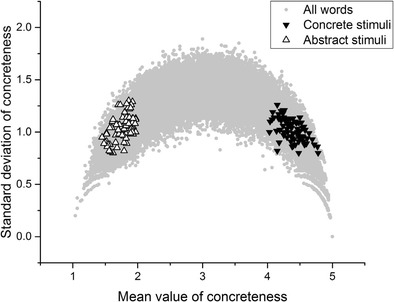
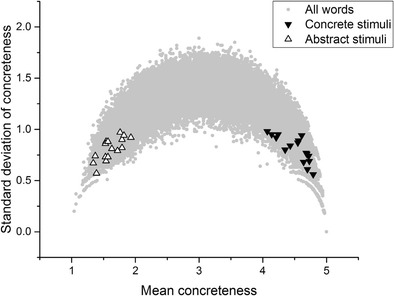
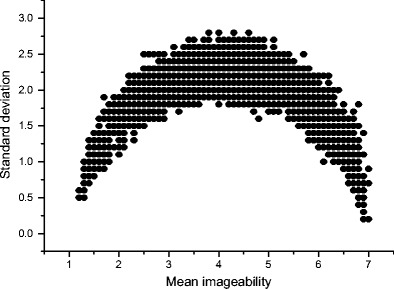
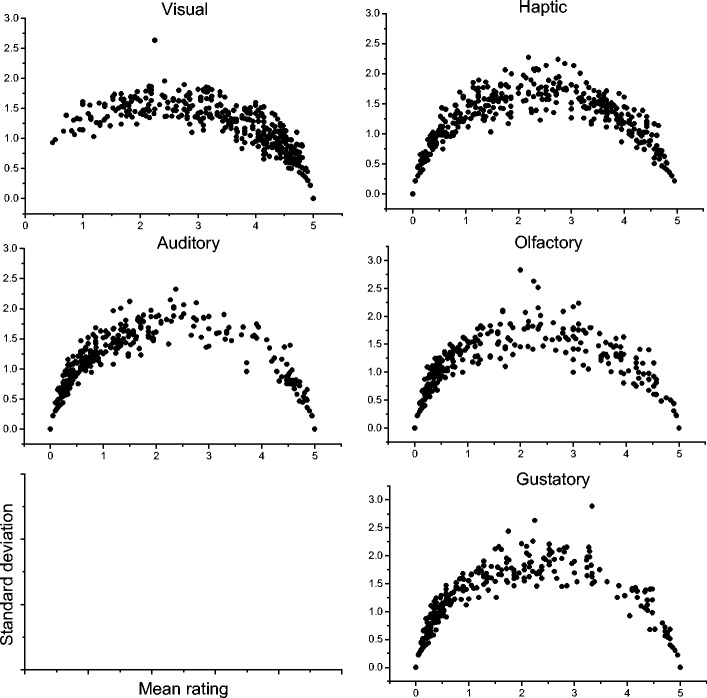
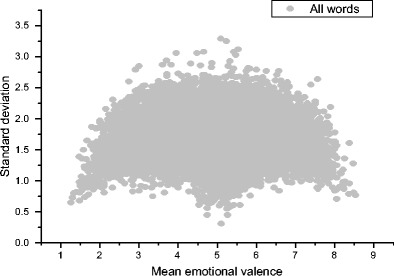
The purpose of this article is to highlight problems with a range of semantic psycholinguistic variables (concreteness, imageability, individual modality norms, and emotional valence) and to provide a way of avoiding these problems. Focusing on concreteness, I show that for a large class of words in the Brysbaert, Warriner, and Kuperman (Behavior Research Methods 46: 904-911, 2013) concreteness norms, the mean concreteness values do not reflect the judgments that actual participants made. This problem applies to nearly every word in the middle of the concreteness scale. Using list memory experiments as a case study, I show that many of the "abstract" stimuli in concreteness experiments are not unequivocally abstract. Instead, they are simply those words about which participants tend to disagree. I report three replications of list memory experiments in which the contrast between concrete and abstract stimuli was maximized, so that the mean concreteness values were accurate reflections of participants' judgments. The first two experiments did not produce a concreteness effect. After I introduced an additional control, the third experiment did produce a concreteness effect. The article closes with a discussion of the implications of these results, as well as a consideration of variables other than concreteness. The sensorimotor experience variables (imageability and individual modality norms) show the same distribution as concreteness. The distribution of emotional valence scores is healthier, but variability in ratings takes on a special significance for this measure because of how the scale is constructed. I recommend that researchers using these variables keep the standard deviations of the ratings of their stimuli as low as possible.
Overview
The claims and statistics of this paper haven’t been checked yet.
Free: it reads the open-access text and checks the first 5 claims that cite a source we can check. Create a free account to check every claim.
Integrity signals
Registry
Cites
Statistics
Figures
Verification
Claims the paper makes
The claims and statistics of this paper haven’t been checked yet.
Free: it reads the open-access text and checks the first 5 claims that cite a source we can check. Create a free account to check every claim.
Claims other papers make about this one
Each is checked against this paper’s own text: does it say what the citing paper says it does?
The cited source says what the claim attributes to it.
In the citing paper
“We note that when distributional CLMMs are used to disentangle meaningful and artefactual contributions to items’ SDs, the striking mean–SD relationships identified as problematic by Pollock (2018) are no longer observed.”
From Rating norms should be calculated from cumulative link mixed effects models (2022) · cites this paper as Pollock (2018)
The cited source says what the claim attributes to it.
In the citing paper
“Notably, Pollock (2018) highlighted a common relationship in ratings of word concreteness (Fig. 2), whereby the lowest SDs are observed at the extremes of a Likert scale, while items towards the centre of the scale show much higher SDs.”
From Rating norms should be calculated from cumulative link mixed effects models (2022) · cites this paper as Pollock (2018)
The cited source says what the claim attributes to it.
In the citing paper
“However, Pollock showed that although it was common for participants to agree on ratings at the extremes of the scale (1 and 5), such inter-rater reliability was exceedingly rare for ratings at midpoints in the scale.”
From Rating norms should be calculated from cumulative link mixed effects models (2022) · cites this paper as Pollock (2018)
Self-check
Percentages, sums and reported differences re-computed from the paper’s own numbers.
The self-check needs the paper’s full text.
Citations
Cites
Fitting Linear Mixed-Effects Models Using lme4
Bates, D., Mächler, M., Bolker, B., & Walker, S. (2015) · Journal of Statistical Software · doi:10.18637/jss.v067.i01 · Cited by 86,835
lmerTest Package: Tests in Linear Mixed Effects Models
Kuznetsova, A., Brockhoff, P. B., & Christensen, R. H. B. (2017) · Journal of Statistical Software · doi:10.18637/jss.v082.i13 · Cited by 24,346
Concreteness, imagery, and meaningfulness values for 925 nouns.
Paivio, A., Yuille, J. C., & Madigan, S. A. (1968) · Journal of Experimental Psychology · doi:10.1037/h0025327 · Cited by 2,827 · cited 2×
“She is told that Bconcrete words are experienced by the senses,^ whereas abstract words are not (Paivio et al., 1968).”
BackgroundBalota, D. A., Yap, M. J., Hutchison, K. A., Cortese, M. J., Kessler, B., Loftis, B., Neely, J. H., Nelson, D. L., Simpson, G. B., & Treiman, R. (2007) · Behavior Research Methods · doi:10.3758/bf03193014 · Cited by 2,742 · cited 1×
“Psycholinguistic variable information was gathered from Brysbaert et al. (2013), Kuperman, Stadthagen-Gonzalez, and Brysbaert (2012), and the English Lexicon Project (Balota et al., 2007).”
MethodThe MRC Psycholinguistic Database
Coltheart, M. (1981) · The Quarterly Journal of Experimental Psychology Section A · doi:10.1080/14640748108400805 · Cited by 2,437
Norms of valence, arousal, and dominance for 13,915 English lemmas
Warriner, A. B., Kuperman, V., & Brysbaert, M. (2013) · Behavior Research Methods · doi:10.3758/s13428-012-0314-x · Cited by 1,959 · cited 2×
“…of the concreteness ratings; AoA: Age of acquisition; Zipf frequency: Word frequency in Zipf units; N Syll: Number of syllables; Length: Length of word in letters; BG mean : Mean bigram frequency; Absolute Valence: Absolute value of 5 minus the Warriner et al. (2013) emotional valence score.”
BackgroundConcreteness ratings for 40 thousand generally known English word lemmas
Brysbaert, M., Warriner, A. B., & Kuperman, V. (2014) · Behavior Research Methods · doi:10.3758/s13428-013-0403-5 · Cited by 1,821 · cited 18×
“Psycholinguistic variable information was gathered from Brysbaert et al. (2013), Kuperman, Stadthagen-Gonzalez, and Brysbaert (2012), and the English Lexicon Project (Balota et al., 2007).”
BackgroundMethodInfluentialAge-of-acquisition ratings for 30,000 English words
Kuperman, V., Stadthagen-Gonzalez, H., & Brysbaert, M. (2012) · Behavior Research Methods · doi:10.3758/s13428-012-0210-4 · Cited by 1,217 · cited 1×
“Psycholinguistic variable information was gathered from Brysbaert et al. (2013), Kuperman, Stadthagen-Gonzalez, and Brysbaert (2012), and the English Lexicon Project (Balota et al., 2007).”
MethodThe representation of abstract words: Why emotion matters.
Kousta, S.-T., Vigliocco, G., Vinson, D. P., Andrews, M., & Del Campo, E. (2011) · Journal of Experimental Psychology: General · doi:10.1037/a0021446 · Cited by 894
Distinct Brain Systems for Processing Concrete and Abstract Concepts
Binder, J. R., Westbury, C. F., McKiernan, K. A., Possing, E. T., & Medler, D. A. (2005) · Journal of Cognitive Neuroscience · doi:10.1162/0898929054021102 · Cited by 656
Cited by
Gorilla in our midst: An online behavioral experiment builder
Anwyl-Irvine, A. L., Massonnié, J., Flitton, A., Kirkham, N., & Evershed, J. K. (2020) · Behavior Research Methods · doi:10.3758/s13428-019-01237-x · Cited by 1,862
Interoception: the forgotten modality in perceptual grounding of abstract and concrete concepts
Connell, L., Lynott, D., & Banks, B. (2018) · Philosophical Transactions of the Royal Society B: Biological Sciences · doi:10.1098/rstb.2017.0143 · Cited by 206
“However, it was possible that this apparent negative relationship between interoception and concreteness was an artifact of the particular concepts near the midpoint of the concreteness scale, where ratings tend to be noisier than ratings at the extremes because they often reflect participant disagreement or confusion…”
BackgroundThe multifaceted abstract brain
Desai, R. H., Reilly, M., & van Dam, W. (2018) · Philosophical Transactions of the Royal Society B: Biological Sciences · doi:10.1098/rstb.2017.0122 · Cited by 141
“As Pollock [21] has recently pointed out, concepts with intermediate concreteness ratings tend to have high standard deviations.”
Rating norms should be calculated from cumulative link mixed effects models
Taylor, J. E., Rousselet, G. A., Scheepers, C., & Sereno, S. C. (2022) · Behavior Research Methods · doi:10.3758/s13428-022-01814-7 · Cited by 126
“For example, item random effects may be bimodally distributed if there are two distinct categories in the data, such as has been argued to be the case for judgements of concreteness (Pollock, 2018).”
BackgroundIconicity ratings for 14,000+ English words
Winter, B., Lupyan, G., Perry, L. K., Dingemanse, M., & Perlman, M. (2023) · Behavior Research Methods · doi:10.3758/s13428-023-02112-6 · Cited by 110
“…languages, including British Sign Language (BSL, Vinson et al., 2008) and American Sign Language (ASL, Caselli et al., 2017), and also in spoken languages, including English (Perry et al., 2015, 2018; Winter et al., 2017), Spanish (Hinojosa et al., 2020), and Japanese (A. L. Thompson et al., 2020).”
InfluentialValence and arousal ratings for 11,310 simplified Chinese words
Xu, X., Li, J., & Chen, H. (2021) · Behavior Research Methods · doi:10.3758/s13428-021-01607-4 · Cited by 94
Gorilla in our Midst: An online behavioral experiment builderPreprint
Anwyl-Irvine, A. L., Massonnié, J., Flitton, A., Kirkham, N. Z., & Evershed, J. (2018) · bioRxiv (Cold Spring Harbor Laboratory) · doi:10.1101/438242 · Cited by 92
Concreteness/abstractness ratings for two-character Chinese words in MELD-SCH
Xu, X., & Li, J. (2020) · PLoS ONE · doi:10.1371/journal.pone.0232133 · Cited by 78
“(For a comprehensive discussion about the lack of highly abstract words as a common phenomenon in concreteness/abstractness research studies, please see Pollock [41]) https://doi.org/10.1371/journal.pone.0232133.g006 https://doi.org/10.1371/journal.pone.0232133.g007 PLOS ONE | https://doi.org/10.1371/journal.pone.0232…”
BackgroundInfluentialA concrete example of construct construction in natural language
Yeomans, M. (2020) · Organizational Behavior and Human Decision Processes · doi:10.1016/j.obhdp.2020.10.008 · Cited by 75
“The results of Study 2 suggest something deeper - that the underlying construct of concreteness may be multifaceted, or domain-specific (Fiedler, et al., 2003; Troche, Crutch & Reilly, 2017; Borghi et al., 2017; Pollock, 2018).”
ResultLievers, F. S., Bolognesi, M., & Winter, B. (2021) · Cognitive Linguistics · doi:10.1515/cog-2021-0007 · Cited by 68
Hollis, G., & Westbury, C. F. (2018) · Behavior Research Methods · doi:10.3758/s13428-017-1009-0 · Cited by 54
Effects of semantic neighborhood density in abstract and concrete words
Reilly, M., & Desai, R. H. (2017) · Cognition · doi:10.1016/j.cognition.2017.08.004 · Cited by 52
“The lack of effect in the full BLP dataset likely reflects the fact that ‘‘middle” concreteness values are actually high in concreteness relative to the abstract words, and likely do not reflect true intermediate values (Pollock, 2017).”
InfluentialConcreteness ratings for 62,000 English multiword expressions
Muraki, E. J., Abdalla, S., Brysbaert, M., & Pexman, P. M. (2022) · Behavior Research Methods · doi:10.3758/s13428-022-01912-6 · Cited by 64
“, 2019) – Examining the quality of word ratings (Pollock, 2018) – Factors influencing word difficulty (Cervetti et al.”
BackgroundThe Grievance Dictionary: Understanding threatening language use
van der Vegt, I., Mozes, M., Kleinberg, B., & Gill, P. (2021) · Behavior Research Methods · doi:10.3758/s13428-021-01536-2 · Cited by 46
“…LIWC website: https://liwc.wpengine.com/ 4 When using theweighted dictionary, users need to be aware thatmean scores in the middle of the scale may be a result of disagreement (high standard deviations) between raters, rather than a reflection of ‘medium’ fit into a category (see Pollock, 2018).”
What Are Abstract Concepts? On Lexical Ambiguity and Concreteness Ratings
Löhr, G. (2021) · Review of Philosophy and Psychology · doi:10.1007/s13164-021-00542-9 · Cited by 38
“A strong overlap would support previous findings of a concreteness effect especially if such findings are based on stimuli generated by stimuli with extreme ratings and low standard deviation as proposed e.g., by Pollock (2018) and Verheyen et al. (2020).”
BackgroundResultDissociating action and abstract verb comprehension post-stroke
Riccardi, N., Yourganov, G., Rorden, C., Fridriksson, J., & Desai, R. H. (2019) · Cortex · doi:10.1016/j.cortex.2019.05.013 · Cited by 36
“Abstract stimuli in many studies also have intermediate and highly variable concreteness (Pollock, 2017), which can introduce inconsistencies between studies.”
BackgroundAbstract concepts and emotion: cross-linguistic evidence and arguments against affective embodiment
Winter, B. (2022) · Philosophical Transactions of the Royal Society B Biological Sciences · doi:10.1098/rstb.2021.0368 · Cited by 41
“for some concepts, participants disagree more in their ratings, as reflected in the corresponding standard deviations [65].”
BackgroundThe Deception Spiral: Corporate Obfuscation Leads to Perceptions of Immorality and Cheating Behavior
Markowitz, D. M., Kouchaki, M., Hancock, J. T., & Gino, F. (2020) · Journal of Language and Social Psychology · doi:10.1177/0261927x20949594 · Cited by 37
“While there are many operationalizations of abstraction or its opposite, concreteness (Pollock, 2018), we chose function words because they are often less susceptible to contextual constraints than other word types (e.g., verbs, nouns; Chung & Pennebaker, 2007).”
BackgroundSpeed, L. J., & Brysbaert, M. (2023) · Behavior Research Methods · doi:10.3758/s13428-023-02239-6 · Cited by 33
“The standard deviation of ratings is important because it can easily be confounded with average value of the stimuli selected (Pollock, 2018) and because it has been found that words with divergence in ratings are better remembered in memory studies (Brainerd et al., 2022a, b).”
BackgroundQuantifying the qualities of language
Hancock, P. A., & Volante, W. G. (2020) · PLoS ONE · doi:10.1371/journal.pone.0232198 · Cited by 33
“, [52]), as well as for the assessment of sematic variables in general (and see [53]).”
BackgroundConceptual Metaphor and Graphical Convention Influence the Interpretation of Line Graphs
Woodin, G., Winter, B., & Padilla, L. (2021) · IEEE Transactions on Visualization and Computer Graphics · doi:10.1109/tvcg.2021.3088343 · Cited by 26
National politics ignites more talk of morality and power than local politics
Dillion, D., Puryear, C., Li, L., Chiquito, A., & Gray, K. J. (2024) · PNAS Nexus · doi:10.1093/pnasnexus/pgae345 · Cited by 23
Vitrano, D., Altarriba, J., & Leblebici‐Basar, D. (2021) · The Journal of Creative Behavior · doi:10.1002/jocb.498 · Cited by 26
Colexification Networks Encode Affective Meaning
Natale, A. D., Pellert, M., & García, D. (2021) · Affective Science · doi:10.1007/s42761-021-00033-1 · Cited by 36
“One can see the absence of the characteristic shapes relating means and standard deviations for word ratings in WKB (Pollock, 2018).”
BackgroundMethodBrainerd, C. J., Chang, M., Bialer, D. M., & Toglia, M. P. (2021) · Journal of Memory and Language · doi:10.1016/j.jml.2021.104286 · Cited by 19
de Zubicaray, G. I., McMahon, K. L., Arciuli, J., Kearney, E., & Guenther, F. H. (2023) · Journal of Experimental Psychology General · doi:10.1037/xge0001477 · Cited by 18
Meersmans, K., Bruffaerts, R., Jamoulle, T., Liuzzi, A. G., Deyne, S. D., Storms, G., Dupont, P. J., & Vandenberghe, R. R. (2020) · NeuroImage · doi:10.1016/j.neuroimage.2020.116892 · Cited by 18
Words matter: age-related positivity in episodic memory for abstract but not concrete words
Hamilton, L. J., & Allard, E. S. (2019) · Aging Neuropsychology and Cognition · doi:10.1080/13825585.2019.1657556 · Cited by 18
“As noted by Pollock (2018), the impact of large standard deviations for these ratings often diminish the likelihood of finding significant effects.”
BackgroundKearney, E., McMahon, K. L., Guenther, F. H., Arciuli, J., & de Zubicaray, G. I. (2024) · Cognition · doi:10.1016/j.cognition.2024.105972 · Cited by 18
“From this initial set, we excluded words that: (1) had low agreement among raters (i.e., SD > 1; see Pollock, 2018), n = 29, 785; and (2) were proper names or numbers, or belonged to lexical classes with fewer than 15 items (based on each word ’ s part-of-speech information; Brysbaert et al.,…”
BackgroundContextual Acquisition of Concrete and Abstract Words: Behavioural and Electrophysiological Evidence
Mkrtychian, N. A., Gnedykh, D., Blagovechtchenski, E., Tsvetova, D., Николаевна, К. С., & Юрьевич, Ш. Ю. (2021) · Brain Sciences · doi:10.3390/brainsci11070898 · Cited by 16
“Although the existing literature clearly highlights differences in abstract and concrete word processing [12], it does not fully explain the mechanistic underpinnings of such differences or the reasons for the absence of "concreteness effects" in several studies [13].”
BackgroundAnalyzing the relationship between text features and grants productivity
Tohalino, J. A. V., Quispe, L. V. C., & Amancio, D. R. (2021) · Scientometrics · doi:10.1007/s11192-021-03926-x · Cited by 15
“While issues with some semantic psycholinguistic variables have been reported Pollock (2018), we decided to use this measurement because it has been useful in other contexts (Diller et al.”
MethodStatistical Relationships Between Phonological Form, Emotional Valence and Arousal of Spanish Words
de Zubicaray, G. I., & Hinojosa, J. A. (2024) · Journal of Cognition · doi:10.5334/joc.366 · Cited by 14
“…to connote statistical regularities in surface form features associated with a category distinction in unaffixed Spanish words (affective content). analyses if participants vary considerably in their responses to a given word, as indicated by a large rating standard deviation (see Pollock, 2018).”
BackgroundInfluentialPaisios, D., Huet, N., & Labeye, É. (2023) · Collabra Psychology · doi:10.1525/collabra.84564 · Cited by 11
Identifying open-texture in regulations using LLMs
Guitton, C., Gubelmann, R., Karray, G., Mayer, S., & Tamò‐Larrieux, A. (2025) · Artificial Intelligence and Law · doi:10.1007/s10506-025-09450-0 · Cited by 15
Suomen kielen hallinta ja sen kehitys. Peruskoululaiset ja nuoret aikuiset
Pajunen, A., & Honko, M. (2021) · doi:10.21435/skst.1472 · Cited by 14
Concreteness and disagreement: Comment on Pollock (2018)
Neath, I., & Surprenant, A. M. (2020) · Memory & Cognition · doi:10.3758/s13421-019-00992-8 · Cited by 10
Semantic gender: Norms for 24,000 Dutch words and its role in word meaning
Vankrunkelsven, H., Yang, Y., Brysbaert, M., Deyne, S. D., & Storms, G. (2022) · Behavior Research Methods · doi:10.3758/s13428-022-02032-x · Cited by 10
“This pattern is typical for word ratings and must be taken into account by researchers comparing words across the scale (Pollock, 2018).”
Magnabosco, F., & Hauk, O. (2023) · Language Cognition and Neuroscience · doi:10.1080/23273798.2023.2274558 · Cited by 10
“Following observations made by Pollock (2018), we retrieved also valence and arousal (Warriner et al., 2013), as the emotional valence and arousal might Table 1.”
MethodConcreteness ratings for 36,000 Estonian words
Proos, M., & Aigro, M. (2023) · Behavior Research Methods · doi:10.3758/s13428-023-02257-4 · Cited by 11
“This is not an unusual finding as the middle of the rating scale has been noted to have a higher rate of disagreement (Pollock, 2018; Neath & Sur-prenant, 2020).”
BackgroundHow does attribute ambiguity improve memory?
Brainerd, C. J., Chang, M., Bialer, D. M., & Liu, X. (2022) · Memory & Cognition · doi:10.3758/s13421-022-01343-w · Cited by 11
de Zubicaray, G. I., Arciuli, J., Guenther, F. H., McMahon, K. L., & Kearney, E. (2023) · Quarterly Journal of Experimental Psychology · doi:10.1177/17470218231184940 · Cited by 9
“…Scott et al. (2019), we excluded items corresponding to the alternative meanings of homo-graphs, then words with rating standard deviations greater than 1.5 (see Pollock, 2018), as well as proper names based on their Part of Speech (PoS) classification in UK English (van Heuven et al., 2014).”
BackgroundResultInfluentialMeersmans, K., Storms, G., Deyne, S. D., Bruffaerts, R., Dupont, P. J., & Vandenberghe, R. R. (2021) · Cerebral Cortex · doi:10.1093/cercor/bhab416 · Cited by 9
“Concreteness ratings are known to vary across subjects (Pollock 2018) depending on the type of words presented (Fig.”
Calculating semantic relatedness of lists of nouns using WordNet path length
Ensor, T. M., MacMillan, M. B., Neath, I., & Surprenant, A. M. (2021) · Behavior Research Methods · doi:10.3758/s13428-021-01570-0 · Cited by 9
“4 The stimuli are a subset of those from Experiment 2 of Pollock (2018).”
BackgroundDistributional Measures of Semantic Abstraction
Walde, S. S. I., & Frassinelli, D. (2022) · Frontiers in Artificial Intelligence · doi:10.3389/frai.2021.796756 · Cited by 8
“(ii) Abstract concepts are considered to be more emotionally valenced than concrete concepts (Kousta et al., 2011; Vigliocco et al., 2014; Pollock, 2018).”
BackgroundInfluentialOrr, R. I., & Gilead, M. (2022) · Behavior Research Methods · doi:10.3758/s13428-022-01911-7 · Cited by 9
“Namely, terms in and around the middle of such scales tend to have high standard deviations that reflect a great degree of disagreement among participants (Pollock, 2018).”
BackgroundThe recognition effects of attribute ambiguity
Chang, M., & Brainerd, C. J. (2023) · Psychonomic Bulletin & Review · doi:10.3758/s13423-023-02291-5 · Cited by 8
“For instance, Pollock (2018) proposed a disagreement hypothesis , in which items with high disagreement in their attribute ratings are harder to Table 4 Unique variance explained by attribute intensity and attribute ambiguity when covariates are included in the models N = number of words included…”
InfluentialWang, T., & Xu, X. (2023) · Behavior Research Methods · doi:10.3758/s13428-023-02274-3 · Cited by 8
“As mentioned previously, ratings averaged across participants may not necessarily reflect individual judgments, as they can associate the word with different emotional experiences, rendering its valence ambivalent (Pollock, 2018).”
Iniesta, A., Bajo, M. T., Rivera, M., & Paolieri, D. (2022) · British Journal of Psychology · doi:10.1111/bjop.12598 · Cited by 7
“Concreteness did not show any influence on performance, presumably due to the reduced variability of the concreteness values in the items included in the dictation task and in addition to the methodological problems related to the concreteness variable highlighted by Pollock (2018).”
BackgroundThe Interrelationships Between Cognitive Biases for Pain: An Experimental Study
Ting, X., Vancleef, L. M. G., Peters, M. L., & Ryckeghem, D. M. L. V. (2024) · Journal of Pain · doi:10.1016/j.jpain.2024.104587 · Cited by 7
Sentiment annotations for 3827 simplified Chinese characters
Peng, C., Xu, X., & Bao, Z. (2023) · Behavior Research Methods · doi:10.3758/s13428-023-02068-7 · Cited by 7
“As pointed out by Pollock (2018), rating variability is a pervasive issue with all types of norming data.”
InfluentialDistributional Interaction of Concreteness and Abstractness in Verb–Noun Subcategorisation
Frassinelli, D., & Walde, S. S. I. (2019) · doi:10.18653/v1/w19-0506 · Cited by 7
“Moreover, as discussed in previous studies by Naumann et al. (2018) and Pollock (2018), mid-range concreteness scores indicate words that are difficult to categorise unambiguously regarding their concreteness.”
BackgroundTouch me if you can: The intangible but grounded nature of abstract concepts
Borghi, A. M., & Tummolini, L. (2020) · Behavioral and Brain Sciences · doi:10.1017/s0140525x19003091 · Cited by 6
Bolognesi, M. (2025) · Frontiers in Psychology · doi:10.3389/fpsyg.2025.1718655 · Cited by 5
“For instance, Pollock (2018) has demonstrated that the mean values reported in large-scale norming studies often obscure substantial variability in participants’ judgments.”
What ratings and corpus data reveal about the vividness of Mandarin ABB words
Hoey, T. V., Yu, X., Pan, T.-L., & Do, Y. (2024) · Language and Cognition · doi:10.1017/langcog.2024.22 · Cited by 6
“When we plotted the mean and standard deviation of each mean item rating against one another (Figure 1), we saw for most ratings a shoe-horse curve that has also been observed in other rating studies (Pollock, 2018; Winter et al., 2023; Xu & Li, 2020).”
BackgroundMethodManaging Semantic Norms for Cognitive Linguistics, Corpus Linguistics, and Lexicon Studies
Winter, B. (2022) · The MIT Press eBooks · doi:10.7551/mitpress/12200.003.0047 · Cited by 5
The role of social and emotional experience in representing abstract words.
Goriachun, D., Strijkers, K., Gala, N., & Ziegler, J. C. (2025) · Journal of Experimental Psychology General · doi:10.1037/xge0001771 · Cited by 4
Hagihara, H., & Miyazawa, K. (2026) · Behavior Research Methods · doi:10.3758/s13428-025-02938-2 · Cited by 7
Relative Embodiment of Japanese Verbs
Mochizuki, M., & Ota, N. (2020) · International Journal of Psychological Studies · doi:10.5539/ijps.v12n3p1 · Cited by 4
“Pollock (2017) pointed out that the mean rating values for semantic psycholinguistic variables do not reflect people’s actual judgments: words in the middle of the scale tend to vary more (have larger standard deviations) than the values which are theoretically expected, because each mean value…”
BackgroundReynante, B. M., Ardoin, N. M., & Pea, R. D. (2024) · Journal of Environmental Psychology · doi:10.1016/j.jenvp.2024.102287 · Cited by 4
BERTAgent: The Development of a Novel Tool to Quantify Agency in Textual DataPreprint
Nikadon, J., Suitner, C., Erseghe, T., Džanko, L., & Formanowicz, M. (2023) · PsyArXiv (OSF Preprints) · doi:10.31234/osf.io/qw6u3 · Cited by 5
Aka, S., & Mathey, S. (2024) · Behavior Research Methods · doi:10.3758/s13428-024-02520-2 · Cited by 3
“…scale), the standard deviation was well above 1 and even as far as 4.5 SDs. Intermediate average values with such elevated standard deviations indicate that half of the participants rated the same word as abstract, while the other half rated it as concrete (Pollock, 2018; see also Winter, 2022).”
InfluentialFrontotemporal network interactions causally support rapid concreteness judgments during reading
Murphy, E., Woolnough, O., Morse, C. W., Scherschligt, X., & Tandon, N. (2026) · PLoS Biology · doi:10.1371/journal.pbio.3003723 · Cited by 3
“Many words that have typically been judged by participants as midscale are simply those words about which participants tend to disagree [42].”
InfluentialMemory effects of semantic attributes: A method of controlling attribute contamination
Brainerd, C. J., Bialer, D. M., & Chang, M. (2022) · Behavior Research Methods · doi:10.3758/s13428-022-01945-x · Cited by 3
A generative approach to extrapolate word concreteness ratings
Wang, T., & Xu, X. (2025) · Quarterly Journal of Experimental Psychology · doi:10.1177/17470218251320641 · Cited by 3
“…or abstractness greatly vary (see Figure 1 for the universal pattern of how perceived word concreteness varies along their respective rating scales for English, Brysbaert, Warriner, et al., 2014, and Chinese words, X. Xu & Li, 2020; see Pollock, 2018 for an in-depth investigation on this issue).”
Knupleš, U., Frassinelli, D., & Walde, S. S. I. (2023) · Conference on Computational Natural Language Learning · doi:10.18653/v1/2023.conll-1.6 · Cited by 2
“Pollock (2018) describes the typical shape of ratings on a scale, pointing out that the mid-range concepts are the least agreed upon, and that the interpretation of the corresponding ratings conflates semi-properties and genuine disagreements.”
BackgroundResultInfluentialBuchanan, E. M., Elsherif, M. M., Geller, J., Aberson, C. L., Gurkan, N., Ambrosini, E., Heyman, T., Montefinese, M., Vanpaemel, W., Barzykowski, K., et al. (2026) · Behavior Research Methods · doi:10.3758/s13428-025-02860-7 · Cited by 3
Distinguishing abstraction from abstractness: Specificity norms for 8,500 English words
Muraki, E. J., & Pexman, P. M. (2026) · Behavior Research Methods · doi:10.3758/s13428-026-02949-7 · Cited by 2
“Despite the proliferation of research using existing concreteness norms, there is growing awareness of factors that add noise to the concreteness continuum, including issues with Likert scale ratings such as the midscale disagreement problem (see Pollock, 2018).”
Effects of emotional ambiguity and emotional intensity on true and false memory
Chang, M., & Brainerd, C. J. (2024) · Memory & Cognition · doi:10.3758/s13421-024-01559-y · Cited by 3
“In contrast to this line of reasoning, Pollock (2018) proposed a disagreement hypothesis, which predicts that items with high rating variability (also indexed by SD s) should impair memory.”
What can emotion and abstract words tell us about context availability ratings?
Mason, C., Hameau, S., & Nickels, L. (2024) · The Mental Lexicon · doi:10.1075/ml.24013.mas · Cited by 2
Relationships Between Subjective Iconicity Ratings and Phonological Variables in English and Spanish
de Zubicaray, G. I., & Hinojosa, J. A. (2025) · Quarterly Journal of Experimental Psychology · doi:10.1177/17470218251407555 · Cited by 1
“Interestingly, Spanish phonaesthemes tended not to be rated as iconic and had large rating standard deviations (Pollock, 2018).”
Variants of Vector Space Reductions for Predicting the Compositionality of English Noun Compounds
Alipoormolabashi, P., & Walde, S. S. I. (2020) · Widening Natural Language Processing Workshop (WiNLP) · doi:10.18653/v1/2020.winlp-1.13 · Cited by 1
“This is surprising on the one hand, given that mid-range ratings typically show higher standard deviations and less agreement across human raters (Pollock, 2018), so one might consider their degrees of compositionality more difficult to distinguish than others.”
BackgroundInfluentialMartínez Iniesta, A. J., Bajo Molina, M. T., Rivera, M., & Paolieri, D. (2023) · British Journal of Educational Psychology · doi:10.1111/bjep.12598 · Cited by 1
Grasping Variance in Word Norms: Individual Differences in Motor Imagery and Semantic Ratings
Muraki, E. J., Born, S., & Pexman, P. M. (2025) · Journal of Cognition · doi:10.5334/joc.418 · Cited by 1
Tohalino, J. A. V. (2023) · Digital Library of Theses and Dissertations (Universidade de São Paulo) · doi:10.11606/t.55.2023.tde-11042023-090221 · Cited by 1
Valence as principal dimension of the semantic space in primary progressive aphasia semantic variant
Liuzzi, A. G., Meersmans, K., Statz, K., Dusart, N., Schaeverbeke, J. M., Pijnenburg, Y. A. L., Deyne, S. D., Storms, G., & Vandenberghe, R. R. (2025) · Brain Communications · doi:10.1093/braincomms/fcaf281
WIP: What Does It Look Like: How Early College Engineering Students Describe What Engineers Do
Tyne, N. V., & Chambers, B. D. (2025) · ASEE Annual Conference & Exposition · doi:10.18260/1-2--57466
Buchanan, E. M., Elsherif, M. M., Geller, J., Aberson, C. L., Gurkan, N., Ambrosini, E., Heyman, T., Montefinese, M., Vanpaemel, W., Barzykowski, K., et al. (2025) · OSF Preprints (OSF Preprints) · doi:10.31219/osf.io/e3afx_v2
Aragón, J. F., Téllez-Alanís, B., Hernández-Galván, A., & Sosa, A. L. (2025) · Current Alzheimer Research · doi:10.2174/0115672050395866250904102045
Quantifying the Degree of Form–Meaning Resemblance: Iconicity Ratings
Giustolisi, B. (2025) · Elsevier eBooks · doi:10.1016/b978-0-323-95504-1.01101-7
Aziz, M., Knupleš, U., Frassinelli, D., & Walde, S. S. I. (2025) · Research Square · doi:10.21203/rs.3.rs-7858980/v1
Artificial Intelligence Approximates Human Affect Ratings of Cannabis ImagesPreprint
Borodovsky, J. T., Macatee, R. J., Preum, S. M., Chung, C., Malone, P., & Gonzalez-Marquez, D. P. (2025) · medRxiv · doi:10.1101/2025.11.14.25339699
“Despite this amplification bias, MGAI still reproduced the parabolic relation between rating means and standard deviations observed in our human sample and other human samples (Pollock, 2018).”
Validering van een mentaal lexicon afgeleid van een grootschalig woordassociatieproject
Vankrunkelsven, H. (2022) · Lirias (KU Leuven)
Concreteness in Metaphor: An Interactionist Perspective
Wadley, P., Wallington, A. M., & Tenbrink, T. (2026) · Metaphor and Symbol · doi:10.1080/10926488.2025.2560322
“Upon closer investigation of Brysbaert et al. (2014) concreteness WordNorms, Pollock (2018) observes that the standard deviations of mid-range words in their ratings are much higher than the concrete or abstract ends, suggesting a large portion of these ratings are unusable for empirical implementation.”
Chu, W., Pavlik, P. I., & Hu, X. (2026) · Psychonomic Bulletin & Review · doi:10.3758/s13423-026-02898-4
“As emphasized by Pollock (2018), when investigating memory effects of a specific semantic attribute, it is important to maximize the contrast between high and low levels of the attribute (i.e., Means) while minimizing ambiguity (i.e., SD s) to ensure high interrater agreement.”
de Zubicaray, G. I., Krsmanović, M., McMahon, K. L., Tolkacheva, V., & Arciuli, J. (2026) · Cortex · doi:10.1016/j.cortex.2026.06.013
Does Variation in Lexical Sentiment Scores Reflect Emotional Polysemy and Ambivalence?
Baumann, A. (2026) · Languages · doi:10.3390/languages11060118
“As a result, the relationship between the rated variable and rating standard deviation assumes a concave inverse U-shape (Pollock, 2018; a pattern that could not be consistently replicated in the present study, however, perhaps due to the limited sample; Figure A2).”
Knupleš, U., Frassinelli, D., Fraser, A., & Walde, S. S. I. (2026) · Transactions of the Association for Computational Linguistics · doi:10.1162/tacl.a.703
“While humans tend to agree on extremely concrete or abstract targets, the mid-scale range shows higher variance among annotators (Pollock, 2018; Knupleš et al., 2023; Paisios et al., 2023).”
Laurino, J. (2025) · Repositorio Digital Institucional de la Universidad de Buenos Aires (Universidad de Buenos Aires)
Examining the Memory Effects of Emotional Ambiguity via the Lens of Emotional Context Variability
Chang, M., Mak, M. H., Giries, E., & Baker, A. (2026) · Quarterly Journal of Experimental Psychology · doi:10.1177/17470218261484462
Influence of Imageability on Visual Word Recognition in Young and Older Adults
Aka, S., & Mathey, S. (2026) · Journal of Psycholinguistic Research · doi:10.1007/s10936-026-10300-6
Chang, C.-T., Chang, T.-C., Liu, Y., & Wu, A.-J. (2026) · International Journal of Speech-Language Pathology · doi:10.1080/17549507.2026.2734394
Обзор современных баз данных с оценками эмоциональной окраски слов
Анатольевна, С. Т. (n.d.) · CyberLeninK (CyberLeninka)
Metadata
- Authors
- Pollock, L.
- Affiliations
- University College London (GB)
- Corresponding author
- Pollock, Lewis
- ORCID
- Pollock, Lewis
- Venue
- Behavior Research Methods
- Published
- 2017-07-13
- Volume
- 50
- Issue
- 3
- Pages
- 1198-1216
- ISSN
- 1554-351X (ISSN-L)
- 1554-3528
- PMC
- PMC5990559
- OpenAlex
- W2734627439
- Cited by
- 90
- References
- 42
- Citations by year
- 2026: 11 · 2025: 10 · 2024: 10 · 2023: 14 · 2022: 12 · 2021: 14 · 2020: 9 · 2019: 5 · 2018: 4 · 2017: 1
- FWCI
- 2.98
- Type
- journal article
- Language
- en
- Open access
- hybrid
- doi.org
- Locations
- Behavior Research Methods (publishedVersion, cc-by)
- Europe PMC (PubMed Central) (publishedVersion, other-oa)
- PubMed Central (publishedVersion, cc-by)
- PubMed (publishedVersion)
- UCL Discovery (University College London) (submittedVersion)
- Funders
- Economic and Social Research Council (ES/J500185/1)
- Topics
- Life Sciences › Neuroscience › Cognitive Neuroscience › Neurobiology of Language and Bilingualism
- Life Sciences › Neuroscience › Cognitive Neuroscience › Memory Processes and Influences
- Social Sciences › Psychology › Experimental and Cognitive Psychology › Categorization, perception, and language
- Keywords
- concreteness, semantic variables, imageability, emotional valence, concreteness effect, abstract words, sensorimotor experience
- MeSH terms
- Data Collection, Emotions, Female, Humans, Judgment, Male, Memory, Psycholinguistics, Research Design, Semantics, Behavioral Research, Young Adult
About these checks
Registry, retraction, Cites and statistics results are computed, not judged, with one exception: a printed reference that no index lists is read once by a model before it counts as a citation error. Claims are extracted by a model and kept only when their quote appears verbatim in the text; each cited source is then checked, with a model’s help, for whether it says what the claim relies on. Those verdicts can be wrong — read the claim’s quote and the cited source before relying on one.
Statistics and arithmetic are recomputed, not judged.
Confidence bands are shown only for fields calibrated on our annotated test set. None is calibrated yet, so no band is shown.
What counts as a claim ›How we measure confidence ›How we check this ›
Are you an author, or do you see a problem with this page? Request a review
Data sources
Bibliographic data: Semantic Scholar, OpenAlex, Crossref.
Contains information from the Semantic Scholar Academic Graph Datasets, made available under the ODC Attribution License (ODC-BY 1.0).
Semantic Scholar’s data is described in: Kinney, R., et al. (2023). The Semantic Scholar Open Data Platform. arXiv:2301.10140.
