

Statistical and methodological problems with concreteness and other semantic variables: A list memory experiment case study
Open accessThe DOI matches its Crossref record; 42 of the 42 references it cites were found in a registry or an index.
Abstract
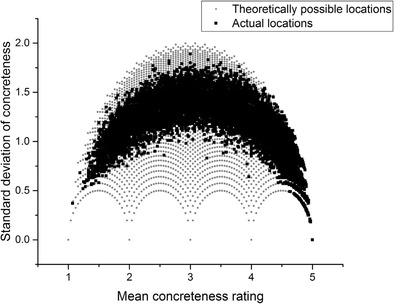
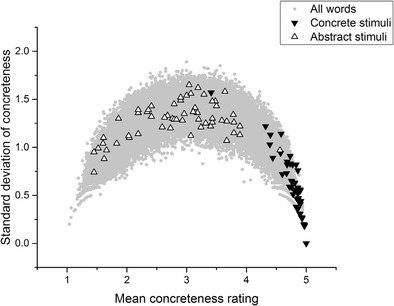
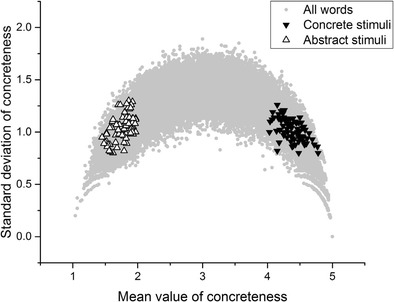
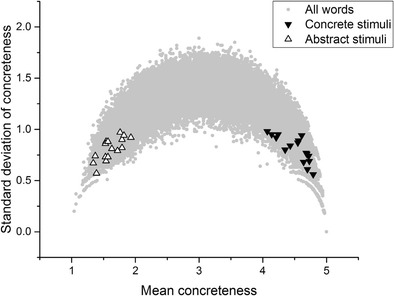
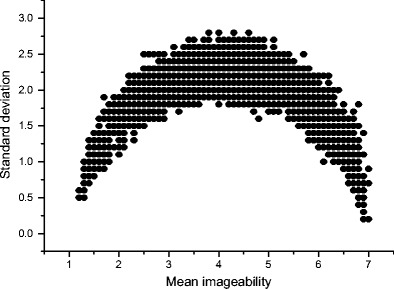
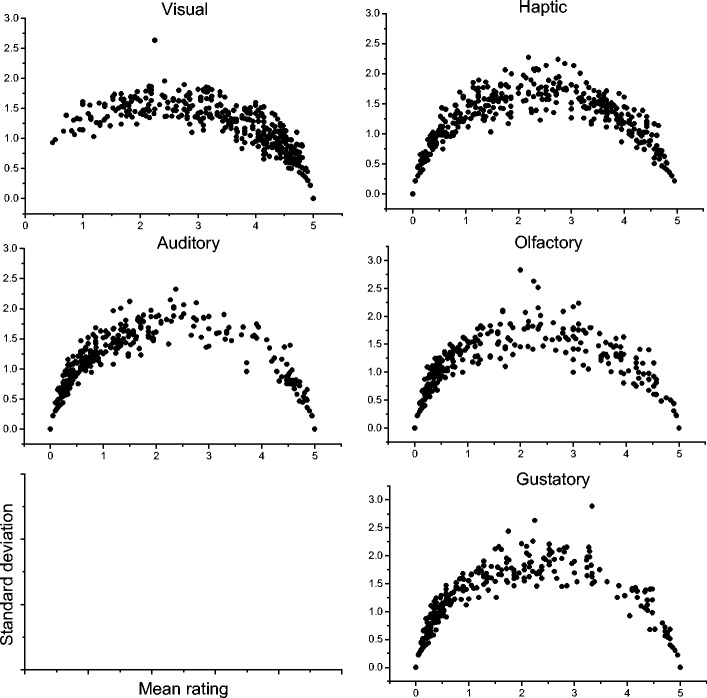
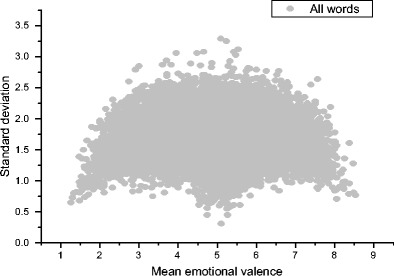
The purpose of this article is to highlight problems with a range of semantic psycholinguistic variables (concreteness, imageability, individual modality norms, and emotional valence) and to provide a way of avoiding these problems. Focusing on concreteness, I show that for a large class of words in the Brysbaert, Warriner, and Kuperman (Behavior Research Methods 46: 904-911, 2013) concreteness norms, the mean concreteness values do not reflect the judgments that actual participants made. This problem applies to nearly every word in the middle of the concreteness scale. Using list memory experiments as a case study, I show that many of the "abstract" stimuli in concreteness experiments are not unequivocally abstract. Instead, they are simply those words about which participants tend to disagree. I report three replications of list memory experiments in which the contrast between concrete and abstract stimuli was maximized, so that the mean concreteness values were accurate reflections of participants' judgments. The first two experiments did not produce a concreteness effect. After I introduced an additional control, the third experiment did produce a concreteness effect. The article closes with a discussion of the implications of these results, as well as a consideration of variables other than concreteness. The sensorimotor experience variables (imageability and individual modality norms) show the same distribution as concreteness. The distribution of emotional valence scores is healthier, but variability in ratings takes on a special significance for this measure because of how the scale is constructed. I recommend that researchers using these variables keep the standard deviations of the ratings of their stimuli as low as possible.
Overview
The claims and statistics of this paper haven’t been checked yet.
Free: it reads the open-access text and checks the first 5 claims that cite a source we can check. Create a free account to check every claim.
Integrity signals
Registry
Cites
Statistics
Figures
Verification
Claims the paper makes
The claims and statistics of this paper haven’t been checked yet.
Free: it reads the open-access text and checks the first 5 claims that cite a source we can check. Create a free account to check every claim.
Claims other papers make about this one
Each is checked against this paper’s own text: does it say what the citing paper says it does?
The cited source says what the claim attributes to it.
In the citing paper
“We note that when distributional CLMMs are used to disentangle meaningful and artefactual contributions to items’ SDs, the striking mean–SD relationships identified as problematic by Pollock (2018) are no longer observed.”
From Rating norms should be calculated from cumulative link mixed effects models (2022) · cites this paper as Pollock (2018)
The cited source says what the claim attributes to it.
In the citing paper
“Notably, Pollock (2018) highlighted a common relationship in ratings of word concreteness (Fig. 2), whereby the lowest SDs are observed at the extremes of a Likert scale, while items towards the centre of the scale show much higher SDs.”
From Rating norms should be calculated from cumulative link mixed effects models (2022) · cites this paper as Pollock (2018)
The cited source says what the claim attributes to it.
In the citing paper
“However, Pollock showed that although it was common for participants to agree on ratings at the extremes of the scale (1 and 5), such inter-rater reliability was exceedingly rare for ratings at midpoints in the scale.”
From Rating norms should be calculated from cumulative link mixed effects models (2022) · cites this paper as Pollock (2018)
Self-check
Percentages, sums and reported differences re-computed from the paper’s own numbers.
The self-check needs the paper’s full text.
Citations
Cites
Fitting Linear Mixed-Effects Models Using lme4
Bates, D., Mächler, M., Bolker, B., & Walker, S. (2015) · Journal of Statistical Software · doi:10.18637/jss.v067.i01 · Cited by 86,835
lmerTest Package: Tests in Linear Mixed Effects Models
Kuznetsova, A., Brockhoff, P. B., & Christensen, R. H. B. (2017) · Journal of Statistical Software · doi:10.18637/jss.v082.i13 · Cited by 24,346
Concreteness, imagery, and meaningfulness values for 925 nouns.
Paivio, A., Yuille, J. C., & Madigan, S. A. (1968) · Journal of Experimental Psychology · doi:10.1037/h0025327 · Cited by 2,827 · cited 2×
“She is told that Bconcrete words are experienced by the senses,^ whereas abstract words are not (Paivio et al., 1968).”
BackgroundBalota, D. A., Yap, M. J., Hutchison, K. A., Cortese, M. J., Kessler, B., Loftis, B., Neely, J. H., Nelson, D. L., Simpson, G. B., & Treiman, R. (2007) · Behavior Research Methods · doi:10.3758/bf03193014 · Cited by 2,742 · cited 1×
“Psycholinguistic variable information was gathered from Brysbaert et al. (2013), Kuperman, Stadthagen-Gonzalez, and Brysbaert (2012), and the English Lexicon Project (Balota et al., 2007).”
MethodThe MRC Psycholinguistic Database
Coltheart, M. (1981) · The Quarterly Journal of Experimental Psychology Section A · doi:10.1080/14640748108400805 · Cited by 2,437
Norms of valence, arousal, and dominance for 13,915 English lemmas
Warriner, A. B., Kuperman, V., & Brysbaert, M. (2013) · Behavior Research Methods · doi:10.3758/s13428-012-0314-x · Cited by 1,959 · cited 2×
“…of the concreteness ratings; AoA: Age of acquisition; Zipf frequency: Word frequency in Zipf units; N Syll: Number of syllables; Length: Length of word in letters; BG mean : Mean bigram frequency; Absolute Valence: Absolute value of 5 minus the Warriner et al. (2013) emotional valence score.”
BackgroundConcreteness ratings for 40 thousand generally known English word lemmas
Brysbaert, M., Warriner, A. B., & Kuperman, V. (2014) · Behavior Research Methods · doi:10.3758/s13428-013-0403-5 · Cited by 1,821 · cited 18×
“Psycholinguistic variable information was gathered from Brysbaert et al. (2013), Kuperman, Stadthagen-Gonzalez, and Brysbaert (2012), and the English Lexicon Project (Balota et al., 2007).”
BackgroundMethodInfluentialAge-of-acquisition ratings for 30,000 English words
Kuperman, V., Stadthagen-Gonzalez, H., & Brysbaert, M. (2012) · Behavior Research Methods · doi:10.3758/s13428-012-0210-4 · Cited by 1,217 · cited 1×
“Psycholinguistic variable information was gathered from Brysbaert et al. (2013), Kuperman, Stadthagen-Gonzalez, and Brysbaert (2012), and the English Lexicon Project (Balota et al., 2007).”
MethodThe representation of abstract words: Why emotion matters.
Kousta, S.-T., Vigliocco, G., Vinson, D. P., Andrews, M., & Del Campo, E. (2011) · Journal of Experimental Psychology: General · doi:10.1037/a0021446 · Cited by 894
Distinct Brain Systems for Processing Concrete and Abstract Concepts
Binder, J. R., Westbury, C. F., McKiernan, K. A., Possing, E. T., & Medler, D. A. (2005) · Journal of Cognitive Neuroscience · doi:10.1162/0898929054021102 · Cited by 656
Emotion words, regardless of polarity, have a processing advantage over neutral words
Kousta, S.-T., Vinson, D. P., & Vigliocco, G. (2009) · Cognition · doi:10.1016/j.cognition.2009.06.007 · Cited by 576 · cited 1×
“However, Kousta, Vinson, and Vigliocco (2009) showed that words with a high emotional valence (whether positive or negative) enjoy a processing advantage over words with neutral emotional valance.2 Abstract words tend to be rated higher for emotional valance than concrete words, and this variable…”
BackgroundBayesian Assessment of Null Values Via Parameter Estimation and Model Comparison
Kruschke, J. K. (2011) · Perspectives on Psychological Science · doi:10.1177/1745691611406925 · Cited by 468
The role of semantic information in lexical decisions.
James, C. T. (1975) · Journal of Experimental Psychology: Human Perception and Performance · doi:10.1037//0096-1523.1.2.130 · Cited by 431 · cited 2×
“Historically, it was claimed that concrete words are responded to more quickly than abstract words in lexical decision tasks (Bleasdale, 1987; James, 1975; Kroll & Merves, 1985), although more recent experiments have shown no difference (Brysbaert, Stevens, Mandera, &Keuleers, 2016), or even that…”
ResultConcreteness effects in semantic processing: ERP evidence supporting dual-coding theory.
Kounios, J., & Holcomb, P. J. (1994) · Journal of Experimental Psychology: Learning, Memory, and Cognition · doi:10.1037//0278-7393.20.4.804 · Cited by 428 · cited 1×
“…University College London, London, UK words and abstract words are distinct (Binder, Westbury, McKiernan, Possing, & Medler, 2005; Dhond, Witzel, Dale, & Halgren, 2007; Kounios & Holcomb, 1994; Pexman, Hargreaves, Edwards, Henry, & Goodyear, 2007; Sabsevitz, Medler, Seidenberg, & Binder, 2005).”
Walker, I., & Hulme, C. (1999) · Journal of Experimental Psychology: Learning, Memory, and Cognition · doi:10.1037//0278-7393.25.5.1256 · Cited by 427 · cited 7×
“Furthermore, the abstract conditions in the experiments of Romani et al. (2008), Walker and Hulme (1999), Miller and Roodenrys (2009), and Allen and Hulme (2006) were not entirelymade up of midscale stimuli.”
BackgroundResultInfluentialModulation of the semantic system by word imageability
Sabsevitz, D. S., Medler, D. A., Seidenberg, M., & Binder, J. R. (2005) · NeuroImage · doi:10.1016/j.neuroimage.2005.04.012 · Cited by 378 · cited 3×
“…Nelson, & Krawczyk (2005) fMRI Lexical decision 4.76 0.52 2.34 1.23 Crutch & Warrington (2005) Patient population Word matching 4.83 0.46 3.53 1.18 Sabsevitz et al. (2005) fMRI Semantic judgment 4.86 0.45 2.58 1.31 ter Doest & Semin (2005) Behavioral Recall 4.72 0.57 2.45 1.26 Lee & Federmeier…”
BackgroundInfluentialImageability ratings for 3,000 monosyllabic words
Cortese, M. J., & Fugett, A. (2004) · Behavior Research Methods, Instruments, & Computers · doi:10.3758/bf03195585 · Cited by 328 · cited 2×
“I also show that the same problem applies to other variables in semantic databases, such as imageability (Cortese & Fugett, 2004; Schock, Cortese, & Khanna, 2012) and individual modality norms (Lynott & Connell, 2012).”
Backgroundde Groot, A. M. B. (1989) · Journal of Experimental Psychology Learning Memory and Cognition · doi:10.1037//0278-7393.15.5.824 · Cited by 318 · cited 2×
“…Abstract Mean Concreteness Mean SD Mean Concreteness Mean SD Kroll & Merves (1985) Behavioral Lexical decision 4.55 0.74 2.17 1.22 de Groot (1989) Behavioral Word association 4.66 0.6 2.36 1.24 Paivio et al. (1994) Behavioral Recall 4.83 0.47 2.29 1.28 Gee et al. (1999) Behavioral…”
BackgroundInfluentialAbstract and concrete concepts have structurally different representational frameworks
Crutch, S. J. (2005) · Brain · doi:10.1093/brain/awh349 · Cited by 315 · cited 1×
“…4.83 0.47 2.29 1.28 Gee et al. (1999) Behavioral Recall 4.73 0.57 3 1.33 Binder, Nelson, & Krawczyk (2005) fMRI Lexical decision 4.76 0.52 2.34 1.23 Crutch & Warrington (2005) Patient population Word matching 4.83 0.46 3.53 1.18 Sabsevitz et al. (2005) fMRI Semantic judgment 4.86 0.45 2.58…”
InfluentialLexical access for concrete and abstract words.
Kroll, J. F., & Merves, J. S. (1986) · Journal of Experimental Psychology: Learning, Memory, and Cognition · doi:10.1037//0278-7393.12.1.92 · Cited by 283 · cited 2×
“…it was claimed that concrete words are responded to more quickly than abstract words in lexical decision tasks (Bleasdale, 1987; James, 1975; Kroll & Merves, 1985), although more recent experiments have shown no difference (Brysbaert, Stevens, Mandera, &Keuleers, 2016), or even that…”
BackgroundResultInfluentialLynott, D., & Connell, L. (2013) · Behavior Research Methods · doi:10.3758/s13428-012-0267-0 · Cited by 229 · cited 1×
“I also show that the same problem applies to other variables in semantic databases, such as imageability (Cortese & Fugett, 2004; Schock, Cortese, & Khanna, 2012) and individual modality norms (Lynott & Connell, 2012).”
BackgroundConcreteness effects on memory: When and why?
Paivio, A., Walsh, M., & Bons, T. (1994) · Journal of Experimental Psychology: Learning, Memory, and Cognition · doi:10.1037//0278-7393.20.5.1196 · Cited by 179 · cited 5×
“In their free-recall analyses, Paivio et al. (1994) calculated the proportions of words remembered and conduct by-subjects and by-items ANOVAs on these proportions.”
BackgroundMethodInfluentialBleasdale, F. A. (1987) · Journal of Experimental Psychology: Learning, Memory, and Cognition · doi:10.1037//0278-7393.13.4.582 · Cited by 170 · cited 5×
“As I argued when discussing the Brysbaert et al. (2013) norms, the middle of the concreteness scale is marked by a high degree of variability that is difficult to interpret. One of the aims of this article was to test the possibility that words that people agree about how to rate are easier to remember than words that…”
BackgroundResultInfluentialWord concreteness and word structure as independent determinants of recall
Nelson, D. L., & Schreiber, T. A. (1992) · Journal of Memory and Language · doi:10.1016/0749-596x(92)90013-n · Cited by 167 · cited 1×
“This effect has been obtained in many paired-associate learning experiments (Begg, 1972; Nelson & Schreiber, 1992; Paivio, Khan, & Begg, 2000; Paivio et al., 1994).”
BackgroundThe impact of word prevalence on lexical decision times: Evidence from the Dutch Lexicon Project 2.
Brysbaert, M., Stevens, M., Mandera, P., & Keuleers, E. (2016) · Journal of Experimental Psychology: Human Perception and Performance · doi:10.1037/xhp0000159 · Cited by 164 · cited 9×
“Psycholinguistic variable information was gathered from Brysbaert et al. (2013), Kuperman, Stadthagen-Gonzalez, and Brysbaert (2012), and the English Lexicon Project (Balota et al., 2007). The stimulus sets were created using MATCH (van Casteren & Davis, 2007). The four conditions were concrete, abstract, agreement, a…”
BackgroundMethodInfluentialSpeech and language processing mechanisms in verbal serial recall
Allen, R. J., & Hulme, C. (2006) · Journal of Memory and Language · doi:10.1016/j.jml.2006.02.002 · Cited by 163 · cited 14×
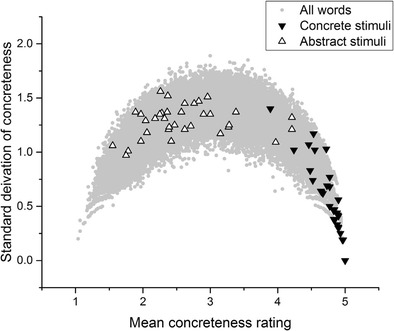
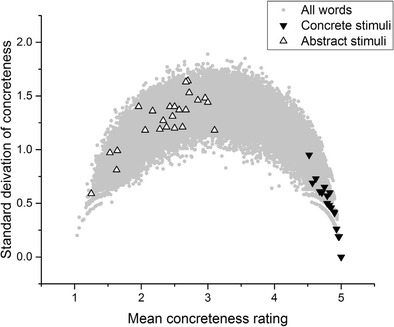
“Figure 4 depicts the abstract and concrete stimuli featured in Allen and Hulme (2006). Again, many Babstract^ stimuli here have standard deviations well above 1, indicating that people disagreed about whether the words were abstract in the first place.”
BackgroundResultInfluentialNeural Correlates of Concreteness in Semantic Categorization
Pexman, P. M., Hargreaves, I. S., Edwards, J. D., Henry, L. C., & Goodyear, B. G. (2007) · Journal of Cognitive Neuroscience · doi:10.1162/jocn.2007.19.8.1407 · Cited by 145
Match: A program to assist in matching the conditions of factorial experiments
van Casteren, M., & Davis, M. H. (2007) · Behavior Research Methods · doi:10.3758/bf03192992 · Cited by 132 · cited 1×
“The stimulus sets were created using MATCH (van Casteren & Davis, 2007).”
MethodConcreteness Effects in Different Tasks: Implications for Models of Short-Term Memory
Romani, C., Mcalpine, S., & Martin, R. C. (2008) · Quarterly Journal of Experimental Psychology · doi:10.1080/17470210601147747 · Cited by 132 · cited 9×
“As in Romani et al.’s (2008) visual paradigms, each word remained on the screen for 3 s.”
BackgroundResultInfluentialImageability estimates for 3,000 disyllabic words
Schock, J., Cortese, M. J., & Khanna, M. M. (2011) · Behavior Research Methods · doi:10.3758/s13428-011-0162-0 · Cited by 127 · cited 2×
“Figure 9 presents a mean–standard deviation plot of the imageability ratings of 6,000 words, amalgamated from two databases (Cortese & Fugett, 2004; Schock et al., 2012).”
BackgroundHuang, H.-W., Lee, C.-L., & Federmeier, K. D. (2010) · NeuroImage · doi:10.1016/j.neuroimage.2009.07.031 · Cited by 109 · cited 2×
“The only exception is Huang, Lee, and Federmeier (2010), in which the standard deviations for both stimulus sets were relatively high.”
BackgroundInfluentialBegg, I. M. (1972) · Journal of Verbal Learning and Verbal Behavior · doi:10.1016/s0022-5371(72)80024-0 · Cited by 88 · cited 1×
“This effect has been obtained in many paired-associate learning experiments (Begg, 1972; Nelson & Schreiber, 1992; Paivio, Khan, & Begg, 2000; Paivio et al., 1994).”
BackgroundA reexamination of the role of imagery in learning and memory.
Marschark, M., & Hunt, R. R. (1989) · Journal of Experimental Psychology: Learning, Memory, and Cognition · doi:10.1037//0278-7393.15.4.710 · Cited by 88 · cited 1×
“Following Marschark and Hunt (1989) and Paivio et al. (1994), each pair of words was presented on the participant’s computer screen for 8 s.”
BackgroundLee, C. L., & Federmeier, K. D. (2007) · Brain and Language · doi:10.1016/j.bandl.2007.06.002 · Cited by 80 · cited 2×
“They also, laudably, included their stimulus sets in their experimental reports, although it is important to note that for Sabsevitz et al. (2005) and Lee and Federmeier (2008) only samples of the stimuli were available.”
BackgroundInfluentialConcreteness and imagery effects in the written composition of definitions.
Sadoski, M., Kealy, W. A., Goetz, E. T., & Paivio, A. (1997) · Journal of Educational Psychology · doi:10.1037//0022-0663.89.3.518 · Cited by 70
Spatiotemporal cortical dynamics underlying abstract and concrete word reading
Dhond, R., Witzel, T., Dale, A., & Halgren, E. (2007) · Human Brain Mapping · doi:10.1002/hbm.20282 · Cited by 65
The interaction of word frequency and concreteness in immediate serial recall
Miller, L. M., & Roodenrys, S. (2009) · Memory & Cognition · doi:10.3758/mc.37.6.850 · Cited by 62 · cited 6×
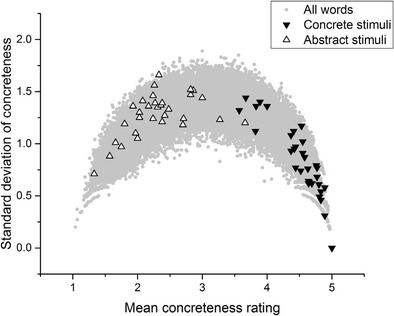
“Figure 5 plots the stimuli featured in Miller and Roodenrys (2009).”
BackgroundResultInfluentialIs the Concreteness Effect a Result of Underlying Network Interconnectivity?
Gee, N. R., Nelson, D. L., & Krawczyk, D. C. (1999) · Journal of Memory and Language · doi:10.1006/jmla.1998.2627 · Cited by 37 · cited 1×
“…4.55 0.74 2.17 1.22 de Groot (1989) Behavioral Word association 4.66 0.6 2.36 1.24 Paivio et al. (1994) Behavioral Recall 4.83 0.47 2.29 1.28 Gee et al. (1999) Behavioral Recall 4.73 0.57 3 1.33 Binder, Nelson, & Krawczyk (2005) fMRI Lexical decision 4.76 0.52 2.34 1.23 Crutch & Warrington…”
InfluentialSkipper‐Kallal, L. M., Mirman, D., & Olson, I. R. (2015) · Cortex · doi:10.1016/j.cortex.2015.04.021 · Cited by 32 · cited 1×
“Warriner et al.’s (2013) emotional valance norms for ~14,000 English words would allow us to check this possibility.”
BackgroundDoest, L. T., & Semin, G. (2005) · European Journal of Cognitive Psychology · doi:10.1080/09541440540000031 · Cited by 30 · cited 1×
“…& Warrington (2005) Patient population Word matching 4.83 0.46 3.53 1.18 Sabsevitz et al. (2005) fMRI Semantic judgment 4.86 0.45 2.58 1.31 ter Doest & Semin (2005) Behavioral Recall 4.72 0.57 2.45 1.26 Lee & Federmeier (2008) EEG Semantic judgment 4.41 0.88 2.27 1.24 Huang et al. (2010) EEG…”
InfluentialPolysemy Advantage with Abstract But Not Concrete Words
Jäger, B., & Cleland, A. A. (2014) · Journal of Psycholinguistic Research · doi:10.1007/s10936-014-9337-z · Cited by 27 · cited 1×
“…Semantic judgment 4.41 0.88 2.27 1.24 Huang et al. (2010) EEG Semantic judgment 3.82 1.17 2.53 1.21 Skipper-Kallal, Mirman, & Olson (2015) fMRI Deep thought 4.44 0.81 2.38 1.22 Jager & Cleland (2016) Behavioral Lexical decision 4.62 0.64 3.29 1.19 deviations of concreteness ratings is controlled.”
BackgroundInfluentialConcreteness and relational effects on recall of adjective–noun pairs.
Paivio, A., Khan, M., & Begg, I. M. (2000) · Canadian Journal of Experimental Psychology/Revue canadienne de psychologie expérimentale · doi:10.1037/h0087337 · Cited by 22
Cited by
Gorilla in our midst: An online behavioral experiment builder
Anwyl-Irvine, A. L., Massonnié, J., Flitton, A., Kirkham, N., & Evershed, J. K. (2020) · Behavior Research Methods · doi:10.3758/s13428-019-01237-x · Cited by 1,862
Interoception: the forgotten modality in perceptual grounding of abstract and concrete concepts
Connell, L., Lynott, D., & Banks, B. (2018) · Philosophical Transactions of the Royal Society B: Biological Sciences · doi:10.1098/rstb.2017.0143 · Cited by 206
“However, it was possible that this apparent negative relationship between interoception and concreteness was an artifact of the particular concepts near the midpoint of the concreteness scale, where ratings tend to be noisier than ratings at the extremes because they often reflect participant disagreement or confusion…”
BackgroundThe multifaceted abstract brain
Desai, R. H., Reilly, M., & van Dam, W. (2018) · Philosophical Transactions of the Royal Society B: Biological Sciences · doi:10.1098/rstb.2017.0122 · Cited by 141
“As Pollock [21] has recently pointed out, concepts with intermediate concreteness ratings tend to have high standard deviations.”
Rating norms should be calculated from cumulative link mixed effects models
Taylor, J. E., Rousselet, G. A., Scheepers, C., & Sereno, S. C. (2022) · Behavior Research Methods · doi:10.3758/s13428-022-01814-7 · Cited by 126
“For example, item random effects may be bimodally distributed if there are two distinct categories in the data, such as has been argued to be the case for judgements of concreteness (Pollock, 2018).”
BackgroundIconicity ratings for 14,000+ English words
Winter, B., Lupyan, G., Perry, L. K., Dingemanse, M., & Perlman, M. (2023) · Behavior Research Methods · doi:10.3758/s13428-023-02112-6 · Cited by 110
“…languages, including British Sign Language (BSL, Vinson et al., 2008) and American Sign Language (ASL, Caselli et al., 2017), and also in spoken languages, including English (Perry et al., 2015, 2018; Winter et al., 2017), Spanish (Hinojosa et al., 2020), and Japanese (A. L. Thompson et al., 2020).”
Influential
Metadata
- Authors
- Pollock, L.
- Affiliations
- University College London (GB)
- Corresponding author
- Pollock, Lewis
- ORCID
- Pollock, Lewis
- Venue
- Behavior Research Methods
- Published
- 2017-07-13
- Volume
- 50
- Issue
- 3
- Pages
- 1198-1216
- ISSN
- 1554-351X (ISSN-L)
- 1554-3528
- PMC
- PMC5990559
- OpenAlex
- W2734627439
- Cited by
- 90
- References
- 42
- Citations by year
- 2026: 11 · 2025: 10 · 2024: 10 · 2023: 14 · 2022: 12 · 2021: 14 · 2020: 9 · 2019: 5 · 2018: 4 · 2017: 1
- FWCI
- 2.98
- Type
- journal article
- Language
- en
- Open access
- hybrid
- doi.org
- Locations
- Behavior Research Methods (publishedVersion, cc-by)
- Europe PMC (PubMed Central) (publishedVersion, other-oa)
- PubMed Central (publishedVersion, cc-by)
- PubMed (publishedVersion)
- UCL Discovery (University College London) (submittedVersion)
- Funders
- Economic and Social Research Council (ES/J500185/1)
- Topics
- Life Sciences › Neuroscience › Cognitive Neuroscience › Neurobiology of Language and Bilingualism
- Life Sciences › Neuroscience › Cognitive Neuroscience › Memory Processes and Influences
- Social Sciences › Psychology › Experimental and Cognitive Psychology › Categorization, perception, and language
- Keywords
- concreteness, semantic variables, imageability, emotional valence, concreteness effect, abstract words, sensorimotor experience
- MeSH terms
- Data Collection, Emotions, Female, Humans, Judgment, Male, Memory, Psycholinguistics, Research Design, Semantics, Behavioral Research, Young Adult
About these checks
Registry, retraction, Cites and statistics results are computed, not judged, with one exception: a printed reference that no index lists is read once by a model before it counts as a citation error. Claims are extracted by a model and kept only when their quote appears verbatim in the text; each cited source is then checked, with a model’s help, for whether it says what the claim relies on. Those verdicts can be wrong — read the claim’s quote and the cited source before relying on one.
Statistics and arithmetic are recomputed, not judged.
Confidence bands are shown only for fields calibrated on our annotated test set. None is calibrated yet, so no band is shown.
What counts as a claim ›How we measure confidence ›How we check this ›
Are you an author, or do you see a problem with this page? Request a review
Data sources
Bibliographic data: Semantic Scholar, OpenAlex, Crossref.
Contains information from the Semantic Scholar Academic Graph Datasets, made available under the ODC Attribution License (ODC-BY 1.0).
Semantic Scholar’s data is described in: Kinney, R., et al. (2023). The Semantic Scholar Open Data Platform. arXiv:2301.10140.
